Distance Running History: An Overview

DISTANCE RUNNING HISTORY: AN OVERVIEW 

(Maybe this article will intrigue some to read more about the fascinating history of their wonderful sport.) 

Pre-History

Primitive Man: Born to Run – nuchal ligament, Achilles tendon, springy foot arch – a ‘weak predator’ that can hunt by distance-running after prey animals until they collapse.

Nowadays, in the rough canyons of the Sierre Madre Occidental, Mexico, the Tarahumara (pictured below) still maintain their tradition of persistence hunting, running down deer and wild turkeys.


The Olympics

Olympia, Greece. The Games began in 776 B.C. Only men were allowed to compete. In 720, the Dolichos, or long foot-race, was added. Less than a Parkrun. Starting and finishing in the stadium, with the race course winding through the Olympic grounds, passing by the statue of Nike, the Goddess of Victory, near the Temple of Zeus. Acanthus of Sparta won the first Dolichos laurel wreath, and his statue was built in Olympia.

Ultra-marathons

490 B.C. The Persian Fleet approaches. (According to the historian Herodotus), Athens sends Pheidippides, a professional long-distance running messenger, to ask Sparta for help. 150 miles over rough hilly country in 30 hours. Immediate aid is refused; so he runs all the way back with bad news (the Spartans actually arrive two days after the battle) and good (the God Pan appeared to the exhausted Pheidippides and promised to help). Athenians are victorious at Marathon and their city is saved from destruction.

In 1983, the first Open International Spartathlon Race took place. The route had been pioneered the previous year by Englishman John Foden and two other R.A.F. officers.

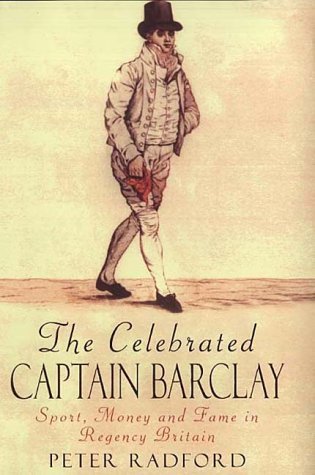
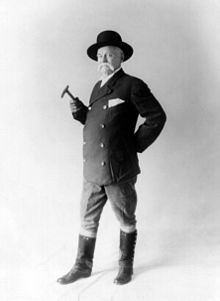
Barclay Allardyce – often simply known as Captain Barclay

Pedestrianism

In Britain, from the late 17th Century, aristocrats often employed footmen who ran and walked long distances, carrying letters and bringing back replies. Some employers boasted about the speed and stamina of their servants and placed bets on who would prove superior in a race trial.

Foot racing and walking evolved into Pedestrianism: professional distance running.

During the late eighteenth and nineteenth centuries, this was a popular betting spectator sport in the British Isles. Pedestrianism became a fixture at fairs – much like horse racing.

Famous pedestrians included Captain Robert Barclay Allardice, called “The Celebrated Pedestrian”, from Stonehaven. His most impressive feat was to walk 1 mile every hour for 1000 hours, which he achieved between June 1 and July 12 1809. The feat captured the public’s imagination and around 10,000 people came to watch, over the duration of the event. In 1864, Emma Sharp became the first woman to emulate the feat. Ada Anderson was named Champion Lady Walker of the World in April 1878, after covering 1500 miles in 1000 hours – at Leeds, England.

Sir John Astley M.P. founded a “Long Distance Championship of the World” in 1878, staged over six days, which became known as the “Astley Belt Races” (or ‘Wobbles’, because of the erratic progress of knackered runners). These events allowed a wide interpretation of rules, with walking, jogging, and running allowed. The competition was partly inspired by a desire to clean up the perception of the sport as corrupted by gambling interests and led to a push amongst some to codify pedestrianism as an amateur sport. The same process was happening to British track and field athletics and gave rise to the modern Olympic Movement.

Famous Six-Day racers included: Edward Payson Weston, Daniel O’Leary, Charles Rowell and George Littlewood, who in 1888 created a new world record of 623 miles 1,320 yards—a world record that wasn’t beaten for 96 years.


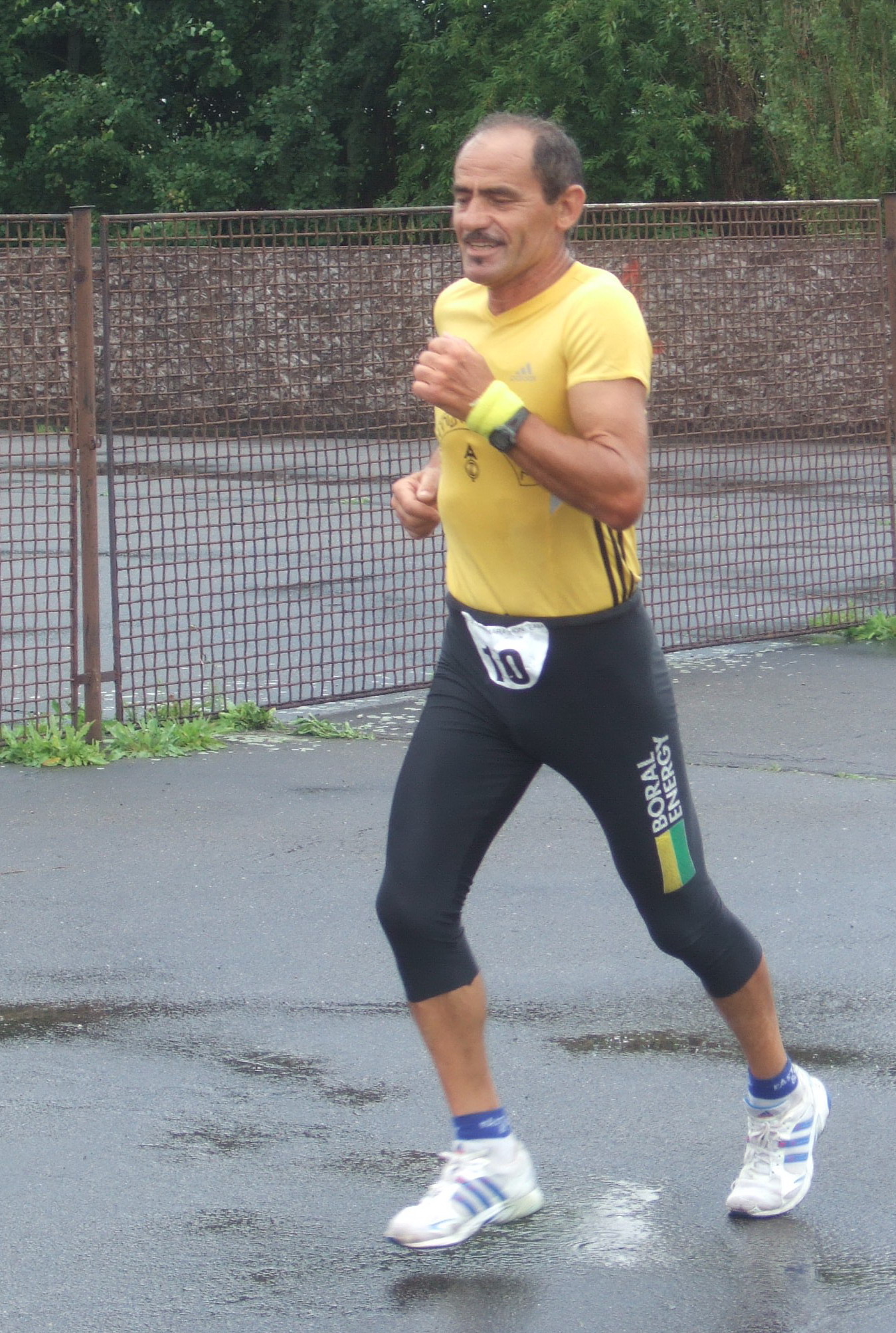
In 1984 Yiannis Kouros (above) from Greece ran over 1,022 km (635 miles) setting a new world record that would stand until 2005, when he improved to 1,036 km (644 miles) at the Cliff Young Australian 6-day race in Colac, Australia.

The women’s world record was broken by Australia’s Dipali Cunningham in 1998 when she covered 504 miles (811 km). In 2001 she improved this to 510 miles (820 km).

  • Middle Distance


W.G. George: Walter Goodall George (1858 –1943) was a runner from Wiltshire who, after setting numerous amateur world records [between one mile and one hour (11 miles 932 yards)], went professional in part to challenge the mile record-holder William Cummings, defeating him in several highly publicised races. On 23 August 1886, he set a mile record (4 minutes 4:12¾ seconds) which was not surpassed for almost 30 years. (In a 1885 handicap race he had run 4:10​1⁄5 – which was not beaten until 1931.)

  • Long Distance


Alfred Shrubb (1879–1964), known as Alfie, was an English middle and long-distance runner from West Sussex. During an amateur career lasting from 1899 to 1905 (when he was barred from amateur competition for receiving payment for running) and a professional career from 1905 to 1912, he won over 1,000 races from about 1,800 started. At the peak of his career he was virtually unbeatable at distances up to 15 miles, often racing against relay teams so that the contest would be more competitive. He won the International Cross-Country Championships in 1903 and 1904. On 4 November 1904, at Ibrox Park, Glasgow, he broke the world record for the one hour run as well as all amateur records from six to eleven miles, and all professional records from eight to eleven miles, running eleven miles, 1137 yards (18.742 km). Altogether he set 28 world records.

  • Scotland: Powderhall


The great annual professional meeting on 1st January, which has taken place every year since 1870, was for many years known simply as Powderhall, since that was where it took place. It is now known mainly as the New Year Sprint and although it is a real festival of sprinting, there have been races at half mile, mile, two miles and long distance. In the era of Open Athletics, amateurs have been permitted to enter since 1993.

Scotland’s greatest ever sprinter George McNeill won the Centenary running of the race in 1970. For the illustrious history of this event, do look up the website: www.newyearsprint.com

You will also find an article about Powderhall under ‘The Games’ in http://www.anentscottishrunning.com/the-games/.

Cross-Country

“Tom Brown’s Schooldays” by Thomas Hughes, was a very successful novel (published 1857). It is set in the 1830s and includes a marvellous description of a paper-chase cross-country run for senior pupils at a top fee-paying residential public school. Adults do not seem to have competed in this sport until Thames Hare and Hounds (the oldest cross-country club in the world) organised events from 1868. Such a steeplechase involved ‘hares’ starting ahead of the main pack, marking their route with a trail of paper. The pack of runners would then follow the trail, the first to catch the hares being the victor.

In 1879 the use of paper trails was banned in Wimbledon Common. 1883 was the year when the English Cross-Country Association was founded. The Scottish Cross-Country Union followed in 1890.

Before that, many cross-country races had taken place in Scotland. In Carnwath in Lanarkshire, the ‘Red Hose’ XC race dates back to the early 19th C. Public Schools and Universities encouraged cross-country running. Clydesdale Harriers was formed in May 1885; as was Edinburgh Harriers (that September). Colin Shields’ invaluable centenary history of the Scottish Cross Country Union (“Runs Will Take Place Whatever The Weather”) gives fascinating details.

This book, combined with the on-line archive of the Scottish Road Running and Cross Country Commission, anentscottishrunning.com and scottishdistancerunninghistory.scot will tell readers a great deal about top Scottish cross country runners, male and female. The articles (in SDRH) about ‘Women’s Cross Country’ are particularly interesting. Between 1931 and 1957, there were only five International XC matches for Scottish women. The modern era began in 1967. However Scottish National championships were run between 1932 and 1938; and from 1951 onwards. The men were much luckier, since Scottish National Championships started in 1886, and the International Championships in 1903, at Hamilton Park Race Course, Scotland.

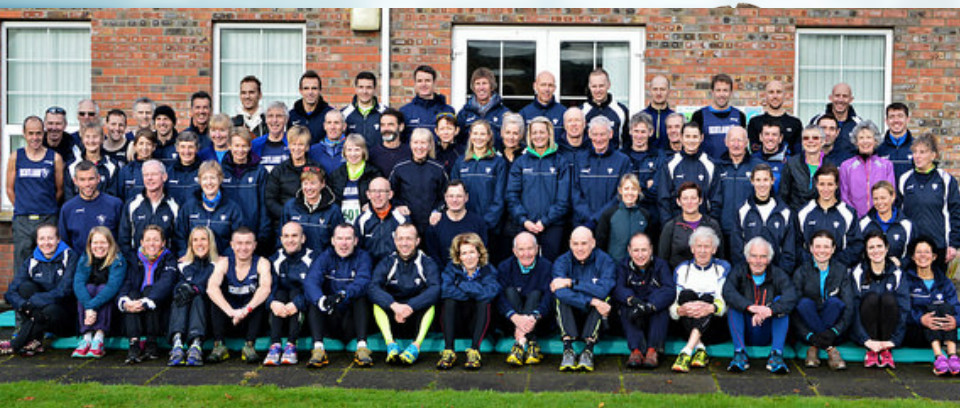
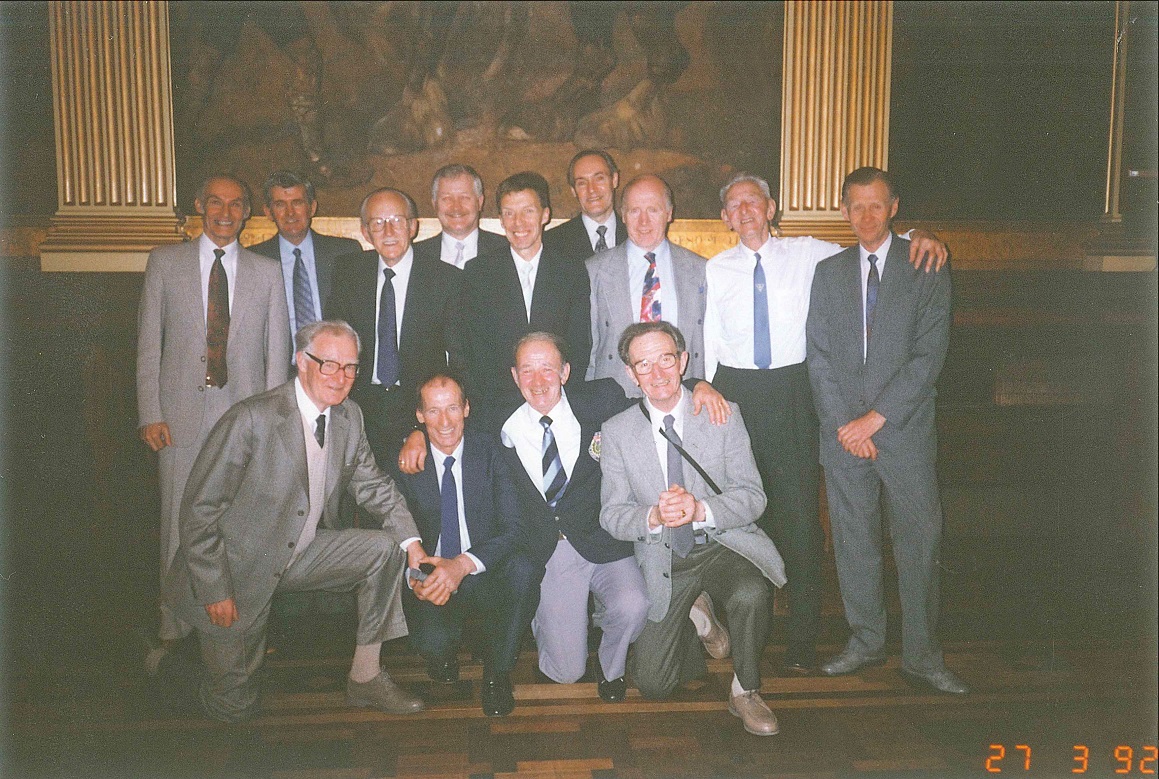
A Scottish Veteran Harriers Club Group

The Scottish Veteran Harriers Club began in 1970. Our cross-country champions include the following.

Dale Greig, Janette Stevenson, Tricia Calder, Sandra Branney, Trudi Thomson, Christine Haskett-Price, Liz McColgan, Sonia Armitage, Lynn Harding, Sue Ridley, Jane Waterhouse, Angela Mudge, Fiona Matheson, Melissa Whyte, Joasia Zakrzewski, Lesley Chisholm, Janet Dunbar, Hilary McGrath, Claire Thompson, Betty Gilchrist, Anne Docherty, Ann White, Katie White, Linden Nicholson, Jennifer MacLean

John Emmet Farrell, Gordon Porteous, Davie Morrison, Andy Forbes, Willie Marshall, Tom O’Reilly, Bill McBrinn, Bill Stoddart, Charlie McAlinden, Alastair Wood, Andy Brown, Hugh Gibson, Hugh Rankin, Ian Leggett, Walter McCaskey, John Linaker, Donald Macgregor, Dick Hodelet, Jim Alder, Brian Scobie, Bill Scally, Brian Carty, Allan Adams, Donald Ritchie, Davie Fairweather, Bobby Young, Pete Cartwright, Doug Gemmell, George Mitchell, Archie Duncan, Colin Youngson, George Meredith, Charlie MacDougall, Ian Elliot, George Sim, Brian Emmerson, Archie Jenkins, Brian Kirkwood, Frank Barton, Gerry Gaffney, Fraser Clyne, Keith Varney, Simon Pride, Ed Stewart, Colin Donnelly, John Duffy, Gerry Fairley, Andy McLinden, Brian Gardner, Ian Stewart, Iain Campbell, Neil Thin, Tommy Murray, Bobby Quinn, Kerry-Liam Wilson, Robert Gilroy, Jamie Reid, Andy McLinden, Frank Hurley, Tony Martin, George Black, Paul Thompson, Alex Sutherland, Les Nicol, Stephen Cromar.

Highland Games: Running

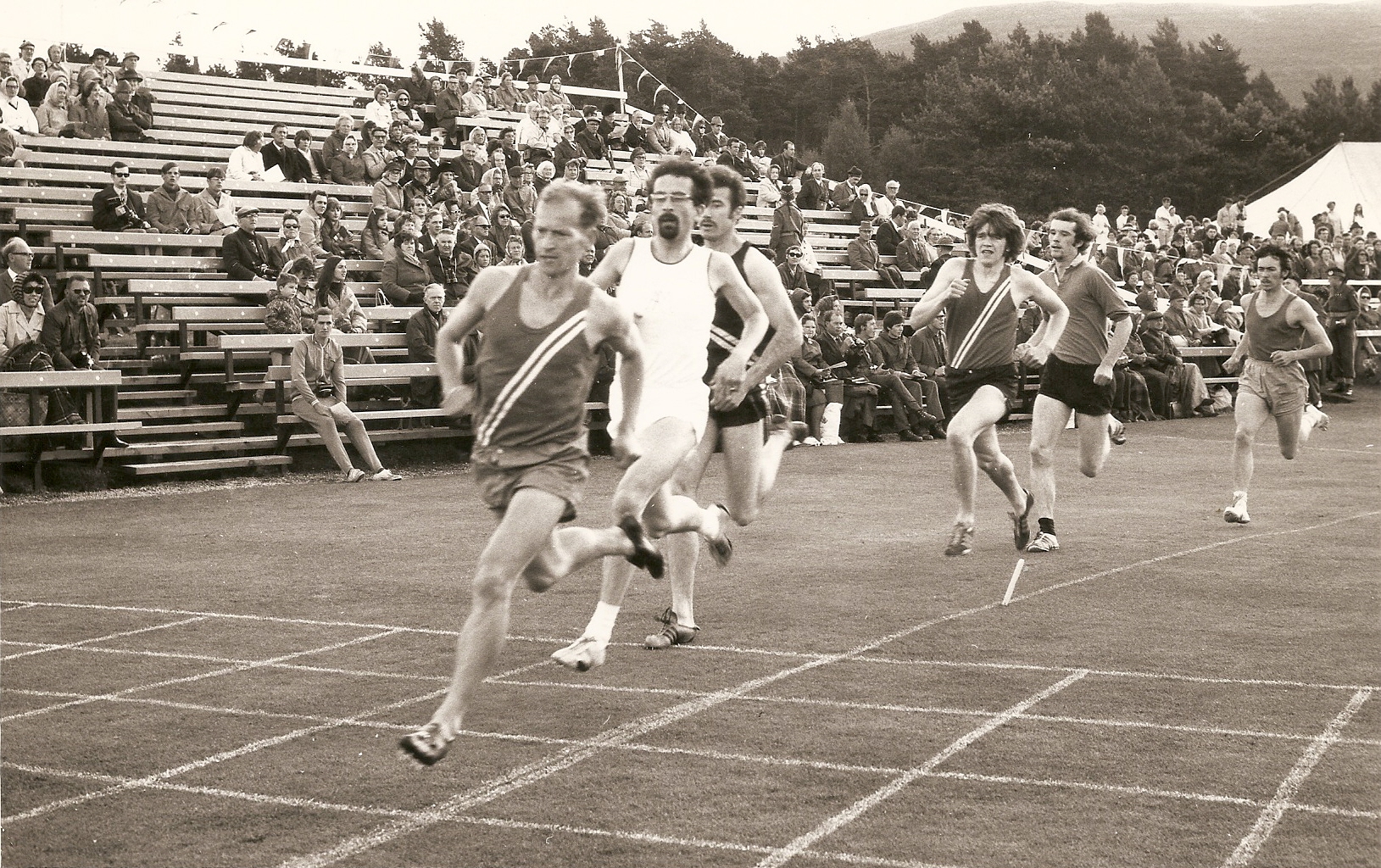
The Highland Games probably go back to the 14th century but, in their modern form, are about 150 years old. The ‘boom’ in Highland Games was due to: the development of the railway system in the middle of the 19th Century; and Queen Victoria’s summer residence in Scotland. At first, all the Games were professional; but since 1993 have been open to every athlete. Two of the most famous are Braemar (picture below) and Ballater, both with hill races.

A series of Amateur Highland Games were introduced eventually – many of them in the Lowlands. Although the ‘Heavy’ Events: caber, hammer, shot put etc are most famous, grass track middle distance races (scratch or handicap) also featured, as well as hill and road races.

For example, Forres Highland Games used to include the finish of the Inverness to Forres Marathon. Nowadays it has a 10k road race and most events have been axed or shortened drastically. Many Games had road races: Strathallan 22 mile; Bute 18; Glenurquhart, the Inverness to Drumnadrochit 15; Glasgow the hilly Drymen to Scotstoun 15; Gourock 14; Dunblane 14; Shotts 14; Carluke 12; Bearsden 10. Kinlochleven had the Mamore Hill Race, with at least a third on the road. Alva had another hill race. Achmony hill race at Glenurquhart is one that survives.

Running those traditional events over non-standard distances was great fun; and the road races were excellent preparation for aspiring serious marathon racers.

Amateur Outdoor Track

From 1865, the Amateur Athletic Club held track and field championships in London. One mile and Four miles races were included. However, entry was restricted to ‘gentleman amateurs’. In 1880 the Amateur Athletic Association took over and the sport was open to anyone who had never been a professional athlete.

The Scottish Amateur Athletic Association was founded in 1883; and the first championships (for men) that year included 880 yards and one mile; ten miles track featured in 1886; and four miles in 1887.

The Scottish Women’s Amateur Athletic Association was formed in 1931: 880 yards was the longest distance run. One mile was added in 1952; and 3000m in 1971.

The Scottish Association of Track Statisticians archive is a superb resource, listing championship winners, statistical profiles of individual athletes, records, Scottish International matches etc.

Scottish Distance Running History and Anent Scottish Running, both contain many more detailed profiles of top Scottish athletes.

Hill Running

Legend has it that King Malcolm III of Scotland, in the 11th century, summoned contestants to a foot race to the summit of Craig Choinnich (overlooking Braemar). Several Highland Games (e.g. Ballater and Braemar) hosted hill races. Nowadays the Scottish Hill Runners online calendar includes over a hundred challenging annual events.

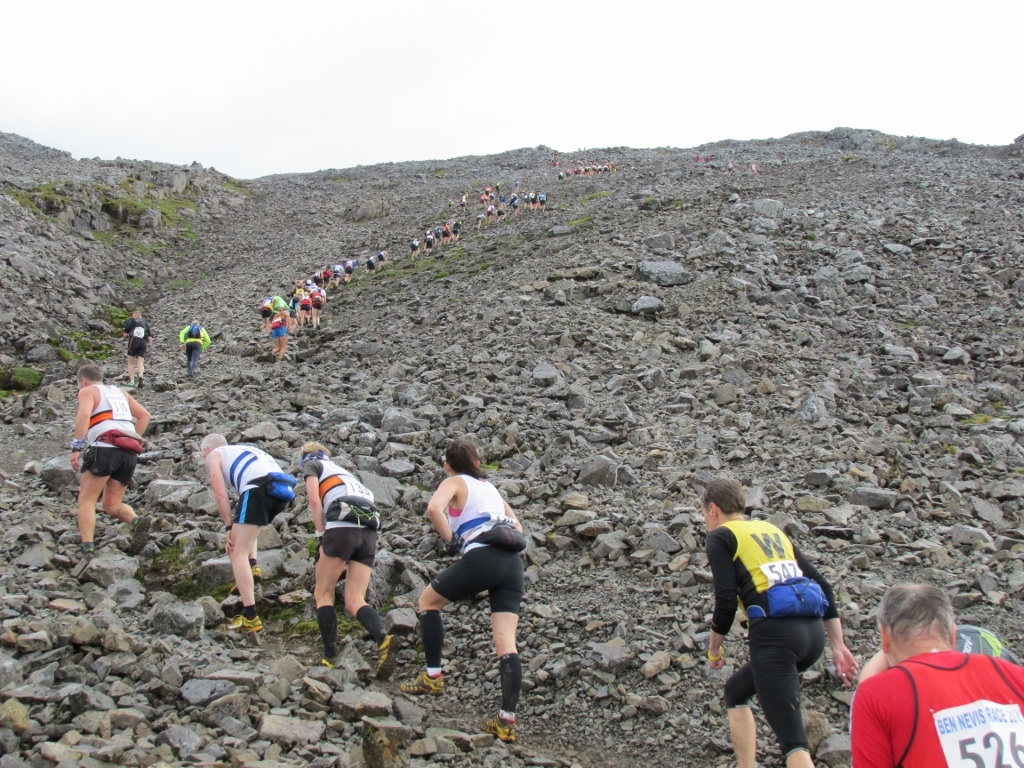
At the beginning of September is the Ben Nevis Race. Britain’s highest mountain tempted athletes to run up and down it from the late 19th Century. William Swan was the first to break 3 hours in 1895. The first race (ascent only) was in 1903; and shortly afterwards Ewen MacKenzie won the first run (in a record 2 hours 10 minutes) from Fort William and back, via the summit. Races took place intermittently until 1951, when the modern era began. The Ben Nevis Race website has all the results right up to 2017. Lots of SVHC members tried it at least once. (The writer, aged 21, a couple of months after completing his first 26 miler, ran the Ben Race in 1969, hated the dangerous downhill and for the next 30 years stuck to safer marathon running!)

Famous Scottish Ben racers include: Jock Petrie, Duncan MacIntyre, Brian Kearney, Eddie Campbell, Jimmy Conn, Pat Moy, Allan MacRae, Bobby Shields, Brian Finlayson, Colin Donnelly, Mark Rigby, David Rodgers and Graeme Bartlett.

The Ben Nevis Race

Modern Olympic Games

Although the Cotswold Games ‘Olimpicks’ took place from 1612-1852; and the Wenlock Olympian Games (which influenced Olympics reviver Pierre, Baron de Coubertin) from 1850; the 1896 Olympic Games in Athens were inspired, not only by tales of the Ancient Olympics but also by the Amateur Athletics movement. In fact, the AAA Laws for Competition were adopted by the International Olympic Committee (1894) for the first Modern Games. In 1896, the middle-distance races held were: 800m and 1500m, both won by London-born Edwin (Teddy) Flack of Australia (‘The Lion of Athens’) who also led the Marathon for some time but had to drop out three kilometres before the finish. Female athletes were excluded from the Olympics in 1896 but took part from 1900. However, 800m for women was not introduced until 1928; and (very unfairly) not reintroduced until 1960. Sheer male chauvinism.

 Marathon

In 1878 the great English poet Robert Browning wrote “Pheidippides”. In a dramatic fashion, he amalgamated two stories about the legendary/mythical Greek runner: Herodotus’s account (written in 450 B.C., 40 years after the Battle of Marathon) of the 300 miles trek to and from Sparta; and, 600 years later in 120 A.D., Plutarch’s tale about Eucles, who (in full armour, just after the battle) was supposed to have run to Athens, gasped out news of the victory and dropped dead.

Browning’s poem includes the lines:

“‘Rejoice, we conquer!’ Like wine through clay,

Joy in his blood bursting his heart, he died – the bliss!”

Roger Robinson wrote: “Presumably it was Browning’s poem that Professeur Michel Breal had in mind, when he wrote to the Athens Olympic Committee in 1894 to propose ‘a race from Marathon’ on the route of ‘the Greek warrior’.

As runners interested in the history of the marathon race will know, the 1896 Olympic event was won by the Greek Spiridon ‘Spyros’ Louis, over a distance of around 40 kilometres (25 miles). The 1908 London Olympic Marathon established the official distance as 26 miles 385 yards (42 kilometres, 195 metres).

Scottish runners completed several ‘marathons’ over a range of distances before the first official Scottish Marathon Championship (for Men) in 1946. (The first Scottish Women’s Marathon Championship did not take place until 1983). The first two men’s events were won by Donald McNab Robertson, who had been AAA Marathon champion six times between 1932 and 1939; a silver medallist in the 1934 British Empire Games in London; and had finished a valiant 7th in the 1936 Berlin Olympics. (He had also been selected, as AAA champion, for the 1932 Los Angeles Olympics but could not go because of work and family commitments).

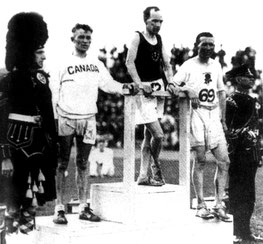
Second in the 1946 Scottish Marathon was ‘the Daddy of them all’ – Duncan ‘Dunky’ McLeod Wright, who had been AAA champion in 1930 and 1931; 1930 British Empire Games victor in Hamilton, Ontario; and a close fourth in the 1932 Olympics.

The Scottish Marathon Club was founded in 1944, by stalwarts like Dunky Wright, Joe Walker and Jimmy Scott. The SMC helped to organise umpteen road races (often linked to Highland Games); liaised with the SAAA to ensure that the Scottish Marathon championship went well; and to nominate a runner to receive the Donald McNab Robertson Memorial Trophy (for Scottish Road Runner of the Year). Certainly, the SMC helped considerably to raise the standard of road running in Scotland. Our current SVHC President Alastair Macfarlane (1979 Scottish Marathon champion and Robertson Trophy winner) was the last SMC President.


Dunky  Wright (centre) in Hamilton (note the casually crossed legs)

Bill Stoddart, the 1969 Scottish Marathon Champion; won the second SVHC cross country championship in 1972; and was a World Veterans champion and record holder several times, including gold medals in the 1992 M60 10km and 25km in Birmingham.

Aberdeen’s Alastair Wood was Scottish Marathon Champion six times; finished 4th in the 1962 European Marathon at Belgrade; and in 1974 became a runaway M40 World Veterans Marathon winner in Paris, leading SVHC to the World Vets Club gold medals.

In the 1972 Munich Olympics, Donald Macgregor finished an excellent 7th. He was later to win three Scottish Marathon titles; and the 1980 World Veterans Marathon in Glasgow.

Gordon Porteous, a truly great SVHC member, was World Veteran Marathon Champion many times. He won World Veteran Marathon gold medals in Toronto 1975, Coventry 1976, Berlin 1978, Hanover 1979, Glasgow 1980, New Zealand 1981 and Rome 1985. Gordon set World age-group marathon records at: M60 (2.51.17); M65 (2.57.00); M70 (3.11.45); M75 (3.23.12); and M80 (3.47.04).

Scotland’s greatest female marathon runner was Liz McColgan (World and Commonwealth 10,000m champion and winner of the first World Half Marathon championship in 1992.) Liz won marathons in London and Tokyo and, seriously hampered by an insect bite which poisoned her system, finished 16th in the 1996 Atlanta Olympic Games.

Modern ultra-distance

After professional 6-Day events lost favour in the 1890s, and marathon fever took over, ultras were ignored. Arthur Newton, born in England but in 1922 a 38-year-old South African farmer, is considered the founding father of modern ultra-running. Between 1922 and 1934 he averaged 20 miles a day of running and walking. His victories included four Comrades Marathon wins – this 54 or 56 miles epic remains the world’s leading ultra – and new records for the London to Brighton 52. Newton broke amateur world records at 50 and 100 miles; and, as a professional, covered 152 miles 540 yards in 24 hours – a record which remained unbeaten for 22 years. The 24-hour mark was set in 1931 on a 12-laps-to-the-mile track in the Ice-Hockey Arena at Hamilton, Ontario. The wooden surface was softened by a layer of felt and paper.

A little known fact is that, on 1st January 1929, the recently professional Newton set a record of 6 hours 39 minutes 50 seconds for running from Glasgow Pavilion to Edinburgh and the Powderhall track (on which he finished by circling four and a half miles). Conditions were atrocious – freezing cold, snowy and slippery in the West and thawing with deep puddles in the East.

In England and Wales, the ultra-marathon scene held many events, encouraged by the London-based Road Runners Club. The RRC also recognised the Tom Scott 10 and the Scottish Marathon, plus the most popular Scottish ultra – The Two Bridges 36, which was run between 1968 and 2005. Many of the best ultra-racers in the world took part and Scottish winners included Alastair Wood (who also won the London to Brighton), Alex Wight, Jim Wight, Don Ritchie, Andy Stirling, Peter Baxter, Colin Hutt, Simon Pride and Alan Reid.

Trudi Thomson finished first woman in the 2 Bridges three times and set an unbeaten women’s record. As well as running for GB in many marathons, she won a silver medal in the World 100km championship. In addition, Trudi won Scottish Marathon titles and the British Veterans Cross-Country Championship.

Then there was the Edinburgh to Glasgow ultra (not the famous 8-man road relay). This 44-mile challenge was run between 1961 and 1972; plus a 50-miler (Meadowbank to George Square) in 1984. Scottish winners included Gordon Eadie, Andy Fleming, Hugh Mitchell, Bill Stoddart, Alex Wight and Jimmy Milne, with Don Ritchie victorious in 1984.

Although these great Scottish races are no more, Scottish Championships have been held over 50km from 1996; and over 100 km since 1992, when the main man mentioned below fittingly became the first champion.

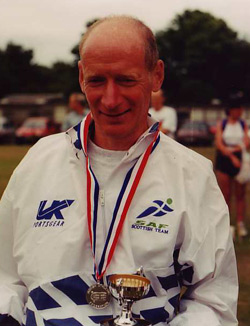
Donald Ritchie (above) of Lossiemouth, Moray, Scotland, has undoubtedly been the greatest ultra-distance runner the world has ever seen. This was the verdict in 1995 of Andy Milroy, a journalist who knows more about this branch of athletics than anyone. Milroy compared Don’s achievements with those of past greats like Charles Rowell, George Littlewood and Wally Hayward; and with his contemporaries Yiannis Kouros and Bruce Fordyce. On the basis of the length of his world-class ultra-running career and his amazing accomplishments, Donald Ritchie is considered to have been the very best.

Do read Don’s full profile on Scottish Distance Running History – you can find it by clicking on ‘Marathon Stars’ and then on his name under ‘The Marathon and Beyond’. Better still, buy his autobiography “The Stubborn Scotsman” on amazon uk. No one has ever run harder than Don Ritchie.

Perhaps his finest performance took place on the 28th of October 1978. At the Crystal Palace track, he ran 100 km in 6 hours 10 minutes 20 seconds. Imagine: 62 consecutive miles, averaging almost precisely 6 minutes per mile! Unsurprisingly, this remains the world record in 2018.

Indoor Track

Peter Lovesey, in his AAA Centenary History, wrote that Indoor Athletics originated in 1863 at the Ashburnham Hall, Chelsea, where the London Rowing Club held their sports indoors by gaslight. Other London venues included Lambeth Baths and the Agricultural Hall, Islington. New York staged America’s first indoor meet in 1868.

Peter Lovesey was also a fine detective novelist. Read ‘Wobble to Death’ for a real insight into corrupt ultra-distance challenges in the Victorian era.

The AAA held Indoor championships from 1935-1939, at the Empire Pool, Wembley. They did not return until 1962 at Wembley and subsequently R.A.F Cosford.

However, amateur indoor track became really popular in the U.S.A, between the First and Second World Wars. ‘Running on the Boards’ featured as Winter and Spring training for college athletes; and the most famous meeting took place at New York’s Madison Square Gardens.

Scottish athletes were successful at AAA Indoors events; but the first SAAA Indoor championships did not take place until 1973-1976. The venue was Bell’s Indoor Sports Centre in Perth: this had a 154 metres long banked track comprising compressed cork with lino strips on a wooden base. Twice Scottish Indoor 1500m winner was Adrian Weatherhead, who later became the fastest Scottish M40 Veteran in 10k road races.

Scottish Indoor Championships were not resumed until 1987 at Ingliston. From then until 2012, the competition was held at Glasgow’s Kelvin Hall, where Scottish Veterans and British Masters championships regularly took place. From 2013, the Championships were held at Glasgow’s new indoor venue, the Emirates Arena.

Relays: SAAA Medley Relay: 1919 – 1929

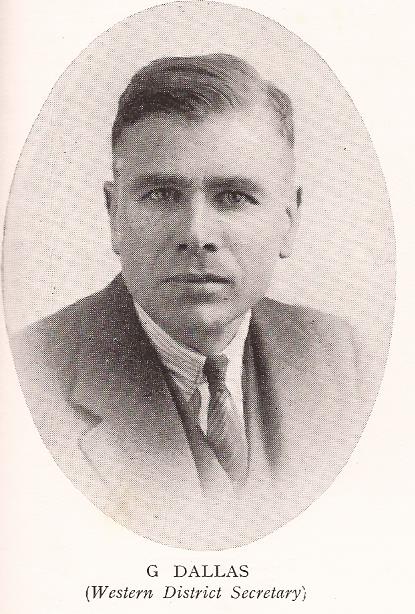
George Dallas, wonderful runner and a great relay racer

The Scots loved relays – sprint relays, Mile relays, mile medley relays, 4 x 100, 4 x 110, 4 x 220, 4 x 440, – anything that started on the programme with 4 x …   was eagerly looked forward to.   Of them all, it is suspected that the medley was the most popular consisting as it did of short sprints, long sprints and middle distance specialists.   It is surprising to note then that although the SAAA was established in 1883, the first medley relay championship was held in June, 1919.  

The preview in the ‘Glasgow Herald’ of 23rd June that year read:  “Next Saturday’s gathering will possess a special interest from the inclusion for the first time of a relay race.   This is an event that has been steadily growing in favour for some years past and it is likely to prove a permanent addition to the championship list.   The issue is not by any means a foregone conclusion as some are inclined to think.   At the Edinburgh University Sports the other week a team representing Maryhill Harriers beat the University quartette but on Saturday last, the latter reversed the order of the finish, and as the excelled in all four sections of the race they may retain their supremacy at the next time of meeting.   Greenock Glenpark Harriers are also to be reckoned with, especially if Hector Phillips is able to assist them; and a second Glasgow club have been mentioned as likely to make a strong bid for the honour of being the first holders of the title of relay champions.”

Came the day and the new champions in a close finish were Maryhill Harriers with a team of G Dallas, H Goodwin, G Hamilton and S Colberry in in 3 minutes 55 seconds; second was Greenock Glenpark Harriers (Sergeant Hector Phillips, HD Soutter, JK Neave and AR Bollini.   It was noted that ‘also competed’ were Bellahouston Harriers and Glasgow University.   Three of the entered teams did not turn out, the programme suggested that it was because the relay took place at the very end of the programme, but it was nevertheless one of the most interesting relay races ever run in the district.   It should be noted that in the half mile, Sgt H Phillips won from G Dallas, Phillips had also been second in the quarter, Bollini, Neave and Colberry had taken part in the 220 and Goodwin, Bollini and Hamilton had run in the 100 which suggested that the event coming late in the programme was not really a reason for not turning out a team.   Regardless, Maryhill were the first winners of the country’s relay championship. 

The following year a Maryhill team won again from West of Scotland in 3 minutes 47 1/5th seconds with three of the previous year’s winners out – the team was Dallas, Colberry, Goodwin and JB Bell.   Dallas had already won the 440y, Bell third in the 220y and second to Dallas in the 440y and Goodwin and Colberry had run in separate races without picking a medal.    

Eric Liddell

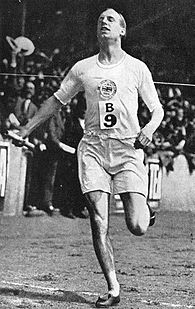
Maryhill were to dominate the relay with Edinburgh University over the first eleven years in which it was contested.   In 1921 Maryhill was going for a treble – two wins under their belt and a good team out that year as well.   Could they do it?  The weather was fine, the crowd at Celtic Park was approximately 5000 and the track was in good condition.   Their team consisted of Dallas, Bell, Colberry and JW Riach.   The treble was possible.  

The ‘Glasgow Herald’ report said “The Edinburgh University tem gave a fine display in the relay race, in which they displaced Maryhill Harriers of the honour that they had won on both previous occasions.   There was hardly any doubt regarding the outcome from the start.  McCormack established a lead of ten yards in the half mile, Liddell made an even greater contribution in the first furlong, GI Stewart lost nothing in the second, and in the finishing quarter, JM Davie made several yards, the Eastern team winning by a substantial margin.   The change of champions should still further popularise an event that is admittedly one of the most fascinating of athletic contests.”

Several of the relay men had run already: Liddell won the  100 yards and also took the 220 yards in which Colberry also ran, Dallas and RB Bell ran in the 440 yards.   The winning time was 3 minutes 43 seconds.

That was the first of a series of victories for the Edinburgh University students.   In 1922 the only man from the previous year to line up for them was Liddell and they won in 3 minutes 40 seconds – a bit quicker than in the previous year.   Held in Edinburgh in wet weather the report was brief to the point of dismissive:  “Maryhill Harriers failed to regain the relay honour which they lost to Edinburgh University last year.   It was not generally expected that they could field a team to beat Brown, Liddell, Dunn and IM Robertson and, as a matter of fact, they did not even get second place.”   That is the report in its entirety.   Second team was West of Scotland Harriers, Maryhill was third and Shettleston fourth..    

The following year, 1923, though, it came down to the big two of relay racing again with the championship held at Hampden Park.  “After winning the relay race for two years Maryhill Harriers have been outdone by Edinburgh University AC, who on Saturday , thanks largely to Liddell’s running on the second furlong, secured their third successive win.”   The Edinburgh team of Brown, Dunn, Liddell and Morrison defeated Maryhill’s quartet of Harrison, Davidson, Burns and JG McCall by five yards in 3 minutes 43.6 seconds.  

In 1924 the title was really up for grabs again because of the absence of Edinburgh University.  

Having won the 100 and 220 yards double in three consecutive years, Eric Liddell decided to go one better and in 1925 he won 100, 220 and 440 yards championships and this may have persuaded Edinburgh University to withdraw.   Certainly they could have fielded a good team but without Liddell it would not have been nearly as good.   “With Liddell running in the relay the chances of Edinburgh University were always obvious, but both RB Hoole (who ran the half mile), and AF Clarke made the champion’s task much simpler by their running.   Liddell’s time in this quarter was unofficially recorded at 51 sec..”  

The 1925 championships saw Maryhill win back the title by two yards and also the first run of the excellent Walter Calderwood in the championships.   They won by five yards from West of Scotland Harriers.   Their team being Calderwood, Duncan, Anderson and McCrae as against the West squad of McIntyre, Burns, Walker and Hope.   Edinburgh University (Finkelstein, Watson, Osborne-Jones and Knipe), Glasgow University (Milligan, Robb, ? and Graham) and Glasgow High School (Riddell, Ward, McLean and McLaren) also ran and the winning time was 3:44.

In the 1926 race five clubs competed and the race was won by Edinburgh University by fifteen yards from Maryhill Harriers in 3 minutes 41 3/5th seconds.   The University team was led off by Hugh Maingay   ,one of the founders of the Atalanta Club, and he was followed by RD Allison, AD McDonald and RB Hoole, while Maryhill was represented by LS Campbell, CH Cowie, DC Duncan and AH Graham.   Allison had already won the 220 yards and been third in the 100, and Hoole had been a close second in the 440 yards.   Other competing teams were West of Scotland, Glasgow University and Edinburgh Harriers.  

Despite the strong runners in other clubs, the battle between Edinburgh University and Maryhill was a hard fought one and it carried on into the next summer’s championship.   The event was held, as in 1926, at Hampden Park in Glasgow on 25th June.   There was no cricket held that Saturday because of the rain and that may be the reason for the longer than usual report on all events.   That on the relay read:  “The relay race was the most interesting since the series was instituted, and Maryhill Harriers thoroughly deserved their victory over the holders, not only because of their smartness in the hand-over but by the sound running of the four members of their team.   Most interesting was the duel in the half-mile between Donald Maclean and JD Hope, and the recovery of the first names after being outpaced entering the straight was one of the features of the meeting.   Not only did Maclean run well, but Andreoli and T Maclean performed so satisfactorily in the furlongs that AH Graham was left with several yards margin in his favour when he came to contest the last quarter with Hoole.   The quarter mile champion could make no impression on the Maryhill man who has within recent weeks appeared to find his old form.”

Earlier in the afternoon, Hoole had won the 440 yards, Hope the half mile and D Maclean the Mile.   The Maryhill team, already named, won by three yards in  3 minutes 45 3/5th seconds from Edinburgh University’s team of HC Maingay, RD Allison, AD McDonald and RB Hoole.   Glasgow University and West of Scotland Harriers were the only other teams forward for the race.

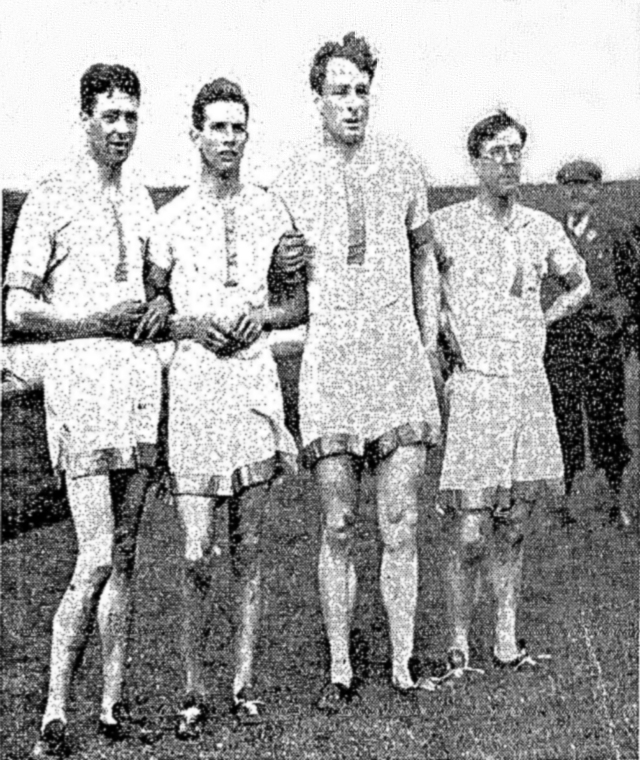
EUAC 4 x 440y Relay team, Hugh Maingay on the left.

In the lead up to the relay at the SAAA Championships in June 1928, HC Maingay of Edinburgh University ‘justified all the good things that had been said about him’ by winning the 880 yards title from Donald Maclean of Maryhill Harriers, who later won the Mile.   Even although Maingay won in a time much below his best, and Maclean had a very easy task in the Mile, a hard race was envisaged when they faced each other on the half mile starting leg of the relay.   However reports tell us that he relay race was notable for the fact that Maingay again defeated Maclean over the half mile distance’.   That distance was not decisive and Maryhill won with a team of Maclean, WP Andreioli, A Kennedy and AH Graham.   The EUAC team of Maingay, FP Reid,  RD Allison, and D Paton finished a mere five yards behind the Maryhill squad who returned a time of  3 minutes 41 3/5th seconds.  

The Glasgow Police Sports were held at Ibrox the week before the SAAA Championships and one of the attractions on the programme was a Mile Relay – a good run-out for teams the week before the National Edinburgh University had a good team out with Hugh Maingay, in excellent form with several outstanding runs to his credit already, ran the half mile against J Calder of Beith ‘who had shown himself the best of  the West half-milers’ he was timed at 1:59.0 and finished his stage only eight yards in front of Calder.   The University advantage was added to by Paton and the race was practically over when Howland took the baton.  FP Reid ran the quarter for them and they won in 3 minutes 50 seconds, 15 yards in front of Beith.    Howland was the subject of much discussion on his eligibility since he had run several races for the Achilles Club that season.    Beith Harriers, based on that and other performances were thought to be in with a chance of winning the SAAA Mile Medley Relay when it was held on 22nd June at Hampden Park.  

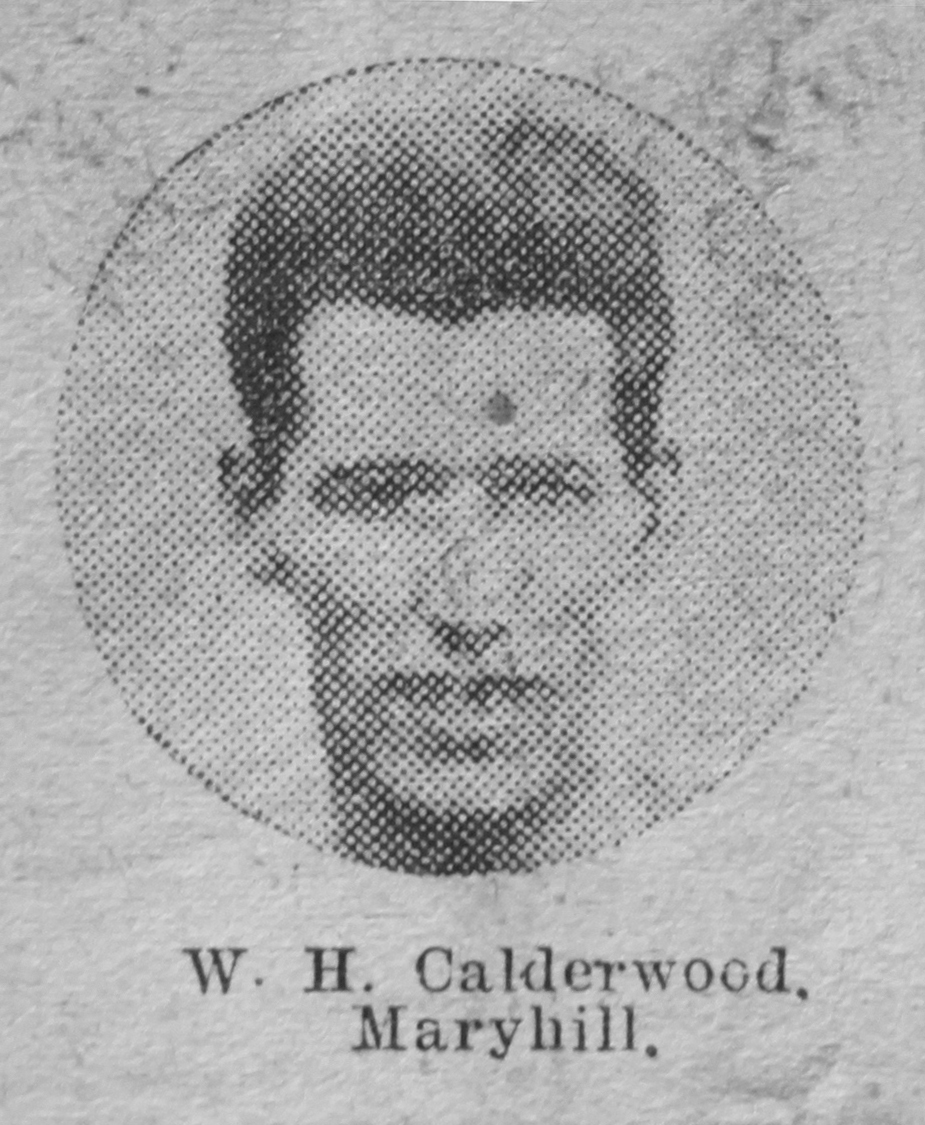
In the National the situation was different of course.   eg where the relay men had almost all raced before that event on both weekends, the standard was much higher at the National.   Maingay won the half-mile comfortably, Maclean had lost a lot of his form and was second in the mile and did not run in the relay being replaced by WH Calderwood who had already won the Mile and Calder was out f the medals in the 880y.   These three were representing their club in the half mile leg of the relay and Maingay was the ‘winner’ with Calderwood second.   Edinburgh went on to win with the team being completed by D Paton, RL Howland and FP Reid, by 10 yards from Maryhill (Calderwood, T McLean, AD Turner and HH Devlin) and West of Scotland (C Freshwater, JG Scott, W Taylor and AF Clark).   Beith?   They were fourth with Shettleston last.   The winning time was 3 minutes 43 3/5th seconds.

Introducing the relay to the championships had been a great success.  There had only been two clubs who had ever won the race in its eleven years but there had been many excellent races and there had been challenges from other clubs, notably West of Scotland, but the title had been swapped between Maryhill and Edinburgh University.   It was not a pattern that would remain throughout the 1930’s. 

Maryhill’s Donald McLean


Summit: Summer 2018

Jim and Carol’s athletes at Summit High School are back in action for the summer season: first results are for the Madras meet which he says were held in a very cold 37 degrees F, ie just under 3 degrees Celsius.   Anyway, the result was a clear victory for Summit in both men’s and women’s groups.   They won the Men’s by 111 points to 34, and the women’s by 142 points to 2.   Which is the story of the meet: eg in the men’s 100m they had eight of the first ten finishers and in the women’s, there were also eight of the first ten, including the first four.   In the 1500m, they had seven of the first ten men, including the first four, and the women had the first five of the nine competitors.    One could call it a promising start to the season.

The second meet was against rivals Bend HS and it was a wee bit warmer – around 50 degrees and the result was a mixed one.   In the Varsity age group, Summit won both competitions, 104 to 41 for the Men and 97 to 48 for the women.   In the (younger) Junior Varsity Group Bend was victorious winning by 124 to 108 in the men’s and 106 to 103 in the women’s. 

Two meets then off on a spring break – Jim says most go to Hawaii where it’s a wee bit warmer at this time of year.

Break over, the biggest meet of the year – the Oregon Relays – came up on 13th and 14th April.   Jim himself reports:

“We entered three 14 year old freshmen in the 3000 and all ran personal best plus a VARSITY girl in the 3000 who also recorded a pb.   The boys DMR – our lead off leg (1200) got knocked on his backside after 450 meters – scrambled to find the baton and finished seventh.   That was on the Saturday, next day we came back to set a school record in the 4×800 finishing second to Wilson from Long Beach California.   In the Girls DMR Summit finished 2nd – Halliday from Mountain View is a 4:46 miler.   The girls won the 4×800 by 10 seconds.   More bad luck in the sprint Medley: the lead off leg dropped baton coming out of the block – our 800 runner moved the team from 7th to 3rd place overall.

All in all – good effort from the kids.”

The initials might seem strange to Scottish athletics fans but put simply the DMR is the Distance Medley Relay where the runners cover 1200 – 400 – 800 – 1600m  and the SMR is the Sprint Medley Relay of 200 – 200 – 400 – 800 metres.  The latter is quite like the Scottish version where the stages are run in the order 400 – 200 – 200 – 800m.

Full results are at   https://www.athletic.net/TrackAndField/meet/318089/results

A week later came the Summit Invitational meet where they entered 20 – half a dozen were only 14 year olds – and they came away with 12 personal best times.   It was also a brighter and warmer day with the temperature in the 50’s.   Full results can be found at   https://www.athletic.net/TrackAndField/meet/315957/results .

*

The State Championship Qualifying meeting was held at the start of May and again the boys and girls from Summit performed well.   On a day when the temperature was 52 degrees F, and with an 18 mph wind, which was great for the sprinters and jumpers who had it at their back but nor so good for the distance runners, the relevant results were as follows.

Qualified – 2 girls – 800/1500/3000   – 2 boys – 800 and 1 in 1500

Table shows district times and seasonal bests

                               
800 Meters  Varsity – Finals x districts season bs   1500 Meters  Varsity – Finals x districts season bs  
1 10 Isabel Max 2:25.49a 2.15.31 Summit   1 12 Taylor Vandenborn 4:50.95a 4.42.23 Summit  
2 10 Azza Borovicka Swanson 2:27.74a 2.21.76 Sum   1 10 Sophie Fisher 4:43.73a PR 4.43.73 Crescent Valley
1 11 Geneva Wolfe 2:23.08a SR 2.23.08 Crescent Valley 2 10 Fiona Max 4:51.19a 4.45.82 Summit  
2 11 Emma Mullins 2:24.76a 2.23.64 The Dalles 3 11 Kelsey Swenson 4:56.78a 4.52.40 Mountain View (OR
1 10 Lucy Tsai   2:23.91a PR 2.23.91 Marist   1 9 Sage Reddish 4:54.42a PR 4.54.42 Ashland  
2 9 Sage Reddish 2:23.93a 2.23.93 Ashland   1 10 Josephine Dickinson 4:56.18a 4.54.53 Hood River Valley
1 11 Jori Paradis 2:24.24a SR 2.24.24 Silverton   2 12 Hannah Mason 4:56.71a 4.54.97 Lebanon  
2 9 Amanda Nygard 2:26.31a 2.24.46 Hermiston 2 12 Ariana Marks 4:56.28a SR 4.56.28 Crater  
1 10 Samantha Prusse 2:24.58a PR 2.24.58 Wilsonville 2 10 Frances Dickinson 4:56.57a PR 4.56.57 Hood River Valley
2 11 Isabella Kansala 2:24.96a PR 2.24.96 Sandy   1 10 Samantha Prusse 4:56.75a 4.56.75 Wilsonville
                3 11 Evelyn Nunez 4:56.86a PR 4.56.86 Hood River Valley
800 Meters  Varsity – Finals x districts season bs   2 11 Brigid Hanley 4:58.85a PR 4.58.85 La Salle Prep
1 12 AJ Sandvig 2:00.33a 1.54.95 Crescent Valley                
1 12 Jerik Embleton 1:57.08a 1.56.39 Marist   1500 Meters  Varsity – Finals x districts season bs  
3 12 Alex Franklin 1:59.77a 1.57.07 Ashland   1 10 Evan Holland 3:54.32a PR 3.54.32 Ashland  
1 12 Chad Ford 1:59.43a 1.57.80 Summit   2 11 Jantz Tostenson 3:59.93a 3.59.93 Crater  
2 10 Ryland McCullough 1:58.25a 1.58.25 Crater   3 12 Alex Franklin 4:00.72a PR 4.00.72 Ashland  
1 10 Ahmed Ibrahim 1:59.29a 1.58.30 Parkrose   4 10 Arlo Davis 4:01.69a PR 4.01.69 Ashland  
1 SR Isaac Sanchez 1:58.36a 1.58.36 Hermiston 1 JR Giovanni Bravo 4:04.41a PR 4.04.41 Woodburn
2 SR Travis Running 1:58.74a PR 1.58.74 Hood River Valley 1 12 Albert Hesse 4:16.40a 4.05.0 Ridgeview
2 12 Cole Rene 2:01.12a 1.58.80 Summit   2 12 Jett Ballantyne 4:18.33a 4.05.0 Summit  
2 12 Oliver Joss 2:01.83a 1.59.92 Corvallis   2 JR Haile Stutzman 4:05.10a PR 4.05.10 Silverton  
2 10 Tayler Kellim 2:00.86a PR 2.00.86 Sandy   1 10 Ahmed Ibrahim 4:07.64a 4.05.50 Parkrose  
3 SR Nick Oja-Zdroy 2:01.08a PR 2.01.08 Pendleton 2 12 Hassan Ibrahim 4:10.72a PR 4.10.72 Parkrose  
                1 10 Sam Alvarez 4:17.61a 4.17.61 The Dalles
                2 12 Braxton Wilson 4:18.30a PR 4.18.30 Hood River Valley
3000 Meters  Varsity – Finals x                        
1 10 Kelsey Gripekoven 9:57.92 PR OR Summit 27-Apr Nike/Jesuit Twilight Relays        
3 10 Sophie Fisher* 10:22.41 PR OR Crescent Valley 10-May 5A-2 MWC Championships        
4 10 Fiona Max* 10:29.2 OR Summit 9-May 5A-4 IMC District meet day 1        
5 10 Frances Dickinson 10:30.69 PR OR Hood River Valley 21-Apr Wilsonville Invitational        


The high spot for most Summit athletes were the State Championships – where they always did well.   2018 was no exception with the girls winning their side of things.   The full results are   here    Note particularly the Girls 800, 1500 and 1500.

Eddie Sinclair as a Coach

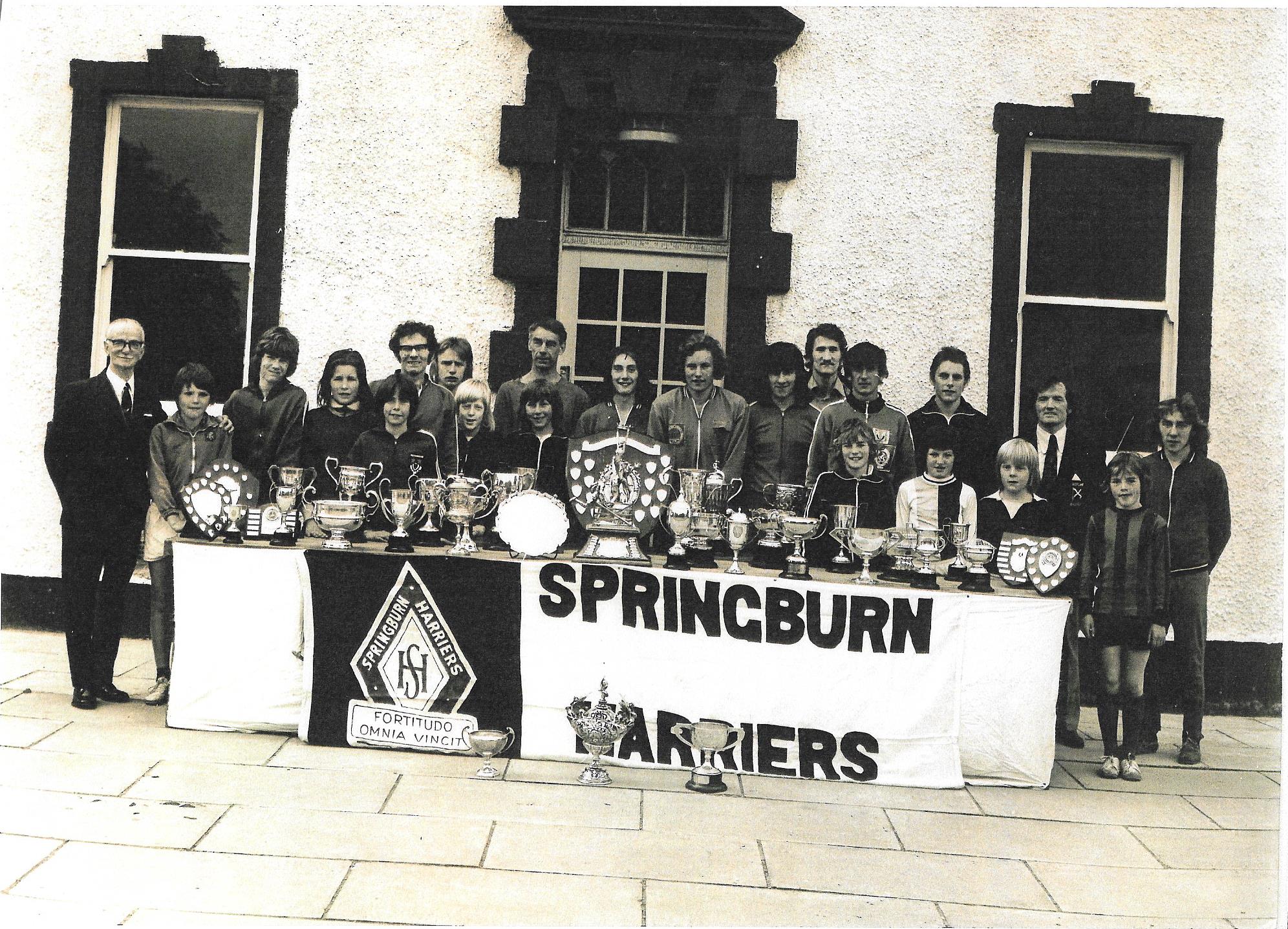
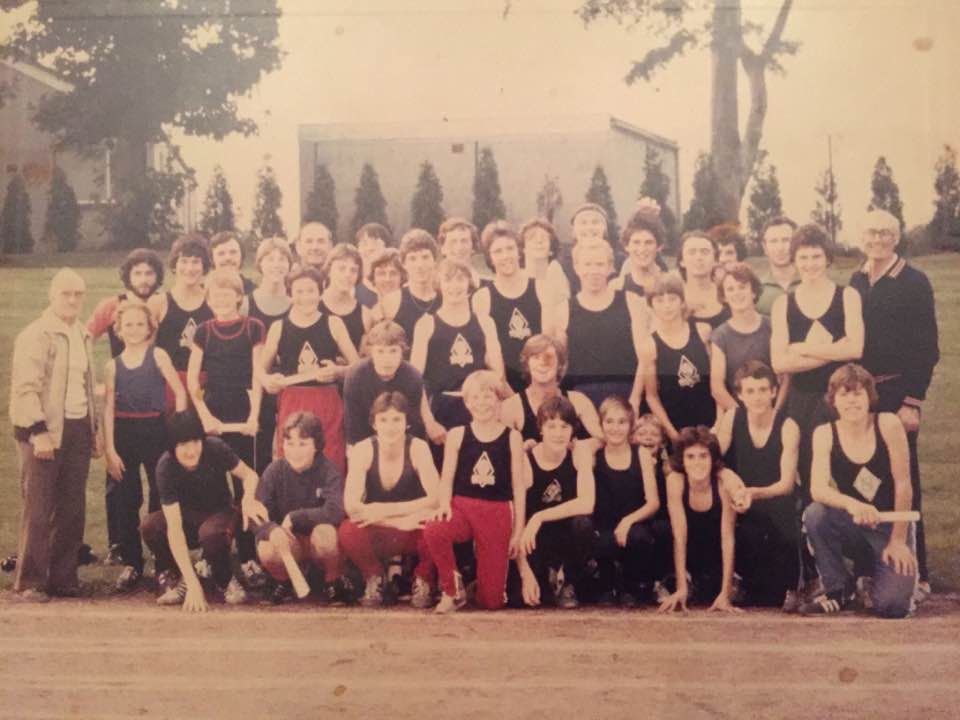
Eddie, second from right, with some of his runners and Springburn club mates:

John Fleming says of this photograph with many of Eddie’s best athletes included:

Ian Murray is behind the shield then it is me (wearing our Scottish Schools’ tracksuits) then Willie Paterson, Tommy Patterson with Harry Gorman behind them. Eddie’s son , Gordon is in front of Tommy and then between Tommy and Eddie is James Martin (Harry’s brother in law). Eddie’s 2nd son,Graeme, is next (in stripes)- Graeme sadly died. The final athlete is Johnny Buntain.  I think this was taken in 1974 outside Huntershill.. 
It was taken on a regular training night but for some reason the picture was missing National Gold team medalists:- Adie Callan, Graham Crawford Jim Lawson, Joe McLean, Donald McLeod, Robert Craig as well as seniors Eddie Knox and Iain Young. The lad between Graeme Williamson and Bill Ramage is Derek Connacher, who was 9th individual in the Scottish Schools Middles Race (more than 300 runners) and because he was the 5th Lenzie counter he didn’t get a team medal ! 

*

Eddie was an excellent runner who ran for Scotland on the track and over the country.   His  range was wide – from 880 yards to six miles and steeplechase on the track, road racing including the Edinburgh to Glasgow relay and cross-country.   When his running days were over, he did not walk away – he stayed to coach generation after generation of young athletes and arguably did more for Springburn than he had done as a runner.   And that had been considerable.  The sheer numbers of trophies won was staggering.   For instance between 1962 and 1981 his Under 15 teams won medals in 16 national championships out of 19 – each team had of course four to count which meant at least five runners per race, so 80 individual medals at national level for the boys to take home.   Of course he had Under 17 and Under 20 teams under his care at the same time – the numbers not as great as the Under 15’s because at 15 many have to spend more time on their school work or are starting to earn their living in the workplace and the numbers inevitably fall for reasons unconnected with athletics or coaches.   The numbers were large but, another surprising fact, they almost all came from the same area of Kirkintilloch and Lenzie.   Arthur Lydiard said that you can find champions anywhere – Eddie found his almost all in the same small area.   We really need to find out more about him and his methods as far as we can.  

The Springburn team at Bute Highland Games Medley Race: Eddie on the right.

Eddie’e career as an amateur athlete was a relatively short one.   After coming through the ranks as a Youth and a Junior, his senior career lasted just three years – but it was meteoric.   On the track he had best times of  9:06 for Two miles, 14:05 for Three Miles and 9:27 for the 3000m steeplechase.     He won the SAAA Three Miles in 1960 and in the same year he was sixth in the National and was selected for the Scottish team for the International Championship.    As a Youth he had been fourth and sixteenth in the National and as a Junior in 1957 he was eighteenth.   As a Senior it was 6th/36th/15th.    In the Edinburgh to Glasgow, his first run was in 1957 when he was on Stage Seven and moved the club from eight to fifth with second quickest time of the day.   We know he ran the same stage the following year but no details are available about his performance.   In 1959 he was sixth on Stage One and in 1960 – his own personal annus mirabilis – he took over in fifth place on Stage Two after Tom O’Reilly had run well on Stage One, and moved through to second with the third fastest time of the day.   His last run in the E-G was in 1961, again on Stage Two when he took over on Stage Two in eighteenth and held that position – by the time Tom came to run on the last stage the club had climbed to fourteenth and that was where he kept it.   He ran as a pro after that for a while but crept back into amateur athletics soon after.    That’s when the coaching started.

We can begin by looking at the record.   He started coaching in the mid 60’s and we take the years from 1963 to 1986.  At National Championships level his teams won a total of 35 sets of medals, of which 12 were gold championship medals.   In the individual championships, his runners won 29 medals, of which 14 were gold.   The best year was arguably 1973/’74 when Springburn Harriers won the Under 13, Under 15, Under 17 and Under 20 team championships.   The results were of course even better in the Midland Districts (until 1975) and Western Districts (from 1976) where the opposition was less numerous but contained all the strongest clubs such as Victoria Park, Shettleston and Cambuslang.   In fact when the West District started their Young Athletes relays (under 13, under 15 and under 17 running in that order, Springburn won for the first six years in succession until Clydesdale Harriers took the title in 1981/82.    There were also many titles won on the track in all the age groups as well as in the Scottish Schools championships.   Graduates from the Eddie Sinclair Academy of Excellence, had their been such a thing, included Eddie Knox, Duncan Middleton, Graham Williamson and Steven Begen.   We could go on quoting similar statistics but the point is made.   One more point has to be made however: many coaches who have success with boys teams, fail to deliver senior athletes at the end of the process.   Eddie’s record is better than that – the four above were all senior internationalists, three of them won British Championships and one won gold, silver and bronze at world cross-country championships.   If the team/individual medals in the national cross-country championships are looked at we see that there were 5 team and 9 individual medals won at U20 level compared with 8 team and 2 individual at U13.   There were more U20 individual golds than at U13 or U15.   

It was really a quite remarkable record, made the more so by two more facts –

  • that he worked on his own – there was no team of supporting coaches following his guidelines.   
  • that his athletes came from the relatively small communities of Kirkintilloch and Lenzie with a few from Bishopbriggs.

Graham Crawford

First-class athlete and member of Springburn Harriers Graham Crawford, who was coached by Harry Gorman at the club and says that he learned a lot from Harry, has been a member of the club for a long time, says of Eddie:

“I have strong memories of the man from club nights and races and I’d sum him up in one word- passion.

“Eddie spoke with conviction. He was like an old style tough football manager who could get his team totally fired up. When he talked you listened. He held the stage. When Eddie roared at you in the final stages of a race you always somehow dug deeper, no matter how tired you imagined you were at that point.

As I’ve grown older I’ve found myself thinking more and more that if he had been my coach I’d have run over broken glass for him. I go to races these days to support the sons of a friend and I find that I remind myself of Eddie, chasing the lads around different parts of the course roaring them on. I get completely caught up in the moment, willing them to get everything out of themselves. That was Eddie, he just wanted you (demanded, expected?) to go to your very limit, ask every question of yourself. Why run if you don’t do that? That would have been his bare boned philosophy.

Eddie trained his athletes like most serious runners of that era, no fancy methods just straightforward hard work with a healthy mix of good sustained runs, often with a burn up at the end, and plenty of intense, quality and high rep track work. No – or little – gym work as far as I know.

He had a reputation for training teenagers very hard. It produced strong contenders and champions, and brought accusations in certain quarters that lesser runners were used as cannon fodder for Graham Williamson, ultimately to their detriment. I remember the same being said about Naylor and Nat Muir at Shettleston.

It was also said that during a period of doldrums for Springburn, nobody really turned up except Eddie, Jack Crawford and Williamson. And ask me to name the three most significant people in the club in my lifetime, and I suppose I may have the longest ongoing continuing connection, and it would have to be those three for their constancy, work and impact.

What Eddie did with Williamson was immense. Eddie asked everything of Graham and Graham had the makeup to respond to those demands. The teenage Williamson trained extremely hard under Eddie, with a heavy emphasis on frequent quality training.

Graham was a hard as nails, a ‘leave nothing behind’ racer because that is how Eddie trained him all through his teens. I’ll leave others to argue over the merits of that but I find it very hard to be critical of Eddie. I know stories, and I know he had his flaws and failings (as I acknowledge my own), but to me, his positives – his passion, commitment, drive, and motivational qualities – overrode everything else. He was a force of nature who had very strong views, a cutting tongue and a strong sense of humour.”

[Graham is quick to point out that “anything I have said about my regard for Eddie takes nothing away from the marvellous support and encouragement I got later from Harry Gorman when he coached me for a number of years. Harry gave me a lot.“]

Eddie Knox

Eddie Knox was Eddie Sinclair’s first international champion: in his first run in the ICCU World Championships he finished fifth, then next time, in 1967, he struck gold.   Colin Shields, in his history of the SCCU, says: “Eddie Knox followed Ian McCafferty as Junior international champion in an exciting race.   He was in the leading group throughout and edged his was into the lead 400 yards from the line, holding on for a two second victory over a Belgian.”  

   In the early/mid 60’s Eddie had a quartet of Eddie Knox. Duncan Middleton, Harry Gorman and Ian Young.  Knox won the International Cross-Country Championship, Middleton was one of the best 880 yards runners in the United Kingdom, Gorman was a very good middle distance runner  who was unfortunate not to get a SAAA title and after leaving school, Ian Young was a member of the really great Edinburgh University team.    Knox confirmed all that Graham Crawford said above about Eddie’s passion and determination but added that ‘you didn’t question his sessions’, you did what he said to the letter or you moved out of the squad.  He was quick to add, however, that Eddie did a lot for him personally.  However this first group that he worked with all achieved wonderful things in their career and one of them, Harry Gorman, went on to coach new generations of Springburn Harriers to success himself.  


From Eddie Knox, the first of his international runners to the man who was probably his last: Steven Begen.   Steven says

I found a different side to Eddie especially in my best years 84 through to 87.   Eddie coached me from my first real introduction into Springburn Harriers in 1978 ensuring that I knew what kind if club I was joining and what it took to succeed.   After a few years if club running Eddie pulled we aside at the start of the 83/84 season stating with real intensity ” Win the Scottish you go to the World’s”  true to that I managed to win with Eddie popping up at real decisive points throughout the course encouraging me in the way only Eddie knew how.  After 84 I worked very closely with Eddie and looking back now realised how ahead of his time he was.
 
Eddie was brutally regimented, tough but fair.. but most importantly Eddie was your mentor, he laughed, joked and chastised you all in one sentence.   He had the mental strength and knowledge  to ensure you had a steely determination to succeed and reinforced that in every single session you did. There was no trainibg session that didn’t have a purpose.   I remember Eddie with great fondness, he was like a father to me after I sadly lost my own father at 15. He understood what a young rough boy from Balornock needed and provided everything to make me a complete athlete and young adult.
 
Eddie could be summed up for me as Mr Springburn.. He only wanted Springburn harriers athletes to reach their potential and for years he made sure that happened.   I think of Eddie loads as I look back, the cold wet nights doing 200 repeats in the grounds of Woodilee Hospital, the lung bursting hill repeats up the Campsie Fells, the sub 2:40 1000m repeats round a busy Bishopbriggs with Adrian Callan, and the like. “

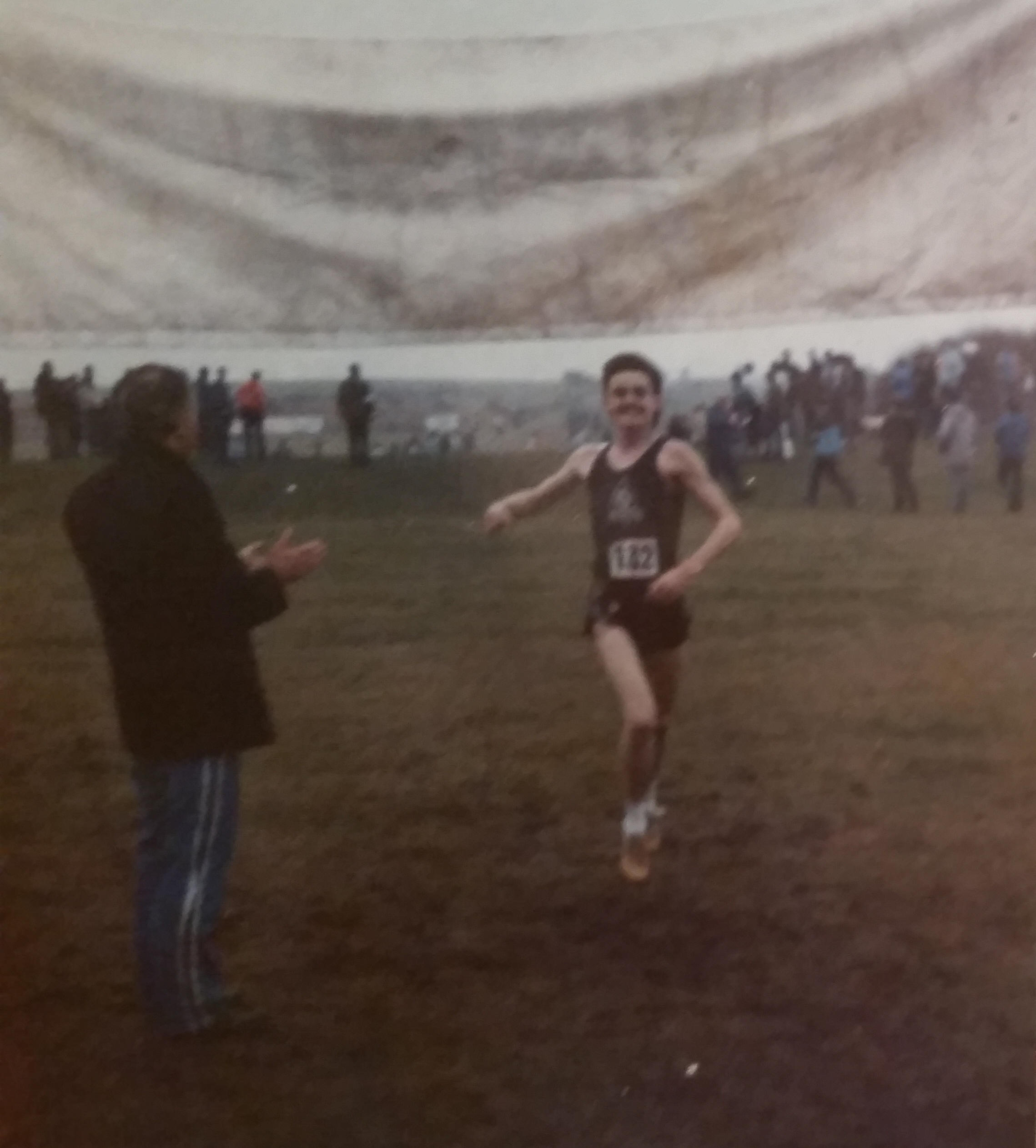
Steven Begen winning the Junior National

Was there any single thing that marked out Eddie’s runners from the rest of the scene, that accounted for the tremendous success of his runners?   Yes, there was, and it reflected the coach’s values in a very practical way.   Eddie’s runners always gave 100% effort.   They never eased up. This was, to me, most easily seen in the Under 17 age group  probably because I was coaching some runners in that age group at the time.   Races for Under 17’s generally started with a bit of a rush and went pretty hard for the first third of the distance, then eased up for the middle third before starting to race properly again for the last third of the race.   The Springburn youngsters just didn’t run that way: there was no steadying up in the middle of the race, there was no wee ‘sleep’ anywhere after the gun went.   They started hard and kept going hard all the way to the finish.   Others learned from that and soon everyone was trying to get their athletes to go from gun to tape.   But  they had a job on their hands. 

Eddie, second from the left with some of his runners in the early 60’s – Ian Young is fourth from the left 

Ian Young was one of his best athletes in the 1960’s who went on to become one of the Edinburgh University team that is generally recognised as being the best University distance running squad ever.   Ian has this to say about training with Eddie.

 “I joined Springburn Harriers as a 15 year old in 1960 because I was beating fellow pupils at Lenzie Academy in cross country and track and wanted to progress.  There was no athletics club in Kirkintilloch at that time and local boys tended to go to Springburn as their nearest athletic club.  At that time. Springburn had 2 significant figures in Scottish athletics in Tommy O’Reilly, 2-time Scottish 3000 metres Steeplechase champion and National Record Holder and Eddie Sinclair, Scottish 3 Mile champion in 1960.  The club also had a wider spread of athletes in those days with sprinters, notably John Young, a 10 sec 100 yards performer and field eventers like David Cairns, Scottish champion high jumper and GB internationalist behind Crawford Fairbrother.


I have no great memory of when Eddie specifically started coaching me, but he trained every day and because we lived fairly close to one another in Kirkintilloch, I tended to go to his house in Eastside after school and we would go out for a run from there.  In the summer we would do interval training, firstly at St Augustine’s School in Possilpark where Springburn Harriers met in the summer months and later at Huntershill when the local authority took over land which the Harriers owned and laid out a track with changing facilities.  Eddie tended to work us on 220 or 440 yard repetitions with a jogged recovery in between as per the Franz Stampfl regime.  Such success as I had, winner of many Dunbartonshire schools half-mile and mile races, culminating in the Scottish Schools mile championship in 1963 was as a result of his coaching these sessions, stop watch in hand and keeping his own meticulous notes of progress or lack of it, throughout the season.


It was during the winter season of cross-country and road races that Eddie came into his own.  He had a number of measured road runs around Bishopbriggs and Auchinairn which he led out, initially as a group run but then at an appointed spot as a ‘may the best man win’ race to the finishing point, then a jog back to the club house.

He had a favourite route in Kirkintilloch of 5 miles called the ‘Milton – Auchenreoch’ starting and finishing at the corner of Milton Road and Kilsyth Road, ironically outside the cottage where Johnny Stirling, the renowned Victoria Park and Hugh Barrow coach lived.  This was used mainly to check progress and improvement amongst his runners.  He would start us off at staged interval, all handicapped according to current performance so that the weaker runners could have a chance of beating the backmarkers who were always champing at the bit to get off in pursuit.


Another favourite training ground of Eddies was a hill called ‘Skimmers Brae’ at Birdston farm near Kirkintilloch.  This could be ploughed field or heavy grassland depending on season and he judged individual fitness by whether or not you could run from bottom to top without stopping.  This trial was only slightly less of a hardship than the Sunday training runs from Eddies house which involved 10-12 miles on the foot of the Campsie Hills.  Outwith the stamina building and speed building training methods which Eddie used, he also adopted a number of practices from the methods used by the professional or ‘pedestrian’ athletes of th time who were banned from amateur athletics, but where the town of Kirkintilloch had a good few exponents, including latterly, Eddie himself.


He used to have me train with lead sheet cut like an insole inside my trainers to strengthen my legs and make me feel like I was ‘flying’ when I took them out to race.  He would have us do 50 -100 yard sprints along the canal bank wearing lead insoles or carrying a 5lb dumbbell in each hand (my father’s foundry was useful for making these) to build up the ability to put in a sudden break in a race to demoralise the opposition.  Other tactics which he taught his runners were to make your break during road or cross country races as you neared the top of a hill, no matter how you were feeling, because you would demoralise the opposition and be gaining ground by racing down the other side while they were struggling to the top and then saw the gap you had opened up!  Another simple instruction was to run close to a wall if there was one bordering the route in a road race because you got a psychological lift from the feeling of speed that that gave you.  Again, recognising that his training built strength rather than speed, Eddie always encouraged us to break in the 3rd lap of a mile race or the second last lap in 2 or 3 mile races and make it a long run for home to kill off the ‘speed merchants’.


Eddie was passionate about the sport and gave his time and knowledge unstintingly to those who would take it on board and work to improve.  He did not limit himself to one age group, tending to use the same methods for all ages but limiting the distances run in training or repetitions or speeds on the track depending on age group, so in this way he could be coaching runners at different stages.  No one wanted a rollicking from Eddie which came if he felt you were not putting in the work or trying hard enough.  Much has been said about Eddie’s methods ‘burning out’ young athletes at an early age or causing them to have injuries which ended their running careers.  I tend to view such examples as guys that had achieved what they wanted to do then moved on to other things or physically had got to the point at which they were not going to develop further and gave up with at least some notable achievements behind them which they would not have had without Eddie’s support, encouragement and training methods. 


Eddie’s skill was in enthusing and bringing on young athletes to develop their talents.  When we reached senior level, for example when I went off to Edinburgh University, we tended to know what we needed to do to run at a high level and had the maturity to know what had to be done to maintain this – hence the significant number of Springburn Harriers who went on to achieve honours as seniors because of the knowledge which Eddie had generously imparted to every one of his protégées, not least of which was the inherent belief that, on the day, you could beat anyone.  A generous person and a great motivator.”

Eddie Sinclair’s contribution to coaching, to Springburn Harriers and to Scottish athletics deserves to be better remembered than it is.

..


Football Club Sports in 1913

It is well known that football clubs were responsible for many athletic meetings from the end of the 19th century until well int the 20th.   The range of these sports was wide – from those held by village football clubs, via those by middle ranking clubs such as Ayr FC right up to the more glamorous ones held by top teams such as Queens Park, Rangers and Celtic.   Most were by 1913 amateur events but this was by no means true of them all: two such meetings were those held by Glasgow Police at the start of June, and that of Clyde FC at Shawfield.   On this page we’ll look at all Sports held by Football Clubs in 1913 as reported by the Glasgow Herald.   Since the comments of the reporter in the Herald on the Police Sports have a general interest they will be included too.   There were several ‘joint meetings’ held around the country – eg Heart of Midlothian and Edinburgh Southern Harriers held an annual fixture, and in Glasgow both Celtic and Rangers held such meetings with athletic clubs, Celtic maybe more than Rangers.   We start with one such.

Monday, April 21st:    The Celtic FC and West of Scotland Harriers are holding a joint sports meeting at Parkhead on May 17th, and it will be historically interesting as the last of these mixed – athletics and cycling – functions which have given that enclosure a world-wide reputation.   The reason for this is that the Celtic directors have come to a decision to demolish the cement track, which is now practically useless, as cycle racing is, to all intents and purposes, a thing of the past – something merely to be recalled as an incident in the sporting life of our great city.   The Celtic are expanding the holding capacity of their ground and this they can do to te extent of at least 20,000 by converting the track into terracing.   Harry Martin, the popular motor-cyclist, will do his best to ensure the “farewell” function with a series of sprint performances which will still further perpetuate the fine sporting traditions of the Celtic cement path.”

The subject of professional athletics will pop up from time to time on this page and in that connection, we can digress and look at this item and wonder what it tells us about amateurism in 1913.

April 28th, 1913:   The AAA of England is  setting its face more determinedly than ever against what is called the “hippodromy” athlete.   This class has been multiplying of late years, and there has been much talk regarding the peregrinating propensities of certain well known runners.   These in the future are to be better controlled, and it is just possible that fewer English runners will be seen at Scottish meetings than in previous years.   The AAA is sending a team  to South Africa at the end of September.   It will consist of half a dozen picked runners who can afford to leave England for four months.   This is an interesting Imperial movement and must have beneficial effects on athletics in South Africa.”

28th April, 1913: “….  in this context it may be mentioned that the Rangers have granted Bellahouston Harriers  training facilities at Ibrox on easier terms than in previous years and it is believed that this and other concessions will help t increase the activities of the club.   … “

Football and athletics enjoyed a close relationship at this time from which both parties benefited.   

*

An interesting note at the start of a report on Bellahouston Harriers Sports at Ibrox, reported  on 12th May, 1913:

“The Bellahouston Harriers held a confined meeting at Ibrox Park the other evening.   Owing to the fact that the track is being lowered at the corners – another indication that cycling is not worth catering for – the races were run on the grass. …”  Note the comment on cycling – we will come back to that!

*

There were many meetings held midweek by athletics clubs at the various football grounds – Bellahouston and Clydesdale tended to hold theirs at Ibrox, West of Scotland and Maryhll at Parkhead.   That was the generality but no connection was exclusive – eg Clydesdale also held meetings at Parkhead, no doubt encouraged by former member Willie Maley.   There were of course still joint matches such as the one held at Parkhead sponsored by Celtic FC and West of Scotland Harriers on 17th May, where the report “Additional interest attached to the meeting from the fact that it formed the last occasion on which the cement cycling track will be used, the Celtic FGC having decided on its removal to provide more accommodation for spectators at football matches.   The demolition of the track is to be begun immediately so that the added area may be available for next football season.   The decision to remove the track, which was opened 16 years ago, suggested the idea of a parade of veterans which brought out eight well known competitors of former times.  …”

Saturday, 24th May, saw the Morton Football Club Sports, reported elsewhere on this website, took place at Cappielow Park, Greenock.  Then on 31st May the Clydesdale Harriers Sports took place at Ibrox.   The clubs had a very close connection which had lasted since the Harriers club was established in 1885 and they had many members in common.   Rangers Sports at Ibrox were supported by the Harriers, and the Harriers events were supported by the Rangers.   On this occasion one of the attractions was a schools relay race with teams from Allan Glen’s , John Street Higher Grade School, Dumbarton Academy, Bellahouston Academy, Paisley Grammar School and St Aloysius College.   Allan Glen’s was the favourite to win and they did so ‘easily’.   There was also a schools relay race at the Police Sports the following week but it had a problem.

*

Friday, June 6th, 1913:   “Glasgow Police Sports:   Being an important factor in the corporate life of the city, the Glasgow Police never appeal in vain for support on the occasion of their annual Sports.   From modest beginnings these Games have grown into a great national function, so much so that a cup or medal won under the auspices of the Glasgow Police Athletic Club has a significance almost as great as a medal or cup won at the championships of the Scottish Amateur Athletic Association.   An effort was made during the winter months to bring the Glasgow, Edinburgh, Dundee and Leith Police athletic clubs into the amateur fold ; to the regret of many it was not successful, but from the impression which the various conferences produced, there is good reason for believing that in the near future the leaders of police athletics will come to recognise that it is better, in many ways, to be under the discipline and control of a governing body such as the SAAA.    There are 31 events on tomorrow’s programme.   A dozen of these are confined to the Glasgow Police, five are open to police forces in Scotland, and the remainder are for all-comers.   Besides these there is a five-a-side football competition with prizes to the value of £20.   The invited teams are Rangers, Celtic, Clyde and Partick Thistle.   

Unusual interest seems to have been aroused by the events open to the Police Forces of Scotland, no fewer than 50 having entered for the 100 yards, 40 for the half-mile, 40 for the obstacle race in uniform and 16 for the cycle championship.    …….    There is also a relay race for schoolboys, and it is said no fewer than 40 schools will be represented.    Unconsciously of course, the Police Sports do those who take part in this race a bad turn.   The meeting is an unregistered one, and all who compete are debarred from running under the SAAA rules.   It is well said that this should be made plain as, in after years, any of those who figure in the races for Youths at Parkhead  tomorrow may, in the event of entering for amateur meetings, be disqualified.”   

Maryhill Harriers was the next club to hold a sports meeting at Ibrox Park, this was on 8th July and contained both confined and open events.  Beith FC and Hamilton Academicals FC each held their own sports on 5th July at their own grounds, and West of Scotland Harriers organised a Sports at Somerset Park, home of Ayr United on Glasgow Fair Friday, and Clydesdale Harriers held a meeting at the Clydebank FC ground.  On 28th June the SAAA Championships were held at Celtic Park and on the same day, Vale of Leven held their sports at Millburn Park, Alexandria and Bellshill Highland Gathering took place.   The links between football and athletics were strong – and not just at the top grounds in the country.   Both sports benefited.


21st July, 1913:  

“The Clyde Football Club are apparently “whole hoggers” as far as professionalism is concerned, and in this respect  they are at least consistent.   Instead of running amateur sports, as so many professional clubs do [amateurism in Scotland is practically subsidised at the expense of Association football] Clyde are running a purely professional gathering on Saturday first.   Of course football is the trump card, but in addition they are introducing Jack Donaldson, the eminent sprinter, and a runner of his impressive accomplishments should attract many to Shawfield on Saturday.   Largely through the influence of Struth, several of the best professionals in Scotland will take part in the proceedings.   Professional running in Glasgow has been pretty low in the water for years, but the Clyde are serving up in an attractive manner on Saturday, and will no doubt be rewarded for their enterprise. “

29th July, 1913:

As already indicated, Celtic Football Club are spreading their sports over two days, Saturday and Tuesday, the latter day being for the convenience of shopkeepers who seldom have a chance of seeing first class running.   Besides football there will be at least two open handicaps, 100 yards and 1000 yards, and should any of the top strangers who are coming to Parkhead remain over  there may be an invitation race.   Certain it is however that Mr William Maley will see that the shopkeepers are provided with a programme that will both instruct and amuse.   With the cement track removed, there will be no more motor thrills to stir the emotions of the Saturday crowd.   This of course willl be a big blank but there will be other novelties, one being a steeplechase with more obstacles and water jumps than hitherto.   This is always a side splitting race but it will be even more so at the forthcoming meeting.   Another novelty will be a three miles distance handicap race with record breaking inducements .   There will be the favourite handicap events, the 100 yards, the 220 yards, the 880 yards and the mile.   The invitation races which are always a prime feature at the Parkhead meeting, will not be determined until it is known who are coming from England and Ireland.  All the same we are safe in assuming  there will be at least two special sprints with a strong international complexion.  Mr Maley is well advanced with the preparations, some of which for obvious reasons can not be made public.  

Still on 29th July:

The Rangers FC are anticipating a big success on Saturday on the occasion of their amateur sports.   These are now limited to one day.   Many will regard this as a false step but of course the Rangers directors know their own business best.   Still, it will be seen that the Celtic directors are nowin favour of the two-fold gathering, and they are regarded as pretty sound judges of public taste in the way of athletic entertainment.  Perhaps in another year the Rangers may revert to the old arrangement of having a supplementary function on the Monday following their sports day proper.   Mr Wilton has arranged a very interesting programme.   WR Applegarth whose great sprinting achievements have  formed  the chief feature of the season’s running in Britain, will be the leading “star” and several minor ones will also be present.   There will be an invitation sprint handicap, and no doubt there will be some exciting sport in the other events holiday form, which always produces sensational results will, as in previous years,  shine out conspicuously at Ibrox Park on Saturday.”

Still on 29th July:

 “Scottish Cyclists Union Officials who were at Ayr on Fair Saturday  expressed themselves as well satisfied with the racing in the two handicaps set apart for wheelmen.   Of course these are the days of small things in that department of sport, nor is there any inclination, as far as we can divine, of richer results.   The Celtic path is no longer in existence.   Ibrox, never at any time safe,  is now out of the question for first-class cycling.   Hampden Park therefore is the only ground in the city where cycling can take place.”  

4th August, 1913

The Rangers Sports were held on 2nd August and the report is elsewhere on this website.   They were a big success with an attendance estimated to be at about 25,000 and many competitors from England.   The Aberdeen Police Sports were held at Pittodrie.   The lead-in to the Celtic FC Sports the following Saturday appeared in the “Sporting Miscellany” column.  

“There is always a strong Hibernian flavour to the Celtic FC Sports and the forthcoming meeting will be no exception in that respect if Mr William Maley’s hopes are realised.   When at Belfast he had a promise from FR Shaw of Dublin University to run in the sprints.   In that case the short distance handicaps will be of an international complexion.  Shaw is the greatest sprinter that Ireland has ever turned out; at all events he has accomplished “times” that no Irish sprinter has ever accomplished, and there is no better test of merit in the sprinting domain than the watch.   Applegarth and others who were at the Rangers Sports on Saturday will also be at Parkhead, and excellent as the sprinting was at Ibrox, it should be even better at the Celtic meeting.   It is to be hoped that Mr Maley will extend the invitations to more than one heat, as at Ibrox.   The public like to see the “big men” often, and in handicaps with heats there is in nine cases out of ten the chance of seeing them twice at least.   Besides it will allow Mr Maley to draw more on home resources, and after all it is an experience which many would cherish to be permitted to run in the same handicap as Applegarth and others.”  

At the Celtic Sports on 9th August, The weather was dull but dry and 36,000 spectators saw Applegarth set a new record for the 220 yards and the meeting itself is reported elsewhere on this  website.   Dens Park, the home of Dundee FC, was the venue for the Dundee Police Sports which like all police sports in the country was a professional meeting.   

The following week the football season opened and most sports at football grounds were at an end.   

This very quick look was in part prompted  by an article that said amateur athletics was subsidised by football.   Certainly we see even from this small sample that many clubs (Clydesdale Harriers, Maryhill Harriers, West of Scotland Harriers, Bellahouston Harriers, Glenpark Harriers) held their own sports at football grounds.   It is not as though they were the only sports grounds available – there were rugby clubs which were older than any open amateur athletic club, similarly there were cricket grounds that could have been used.   Pat of the reason may be that there were many football players who took part in the athletic contests and both sets of clubs had members in common.   Many clubs had their own sports of course – the Ayr United Sports were said to be more important than the SAAA championships, Rangers and Celtic Sports were maybe the biggest and longest lasting, Partick Thistle sports went back before the amateur era and the St Mirren sports at Love Street were always well attended.   The Queen’s Park sports too were looked forward to with enthusiasm.   It is certainly a subject worthy of a more detailed investigation than is presented here.   Maybe a PhD for a Sports degree candidate???

A Philosophy of 800m Running by Peter Hoffmann

Peter Hoffmann leading Paul Forbes in a Training Session at Meadowbank.

Wish upon a star

‘…Questions unanswered

Questions not asked

Some are worth knowing

Some left in the past

Go in with eyes open

Your life will be grand

Just give it your damndest

And go lead the band…’

Roger Turner

Forty years ago I ran a half mile in 1 minute 46 seconds, still a respectable performance today. At one time I even had an ambition to have raced Coe and Ovett down the home straight in the race of the century at the 1980 Olympic Games 800 metres final in Moscow.

Most runners look back on their careers feeling they never quite fulfilled their potential. As the old saw goes if is the saddest word in the English language. If only I had…Like many of you out there, from a distance of forty years I discern many good patterns of what we did well, but also some key mistakes too, which of course tear at the soul. And talking of souls, Father Gianni in the recent BBC series set in Tuscanny, Second Chance Summerexpressed it rather beautifully when he said: ‘…the problem is you only learn with age and experience, so by the time you realise you have learnt a lot of things unfortunately a lot of time has passed and many chances have been lost.’  

But for others-today’s and tomorrow’s young athletes it is not too late. Ben Jones, M.D. said ‘The saddest thing about dying is that all the stuff you’ve learned goes in to the ground with you. Make sure you pass it on before you croak.’  Following Ben’s advice, here’s my starter for ten. 

But first, a health warning. I’m neither a coach; nor a sports scientist; nor an academic, but instead someone who has run for almost 60 years – a reflective practitioner. This is not an academic nor a scientific treatise which works back from the demands of the event, relating them to your strengths and weaknesses and accordingly tailors a training programme, based on lactate tolerance or VO2 levels etc. Instead, it offers some practical, simple, common-sense tips garnered from a lifetime’s running experience from beginner, to international, to fun runner. I’m advocating a simple approach, but one which I sincerely believe will help any half miler run a best performance. I’m targeting it at international class athletes, but it’s equally applicable to aspiring youngsters wishing to run a great half mile or any master’s athlete out there too-just apply the principles and alter the times.

Peter preparing for a Track Session

  1. Dream Baby, Dream

In the 1920s, the writer and mythologist, Joseph Campbell (who also happened to be one of America’s finest half milers) wrote of following your bliss:

If you do follow your bliss, you put yourself on a kind of track that has been there all the while waiting for you, and the life you ought to be living is the one you are living. When you can see that, you begin to meet people who are in the field of your bliss, and they open the doors to you. I say, follow your bliss and don’t be afraid, and doors will open where you didn’t know they were going to be. If you follow your bliss, doors will open for you that wouldn’t have opened for anyone else.

You need to have a dream to sustain you over the years; find out what motivates you to get out there season in, season out, to train in all weathers. Find your dream, then follow it; and remember   Festina lente – Make haste, slowly.

Peter in a 200m race: note the GB vest

  1. Control Your Weight

Ensure your weight is at its ideal level. If it’s not, you won’t fulfil your potential. Simple fact. But that doesn’t mean being as light as possible. Too often I see good international runners who are actually too light. Don’t sacrifice lightness for strength. Instead, what you’re really after is the optimum power to weight ratio. So it’s better to be two or three pounds heavier with good power than to be too light with little power. The best athletes glide effortlessly over the track. Think Ovett at his peak over 1500 metres at the 1977 World Cup.

Control and monitor your weight; if you need to lose anything, do so, but very slowly. Be patient. If you’ve gained weight you will have done so over a period of time. To lose it, do so similarly. A pound a week is aplenty and you will hardly notice the effort; yet over 6 months that would add up to almost two stones! Eat regular, balanced, healthy tiffins every few hours. Drink plenty of water. Most people know what they should be doing. At the end of the day, retire to bed in the evening knowing that when you awake the following morning you will be very, very slightly lighter.


Peter and Paul Forbes

  1. Practice Running FAST!


By running fast, I mean sprinting flat out several times each week. Be honest with yourself-when did you last sprint as fast as you could, putting the pedal flat to the floor? For most athletes it will be months-probably years! Unless you’re a 60 metres indoors specialist or a 100 metres sprinter, 99% of runners never practice running flat out, so how can you expect to suddenly turn on the turbo-jets come a race, especially if it’s a year on from the previous summer? So, incorporate sessions over 30-50 metres several times each week e.g. 2 x 4 x 30 metres with a good recovery. And that’s just to maintain your speed. By the time you get into your early 20s your performance will deteriorate. Incorporating pure sprints into your training programme will help make the key middle distance sessions easier andswifter too.

  1. Strength and Power

But better still, rather than just maintaining speed, let’s improve it by improving your power. Get in to the gym twice a week. Do plyometrics; weights; gym work and bounding. In the off season run fast 20 seconds hill repetitions up a slight incline wearing a weights jacket. Do a Togher body weight circuit or get along to a Metafit session which is also a valuable cardio workout too. Work your glutes. Do squats. Do step-ups. If time is scarce run a few sprints followed by your strength work; it makes for good sense. Develop a strong core-everything comes from there. Buy a pair of 1lb barbells and practice fast arm action in front of the mirror for 2 minutes each evening.

But, on top of that here’s something different. Many athletes’ performances tail off toward the end of the season. Commentators say this is due to tiredness or getting stale and lacking motivation. I believe it’s more to do with the fact that after the spring most athletes neglect strength-work through the summer months. A radical proposal-keep the strength-work going throughout the track season. In 1984 Coe was still in the gym a week before the Los Angeles Olympics. Similarly, Salazar likes to see Farah et al keep that snap going throughout the racing season. You won’t need to do so many repetitions-just do enough to maintain your power to weight ratio; and perhaps ease off altogether ten days before your main competition of the season.

  1. Cardiovascular System

To run a good half mile you need a reasonable aerobic base; equally importantly, you need to be fit enough to undertake the key middle distance track sessions. I recommend doing a steady run every third day. But you will end up supplementing this when you warm up and warm down for your track and gym sessions on other days adding another half hour of daily aerobic running. Every couple of weeks incorporate into your schedule a long, steady run of between 60 and 90 minutes. If a 5k Parkrun happens to fall on such a day, give it a go-it will give you a useful base line as well as motivating you to run fast and hard on occasion. But quality and speed and tiredness should never be sacrificed at the altar of high mileage. There’s a trade-off and that needs to be in favour of track work and gym. If high mileage was the key to running fast half miles then all those millions of runners churning out 70 mpw would be running them. Generally, they don’t. And when they do, it’s the exception that proves the rule.

6. Box Clever

There are lots of little maxims out there; some of them are wise. Amongst them, less is more, is excellent advice. The Greeks had a word for it-practice the golden mean-nothing in excess, everything in moderation. Train only once a day and rest up for 24 hours before your next session. It will prevent injuries in the long term; help you recover from the previous day; and equally importantly you’ll have a zest for the next session. Similarly, it’s better to under-train than to over train.

Try to always run with the wind-practice running quickly and with good technique. And talking technique, if you don’t have it, identify with someone who does and copy them. El Guerrouj was the most beautiful runner; as is Bernard Lagat.

It’s still useful to have heroes; adopt a phenomenological approach; identify with someone you admire and respect and when those key moments of choice come along, ask yourself how they might behave or react in this situation. What would they do?

Closer to home, find a good mentor. When my good friend Paul Forbes (a 1 minute 45 seconds half miler) and I were teenagers we trained regularly with Adrian Weatherhead, a sub 4 minute miler. He was a decade older and taught us much, mainly informally, often when we were warming up or warming down after a session.

Get into a good training environment and squad. Training should be hard, but fun. Try to run sessions where sometimes you’re the top dog-it’s good to be confident and to reinforce this attribute; on other occasions run with peers to introduce a little bit of competition and edge; and occasionally train with people who are better than you at some sessions-but not too often, as you want to be a very positive athlete and racer. But such sessions will help push you and take you out of your comfort zone.  At weekends we had the best training squad in the world featuring World number 1 David Jenkins; World Student Games silver medallist, Roger Jenkins; 8 Nations gold medallist, Paul Forbes; GB international, Norman Gregor; sub 4 minute miler, Adrian Weatherhead; as well as myself, an Olympian and European Junior silver medallist. It meant that if we were running 6 x 500 metres, each athlete would take one run from the front, with Adrian on the last rep. It meant for a much higher quality session than we could have managed alone. But, it was important to get away from that elite squad at other times to prevent burning ourselves out.

Listen to your body. What is it telling you? Athletes tread a fine line-it’s like being a tightrope walker, making continuous fine adjustments to achieve that elusive balance between two polarities-being honest with yourself and staying disciplined-getting out there and just doing it, but also being sensible and taking the occasional day off too when you’re feeling exhausted or coming down with a cold.; as mentioned above, it’s always better to under train than to over train.

And as in all important areas of life, prioritise. You only have so much energy and those aspects of training that are most important should never be at the mercy of those areas which are less so. Distribute your energy as if it’s gold and allocate it wisely. Be at your freshest and at your very best for the key middle distance track sessions of the week. Make sure you’re turning up for these sessions with an eagerness-with an appetite-you’re excited and slightly nervous and apprehensive and not knackered, tired or unenthusiastic, where you end up just going through the motions. In other words don’t sacrifice quality for quantity. And talking of quality here’s some radical advice-simulate half mile racing-regularly. 

7.   Simulate 800 metres running-regularly

That begs the question what do I mean by quality. Similar to athletes ignoring sprinting flat out, most half milers only ever run occasional flat out 600s throughout the year; perhaps on fewer occasions than on the fingers of one hand, usually in the late spring. And yet this is what they’re expecting their bodies to do in a race! It’s crazy. Get your body used to doing what it’s expected to do come race time. Surely, it’s common-sense to practise this key aspect much, much more regularly so that you not only do you get used to running like this, but so that you become better too?

Each new season you hope to improve on what you’ve run the season before, yet you’ve spent up to a year avoiding doing so! So, here’s a radical proposal-if you really want to run a fast half mile in 1.44 or better, start running very fast 600 metres or similar every ten days throughout the year. Ideally you should be aiming to run them in 75 seconds or better. Otherwise, how can you expect to turn up for an international meet 800 metres and run relaxed through 600 metres in 78 seconds and maintain that pace if you haven’t been practicing it throughout the year; get your body accustomed to how it feels allowing it to make the key physiological adaptations. So, use pacers and aim to run two or three in training at around 75 seconds; come race day you’re more likely to be able to flow through the 600 metres mark in 78 seconds with a speed reserve for the last quarter of the race. An alternative good session which we used to do was a 600 metres (78 seconds); 500 metres (63 secs); 400 metres (48 secs); 300 metres (34 secs); and a 200 metres (22 secs) with a good recovery. Don’t shy away from these sessions. By incorporating this regime into your training programme you will steal a march on your rivals.

  1. Bread ‘n Butter Half Mile Sessions

To run a great half mile you also need to run bread ‘n butter half mile sessions; run 5 x 300 metres with a rolling start with a one minute walk 100 metres recovery, kicking off with 36 seconds. Or, 8 x 300 metres with a 3 minutes recovery starting with 37 seconds and try to hold the pace for as long as possible. 5 x 500 metres in 65 seconds with a 5 minute recovery is good as is 2 x 4 x 200 metres (30 seconds recovery) kicking off at 24 seconds. Clocks are excellent for gradually bringing on a jaded tiredness as you try to maintain speed endurance and quality-100-150-100 and 150-200-150 clocks (up and down in 10 metres) with a jog back 90 seconds recovery are excellent-they’re niggly little sessions. There’s no harm in occasionally joining the milers pack for one of the more traditional middle distance sessions-8 x 400s (1 minute recovery) or 4 x 600s (4 minutes rest) but they should be just that-occasional.

  1. Quarter Miling

To run a fast half mile you need to be able to run a great quarter too. Sometimes I ask good half-milers what they can run for 400 metres; they will reply vaguely, Oh! I’ve run sub 48 seconds-but when you ask what they can run right here, right now, there’s a world of difference. So don’t kid yourself. To run fast over a quarter you need to incorporate regular quarter-mile sessions e.g. 3 x 300 metres flat out in around 34 seconds. Or, 8 x 100 metres rolling with an easy 5 minutes’ walk around the track recovery.

  1. Resilience and Racing

Training and competition requires resilience. A few people have this quality in spades-a rod of steel running through them. I’ve trained with former world 5000 metres record-holder, David Moorcroft, and regularly with Adrian Weatherhead; with them it’s something inherent. I’ve seen it too with many of the distance runners-the iron men of the iron ground, who churn up the laps in cross country running. But the rest of us aren’t quite so hardy. However, you can help to overcome this with clever stratagems. Remember that dream. Use it to motivate yourself. Ask yourself what your success would mean to others who help you-your family, your friends? Develop mantras for when the going gets hard-First to the tape, First to the tape    or   Never give in, Never give in.

As usual, Kipling is good:

If

‘…If you can fill the unforgiving minute

With sixty seconds’ worth of distance run,

Yours is the Earth and everything that’s in it,

And—which is more—you’ll be a Man, my son…


If you can force your heart and nerve and sinew

To serve your turn long after they are gone,

And so hold on when there is nothing in you

Except the Will which says to them: “Hold on!’


If you’re doing a hard reps session don’t think too far ahead; leave the next run until towards the end of the recovery period-often people throw in the towel far too early. Take one run at a time. And when it becomes painful either embrace the pain-associate with it or alternatively disassociate from it by deploying some distraction techniques.

Some of you will recall the great BBC athletics commentator for forty years, David Coleman, and how he brought to life David Hemery’s stunning Olympic run in Mexico, 1968 or Ian Stewart’s magnificent 5000 metres win at the 1970 Commonwealth Games. On occasion,when I struggled through a tough training session wanting to give up, come these last few repetitions, in my imagination I could hear Coleman’s voice in my mind’s-eye ‘…and it’s Hemery (Hoffmann) gambling on everything…he’s really flying down the back straight…Hemery (Hoffmann) leads…it’s Hemery (Hoffmann) Great Britain…it’s Hemery (Hoffmann) Great Britain…and Hemery (Hoffmann) takes the gold…he killed the rest…he paralysed them…Hemery (Hoffmann) won that from start to finish…’ And before I knew it, the session was over and I’d run as best as I could and got through another tough work-out. I guess it’s called motivation-self-motivation. Find it where you can.

Ecclesiastes 9:11 says ‘…I returned, and saw under the sun, that the race is not to the swift, nor the battle to the strong, neither yet bread to the wise, nor yet riches to men of understanding, nor yet favour to men of skill; but time and chance happeneth to them all…’ so grab the opportunity in any race-be brave-show some chutzpah-seize the day; sometimes a smarter, more confident athlete can beat a better one-Matt Centrowitz ran a great race at the Rio Olympics in the 1500 metres. Races are nerve wracking so get used to handling them well by racing often-race under distance events such as 400 metres where there is slightly less pressure.  

Rest up before you race, making sure you taper your training. The people who knew best how to bring athletes to their peak were the old Pro schools in Scotland training athletes for the famous century old Powderhall Sprint. Money talks. And some of those schools stood to make significant monies from the bookies.  Come the race, if you can and have the confidence to do so, aim to distribute your energy wisely in half-mile races. Run the shortest distance and run even pace.

My final thought on racing is ensure you’re thoroughly warmed up having blown the carbon out of the engine! Too many athletes don’t warm up sufficiently; and when the race kicks off it comes as quite a shock to the system and naturally, negatively impacts mentally on their confidence too. How often have you found in training that it’s the second or third repetition that’s the easiest? The first few runs feel hard because of the systemic shock; the latter runs are hard because you’re beginning to tire. Whereas, on the intermediate repetitions you glide along, often effortlessly, because your body is completely warmed up; make sure you go to the line having struck the optimal balance so that you’re ready to race from the bang of the gun.

Whether, you’re an international athlete, an aspiring one, or a master runner, adopt the above and you’ll fly a half mile. Good luck with your adventures and seize the day.

A Hypothetical 800 metres Training ‘Week’

Day 1 3 x 600 metres flat out (15- 20 minutes recovery)

Day 2 60-90 minutes steady run

Day 3 5 x 300 metres (walk 100 metres recovery)

Day 4 2 x 4 x 30 metres (3 minutes recovery; 15 minutes between sets) followed by strength-work

Day 5 8 x 100 metres fast (walk 300 metres recovery)

Day 6 Parkrun 5k

Day 7 8 x 300 metres (3 minutes recovery)

Day 8 6 x 50 metres flat out (4 minutes recovery) followed by strength-work


*Peter Hoffmann partnered Steve Ovett and Sebastian Coe as one of Great Britain’s three 800 metres athletes at the 1978 European Championships and was also part of the 1976 Olympic 4 x 400 metres squad at Montreal. He is the author of several books including A Life In A Day In A Year-A Postcard From Meadowbank which follows a ‘year’ in the life of an athlete. He is available for athletics advice on 400 and 800 metres running.*


Jack MacLean

Jack racing on the track in Bellahouston Park

Jack MacLean is a well-liked, much respected athlete who has been seriously involved in middle and long distance running since the 1950’s.   A life member of Bellahouston Harriers, he joined the club in 1950 after his National Service was over.  Jack has run all distances from 880 yards up to marathon in his career and has even won a medal, as part of an English team, for walking.   Known throughout Scotland, he was a member of the Scottish Marathon Club, the British Marathon Runners’ Club and a founder member of the Scottish Veteran Harriers Club.   He is currently in his 68th year as a member of Bellahouston Harriers and to find out what has kept him in the sport so long we asked him to complete a short questionnaire and we can look at his responses before going on to some detail about his involvement in the sport.

Name:  Jack MacLean

Date of Birth:  20th June 1929

Occupation:   Newspaper printer

When did you get into the sport:  In 1950 after an introduction to Davie Corbett

Personal best times:   Two Miles:  10:03    Three Miles:   16:29      Six Miles:  33:20     Ten Miles  54:00

                                        Half Marathon:   1 hour 16 minutes     Marathon:  2:40:00    

Has any individual or group had a marked influence on your times or attitudes:  Davie Corbett, Bob Climie and Harry Fenion

What has athletics brought you that you would not have wanted to miss:  Good health, good friends, camaraderie and a feeling of well being.

Have you ever been a member of a club other than Bellahouston Harriers:  Scottish Marathon Club (Jack was captain and president of the club), British Marathon Club, founder member of the Scottish Veteran Harriers Club.

Have you any thoughts on the sport in Scotland at present?   Generally the times are slower now with several outstanding exceptions like the Hawkins brothers and Andrew Butchart.   In general terms, when I was running we had a golden period for a number of years but we did not realise it at the time.   There were many runners running 2 hrs 13/2hrs 15 for the marathon or 28 min for the 10000m,   These were great times and many were run in Scotland.  

Jack mentioned three people as being influences on him when he joined Bellahouston Harriers.  David Corbett and Harry Fenion are well known, but Bob Climie is not a name that means much to modern athletics people.   Bob was a top class runner who came through the War and was a very good athlete for several years thereafter.  I quote only his record in the Edinburgh to Glasgow [remember that stages two and six were the toughest of the tough].   In April ’49 he ran second and moved from eleventh to sixth, in November ’49 he again ran second and held on to second place and  in ’50 he held 7th on the sixth stage.   Jim Irvine says: 

“Bob came back from the war and was the clubs best runner into the early 1950`s , he was one of the type who could run any distance 220 yards- cross country , he was third in the Renfrewshire cross country beating Harry Fenion into fourth , he also won the Scottish steeplechase two mile championship .  He moved around about a bit, going to stay in Melrose, then Tomintoul, then Elgin.   He got into orienteering, wrote the history about it , and got an M B E for his service to the sport.   When I was young he gave me some great advice.  One thing he said to me once  “ IF YOU CAN`T SAY ANYTHING GOOD ABOUT SOME ONES RUNNING, NEVER SAY ANYTHING BAD ALWAYS TRY TO HELP THEM WITH ENCOURAGEMENT” .


Bellahouston Harriers Club Group in 1958: the year they won the Edinburgh to Glasgow:

Jack is third from the right in the back row, half hidden.

Jack continues and says “I always loved running.   Born in the Gorbals in 1929, there was little traffic on the street so all the children played outside.   Being Glasgow, there was a lot of football but numerous other games whose base was running.   The Co-op had a Youth Club and there were many branches in Glasgow.  I joined up and played football for them.   One night the committee annnounced a sports night for all the co-op clubs in Glasgow and asked for volunteers to take part in the meeting at Helenvale Park.   Three hands went up – me and my two pals.   But they needed four runners because there was a medley relay, so one member said he would run 220 yards but no further.   The night arrived and my big pal, who was 6’2” tall, won the hop, step and jump as it was called then, and my other pal won the high jump which was stopped to allow him to run in the 440 yards where he finished second.   I ran the half-mile and finished second.   Then came the medley relay: I ran another half-mile and the team finished second.   I then ran in the mile where I was beaten by the boy from Shettleston Youth Club: he was in fact a ‘ringer’.  He was the Scottish Junior champion, not a member of the youth club, and his name was Eddie Bannon.   He later ran many times for Scotland.   Overall our team of four boys were runners-up in the competition, all on football training.   That was my introduction to track running.   

The football continued and I played for a team from Kilbarchan called Glentyan Thistle.   Like everyone else I went into the Army for two years National Service in 1948 and ran in cross-country races.   I won a couple of these plus some three mile track races.   After leaving the Army and playing a couple  of games for my old club, I decided to run seriously.   Having been introduced to Davie Corbett, I joined Bellahouston Harriers in 1950.   Such was the standard at Bellahouston with runners like Harry Fenion and Joe Connolly that it was difficult to make the team.”

Start of the SAAA Marathon Championship in 1969: Jack is seventh from the left in the headband

When Jack mentions the standard of running at Bellahouston Harriers in the 1950’s, and mentions particular runners, he was telling 100% of the truth.   Scottish distance running at that time was of a high standard – a fact not realised now.   The Victoria Park road running team with Scottish title holders and record breakers such as Andy Forbes, Ian Binnie and Bob Calderwood  was quite superb, the Shettleston team with Eddie Bannon, Hugo Fox, Harry Howard and Clark Wallace was also at a peak and Bellahouston Harriers was always right in the mix.   They had gold, silver and bronze in County, District and National events and when they won the Edinburgh to Glasgow eight man relay in 1958 it completed the set of gold, silver and bronze for that race too.   Harry Fenion won the National cross-country title as well as winning the SAAA Marathon championship, Joe Connolly ran internationally on the country and  in the Empire Games on the track.        Nevertheless Jack ran regularly for the club in all the major championships – county, district and National relays, county, district and national championships.  Given the high competitive standards at the club he only ran in one Edinburgh to Glasgow relay, but given his fitness and reliability he was always one of the runners and reserves entered on the programme.   He appeared in the programme in 1958 (number B17) with such runners as Joe Connolly, Harry Fenion, Des Dickson, Gordon Nelson, Fred Cowan, Tommy Mercer and Gavin Bell; sixteen years later, in 1974, he was again in the list (C13) with runners like Jack Adair, Brian Goodwin, Campbell Joss, Iain Kerr, Alistair McAngus, Murray McNaught, Rab Marshall and Jim Russell.  He was in every programme in between. The only other man in both squads was Jim Irvine.   I would hazard a guess that he appeared prior to ’58 and subsequent to ’74 too.   

Jack in the centre of the picture (0570) in the Glasgow Marathon with club mate Jim Russell on the right.

Jack started to run in longer races and discovered that he was better on the road than on the country.   His best position in the National was a commendable 44th.   “I joined the Scottish Marathon Club and ran the first of many Clydebank to Helensburgh 16+ miles races.   My personal best for the course was one hour and 30 minutes.   I also ran in the Ben Nevis race twice – in 1956 and 1958.   In the first of these, I had a bad fall descending, cutting my hand.   I was in 9th position at the time and after getting a handkerchief from a walker to wrap around the wound, I continued  and finished 19th out of 95 runners in 2 hours 15 minutes.   I then had to go to Belford Hospital to get the wound stitched. 

I ran a total of 64 marathons and two ultra marathons – the Two Bridges 36 miles race in 4 hours 11 minutes, and the Edinburgh to Glasgow 45 miles in 5 hours 20 minutes.”

The Scottish Marathon Club of which Jack was a member had been set up in 1944 ‘to foster marathon running in Scotland’.   To this end they helped organise many road races the length and breadth of Scotland.   They had a club championship with points awarded for positions in three out of four races, one of which had to be the Scottish marathon championship.   The races were the Springburn Harriers 12, the Clydebank to Helensburgh 16+, the Strathallan Gathering 20+ and the SAAA marathon.   Jack ran in them all from time to time.  He has mentioned the Clydebank to Helensburgh as one that he ran in a lot.   It was a very high standard of competition.  In 1960 Gordon Eadie won in 1:32:22, in 1962 Andy Brown won in 1:27:31, 1but other than that the winning time was usually in the low/mid 1:20’s.  The course record was under 1 hour 20 minutes set when the prevailing wind, which was usually in the runners faces almost all the way, was in the other direction and almost threw the runners to Helensburgh.   Gordon Eadie’s win in 1960 in a time that Jack and I could and did beat didn’t mean that we could have beaten him.   It was down to conditions.   Jack’s personal best of 90 minutes for the 16.25 miles works out at 5:57 a mile pace on that trail is not bad running at all.   Jack was a good solid club runner and an almost ever present in races like that.

Jack’s marathon running took him to  many parts of the globe in addition to the Scottish venues, he ran in London six times, as well as in Toronto, Hanover, Cologne, Paris and Viareggio where as a vet he ran a time of 3 hours 07 minutes in a temperature of 90 degrees.   Jack’s wife comes from New York and they travelled there for the marathon in 1980 when he was timed at 2:55.

Jack, second left, front row, at the club’s Centenary Dinner

Jack has been a member of three other clubs in addition to Bellahouston: we have mentioned the Scottish Marathon Club in which he filled the roles of President and Captain at various times, he was a member of the British Marathon Runners Club.   On 19th October 1968, the year before he became a veteran runner, Jack ran his longest race ever – the 44 mile Edinburgh to Glasgow.   Seventeen men faced the starter in Edinburgh for the eighth running of the race which featured many well known ultra-distance runners such as Bob Meadowcroft from Bolton United Harriers, Geoff Stott of Warley in the English Midlands, Hugh Mitchell (Shettleston), Bill Stoddart (Greenock Wellpark Harriers), Gordon Eadie (Cambuslang Harriers) and Don Turner (Pitreavie AAC) who were all real competitors over the longer distances.   Foley and Meadowcroft from Bolton both started six minutes behind the field.   The first man dropped out at 15 miles, another at 20 miles, one more at 25 and yet another at 30 miles.   Among the well known runners to drop out were cross-country internationalist John Stevenson of Wellpark, Willie Russell of Shettleston and Jimmy McNeil of Shettleston.   Jack worked away and finished eleventh in 6 hours 6 minutes 14 seconds: he was less than three minutes behind former winner Stott (6:13:17) and just over ten minutes behind David Anderson of Wellpark.   It was a very good run over a longer distance than he had ever done. 

The club in which he been most active has been the Scottish Veteran Harriers Club, of which he is the only surviving founder member.   The other members of the group were Walter Ross  of Garscube Harriers, Jimmy Geddes of Monkland Harriers, George Pickering, Roddy Devon of Motherwell and Johnny Girvan of Garscube.  How did that come about?

After the Midland District Cross-Country Championship at Stirling University in 1970, Walter Ross spoke to me.   He wanted to form a veterans club with a minimum age of 40 years, and paid me the compliment of being one of the enthusiasts of the game.   The committee was formed of Walter and six others, and we held our meetings in Reid’s Tea Room in Gordon Street with a regular starting time of 7:00pm.   We all put forward our ideas and Walter drew up a constitution.   In the beginning the age groups went up in ten year intervals. 

I organised the very first Veterans race.   It was in Pollock Estate on Saturday 20th March, 1971.   We had very few officials at that point: Davie Corbet of Bellahouston started the race and shouted the times to George Pickering of Renfrew YMCA.   I had laid the trail in the morning with markers of wee pegs with paper attached.   33 runners started and 32 finished.   As I worked in the “Daily Record”, I arranged for a reporter and a photographer to attend.   There was a wee piece in the Daily Record about it.      The race was run over about 5 miles and the winner was Willie Russell of Shettleston.   He was followed by Hugh Mitchell, Willie Marshall, Tommy Stevenson, Williue Armour, Chic Forbes, Jack McLean and Andy Forbes in that order.   

Within a year we had 1000 members from the whole of Scotland.   Internationally we had great success as a small country.   The first World Championship for the marathon was held in Toronto in 1976.   I took part.   There were about 750 runners.   The race started at 7:30 am to avoid the heat.   I started well and was twenty second at two miles.   Then I started to be sick, I kept running and vomiting but I recovered at about 8 miles and finished 27th in 2 hours 43 minutes.   Gordon Porteous finished not long after me, smashing the world record for the sixties age group. 

After that I put it to Walter that ten year age groups were too much, so Walter put it forward at the World Committee meeting.   Vets were well established by then and five year age groups were adopted.   I also put forward the idea of colour coding for groups which was also adopted.   In the beginning the Scottish Vets took part in all the World Championships.   

  •   In Cologne I ran the marathon, Bill Stoddart ran in the 10000m.   The Australians were boasting that they had the winner in Dave Power, double gold medallist (six miles and marathon) in the Empire Games in Cardiff.   Stoddart beat Power in just over 30 minutes.  
  • Walter organised a large group to go to Paris for the World Masters Marathon in 1970.  There were between 600 and 700 runners.  On a day that was great for the spectators with a temperature of 88 degrees and not a cloud in the sky, Alastair Wood won the men’s marathon in 2:28:40 and Dale Greig won the Ladies marathon.   Charlie Greenlees of Aberdeen was 23rd and I was 33rd,  We won the team race and I was 7th British runner to finish.   
  • In 1980 the Scottish Vets staged the World Championships for 10,000m and the marathon.   I, along with Willie Armour set out the course: Willie in his car with the clipboard, me walking with a surveyor’s wheel measuring the course.    On the day, the whole thing went off very well with the Glasgow Corporation giving a great meal to the competitors in the City Chambers.   

Having been one of the founding members of the Scottish Veteran Harriers Club, I served on the Committee for 10 years before giving it up.   One of the unsung pillars of the organisation was Dale Greig,   She worked for Walter in his printing business and, as well as typing the newsletters, she did a tremendous amount of work behind the scenes.   

I ran my last marathon in London when I was 65, and it took me three hours and twenty two minutes but I continued running until I was 80 in 2009.   After that I kept on jogging.   I didn’t get many prizes or tangible returns for my  100 miles per week, but I got good health, great camaraderie, a feeling of well-being for years and many friends.”   

Jack with 200 yards to go in the New York Marathon where at the age of 51 he ran a time of 2:55

Jack has spoken of Cologne and Paris but there were other vets international races in which he took part.   For instance in Toronto in 1975 he ran in the Marathon, in the 45-49 age grouping and was 10th in 2:47:09.

Hanover 1979 was a bigger tale altogether.  At the start of the meeting he raced in the 10,000m in the 50-54 age group where he was 26th in 37:33.3.   Donald Macgregor was watching and he was approached by some English race walkers who lost the 10K road walk because they only had four runners while the race rules required ‘five to count’.   They asked Donald if there were any Scots who could fill in as a walker at the 20 km distance!   He suggested Jack.   They then approached Jack and, despite his protests, entered him for the race.   He was given a lesson in the car park in how to walk by English international Judy Farr and Athletics Weekly correspondent Colin Young.   Warned before the race not to get disqualified, he took part and finished in the first third of the field.   The team of Eade, Withers, Jacques, Goodwin and McLean finished second behind France and Jack had a silver medal.   The trail was around a lake for leisure boating and a large plaque on the wall said that Hitler had opened the venue in 1936. 

Of course, Jack continued to run in vets races at home and in the course of these he has beaten some notable athletes, eg he once defeated Ben Bickerton of Shettleston Harriers in the 10000m championships at Bellahouston Park.   Ben  was always a quality athlete and you can read about him here .    Always a good advert for the sport, Jack recruited other runners to the sport.   These include Hugh Currie who worked on the ‘Daily Record’ when Jack was there.   Hugh had been a member of the Creag Dhu Mountaineering club and was very fit so that when he came into the sport as a veteran he was immediately very successful and set the M65 record for the London Marathon.   

It is clear from the above that Jack has had a wonderful career in the sport.   A career in which he ran hard and well for many years before putting a lot back in the form of his work with the veterans movement worldwide.   Always the same to speak to, Jack was always even tempered and good natured and never had a bad word to say about anybody.   Jack died in January 2020 at the age of 90.


University Track and Field: 1970 – 74

.

Alistair Blamire (E) winning the BUSF 10,000 at Westerlands in 1968 fairly comfortably

1970 was the BIG YEAR.   The Commonwealth Games w coming to Scotland for the first time, to Edinbuirgh in fact and all who had any ambition at all were training and laying out race schedules with that in mind.   The whole season was coming forward and peaks had to be reached earlier.   With their season normally starting in early April and peakiong in June, the universities suddenly found other meetings were starting to crowd their season and ‘pinch’ their big race dates.   There was nothing they could do about it so they just went on with their normal fixtures with minor tweaks.

The season started on 11th April with Heriot-Watt competing against Queen’s University, Belfast, and Edinburgh Southern Harriers at Pitreavie: the match replaced the cancelled fixture between Edinburgh University and Queen’s and resulted in a win for Heriot-Watt (96 pts) from Queen’s (82) and ESH (66).   The result was pretty well meaningless – David Jenkins ran as a guest for H-W and won the 100 and 200m.    TA Renwick (H-W) won the 400m and 800m, and G Grant (H-W) won the 1500m.   Looked good for Heriot-Watt and the following Saturday they held their club championships.   On that day, 12 of the 17 titles on offer went to Norwegian athletes.   K Karlsen won three events (pole vault, javelin and weight-over-bar), and A skiftenes (1500m and 5000m), T Tangen (110m hurdles and long jump) and J Ranke (discus and hammer) won two events each.   

Edinburgh University opened its season on 25th April against Dundee and Heriot-Watt at Peffermill.   Star of the day was hurdler AG Webb, reigning SAAA 400m hurdling champion,  who won the 200m and the 400m hurdles.   Edinburgh defeated Heriot-Watt by 94 to 86, and Dundee by 111 to 41;  and Heriot-Watt beat Dundee 115 to 49.   In the women’s triangular match, Dundeee had 49 points to 46 for Edinburgh to 10 for Heriot-Watt.   

The annual contest for the Appleton Trophy between Glasgow and Edinburgh Universitie took place on 2nd May at Westerlands  and Edinburgh won yet again – 155 to 123 points.   Glasgow won the 100m and 200m (W McCrorie), 400m (I O’Muircheartaigh), 110m hurdles (B Clarke),  and Edinburgh won the 800m (Jack Macfie), 1500m (J McDougall), 5000m (Dave Logue and Andy McKean), 400m hurdles (Andy Webb), high jump & shot putt (J Bruynhooghe), long jump & hammer (G Davidson), and javelin (G Ritchie) .   The District championships were held on 23rd May.   The only students who did well in the West was I O’Muircheartaigh (G – 3rd 400m) and he wasn’t even Scottish.   In the East, the situation was much healthier.   WT Bell (St A) was second in the 100m, CA Murdoch (A) was third in the 200m, Tom Renwick (H-W) won the 400m, N Hargreaves (E) was third in the 400m), Jim Dingwall (E) second in the 1500m, Dave Logue (won the steeplechase, RA Davidson (E) won the 110m hurdles, Andy Webb (A) won the 400m hurdles, AH Brown (St A) third in the 400m hurdles, KG Morrison (E) second in the long jump, W Clarke (E) won the triple jump, GJ Davidson (E) second shot putt, and JH Burnett (E) second in the javelin.

On 16th May, 1970 the Scottish Universities Championships championships were held at Meadowbank.  There were no fewer than 12 best championship poerformances – eight by men and four by women.   Possibly the best was by David Wilson (H-W) who won the high jump with a height of 6′ 7 1/4″ which bettered the existing record by 4 1/4 inches.   The event winners were (championship best performances marked *

100m:  I O’Muircheartaigh (G) 10.3 *      200m:  T Renwick )H-W) 21.8*      400m   Renwick   48.9 *     800m:  G Grant (H-W)  1:54.8*

1500m:  J Dingwall (E), 4:02.3;   5000: A McKean (E) 14:04.5*; Steeplechase:  D Logue (E) 9:26.6

110y hurdles:  RA Davidson (E) 15.5 *;  400y hurdles: AG Webb (E) 53.7*

High jump: D Wilson (H-W) 6′ 7 1/4*;   long jump: N Alford (St A) 22′ 6″;  triple jump: W Clarke (E) 48′ 7 3/4″*;  

Javelin: J Bennett (E) 184′ 3″; discus: C Davidson (E) 130 3 1/2″;  shot: D Myklatun (H-W) 41′ 4 1/2″;  hammer: P Scott (E) 146′ 11″

Team result:  1.   Heriot-Watt 109;  2.   Edinburgh 104;  3.  Glasgow 46 points

Women’s 100m:  Mary Flockhart (A)  12.6;  200m: I Comrie 27.1*;   400m: J Sawkins (D) 64.2   800m:  S Wanless (A)  2:2:21.6*

80m hurdles:   Joan Goodall (A) 17.9′   200m hurdles:   Joan Goodall (A) 31.5*

high jump: S Wanless 4′ 7 1/2″;  long jump:  S Wanless 17′;  discus:  A Dale (St A)  117′ 8 1/2″;  shot:  A Sadler (E) 29’2″

Team result: 1.  St Andrews 69;  2,  Aberdeen  68.

The women’s team result was the closest for a long time – and neither of the ‘big two’. Edinburgh and Glasgow figured in it at all.   With Heriot=-Watt winning the men’s competition, it was a rather different looking universities championship.   

Dave Logue (E) Steeplechase champion, 1970

 The District championships were held on 23rd May.   It was a tale of two halves.   The only students who did well in the West was I O’Muircheartaigh (G – 3rd 400m) and he wasn’t even Scottish.   In the East, the situation was much healthier.   WT Bell (St A) was second in the 100m, CA Murdoch (A) was third in the 200m, Tom Renwick (H-W) won the 400m, N Hargreaves (E) was third in the 400m), Jim Dingwall (E) second in the 1500m, Dave Logue (won the steeplechase, RA Davidson (E) won the 110m hurdles, Andy Webb (A) won the 400m hurdles, AH Brown (St A) third in the 400m hurdles, KG Morrison (E) second in the long jump, W Clarke (E) won the triple jump, GJ Davidson (E) second shot putt, and JH Burnett (E) second in the javelin.  All events were earlier in the season becaude of the imminence of the Empire Games with the SAAA championships being held on the first Saturday in June.   

Saturday, 6th June at Meadowbank was the venue, SAAA championships followed by the meeting of selectors who would pick the team.   University athletes who medalled were – gold:   DN Wilson (H-W, 110 hurdles and High Jump) and G Bryan-Jones (E, Steeplechase);  silver: RA Davidson (E, 110 hurdles) and AG Webb (E, 400m hurdles); bronze: J Dingwall (E, 1500m).   There were no women from the universities in the top three in their events where, to be fair to them, a whole host of the very best Irish women from Short’s, from Ballymena and from Albert Foundry were scoopimng up medals.   Former students such as Bill Ewing (A), Adrian Weatherhead (H-W), David Stevenson (E), Steart Seale (E) aand L Bryce (S) were all among the medals too.   The team was announced on 16th June, 1970, and the universities had less representation than they might have warranted for a home Games.   Wilson was included for the high jump,  along with Fairbrother who was the team captain, but not for the hurdles where there was only one runner picked; Bryan Jones was selected for the steeplechase; A Webb (E, 400m hurdles) and Lawrie Bryce was selected for the hammer throw and that was the extent of the men deemed worthy of a place.   Former students who were nominated included Fergue Murray (E) and D Macgregor (St A) for the marathon, HC Robertson (triple jump), D Stevenson (E, pole vault).    

How did they perform?   Gareth Bryan-Jones was fourth in the steeplechase final, missing a medal by 3 seconds with Dave Logue representing Ireland going out in the second heat; David Wilson was seventh, and first Scot, in the Final;  Andrew Webb progressed to the semi-final where he was eliminated, Lawrie Bryce was fourth in the final of the hammer.   Fergus and Donald performed nobly in the marathon, finishing 7th and 8th,  Hamish Robertson was eighth in the final of the long jump and failed to qualify in the triple jump and David Stevenson was ninth in the pole vault.   Bernie Nottage of Bahamas and Aberdeen University ran in both 100 and 200m without making the final.

*

On 1st May 1971 the big universities match was a four cornered affair between Edinburgh University, Heriot-Watt University, Aberdeen University and Edinburgh Southern Harriers which was won by ESH with 192 points from H-W (157), EUAC 148 and Aberdeen (100).   David Jenkins for the University was the stand out performer when he won the 100m in 10.8 and then won the 400m in 46.4 seconds which was the fastest time by a British runner since 1968 and well inside the qualifying time of 47 seconds for the European Games.   It was also an age best for an 18 year old.   Craig Douglas for ESH won the 800m in 1:53.5 and the 1500m in 3:48.1.    Commonwealth Games runner IW Turnbull (A) won the 200m, I Elliott (ESH) won the 5000m, David Wilson (H-W) won the 110 hurdles and the high jump, AT Murray ESH won the 400m hurdles, W Clark (E) won the long and triple jumps, W Swann (ESH) won the pole vault, Sandy Sutherland (ESH) won the shot, AM Black (H-W) the discus, G Applegate (A) the hammer and JM Burnett (A) won the javelin.    

On the same day, St Andrews was expecting a match against Strathclyde University but only 5 athletes turned up from Glasgow so the match was declared void.  However in the events which were covered D Lorimer won the 5000m in 15:33.2 which was a university record, taking 18.3 seconds from the existing best time.   

The Universities Championships were held on 15th May at Pitreavie where again David Jenkins ran well enough to take two titles but with a headwind in the straight his times for 100m and 200m  a bit slower – ‘only’ 10.9 for the 100 into a 20 mph headwind!   Arguably Graeme Grant (H-W) had a better day than Jenkins with victories in 400m (50.7), 800m (1:59.3) and 1500m (4:o2.7).   The middle distances were all well contested with some excellent second and thirds – eg in the 800m Frank Clement (S) was second to Grant, in the 1500m Stuart Easton (St A) was second to Grant and in the 5000m Colin Youngson (A) was second to Alistair McKean (E).   The 110 hurdles was won by David Wilson (E) from previous winner RA Davidson (E), in the high jump Wilson won from Kevin Maguire (E).   The team result was a victory for Heriot-Watt (117) over Edinburgh 93, St Andrews 47, Glasgow 46, Aberdeen 37, Strathclyde 27 and Dundee 22.   The women’s competition was also a good one in the prevailing wind, with I Cormie (G) winning the 100 and 200m, I Parkin (D) won the 400m, L Rae (A) won the 800m, Moira Walls (Glasgow) won the 100m hurdles and the high jump, Blackwood (S) won the shot and discus,  and H Rutherford (A) won the javelin.   Winning university was Glasgow with 69 points, second was St Andrews with 55 and then came Aberdeen 44, Edinburgh 34, Strathclde 14 and Heriot-Watt 10.

In the District Championships, it was the same old story: many titles and medals in the East were won by University athletes with not a single championship coming the way of either Glasgow or Strathclyde Universities.   Winners in the east included Graeme Grant (H-W), Alistair McxKean (E), a one-two in the steeplechase where Bryan-Jones (E) won from Youngson (A), and a double from Clark (E).   The British Universities Championships were held on 12th June at Birmingham and several Scots took the chance to make their mark.   Wendy Blackwood won the shot putt s well as the discus throw and Tom Campbell won the hammer.   Both were from Strathclyde.    Other notable performances from Scots were Frank Clement’s second place in the 1500m in 3:48, W Adlei (S) second in the high jump, D Rae (G) 3rd in the shot, N Sandilands (G) 3rd in the discus and K Hay (A) 4th in 400m hurdles.   Women who came home with medals, in addition to Blackwood, M Flockhart (A) 3rd in 100m; J Goodall (A) 2nd in 80m hurdles and J Robertson (St A) 2nd in high jump.   

The national championships held at Meadowbank on 26th June David Jenkins (EUAC) again won two events – the 200m and 400m this time – as did David Wilson (also EUAC) when he won the sprint hurdles and high jump.   Some outstanding former students such as Gareth Bryan-Jpones, Hamish Robertson and Sandy Sutherland came away with gold in their kit bags too.   Second places were taken by Frank Clement (S) in the 800m, Tom Campbell (S) in the hammer and S McCallum (G) in the long jump.   In the women’s championships there was an invasion of top class athletes from England and three Americans too which meant there were ew titles for Scots women and even fewer for Scottish university students.   Moira Walls (G) was second in the long jump and E Rutherford (E) second in the javelin were the only medal winners from the universities.

*

In 1972, Olympic year, the first inter-university match was on 15th April between St Andrews and Queen;s, Belfast, which was won by the Irish team by 99 points to 83.   Next week, 22nd April saw several matches ake place.   Edinburgh Southern Edinburgh AC, Heriot-Watt and Dundee University faced off at Meadowbank where the scores were ESH 186, EAC 146, Heriot-Watt 130 and Dundee 102.   In the Glasgow, Aberdeen and Strathclyde meeting at Westerlands, Alistair Hunter and Charles Kyatzui (Both Glasgow) had doubles – Hunter won the 400m (51.4) and the 800m (1:56) and Kwatzui won the 100m/200m double in 11 sec and 22.6.   Glasgow won the contest with 169, Aberdeen had 140 and Strathclyde 62.   Edinburgh took on St Andrews whom they defeated with 97 1/2 to 84 1/2 at St Andrews.   Edinburgh’s Andrew Makowski won both discus (115′ 3″) and hammer (24.69m)and Robert Smith of St Andres won both hurdles races.   The Glasgow championships were held on th May and the main item to note was the win in the 5000m of Dave Logue who had run in the Commonwealth Games for Ireland while a student at Edinburgh University.   He had now moved along the M8 to Glasgow to continue his studies.   

The Universities Championships that year were held at Balgownie, Aberdeen.   Results were as follows:

100m:  Charles Kyazui (G) 11.5;  200m:  Bill Harrow (H-W)  23.7;  400m:  Nigel Hargreaves (E)  51.0;  800m: Frank Clement (S) 1:55.1;   1500m: Jim Dingwall (E) 4:14.6;  5000m:  Alastair McKean (E) 15:12;  3000m S/c: David Lorimer (St A) 9:43.2; 110 hurdles:  David Wilson (H-W) 15.2;  400m hurdles:  John McGing (D) 56.4;  high jump:  David Wilson (H-W) 1.90;  long jump:  Ken Morrison (E) 7.02;   Triple jump: Ken Morrison (E) 14.37;   pole vault: Dick Williamson (H-W)  3.35;   shot putt:  Bruce McKay (A) 13.31;  discus:  Alex Black (H-W)  42.50;  hammer:  Tom Campbell (S)  51.81; javelin:  Alex Black (H-W) 57.0m

Unfortunately the Athletics Weekly did not publish the omen’s results and the Glasgow Herald did not publish any results and there were no team totals available either.

In April, 1973, the match between Edinburgh and Glasgow Universities was held at Peffermill on 28th of the month with Edinburgh winning the overall points tally for the Appleton Trophy: their men lost to the Glasgow team but the women won decisively to have an aggregate of 145 to Glasgow’s 144 points.   This was a good tune-up for the Scottish Universities championships two weeks later but the final result was the same.   The report in the ‘Glasgow Herald’ read as follows:

“Glasgow University could legitimately claim that the fates had been unkind to them this season.   After leading all the way through the Appleton Trophy contest in Edinburgh recently, only to be beaten by one point by the home club, they suffered a similar affront at the Scottish Universities championships at Meadowbank on Saturday.   Glasgow had won seven men’s titles to four by Edinburgh when the men lined up for the last event, the 4 x 100 metres relay.   Glasgow were comfortable winners only to be disqualified for an infringement at the first take-over.   Edinburgh therefore won the event and the Rosebery Trophy.

After the hubbub had died down it appeared that Edinburgh would have won itin any case, although only by two points.   But amid the usual grousings that usually follow such narrow defeats there were more allegations that several Glasgow athletes were refused admission for reporting late while similar infringements went unpunished.   David Wilson had a successful comeback after his knee operation for Heriot-Watt, the holders who finished third.   He won the 110m hurdles in 14.9 sec, and the high jump with an easy 6 feet.   Results (men first):

100m:  C Kyatzui (G)  10.9;  200m:  C Mathieson (G) 22.6 ; 400m D Hargreaves (E);  800m  A Hunter (G)  1:58.7;  1500m:  J Dingwall (E) 4:01.7;  5000m: J Dingwall (E) 14:43.8.   3000m S/c: R O’Brien (E)  9:10.6;  110 hurdles  D Wilson (H-W);   400m hurdles  N Gregor (G)  55.9.   high jump  Wilson (H-W); Pole Vault  R Williamson (H-W)  13′ 6 1/2″; long jump  J Lumley (G) 21′;  triple jump:   Lumley  44′ 7 1/2″;   shot  N Sandilands (G) 43′ 0 1/2″;  discus  A Black (H-W)  146′ ;  hammer  T Campbell (S) 180′ 6″; A Black (H-W) javelin  174′ 3″.   EUAC  111 pts, Glasgow 103, Heriot-Watt 67.

100m: J Robertson (St A)  13.1;  200m:  M Nimmo (G)  22.3;  400m: T Parker (St A) 62.6;  800m: A Brear  (St A) 2:16.9; 100m hurdles:  Nimmo  14.6;  200m hurdles: T Parker 33.1.   high jump: P Robinson (A) 5′;  long jump: Parker 16′ 3 1/4″; Shot:  W Blackwood 38′ 0 1/4″; discus: Blackwood 130′ 7″; 4 x 100m relay:  St Andrews  53.5 sec.  Team totals:   1.  St Andrews 100 pts,   2.  Edinburgh 66,    3.   Glasgow 43

The standards in 1973 were, by and large, not quite as high as in previous years although there were some standout performers – Jim Dingwall, David Wilson, Wendy Blackwood and Norman Gregor being probably the pick.   

*

The championships the following year saw Myra Nimmo winning five titles at Westerlands on 18th May.   She was also part of the winning relay team and was third in the shot putt.   She won the 200m (26.7), 100m hurdles (15.3), 200m hurdles (66.1), high jump (1.52m) and long jump (5.50m).   David Jenkins dignified the meeting with a solitary appearace – in the 4 x 400m relay – which was duly won by Heriot-Watt.   His brother Roger won the 100m and the 200m in 11.3 and 22.3.   There was a whole host of middle distance talent on dissplay though with Ron McDonald (G) winning the 800m (1:52.6), Lawrie Spence (S) the 1500m (3:56.9), Jim Dingwall (E) the 5000m (14:11.6).   


University Track and Field: 1965 to 69

Edinburgh University Sports, 1965: Alistair Blamire (30) and Fergus Murray immediately behind.

Between them these runners could cover at least 880y, Mile, Three Miles, Six Miles, Steeplechase

Because of the fact that that the university year ends in June, and because of the importance of end of year and degree examnination work, their ahletics season actually starts in early April although interest in the wider community in their sports tends to begin in May with events such as the annual Glasgow  v  St Andrews  v  Queen’s University, Belfast and the Appleton Trophy contest between Glasgow and Edinburgh Universities.   For instance the 1965 programme looked a bit like the one below.   Not all University events are included but the length of their season and the ratcheting up of the intensity and importance can maybe be seen.   

April 17th: Shettleston (103) v  St Andrews (95)

April 21st:    GU Track and Field Trials – all events for men except 3 and 6; for women 100, 220, 440, 80m hurdles, high, long, javelin

(The death of Sir Edward Appleton, Principal and Vice Chancellor at Edinburgh, one of the world’s most distinguished scientists suddenly at home: 72.)  

April 24th Aberdeen  v  Glasgow;     Edinburgh v Strathclyde and Queen’s

May 1st: Queen’s  v  Glasgow  v  St Andrews;    Strathclyde  v  St Modans  v  Aberdeen  v  Glasgow seconds

May 5th: Bellahouston v St Andrews

May 8th:   GU Championships;     Octavians  v St Andrews 

May 15th:  UAU Championships;     Strathclyde  v  Newcastle  v  Aberdeen  v  Glasgow;     St Andrews  v  VP  v  Ayr Seaf

May 22nd:  Appleton Trophy

May 29th: District Champs 

June 5th: Scottish University Championships

June 12th  SAAA Decathlon Champs (N Foster);   Lanarkshre Police Sports

June 19th:   SAAA Relays held at the Scottish Schools Championships

June 26th:   SAAA Champs
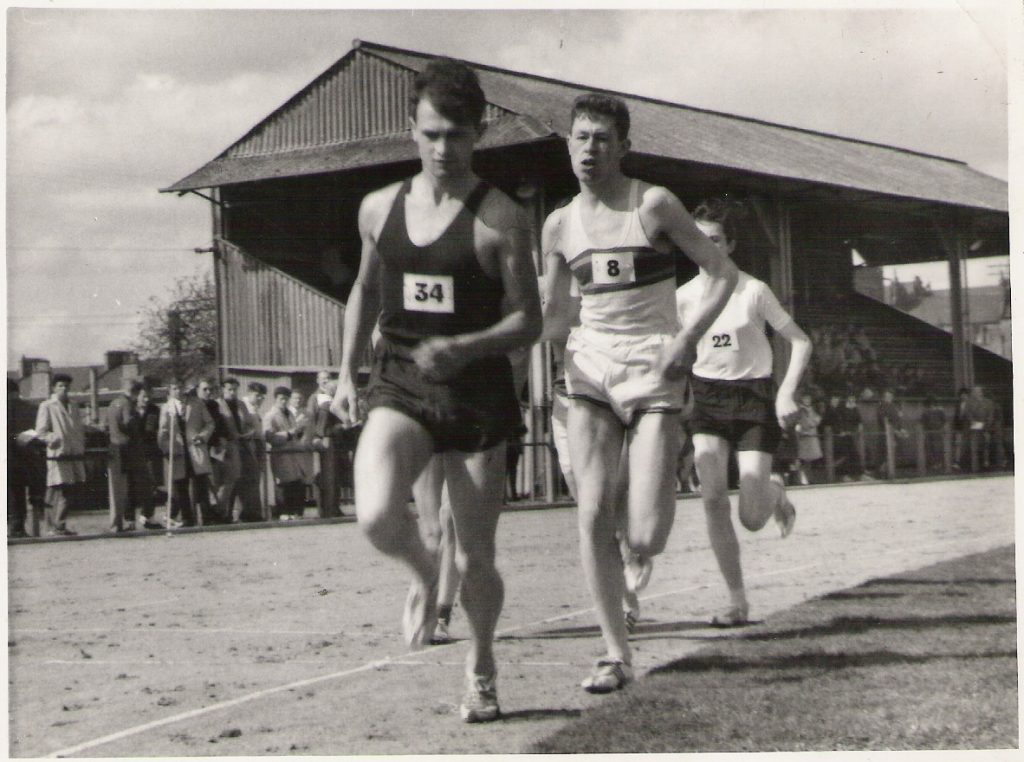
Allan Faulds, Glasgow, leading the field at Westerlands

We can’t cover them all here but we can start at the very beginning with the Shettleston v St Andrews at Barrachnie on 17th April where Shettleston won a close fought contest by 103 points to 95.   A University man was the key factor in Shettleston’s victory – Norrie Foster, who would be competing for Glasgow University that season won four events – 120 yards hurdles in 16.4, 440y hurdles in 61.7, the long jump with 21’9″ and the pole vault with 13’9″.   Winners for St Andrews who would figure in university athletics included J Tretheway won the 220 yards, D Dempsey who won the 440 yards, MF Davies who won the 880 yards, M Snow won the javelin, H Cameron the hammer, C Kelk the triple jump and the university won both relays.   It was a men only competition and had the match been held at St Andrews, that might have been the difference between success and failure.   Minor places count in these competitions.    

Foster featured again in the Glasgow University trials on 23rd April at a windy Westerlands when most of the known names were in action.   Winners of the A races, there were A and B races in the sprints) are below but note the first real appearance of Brian Scobie in the half-mile where his time was felt to be a very good one in the gusty, windy conditions.    

100 yards: WM Campbell 10.1; 220 yards: WM Campbell 22 seconds; 440 yards: Barclay Kennedy 51.2; 880 yards: BWM Scobie  1:56.4; Three Miles:   J Bogan 14:57.8;  1500m steeplechase: R Baillie  4:39.4;     High Jump: B Jackson  5’4″;  long jump:  G McInroy 20′ 3″;  Triple jump:  A Wellins  38′ 4″; Pole Vault:  N Foster  12′ 6″;   Shot Putt:  AL Sutherland47′ 10″;  Discus:  AL Sutherland  122′ 5″;  Javelin: B Seton 149′ 6″.   

In the Glasgow  v  Aberdeen on 24th April , Glasgow’s winners were Campbell (100, 220y), Mayberry (440y), Scobie (880y), Baillie (3 Miles), GL Brown (120 and 440 y hurdles), A Jackson and AL Sutherland (Shot); Aberdeen’s top men were W Ewing (Mile), I Grant (long jump), Bernie Nottage (triple jump), DH Taylor (discus), A Fowlie (javelin) and G Wilkie (Hammer).   Final score: Glasgow 59 points, Aberdeen 4 .

Cherryvale Park in Belfast was he venue on 1st May for the annual triangular match between Queen’s College, Glasgow University and St Andrews University.   Glasgow with 83 beat Queen’s with 67 and St Andrews with 23 points and in the women’s match, Queen’s had 42 1/2 points, Glasgow 34 1/2 and St Andrews 20.   The Glasgow Herald report read: “The contest, which was to have been held on a new all-weather track was transferred to a grass track of doubtful maintenance, because the new one was not ready for use.   Offsetting the poor ground conditions for some was the decision to run the 100 yards and the 120 yards hurdles on the back straight with the help of the wind.    None of the others was able to benefit in any way and not unnaturally times throughout the day were slow.   After allowing lesser mortals in the 880 to act as hares and, what was more important, as windbreakers for him, BWM Scobie (Glasgow) broke away with half a lap to go and won in 2 min 1.2 sec, a time that on any other day but Saturday he would have readily scorned.   Queen’s, perhaps more knowledgeable of the peculiarities of the field and certainly better equipped as a team than they were at Westerlands last year, won the high jump, triple jump, discus and javelin, and St Andrews, faced with the prospect of another obscure year in athletics were able only to win the mile.”   A bit harsh on St Andrews who had been producing very good athletes all through their history but, not surprisingly given the relative size of the establishment, were short of  numbers.  As of course was Aberdeen who also produced good athletes every year.   It was not an accident that the two biggest universities, Glasgow and Edinburgh, turned out winning teams on a regular basis.    On this occasion, the double winners were Campbell (G 100 and 220y), Brown (G 120yH and 440yH), Corkey (Q W100y and 220y) and F Fernie (G WHJ and WShot).   

On the same day, Strathclyde took on Aberdeen University, St Modans and Glasgow University second team.  Strathclyde won most points (48) from St Modans (32), Aberdeen (14) and Glasgow seconds (6).   
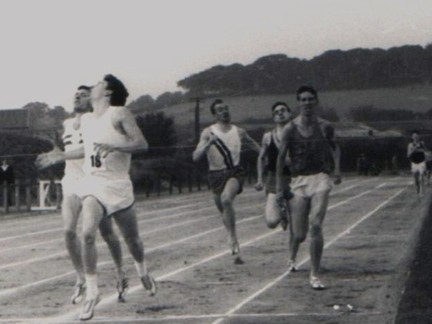
Brian Scobie winning an invitation 880 yards race at Westerlands

The Glasgow University championships were again held in dreadful weather with wind and rain and, maybe related to this, small numbers of competitors.   This was most evident in the triple jump where Norrie Foster was the only competitor and ‘won’ with a single jump.  There were only two competitors in the 880 yards, three miles, 440y hurdles, long jump and steeplechase.   The 120y hurdles was cancelled because there was only one runner.  The Biles Cup went to RD Baillie who won the Three Miles in 14:37.8.   The administrators on the day were again creative with the sprinters allowing them to run with the wind and the 100 was won by WM Campbell in 9.4 seconds.   Foster won all four jumps and the hammer, and was second in shot and discus.   Sutherland won both shot and discus.   In the women’s events, JP Murray won 100 yards, 80m hurdles and long jump and J Semple won discus and javelin.    And at Nethercraigs, Bellahouston beat St Andrews 133 to 68.

On 14/5th May the first major championships of the season took place at Wyncote Sports Ground in Liverpool.   The Scots did well –  two gold medals on the Friday night  and then four gold, three silver and three bronze on the Saturday indicated that university athletics north of the border were in good fettle.   WM Campbell won the 100y on Friday night and the 220 on Saturday, LM Bryce won the hammer, Miss EK Patrick (St A) won the 80m hurdles and the long jump, GL Brown won the 440 yards hurdles on the Friday evening and was second in the 120y hurdles on Saturday in 15.2 seconds, AB Kennedy of Glasgow was second in the 440y and W Ewing of Aberdeen was third in the Mile in 4:10.3.     Back at home there was a four cornered match between Strathclyde, Newcastle, Aberdeen and St Andrews which was won by Newcastle from Aberdeen, Glasgow and Strathclyde.

The Appleton Trophy was always well contested and on 22nd May at Craiglockhart Edinburgh won: by 83 to 51 in the men’s contest and in the women;s contest Glasgow won by 42 to 35.   Norrie Foster was top man for Glasgow ith wins in the 440 yards,long jump and pole vault.   For Edinburgh Fergus Murray won the mile and was first equal in the three miles – an event in which he coulkd easily have been first.    In the women’s contest, Miss A Dixon won Long Jump, shot putt and discus and Miss P Kerr won both 100 and 220 yards.    In the men’s events E Osbourne won both 100 and 220 hurdles  for Edinburgh before B Kennedy won the 440 for Glasgow.   J Steels took the 880 yards for Glasgow and Hugh Stevenson won the 120 yards for Edinburgh.   In the field events AL Sutherland (G) won both shot and discus, Santini (G) won the triple jump and LM Bryce won the Edinburgh title.  

In June 1965  at the Scottish Universities championships, Foster won no fewer than four events, establishing himself as the top universities multi-eventer.   Other winners included Hugh Stevenson (120y hurdles,), M Sinclair (E 880y from Scobie), Fergus Murray (Mile and Three Miles).   


Later in June, at the Scottish Schools Championhips, Glasgow University won the SAAA Senior relay titles over the 4 x 110 yards  (McGeoch, Murdoch, Foster and Campbell)  and 4 x 440 yards (Foster, Scobie, Kennedy, Campbell) distances.  The latter was won in very controversial circumstances when after overcoming an eight or nine yards deficit on Campbell, Ross Billson of Ayr Seaforth fell through the tape at the same time as the University man.   Not all were happy with the judges decision but it stood.

Billson gained some compensation on 26th June in the SAAA Championships proper when he won the 440 yards in 49 seconds after Campbell had withdrawn because of a knee injury.   Campbell had however won the 100 yards and 220 yards in 9.5 and 22.7 seconds.   E Osbourne of Edinburgh University was second in the 100 making it a university 1-2.   GL Brown (G) was third in the sprint hurdles, Foster (G) won the pole vault, in which C Balchin (E) was third,  and was third in the long jump, AL Sutherland (G) was second to D Edmunds (Strathclyde) in the shot putt and L Bryce (E) won the hammer with F Scott (E) third.   Among the Junior winners, JRA Blamire (E) won the Mile, H Stevenson won the 120y hurdles and was third in the high jump and R Morrison*S) was second in the hammer.   An interesting extra was the Scottish Schools 1500m steeplechase held on the same day where D Gillon of George Watson’s won from J Fairgrieve of Currie Secondary in 4:25.7.    

That effectively ended the Universities season although their members continued to compete as individuals – some in the university colours, many for their own ‘home’ club – several of whom gained international honours before term started again in October. 
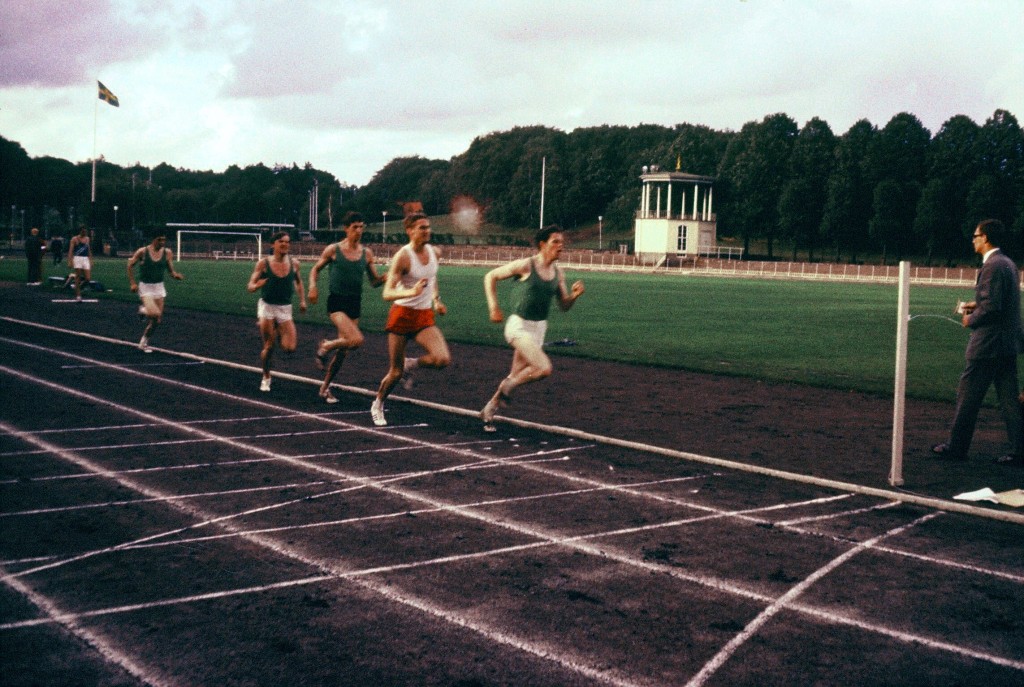
Summer 1966 started as in previous years with all the April fixtures and trials, and all five were in action on 22nd April.  The annual Glasgow  v  St Andrews  v  Queen’s was held at St Andrews, and Aberdeen  v  Edinburgh had been enlarged to include Strathclyde in Aberdeen.   Edinburgh (90) defeated the others, St Andrews were on 75 and Strathclyde 15.   Aberdeen’s Bernie Nottage won both sprints plus the triple jump and J Dixon won the 440 yards but in the middle distance events, it was Edinburgh students who shone with C Elson winning the Mile and A Blamire the Three Miles.  Edinburgh went on to win the 120y hurdles, 440y hurdles, high jump, long jump, pole vault and all the throws events thanks to LM Bryce and P Eddy.    The ‘Herald’ described the women’s performances as moderate but nevertheless K Goodfellow of Edinburgh won the 100 yards (12.2), 220 yards (30.3) and long jump (14′ 3″).

In the match at St Andrews, Queen’s won (86) from Glasgow (54) and St Andrews (45).   Queen’s won largely because of the wonderful multi eventer and pole vaulter Mike Bull (who won long jump, shot putt and pole vault) and J Kilpatrick (100 and 220 yards).   Glasgow had three double winners in Dick Hodelet who won both 440 yards and the half mile, RD Baillie who had the difficult double of Mile and Three Miles  and GL Brown who won both hurdles races.   Other Scottish victors were R Souter (G) in the high jump, C Durant (St A) javelin and H Cameron (St A) hammer.   

The following week, DM Edmunds, competing for Strathclyde against St Andrews set a new record for the St Andrews ground in the shot putt with 49′ 3 1/2″.   He also won the discus with 136; 9 1/2″.   G Muir (S) won 100y, 220y, long jump and triple jump setting a ground record for the long jump of 23′ 5 1/4″    The home team won by 67 to 49 in the men’s match and 44 to 23 in the women’s.   There was another new university competing against Glasgow and Aberdeen at Westerlands – Heriot-Watt was the second newcomer to the ranks of Scottish universities.   They finished third (26 points), behind Aberdeen (76) with Glasgow winners (89).   Where WM Campbell was the sprint winner in previous years, this time round it was Bernie Nottage of Aberdeen who took the 100 and 220 yards.   Campbell was meanwhile competing for Grascube Harriers against Pitreavie and Dumbarton in a League fixture.   The other double winner was Dick Hodelet (G) in the 440 and 880 yards events.  Glasgow’s women beat Aberdeen by 63 to 36 with no representation from Heriot-Watt.   

14th May was a packed day of athletics for Scottish universities’ athletes ancient and modern.   Edinburgh had the university’s centenary sports day, Glasgow had their own championships, the two new teams  (Strathclyde and Heriot-Watt) faced off against each other at Redford and St Andrews hosted Aberdeen with the women’s teams including Dunfermline College of Physical Education to make it a triangular contest.   The Athletics Weekly report on the centennial games read:

“This being their centenary meeting, Edinburgh University included seven invitation events in the programme, all of which produced fine performances.   Howard Payne added one inch to his Scottish all-comers record in the hammer with Lawrie Bryce a good second.   Dave Stevenson’s pole vault clearance was the best in Britain to this date.

100y:  E Osborne 19.5;   220y:  N Patrick 23.7; 440/880y: M Sinclair 52.9/1:52.3; Mile:  AF Murray 4:22.4; 120y hurdles/220y hurdles/440y hurdles: H Stevenson 16.3/26.9/62.1; High Jump: K Chubb  5′ 8″; Pole Vault: P Balchin 13m; long jump: D Seale 20.3; triple jump: G Kerr 42′ 7″; Shot/Hammer: L Bryce 40’3″/184′ 11″; Discus/Javelin: P Eddy 118’10″/159′ 4″.

Women: K Goodfellow 199y/220y  12.5/27.9; 440y:  M Redhead 66.4;  Discus/Javelin:  E Shedden  82′ 3 3/4″/100 – 1/2″

Invitation Events:  100y  WM Campbell (Garscube H) 10.3 ; 880y:  C Douglas (Teviotdale) 1:56.9; Mile I McCafferty 4:15; PV: D Stevenson (ESH)  15.0;  Shot Putt: D Edmunds (Strathclyde) 47′ 8 1/2″; Hammer: H Payne 200′ 4″; Scots Hammer:  I McPherson (Pit)  123′ 2″.   

10 Miles Road Race:  AH Brown (MYMCA)  50:04 (in front of A Wight (EU) 50:14, D Macgregor 50:34, Alex Brown 51:00 and G Bryan-Jones (EU-J) 51:07.  

In Glasgow there were four wins for Dick Hodelet (220y, 440y, 880y and Mile), three for Norrie Foster (discus, shot putt and hammer plus second in the javelin) and two for GL Brown in the hurdles races.   Hodelet won the Biles Cup for his 880 yards win in 1:53.5 which took 2.8 seconds of JR Boyd’s time of 1957.   Other winners included J Hickey, a very talented Irishman no studying at Glasgow, in the Three Miles in 14:48.9, Jim Bogan won the Steeplechase in a new record of 9:59.4 – Ray Baillie was second in both of those races, Robin Souter in the high jump and B Quinn in the 100 yards.  Miss P Fernie set a new record in the shot putt of 32′ 1 3/4″and also won high jump, javelin and discus.   

At Redford Barracks, Heriot-Watt beat Strathclyde by 98 1//2 points to 82 1/2.   Adrian Weatherhead had a treble when he won the 880, Mile and javelin and  I Dobson also won three events – both hurdles races along with the pole vault.   The Edinburgh University centennial had several invitation events and two of Strathclyde’s men – D Edmunds and Gordon Muir – were competing at both events since the grounds ere so close.   Edmunds won the  shot and discus and Muir the 100y and long jump.   In the Aberdeen v St Andrews, Aberdeen won 72 – 45 for the men and DCPE won the women’s with 69 points to St Andrews 29 and Aberdeen’s 18.   

Two very good new names among the distance runners now in the frame – sub-four miler Weatherhead for Heriot-Watt and Irish international Hickey for Glasgow.

The British Universities Sports Federation held their championships on 21st May and Lawrie Bryce (E) retained his title with a throw of  179′ 3″ and another Edinburgh competitor, PT Scott, was third.   In the long jump HC Robertson (G) was second  23’8″.    Dick Hodelet had a real go at winning the half-mile by breaking away from Dave Cropper halfway down the back straight but was caught almost on the line to finish second in 1:54.8 – only one fifth of a second separated them.  Bernie Nottage of Aberdeen had two third places – the 100 yards and the 220 yards.   RL Brown injured his instep in an early heat and could only finish third in he final.   Robin Souter (G) was fourthin the high jump having cleared 6 feet.   

The District championships were held on the last Saturday in May as usual and, as usual, there were many University medal winners.   In the West the winning students were Hodelet in the half mile in 1:52.2, HC Robertson in the long jump with Foster second  and the triple jump, D Edmunds in the shot and AL Sutherland in the discus.   In Edinburgh the East District title winners were Nottage in the 100 (9.8) and 220 (22.1), AF Murray (three miles), W Ewing (A) steeplechase, and LM Bryce in the hammer.   

The peak of Scottish Universities  athletics is the Scottish Universities championships and they were held on 4th May at Craiglockhart.   Top man was Aberdeen’s medical student from the Bahamas Bernie Nottage who won the 100 yards in 9.9 and 220 in 22.2.   Other doubles were from HC Robertson (G) in long and triple jumps and DM Edmunds in shot and discus.   There were three best championship performances – by Edmunds in the shot (49’5″), LM Bryce (E) hammer (183′ 6″) and Miss J Goodall (A) in the 880 yards (2:28.0).   The men’s team trophy (the Rosebery Cup) went to Edinburgh (63 points to Aberdeen’s 44), the women’s contest was won by Edinburgh (40) from Aberdeen (29) and the contest between Edinburgh and Glasgow, combined men’s and women’s teams, for the Appleton Trophy which hadbeen included here, was won by Edinburgh,  103 points to 70.    

Aberdeen had six first places – Bernie Nottage in both sprints, John Dixon in the 440, Bill Ewing in the Mile, Doug Fowlie in the javelin and the 4 x 110 yards relay.   Other winners were Sinclair (E) from Weatherhead (HW) in the 880, Murray from DG Bryan-Jones (both Edinburgh) in the three miles, Stevenson (E) from Foster (G) in the 120y hurdles, Foster from Stevenson in the 440y hurdles, Souter (G) high jump and Balchin (E) pole vault.    Women’s winners were K Goodfellow (E) 100 and 220y, A Barron (A) 440y, A Dixon (E) 80m hurdles, P Fernie (G) high jump, R Mawer (St A) long jump, E Taylor (A)  discus, E Sheddon (E) javelin and Glasgow won the relay.  
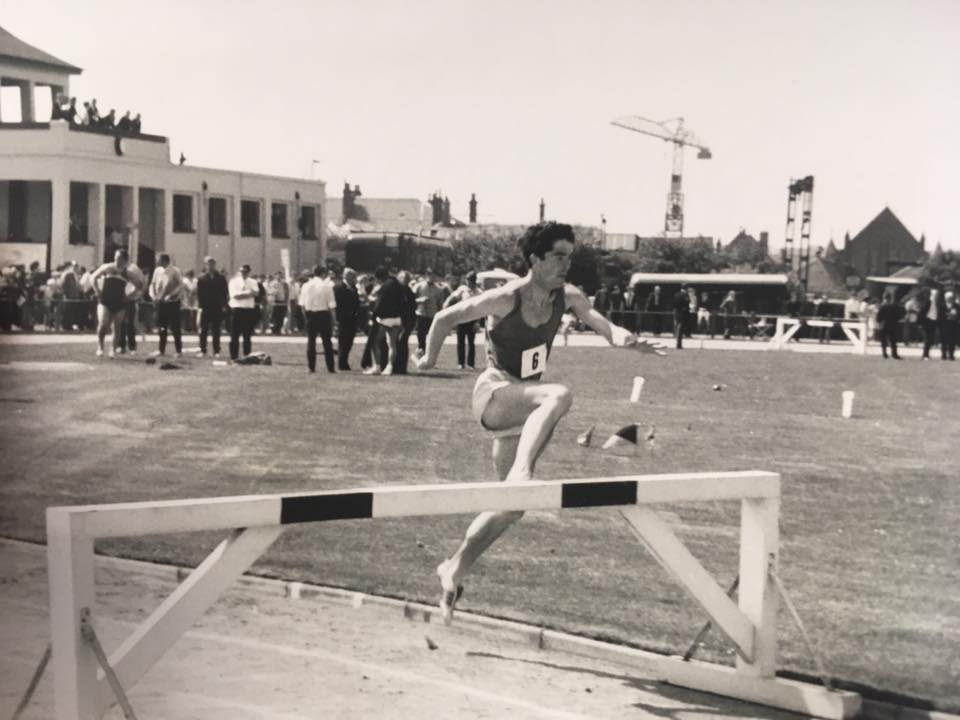
Gareth Bryan Jones, Westerlands, 1968, BUSF Championships

There had been several changes in student athletics since 1964 that were important in themselves and for what the promised for the future.  It is more than just the arrival of more talented athletes such as Gareth Bryan-Jones and Bernie Nottage at Aberdeen.   The Universities Championships and the Atalanta Club were limited to the four ‘ancient’ universities but in 1964 Glasgow’s Royal College of Science and Technology (the ‘Tech’) became Strathclyde University and in 1965 began to compete against the ‘Big Four’ as an equal.   In 1966 Heriot-Watt University appeared on the scene and with athletes like Adrian Weatherhead and Martin Sinclair had a strong men’s team.   The four had become the six.   And it would not stop there – there would be more and more universities appear on the scene from the South-West to the Highlands and Islands.   Stirling, Paisley, Glasgow Caledonian and many more would enter the stage.   And the Atalanta Club disappeared to become simply a Scottish Universities team.    In 1966 the Appleton Trophy meeting which had been an annual fixture in its own right between Glasgow and Edinburgh Universities, was contained within the Scottish Universities Championships.   It returned to its former status in 1967 but the pressure on inter-university fixtures with more universities and a limited time span was increasing.   The university major fixtures at the start of 1967 were as follows.

22nd April:  Glasgow  v  St Andrews, Westerlands; Edinburgh v Strathclyde v Dundee Hawkhill

29th April:  Appleton Trophy, Craiglockhart, Edinburgh v Glasgow; St Andrews v Heriot-Watt v Strathclyde.

5th May: Edinburgh v Glasgow v Aberdeen v Leeds v Durham v Carnegie v Sheffield at Durham; Heriot-Watt Championships; Aberdeen University  v  Glasgow v  Jordanhill College.

13th May:  Glasgow University men’s championship; Edinburgh University championships.

20th May: Edinburgh University v Edinburgh Southern Harriers v Octavians

27th May:  District Championships

3rd June:  Scottish Universities Championships, Westerlands
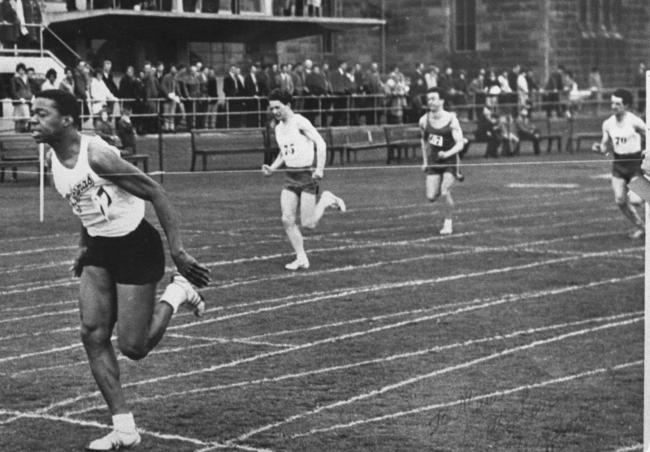
Bernie Nottage

Bernie Nottage was a Bahamian international sprinter and politician who died earlier this year (28 June 2017) at the age of 71.   He was a medical student at Aberdeen University and won Scottish and British Universities titles in their colours.   In three consecutive years, 1966/67/68, he won both 100 yards and 220 yards at the SAAA Championships – this at a time when ‘Ming’ Campbell, Les Piggott and Don Halliday were sprinting well.   Only three men had achieved the feat – Campbell, Willie Jack and Alf Downer.   He ran for Bahamas in the Pan American Games in 1967 (sixth in 200m final) and in the Mexico Olympics (1968) in the 100m, 200m and relay where he was part of the team that set a new national record.   I quote from the obituary in the Scotsland in June: 

Bernie’s medical studies were his priority, although he did find time to enjoy a social life and at one point sang in a band. A smart dresser, it was always known that Bernie was at the track when his expensive suit could be seen hanging up in the changing room at a time when others could not aspire to such tailoring. A well-built, powerful athlete, he was a formidable presence on tracks here and elsewhere. Les Piggot, who competed in the 1968 and 1972 Olympics, enjoyed a number of duels with him. He commented: “In the best possible sense, he was a bit of a thorn in the flesh for us Scottish sprinters! He had bags of natural ability and a wonderful rhythm to his running. A smashing guy who was also very humble.” Prior to coming to Aberdeen Bernie had competed for the Bahamas in the 1962 Central American and Caribbean Games, in the sprint relay in a team which set a new national record, but it was really only after coming to Scotland that his athletic career began to fulfil its early potential. One of his inspirations was his country’s greatest ever sprinter, Tom Robinson, a Commonwealth Games gold and silver medallist with whom he ran in the national relay team at the Mexico Olympics and whose supremacy he sought to challenge. While at Aberdeen Bernie also represented Scotland in four internationals between 1966 and ’69, notching a sprint double in the first against Wales and Midland Counties at Birmingham and contributing to a sprint relay success in 1968 at Grangemouth against England,Wales and Northern Ireland with teammates  Ian Turnbull, “Ming” Campbell and Les Piggot. His early interest in politics, popularity and sporting stature led to Bernie being elected President of Aberdeen University Sports Union, a role he carried out with distinction. “
[Read more at: https://www.scotsman.com/news/obituaries/obituary-bernard-j-nottage-bahamian-international-sprinter-and-politician-1-4508147} ]
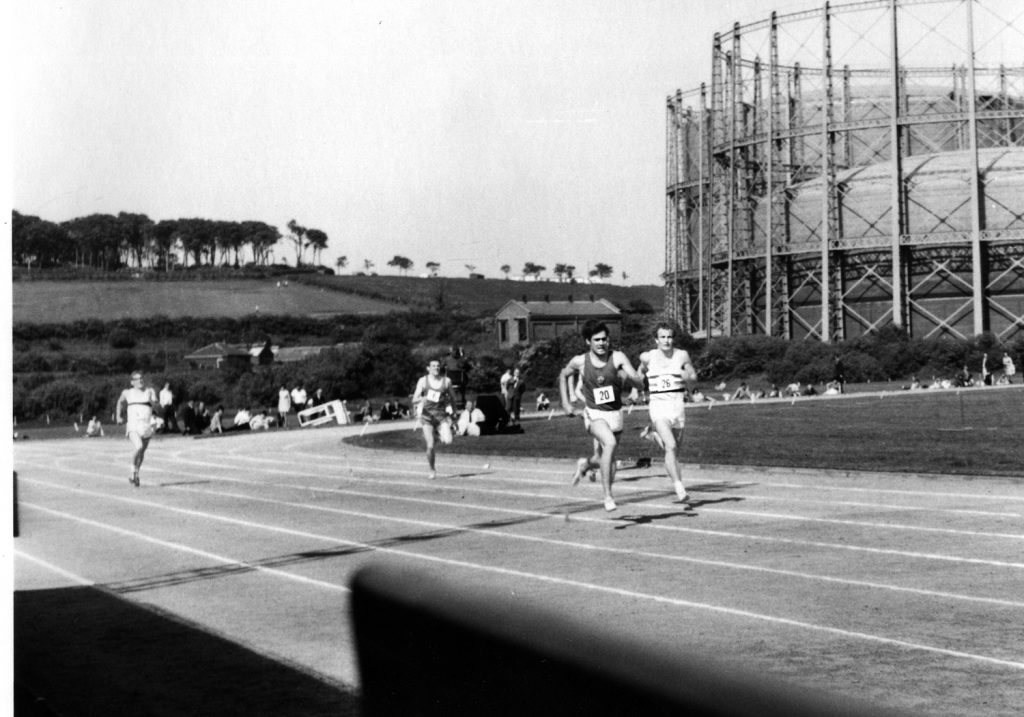
 HC Robertson was the star of the Glasgow  v  St Andrews match at Westerlands on 22nd April when he won four events – long jump, triple jump, 120 yards hurdles and 440 yards hurdles.   Glasgow won the men’s match by 104 to 73 and the women’s by 76 to 43.   Other winners included D Walker (G) 100 yards, K Clark (G) 220 yards, 440 yards J Gilligan (G), W McDonald (G) 880 yards, J Bogan (G) Mile, R Heron (St A) three miles, A Jackson (G) high jump, AG Pollock (G) pole vault, G Newsom (St A)) shot putt and javelin, A Fraser (G) discus and S Cameron (St A) hammer.   St Andrews won the 4 x 110 yards relay.   For the women GW Adams won no fewer than three events – 100y, 220y and 440y – A Ainslie (St A) won the 880y, N Barron (G) the 80m hurdles, F Fernie (G)  the high jump and shot putt, L Monteforte (G) long jump, J Paris (G) Javelin, A Dale (St A) discus, and the relay was won by Glasgow.
 A very good start to the season for Glasgow on a Saturday when none of the other Universities were in action.
The Appleton Trophy contest between the combined men’s and women’s teams at Craiglockhart on 29th April resulted in a convincing win for Edinburgh by 109 points to 82.   In 1967 however, Aberdeen was included in a separate three way contest with the resultant score being Edinburgh 76, Aberdeen 66 and Glasgow 43.   These places were neatly reversed when Glasgow (39) was first, Aberdeen (36) second and Edinburgh (33)  third.   The results were:
100y   1.   B Nottage (A) 10.4          100y (women):   1.   W Adam (G)  12.5
220y:  1.  B Nottage (A) 22.5          100y (women)    1.   W Adam (G)   27.8
440y: 1.   I Hathorn (E)  57.2         440y (women)   1.   A Barron (A)   65.6
880y  1.   M Sinclair (E) 1:57.9      880y (Women)  
80m hurdles:                                                                   1.  M Fleming (E)  14.3
120y hurdles:  1.  GL Brown (G) 15.9
440y hurdles: 1.  GL Brown (G)  57.3
high jump:  1.  G Balfour (E) 5′ 10″   high jump (women)  1.   F Fernie (G)  4′ 8″
long jump:  1.  HC Robertson (G) 21′ 6 1/2″   long jump (women)  S McRoberts (E) 15′ 8 1/2″
triple jump:  1.  HC Robertson (G) 43′ 1″
pole vault:  1.  S Seale (E) 12′ 6″
shot putt:   1.  D Clarke (A) 40’7″       shot putt (women):  1.  E Taylor (A) 35′ 6″
discus:  1.  D Clarke (A) 115′ 7″           discus (women):  1.  E Taylor (A)  96′ 10″
javelin: 1.  DG Fowlie (A)  179 4 1/2″    javelin (women): 1.  W Paton (A)     90′ 7″
hammer:  1.  PJ Scott (E)  157′ 7 1/2″
Relay:   1.   Aberdeen                             relay (women)  1.  Glasgow
Results were shown in detail to show the improvement in the Aberdeen scores with 6 first places of 14 events in the men’s match compared with 5 for Edinburgh and  4 for Glasgow they had a higher proportion than at any time in recent years.     Maybe the students national championship would be tighter this year.   
A new name for Scottish university athletics followers appeared on 6th May.   The Rowland Shield was contested by Edinburgh, Strathclyde, Aberdeen, Glasgow, Durham, Carnegie and Sheffield at Durham and the teams finished in the above order.   Only five of the individual events were won by students from south of the border – and one of these was MR Lindsay, the Scottish international shot putter, who won two of the five.   The Scots victors were as follows.
B Nottage  100yds/220yds  10.2/22.7 seconds;   GL Brown (G) 120yds hurdles/ 440 yrds hurdles 15.8/55.8;  G Bryan-Jones (E)  steeplechase  9:13.4; high jump  G Balfour (E) 5;11″;  HC Robertson (G) long jump/triple jump  23′ 3 1/4″/44′ 10 1/2″‘;  S Seale  pole vault  12′ 6″; javelin  D Fowlie (A) 186’ 4″; hammer  LM Bryce (S)  186’0″.
At home Aberdeen beat Glasgow and Jordanhill TC 63 to 58 to 56.    And in Edinburgh Doug Gillon won four events at the Heriot-Watt championships – he won the 880 (2:06.1), Mile (5:12.3), Three Miles (16:20 and 440 yards hurdles (61.3).   
GL Brown had been competing at a very high level for several years and on 13th May, 1967, he won the Biles Trophy for the best performance at Glasgow University’s Sports.  The closed championships at the various universities were always a good indicator of how they were liable to perform in the Scottish universities later in the month.   Brown won both hurdles events, the 120y in 15.3 and the 440 in  56.4 and he was unlucky not to win the 100y sprint where he was second.   A feature of this race was that HC Robertson, better known as a jumper, won in 10.4 seconds which, when added to the triple jump, gave him a double.   GL Brown won his events,    Jim Bogan won both Mile and 3000m steeplechase events and on the women’s side of the meeting, CF Fermie won four events (high jump/ discus/javelin/shot putt) and W Adam three (100/220/440).
 
In Edinburgh first year student Miss M Fleming won four events (100, 220, 440, 80m hurdles) and two men each won three events – Hugh Stevenson took all three hurdles races and SD Seale won pole vault, long jump and discus.   Edinburgh was the only university to hold a 220 yards hurdles race – one of the very few clubs university or not to hold such an event.   Stevenson won that one along with the more usual 120 yards and 440 yards hurdles.   
A new name appeared in the West District championships on 27th May: John Myatt who was studying at Strathclyde and finished third in the mile behind Ian McCafferty and Lachie Stewart.   HC Robertson won both jumps-for-distance, GL Brown won the hurdles events, D Edmunds won shot and discus and LM Bryce, now at Strathclyde University, won the Hammer.   Meanwhile in the East Nottage won the 100 yards in a record equalling 9.8 seconds but dramatically lowered the 220 time from 22.1 to 21.7 seconds.   His team mate at Aberdeen, I Turnbull was third in the 100 yards.  Martin Sinclair (E) won the 880 yards with JA Macfie (E) third, winning time 1:53.8.   Gareth Bryan-Jones won the Three Miles from Ian Young (both EUAC) in 13:58.   W Allan and A Blamire (both EUAC) were second and third behind a very good steeplechase win for W Ewing in 9:06.2.   G Balfour (E) won the high jump, P Gammell (E) was second in the long jump and in third place in that event was S Rogers of Dundee University – the first appearance that we have so far of anyone from the very new Dundee University winning a medal in one of the main championships.   In the pole vault, Balchin and Seale (both EUAC) were second and third to erstwhile team mate DD Stevenson, Fowlie of Aberdeen University won the javelin, Wilkie of Aberdeen was second in the hammer and Don Clark, also Aberdeen, was second in the discus.   
The University championships which had been exclusive to the four ancients, now included Strathclyde, Heriot-Watt and Dundee with others lurking on the sidelines about to come on to he pitch seeking some of the action.   Winners on 3rd June when they were held at Westerlands were as follows.
100y/220y:   B Nottage (A)  10.1/22.8       440y:  G Miller (S) 49.9     880y:  M Sinclair (E) 1:58.6
Mile:  AT Weatherhead (HW)  4:14,7;   Three Miles: I Young (E) 14:16   Steeplechase: GB Jones (E) 9:17.8
120y hurdles:   R Davidson (E)  15.8;  440y hurdles:  H Stevenson (E) 57.2
high jump:  R Souter (G) 5’10”; long jump:  H Robertson (G) 23′ 0 1/4″; triple jump:  H Robertson (G) 
javelin:  S Seale 181′; discus: D Edmunds (S) 139′ 7″; shot:  Edmunds  49′ 8″;  hammer:  Edmunds 143′ 9″
pole vault: S Seale (E) 13;
Women: 100y  W Adam (G)  12.1;  220y: G VD Lippe 27,5   440y:  A Barron (A) 60,8; 880y  Barron 2:28.9
80m hurdles M Fleming (E)  13.4; high jump: S Dennler (E)   5;2″; long jump:  L Monteforte  15′ 10 1/2″
Discus:  E Taylor (A) 107 5 1/2″   shot putt: E Taylor  57.6″javelin: E Shedden (E)  115′ 2″
The contending universities’ championship was won by Edinburgh from Glasgow with the others being Aberdeen, St Andrews.   The quality was excellent.  eg in the mile there were Weatherhead, Dave Logue, John Myatt, in the three miles A Blamire and John Myatt finished second and third behind Ian Young while in the steeplechase Willie Allan and Jim Bogan were behind Gareth Bryan Jones.
As usual the season continued with members of the various university teams continuing to compete and excel, 1967 had been a good year for student athletics – many records being broken by women as well as by men, many new faces appearing that would soon be senior Scottish and British internationalists and at least two Olympians. There were also more new universities – Dundee being the latest to joining what had formerly been a pretty exclusive club along with Heriot-Watt and Strathclyde.   The two teacher training colleges at Jordanhill and the Dunfermline Training College in Edinburgh for women – were also taking the varsity teams athletically.  What would 1968 bring? 
British Union of Students Federations (BUSF) Championships at Westerlands in June 1968
Note the television gantry and power cables above the track for nationwide coverage
 
Glasgow University was the first to actually publish its fixture list for the new 1968 season.   As it appeared in the ‘Glasgow Herald’ of 15th April, it read as follows.
April 17th: Team Trials at Westerlands;    19th/22nd: Irish tour – Queen’s Belfast; Unversity College, Dublin; 24th: Trials, Westerlands;  27th: Edinburgh, Westerlands;  2nd team, Edinburgh
May 1st:  1st team v Heriot-Watt; Strathclyde, Westerlands; 3rd/4th: 1st Team, Durham Trophy, Durham;  4th: 2nd team v Aberdeen, Westerlands; 8th:  1st team v Victoria Park, Bellahouston, at Scotstoun; 2nd Team v Jordanhill, Jordanhill; 11th: Glasgow University championships, Westerlands; 15th:  Women’s Meeting, Westerlands; 18th:  1st team v Aberdeen and Dundee, Aberdeen; 22nd:  1st Team v Edinburgh Southern, Westerlands:   25th: Western District Championships; 29th: 1st team v Jordanhill and Strathclyde, Jordanhill; 31st – 1st June:  Scottish University Championships, St Andrews.
June 12th: 1st team v Strathclyde and Queen’s Belfast, Nethercraigs;  14th/15th: BUSF Championships, Westerlands; 18th:  1st team v Glasgow Schools, Westerlands;  21st/22nd: Scottish championships, Grangemouth; 24th:  1st team  v  Trinity College, Dublin, Westerlands.
 That is the length of the Universities athletics season as defined by the club fixture list.   Note the new teams on the schedule from 1965 – and we now have  actual head-to-heads with Dundee, Jordanhill TC and Trinity College from Dublin appears twice in the season instead of once.   And where is St Andrews in the list?    Of course matches with Jordanhill (at Jordanhill) and Strathclyde University (Nethercraigs) the matches were pretty well home meetings and as well as saving on travelling time and expenses, a full turn out of selected athletes was pretty well guaranteed. 
 
While Glasgow was on its Irish trip, Edinburgh University was defeating Aberdeen (86 – 85) and Heriot-Watt (91-88) at Saughton as part of the new Scottish Universities League.   Note how close the scores are – one point and three points by the strongest team in student athletics.   The only double winners were from Aberdeen  Bernie Nottage (sprints) and I Grant (both jumps for distance).      
 
The next week, Glasgow and Edinburgh came head to head yet again in the annual battle for the Appleton Trophy, amnd again Edinburgh came out on top winning the men’s contest 98 – 85 and the women’s 60 – 57.   I O’Muircheartaigh (Morarity) won two events – the 440 in 49.5 seconds, and the 220 in 22.6 seconds.   For ERdinburgh Gareth Bryan-Jones won the three miles in 13:44.6.   Other winners of note were Jack Macfie in the 880 for Glasgow in 1:56, Alistair Blamire (Edinburgh) the mile in 4:18.1, HC Robertson of Glasgow won the long and triple jumps and one of the new faces to win was Bill Gentleman in the hammer for Edinburgh.   Top women were W Adams of Glasgow who won 100, 220 and 440 yards, A Saddler of Edinburgh who took both discus and shot.
 
The same middle distance men all performed well in the Rowland Cup match at Durham on 4th May with Macfie, winning the half-mile in 1:54.2, Blamire the three miles in 13:58.6 and Bryan-Jones the steeplechase in 8:53.   The result was a win for Edinburgh with Leeds Carnegie second, Glasgow third, and Strathclyde fourth.   Edinburgh’s women were second to Durham, beaten 60 – 57.   Doug Edmunds (S) won the discus and was second in hammer and shot.   
Back at home on 11th May, the Biles Trophy at Glasgow University Sports was won by high jumper Robin Souter who added an inch to the existing record when he cleared 6′ 1″.    O’Muircheartaigh won both sprints.   The last Saturday in May was always the District Championships and on `8th May, the only University athletes to win titles were throwers from Strathclyde University.   DM Edmunds won the shot putt and discus throw and LM Bryce won the hammer.   Other university men to win medals were O’Muircheartaigh second in the 220, R Cassie (G) was second in the 440y hurdles and  R Souter was second in the high jump.    Title winners in the East championships were IW Turnbull (A) ho won both sprints beating Bernie Nottage in the 100, G Bryan-Jones who won both three miles and steeplechase in 14:00.8 and 9:09.2, Balfour (E) won the high jump from team mate R Bruynooghe and Heriot Watt’s D Cunningham, and J Fowlie (A) won the javelin from JA McKenzie (A) and R Burnett (H-W).   Other placed athletes were JMM Dixon (A) second in the 440, JA Macfie (E) second in the 880, I Hathorn third in the 880, D Logue (E) third in the mile, A Blamire (E) second in the three miles, I Young (E) third in the three miles, RA Davidson (E) third in the 120y hurdles, AG Webb (E) third in the 440y hurdles, S Seale (E) second in the pole vault, T Tangen (H-W) second in long jump, JW Keddie (H-W) third in triple jump, P Myklatun (H-W) third in shot, Fowlie (A) second in the discus, T Beare (D) third in the discus, RT Cross (H-W) third in the hammer, and JA McKenzie (A) second in the javelin.   Many, many more students in the medals in the East than in the West.   Harder to win in the West  –  or better styudent athletes in the East?   The championships would sort that one out.
 
The University championships took place on 1st June at St Andrews and there were seven universities competing.   It was one of the rare occasions when the field events eclipsed the track events in excitement and maybe even in standard of performance.   There is no more dramatic event than the javelin and this time David Birkmyre of Strathclyde set a new championship best performance of 210′ 3 1/2″.  His second best throw of 207′ 8″ indicated that this was no fluke.   The record had previously belonged to Fowlie of Aberdeen who threw 199′ 7″ which would have been a championship best performance in its own right.    Stewart Seale of Edinburgh not only produced a personal best in the pole vault but a championship best of  14′ 3 1/4″.   DM Edmunds of Strathclyde won the shot and discus and  LM Bryce won the hammer.    
On the track, Bernie Nottage won the sprint double and Gareth Bryan-Jones won the Mile in a ground record of 4:13.5 and Alistair Blamire won the three miles in 14:16.8 which equalled the championship record.   The other events were won by I O’Muircheartaigh (G 440y), Jack Macfie (E 880), RA Davidson (E 120y hurdles), A Webb (E 440y hurdles), A Balfour (E) high jump, T Tangen (H-W long jump) and I Grant (A triple jump).   Edinburgh won 78 events, Aberdeen won 3 plus the relay, Strathclyde won 4, Heriot-Watt 1, Glasgow won 0, St Andrews won 0, Dundee won 0.   [Note that the day after these championships, Gareth Bryan-Jones running for ESH set the fastest steeplechase time in GB so far in 1960 when he ran 8:40.6: 4 seconds inside the Olympic qualifying standard.
In the women’s events, W Adams (G ) 10n the 100 y, M Campbell (A) won the 220y, A Barron (A) won the 440y, M Ainlsie (St A) won the 880y, J Dry (E) won the 80m hurdles, E Duke (D) won the 100m hurdles, C Howarth (E) won the high jump, K Rennie (G) won the long jump, E Taylor (A) won the shot, A Dale (St A) won the discus and A Sadler (E) won the javelin.   Edinburgh won 3 events, Aberdeen won 3, Glasgow won 2, St Andrews  2, Dundee won 1, Strathclyde and Heriot-Watt won medals but none were gold ones.
The report by Willie Diverty in Athletics Weeekly read:  

“Championship bests in pole vault, hammer and javelin and was equalled in the 3 miles.

Bernie Nottage gained revenge on clubmate Ian Turnbull for a recently inflicted repeat and was the only treble winner of the day with individual first and a share in Aberdeen’s relay victory. Doug Edmunds won shot and discuss, the only field events double.

100: B Nottage 10.0, I Turnbull 10.1; 220: B Nottage 22.2  Turnbull 22.6; 440 I Moriarty (G) 50.6, John Dixon (A) 51.2;  880 Jack McFie (E) 1.58.2, G Grant (HW) 1.58.3; Mile: G Bryan-Jones (E) 4.13.4, J Myatt (Strath) 4.17.3; 3M: A Blamire (E) 13.55.0, J Wight (E) 14.16.8; 120H: R Davidson (E) 15.4; 440H: A Webb (E) 57.0; 4×110: Aberdeen 43.8; HJ: G Balfour (E) 5’10’’; LJ: T Haugen (HW) 22ft quarter inch; T.J: I Grant (A) 44 ft one inch; PV: S Seale (E) 14 ft three quarters inch; SP: D Edmunds (S) 50ft 3 and a half inches, L Bryce (S) 47.10; DT Edmunds 138’ 5’’; HT L Bryce 184’9’’; JT D Birkmyre (S) 210’3’’;

Teams: Edinburgh 102; Aberdeen 93; Strathclyde 62, Heriot-Watt, St Andrews, Dundee, Glasgow.

Women: 100 W Adam (G) 11.9; 220 M Campbell (A) 27.3; 440 A Barren (S) 63.2; 880 M Ainslie (A) 2.29.6; 80mH J Dry (E) 13.2; 100mH E Duke (D) 17.2; 4×110 Aberdeen 54.3; HJ C Howarth (E) 4’5’’; LJ C Rennie (G) 16’; SP E Taylor (A) 32’11’’; DT A Dale (St A) 112’2’’; JT A Saddler (E) 113’4’’;

Teams: Edinburgh 82, Aberdeen 62, St Andrews 49. G, D “

The Edinburgh team was triumphant again and the university  athletic season was over and although the individuals continued to compete, some in club colours and others in university strips, it had already been a good season with several more talents coming through to replace those who had moved on.
There was however on really big university championships to come in 1968 – the British Universities Sports Federation (BUSF) championships were coming to Glasgow and they took place at Westerlands on June 14th/15th.   The Scottish winners were: I (A) Turnbull (100/220), A Blamire (E – 6 Miles), G Bryan-Jones (E – Steeplechase), S Seale (E – PV),  DM Edmunds (S – SP).   Women: W Adams (G –  100/220).   Ron Marshall in the ‘Glasgow Herald’ covered it  at some length and the following are extracts from his commentary:  “In the hammer, LM Bryce, the holder, suffered one of his rare defeats from a British opponent when B Williams (Salford)threw 198 feet 1 inch.   Bryce, recently speaking out about the frustration of being stuck in the 190 foot range againburied the hammer to that mark.   This was 20 feet further than the next athlete, but second places to him are value-less.   A Edwards (Loughborough) sent the javelin to a championship and ground record of 238 feet 9 1/2 inches , only 11 1/2 feet short of the all-comers record.   D Birkmyre, Scotland’s top student thrower, fell well below his best , which would have given him second place, and his farthest throw landed below the 200 foot mark.   This pushed him into fifth position.   On the track, IW Turnbull (A) and Miss W Adam (G) completed their sprint doubles in imperial fashion.   Turnbull, not the most elegant sprinter in the country, shot his way up the 100 straight for a 9.8 victory, giving notice of a strong challenge this Saturday in the national championships.   Miss Adam can generate more miles an hour than her short frame suggests.   She leaned into the 220 bend like an expert and came into the straight knowing the race was hers.   Her time, 25.5, would have been a ground record but for the wind assistance.   
A Blamire covered 24 hot, dusty laps at creditable speed for an easy win in the six miles. “
 
The   other Scots to win medals on Saturday were I O’Muircheartaigh (G) third in the 440 yards, G Grant (H-W) second in the 880, R Davidson (E) third in the 120y hurdles, T Tangen (H-W) second in the long jmp, A Forster (G) third in the long jump, DM Edmunds (S), first in shot putt, H Smith (E) second in the shot, S Seale (E) first pole vault;  WOMEN: M Ainslie (St A) third 880, J Dry (E) second 80m hurdles, A Duke (A) third in 80m hurdles,  E Taylor (A) second shot, E Shedden (E) third shot, E Dole (St A) second discus, and C Howarth (E) third equal in high jump.


BUSF  Women’s 220 yards, Westerlands, 1968
1969 started with Heriot-Watt defeating Glasgow and Aberdeen in Glasgow (121 points to 113 and 110 respectively.   Iggy O’Muircheartaigh (G) won the 100y, 220y and the 440y and Douglas Fowlie (A) won the javelin.   In the women’s match Aberdeen beat Glasgow 95 to 44.   The season was underway and Glasgow went on to face Edinburgh in the Appleton Trophy in Edinburgh the following Saturday.   
That Glasgow won the Appleton Trophy was largely due to the women’s section.   Edinburgh’s men won by 101 to 84 but their women lost by 30 points (75 to 45).    Edinburgh was weak in the shorter events – Glasgow winning 100m (McCrorie), 220m and 400m (both O’Muircheartaigh) plus relay.  and Edinburgh taking 800m (Macfie), 1500m and 5000m (both Blamire).   Edinburgh won both hurdles races (Webb and Davidson) and all four throws (Davidson shot, Scott hammer and Burnett javelin.) Glasgow won three of the jumps (Forster long and triple jump and Black high ump)  and Seale won the pole vault for Edinburgh.   Glasgow won 7 events and Edinburgh 10: it was the minor places that won the men’s match for them  In the women’s events, Wendy Adam (G) won 100m, 200m and 400m, H Morton (G) won the 800m and B Twiss (G) won the 100m hurdles.   Glasgow also won the relay to give them a clean sweep of the women’s running events.   In addition for Glasgow K Rennie won the long jump, S Robb the discus and G Ritchie the javelin.   The only event that Edinburgh won was the shot putt by V McLaren.   A very competitive match and one that boded well for the coming season.
The rivalry continued the following week at Durham in the Rowlands Trophy match on 10th May.   The report on the match read:  “Edinbvurgh retained the Rowlands Trophy on Saturday after a hard fight with Glasgow in the inter-university match organised by Durham University.   A Blamire was outstanding for Edinburgh, winniong the 5000m and 3000m steeplechase and R Davidson and A Webb gave them the 110 and 4oom hurdles respectively.   Ignaid O’Muircheartaigh won the 400 metres and anchored the Glasgow team to victory in the 4 x 400 metres relay.   Allan Fraser won the long and triple jumps for Glasgow.   Ian Turnbull (Aberdeen) scored two splendid wins in the 100 and 200 metres.   Durham won the women’s match for the Wimpenny Trophy with 59 points to Glasgow’s 48.   Miss Winnie Adams, Glasgow, was the outstanding woman competitor, winning the 200 and 400 metres.”
And that was it: no times or distances, no results – not even a list of winners.  But it was like the old days with Edinburgh and Glasgow battling it out.
 
 On to the 17th May and it was universities championships day.   The headline at Glasgow’s sports was “Three Wins for Irish Sprinter”   tells the tale.   Iggy won all three sprints in respectable times – 10.8, 22.3 and 50.2.   Respectable enough to win him the Biles Trophy for the most meritorious performance of the championships.    There was no 800 metres because there were not enough athletes forward for it – not a good sign.   He wasn’t the only ‘treble’ winner – A Halkerston won shot (32’8″), discus (105′ 5 3/4″) and Hammer (137′ 10″),   and    S McCallum won 400m hurdles (57.3), pole vault (10′ 6″) and javelin (137′ 10″) – and, yes, hammer and javelin were given the same distance.   Four titles were won by athletes who were also members of Springburn Harriers – R Beaney won the 1500m and the 5000m, K Lunn won the steeplechase and R Souter won the high jump.   Top women were K Rennie who won the 100, 200 and long jump, G Ritchie who won shot, discus and javelin.
In Edinburgh, the Donovan Cup was shared between hurdler R Davidson and distance runner A Blamire.   Davidson was first in four events (100m, 200m, 110m hurdles and 200m hurdles) and second in two others, while Blamire’s time in the 5000m of 14:23.6 was relatively the best performance of the afternoon.   AG Webb won two races – the 400m and the 400m hurdles and J Davidson won the long jump and the shot putt.   Other winners included J Macfie in the 800m, D Logue in the 1500m, G Balfour won the high jump, HM Burnett won the pole vault and JN Burnett won the javelin.
In the women’s events, M Ferrie won three events (100m, 200m and long jump), M Fleming also won three (400m,100m hurdles and  javelin),  and P Burke won two (high jump and discus) and theshot putt was won by S Burke.    Edinburgh had trophies for best performance and these were won by the two men mentioned and Morag Ferrie.   Edinburgh alone among the universities had additional trophies for ‘best style’ at the meeting and PJ Scott (winner of the hammer) won the Fahmy Cup for best style, and M Ferrie won the Haultain Trophy for best style in the women’s events.    and Heriot-Watt.   
 
On 24th May at Peffermill, Edinburgh University took on Edinburgh Southern Harriers and lost 101 to 84.   A rare setback but the following weekend was that of the District championships.  In  the west the university men who won their events were S McCallum who won the pole vault with a height of 11′ 6″ , Doug Edmunds in the discus, and Laurie Bryce in the hammer.   In the East, Nottage won the 100m, Turnbull (A) the 220, Martin Sinclair (H-W) the 800m, I Dobson the pole vault, and D Fowlie (A) the javelin.   The result of the intrer-club held in conjunction with the meeting resulted in a win for Edinburgh Southern from Edinburgh University and Heriot-Watt.    
 
The universities championships for 1969 were held at Westerlands and the report from the ‘Glasgow Herald’ read:   “R Bruynooghe (E) and Laurie Bryce (Strathclyde) were the two leading field events competitors In the Scottish Universities championships at Westerlands on Saturday.   Bruynooghe clipped two and a quarter inches off the university high jump record wth a clearance of 6′ 3″.   Bryce who hopes to beat the all-comers record of 200′ 4″ set by Howard Payne at Craiglockhart three years ago, broke the Scottish universities record  of 195′ 5″ which was his own best performance set two years ago, with a throw of 200′ 0 1/2″.   RA Davidson (E) who won the 110 metres hurdles in 15.6 sec, and A Webb the 400m hurdles winner in 55.4 gave Edinburgh further points which enabled them to retain the Rosebery Trophy .   M Sinclair, also Edinburgh, won the best race of the day, the 800m, in 1:55.1 holding off his team-mate Jack Macfie in a tight finish.   Winifred Adams (G), had easy wins in the 100m and 400m for women, and she would also have taken the 200m title but a pulled muscle forced her to pull out six yards from the finish.”
For the record the 200m was won by K Rennie (G) who also had seconds in the 100m and the long jump.  M Ainslie (E) won the 800m and was second in the 400m.   Glasgow won the women’s competition from St Andrews (96 to 42).
 
Another season of universities athletics had drawn to a close and the closing five years of the decade had seen superb athletes like Berni Nottage, ‘Ming’ Campbell, Fergus Murray, Gareth Bryan-Jones, Alistair Blamire, Bill Ewing, David Stevenson, HC Robertson, Sandy Sutherland, Doug Edmunds, Laurie Bryce, Norman Foster all competing.    If university athletics was not all about competing, it nevertheless posted some excellent results from international athletes on an annual basis.
 
 .
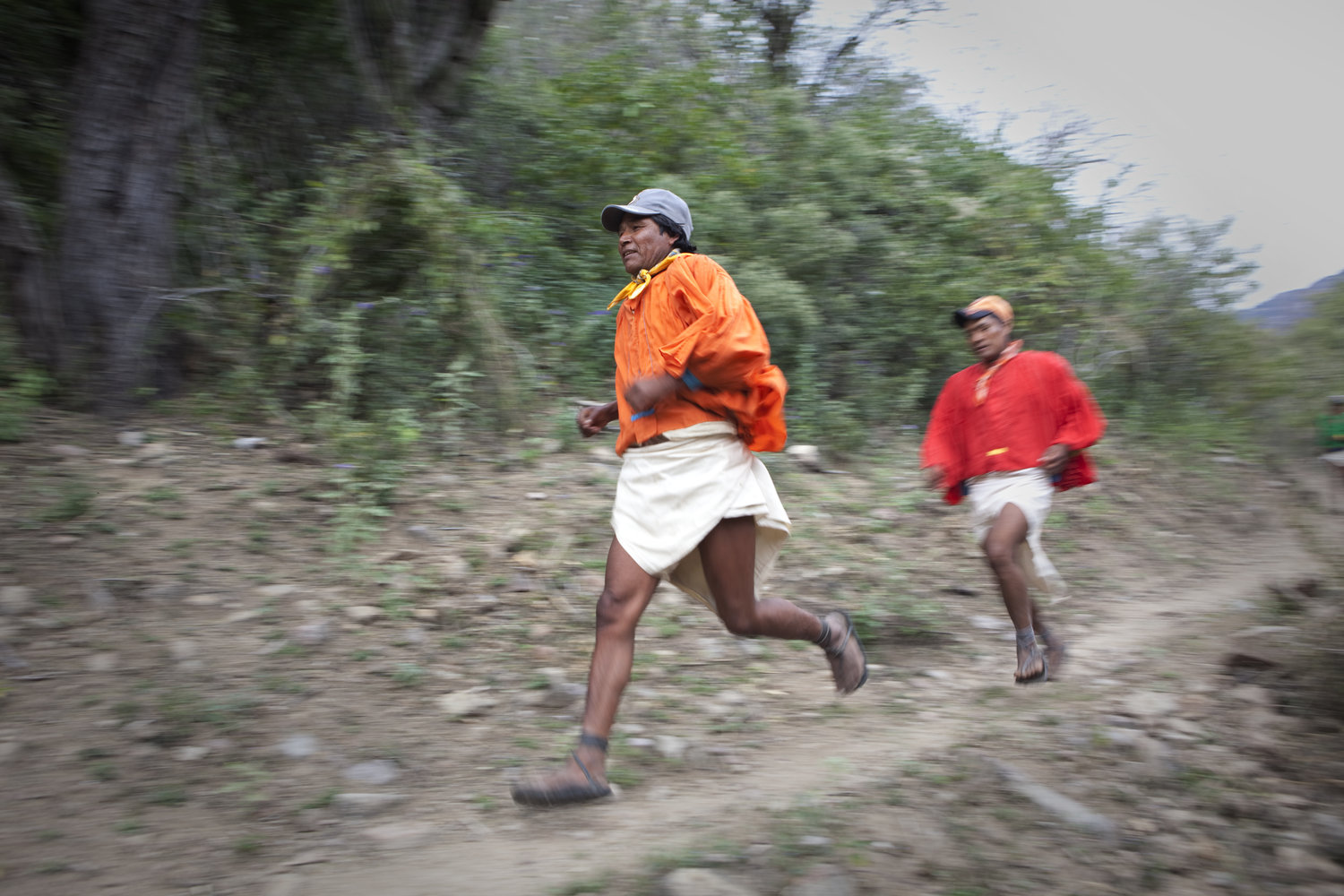
University Track and Field: 1960 – ’64

Glasgow University Hares & Hounds, mid 60’s

Where Edinburgh was the top team of the 1950’s as far as universities were concerned, they did not have it all their own way in the next decade.  the Glasgow University teams of the 1960’s were among the best in the country with athletes like Calum Laing, Allan Faulds, Doug Gifford, Brian Scobie, Menzies Campbell, Robin Souter and many others and with a good team manager in Willie Diverty (2nd right, middle row), and St Andrews had DJ Whyte, one of the country’s best long jumpers and no mean sprinter.  
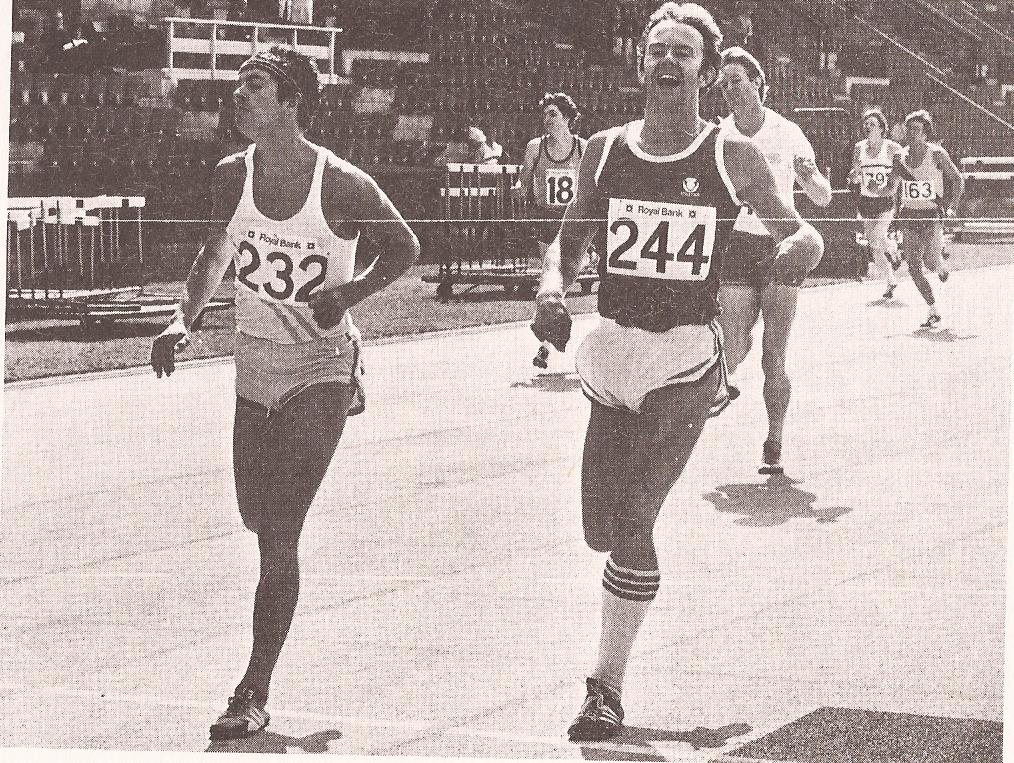
The Glasgow and Edinburgh rivals met on 30th April, 1960 at Westerlands for the annual contest for the Sir Edward Appleton Trophy and Edinburgh won 64 -55 in the men’s contest and 44 – 26 in the women’s.   The report on the event read as follows.   “A Millar (Glasgow) in the 100 and 220 yards, HM Mabon (Edinburgh) in the shot putt and discus, and J Addo (Glasgow) in the long jump and hop, step and jump, gained doubles in the men’s event.   The most exciting race of the day was the medley relay which was just won by Glasgow.   S Horn failed to hold AG Mowat over the half-mile relay, but Miller put in a splendid furlong effort and passed on to M Campbell with a slight lead.   R McCrindle held on grimly, in spite of a fine effort by RL Hay to catch up over the final quarter mile.   O Drummond (Edinburgh was the outstanding woman athlete with wins in the 100 yards, 220 yards and the long jump.”

The results were a mix of old and new faces – look at these and you will be able to spot the up-and-comers (M Campbell – Big Ming – has already been noted!)   Men’s results:

100 yards:   A Miller (G) 10.6 sec;   220 yards:  A Miller 23.1;   440 yards:  R McCrindle (G)  52 sec;   880 yards:  AG Mowat (E) 2:0.7;   Mile:  J Bogan (G) 4:27.8;   Three Miles:  A Jackson (E)  15:10.4;  Medley Relay:  Glasgow (Horn, Miller, Campbell, McCrindle) 3:40.4   120 y hurdles:  P Crawley (G) 16.1 sec;  440 y hurdles: RL Hay (E)  57 sec;  High jump:   GOA Ladido (G)  5′ 9″;  Long Jump:  J Addo (G) 21′ 7″;  Hop Step and Jump:  J Addo 43’11;  Pole Vault:   D Stevenson (E) 11′ 7″;   Shot Putt:  H Mabon (E) 45′ 9″;   Discus:  H Mabon 134′ 6″;   Hammer:  N McDonald (E) 1474′ 7″;   Javelin:  CR Keith (G) 173′ 1″     Glasgow won 10 events to Edinburgh’s 7

  Women’s Match:  100: O Drummond (E) 12.2: 220: O Drummond 25 sec;  440: A Glen (G) 63.5;   4 x 110 yards relay:  Edinburgh 53.1;   High jump:  A Langlands (G) 4′ 6″;  Long jump:   Drummond 16′ 3″; 80m hurdles:B Davies (E) 13.4;  Discus:  B Davies, 90′ 9″;  Javelin:   B Affleck (E) 74′ 1″;  Shot Putt:  B Affleck, 27′ 11″    Edinburgh won 8 events to Glasgow’s 2.

Although Edinburgh won. the men’s match was much closer and with sprinters such as Miller and Campbell for Glasgow, and field events men such as David Stevenson and Hunter Mabon coming in for Edinburgh there was promise of much good competition to come in 1960.   In the Aberdeen v St Andrews match at St Andrews the home team won by 65 to 49 in the men’s match and their women won every event in their competition.   I McPherson of Aberdeen won three of the throws events – shot discus and hammer – and DJ Whyte of St Andrews won both jumping events.   

The following weekend saw the annual St Andrews  v  Glasgow  v  Queen’s, Belfast match held at St Andrews where the home team won.   Points were St Andrews 74, Glasgow 63 and Queen’s 43.   DJ Whyte won all three jumps and had a third in the 100 yards while WM Campbell of Glasgow ran 50.3 for the quarter-mile which was eight-tenths of a second quicker than JV Paterson’s record of four years earlier.   Elkins (Queen’s) pole vaulted 11′ 9″ which added 1″ to the meeting record set by RF Edington, Glasgow 12 years earlier.  In Glasgow, Edinburgh University defeated Shettleston at Barrachnie by 78 to 64.  

Saturday 14th May was packed with action – Glasgow, Edinburgh and Aberdeen Universities all held their club championships and St Andrews hosted a triangular match with Edinburgh Southern and Shettleston.   Points won:  St Andrews  95 points, Southern 62 and Shettleston 27.   There was a women’s competition too and the result there was a win for Jordanhill TC39, to Southern’s 36 and St Andrews 33.   DJ Whyte again won high and long jumps and the 100 yards.   In Edinburgh there were many notable results – David Stevenson ‘a freshman from Dumfries’ attempted a ground record for the pole vault but had to be content with equalling the existing record, RL Hay won 220y and 440y, AG Mowat , the cross-country captain won the half mile in 1:57.9, Adrian Jackson, the university’s long distance runner’ was defeated in the Mile by RA Clark from Paisley but did retain his Three Miles title.   Weir won the 220 and 440 yards hurdles, HM Mabon won the shot putt (47′ 4 1/2″) and discus (140 11 1/2″), the shot with a university record by 1′ 7″.

In Glasgow a record was set in the javelin when CR Keith threw 169′ 4 1/2″ but there were several other good performances: Alex Miller won both sprints from WM Campbell, who won the 440 yards from McCrindle, Stan Horn won the half mile, Jim Bogan the Mile and Three Miles.   Bobby Mills won both hurdles races, the 440 yards hurdle in 57 sec which was only four tenths outside Gracie’s meeting record.   Addo won the long jump and had second places in both high jump and hop, step and jump.   

On 21st May the Universities Athletics Union championships were held at Nottingham and there were several Scots involved.   In the 440 yards hurdles, RL Hay (E) and RR Mills (G) were second and third in the 440 yards hurdles which was won in 53.1 seconds.   D Stevenson (e) was third in the pole vault with 12 feet.   In the women’s contest the small contingent from Edinburgh was third in the equivalent contest at Leicester.   O Drummond was second in both sprints, B Davis was second in the 880 yards and J Hogarth was third in the 440 yards.   Back at home, Glasgow and Aberdeen, both under strength tied on 60 points each and Edinburgh beat Jordanhill with 68 points to JTC’s 50.

The following week was the traditional date for the District championships and many university athletes were involved in these.   A Miller (G) was third in the West District 100y and second in the 220.   Ming Campbell won the 440, RR Mills was second in the 120y hurdles but won the 440y hurdles, John Addo won the long jump, A Robertson was third in the discus and CF Riach was second in the javelin and first in the shot putt.   On the East coast, DJ Whyte won the javelin and discus and was second in the 100 yards.   I Docherty was third in the Three Miles   McLeod and Weir were first and third in the 120y hurdles and RL Hay won the 440 y hurdles.   In the pole vault DD Stevenson was in control.  HM Mabon again won the discus and shot.   

Lots of interesting results there but when it came to the Scottish Universities championships on 4th June, the top team was Glasgow with  65 points to Edinburgh’s 55; it was the first time in ten years that Edinburgh had failed to come out on top.   David Stevenson cleared 12′ 1″ for a meeting record and Hunter Mabon won the shot putt from I McPherson.   There was an upset when John Addo and J Swai (both Glasgow) beat him into third place with Addo winning not only the long jump but also the high jump.   RL Hay won the 440 yards and 440y hurdles –  the latter only by inches from RR Mills (G).   Another upset came when John Glennie (A) won the three miles from Jim Bogan (G).   The other middle distance races went to Edinburgh with AG Mowat winning the 880y in 1:56.5, RG Clark winning the Mile from  AS Jackson in 4:22.   In the women’s events, O Drummond (E) won both sprints and the long jump and Ann Glen won the 440 yards.   

 The 120 yards hurdles had been won by RD McLeod of Aberdeen University who also won the SAAA championships in 15.2 seconds which would have been a new native record but for the fact that there was a following wind above the legal limit.   Nevertheless it was a notable double.  In the longer hurdles race, RL Hay won from RR Mills in 55 seconds.  David Stevenson set a new junior championship record for the pole vault of 12′ 0″ when finishing second in the senior event.   RG Clark, Edinburgh, was second to Morrison of Larkhall in the 880 yards after having run the fastest qualifying time. 

At the start of July Hunter Watson, competing for Heriot’s AC, won the SAAA Decathlon title from RL Hay, Edinburgh University, with a total of 5103 points.   Within the competition, individual events were won by RR Mills, Glasgow University, in the 1500m of 4:27 and DD Stevenson, Edinburgh University, cleared 11′ 3 /4″ in the pole vault.   Stevenson tackled the AAA Junior championships at the end of July at Hurlingham in London and won in a new championship record of 12′ 2″.    University track rankings are below – event/name/university/time/rank.

100 yards:   A Miller (G)  10.1   10=

220 yards:   A Miller (G)  22.5    9=

440 yards:   R Hay (E)      49.7    7

880 yards:   R Clark (E)  1:55.2   8

Mile:              –

Three Miles:   –

120y hurdles:  R McLeod (A)  15.2    2;   F Crawley (G)   15.6  3;   K Gilham (St A)  15.8  6;  D Wright (E)  15.9  8

440y hurdles:  R Hay (E)  55.1 sec  1=;  RR Mills *G)  55.1  1=;  K Gilham (St A)  57.5  6;  M Weir (E)  57.6  8;  

                           E Davidson (St A)  58.5  9;   E Smith (A)  58.5  9

DJ Whyte, winning the AAA’s Junior title with 23 feet 4 inches

The 1961 season began for the Universities on 29th April when Glasgow and Edinburgh fought out the Sir Edward Appleton Trophy at Craiglockhart.   Glasgow won by 99 points to 90 in a match containing 27 events, both and women’s.   The women won their contest by six points and Glasgow won the men’s event only after victory in the final, event, the relay. The Press agreed that the performance of the meeting was by Callum Laing in the Three Miles where he won in 14:44.4 which was 14.8 sec faster than the winner of the Scottish Universities title in 1960.   RL Hay (440y and 440y hurdles), J Addo (longjump and hop, step and jump) and Miss M Thomson (E) (100y and 220 y) all won doubles.   Among the other winners were D Stevenson (E) and J Bogan (Mile).  In Aberdeen, St Andrews defeated Aberdeen University by 11 points (66 to 55) with DJ Whyte being the stand out performer with victories in all three jumps on the programme.

On 5th May, 1961, there was the annual triangular fixture between Glasgow, St Andrews and Queen’s, Belfast which was held at Westerlands.   After a closely fought men’s contest St Andrews came out on top with 74 1/2 points to Glasgow’s 71.   In the women’s event Thelma Hopkins again had a good day when she won five of the nine events on the programme.   Her best performance, relatively speaking, was victory in the high jump with 5′ 3″ which was a ground record of six years previously.   In the men’s contest, DJ Whyte of St Andrews had a triple succes winning the long jump, hop, step and jump and the high jump.   WM Campbell won two events – 220 yards and 440 yards, and G Den of Glasgow won shot and discus.   Callum Laing of Glasgow – a name that would become well known among the distance running fraternity – won the Three Miles in 15:01.5.   Hopkins won 80m hurdles, long jump, high jump, discus and shot putt for Queen’s with J Atkinson, also of Queen’s, winning the 100 yards and 220 yards, A Glen of Glasgow won the 440 yards but Queen’s won the 4 x 110 yards relay giving them eight wins from nine events.

Edinburgh and Aberdeen Universities had their own inter-club at Craiglockhart where Edinburgh won the men’s match by 39 points and the women’s by 18.   More new faces appeared in this fixture – MacFarquhar for Aberdeen and Craven for Edinburgh.   RL Hay won the 220 and the 440 yards hurdles for Edinburgh.   On the track, W Russell won the 100y for Aberdeen before finishing second to TG Bower in the 440y.   Roddy MacFarquhar won the half-mile for Aberdeen, Clark the Mile for Edinburgh, then Martin Craven (E) and D Dingwall (E) dead heated for the Three Miles.   DD Stevenson (E) won both the pole vault and hop, step and jump  and J Nicholson won both shot and discus for Edinburgh.   Among the women O Drummond again took the honours with a sprint double plus the relay victory.   

13th May was the day for club championships.   Menzies Campbell won the Biles Cup when he won the 220 yards in a personal best and university record of 21.7 seconds which was 0.6 faster than the record set by the watching JAM Robertson 19 years earlier.   A Miller, the title holder who had earl;ier won the 100 yards, eased off in the finishing straight to avoid exacerbating a thigh injury.   Campbell went on to win the 440y in 52 seconds.   Callum Laing took 10.2 sec from D Johnstone’s record in the Three Miles when he ran 14:551.2.   Other winners included J Bogan in the Mile, CD Young was unfortunate to be second to two different runners in the hurdles – Crawley in the 120y and Wilson in the 440.   In the women’s events, A Paxton won three events (110y, 220y and long jump), N Fraser won the javelin in a new record of 95′ 2 1/2″and A Glen again won the 440 yards.   In the Edinburgh championships, the Donovan Cup for the utstanding performance went to N McDonald who had a club and sports day record in the hammer throw with his best of 168′ 5 1/2″ which was over 9′ better than the club record.   RL Hay won three titles – 220y, 220y hurdles and 440y hurdles, AG Mowat won the 440y and 880y, the latter in a sports day record of 1:55.5, David Stevenson won the hop, step and jump as well as the pole vault and H Mabon won both discus and shot.   Martin Craven who was second to RG Clark in the Mile, won the Three Miles in 15:28.7.     

St Andrews took on Shettleston and Edinburgh Southern Harriers at Barrachnie where DJ Whyte won all three jumping events.   

DD Stevenson, Edinburgh

In the Universities Athletic Union championship on 27th May at Motspur Park in Surrey, DJ Whyte retained his British universities championship when he won the long jump with 23′ 10 1/2″.   DD Stevenson was second in the pole vault with 12; 6″ anbd N McDonald was third in the hammer with a best of 156′ 5 1/2″.    In the West District Championships Addo won the long jump and the hop, step and jump, Menzies Campbell won the 220y, the only race he contested, and in the East Districts B Jaiyeela of St Andrews won the 100 yards, B Linley, also St Andrews, won the 440y, and there were several others who performed well, eg HM Mabon, who were competing for clubs other than the university.

The universities championship was held at Aberdeen on 3rd June, and the report from the Glasgow Herald is reproduced here. 

“Best championship performances were broken in five events on Saturday during the Scottish Universities athletic championships at Aberdeen.   Glasgow and Edinburgh tied in the team event for the Rosebery Cup, each team scoring 55 points.   St Andrews (50) and Aberdeen (15) were third and fourth.   WM Campbell (Glasgow) beat the holder, RL Hay (Edinburgh) in a record quarter-mile time of 49.1 seconds – his personal best time.   He also won the furlong race from a team mate, AM Miller, who lost his sprint title because of a bad start.   Rod MacFarquhar (Aberdeen) beat the mile champion R Clark (Edinburgh) by five yards in 4:15.5, a record.   Clark equalled the previous best of 4:16.2.   C Laing (Glasgow) won the three miles, making the pace all the way and winning easily in a new championship best time of  14:37.8.   

The other leading performers were DD Stevenson (Edinburgh) with a pole vault record of 12 feet 6 inches, and DJ Whyte (St Andrews) who set a high jump meeting record of 6 feet 0 3/4 inches.   Whytre also won the long jump and hop, step and jump events.   St Andrews won the women’s contest with 34 points, Glasgow had 28, Edinburgh 27 and Aberdeen 18.”   

There were other commendable performances – with athletes like Campbell (100 yards), John Addo (both jumps for distance) and Craven (Three Miles) filling second places, some indication of the quality of student athletics at the time is seen.   Hunter Mabon won shot and discus and CR Keith won the javelin.   In the women’s match, Ann Glen (G) again won the 440 yards, this time in 62.6, K Fossey (E) won both sprints and C Walters (St Andrews) won 80m hurdles and long jump.    

*

In the next major championships, the SAAA no less, Campbell again won from Hay in 49.0 seconds.   The rivalry between the two students from different sides of the country was producing good times.   Hay went on to win the 440y hurdles from FW Dick (Edinburgh Southern Harriers) in 54.9 seconds. and Campbell was third in the 100 yards.  There were other students competing and winning medals – FK Crawley of Glasgow was second in the 120y hurdles, N McDonald was second in the hammer throw and DD Stevenson was third in the pole vault.  There were some good athletes also competing in the Junior championships held on the same day: AJ Patrick (E) second in the 220y, WE Ewing (A) third in the Mile and AGS Tulloch (E) won the pole vault.   The indefatigable Hay took part in the SAAA Decathlon the following week and finished third with his best events being 400m in 51.1 seconds and 1500m in 4:36.1.   

There was a match against Atalanta the following week at Pitreavie.   The Atalanta Club was a combined team representing the four ancient universities, and for more information on the club and its competitions go to:   http://www.scottishdistancerunninghistory.scot/the-atalanta-club/

*

1962’s universities athletics season started with the contest for the Appleton Trophy contest between Glasgow and Edinburgh Universities which the hosts (Glasgow) won by 100 to 89.   Glasgow won the men’s match (68 – 51) and Edinburgh the women’s (38 – 32).   David Stevenson (E) set a ground record in the pole vault of 12′ 8″ and John Addo (G) won the other three jumping events.   Menzies Campbell (G) won both the 220 yards (21.9) and the 440 yards (49.5).    Other winners included AM Miller in the 100 yards for Glasgow but Edinburgh produced more top class endurance runners about whom we would hear more in the years to come – Chris Elson won the Mile in 4:21 and Fergus Murray won the Three Miles in 14:35.2.   FK Crawley (G) won the 120 yards hurdles and RL Hay (E) won the 440 yards hurdles.   In the throws AL Sutherland (G), another name to watch, won the shot puttwon both shot and discus.   This list of names indicated the sheer quality of University athletics at this time – Campbell in the sprints would go on to do the treble (100,220 and 440) in the SAAA, run for and captain Great Britain, and when he ran in the Olympics in Tokyo Fergus Murray was also in the team.   RL Hay was an outstanding hurdler, international athlete and Games competitor, David Stevenson top class international competitor for Scotland and Britain and another Olympian with Sandy Sutherland and John Addo  top talents in their respective events.   

In St Andrews, the home team defeated Aberdeen’s men and women in their inter-club fixture.   Top man had to be Aberdeen’s W Russell who won 100 yards (10.6), 220 yards (23.5) and 440 yards (51.6) as well as runninbg in the relay.   His team mate Alan Milne also had a double winning shot and discus and for St Andrews DJ Whyte won long and high jumps, and K Gilham won both hurdles events.   The quality here was also very high with all those already mentioned being of a very high calibre plus P Judge who won the Mile and Mel Edwards who won the Three Miles for Aberdeen in 15:16.  

May 12th was the date for the Universities championships – Glasgow at Westerlands, Edinburgh at Goldenacre and St Andrews had their annual triangular fixture with Shettleston Harriers and Edinburgh Southern at Fernieside.   In Glasgow, five men’s records were broken and two equalled, while on the women’s side one was beaten and two equalled.   The star athlete had to be Menzies Campbell who won the 100 yards in 10.0, the 440 yards in 49.2 (each equalling the best championship performance) and finished the day with a win in the 220 yards in 21.5 which eqqualled the Scottish native record.   Callum Laing improved his championship time for the mile by 8.8 seconds when he won in 4:18.1; he later won the three miles, taking 9.2 seconds off his championship best, with 14:42.3.   FK Crawley won the 120 yards hurdles in a new championship best time of 15.4 seconds, and AL Sutherland won the shot putt, also in a best distance of 45′ 6 1/2″ adding 1 1/2 inches to a 22 year old mark.   Ann Glen was the only woman who broke a championship record when she ran 63.8 seconds and J Murray equalled the champiponship best for the 220 yards and for the 80m hurdles.     CD Young won the 440 yards hurdles in 59.4 seconds.   Laing had defeated Ray Baillie to win the Mile and Allan Faulds and Cameron Shepherd to win the Three Miles, and in the steeplechase Nick Rodgers won from Dick Hartley and Jim Bogan: all of these results indicating a qualiity in depth.   In the field events, Addo had two firsts and a second in the high jump, while Sutherland won shot and discus and also finished second in the hammer.   

Across the country in Edinburgh, the top man, and Donovan Cup winner, was David Stevenson for his pole vault of 12′ 11 1/2″ which beat his previous sports record by 10″.   AJ Patrick equalled the record when he won the 100 yards and also won the 220 yards.   P Brown won the women’s  220 yards and 440 yards.   She equalled the record (26.8) in the  former and set a new record of 60.4 seconds in the latter.   Among the performers not mentioned above, RL Hay won the 440 yards and the 220 yards hurdles, F Dick won the half-mile, Fergus Murray won the Mile in 4:21.4,  Martin Craven won the three miles in 15:17.2, and Lawrie Bryce won the shot and the hammer.   

In the St Andrews triangular match, the university lost the match with Edinburgh Southern and won the match with Shettleston Harriers.   

One week later and Glasgow beat Aberdeen in Aberdeen by 72 to 47.   Menzies Campbell won both 220 and 440 yards events, after AM Miller won the 100 yards.   In the middle distance events, Rod MacFarquhar (A) won the half Mile,  Laing (G) won the Mile and A Faulds (G) won the three miles.    CD Young (G) won both hurdles races and Glasgow won the relay.   All but one of the track events went to Glasgow.  In the field events, Sutherland of Glasgow won the shot pputt, but all the other throws went to Aberdeen – A Milne discus, A Hutchison javelin and D McMillan hammer.   In the jumps, Glasgow won three – G Ladipo the high jump, W Thomson long jump and IH Bilsland pole vault – with J Grant Aberdeen’s sole winner when he took the triple jump.   Meanwhile St Andrews won their contest with Bellahouston at St Andrews.   They only won one track event – the Mile by P Judge – but in the field there were wins in long jump, triple jump and pole vault plus javelin and hammer.   

In the District championships on 26th May, there were both highs and lows for the universities contingent.   In the West Campbell was second in both short sprints to MG Hildrey and had not entered the 440 yards.   In the Mile R Baillie was second to JP McLatchie but one of the highlights was Callum Laing’s victory in the Three Miles in 14:01.5 from Mike Ryan of St Modan’s.   Laing also won the Six Miles for a remarkable double in 30:27.1.   T Moncur of Glasgow, was third in the 440y hurdles, one place behind ex-university man RR  Mills.    JJ Addo won the long jump, and was second in what was now officially called the triple jump.   AL Sutherland won the shot and discus events with P Davidson third in the former.   CR Keith was third in the javelin behind Riach of Jordanhill and Hill of Victoria Park.    On the East coast, Edinburgh University defeated the holders Edinburgh Southern for the team title, led by RL Hay who won both 44 yards and 440y hurdles.   FW Dick won the 880 yards with B Stacey third, and CJ Elson won the Mile from WH Watson, both of Edinburgh University.   AF Murray was third in the three miles behind Steve Taylor and Alastair Wood of Aberdeen.   DD Stevenson was second in the pole vault, J Balfour third in the high jump, D McKechnie (E) won the long jump and triple jump to give Edinburgh four out of four for the jumps and Hobson of Edinburgh won the javelin.   All in all an excellent day for the universities.

Fergus Murray

The programmes and the results for the inter-universities championships in 1961 and 1962 can be seen    here  .

The last big championship of the year was the SAAA Championships on 23rd June.   Campbell was second in the 220y and first in the 440y.   Stevenson in the pole vault cleared 14′ 0 1/2″ .    Other winners from the universities included Sandy Sutherland (G) in the shot putt, DJ Whyte (St A) in the long jump and RL Hay (E) in the 440y hurdles.   Placed athletes were LM Bryce (E) second in the hammer, Laing third in the three miles and CR Keith third in the javelin.   

Then on 7th July Menzies Campbell did what many had been forecasting and set a new Scottish 100 yards record of 9.8 second in an invitation event in Edinburgh.   The following week at the White City in London David Stevenson injured himelf in the pole vault when clearing 13′ 6″.   That placed him fourth but he was out of the competition.   There was an unusual result in the Gourock Highland Games where several Glasgow University men were taking part – TD Gifford was second to Ian Kerr in the 14 miles road race: it was unusual for students from any of the four universities to take part in races on the road at any time.   The furthest any of them races in summer was the Six Miles track race, and that only infrequently.   

The decade was by now well under way and the sprinters and field events athletes were all doing very well.   The field events athletes rankings were interesting.

High Jump:   David Whyte, St Andrews, 1.83m  9;   Olanyi Lapido (Nigeria)  Glasgow 1.83  

Pole Vault:   David Stevenson, Edinburgh, 4.28m  1;   Ian Cuthbert,  St Andrews,  3.66  6;  Mchael Hill, St Andrews 3.50  8

Long Jump:   David Whyte, St Andrews, 7.05  1;   John Addo, (Ghana) Glasgow, 7.02;  Ian Grant, Edinburgh 6.83  4;  David Stevenson, Edinburgh 6.65  9

Triple Jump:  John Addo (G)  14.54;   David Whyte (St A) 13.99 3;  David Stevenson (E) 13.73  5;  Ian Grant  (E) 13.61

Shot Putt:  Sandy Sutherland, Glasgow  14.58  3;  Lawrie Bryce, Edinburgh, 14.04  4;  John Nicholson, Edinburgh, 13.66  6; George Hobson, Edinburgh, 13.30   8;   James Tynan, Glasgow, 13.26  9

Discus:  Ian McPherson, Aberdeen, 43.69  4;  Sandy Sutherland, (G) 41.17 7;  Robert Robertson, Glasgow, 38.25, 10

Hammer: Niall McDonald, Edinburgh, 50.41  4;   

Javelin: Colin Keith, Glasgow, 56.41  3; George Hobson, Edinburgh, 53.24   6;  James Tynan, Glasgow 51.89 9; A Derek Fraser, Glasgow, 51.59  10

There are a good number of international athletes there including at least two Olympians and even more GB internationalists.   


Allan Faulds (G) leading Donald Macgregor (St A), Martin Craven and Fergus Murray (both E) in Scottish University Three Miles Championships, 1963 at Westerlands

From the ‘Glasgow Herald’ of April 22nd, 1963:     “Edinburgh won the Appleton Trophy when they beat Glasgow in the first inter-university  athletic contest for the seasonwith the combined aggregate of 102 points to 85 over the 27 event series for men and women at Craiglockhart on Saturday.   The men’s match was won by Glasgow by 63 points to 54,    Edinburgh won the women’s series by 48 to 22.   Performances suffered because of strong winds and a soft track, which accounted for slow times from the quarter-mile upwards.   There were four triple winners – WM Campbell (Glasgow) in the 100, 220 and 440 yards, DD Stevenson  (Edinburgh) in the longand triple jumps and pole vault, Miss P Brown (Edinburgh) and Miss A Dixon (Edinburgh). ‘

The point about slow times is well made – Campbell running outside 54 seconds for the 440 yards is a good indicator of that.   Glasgow had first and second in every event up to the 440, in the half mile Glasgow won with JC Wilson from B Stacey of Edinburgh and Barclay Kennedy (G) third; in the Mile Ray Baillie won from Jim Bogan – both Glasgow; in the Three Miles Martin Craven of Edinburgh won from Callum Laing and Allan Faulds, both Glasgow.  In the hurdles, Glasgow won the 120 yards with JF Crawley and JE Davidson of Edinburgh won the 440 yards hurdles from Carter of Edinburgh.   The only jump not won by Stevenson was the high jump which went to G Balfour of Edinburgh, and in the throws, L Bryce, Edinburgh,  won the Shot Putt and the hammer, Keith of Glasgow won the javelin and Edmunds of Glasgow won the discus.     

In the women’s events, Brown won 100, 220 and 440 yards, Dixon 80m hurdles, shot putt and javelin.   F Kidd of Glasgow won the high jump, E Bruce of Edinburgh won the long jump.    

On 4th May, Glasgow defeated St Andrews and Queen’s Belfast at St Andrews by a wide margin – Glasgow 106 points, St Andrews 43 and Queen’s 39/   Edinburgh had anpother good day when they beat Aberdeen by 75 to 43.   Aberdeen’s top men were McDonald in the sprints and McFarquhar in the middle distance events while Stevenson was the best for the Edinburgh team.   A week later, 11th May, Glasgow and Edinburgh both held their club championships.  In Glasgow the Biles Cup was awarded to Doug Edmunds@ a former pupil at Str Joseph’s School in Dumfries he set a new record in the shot putt when he defeated holder Sandy Sutherland with 46′ 3″, and he also won the Hammer.   In Edinburgh the Donovan Cup went to Fergus Murray for setting a new record in the Three Miles of 14:26.8.The winners in both events were

Event,                Glasgow ,        Perf,           Blank,       Edinburgh ,              Perf

100y,               A Gibbons,        10.2 sec,        – ,           AJ Patrick,                10.5

220y,               WM Campbell, 22.7,             – ,            AJ Patrick,                23.1

440y,              WM Campbell, 50.6,            – ,             A McLean,                 53.6

880y,              JC Wilson,        1:59.5,         – ,             R Sinclair,                  1:58.9

Mile,               R Baillie,          4:28.5,         – ,              B Stacey,                   4:32.3

Three Miles, C Laing,            15:06,         – ,               AF Murray,              14:26.8

120yH,          FK Crawley,     17 sec,         – ,               R McDonald,           17.2

440yH,        TF Moncur,       60.6 sec,    – ,               E Davidson,             54.9

S/chase,      J Bogan,            10:26.6,      –     ,           no event, ,                 –

High jump,  J Addo,             5′ 10″,        – ,                G Balfour,                 5′ 7″

Long Jump, J Addo,            22′ 1 1/4″,  – ,               R Hallett,                  21′ 2 1/2″

Triple Jump, J Addo,         45′ 1 1/2″,  – ,                DD Stevenson,        40′ 10 1/2″

Pole vault, I Bilsland,           – ,             – ,                 DD Stevenson,        12′ 6″

Shot Putt, D Edmunds,      46′ 3″,       – ,                J Nicholson,             45′ 8 1/2″

Discus, S Sutherland,          – ,             – ,                 J Boulton,                 114′

Hammer, D Edmunds,     113′ 6 1/2″,  – ,              LM Bryce,                 153′ 10″

Javelin, CR Keith,               – ,               – ,               ?Leefe,                       164′ 8″

Sandy Sutherland, Goldenacre, 1961

  Things were hotting up with the expected athletes not always winning, even at their own Sports Meetings and the Universities Athletic Union Championships were held on 18th May at Motspur Park in Surrey.   Miss AD Dixon of Edinburgh University won two titles – the javelin (94′ 4 1/2″) and the shot putt (35′ 10 1/2″) and was third in the discus (89′ 10 1/2″).   She was the only Scot to win any event at the championships although four men took second place.   Two Glasgow men J Wilson and T Steel were second and third in the half mile behind JP Boulter.   The other Scottish runners up were LM Bryce in the hammer with 157′ 4 1/2″, AL Sutherland in the shot putt with 47′ 5 1/2″ and DD Stevenson with a pole vault of 13′.    R Hallett (E) was third in the long jump with 22′ 9 1/2″.   Back at home that day, St Andrews was in a triangular match with Bellahouston and Victoriua Park at Corkerhill in Glasgow.   The most noteworthy performance by a St Andrews man was by Donald Macgregor who won the six miles in 32:06.6,  and  Glasgow University defeated Aberdeen at Westerlands.

In the West District championships at Dam Park, Ayr, there were two Glasgow University men with double victories: Campbell won won the 100 yards (10.1) and 220 in 21.6, and Sutherland won both shot (47′ 5″) and Discus (134′ 7″) from fellow Glasgow student D Edmunds whom he beat by a full 19 feet in the discus.   There were sevral placed men from the University too, Gibbons was third in the 100, Miller second in the 220, Steel third in the 880 yards, Wilson second in the Mile, Moncur was second to RR Mills of Dumbarton in the 440y hurdles,and McInroy was second in the long and triple jumps.   At Meadowbank, the East championships were being held with one track and one field event record being set by University athletes.   AF Murray won the Three Miles in 14:07.4 from Martin Craven and DD Stevenson won the pole vault with 13′ 1″.    Other University medallists were Patrick (E) second in 100, McFarquhar (A) won the 880 from Sinclair (E), Balfour (E) was second in the high jump, Hallett (E) won the long jump, LM Bryce (E) won the hammer and was second in the long jump, and V Mitchell (A) won the javelin.   

The Scottish Universities championships were held in Glasgow on 1st June, 1963 and Glasgow won the points competition over Edinburgh after a dramatic surge over the last three events.  Scores were 76 for Glasgow, 70 for Edinburgh, Aberdeen 27 and St Andrews 11.   Edinburgh did win the women’s contest however with 48 points from Aberdeen 22, St Andrews 19 and Glasgow 18.   The report read:  “WM Campbell (G) increased his collection of Scottish Universities Athletics titles when he won the 100 yards, in addition to retaining the furlong and quarter-mile titles at Westerlands on Saturday.   With the the help of a wind that varied from 12 to 19 feet per second, Campbell equalled the best champiponship time of 9.8 secondsfor the 100 yards and beat by 0.4 seconds the furlong record of 21.6 seconds which was set 40 years ago by the late Eric Liddell.   He was in such convincing form that he also took the quarter-mile by 10 yards in the respectable time of 50.3 sec and then did much to bring about the success of the Glasgow relay team, when he took over level with A Patrick (E) for the final 100 yards.   Glasgow’s winning time of 43.4 sec was also a championship best.

F Crawley (G) with 15.1 seconds, cut 0.2 sec off the best championship time for the 120 yards hurdles, but he also was favoured by the wind.   

The closest race of the afternoon was the half-mile.   Rod MacFarquhar (A) always lay handy during three-quarters of the race behind JA Wilson (G) who set a warm pace, and, timing his effort judiciously, succeeded in warding off the challenges of G Reed (A) and Wilson.   Less than three yards covered the three in the fine time of 1:54.7.   Miss P Brown (E) had a fine treble in the women’s events – the 100 yards in 11.2 equalling the best championship time, the 220 yards in 25.8 sec and quarter mile in 60.6 sec – and helped her team win the relay in a best championship time of 51.8 sec.   Miss A Dixon (E) established a shot put record of 38′ 8 1/4″ .

Among the winners not mentioned above, AF Murray (E) won the mile from W Ewing (A) in 4:18.8, M Craven (E) won the Three Miles from Murray and C Laing (G) in 14:33.4.   G Shannon (E) won the high jump, J Addo (G) won the long jump and triple jump and was also third in the high jump, AL Sutherland won the shot putt and discus, LM Bryce the hammer, V Mitchell the javelin.   The women’s winners were, in addition to those already mentioned, I Mackie (A) 80m hurdles and high jump, E Patrick (St A) long jump, and M Wilson (A) discus.

Not content with winning three university titles in one day, Campbell repeated the feat at the SAAA championships on 22nd June , also at Westerlands.   10.1, 23.2 and 48.4 were the winning times this time.   There were several university athletes competing under club colours – Murray for Dundee Hawkhill won the Three Miles in 14:01.6 and Ewing for Aberdeen AAC third in the Mile – but medals won by athletes in their university colours included Miller GUAC) third in the 220y, Wilson (GUAC) third in the 880, Hallett of Edinburgh University won the long jump and Sutherland and Edmunds were second and third in the shot.   It was a very good year for University athletics but would 1964 be any better?

*

The Appleton Trophy competition between Glasgow and Edinburgh Universities is traditionally the first real inter varsity match of the summer and it took place on 18th April, 1964, at Westerlands when the visitors won by 20 points – 108 to 88.   In the absence of DD Stevenson who had won three events in 1963, Edinburgh depended on the women’s team (who beat Glasgow by 48 to 22 – for their victory.   Top men’s athlete on the day was again Menzies Campbell who won 100 and 220 yards in 9.9 and 21.6 seconds before contributing mightily to victory in the relay where the changeover was a bit of a mess-up  and he ran what was estimated to be the fastest 110 yard he ever ran.   Fergus Murray had been second in a 3000 metres race (8:18.6) at Wembley the night before was outstanding in the Mile and Three Miles.   He won both in 4:13.8 and 14:25.6.   Dick Hodelet’s 880 yards  was one of the fastest ever run at Westerlands when he defeated team mate J Steel in 1:54.5.   In the women’s match Miss P Brown (E) won the 100, 220 and 440 plus a stage of the relay.   

Glasgow staged a decathlon at Westerlands on Friday 24th and 25th April which was won by DD Stevenson (E) with 4895 points.   And at St Andrews Aberdeen defeated St Andrews and the Royal College of Science and Technology.

The next of the traditional opening matches, however, was the triangular match between Glasgow, St Andrews and Queen’s University, Belfast.   It was held on   May 2nd at Westerlands and resulted in a win for Glasgow beating Queen’s by 60 points and St Andrews by 92.   Campbell won the 100 and 220 yards races, Steel defeated Hodelet in a hard fought half mile, Wilson (G) defeated Scobie (G) in the Mile and Laing (G) beat Greenwood (Q) in the Three Miles.   Addo again won both long and triple jumps with third in the high jump, Sutherland won both shot and discus.   This was followed on 9th May by the Glasgow and Edinburgh championship meetings.

In Edinburgh, two records were set despite high winds.   DD Stevenson added nine and a half inches to his pole vault record with 13′ 9″ and L Bryce added 3″ to his hammer record with 171′ 3″.   The most prolific winner was C Young with four successes – 100 yards novice, 120 yards hurdles, 220 yards hurdles and 440 yards hurdles.   G Evans won both quarter and half mile events and AF Murray won the Mile.   At Westerlands, Campbell won the 100, 220 and 440 yards for which he received the Biles Trophy.   J Tynan won shot, discus, hammer, and javelin defeating holder Sutherland in the first two.   Wilson finished first in a disappointing half mile with the favourite R Hodelet finishing ten yards back.   It should be pointed out that Hodelet did win the Mile, and Callum Laing woin the Three Miles from B Scobie.   GL Brown won both jurdles races,  Jim Bogan won the steeplechase from A Faulds and Addo won the long and triple jumps with third in the high jump.  

The build up to the national university championships continued and on 16th May, Edinburgh University had a triangular match against Edinburgh Southern and Durham University at Craiglockhart which they won with 94 points to Southern’s 74 and Durham’s 16.   Murray was again the hero – having just qualified for the Olympic 5000m, he set a new record for the Mile of 4:08.2.   Lawrie Bryce won shot putt and hammer with a new ground record in the latter of 181′ 9″.   A new member of the Edinburgh team was E Osbourne, a former English schools champion who finished second in the 220 yards.   Meanwhile at St Andrews the students lost to Bellahouston in a triangular match with Octavians.  In the UAU Championships at Oxford on 23rd May, there were several Scots in action, notably Edinburgh’s Lawrie Bryce who broke the championship record for the hammer by more than 22 feet when he threw 181′ 10″.   E Osbourne (E) was second in the 220 yards, GL Brown (G) was second in the 120 yards hurdles, Fergus Murray second in the Mile, Miss E K Patrick (St A) first in the long jump, Miss P Brown (E) second in 220y and 880 yards,  and Miss A Dixon (E) was third in the discus.   

The last Saturday in May was the date of the District championships and at Westerlands John Addo won both long and triple jumps, Dick Hodelet won the half mile and GL Brown won the 120y hurdles.   In the East, Lawrie Bryce won the hammer  and the shot putt (both with new meeting records), DD Stevenson won the pole vault wit 14′ 0″, Chris Elson (E) defeated Murray in the Mile, Mel Edwards (A) won the Three Miles, and EL Heath won the javelin.

June 6th was the culmination of all the hard work put in so far on behalf of the universities when the Scottish Universities championships were held at St Andrews.   The team competition results for the men were Glasgow 87, Edinburgh 57, St Andrews 24, the Royal College of Science and Technology (later Strathclyde University) had been admitted to the competition and had 19.   The women’s competition result was Edinburgh 54, St Andrews 40 and Glasgow 13.   The headlines  had variations of  “Campbell wins Three Sprints”.

It was becoming a habit for Menzies Campbell to win  100 yards, 220 yards, and 440 yards as well as take a hand in the relay and this time his times were 10.0, 22.0 and 49.1 seconds, and Glasgow won the relay.   Four gold medals for one afternoon was becoming commonplace, as were meeting and ground records – the 220 and 440 times filled these slots for him.  Other notable performances included

  • Miss A Dixon who held the British Universities shot putt title, also won three events – shot (36′ 8 3/4″ which was a new Scottish universities record), discus (93′ 3″) and javelin (92′ 3 1/2″) and was second in the 80m hurdles.   
  • Miss E Patrick (St A) won the long jump breaking a 31 year old record with 18′ 2 1/4″, and also won the 80m hurdles.   
  • John Addo (G) won thre events – long jump (21′ 8″), triple jump (46′ 9″) and high jump (5′ 10″).   
  • DD Stevenson (E) won the pole vault with 14′ which equalled his ground breaking record.

In the middle distance events, RT Hodelet won the half mile, D Orr (E) won the Mile and W Eadie (RCST) won the Three Miles.   GL Brown (G) won both hurdles races, D Edmunds won the shot and discus events, L Bryce (E) won the hammer and G Hobson (E) won the javelin.   For the women in the events not already noted, the winners were E Bruce (E) 100y, P Brown (E) 220y and 440y, W McLaren (St A) high jump, and Edinburgh won the relay.   The puzzle is, why were there no competitors from Aberdeen present?   There was not a single Aberdonian among the results and, had they been there, athletes like Mel Edwards and Roddy MacFarquhar would certainly have figured among the results.   

The Scottish Decathlon championships were held on 12th and 13th June and Glasgow University student Norrie Foster was the winner with 5633 points.   At the Babcock & Wilcox Sports on 20th June, the Glasgow relay team of McGeoch, Gibbons, Ewan and Campbell won the SAAA Championship 4 x 110 relay, and then Foster, Wilson, Hodelet and Campbell won the SAAA 4 x 440 yards relay title.  None of the runners emerged victorious in the inmdividual events – whether because they had not entered or because they were ‘handicapped out of it’ is unclear.   The former is probably the reason since the SAAA track and field championships were coming up the next week.

On Monday 29th June, the headline in the ‘Glasgow Herald’ read “Campbell again takes three titles.”   Still racing in the Glasgow University colours, he won the 100 in 10.1, the 220 in 21.4 and the 440 in 48.4 seconds.   The headwind varied from 10 to 15 feet per second down the finishing straight, and that, the Herald correspondent suggested, indicated that on a still day, Campbell would have been inside the ‘seconds’ figures – ie sub-10 for 100 yards, sub-22 for 220 yards and sub-48 for 440.   Despite fields of very high quality, only one record was broken at these championships and that was in the pole vault where Syevenson cleared 14′ 4″.   There were however best championship performances by university men in the following events:

  • 880 yards:     RT Hodelet,  Glasgow University, 1:52.6
  • pole vault:      DD Stevenson, Edinburgh University, 14′ 4″
  • three miles:    AF Murray,  Edinburgh University,  13:47.8

Other students to be placed included Mel Edwards (Aberdeen U) third in the three miles, GL Brown (Glasgow) first in 120y hurdles, J Addo (Glasgow) second in long jump, N Foster (Glasgow) second in pole vault, DM Edmunds (Strathclyde) second in shot putt, J Tynan (Glasgow) second in javelin, and LM Bryce (Edinburgh) second in hammer.

These were the highlights of the domestic universities athletics year but it was of course an Olympic year with the Tokyo Games to be held in Autumn.   Two of the winners above went to Japan with th team – WM Campbell (‘Big Ming’) was one and Fergus Murray was the other.   The latter selection caused some controversy (what selection doesn’t?) but the fact that he qualified for the 5000m and was passed over in favour of English runners (nothing new there either) for the 5000m and was selected for the 10000m  caused irritation to some commentators.   But his selection was justified and he was on the plane.    They were the only two Scots, university or not, whio were picked for the team.   How did they do?

Selected for the 200m, Campbell won the second heat of the first round in 21.3 seconds from three other athletes all clocked at 21.5 seconds.   In the second round, he was in the third heat (won by Harry Jerome in 21.2) he was sixth in 21.7 and eliminated.   He also ran in the 4  x  100m relay where in a team of Radford, Ron Jones, Campbell and Lynn  Davies, he qualified from the first heat where the team was third in 40.1 seconds.   In the semi-finals the same team qualified for the final by finishing fourth in 40.1 seconds.   In the final, won by America in a world record of 39.0 seconds, the same quartet ran faster (39.6 seconds) but finished eighth.   Only six tenths behind a world record set by Drayton, Stebbins, Ashworth and Bob Hayes and they were eighth!   

The 10000m was one of the most dramatic in Olympic history.  There were 38 starters and 29 finishers.   The field included Ron Clark, Mamo Wolde, Gerry Lindgren, Ron Hill and other top class 10000m runners.   It was won by American Indian Billy Mills in a dramatic last lap where the leaders weaved their way through the crowds of lapped runners.  Mills won in 29:24.4, an Olympic record from Mohammed Gammoudiand Ron Clark with Mamo Wolde fourth, Ivanov fifth, Tsuburaya sixth.   Many good men dropped out including Ireland’s Jim Hogan, Kenya’s Naftali Temu and Dutov of the Soviet Union.   The British runners were Ron Hill, Mike Bullivant and Fergus.   They finished 18th (29:53), 21st (30:12.0) and 22nd (30:22.4).   Imnmnediately behind Fergus were Barry Magee (NZ), Pyotr Bolotnikov (USSR) and Ron Larrieu (USA).   Very good company, respectable run.   

*

The early 60’s was a good time to be a student interested in athletics: every one of the four universities produced top class athletes and, by 1964, the four had become five with RCST becoming Strathclyde University and joining the various events.    The universities continued to contribute to the Scottish athletics scene in a big way.