Summit results: Winter 2017/18

The Annual George Fox Classic in October was another great result for the Summit team: just for a change, Jim tells us that the weather was good and not the usually grim and drizzly stuff that it usually gets.   Not that it makes any difference to the teams that they turn out.

5,000 Meters Varsity Gold

Official Team Scores

1. Summit 73
2. Xavier College Preparatory 103
3. Lincoln 122
4. St Mary’s Academy 128
5. Camas 143
6. West Valley 180
7. Wilson 184
8. South Eugene 248
9. West Linn 254
10. Tualatin 277
11. Forest Grove 280
12. La Center 309
13. South Medford 317
14. Catlin Gabel 327
15. Hood River Valley 332
16. South Salem 436
17. West Salem 470
18. Roseburg 48


The winter of 2017/2018 started with some excellent team results for Summit.   For coach Jim’s comments which tell us a lot in a few words, he says

“The kids did ok – especially the JV – good bunch of 14 year olds

our #4  varsity girl was off visiting universities which probably cost us the  team race
the lack of running outside due to forest fires has put a crimp in our fitness level.
Two more meets then the State champs where the girls are going for a new state record of 10 consecutive team titles “

 Mens Results

5,000 Meters Junior Varsity Blue


Distribution – 101 Athletes05101520

Bracket 18:00.00-18:59.00 19:00.00-19:59.00 20:00.00-20:59.00 21:00.00-21:59.00 22:00.00-22:59.00 23:00.00-23:59.00 24:00.00-24:59.00 25:00.00-25:59.00 26:00.00-26:59.00 27:00.00-27:59.00 28:00.00-28:59.00 30:00.00-30:59.00
Time Bracket 1 11 10 19 15 18 8 4 8 3 3 1
 
  • Athletes Distribution | Place vs Time | Time vs Place
  • Team Scores | Total Time | Spread

Official Team Scores

1. Centennial 15
2. Caldwell 66
3. Sisters 85
4. Roseburg 92
5. La Pine 144
6. Madras 180
7. Nampa Christian 184


1. 12 Cameron Storm   18:45.02 Centennial
2. 10 Tyson Leigh   19:01.21 Centennial
3. 11 Ben Wyatt   19:03.46 Centennial
4. 11 Trent Brown   19:04.78 Centennial
5. 12 Tommy Munroe   19:31.64 Centennial
6. 11 Tyler Bendele   19:37.25 Centennial
7. 9 Vincente Rebolledo   19:40.70 Sisters
8. 12 Ian Jackson   19:43.23 Centennial
9. 10 Jett Nelson   19:47.25 Centennial
10. 11 Conner Taylor   19:50.11 Centennial
11. 11 Kyle Dixon   19:50.61 Centennial
12. 12 Matt Cotner   19:55.45 Centennial
13. 10 Saul Aguilar   20:10.02 Caldwell
14. 12 Joe Jackson   20:15.34 Centennial
15. 9 Cyress Wilson   20:21.53 Caldwell
16. 11 Logan Ader   20:22.06 Centennial
17. 10 Steen Olson   20:33.26 Roseburg
18. 11 Skyler Carnahan   20:40.96 Centennial
19. 9 Nicklaus Leong   20:42.08 Valley Catholic
20. 11 Kyle Ralston   20:45.41 Caldwell
21. 10 Austin Pade   20:49.35 Sisters
22. 9 Olaf Coffey   20:49.79 Klamath Union
23. 11 Sam Browning   21:05.48 Centennial
24. 10 Kalden Gilbert   21:07.31 Sisters
25. 9 Aidan Crowley   21:07.67 La Pine
26. 11 Trenton Hoschouer   21:08.74 Roseburg
27. 10 Alex Kahle   21:13.54 Caldwell
28. 9 AJ Hernandez   21:14.50 Caldwell
29. 10 Isaac Ferro   21:19.92 Caldwell
30. 10 Wyatt Lowe   21:21.93 Roseburg
31. 11 Isaac Allen   21:23.64 Roseburg
32. 9 Tyler Lambson   21:33.54 Caldwell
33. 12 Zach Moulton   21:45.20 Caldwell
34. 11 Victor Smith   21:45.90 Centennial
35. 10 Joe Palafox   21:47.16 Centennial
36. 9 Wyatt Clifton   21:47.73 Caldwell
37. 9 Brad Palmer   21:50.08 La Pine
38. 11 Nicholas Bolin   21:50.70 Roseburg
39. 11 Ryan Waddell   21:54.07 Sisters
40. 9 Sam May   21:55.38 Sisters
41. 10 Kenny Newman   21:59.53 Caldwell
42. 10 Robby Clarke   22:02.44 Roseburg
43. 12 Tyler Blaser   22:03.71 Centennial
44. 11 Jackson Bowe   22:06.49 Sisters
45. 9 Grayson Symons   22:08.08 Madras
46. 9 Bryce Konopaski   22:09.57 Roseburg
47. 10 Zach Snow   22:10.51 Centennial
48. 9 Cruz Flores   22:20.85 Caldwell
49. 10 Sean Smith   22:21.17 La Pine
50. 11 Austin Mobley   22:23.11 Lakeview
51. 11 William Morris   22:23.75 Lakeview
52. 10 Alex Buster   22:36.53 Roseburg
53. 10 Joseph Larson   22:38.67 Roseburg
54. 12 Griffin Carson   22:39.88 Nampa Christian
55. 9 Spencer Hegstad   22:49.36 Caldwell
56. 11 Amial Rhoan   22:50.39 Madras
57. 11 Mark Gray   23:02.35 Centennial
58. 9 Joshua Bowden   23:09.99 Nampa Christian
59. 10 Donnie Bagley   23:17.67 Madras
60. 12 Robert Hansen   23:20.82 Centennial
61. 12 Jackson Hawkins   23:20.95 Caldwell
62. 9 Jonathon Reed   23:23.10 Klamath Union
63. 9 Peter Knudsen   23:23.43 Nampa Christian
64. 10 Theron Gray   23:30.81 Klamath Union
65. 12 Turrell Wilson   23:36.38 La Pine
66. 11 William Best   23:36.45 La Pine
67. 12 Ben Widener   23:40.13 Centennial
68. 11 Jered Salazar   23:44.06 Caldwell
69. 9 Colby Fairbairn   23:45.85 Roseburg
70. 12 Bryce Broadhead   23:49.76 Centennial
71. 9 Justin Plant   23:52.62 Madras
72. 9 Aidan Kronz   23:53.30 Nampa Christian
73. 10 Cameron Blodgett   23:55.02 Roseburg
74. 11 Jackson Rheuben   23:55.95 Sisters
75. 11 Matthew Bridges   24:07.89 Nampa Christian
76. 12 Garrett Young   24:11.90 Sisters
77. 9 Jesse Peskin   24:21.09 Sisters
78. 10 Keegan Dentinger   24:25.10 Klamath Union
79. 12 Austin Crooks   24:36.07 Nampa Christian
80. 9 Conan Camara   24:52.27 Caldwell
81. 12 Michael Cuevas   24:54.52 Madras
82. 12 Rich Danzuka   24:54.59 Madras
83. 10 Nathaniel Everly   25:07.73 La Pine
84. 9 Conner Petke   25:42.65 Sisters
85. 11 Luis Cervantes   25:45.96 Roseburg
86. 11 Michael Person   25:46.85 Centennial
87. 9 Max Springer   26:00.72 Sisters
88. 9 Andrew Suppah   26:01.53 Madras
89. 9 Aidan Alcock   26:02.27 Roseburg
90. 10 Noah Bianche   26:04.69 Roseburg
91. 9 Eliot Dayley   26:07.84 Caldwell
92. 11 Justin Smith   26:13.90 Madras
93. 9 Zach Vialovos   26:15.37 Sisters
94. 10 Collin McCullough   26:16.48 La Pine
95. 11 Tasman Rheuben   27:35.78 Sisters
96. 10 Leander Smith   27:35.87 Madras
97. 9 Elijah Vander Woude   27:53.17 Nampa Christian
98. 10 Ethan Huddleston   28:05.69 Henley
99. 10 Austin Bellew   28:36.20 Roseburg
100. 9 Jamal Stratta   28:49.25 Madras
101. 11 Chris Shelley   30:38.67 Nampa Christian
Provided by Athletic.net

5,000 Meters Varsity


Distribution – 183 Athletes015304560

Bracket 16:00.00-16:59.00 17:00.00-17:59.00 18:00.00-18:59.00 19:00.00-19:59.00 20:00.00-20:59.00 21:00.00-21:59.00 22:00.00-22:59.00 23:00.00-23:59.00 24:00.00-24:59.00 25:00.00-25:59.00 26:00.00-26:59.00 30:00.00-30:59.00 39:00.00-39:59.00
Time Bracket 8 43 50 28 28 11 6 1 3 2 1 1 1
 
  • Athletes Distribution | Place vs Time | Time vs Place
  • Team Scores | Total Time | Spread

Official Team Scores

1. South Eugene 61
2. Ashland 79
3. Summit 110
4. Bend 144
5. Roseburg 168
6. Sunset 186
7. North Medford 220
8. Eagle 231
9. Southridge 269
10. Mountain View (OR) 285
11. Caldwell 309
12. Centennial 342
13. Crook County 352
14. Sisters 354
15. Valley Catholic 392
16. Klamath Union 394
17. Redmond 441
18. Lakeview 458
19. Ridgeview 491
20. Madras 533
21. Skyview 534
22. Nampa Christian 589
23. La Pine 696
24. Castle Rock 745
25. Henley 752
26. Toledo 786


1. 10 Evan Holland   16:01.58 Ashland
2. 12 Jett Ballantyne   16:04.23 Summit
3. 12 Albert Hesse   16:30.62 Ridgeview
4. 12 Alex Franklin   16:36.64 Ashland
5. 11 Ethan Reese   16:51.86 Sunset
6. 10 Nate Tavakolian   16:54.51 South Eugene
7. 12 Jordan Pollard   16:58.21 Sisters
8. 11 Jacob Allmaras   16:58.25 North Medford
9. 10 Derek Litzsinger   17:00.59 Eagle
10. 11 Ian Twyman   17:01.04 South Eugene
11. 10 Arlo Davis   17:01.87 Ashland
12. 12 BJ Sauter   17:02.16 South Eugene
13. 10 Bennet Jackson   17:02.37 Bend
14. 11 Zachry Weber   17:03.36 Summit
15. 11 Trevor Wilber   17:15.20 Bend
16. 12 Spencer McNall   17:16.89 South Eugene
17. 12 Peter Shen   17:18.09 South Eugene
18. 10 Mason Gerwig   17:23.31 Sunset
19. 12 Quinn Olarrea   17:23.69 Mountain View (OR)
20. 11 Wyatt Goff   17:23.87 Mountain View (OR)
21. 9 Reed Pryor   17:25.63 Ashland
22. 9 Jakob Knox   17:26.78 Bend
23. 11 Hunter Agsten   17:27.88 Roseburg
24. 12 Nate Schmidlin   17:28.67 Valley Catholic
25. 11 Jedaiah Wasson   17:28.79 East Linn Christian
26. 12 Jackson Malace   17:29.14 Summit
27. 9 Ethan Hosang   17:33.96 Sisters
28. 12 Tyler Anderson   17:37.90 Madras
29. 11 Elijah Hansen   17:38.91 Roseburg
30. 12 Treyson Conley   17:41.09 Redmond
31. 9 Alec Carne   17:41.38 Crook County
32. 10 Zachary Traul   17:43.73 Roseburg
33. 11 Mihira Sogal   17:44.19 Sunset
34. 9 Joseph Sortor   17:44.54 Summit
35. 11 Jordon Stetson   17:44.79 Eagle
36. 11 Nicholas LaPlante   17:48.69 Southridge
37. 9 Sam Hatfield   17:49.35 Summit
38. 12 Liam Monroe   17:49.75 South Eugene
39. 11 Ben Blake   17:53.50 Klamath Union
40. 12 Maitiu Millar-Sanc…   17:54.29 Bend
41. 10 Reid Quiggins   17:54.78 Southridge
42. 12 Harrison Townsend   17:55.34 Roseburg
43. 12 Henry Cobb   17:55.59 Ashland
44. 12 Ian Lavin   17:56.19 Eagle
45. 12 Dylan Dunn   17:56.30 Lakeview
46. 12 Josiah Buster   17:56.86 Roseburg
47. 12 Matthew Hageman   17:58.15 North Medford
48. 12 Juan Saavedra   17:58.24 Caldwell
49. 12 Max Standley   17:59.02 Caldwell
50. 12 Samuel Schoderbek   17:59.74 Summit
51. 12 Peyton Schlafke   17:59.78 North Medford
52. 10 Henry Williams   18:02.19 Ashland
53. 12 Aaron Sorenson   18:02.39 Southridge
54. 11 Matthew McMurray   18:04.11 Centennial
55. 11 Jackson Miller   18:04.62 Valley Catholic
56. 12 Kailash Moore   18:05.02 Bend
57. 9 Ryan Kanahele   18:05.40 North Medford
58. 11 Miles Chaney   18:06.40 Crook County
59. 11 Sean Gingerich   18:07.68 Skyview
60. 11 Jacob McGonigle   18:11.82 Klamath Union
61. 11 Brodie Dick   18:13.22 North Medford
62. 9 Oscar Roering   18:13.36 South Eugene
63. 12 Austin Kreiter   18:14.07 Southridge
64. 12 Ivan Escobedo   18:14.83 Caldwell
65. 11 Austin Keetch   18:15.09 Centennial
66. 12 Parker MacMillan   18:15.44 Sunset
67. 10 David Cummings   18:15.46 Sunset
68. 11 Jeffrey Stewart   18:17.65 Nampa Christian
69. 11 Nolan Edgerton   18:18.35 Mountain View (OR)
70. 12 Blake Jones   18:19.05 Centennial
71. 10 Chandler Emerson   18:19.10 Eagle
72. 10 Brady Monteith   18:25.92 Klamath Union
73. 10 Khaled Mahmoud   18:26.88 Sunset
74. 11 Dakin Rust   18:27.45 Centennial
75. 12 Kenesen Barber   18:28.90 Caldwell
76. 12 Nate Warren   18:32.70 Eagle
77. 11 Kian Bangerter   18:35.31 Ridgeview
78. 10 Sean Standley   18:36.50 Caldwell
79. 12 Lars Weston   18:36.71 Ashland
80. 12 Tyler Lawson   18:36.97 Crook County
81. 11 Ethan Fine   18:38.36 North Lake
82. 12 Jonathan Hill   18:38.41 Southridge
83. 11 Noah Chaney   18:39.04 Crook County
84. 12 Seth McGuire   18:39.14 Bend
85. 12 Riley Cahoon   18:40.49 Centennial
86. 11 Nate Cannon   18:42.16 Mountain View (OR)
87. 9 Aiden Barnes   18:42.72 Eagle
88. 10 Joshua Liddell   18:43.93 Sisters
89. 12 Jacob Kearsley   18:46.27 Centennial
90. 11 Connor Agnew   18:46.99 Redmond
91. 11 Aaron Park   18:47.05 Redmond
92. 12 Cole Rene   18:47.49 Summit
93. 12 Kyle Deiter   18:47.61 Lakeview
94. 12 Evan Koenigsman   18:49.88 North Medford
95. 12 Christian Mehiel   18:51.35 Caldwell
96. 11 Noah Koker   18:53.27 Mountain View (OR)
97. 12 Christian Strawn   18:53.54 East Linn Christian
98. 11 Chase Crandall   18:53.58 Centennial
99. 11 Benny Saito   18:53.71 Redmond
100. 12 Jackson Hicken   18:54.83 Valley Catholic
101. 12 Joseph Ringo   18:55.97 Bend
102. 11 Jeran Keogh   19:00.14 Castle Rock
103. 10 Paul Lindsley   19:01.21 Lakeview
104. 10 Joshua Scull   19:01.42 North Medford
105. 10 Devin Herbers   19:01.64 Southridge
106. 12 Declan Tomlinson   19:05.20 Eagle
107. 11 Jadyn Berry   19:07.73 Nampa Christian
108. 10 Jonas Rice   19:08.71 Crook County
109. 12 Matt Ierardi   19:09.57 Valley Catholic
110. 9 Alex Rodriguez   19:11.14 Crook County
111. 11 Rowdy Gerber   19:15.10 Lakeview
112. 11 Joseph Frey   19:15.56 Skyview
113. 12 Israel Tapia   19:21.23 Madras
114. 11 Jack Tetzloff   19:23.82 Valley Catholic
115. 11 Declan Ritter   19:23.89 Klamath Union
116. 12 Kevin Pfeil   19:25.32 Mountain View (OR)
117. 10 Isaac Bailey   19:25.47 Klamath Union
118. 10 Tyce Grassman   19:25.90 North Lake
119. 11 Dawson Pointere   19:27.65 Lakeview
120. 11 LR Burns   19:35.47 East Linn Christian
121. 11 Nathan Turpen   19:37.16 Ridgeview
122. 9 Will Thorsett   19:42.46 Sisters
123. 12 Cole Pade   19:43.21 Sisters
124. 12 Ben Potter   19:43.70 Skyview
125. 9 Donovan Eyer   19:45.46 Skyview
126. 11 Alex Hancock   19:47.79 Southridge
127. 12 Josh Meidl   19:48.07 Southridge
128. 9 Jacob Steele   19:49.58 Nampa Christian
129. 12 Genesis Lucei   19:57.97 Madras
130. 11 Brandon VanMeter   20:06.78 Klamath Union
131. 11 Matthew Leslie   20:12.17 Valley Catholic
132. 11 Jack Berg   20:12.21 Sisters
133. 12 Mathew Smith   20:12.22 La Pine
134. 10 Edgar Jimenez   20:16.88 Skyview
135. 9 Max Miller   20:18.45 La Pine
136. 11 Boone Olson   20:23.49 Roseburg
137. 12 Zachary Casberg   20:24.29 Toledo
138. 12 Tyler Whipple   20:24.43 Skyview
139. 10 Chisel McFarland   20:25.22 Mountain View (OR)
140. 12 Nate Griswold   20:26.21 Caldwell
141. 10 Jake Preston   20:27.22 Henley
142. 12 Stephaugn Jackson   20:32.62 Madras
143. 12 Hunter Ashwill   20:35.33 Madras
144. 10 Luke Homfeldt   20:36.18 Henley
145. 10 Stephen Saucedo   20:37.96 Redmond
146. 9 Chase Grooms   20:39.08 Redmond
147. 11 Cameron Caldwell   20:39.46 Henley
148. 9 Ryan Schober   20:40.12 Nampa Christian
149. 10 Brandon Wensel   20:41.11 La Pine
150. 11 Jed Kizziar   20:45.43 Sisters
151. 11 Elisha Roth   20:45.93 North Lake
152. 10 Trevor Middleton   20:45.98 Ridgeview
153. 10 Benjamin Herrold   20:46.71 Roseburg
154. 12 Austin Charley   20:49.53 Madras
155. 9 Jesse Ordonez   20:50.64 La Pine
156. 12 Peyton Manley   20:53.92 La Pine
157. 10 Tracy Turnsplenty   20:58.60 La Pine
158. 9 Trent Tobiasson   21:09.86 North Lake
159. 11 Jackson Bojanowski   21:12.43 Ridgeview
160. 11 Parker Casberg   21:19.84 Toledo
161. 10 Antonio Reyes   21:21.97 Skyview
162. 9 Connor Dunstan   21:27.85 Nampa Christian
163. 9 Tannyr Rose   21:35.82 Klamath Union
164. 11 James Nelson   21:39.96 Nampa Christian
165. 10 Aaron Ross   21:45.16 Castle Rock
166. 11 Jared Hearing   21:47.47 Ridgeview
167. 12 Thomas LeClaire   21:50.43 Madras
168. 11 Daniel Mamataliev   21:54.11 Toledo
169. 12 Howard Beer   22:13.98 Castle Rock
170. 9 Ethan Peters   22:15.60 Ridgeview
171. 10 Josh Hockett   22:24.30 Castle Rock
172. 12 Michael Hefley   22:42.00 La Pine
173. 9 Parker Labeau   22:48.74 Castle Rock
174. 10 Joseph Hernandez   22:54.04 Castle Rock
175. 11 Ethan Soyars   23:32.14 Castle Rock
176. 10 Devon Durant   24:05.67 Henley
177. 12 Franci Kocaj   24:14.52 Paisley
178. 9 Kyle Turner   24:21.83 Nampa Christian
179. 11 Simon Schwarzlmuller   25:03.52 Henley
180. 11 Gavin Chipman   25:34.02 Toledo
181. 10 Storm Greene   26:20.75 Toledo
182. 11 Jacob Frederic   30:59.69 Toledo
183. 11 Seth Houck   39:34.86 Toledo
Provided by Athletic.net

5,000 Meters Junior Varsity Gold


Distribution – 211 Athletes013253850

Bracket 17:00.00-17:59.00 18:00.00-18:59.00 19:00.00-19:59.00 20:00.00-20:59.00 21:00.00-21:59.00 22:00.00-22:59.00 23:00.00-23:59.00 24:00.00-24:59.00 25:00.00-25:59.00 26:00.00-26:59.00 27:00.00-27:59.00 28:00.00-28:59.00 29:00.00-29:59.00 30:00.00-30:59.00 32:00.00-32:59.00
Time Bracket 1 23 28 42 39 29 14 8 11 7 3 1 3 1 1
 
  • Athletes Distribution | Place vs Time | Time vs Place
  • Team Scores | Total Time | Spread

Official Team Scores

1. Summit 46
2. Sunset 51
3. Bend 60
4. Eagle 77
5. South Eugene 133
6. Southridge 179
7. North Medford 190
8. Mountain View (OR) 242
9. Crook County 268
10. Redmond 273


1. 9 Jack Strang   17:58.88 Summit
2. 10 Robert J Gorman   18:06.07 Summit
3. 9 Stathi Davis   18:06.36 Sunset
4. 10 Lars Deboutte   18:18.14 Sunset
5. 11 Hunter Greene   18:21.71 Bend
6. 9 Garrett Ahlstrom   18:27.33 Eagle
7. 12 Ryan Daley   18:28.45 South Eugene
8. 10 Trever Chick   18:33.24 Eagle
9. 11 Gavin Ross   18:34.83 Sunset
10. 11 Noah Rossi   18:35.12 Bend
11. 12 Pratheek Makineni   18:36.55 Sunset
12. 9 Sam Timms   18:42.19 Summit
13. 10 Soren Nyquist   18:43.99 Bend
14. 12 Alex Houslet   18:45.65 Bend
15. 10 Bryce Capuano   18:45.79 Summit
16. 9 Jesse Vandenborn   18:47.32 Summit
17. 9 Easton Fabrizio   18:50.33 Eagle
18. 11 Henry Jones   18:52.37 Bend
19. 9 Jeffrey Bert   18:53.10 Summit
20. 11 Luke Wilhite   18:55.24 Eagle
21. 10 Jasper Tadjiki   18:55.40 Bend
22. 10 Nathaniel Henson   18:56.66 Summit
23. 12 Brian LaRoche   18:57.93 Southridge
24. 12 Marcus Curlin   18:59.78 Sunset
25. 11 Alden Dupras   19:00.65 Summit
26. 11 Trask Conrad   19:05.90 North Medford
27. 9 Jaden McCabe   19:09.34 Summit
28. 11 Brody Schut   19:10.13 Eagle
29. 12 Connor McVay   19:15.83 South Eugene
30. 10 Michael Graham   19:17.69 Sunset
31. 10 Connor Bellusci   19:18.74 Bend
32. 10 Luke Hanna   19:18.87 Summit
33. 12 Sam Hemsley   19:22.43 South Eugene
34. 12 Peter Sherwood   19:23.13 Bend
35. 9 Brady Pfeiffer   19:24.16 Summit
36. 11 Isaac Hathaway   19:27.43 Redmond
37. 9 Rex Zhao   19:28.29 Southridge
38. 11 Benjamin Griffin   19:28.30 Bend
39. 12 Dominic Daprano   19:31.00 Summit
40. 12 Cyrus Tadjiki   19:31.78 Bend
41. 11 James Anderson   19:34.10 Bend
42. 9 Grant Lulich   19:34.24 North Medford
43. 9 Liam Kaperick   19:35.62 South Eugene
44. 9 Henry Anderson   19:36.11 South Eugene
45. 12 Alex Dzubay   19:38.44 South Eugene
46. 11 Ajay Patel   19:50.10 Southridge
47. 11 Conner Mowery   19:52.19 South Eugene
48. 11 Brendan Sheerin   19:54.50 South Eugene
49. 11 Turner Nye   19:55.50 North Medford
50. 9 Evan Knox   19:58.23 Bend
51. 12 Axel Gonzalez   19:58.63 Southridge
52. 12 Jack McMillan   19:59.38 Sunset
53. 12 Ethan Edwards   20:02.17 Bend
54. 11 Gabriel Ditmore   20:02.75 Bend
55. 11 Ian Curtis   20:04.73 South Eugene
56. 12 David Chen   20:04.91 Sunset
57. 9 Fisher Bien   20:06.45 Summit
58. 10 Maximus Nye   20:07.04 Bend
59. 12 Simon Bennett   20:09.61 Sunset
60. 10 Galen Moll   20:10.57 South Eugene
61. 9 Myles Courtney   20:11.15 South Eugene
62. 10 Caleb Phay   20:11.74 Crook County
63. 12 Levi Schwarz   20:13.69 Bend
64. 9 Jace Clark   20:14.36 North Medford
65. 10 Joel Tranby   20:16.41 Mountain View (OR)
66. 10 Jeremy Cartlidge   20:16.73 Crook County
67. 11 Jordan Conroyd   20:16.82 Mountain View (OR)
68. 9 Kai Wagner   20:18.04 Southridge
69. 10 Christopher Cardenas   20:24.96 Bend
70. 11 Syrus Schrubb   20:31.29 Bend
71. 12 Kyle Nordlund   20:32.64 Bend
72. 9 Paul Shilling   20:34.82 Mountain View (OR)
73. 9 Lucas Braun   20:35.59 Southridge
74. 12 Kyle Taylor   20:37.20 Bend
75. 11 Luke Wallenfels   20:37.28 Summit
76. 9 Thomas Touchette   20:37.51 South Eugene
77. 10 Garrett Bishop   20:38.10 Bend
78. 10 Jonovan King   20:39.12 Bend
79. 10 Brennan Sampson   20:40.69 North Medford
80. 10 Daniel DeCosta   20:40.90 South Eugene
81. 11 Carsen Robbins   20:44.93 Mountain View (OR)
82. 10 Parker Ruggles   20:45.32 Bend
83. 9 Jonathan Skidmore   20:49.05 Summit
84. 9 Ethan Niemeyer   20:50.55 North Medford
85. 9 Tristan Piper   20:51.98 Mountain View (OR)
86. 11 Nicolas Campbell   20:52.35 Summit
87. 9 Cody Santaguida   20:52.88 Mountain View (OR)
88. 11 Karam Oubari   20:53.39 Mountain View (OR)
89. 9 Ansel Moll   20:54.87 South Eugene
90. 11 Harrison Matlock   20:55.04 Summit
91. 11 Drake Buckmaster   20:55.53 Mountain View (OR)
92. 10 Rhett Roberts   20:58.07 South Eugene
93. 10 Tyler Shakespear   20:58.39 South Eugene
94. 9 Dylan Washenberger   20:59.85 Summit
95. 9 Aidan Vanderhoof   21:02.83 North Medford
96. 10 Diego Chaves   21:03.76 South Eugene
97. 10 Brandon Roberts   21:12.48 Redmond
98. 11 Eliab Rice   21:13.61 Crook County
99. 11 Micah Capson   21:13.87 Ridgeview
100. 9 Iggy Burk   21:14.68 Redmond
101. 9 Jacob Christensen   21:16.06 Summit
102. 11 Logan Tanner   21:18.09 Crook County
103. 9 LaMar Davis   21:19.77 Summit
104. 9 Alex Shaffer   21:22.05 Summit
105. 9 Hayden Thornbrugh   21:25.89 Southridge
106. 10 Lucas Dairy   21:26.53 Bend
107. 11 James Longoria   21:26.71 South Eugene
108. 10 Eliud Ansaldo   21:28.49 North Medford
109. 9 Sam Eldridge   21:29.25 Redmond
110. 9 Xavier Layne   21:29.74 Crook County
111. 10 Ethan Barker   21:30.01 Summit
112. 9 McKay Hokanson   21:30.21 North Medford
113. 9 Austin Osborne   21:30.93 Redmond
114. 11 Roman Stenbeck   21:31.10 Crook County
115. 9 Joseph Solomon   21:31.98 Bend
116. 12 John Hawkins   21:38.49 Summit
117. 9 Skylar Jones   21:38.77 Redmond
118. 11 Johan Becht   21:40.22 Crook County
119. 9 Peyton Brostad   21:40.71 North Medford
120. 9 Otis Vinton   21:41.21 Bend
121. 9 Tyler Backstrom   21:41.97 Mountain View (OR)
122. 10 Eric Logan   21:43.10 Crook County
123. 11 Kyler Outman   21:44.08 Redmond
124. 9 Maximus Melner   21:45.82 Summit
125. 9 Preston Murdoch   21:48.82 Bend
126. 11 Anthony Reinemer   21:49.42 Redmond
127. 9 Anton Micek   21:52.86 Bend
128. 10 Chase Anspach   21:53.35 Redmond
129. 9 Michael Schoening   21:54.47 Southridge
130. 12 Tanner Doyle   21:56.39 Bend
131. 9 Andrew Elliot   21:56.43 Crook County
132. 10 Forrest Hassell   21:57.94 Mountain View (OR)
133. 10 Travis Walker   21:59.67 North Medford
134. 9 Dasan Simmons   22:01.00 Summit
135. 10 Jordan Graydon   22:02.81 Crook County
136. 10 Alec Layden   22:04.06 Summit
137. 10 Riley Choffel   22:04.55 Mountain View (OR)
138. 9 Luke Beebe   22:06.08 Summit
139. 11 William Andrews   22:06.21 Bend
140. 10 Daniel Shlesinger   22:09.22 South Eugene
141. 11 Ryan Hooten   22:11.30 Southridge
142. 9 William Key   22:11.41 Summit
143. 9 Jake Milligan   22:11.63 North Medford
144. 9 Ian Horn   22:12.57 North Medford
145. 10 Raymond Link   22:14.29 Bend
146. 9 Luke Pardini   22:14.51 Summit
147. 10 Owen Rogers   22:14.93 Bend
148. 10 Mason Kessler   22:18.65 Bend
149. 9 Zach Berler   22:25.22 Mountain View (OR)
150. 9 Daniel Gross   22:29.35 Bend
151. 11 Adam Wright   22:32.84 Bend
152. 9 Peyton Wood   22:32.90 Bend
153. 10 William Lane   22:35.58 Mountain View (OR)
154. 11 Isaac Logan   22:37.05 Crook County
155. 10 Brock Jacobson   22:38.43 Southridge
156. 9 Anthonee Parry   22:43.07 Ridgeview
157. 10 Ben Pierce   22:45.18 South Eugene
158. 9 Gabe Gonzalez   22:49.24 Mountain View (OR)
159. 9 Manuel Morlales   22:49.40 North Medford
160. 12 Ethan Wahl   22:50.58 Southridge
161. 9 Helios Alevizos   22:53.32 Mountain View (OR)
162. 9 Jaden Root   22:54.56 Summit
163. 9 Elijah Lappin   23:00.09 Bend
164. 9 Jacob Horat   23:01.11 Culver
165. 9 Charles Armstrong   23:11.95 Southridge
166. 10 Evan Bolen   23:12.99 Mountain View (OR)
167. 9 Oliver Niga   23:17.01 Southridge
168. 9 Zachary Napier   23:17.50 Bend
169. 12 Logan Geary   23:20.54 Bend
170. 9 Gabe Schendel   23:28.78 Mountain View (OR)
171. 12 Sean Ryan   23:37.79 Summit
172. 9 Michael Pham   23:39.13 Southridge
173. 11 Dylan Schillinger   23:40.94 North Medford
174. 11 Jack McColgan   23:42.42 Bend
175. 9 Graeme Wiltrout   23:53.47 North Medford
176. 9 Connor Thomas   23:55.63 Cascades Academy of …
177. 11 Carson Hall   24:03.23 Bend
178. 9 Isaiah Giroux   24:09.88 Bend
179. 9 Andrew Cahn   24:16.05 North Medford
180. 10 Joshua Bailey   24:18.00 Ridgeview
181. 11 Michael Schumacher   24:21.85 Mountain View (OR)
182. 9 Adam Henry   24:31.61 Mountain View (OR)
183. 12 Devin Yelvington   24:48.82 Southridge
184. 12 Nathan Miller   24:57.39 Summit
185. 10 Zachary Zahniser   25:04.45 Bend
186. 9 Samuel Mckee   25:12.99 Mountain View (OR)
187. 10 Kaden Bernard   25:21.96 Crook County
188. 9 Logan Lasala   25:27.59 Summit
189. 9 Leif Lindquist   25:33.47 Southridge
190. 9 Patrick Ronan   25:34.37 Cascades Academy of …
191. 9 Maxwell Skolnick   25:34.43 South Eugene
192. 9 Nathaniel Rubenstein   25:35.42 Bend
193. 9 Jaylen Graymer   25:36.38 Southridge
194. 10 Riley Hodgson   25:41.14 Bend
195. 12 Alden Bergener   25:41.69 Summit
196. 9 Riley King   26:06.22 Summit
197. 9 Giovanni Escobedo   26:13.88 Redmond
198. 10 Tate Bury   26:17.30 Bend
199. 11 Patrick McMahon   26:18.43 Bend
200. 12 Joel Zacarias   26:35.39 Bend
201. 11 Tyler Nelson   26:41.94 Summit
202. 12 Cody Middleton   26:48.95 Ridgeview
203. 10 Dylan Waring   27:03.45 Cascades Academy of …
204. 10 Preston Johnson   27:06.14 Mountain View (OR)
205. 9 Christopher Sachse   27:56.81 Bend
206. 9 Luke Nordlund   28:07.39 Bend
207. 10 Gabe Gibson   29:00.90 Culver
208. 9 Carson Phillips   29:15.36 Mountain View (OR)
209. 10 Austin Williams   29:21.67 Culver
210. 9 Max Cordell   30:32.72 Mountain View (OR)
211. 9 Vincent Anello-den…   32:05.47 Bend

St Peter’s AAC Inter-Club Sports

Probably the biggest relay meeting held in Scotland was the inter-club championship help in Glasgow in June which had at least five relays and at one point six as an essential part of the programme.
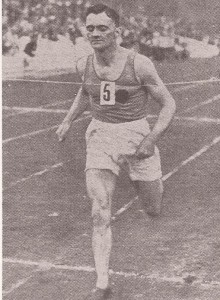
Bob Graham

Bobby Graham

There have always been clubs in Scotland that do sterling work for the sport and then just disappear, almost without trace.   Perhaps because the spark that created them has left the sport for whatever reason, perhaps because good as they were the club was in the shadow of a much bigger outfit whose sheer size and momentum prevailed.   One such club was St Peter’s AAC which was based in the west end of Glasgow.   The club competed well  and contributed to athletics in the area but its real contribution was in the organisation of the big Inter-Club Meeting in June every year from 1928 to 1936.

Held on 2nd June, 1928 at Shawfield Park and before a crowd of 2000 people, there were to start with four open races – 100 yards handicap, 100 yards scratch, 440 yards handicap youths and half-mile handicap.   The real business however was the inter-club contest which involved six relays, a four miles team race, and five field events.   All branches were involved: sprinters, middle distance men, long distance runners, hurdlers, jumpers and throwers all were catered for.   The trophy awarded was the “News of the World Challenge Trophy”.   That particular newspaper sponsored many events across the length and breadth of Britain with the four multi-stage inter-city relays being the biggest and best.   The event would settle into the second Saturday in June at Celtic Park, but the first was on the first Saturday.

It was reported on in the ‘Glasgow Herald’ as follows:

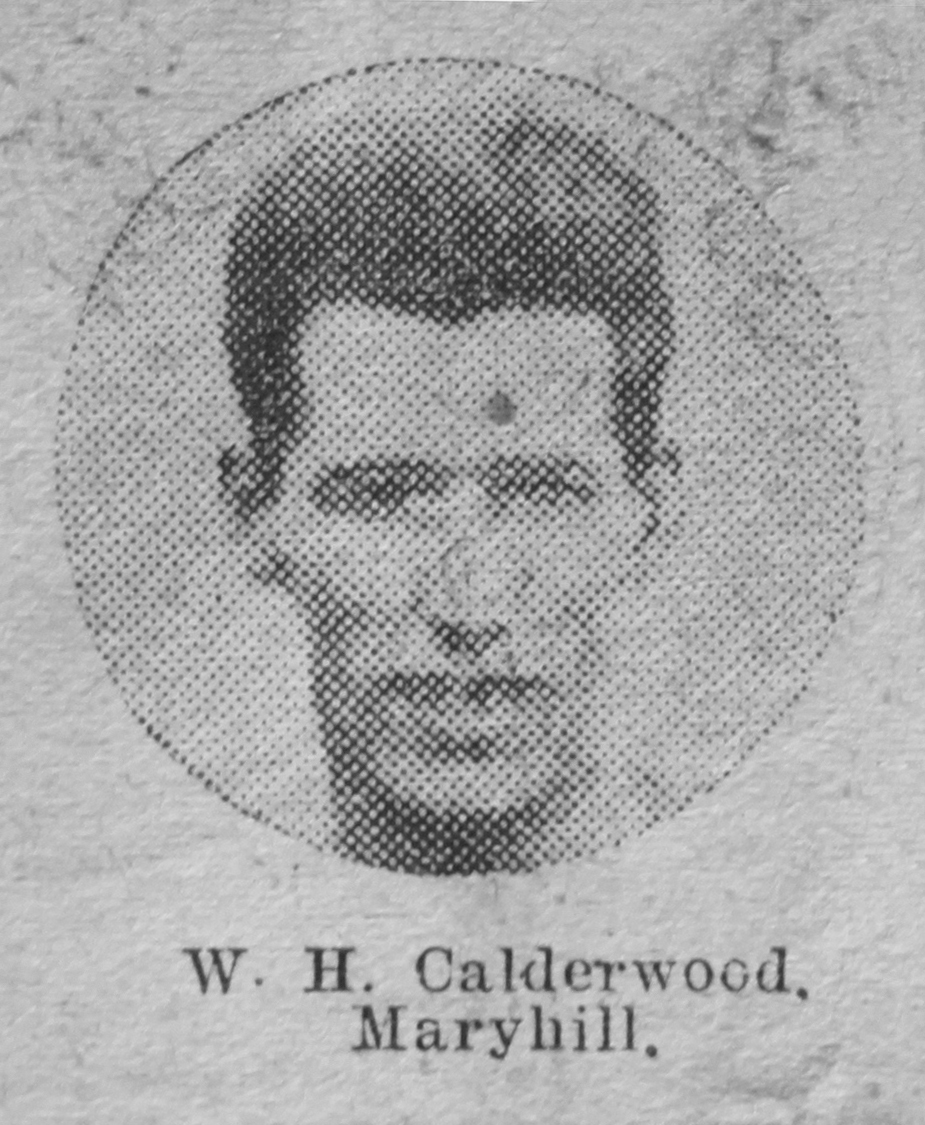
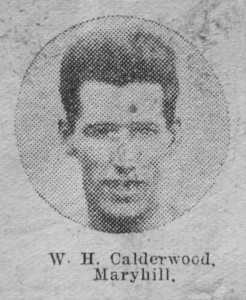
“It was generally expected that with the strength at their disposal, Maryhill Harriers would take pride of place at the meeting organised by that enterprising young club, St Peter’s.   In the mid-distances with D McLean, WH Calderwood, W McRoberts, GP Inglis and A Mair they have a string that no other club can compete with at the moment, and winning four of the six relay flat events they won the trophy with a comfortabkle margin from the West of Scotland Harriers.   The last-named club, for whom PW Brown confirmed his fine running of a week ago, were not over-weighted in the shorter distances, and won two events, the quarter mile and the mile, due in no small measure to smart understanding at the hand over.

The best race of the afternoon was the three miles team event.   Here only one point separated Maryhill and Plebeian Harriers, and it was Donald MacLean’s final burst to the tape that earned the former their victory in this event.   The mile champion ran also in the two miles, and here the expected duel between him and JD Hope did not materialise, as he took over with a lead of 20 yards and this was an impossible start for Hope to concede.   Hope, making his first appearance of the season, showed good form, and A Nicolson, the Scottish champion, had a creditable effort in the weight of 42 ft 11 ins.   Interesting too was the running of J Crawford, the Queen’s Park footballer.   He has cultivated a new style which does not please the critics, and any increase in speed which he has made has been at the expense of smoothness.”

It will be noted straight away the some names appear more than once – in inter-clubs there are always demands made on athletes to ‘double up’ no matter which decade in athletics history we are speaking about.   The quality of these athletes was very high indeed and the results of relays and team races are noted here.

440 yards relay (4 x 110): 1.   West of Scotland (PW Brown, JG Scott, S Bernstein, AF Clarke).   2.   Maryhill H;  3.  Shettleston H.

880 yards relay (4 x 220):  1.   Maryhill (WP Andreoli, DE Duncan, T McLean, R Kennedy); 2.  West of Scotland; 3.  Bellahouston H.

Mile Relay (4 x 440): 1.   West of Scotland (AF Clarke, PW Brown, H Elliott, JD Hope); 2.  Maryhill; 3.   Shettleston.

Two Miles Relay (4 x 880): 1.   Maryhill (W Roberts, WH Calderwood, D Sharp, D MacLean); 2.  West of Scotland; 3.  Cameron Highlanders

Four Miles Relay (4 x 1 Mile):  1.   Maryhill Harriers (GP Inglis, T Cowan, WH Calderwood, D MacLean; 2.  Garscube H;  3.  Camerons.

480 yards hurdles relay (4 x 120):  1.   West of Scotland (J Porteous, AF Clarke, T Clark, C Clark); 2.  2nd Cameronians

Three Miles Team Race: 1,   Maryhill ( D MacLean 1, D McL Wright 4, WH Calderwood 5: 10 pts); 2.  Plebeian (Combe 2, Gunn 3, Connolly 6)

Championship Cup:  1.  Maryhill 20 pts;  2.  West of Scotland  13 pts;  3.  Cameronians 11 pts.

As far as the field events went, Maryhill only won the high jump while the Field Events Club won the hammer, 2nd Cameronians took the long jump, Glasgow Police won the putting the weight.
If 1928 was a success, 1929 was a revelation of the interest taken in an inter-club contest by Scotland’s athletes.   The meeting was on 8th June and all cncerned were assessing the athletes form for the SAAA Championships which were to be held on 22nd June – just two weeks later.

It is pleasant to be able to record in these supposedly materialistic days, that 15 clubs, representing some 500 athletes, can be fund willing to take part in an inter-club contest where individual glory plays second part to the team spirit.   It fell to the lot of St Peter’s, one of the youngest but one of the most enterprising clubs in the Western area, to discover this fact a year  ago, and the success which attended their meeting at Scotstoun on Saturday demonstrated that the clubs were again more than anxious to participate in a meeting of this kind.   

The competition throughout was keen and it was not until the very last event on the programme, the broad jump, that victory rested with Glasgow University by a bare margin of 2 points over Maryhill Harriers who were winners a year ago at Shawfield.   

In a meeting of this kind it is somewhat difficult to assess individual values, but several of the candidates for championship honours acquitted themselves well, and we had the added satisfaction of seeing two Scottish champions, in James Crawford and KM Smith, in action for the first time this season.   The Queen’s Park flyer, who ran in Shettleston’s colours in the two shorter relays, moved well enough to suggest he will be fit and ready for June 22nd.   He was beaten in the final leg of the 440 relayn by JA Robb on practically equal terms, but an impartial survey of the race suggests that this was due as much to an indifferent change-over as to any inferiority in pace.   ….

In the distance events the reserve strengt of Maryhill Harriers was apparent, their victory in the mile, two miles and four miles being earned somewhat easily.   Donald MacLean, the Scottish champion, moved in freer style than in his previous races this season, and his mile was unofficially times at 4 min 41 3-5th sec, so that there is every hope that he may be back to form ere the championships.   In these sections WH Calderwood, C Freshwater and J Hood all acquitted themselves well, and among the younger runners, none did better than A Fisher of West of Scotland.   To defeat a tried performer like AH Blair was no mean feat.    …..   “

The report goes on to discuss the three miles team race, won by Plebeian Harriers over Springburn by three points with Maryhuill thirs.   Meeting relay results:

480 yards relay:  1.   Glasgow University (Wright, Smith, Borland, Robb).  2.  Shettleston H.   3.   West of Scotland Harriers

Half-mile relay:    1.   Glasgow University (Wright, Smith, Borland, Robb)    2.  West of Scotland H;  3.   Maryhill H

One Mile Relay:   1.   Maryhill H (Duncan, Turner, Allison, Devlin);  2.  Bellahouston H;   West of Scotland H

Two Miles Relay:  1.  Maryhill H (Herbert, McRoberts, Blair, Calderwood);  2.  Glasgow University;   3.  Shettleston H

Four Miles Relay: 1.  Maryhill H (Maclean, Kellas, Blair, Calderwood);  2.  Glasgow University;  3.  Bellahouston H

480 yards hurdles relay:   1.   2nd Cameronians;   2.  West of Scotland Harriers;   3.  Shettleston H

Three Miles team race:   1.  Plebeian Harriers (Gunn 1, Rayne 3, Lamont 11 = 14 points); Springburn Harriers (J Stevenson 4, R Allison 6, A Stevenson 7 = 17 pts;  3.  Maryhill 28 pts.

Such was the emphasis on the inter-club nature of the event, that even the field events were included but with the results calculated as for distance track races.   eg Maryhill won the high jump with the aggregate height of two representatives being 11′ 0″ (Smith 5′ 8″, Bulloch 5′ 4″) with the Field Events Club being second with a total height of 10′ 8″ and the 2nd Cameronians third with 10′ 2″.   With three throws and two jumps, the field events were important in deciding the destination of the event.   The News of the World Trophy in 1929 went to the University who had a total of 16 pts, from Maryhill on 14 pts and the Cameronians on 9 pts.
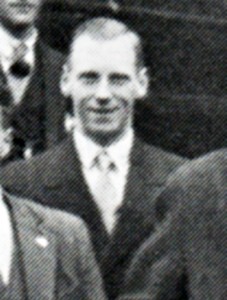
Walter Gunn, Plebeian Harriers

The St Peter’s Inter-Club contest was held on 14th June in 1930 at Celtic Park,  and success continued unabated.   Glasgow University again won the trophy, defeating Maryhill – but not until the last event, the javelin this time, was over.   Edinburgh University won that from Glasgow University  with Shettleston third and it was good enough to see the Glasgow students win with exactly the same scores and points difference as the previous year – their 16 points defeating Maryhill’s 14 by two with Edinburgh University two further adrift on 12 pts.   The attendance was reported as ‘moderate’ but that was not the point of such an event.  There were some changes in the format – one was that the Four Miles Relay became a One Mile team race.   It was still part of the inter club but saved a fair bit of time on the programme!  Results of the relays:

440 yards relay:   1.  Maryhill H (Anderson, McBride,  t McLean, Turner);  2.  Shettleston H;  3.  Glasgow University

880 yards relay:  1.  Glasgow University (Murdoch, ? , Wright, Borland); 2.  Maryhill;  3.  Edinburgh University

Mile relay:   1.  Springburn Harriers (McLaughlin, Scott, Mackill, Devon); 2.  Glasgow University;  3.  West of Scotland

Two Miles relay:  1.  Maryhill (Muir, Blair, Calderwood, D MacLean); 2.  Edinburgh University;  3.  West of Scotland H

480 yards hurdles relay:  1.  Edinburgh University (Decker, Campbell, Barker, Holmes);  2.  Field Evcents Club;  [GUAC second but disq)

One Mile Team Race:  1.  Maryhill Harriers (MacLean 1, Muir 3, Blair 4); 2.  Glasgow University AC;  3.  Bellahouston

Three Miles team race:   1.  Maryhill Harriers (D Wright 1, Muir 3, Robertson 4); 2. Bellahouston H;  3.  Garscube H.

Glasgow University won the trophy largely because Maryhill Harriers got almost no points at all in the field events wheras the students picked a couple of firsts, a second and a third.

The changes referred to above were interesting in their own right:

a.   open events had increased in number from four in the first match to eight this time round plus two cycle races.

b.  The events were 100 yards, 440 yards (both handicaps), 100 yards junior scratch; 100 yards novice scratch;

c.   There were three races for women, one of which was a relay -100 yards,  220 yards; 440 yards relay .   Edinburgh University and Maryhill Harriers were the strongest women’s teams with Glasgow University also providing a placed runner.

d.   Celtic Park had a concrete cycle track outside the cinder track and so for the first time it was possible to hold a 440 yards cycle race and a one mile cycle race without interfering with the state of the track.
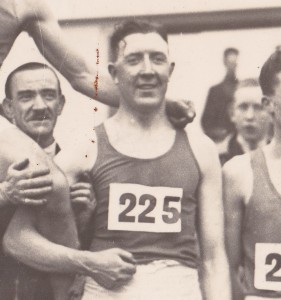
The meeting on 13th June 1931 was again held at Celtic Park and there were again innovations and changes to the format.

Results:

440 yards relay:  1.  Maryhill H (Turner, McBride, Stewart, Hamilton); 2.   Dublin Metropolitan Garda; 3.  Shettleston H

880 yards relay:  1.  Maryhill H (Turner, Brown, McBride, Hamilton);  2.  Shettleston Harriers; 3.  West of Scotland H

Mile Relay:   1.  Maryhill H (A Edmiston, Lieut A Harvey, P Dolan, R Hamilton);  2.  Springburn H;  3.  Dublin Metropolitan Garda

Two Miles Relay:  1.  Maryhill H (McNiven, Wilson, Calderwood, MacLean);  2.  Springburn H;  3.  Shettleston H

480 yards hurdles relay:  1.  Dublin Metropolitan Garda;  2.  Fied Events Club;  3. West of Scotland H

Mile Team Race:  1.  Maryhill H  (MacLean 2, Calderwood 4, Blakely 6); 2.  Plebeian H;  3.  Springburn H

Three Miles Team Race:  1.  Maryhill H  (Muir 4, Blakely 5, Blair 9);  2.  Heriots FP;  3.  Springburn H

Two Miles Junior Relay:  1.  Plebeian H (Blackwood, Armstrong, Black, Illingworth); 2. Garscube H;  Victoria Park.

Two things stand out here – one is the addition of yet another relay – the two miles junior event (4 x 880), which seems to prove the popularity of the format; and the arrival on the club scene of Victoria Park AAC.   The club had been formed only one year earlier.   We can go further and note that the events for women were now over 100 yards open, 100 yards  (confined to St Peter’s), 220 yards, half mile and 440 yards relay.   This time there were more clubs involved – Shettleston, Bellahouston and Maryhill were all represented.   As for the contest – Maryhill won with 24 points, from Dublin Metropolitan Garda on 19 1/2 pts with Shettleston well back on 9 pts.   Previously regarded as the unofficial club championship of Scotland,  the entry of the Irish team maybe complicated things.   Maryhill had made a clean sweep of the track events, bar the Junior Two Miles relay for which they had not entered a team and they competed better in the field events than the year before with 2nd in the broad jump and hammer, plus  3rd in the high jump and weight.   The absence of the University teams was to be regretted since they had their own championships at Craiglockhart that same Saturday
 

The Inter-club competition the following year was held on 4th June 1932, and was again at Celtic Park.    It had moved about between the first three Saturdays in June sinceits inception because of the other events being held.   The Queen’s Park Sports were on the first Saturday and St peter’s wanted to keep clear of that date, but if the Irish international was on the second Saturday, they had to move back a week.   Or forward.   The University championships were usually on the second Saturday of the month so it was sometimes better to go to the third Saturday.   However, the report on the ’32 version started as follows:   “The strength of the Glasgow University team in the field events made the Students’ victory in the inter-club contest at the St Peter’s AAC meeting at Celtic Park on Saturday afternoon much more decisive than was anticipated.   They actually collected 17 of the 18 points at stake in this section and although Edinburgh were handicapped by the absence of their champion, RW MacKay, the relative placings of the two teams at the finish should give the teams every encouragement for their meeting in the inter-university contest at Westerlands on Saturday first.   Glasgow University’s final tally was 30 points, Maryhill Harriers being runners-up with 18, while Edinburgh University and Springburn tied for third place with 5 points each.   In only one of the ten events, the three mile team race, did Glasgow fail to score, and they never fell behind second place.”   

440 yards relay:   1.  Glasgow University (Stead, Clark, Kitchen and McCush) ;  2.  Edinburgh University;  3.  Bellahouston Harriers

880 yards relay:   1.  Maryhill H (Brown, McBride, Bell, Dolan);  2.  Glasgow University;  3.  Victoria Park

Mile relay:   1.  Glasgow University (Glen, Young, Barlow, Borland);  2.  Springburn H;  3.  Maryhiull H

Two Miles relay:  1.  Glasgow University (Glen, Barr, Wynne Roberts, Murison);  2.  Maryhill H;  3.  Springburn H

480 yards hurdles relay: 1.  Glasgow University (Selkirk, Souter, Taylor, Kitchin)  walked over.

One Mile team race:  1.  Maryhill H (Calderwood 1, MacLean 4, Muir 5); 2.  Glasgow University;  3.  Plebeian Harriers

Three Miles team race:  1.  Maryhill Harriers (Blakely 1, DM Robertson 3, W Nelson 4); 2.  Plebeian H;  3.  Garscube H

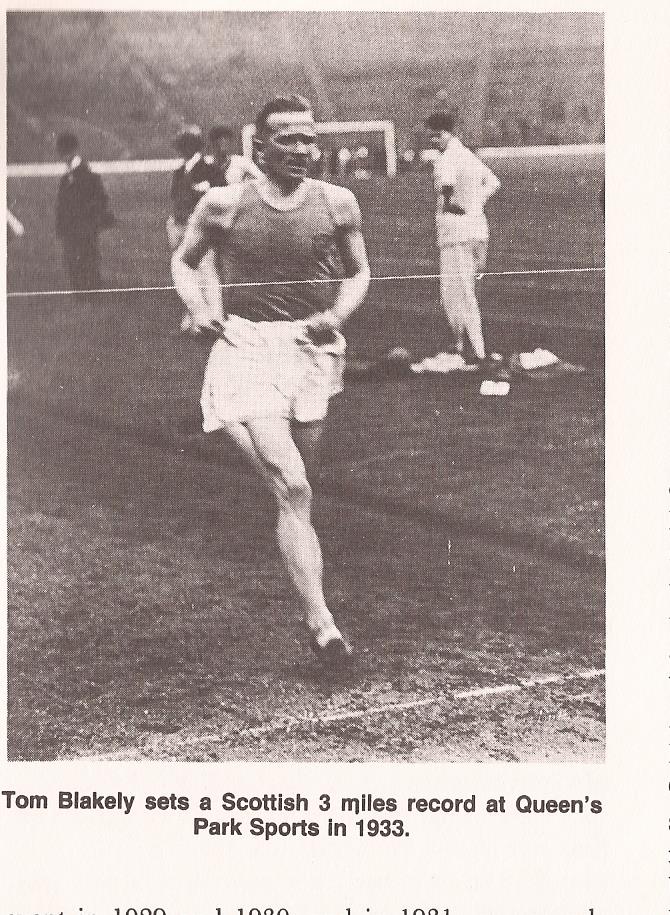
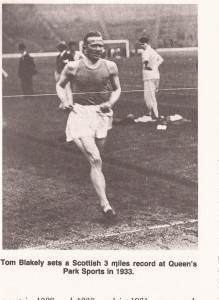
There were two records set at the meeting – Tom Blakely of Maryhill set a new Scottish record for three miles of 14 min 38 1-5th sec and Constance Johnston, SWAAA champion set a new record for the half mile of 2 min 24 1-5th sec.   The open track events were held but this time there were no cycle races at all and the two miles junior relay had been dropped.

“For the fourth time in the six years that have elapsed since the meeting was first instituted, Glasgow University won the inter-club contest held at Celtic Park on Saturday afternoon under the auspices of the St Peter’s club.   This has come to be regarded as the unofficial all-round championship and a test of the strength of the clubs in track, field and heavy events.   Let it be said that the Glasgow students by gaining first place with their total of 22 points fully deserved their claim to be the best team in Scotland, as in only one of the 12 events on the programme – the three miles team race – did they fail to secure points.   They won four events (Mile relay, high jump, broad jump, javelin), finished second in three (880 yards relay, two miles relay and putt), their third placings being in 440 yards relay, 480 hurdles relay, one mile team race and hammer. “

Glasgow Police were second and Maryhill and Edinburgh University tied for third.    Results:

440 yards relay:   1.  Maryhill H (Turner, McBride, Bell, Brown);  2.  Edinburgh University; 3.  Glasgow University.

880 yards relay:  1.  Maryhill H (Brown, Bell, McBride, Turner);  2.  Glasgow University; 3.  Springburn Harriers

Mile relay:  1.  Glasgow University (Murray, Wright, Young, Glen);  2.  Glasgow Police;  3.  Springburn H

Two Miles relay:  1.  Glasgow Police (Wilson, Lyons, Davie, Scott);  2.  Glasgow University;  3.  Maryhill H

One Mile team race:  1.  Shettleston Harriers (Sutherland 2, McCubbin 3, Young 12); 2.  Garscube H;  3.  Glasgow University.

Three Miles team race:  1.  Plebeian H (Tombe 1, Gunn 2, Armstrong 5); 2.  Maryhill H;  3.  Garscube H.

Although there was no team in the team race from Heriot’s FP, JF Wood was first to finish in the three miles in 15 min 7 3-5th sec.
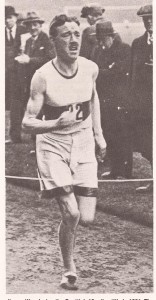
JF Wood, Heriot’s FP

16th June 1934: For the third year in succession and the fifth time since the inception of the event in 1928, Glasgow University in the inter-club contest held under the auspices of St Peter’s on Saturday proved themselves to be the best of the Scottish clubs in an all-round trial of strength in track, field and heavy events.   They finished first of the twelve clubs competing, and in only two of the twelve events, the mile and the three miles team events, did they fail to register points.   Their total of 22 points was taken from firsts in the 880 yards relay, 480 yards hurdles relay and the high jump, seconds in the 440 yards relay, one mile relay, two miles relay,  high jump, putt and hammer, and a third in the javelin.   Shettleston, who alone of the Harrier clubs have devoted much time to the field and heavy events, were a good second with 14 points, and it is to be noted that this section of the club, led by JK Braid and ER Walker, collected all but three of the total.   Maryhill was third with 8 points, and Glasgow Police and West of Scotland tied for fourth with 7 points.   It ios pleasant to see the last named, one of our oldest clubs, coming back into the limelight after several seasons of partial eclipse.”

Results:

440 yards relay:   1.  Maryhill H (Turner, McBride, Brown, Williamson) ;  2.  Glasgow University;  3.  Bellahouston H

880 yards relay:   1.  Glasgow University (Bishop, Stone, Robertson, Murdoch);  2.  Maryhill H;  3.  Glasgow Police

Mile  relay:   1.  Springburn Harriers (C Campbell, Carson, McKell, A Campbell);  2.  Glasgow University;  3.  West of Scotland H

Two Miles Relay:   1.  Maryhill H (Graham, MacLean, Scholes, Calderwood);  2.  Glasgow University;  3.  Victoria Park

4 x 120 yards hurdles relay:   1.  Glasgow University (Chassels, JA Kitchin, TH Souter,  AS Kitchin);  2.  Shettleston H;  3.  West of Scotland

One Mile team race:  1.  Plebeian Harriers (Gunn1, McGregor 4, Robertson 8);  2.  Shawfield Harriers;  3.  Shettleston H

Three Miles team race:  1.  Garscube Harriers (Bennett 3, Lindsay 5, DB Brooke 7);  2.  Shettleston H;  3.  Springburn H.

In the field events, Shettleston Harriers won the shot and the javelin, Glasgow University won the broad jump West of Scotland won the high jump and Glasgow Police won the hammer event.   It should be pointed out in defence of the Harrier clubs, that one of the reasons they did not embrace the field and heavy events was probably a lack of appropriate facilities.   The Universities with exclusive use of Westerlands and Craiglockhart with equipment for all the events available on demand.   They also of course had the time for training and in addition the actual work done by most athletes in the shipyards, factories and coal mines was more physically demanding than the life of most students.   The university teams might well have won the championship in any case – they had some superb athletes – but the above factors (access to facilities, less time for training and a more physically demanding lifestyle) are offered in defence of the harriers.
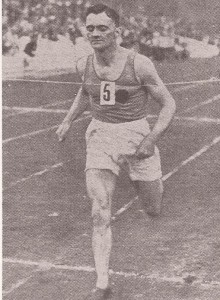
When St Peter’s held the event at Celtic Park on 8th June 1935, the Inter-Universities Championship was held at Craiglockhart in Edinburgh and this not only reduced the number of teams competing in Glasgow, but made the championship more open than it had been for several years.   It was held on a wet and heavy track with nasty cross-winds but went ahead as usual.   Results:

440 yards relay:   1.  Garscube Harriers (Walker, J McIsaac, JT McIsaac, Pitcairn); 2.  West of Scotland H;  3.  Maryhill H.

880 yards relay:   1.  Bellahouston H (Thomson, Gallagher, Lawn, Fraser);  2.  West of Scotland;  3.  Maryhill.

Mile relay:   1.  Maryhill H (Terry, Cairns, Scholes, Morrison); 2.  Victoria Park;  3.  West of Scotland.

Two Miles relay:   1.  Maryhill H (MacLean, Morrison, Osborn, Calderwood);  2.  Victoria Park;  3.  Plebeian H.

480 yards hurdles relay:  1.  Bellahuston H (CG Gordon, Arnott, Wyper, OG Gordon);  West of Scotland finished but were disualified.

One Mile team race:   1.  Maryhill H (MacLean 1, Osborne 7, Calderwood 8);  2.  Garscube H;  3.  Plebeian H.

Three Miles team race:   1.  Bellahouston H (Campbell 1, Lamb 2, Mowat 5); Maryhill H;  3.  Plebeian H

Championship:  1.   Maryhill H 18 pts;  2.  West of Scotland  17 pts

*

There was no St Peter’s AC Inter-Club contes held in 1936 – or in 1937 or 1938 either.   There were so many other meetings that they may have been crowded out of the calendar.   There were only three Saturdays available in June: the fourth was always the SAAA championships, and on that Saturday there were a couple of minor meetings such as Lugar Sports.   The first Saturday in June was always the Quen’s Park FC Sports which was a very attractive draw for athletes and the other regular meetings were the Singer’s Factory Sports at Clydebank and the Alloa meeting.   It would have been hard for a club to get all their best men out for a meeting such as the inter-club on that date.   The second Saturday was not any easier and that was traditionally the date for St Peter’s event: the Universities usually had their championships on that date and we hav seen how important their presence was for the Glasgow meeting.   It was also unfortunate that the Babcock’s Sports had been going for five or six years by 1936 and it was offering the Empire Exhibition Trophy to the club with most points at the meeting which had two relays (4 x 100 and medley) and a track team race in addition to points for places in most events on the programme.   It almost duplicated some aspects of the St Peter’s programme and it was easier to forward a team.  And it was on the same day.  On the third Saturday it was the Glasgow Police Sports: formerly a professional meeting it had joined the amateur ranks and proved to be very successful with some really good relays (normally two per programme).   There was also an Edinburgh meeting on the third Saturday and the Dalmuir United FC had their sports on that date.

The situation for St Peter’s was one where they had to decide to either

a.   Keep the date they had which clashed with the Universities champ[ionships, and, possibly more important, with Babcock and Wilcox Sports with the Empire Exhibition Trophy’;  or

b.   Move back a week and face the challenge of the Queen’s Park Sports which most athletes found quite attractive;; or

c.   Move forward and clash with Glasgow Police Sports being held at Ibrox; or

d.   Stop holding the meeting.

They were a small club, crowds were usually described as ‘moderate’ with no figures given, and they maybe just did not have the personnel or the drive to continue.   However it turned out, there were no more inter-clubs held by St Peter’s.   This was a pity because it was at a time when there were no track leagues of any form and whole club competition has a lot to commend it.   It filled a gap, and right well did it do it.

Queen’s Park Sports: 1926 – 1929

CB Mein winning a handicap

The Queen’s Park Sports of 1925 had been very successful with many of the top athletes participating.   The meeting of 1926 also had several top men in action across the board.   Held on 5th June in brilliant sunshine and before a crowd of approximately 7000 spectators, Tom Riddell was the top performer – or the ‘feature of the meeting’ as the Herald report had it.   He finished second in the half-mile and defeated CB Mein  (above)in the first stage of the inter-city relay race.   This played no small part in Glasgow winning the event for the first time.   The Two Miles Harriers Race was won by Walter Calderwood of Maryhill Harriers with Frank Stevenson of Motherwell second, Charlie Freshwater and Dunky Wright of Caledonia AC third and fourth.   Caledonia AC was set up to be a ‘club of champions’ with W Sans Unkles and Dunky Wright the main protagonists.   It only lasted for the one season – Charlie Freshwater had signed up from Clydesdale Harriers and Wright had come from Clydesdale by way of Shettleston before going on to jon Maryhill when the Caledonia adventure came to naught.   The club won the team race from Maryhill Harriers.   Celtic beat Rangers in the final of the five-a-sides by 2 goals to none.   In the open events, Walter Lawn won the 100 yards and was third in the 220 yards – Lawn went on to have a printing business that provided numbers for the SAAA championships for many years as well as for most open meetings of any size.
In 1927 the club sports were held on June 4th and the report in the ‘Glasgow Herald’ read:

The weather and ground conditions which prevailed at the Queen’s Park club’s annual sports on Saturday afternoon were not of the kind conducive to to exceptional performances, yet the sport throughout was interesting and the times recorded were distinctly good.   The outstanding event at the meeting, both in point of competition and on merit, was the invitation quarter-mile, and in winning from two yards in 51 4-5th sec, RB Hoole gave a glimpse of better form than he has hitherto shown in the West.   He had to fight all the way for his victory against RT Hollinger of Plebeian Harriers and JC Hamilton the Glasgow University champion, and the manner in which he secured victory on the tape from the first named, was  a tribute to his pace, stamina and judgment.   

JD Hope, the champion, was not suited by the conditions.   He is of a build better suited to calm than storm, and he was never concerned with the ultimate issue.   Hoole and Hope were down to meet later in the afternoon in the inter-city relay race, but the withdrawal of HC Maingay from the Edinburgh team robbed this promised trial of skill on level terms in the quarter-mile section, and also that of RD Allison and R McLean in the furlong, of much of their interest, as CB Mein, who sportingly stepped to the vacancy was obviously not fit and accordingly not able to hold RB McIntyre who ran the half-mile for Glasgow.   The ground lost there was never regained by Edinburgh and we will have to wait untl the championships to have the merits of these opponents accurately tested.   Enough was seen, however, to suggest that both furlong and quarter-mile championships will prove exceedingly interesting.

As is usual, the student element was strongly represented in the prize list.   In addition to Hoole, AF Clarke and GPS Macpherson occupied first and second places in the hurdles; R Patience of Glasgow won the Mile with something in hand, and A Tindal, also a Gilmorehill student, took second place in the open hundred.   Tindal’s achievement in the hundred was somewhat unique, as he has hitherto been regarded as a distance man, and not only did he win the Mile at his University competition, but he took part in the SAAA 10 mile championhip in mid-April.   Patience, a strongly built lad,  was suited by the conditions in the Mile, but apart from that it was apparent that the handicapper took too lenient a view of the ability which several good judges are convinced he possessed.

T McLean, the Rover Scout, is running well at present. as his victory in the 220 yards following upon his third in the hundred suggests, and another genuine runner, J Calder of Beith Harriers, added another win to the series he has at his credit by capturing the half-mile off 30 yards in 1 min 59 sec.   Under the conditions this time was much better than it reads on paper.    The three miles revealed a very level degree of merit between Maryhill Harriers and Monkland Harriers, the first named being winners by one point only, and the issue depending on the efforts of the third man in each team.   It was all the more rgrettable therefor that the race should be marred by a series of incidents which were, to say the least, not creditable to the runners concerned.   It was all the more welcome that Donald McLean, the Maryhill Harrier who was first man home, was not in the trouble and his win was decisive enough to suggest that he is to be a strong candidate for a title at the championships in three weeks hence.”

  There was no meeting reported for 1928 but the event was only resting and it was back on the usual Saturday in 1929.

On 1st June 1929, J Suttie Smith from Dundee wanted to attempt a new Scottish record: he was a top class internationalist on the track and over the country with several national titles to his credit and Queen’s Park regulars were keen to see him in action.   “Chief interest in the meeting of Queen’s Park at Hampden lay in the attempt made by J Suttie Smith upon the existing Scottish native record for two miles.   A special handicap had been framed for the occasion, and had the champion been able to head WJ Gunn , who ran off 85 yards, he might have been able to accomplish it, the Plebeian Harrier’s winning time being 9 min 31 1-5th sec.   As it was Smith failed to do this, his time for the distance being 2 3-5th sec seconds worse than McLean’s existing figures of 9 min 31 sec.  

Smith did not appear to be moving too freely in the first three laps, but ran well in the closing stages.   The times in the open races were fast, and it appears now that to win an open sprint even-time is necessary, judging by what happened at the Maryhill meeting and also at Hampden.   Two juniors of last season figured successfully in these events.   AD Turner of Maryhill Harriers who had almost a monopoly in his class last year, made a bright debut as a senior, as he ran second in the 100 yards, and won the furlong in 22 4-5th sec, while R Davie of Springburn Harriers, in his first public essay over the distance captured the half-mile in 1 min 58 3-5th sec.   Both will win further races.

Donald McLean again turned out in the Mile, but again ran indifferently.  His clubmate WH Calderwood ran well bth in the first class mile and in the relay.   The latter event was won by Beith Harriers, who triumphed over Maryhill Harriers and West of Scotland Harriers.   The Ayrshire club has two excellent runners in J Calder and TJ McAllister, and this pair contribted largely to their success.”

 There were ten track races plus an obstacle race, a high jump and a five-a-side competition won by Partick Thistle from Rangers by two goals to one afterextra time.   Because of the very large numbers, the mile was divided into two races – the first class mile for the best runners (ie those with low handicaps) entered, and the second class mile for those with higher handicaps.

1934 Empire Games

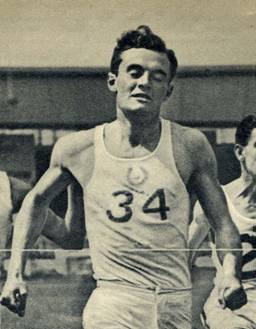
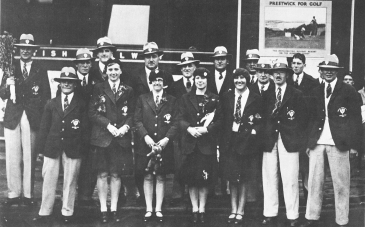
Scottish Empire Games team, 1934

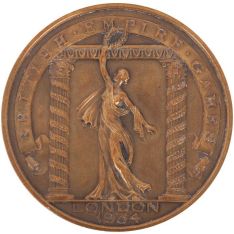
1934 medal

1934 Empire Games Participation Medal

The 1934 British Empire Games were the second of what is now known as the Commonwealth Games.    They were held in England from 4–11 August 1934:  London’s Wembley Park was the main arena, although the track cycling events were in Manchester.    Seventeen national teams took part, including the Irish Free State (the only Games in which they participated, although at the earlier 1930 Empire Games a single team representing the whole of Ireland competed).   London seems to have obtained several Games for reasons other than the straightforward allocation.   This was one of the times: the 1934 Games had originally been awarded to Johannesburg in South Africa, but were changed to London because of concerns (particularly from Canada) about the way South Africa would treat black and Asian athletes.

Six sports were featured in the Games: athletics in the White City Stadium; boxing, wrestling, and aquatics (swimming and diving) in the Empire Pool and Arena, Wembley; cycling in Fallowfield Stadium, Manchester; and lawn bowls at Paddington and Temple. Women’s events in athletics were held; in the inaugural Games, the women’s events were found only in swimming.   There were twenty one events for men and nine for women.

Although several Scots had competed in Canada in 1930, there was no formal team management and 1934 is regarded as the first year in which a Scottish team was forward.

hamish-stothard

Hamish Stothard

The Scots athletes and their performances were as follows, Track events first:

100 yards men: Ian Young 3rd, 10.1 sec; David Brownlee 3rd Ht 2;  Archie Turner 4th Ht 4

100 yards women: Joan Cunningham, 4th Ht 2;   Margaret McKenzie 5th Ht 2; Cathie Jackson, 5th Ht 1; Barbara Barnetson 5th Ht 3

220 yards men: Robin Murdoch 4th (22.8 Ht); Ian Young 5th (22.9 Ht); David Brownlee 5th Ht 2; Archie Turner ran, no details.

220 yards women: Sheena Dobbie 4th Ht 3; Cathie Jackson 5th Ht 1;  Margaret McKenzie 5th Ht 2; Barbara Barnetson 5th Ht 3.

440 yards men:   Frank Ritchie Hunter 6th (51.1 Hts); Robert Burns Wylde ran Ht 3; Robert H Wallace 5th semi final (50.9 Ht)

880 yards men:  James Hamish Stothard 3rd  1:55;  Robert Graham  5th Ht 2;

880 yards women:   Mildred Storrar 7th.

Mile men:   Robert Graham 5th;  John Pratt Laidlaw ran Ht 2.

Two Miles Steeplechase:  Walter Gunn 6th

Three Miles:  John Pratt Laidlaw  7th; James MB Caie 9th.

Six Miles:  No Scots

Marathon:  Donald Robertson 2nd 2:45:08 ; Duncan Wright 3rd 2:56:20

80 m hurdles women: No Scots

120 yards hurdles men: No Scots

440 yards hurdles men:   Frank Ritchie Hunter  1st 56.2 seconds

4 x 110 yards relay men:  3rd (Turner, Brownlee, Young and Murdoch) 43.0

4 x 440 yards relay men: 3rd (Hunter, Stothard, Wallace and Wylde) 

4 x 440 yards relay women:  dnf  (Barnetson, Jackson, Dobbie)

Field Events

Shot Putt Men: No Scots             Discus Men:  No Scots

Hammer Throw: William McKenzie  3rd 139′ 5″

Javelin Throw Men:  No Scots   Javelin Throw women: No Scots

High Jump Men:  James Fraser Michie 3rd 6’3″ (First three men all stopped at 6’3″).

High Jump Women:  No Scots

Long Jump Men:  Robert Nelson McQueen Robertson unplaced

Long Jump women: No Scots

Pole Vault Men: Patrick Bruce Bine Ogilvie 6th  11’6″

Triple Jump Men: No Scots

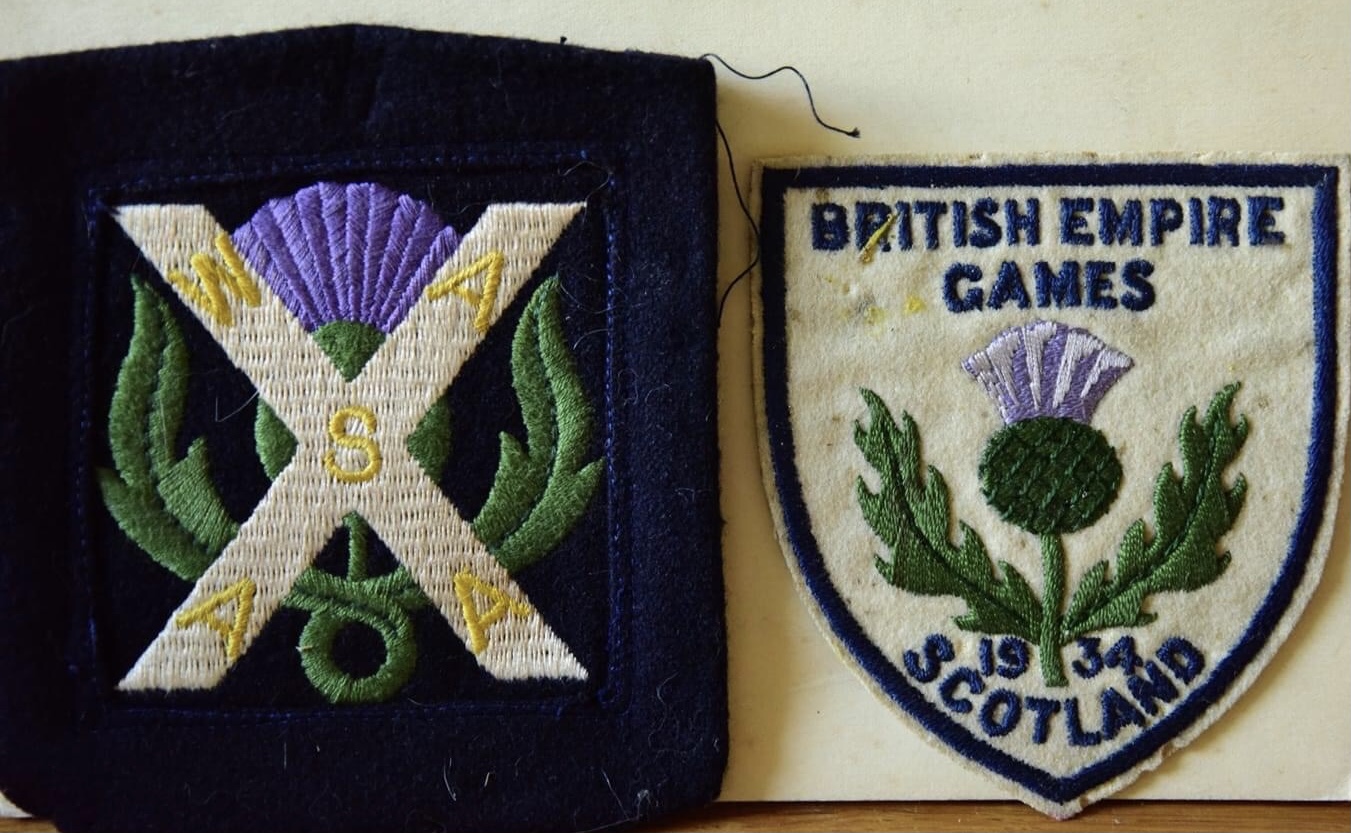
Below: Mildred Storrar’s Track Suit Badsges, courtesy Janet Hardy, as is the photograph at the top of the page

1938 Empire Games

1938_British_Empire_Games

The 1938 British Empre Games were held in Sydney, New South Wales in Australia from 5–12 February 1938.   They were timed to coincide with the celebrations of the foundation of British settlement in Australia exactly 150 years before. Venues included the Sydney Cricket Ground (the main stadium), the Sydney Sports Ground, the North Sydney Olyumpic Pool and Henson Park. An estimated 40,000 people attended the opening ceremony.   Continuing the tradition of the athletes village established in Canada eight years earlier, a competitors’ residential village was established within the grounds of the Sydney Showground.   Due to the onset of the Second World War, the games were not held again until 1950.

Ten countries took part – Australia, Bermuda, British Guiana, Canada, Ceylon, England, Fiji, India,  New Zealand, Northern Ireland,  Scotland, South Africa, Southern Rhodesia, Trinidad and Tobago, Wales.   The countries in bold are those that won any medals at all with the top nations being Australia (66), England (44) and Canada (40) while Scotland was eighth with just five medals – two silver and one bronze.   In athletics there was one solitary silver – won by David Young in the Discus Throw with a best 43.04 metres – 1.71m behind the winner.

It was the smallest ever Scotland squad up to that point – there was one sprinter, two distance runners and one field events competitors.   The sprinter was Margaret Marie McDowell from Ardeer (SWAAA 100 yards champion in 1937 and again in 1939 + 220 yards champion in 1937, ’38 and ’39) who fourth in Heat three of the 100 yards, and fifth in the second semi-final of the 220 yards.   The middle distance runner was Bobby Graham who was 5th in the second heat of the half-mile and so did not qualify for the final, and then he did not finish in the final of the Mile after recording 4:18.8 in his Heat.   He did not start in the Three Miles where he was entered.   The long distance runner was the wonderful Donald McNab Robertson (second in the 1934 Games marathon) who was fourth in the marathon in 2:42:40.   The Glasgow policeman David Young  was the only field events athlete to represent Scotland and he was the most successful of the four there – second in the discus salvaged some pride with a silver medal although even he did not compete in all that he had been entered for – he was a ‘dns’ in the shot putt.   He was SAAA Discus champion in 1937 and 1938 and then again after the War in 1946 and 1947).

Robertson and Young were both in action on the second day of competition – Monday, 7th February and their events were written up as follows by the ‘Glasgow Herald’.

“D McNab Robertson (Maryhill Harriers) who carried Scotland’s hopes in the marathon, an arduous 26 miles test, could only finish fourth to JL Coleman (South Africa) who won in the really fin time of 2 hours 30 min 49 8-10th sec.   There is no official world record for this race, but Coleman’s time was within a minute and a half of K Son’s (Japan) Olympic record time. A Norris, the Polytechnic marathon winner, ran a splendid race to finish second and will win a great deal of satisfaction from the race in beating his old rival Robertson.Norris has also the satisfaction that even had he run as well as he has ever done in his life he would still have been several minutes behind Coleman’s time.    

Robertson’s performance however – his time was 2 hr 42 min 40 sec – was particularly praiseworthy as he had been suffering from a poisoned finger, which he had lanced on Sunday, and also found the extremely hot sun which streamed down throughout the race particularly exhausting.   The heat was however particularly relished by the South African runners, Coleman and HA Gibson who took third place.

However Scotland gained some consolation in the discus event.  David Young, Scotland’s champion discus thrower, took second place in this event.   His best throw of 141 ft 1 3/4 in was 4 ft 1 1/2 in better than the previous record set up at the 1934 Games by H Hart of South Africa.   A new record however was made by the winner, Eric Coy the Canadian thrower with 146 fet 10 1/2 in.   Hart’s record was beaten by both men with their qualifying throws.   Young was followed by G Sutherland (Canada) who took third place with 136 ft 01/2 in.

Young could have done a lot better yesterday for he had already thrown a distance of 146 ft 1 in in Australian competition.”

Reporting in the ‘Herald’ of 11th February on the Mile it was noted that there were three Britons in the Final – JWL Alford (Wales), R Graham Scotland) and RW Eales (England) before the actual report which read:

“Graham was content to take second place in his Mile heat.   Unextended he came in second to the Welsh One Mile champion, Alford.   After a slow start, Graham, whose best Mile time is 4 min 12 sec, or 0.8 sec quicker than the Games record set by J Lovelock in 1934, quickly took the lead.   He was followed by F Barry-Brown, the Australian, with Alford lying third.   At the half-way Graham was still striding away effortlessly in the lead.   The order was unchanged except that Allen had dropped to sixth.   Now Alford overtook Barry-Brown without difficulty and lay a close second to the Scottish champion.   With a quarter of a mile to go the Welshman speeded up but Graham did not respond to the challenge.   He was content to qualify.   Alford passed him at the beginning of the straightand went on to win by 10 yards in 4 min 17 3-10th sec.   Graham was four yards ahead of Pullen who took third place.

Graham’s chief opposition in the Final will come from the leaders in the second heat – Gerald Backhouse the Australian Olympic runner, and VP Boot, the young New Zealander who set up a new record for the half-mile on Monday.”

None of the  British women qualified for the Final of the 220 yards.   McDowell qualified from he heat for the semi-final: “Miss McDowell had taken third place in her first round heat to qualify for the semi-final.   The Scottish champion ran a good race in this first round heat.   She was drawn on the worst track but qualified easily, being able to slow up considerably towards the finish.   The heat was won by Miss J Coleman of Australia in 25.3 sec, beating the Australian record by .2 sec.   The Scottish girl was content to take the last qualifying place without exerting herself.   In her semi-final heat, Miss McDowell was opposed by Miss M Meagher (Canada) who had won her qualifying heat, Miss Coleman, Miss Wearne (Australia) who had taken second place to Miss Meagher and Miss Susan Stokes, the London girl.   Miss Meagher won in 25 1-10th sec with Mis Coleman, half a yardbehind, second.   Miss McDowell was last.”

 The Mile final was on the last day and the report merely said that Graham disappointed.   After setting a fast pace he lagged behind and did not finish.   There was no word about whether he had been injured, ill or otherwise disadvantaged by fate.

Bob Graham

Bobby Graham

1930 Empire Games

Bobby Robinson

The first British Empire Games were held in Hamilton, Ontario in Canada between 16th and 23rd August in 1930 with a total of 400 competitors.    They were a great success and many of their innovations were adopted by the Olympic movement which watched this new competition with interest.   eg there hd never been a podium for the awards to be presented while the flag was unfurled for the winner.   The Olympics had the flags, but no podium and they first used a podium in 1932.   Where did the British Empire Games come from?   What were their origins?   My main source for what follows in “the Commonwealth Games” by Brian Oliver, although other sources have also been consulted.

Bobby Robinson, above, was born in Peterborough, Ontario in 1888 and was an important figure in the newspaper business and a well connected businessman.   He was known as a dynamic and aggressive campaigner who in 1929 first set out his plans for the Games.   He and a fellow businessman, Howard Crocker,  had been discussing ways to get their athletes more and better competition and Crocker had mentioned the Festival of Empire held in London in 1911 for King George V’s coronation; he also mentioned the ‘Pan Britannic Festival of Culture and Sport’  dreamt up by J Astley Cooper in the early 1890’s.    Robinson liked what he had heard and is said to have begun planning from then for the Empire Games.

He was further spurred on by the perceived treatment of Canadian athletes at the 1928 Olympics in Amsterdam.   Mainly by the Americans and Germans.    When Percy He was interviewed by the Toronto Star writer Lou Marsh who reported that “as a result of the dominance, real or imagined, by Germany and America at the Olympic meet, … Robinson finally boiled over and, after consultation with other Canadian officials, met representatives of the other British teams.”   Among his complaints were the Williams incident mentioned above, the fact that the Americans were allowed to train on the Olympic track while the Canadians were not, a disputed verdict in the women’s 100m which was given to the Americans when Canadians thought it should go the other way, and a direct insult by Avery Brundage of America to a Canadian official.   These comments of course only added fuel to the fire of rivalry between the two nations, and , maybe unfortunately, the official correspondence preceding the Hamilton meeting has been lost.

However, in January 1929, Robinson asked the Hamilton city fathers for $25,000 to run the Games and a further $150,000 to build the stadium and other facilities.   Other countries came on board, not without difficulty and the main supporters of Australia, England and New Zealand all stated their intention to be present.   In the event, there were 11 nations present.

 The sports included athletics, boxing, lawn bowls, rowing, swimming, and wrestling. The opening ceremonies and many events were held at the Civic stadium  in east Hamilton.   The games were opened by the Governor General of Canada, Lord Willingdon on the 16 August.   As at the Olympic Games, the competitors all marched in behind their national flag but the whole parade was led in by the Union Jack as an indication that they were all part of the British Empire.   the oath taken by Percy Williams, on the flag, on behalf of the athletes was “From many parts of the British Empire, we are here assembled as amateur athletes to compete in friendly competition.   We pledge our best endeavours to uphold the honour of our country and the glorious traditions of British Sportsmanship.”  

Once the games started, Scotland won 17 medals – 2 gold, 3 silver and 5 bronze which placed them fourth behind England (61), Canada (54) and South Africa (17) but ahead of New Zealand (9) and Australia (8).   Not bad.   There was only one athletics medal – gold for the marathon by Dunky Wright.  There was also a gold, a silver and a bronze from boxing, bronze from bowls and finally two silvers and three bronzes from swimming.

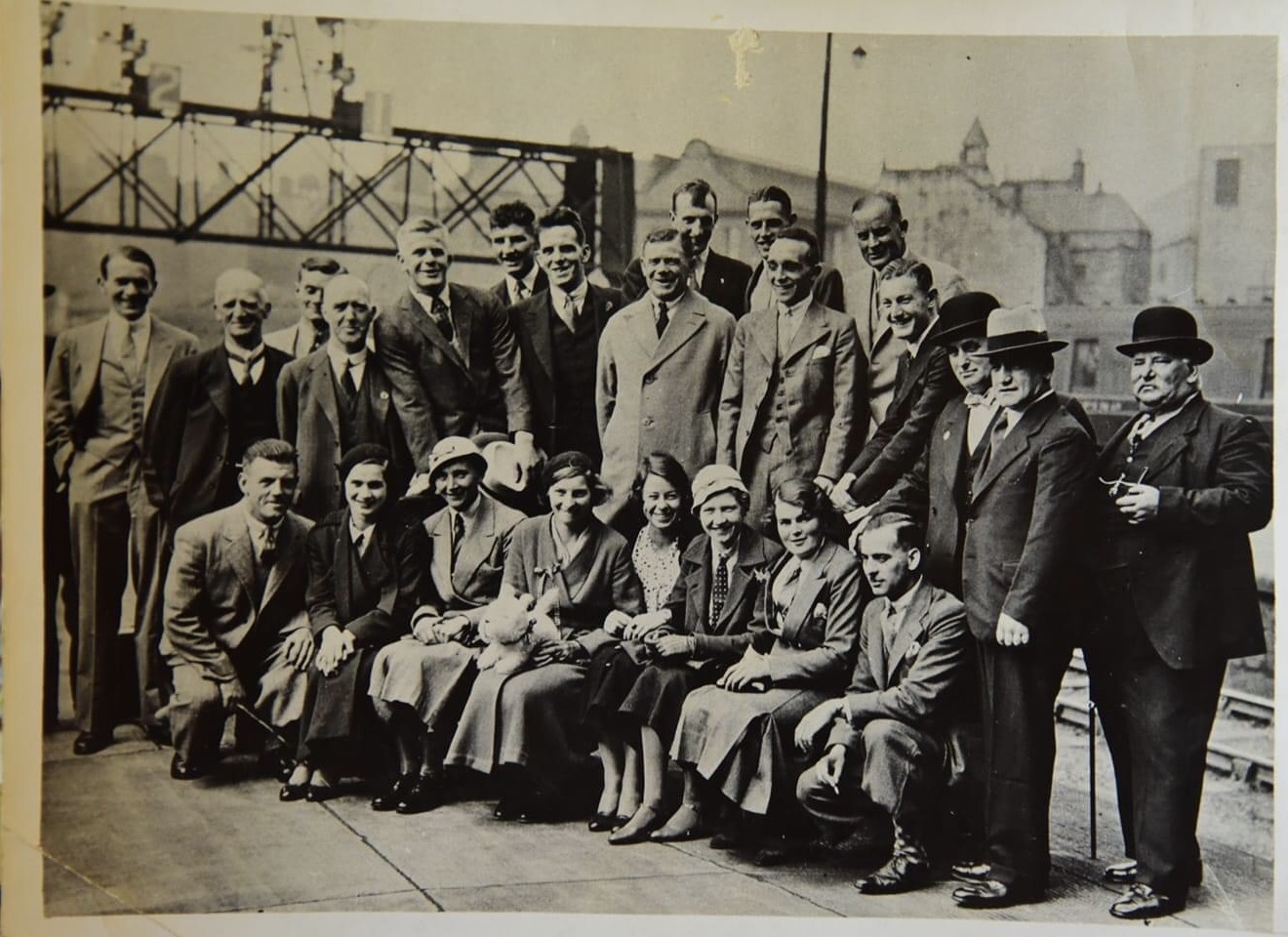
CG 30 departure photo

The team at departure

Events and Scottish placings   John Astley Cooper

Willie Carmichael

Willie Carmichael0004

Willie Carmichael

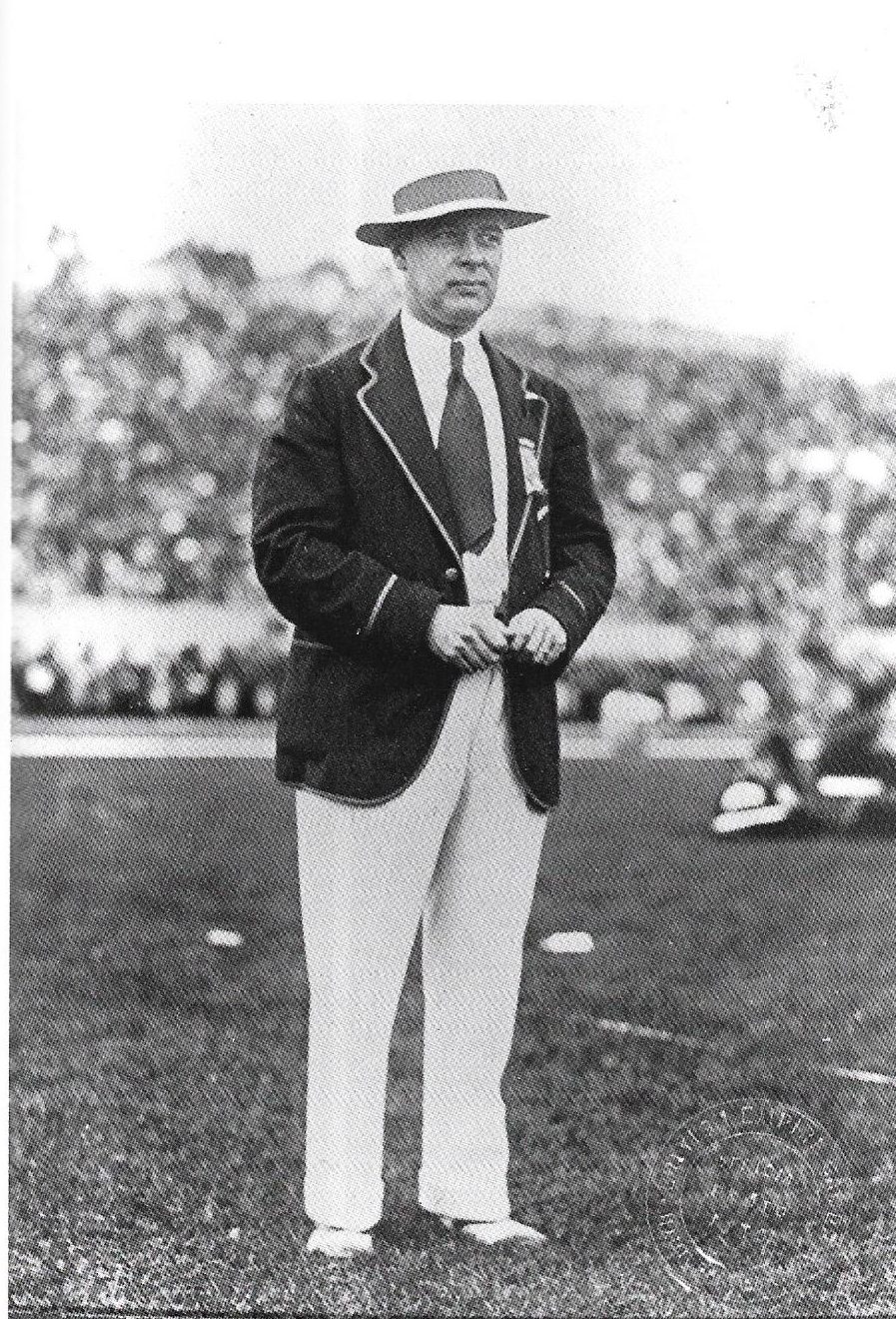
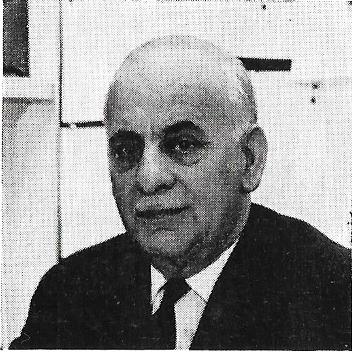
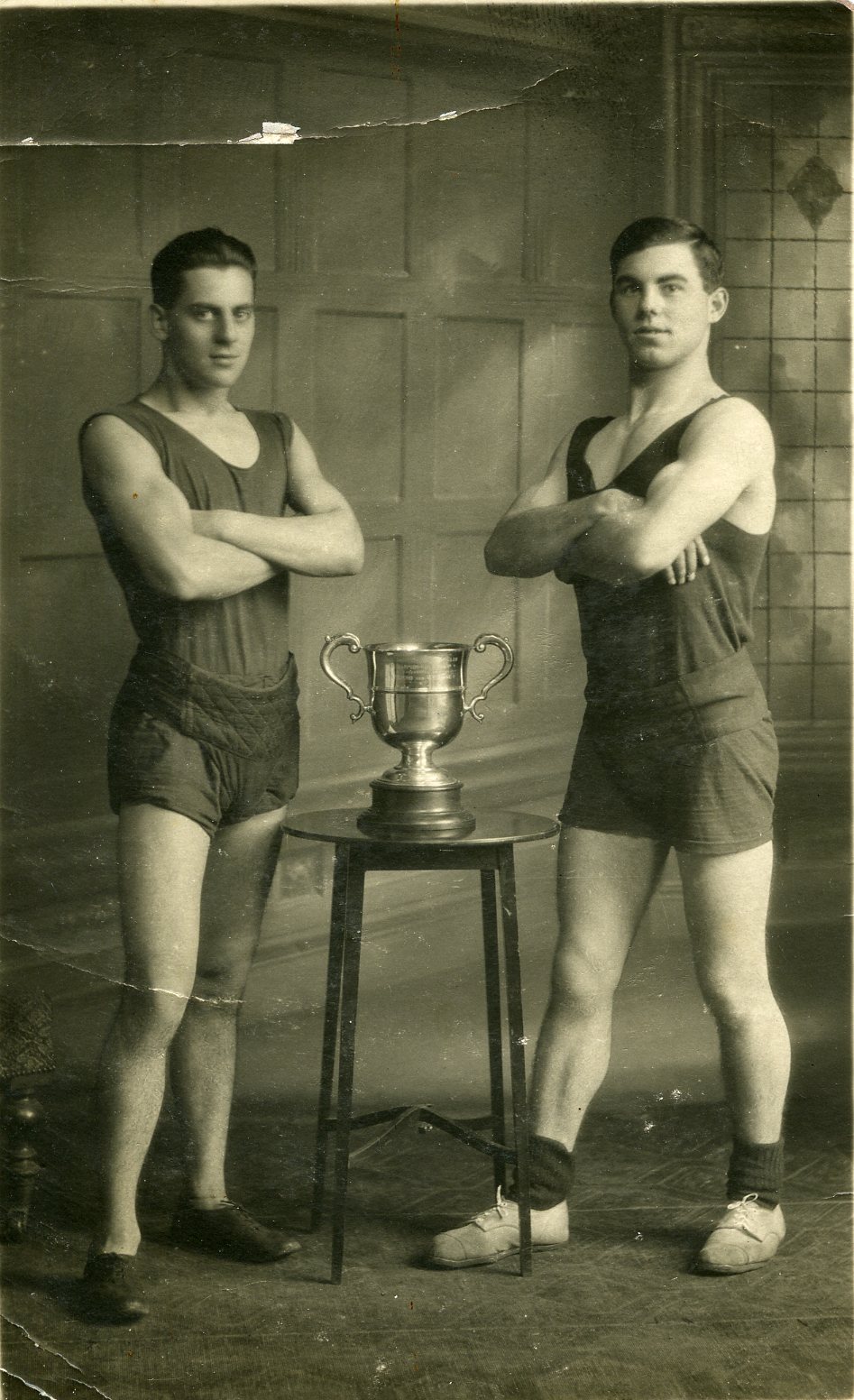
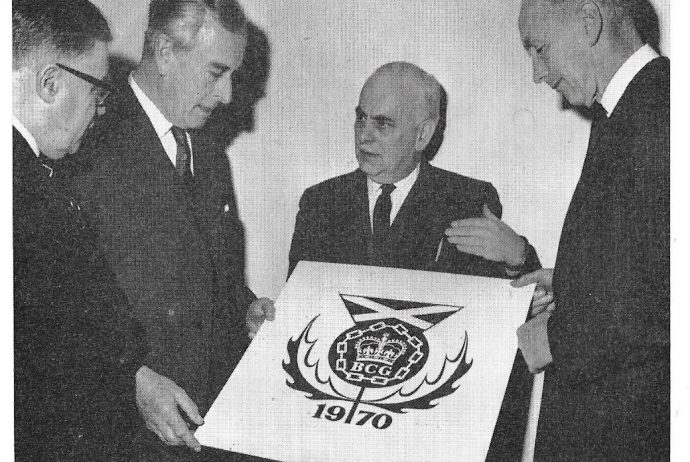
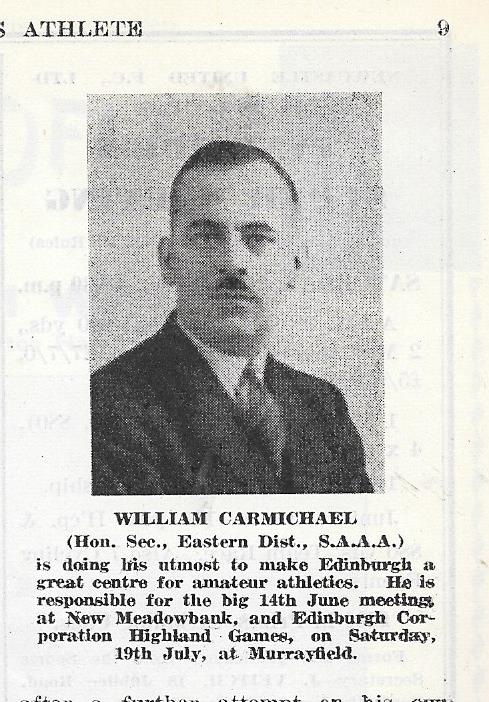
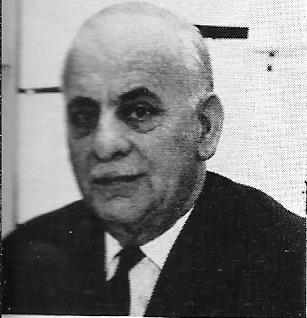
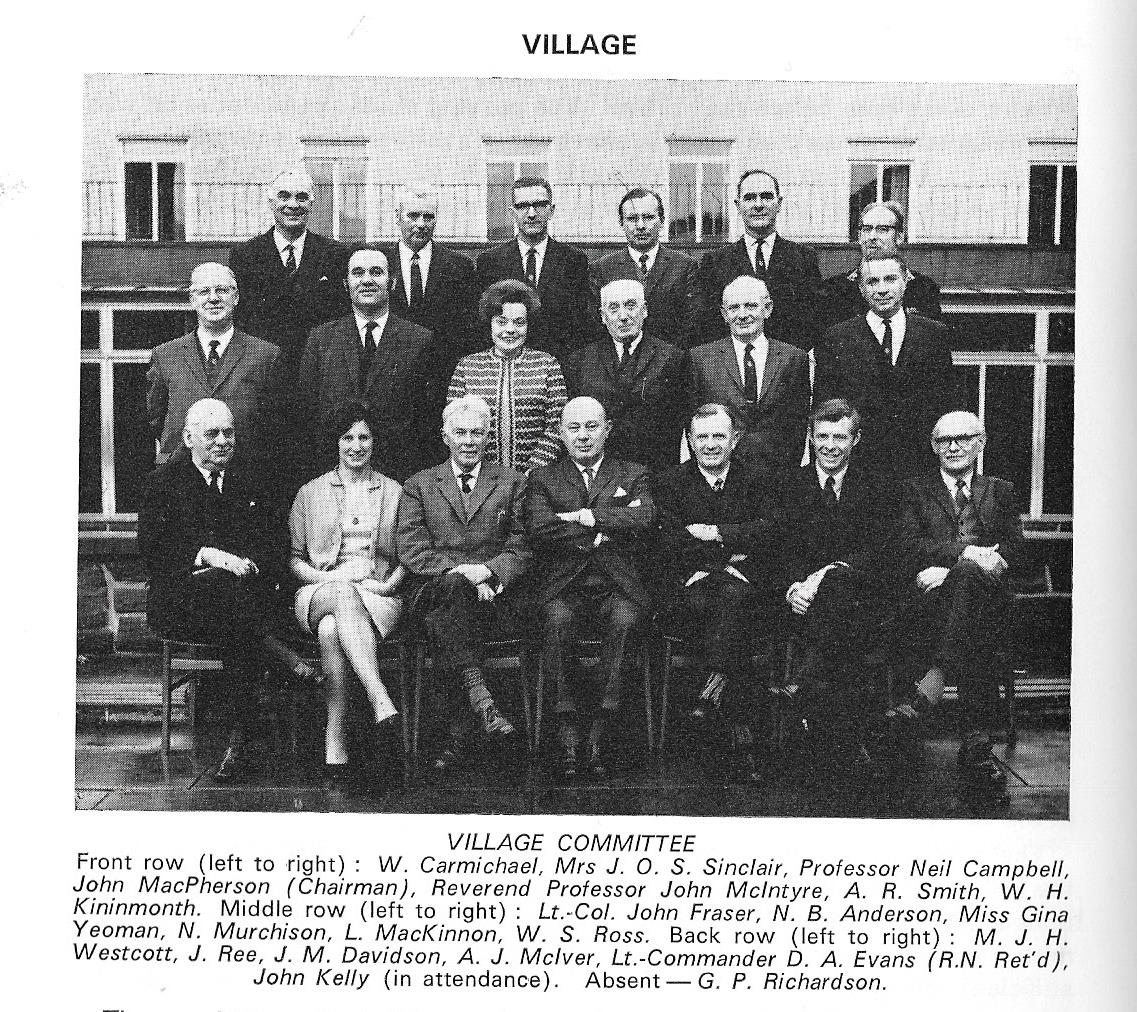
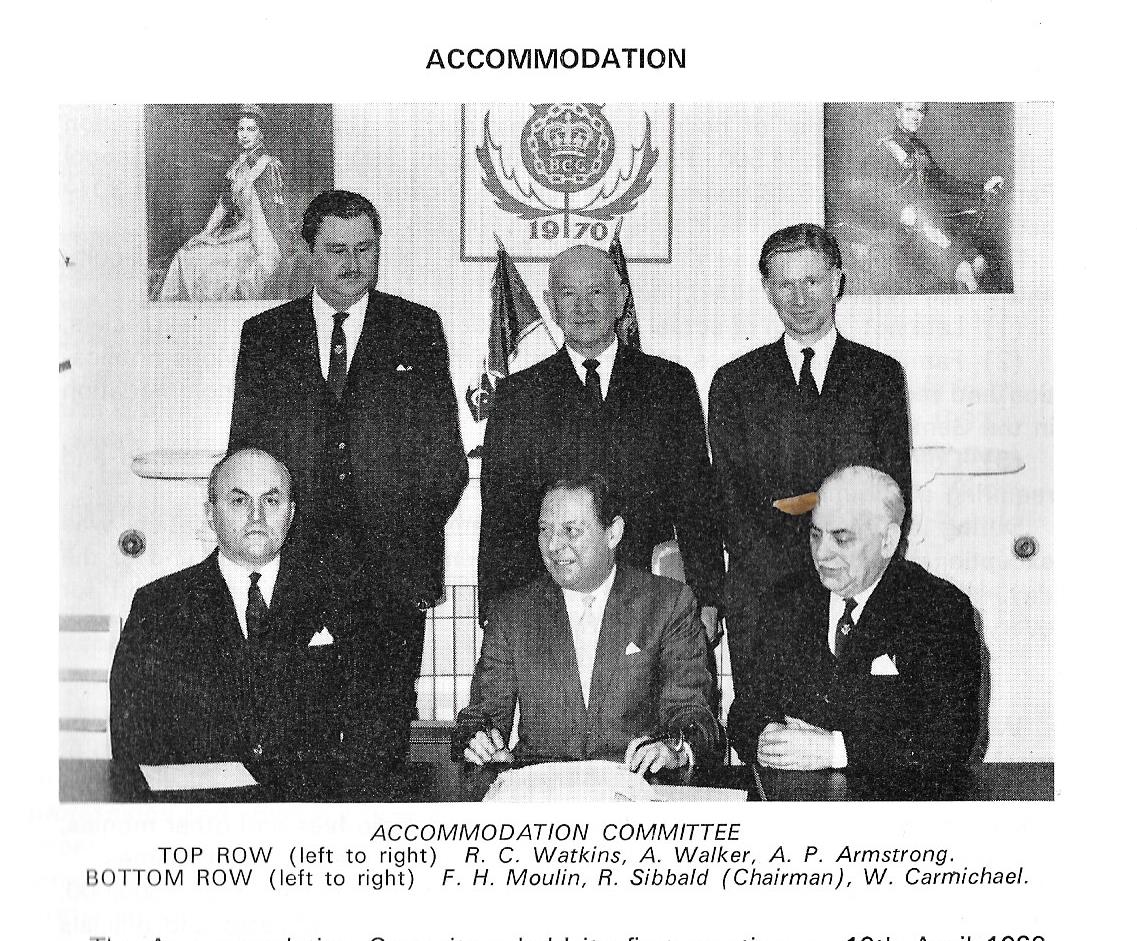
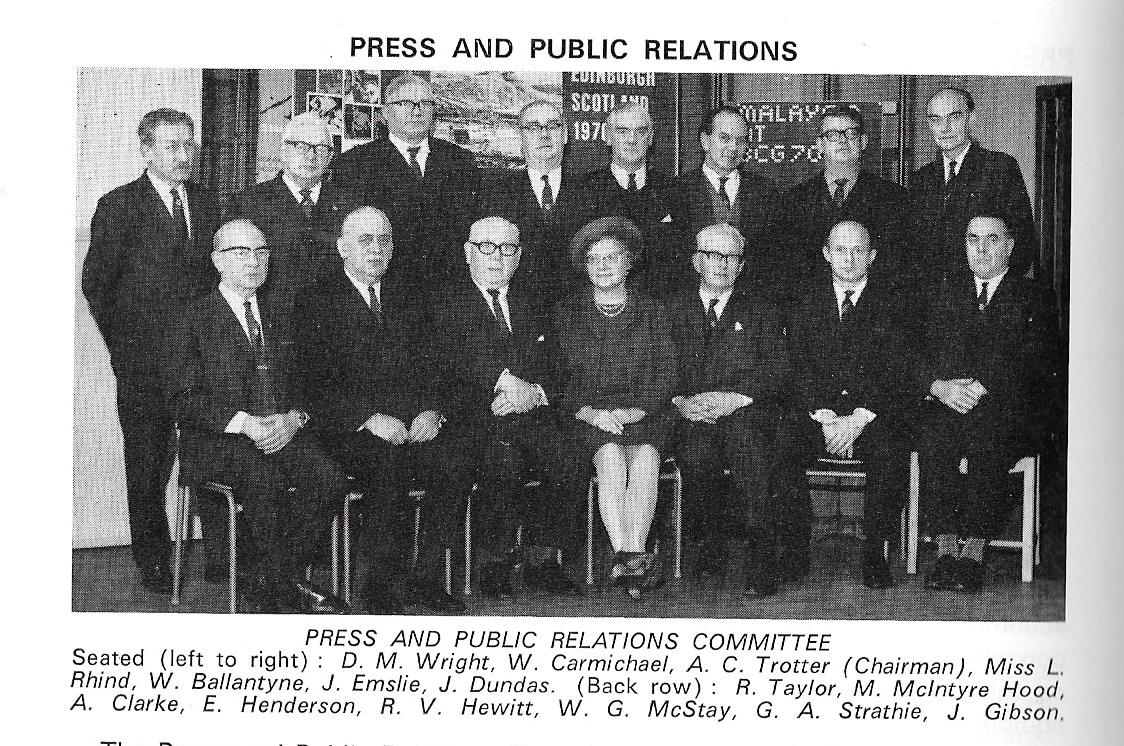
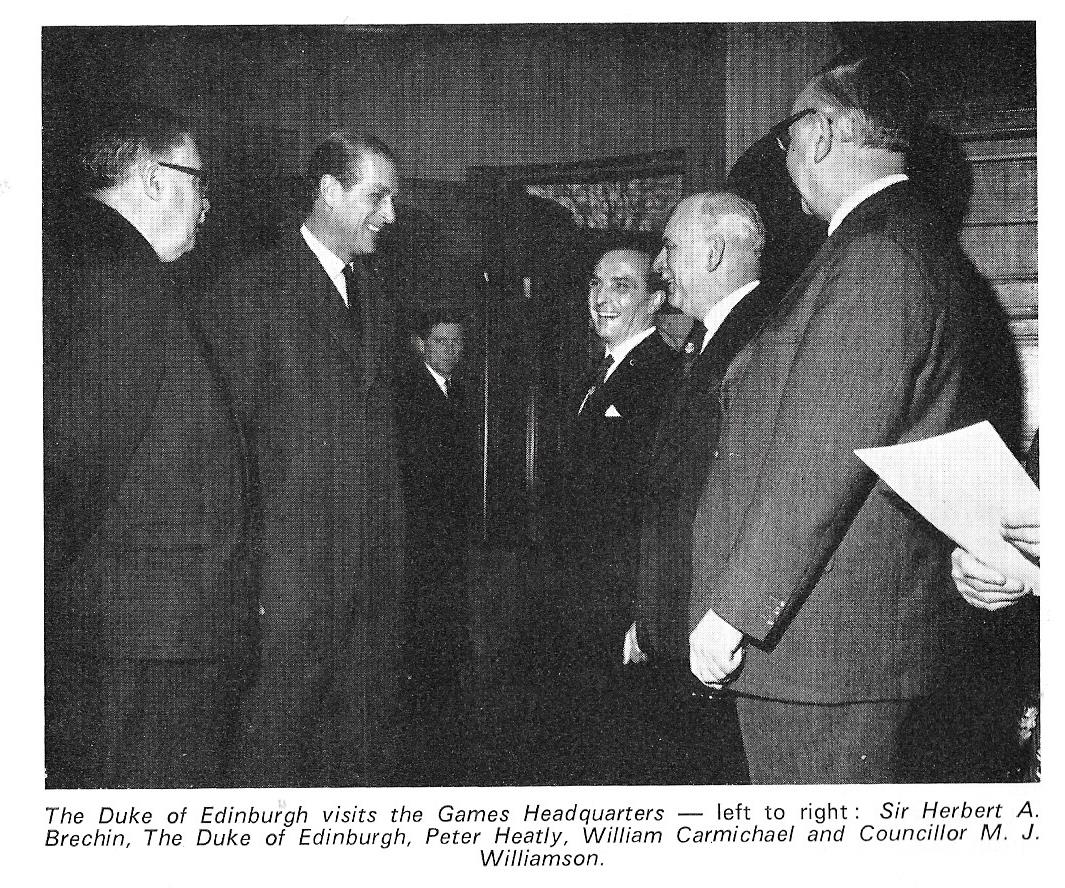
Willie Carmichael was very influential in Scottish athletics for several decades and yet his name is hardly known in current sporting circles.   His  career in the sport began in 1921 as a member of Edinburgh Northern Harriers before helping set up Canon Amateur Sporting Club in 1922.    He was also a a champion wrestler who went on to manage the Scottish team at the 1934 Empire Games, and such was his involvement with that movement that he he was honoured with an OBE in 1971.  He had energy in abundance,  a vision equalled by few and was a great servant of Scottish athletics.

WC 03 10 001

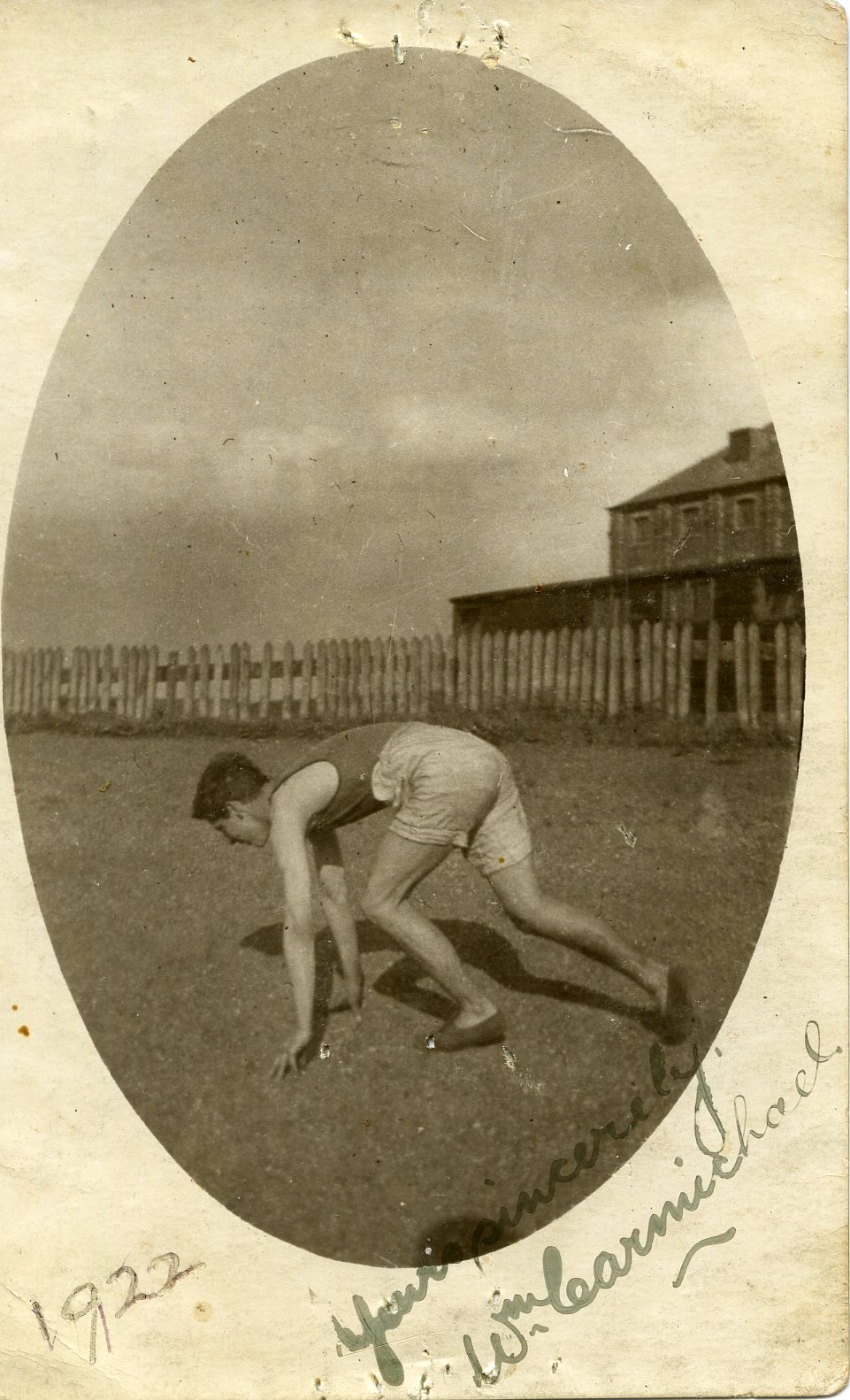
1922, Hawkhill.   W Carmichael of Edinburgh Northern Harriers

In 1922 at the age of 17, Willie, who had started in athletics a year earlier in 1921 with Edinburgh Northern Harriers,  was a founder member of Canon ASC .   Although a runner, he was also already a committee man and, representing the club, he was the second man to hold the post of  secretary of the East District Cross Country League (which was established in 1924) from 1926 .  It was a post he held until 1928 when he went off to India to work.   On his return two years later,  he became League President from 1930 t0 1934, still as a member of Canon.   1934 was a significant year for Willie:  when Canon ASC became Edinburgh Eastern Harriers he was a founder member; and in that same year he was manager of the Scottish wrestling team at the Empire Games in London.   The Scottish Amateur Wrestling Association was formed in 1931.  By 1938 Kenneth Whitton was President and Willie Carmichael Secretary of SAWA and they were joint team managers at the 1938 Empire Games in Sydney, Australia.  (Kenneth Whitton was also an athlete and athletics historian who made several contributons to the official 50th anniversary history of the SAAA).   Willie was very active in both sports simultaneously and by 1938, at the age of 36, already had experience of three Empire Games.

WC 03 10 003

Final, Thomas Young Cup.   W Carmichael  v  J Cropper (winner)  1932

As an elected member of the SAAA, he was automatically on the East District Committee of which he was Secretary from 1937 to 1951.   President of the Scottish Cross-Country Union in 1937/38, he is better known for his work with the cross-country side of the sport before the War in 1939.      The War started in 1939 and athletics was the least of anybody’s problems with the sport on a back burner until 1946.

Even the War couldn’t hinder his interest in the sport.   Betwen 1944/45, while Director of Salvage for Northern Ireland, he was a member of the NIAAA committee and chaired the meeting of North and South which formed the Irish Amateur Athletic Board.

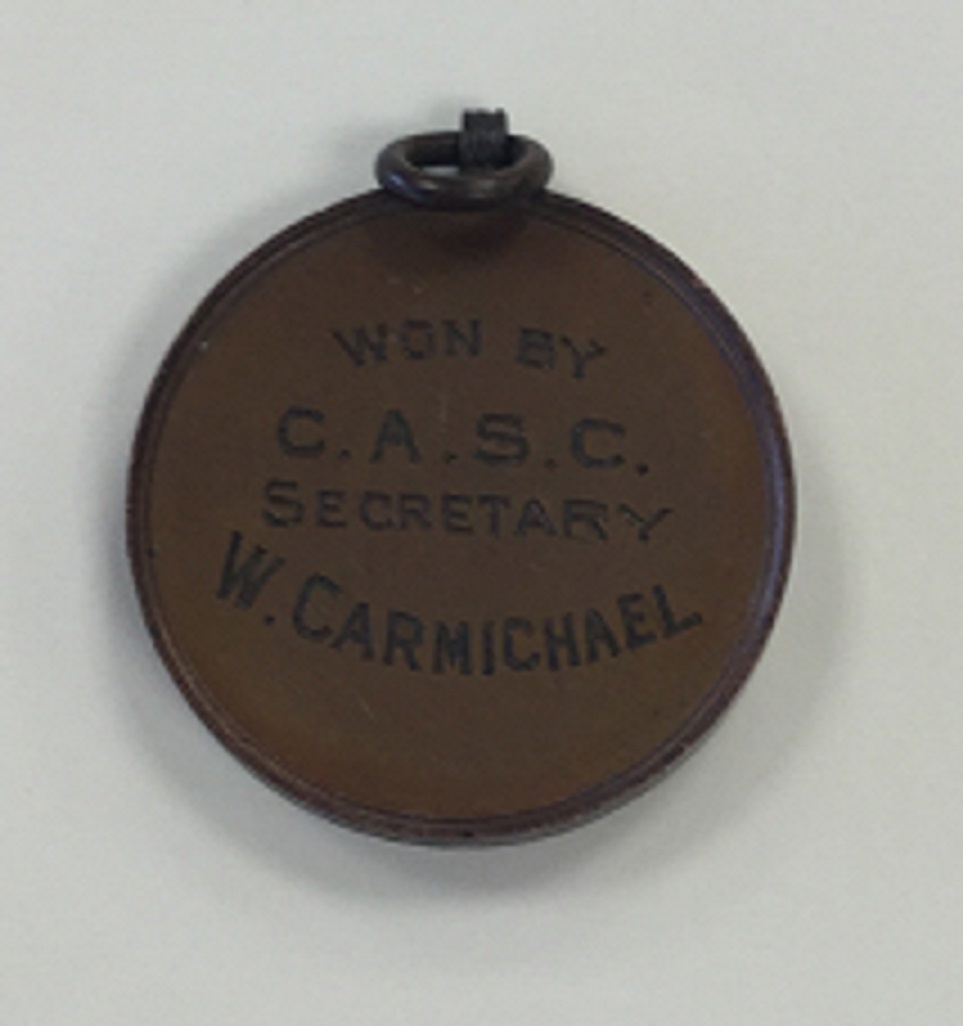
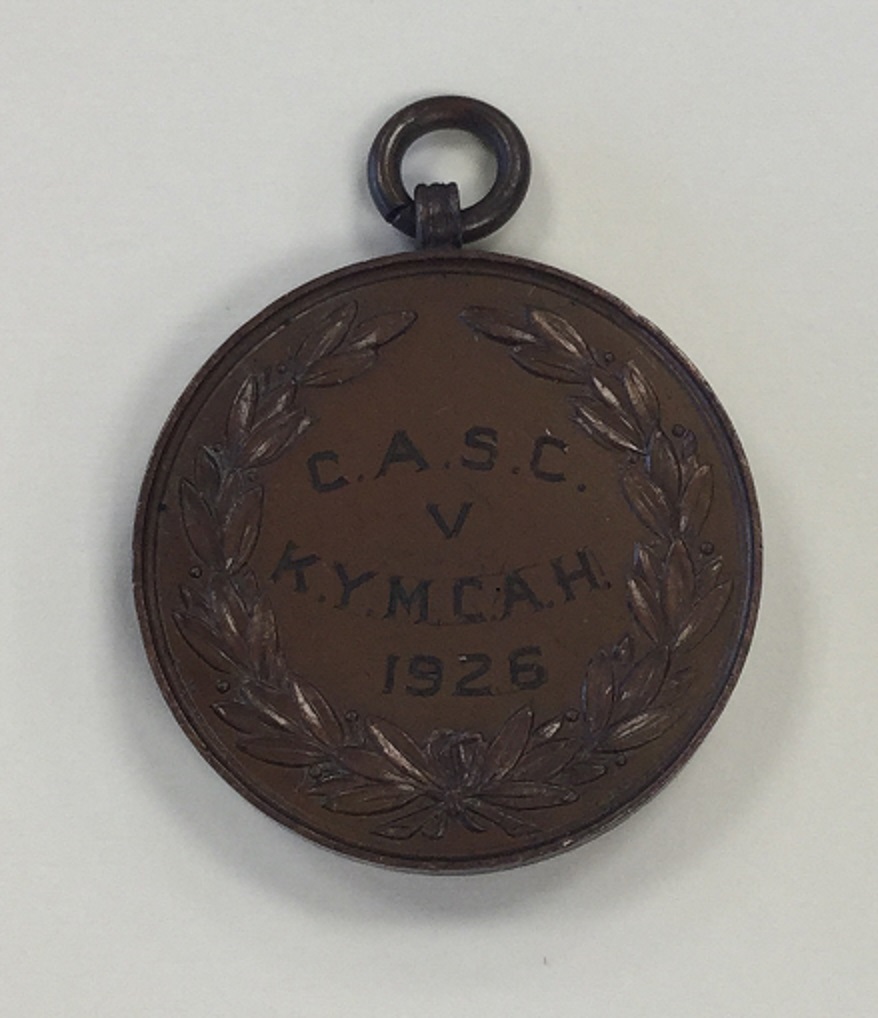
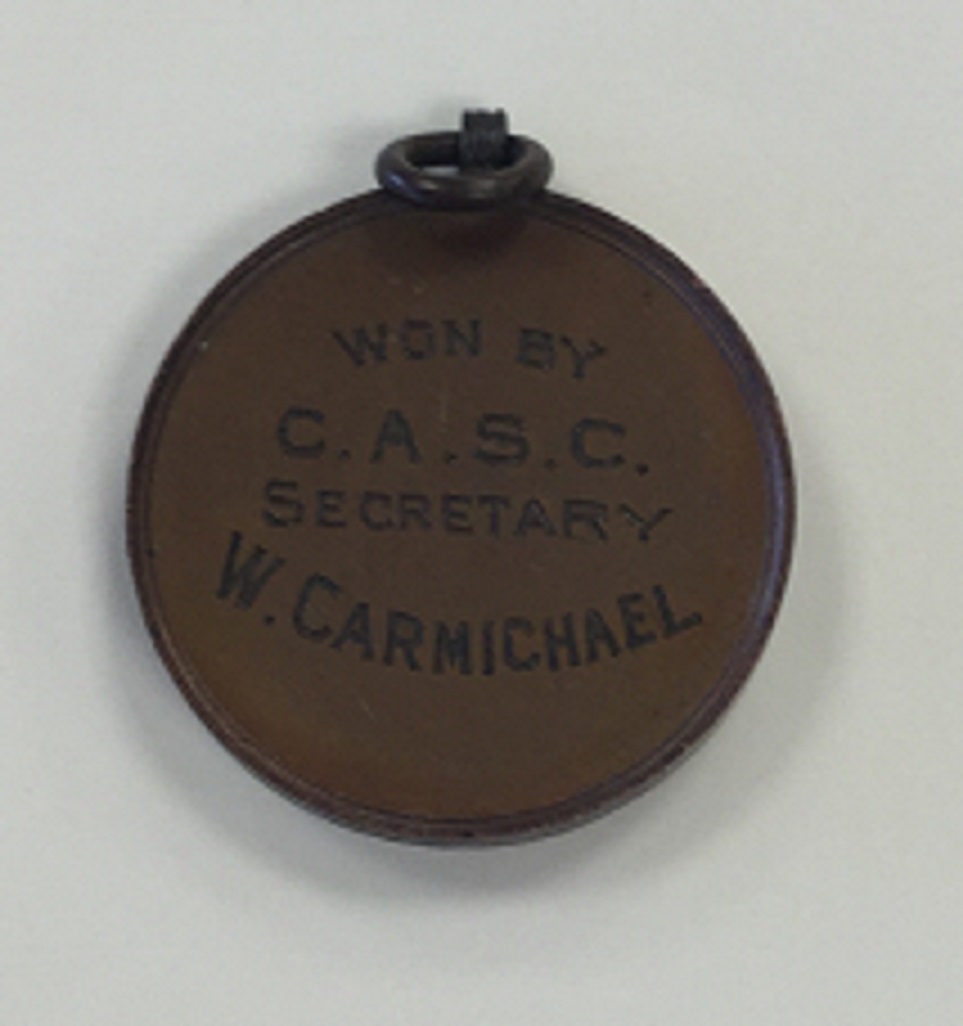
WC CASC 2Medal for winning the Canon ASC v Kirkcaldy YMCA 2 Miles.

After the War Willie is better known for his work in track and field athletics.   He remained on the East District and SAAA Committees and hard as he worked there, he still found time to serve the sport in a multitude of ways.   For instance in August 1947 it was decided to publicise the ‘Enterprise Scotland Exhibition’ by organising an Edinburgh to London Relay.   There were 26 runners involved and it was a mammoth undertaking – the logistics of providing transport, food, lodgings, etc were difficult enough but there were the added complications of ‘glad handing’ local dignitaries in every town and city they passed through and feeding information and publicity to the Press.   The team manager was Willie Carmichael.   He wrote about it in the ‘Scots Athlete’ magazine of October/November 1947 where, although he does not make it sound exceptional, it really was a first class piece of organisation and management.

WC 03 10 004

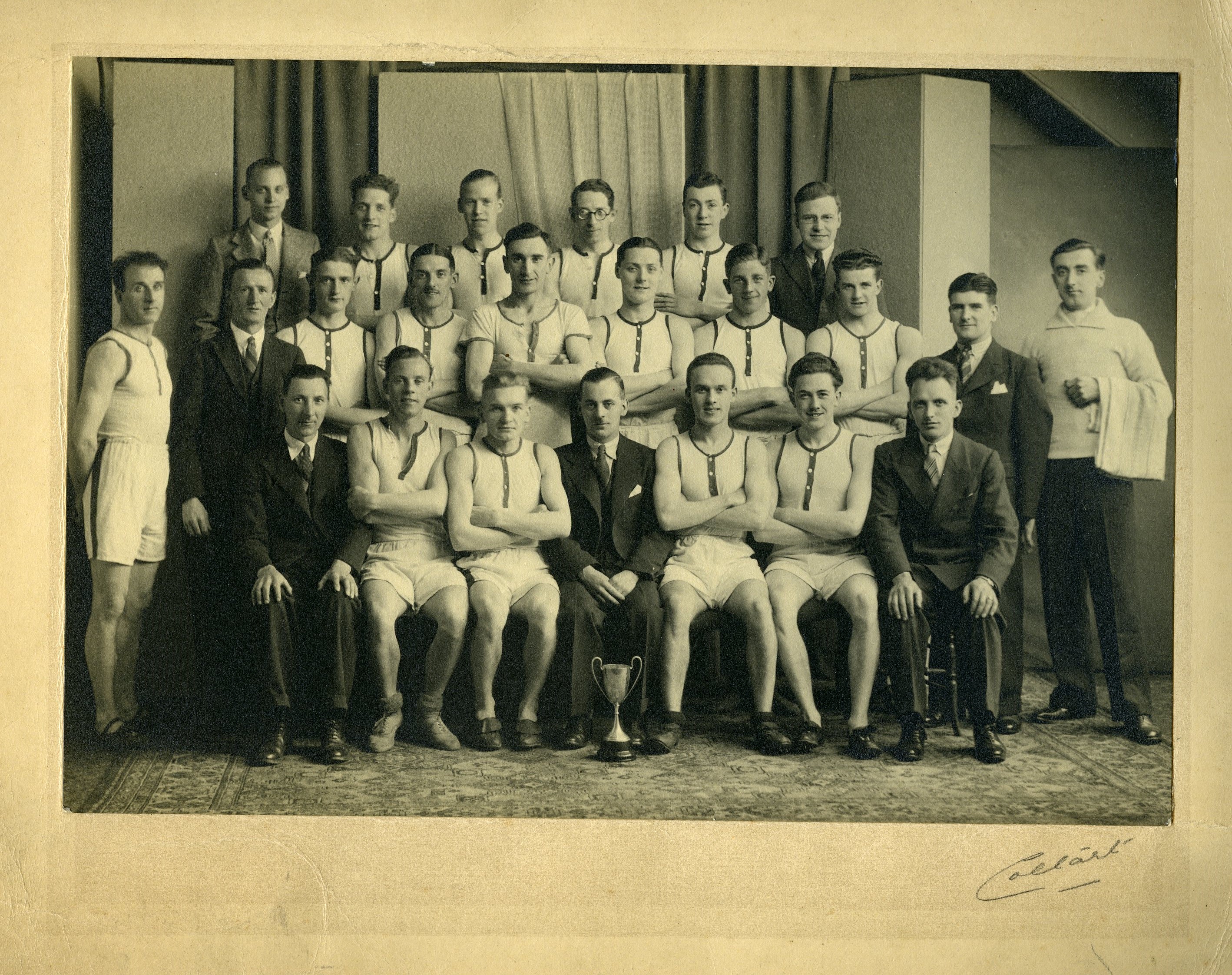
Edinburgh Eastern Harriers, winners of Heriot Athletic Trophy

‘Braw Lads’ Challenge Shield for Mile Relay Race at Galashiels.Braw Lads Sportr

Willie Carmichael, President

That magazine made a point of covering the top athletics meetings of the day in detail – the Rangers Sports, the Glasgow Police and the Edinburgh Highland Games being the major ones.   In the June 1947 issue,  below the accompanying photograph, it noted:

“William Carmichael (Hon Sec, Eastern District, SAAA) is doing his utmost to make Edinburgh a great centre for amateur athletics.   He is responsible for the big 14th June meeting at New Meadowbank, and Edinburgh Corporation Highland Games on Saturday 19th July at Murrayfield.”   

Willie worked for the Lighting and Cleansing Department and had organised, among other things, the Edinburgh Lighting and Cleansing Department Open Meetings.   When the Edinburgh Highland Games started out in 1947, who better to organise them than Willie Carmichael: I quote from the September, 1949, issue of the Scots Athlete:

A Bouquet for Edinburgh

W Carmichael who was the guiding light in this promotion once again proved his great flair for organising and it was grand to see such a resounding success.   The hard-working Eastern District Secretary has the gift of imagination and believes in doing things on a big scale.   For instance the appearance of Arthur Wint and Fanny Blankers-Koen would alone have drawn the crowd.   But an invitation was also extended to a select  British team of athletes and cyclists; and what a team Jack Crump had with him.     …………..   But at the end of the day in attempting to recapture once more the highlights of the meeting, perhaps the most striking feature of all was the magnificent enthusiasm of the spectators.   The warm sportsmanship of the Edinburgh audience remains a fragrant memory”.

Willie was not just an administrator either although he organised the Edinburgh Games for a total of 31 years.   He was a Grade One Judge for all three disciplines of track, jumps and throws and officiated latterly as referee at meetings big and small.  eg he officiated at the Rangers Sports from at least 1950 to 1962.   In 1948 he worked at the London Olympics as a track judge and as a wrestling judge. He thus officiated as a Judge or official at Scottish open, District, National and International events on the track and over the country.   He also officiated on the Edinburgh to Glasgow eight-man road relay.   As a reward for his work with the SAAA he was elected President in 1953.

WC 03 10 002

Mr Carmichael centre with Local Authority officials from the North of England

Not only was the man active on the Scottish stage, in 1952 he was a Scottish representative on the British Amateur Athletic Board – this was a three year appointment and it coincided ith his election as President of the SAAA.

So far Willie had had a good career in athletics, but the best was yet to come for Scottish athletics from Willie Carmichael.    SAAA triple jump champion Graham MacDonald recalls that as a young competitor in the 1960’s, ” I remember Willie when he was competing in the East District Championships at what was then called New Meadowbank.   That was the track constructed next to the Meadowbank Speedway Track used by Edinburgh Monarchs.   All gone of course when the Commonwealth Games stadium was built for the 1970 Games.   I didn’t know who he was but he looked very dapper and important in his Blue Blazer with a Commonwealth Games badge and wearing a soft hat. Later I realised who he was and at one meeting I overheard him saying to another official ‘we can do it you know’.   I guess he was referring to the 1970 Games and I think that he was a driving force if not the main driving force behind Edinburgh’s bid.” 
At that time Willie had been Chairman of the the Commonwealth Games Council for Scotland from 1950 to 1955 and followed that with Secretary of the Council.   He would hold that post from 1956 to 1979.   Willie was General Team Manager for the Vancouver Games in 1954 when Joe McGhee won the dramatic marathon and Bannister defeated Landy in the Mile.   There is a little-known story of delay of the return home flight while repairs were carried out to an engine and Willie took the whole team to the pictures.   ‘Three Coins in the Fountain’ was the film.   would probably inspire many and probably sharpened Willie’s desire to have the Games in Scotland.  The ‘hard-working East District secretary with a gift of imagination’ and who ‘believes in doing things on a large scale‘, as Emmet Farrell had it in 1947 was about to tackle his biggest task yet.

Willie plus three0003

The Commonwealth Games in 1970 was an undertaking the likes of which had never been seen in Scotland before: there had been two Olympic Games held in London in times of genuine austerity when Britain took on the Games at short notice, and the Empire Games had been held in London in 1934 and Cardiff in 1958, but they had never been held in Scotland.    Willie and Lord Provost Herbert Brechin fought hard to get the Games to Edinburgh.   It was not just one bid that they tendered.   I quote from the ‘Official History of the IXth British Commonwealth Games’:

“Scotland’s wish to be considered as a host country was presented to the British Commonwealth Games Federation in General Assembly at Melbourne in 1956, at Cardiff in 1958, at Rome in 1960, Perth, Australia, in 1962 (when Scotland was defeated in its quest by Jamaica by a vote of 17 to 16), at Tokyo in 1964, and eventually, successfully, by 18 votes to 11, over New Zealand at Jamaica in 1966, for the 1970 or IXth Games.   There the case for Scotland was presented by the Rt Hon Sir Herbert Brechin, then Lord Provost of Edinburgh, and Mr W Carmichael Honorary Secretary of the British Commonwealth Games Council for Scotland, and supported by Councillor Magnus J Williamson (Edinburgh Corporation), and Messrs P Heatly, GA Hunter and DM Wright (Council for Scotland).”

Statisticians Colin Shields and Arnold Black say in their book

“This was not at all just some happy accident. Nothing was left to chance. The meticulous planning began even before Edinburgh beat Christchurch for the right to host the Games at a vote at the Tokyo Olympics in 1964, and the man responsible for so much of it was Edinburgh citizen Willie Carmichael. “More than any other single person, Carmichael brought the Games to Edinburgh,” Colin Shields and Arnold Black write in The Past Is A Foreign Country. “He was Scotland’s wrestling team manager at the inaugural Games at Hamilton in 1930 and had always had the guiding dream of bringing the Games to his native city. “Carmichael not only brought the Games to Edinburgh but organised them as well, acting as full-time director of operations. On a budget of £670,000, he produced the most thrilling and successful sporting extravaganza that Scotland had ever seen. His undoubted talent for organisation and stylish presentation resulted in the Games being judged an overwhelming success both in organisational and sporting terms. “It was by far the largest Games ever held, with 1,383 competitors and 361 officials from the record 42 countries taking part. Meadowbank Stadium, the host for the athletics events, had been constructed especially for the Games at a cost of £2.4 million, including a government grant of £750,000.”

Having learned something at all of these meetings and venues, the bid was sharper every time and by 1966 they must have had known exactly what was required.  The voting had been 18 votes for Scotland against 11 for Christchurch, New Zealand.  They now had the Games for Scotland.   In December 1967 the Appeal Fund was set up with the aim of raising £200,00 towards the costs of organising the Games.  Who better to oversee this mammoth task of previously unseen dimensions with the certainty of unexpected problems than Willie Carmichael.     The first task was to set up the overall organising structure and it appeared like this:

Willie was the Director of Organisation.   Oversight of everything, ex-officio on every committee and committees were set up to deal with Accommodation, Appeals, Catering, Ceremoinial, Queen’s Relay, Communications, Finance, Legal and Concessions, Main Stadium, Medical, Pool, Press and Public Relations, Sports Technical, Tickets, Traffic, Transport, Village, VIP Hospitality and Welcome.   19 sub-committees in all.   All had to be staffed, all had to be accountable and all had the responsibility of ensuring that Scotland was portrayed  in a good light.   All of Scotland’s sports clubs were involved, all interested in sport were involved and every local authority in the land was involved to a greater or lesser degree.   It was a massive undertaking.   Ultimately though, Willie Carmichael was at the heart of the whole structure.

The Village Committee below was only one of those set up to oversee the various aspects of organisation.

The success of these Games is legendary – from Lachie Stewart winning the 10000m in the rain from Australia’s Ron Clarke on opening night right the way through to Ian Stewart and Rosemary Stirling on the last day of athletics it was a triumph and the competitors from all over the Commonwealth reflected the exuberance of the Scottish hosts.   The same tale could be told from all sports – cycling, weight lifting, wrestling, etc all had their moment in the sunshine.

They had been the biggest Games with 42 countries taking part, and they were the first Games to be called the Commonwealth Games.   Scotland was fourth on the medal table behind the big countries of Australia, England and Canada.

1970 was run by sports people for sports people and captured the imagination of the whole country, of those interested in sport and those who had never attended a sporting event in their lives.   There is a piece of film at

 https://scotlandonscreen.org.uk/browse-films/007-000-002-473-c

which shows various key moments of the Games.   The description from Scotland on Screen says:    “This film features amateur footage from the IXth Commonwealth Games held in Edinburgh in 1970. In the film we see a number of key events from the ceremony, opening with pipe bands marching in front of crowds at the stadium, and the arrival and reception of Prince Philip. There is then Highland dancing, followed by the march past of the attending Commonwealth nations, before an athlete presents a scroll to Prince Philip and doves are released into the air. Various events follow, including a medal being presented to a female athlete. The first race takes place. Scottish athletes, Ian Stewart and Ian John McCafferty, take silver and gold in the 5000 metres. During the closing ceremony, we see the Queen going around stadium in horse drawn carriage before the lyrics of Auld Lang Syne are shown on the scoreboard.”

For those who wish a detailed look at the Games in print, there is a good paper under the title  ‘A Spectacular Tableau’ at

https://aspectaculartableau.wordpress.com/2017/02/09/the-edinburgh-1970-british-commonwealth-games-representations-of-identities-nationalism-and-politics/  .

It is an academic publication, includes some gentle criticism and is worth at least a look.

Lachie 70 4

Lachie Stewart (317) tracks Clarke and Taylor in the 10000m

For his part in the winning and organisation of the Games, Willie Carmichael was deservedly awarded the Order of the British Empire (OBE) in 1971 with the citation saying simply  ‘Director of Organisation, 1970 Commonwealth Games.’     Commandant of the Scottish team at the Games in New Zealand in 1974, he oversaw a very successful team performance that had clearly fed off the superb 1970 teams.   The team was just ovcer 60 strong and Carmichael announced at a dinner in October 1970 that it would be at a cost of £40,000.    In twenty first century terms of medals per pound sterling, it was one of the most successful ever!

Officials and administrators for the 1974 Games team

He was also in action in 1978 – his last Commonwealth Games as an official – in Edmonton, Canada and afterwards stepped down from the International Committee.   By then he was Honorary Vice-President of the Federation with Prince Philip filling the President’s post.He remained Secretary of the Commonwealth Games Council Scotland until 1979.    His interest in wrestling continued right into the 70’s.

But the Games was undeniably the summit of Willie Carmichael’s career in sport – everything he had done beforehand can be seen as preparation for it.

  • Experience of  managing sports teams at the Empire Games from the very first meeting
  • General Team Manager at the 1954 Empire Games
  • Experience of m ore than one sport at international level
  • Administration of domestic championships
  • Organising big international meetings such as the Edinburgh Highland Games
  • Albeit on a smaller scale, the multi-faceted and complicated logistics of the Glasgow to London Relay

Although the Games of 1970 were the undoubted apogee of his career in sport, he did not do, as many would have and some did, retire at the top of his game.   He stayed with the sport – was he not Secretary of the Commonwealth Games Council for Scotland until 1979?   He officiated at many meetings thereafter simply because his love of sport was part of his character.   Above all he remained involved with Scottish athletics.   At the 1974 Commonwealth Games in New Zealand, he was team commandant, and he was also with the team in 1978 – the year before he stepped down as Council Secretary.

78 Group 1

Publicity shot for 1978 Games in Canada

Scottish athletics were lucky to have had him as one of its more faithful servants.   When I stepped down from the SAAA Committee, Willie Carmichael was an Honorary Life Vice President having been elected as such in 1958.    Even without the 1970 Commonwealth Games he would have had a wonderful career.   The work done before during and after made it a totally unique career in the sport.

Some links to extra material:   Willie Carmichael’s Commonwealth Gallery : Some photographs from Willie’s career plus several Games pictures

   Extract from the History of the Edinburgh Games, 1970: 1.  Tasks facing the organisers once the Games were won    and

2.   Drawings from the various venues.   As an indicator of the difference between these wonderful Games and thc current bloated affair

Finally, thanks to all those who helped with this task: Alex Jackson and Graham McDonald who helped get it started and Karl Magee and Ian Mackintosh in the Archive Department in the Stirling University Library.   If you are at all interested in the Commonwealth Games of any era, they are a great source of information.   Thanks, folks.

WC Pre group

  Taken at a reception organised by Lothian Regional Council on 22nd August, after the Games which lasted from 3rd to 12th August, – and they’re waiting for a team photo to be taken.   Names so far:

Left in shades John Graham;  Jim Turnbull wrestler standing third left; Chris Black, hammer, back row with beard is talking to Peter Hoffman, runner;

Seated (2nd row):  Drew McMaster, sprinter, left, Allister Hutton, runner, 2nd left; Paul Forbes, runner, 3rd left;

Third row: Jackie Hynd, weightlifter 3rd from right, Brian Burgess, high jumper 2nd from right ; Willie Wood, bowler, in second row on the right.

Ronnie Hurst, diver,bottom far right;

1970 Extracts: 2. Gate Money

Willie Carmichael0004

Among the really big differences between the Games of 1970 and those of the 21st century, is the difference in the money involved.   What I have added here is the money taken at the various venues for the Games.    It was of course possible to buy tickets for particular sports and particular days so that most of those attending were either involved in active participation in the sports or former participants or supporters.   Anyway, below are the pages which deal with ‘takings’ at the various venues.

OHCO Rec 1

OHCO REC 3

OHCO REC 5

1970 Extracts: 1. Tasks

Willie plus three0003

The Official History of the IXth British Commonwealth Games was compiled and edited by Willie Carmichael  and M McIntyre Hood and was a very detailed account of the Games from conception to conclusion.   We have here extracts from the history and begin with Sir Herbert Brechin’s intrduction.   He was Lord Provost of Edinburgh at the time and had played a major part in the acquisition of the Games for Scotland.   He says:

“The Games in Scotland, within the ancient capital city of Edinburgh, have taken place and the 15 years of overall preparation have concluded in a spectacle of which the British Commonwealth of nations can be justly proud.   In a previous message I said ‘In all those arrangements we look forwrad to the 9th in the series of the Games being reckoned as being one of the most memorable in the series.

Many tens of thousands are now able to judge for themselves whether our hopes were fulfilled.   From the record number of counmtries participating, from the record number of competitors and officials taking part and from the wave of enthusiasm which pressed over the country, I am convinced that the IXth Games will long be remembered as one of themost successful of the series.  

The facilities provided, including the new modern Sports Centre at Meadowbank, and the advanced design of the new Commonwealth pool, allowed the competitors the fullest opportunity to participate and give of their best in their many skills.   A great measure of the success of the Games lay in the pleasure all had in seeing HRH the Queen, HRH the Duke of Edinburgh, HRH the Prince of Wales and HRH the Princess Anne so happy in their midst.   The Games were honoured in addition to the presence of the Royal Family by the way in which each participated.   It was the first occasion in which HRH the Queen was present in person and the first occasion when the Queen presented medals in several of the Victory Ceremonies.     Their obvious plesure and enjoyment during their visits quickly created that incomparable atmosphere which goes to create ‘The Friendly Games’, so aptly named by HRH the Duke of Edinburgh.

It would be impossible to detail completely all that was done to make the Games so memorable.   The meticulous care and precision which went into the organisation and ceremonial of the Games, and which characterised these Games, was the result of perfect team-work by possibly the largest-ever team which operated over the four years of detailed organisation prior to the event.   The British Government, the Local Authoprities of Scotland, the business houses in the commercial and industrial fields, the business people and individuals all combined in the accomplishment of this ideal.

The coming to Edinburgh and Scotland of so many thousands of people from so many countries of the world made the consummation of the final project possible by their presence.   They rejoiced with us, they inspired us, and they left behind a fragrance of memory and happy association which will always stand high in the traditions of Scotland.

Sir Herbert Brechin

KBE, OL, JP, D Litt, FRICS, FRSE

Willie plus three0003 As an example of the tasks that had to be addressed right at the start, extracts from pages 18 to 27 are copied below:

OHCO 18

OHCO 20

OHCO 21OHCO 24

OHCO 25OHCO 26

OHCO 27

And so on with detailed instructions on the dates, venues and times of Royal visits to the many venues and events.