Training with McLatchie: 7

Justin Chaston: Steeplechaser

The range of athletes that Jim McLatchie has worked with or brought all the way through to international honours is very wide – we have already seen some of his work with mile and marathon runners as well as with cross-country champions.   This section is on his work with steeplechasers.   By far the best man he worked with in this event was Justin Chaston (pb 8:23.90).   Chaston ran in three Olympic Games (1996, 2000 and 2004), World Championships (2004), Commonwealth Games (2004), Universiade (1995) and the World Cross in 1987.   A remarkable record by any standards.   The workoits that he did before the Olympics in 2004  are detailed  here   for you to see.   When I contacted him he reckoned that Jim had kept more detail on him than he had recorded himself!

This is what Jim has to say about training good class steeplechasers.

STEEPLECHASE PROGRAM 

Workouts described below are for steeplechasers with examples using 3K and 5K as the base for establishing workout times. 

8 Weeks Build-Up (September – October)

  1. 1 Hour easy run
  2. Hill work –     short hills plenty of reps with short rest

10 x short loop (150M with 2 hills) 30 sec rest/ jog 5 min/ repeat

Build up to 8 x 450M with 90 sec rest

  1. 1 hour easy
  2. Tempo Runs   e.g.: 2 mile easy/ 1 – 5k pace/ 1 – 10k + 20 sec/mile/ 1 – 10k pace/ 1 – 5k/

Cool down. Note any combination to equal 8 miles of continuous running.

  1. 1 Hour easy
  2. 45 min easy
  3. Long run start at 1 ¼ hours add 15 min every 2 weeks until 2 hours is reached

November – December

  1. 2 hours easy
  2. Track work – Long repeats: 2 x mile 30 sec rest between/ jog 5 min/ 4 x 800 30 sec rest

4 (mile 1 MR 200 quick) 3 min between sets

2 x 3000M 4MR          Try and do

3 x 2000M 3MR           at today’s

4 x 1500M 3 MR          5K pace

6 x 1000M 2 MR

  1. 1 hour easy with 2 x 5 min pick-ups during the run
  2. 10 mile Tempo run. Any combination of pace per mile to equal 10 miles

warm up/ 2 mile – 10k pace/ 1 mile 10k pace + 20 sec/ 1 mile – 5k pace

1 mile 10k pace + 20 sec/ 1 – 5k pace/ cool down

  1. 1 hour easy run
  2. 30 min easy if racing tomorrow else 45 min easy
  3. Race or Hill/grass work – long reps e.g. 3 x mile 3 min rest/ or 6 x 800 3 min rest/

or mile: 2 x 800: mile 3 min rest between

January – February

  1. 2 hours easy
  1. Track work – Variable repeats: 16 x 200 30 SR between/ Jog 5 min/ 800

                                                or            10 x 300  30 SR between/ jog 5 min/ 800

or              6 x 400 30 SR between/ jog 5 min/ 800

or              2 ml/ 2 MR/ 2 x mile 1MR/ 4 x 800 30 SR

or               3 x 1000 30SR/J 400/ 2 x 1000 30SR/ j 400/ 1000

  1. 1 hour easy with 3 x 4 min pick ups during the run
  2. 10 mile Tempo run. Any combination of pace per mile to equal 10 miles

warm up/ 2 mile – 10k pace/ 1 mile 10k pace + 20 sec/ 1 mile – 5k pace

1 mile 10k pace + 20 sec/ 1 – 5k pace/ cool down

  1. 1 hour easy run
  2. 30 min easy if racing tomorrow else 45 min easy
  3. Race or Hill/grass work over hurdles.     E.g.     1000M 3MR/ 2 x 500 90SR/ 1000M

Or 3 x 1000M 3 MR

Or 500M 90SR/1000M 3MR/1000 3MR/500

March – April

  1.  Two hours easy.
  2.  Track work – Long repeats: 4 x mile 2MR

                                                or        

          3000M/2 x 1000/ 2 x 600/ 3 MR between

or         2000/ 5MR/ 1000/ 3MR/ 500

or         4 x 800 2MR/ jog 5 min/ 4 x 800 1M

  1. 1 Hour easy with 4 x 3 min pick-ups during run
  2. Track work- short reps 200:400:600:400:200 3MR between

Or        10 x 200 200 jog between

Or        2x(4 x 400 2 MR) 5 min between sets

Or        4 x 400 rest = 3M/2M/1M/ jog 5 min/repeat

  1.  1 hour easy run
  2. 30 min easy if racing tomorrow else 45 min easy
  3.  Race or Hurdle work on track.  E.g.   Water jump drills

Hurdle drills

Flexibility

May – June

  1. 1 hours easy
  2. Track work – emphasis on pace:  2 x mile 8 MR over hurdles

or         1600/1200/800/400 3MR over water

or         6x 800 3MR change up: 2 @ 2.12:2.04/2.10 no hurdles

  1. 1 hour easy.
  2. Track work- variable reps 400:1200:400 4MR over hurdles no water

Or        1600:800:1600 4MR over hurdles every 2nd lap

Or        400/ 60SR/800/2MR/400? Jog 10M/ 400 fast. No hurdles

Or        1000/ 1MR/500 3MR/ 500/ 1MR/1000 over hurdles

  1. 1 hour easy run
  2. 30 min easy if racing tomorrow else 45 min easy
  3. Race or Hurdle work on track. E.g.   Water jump drills

Hurdle drills

Flexibility

10 Day – Pre Big Race

  1. 1 hour easy
  2. 1500M race
  3. 10 miles easy
  4. 1600:1200:800:400 3MR over water only (4.28/3.18/2.10/58)
  5. 1 hour easy run with a 5 min pick up in middle
  6. 400:1200:400 4MR over hurdles no water at race pace
  7. 1 hour easy
  8. 30 – 40 min easy with a few strides
  9. Heats – 3000M S/C
  10. Final – 3000M S/C


Training with McLatchie: 6

Marathon

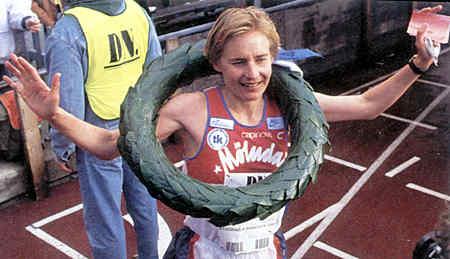
MIDDE HAMRIN, Swedish Olympic Marathon, 1984: Coached by Jim

Very few Scottish coaches or athletes realisejust how good a coach Jim is.   He has worked with several Olympians at different distances – Mile, Steeplechase and Marathon.   Midde Hamrin above ran in European Championships, Olympic Games, World Championships as well as in the big city races.  She has a marathon pb of 2:36:15.   Training for two more of his best marathon runners is given below bur first he just lays out what his general principles are and gives a 10 week schedule for a top class marathon runner.

Determine feasible goals for the race, then figure out marathon pace per mile. Eg: Marathon in 3:03.3 is 7 minutes race pace
7 mins = 420 secs. Race pace less 10 secs = 420-10 = 410 = 6:50
Predicted time for 800 with 20 secs less per mile = 420-20 400=/2 = 200= 3:20

Workout
– Saturday runs should be run at 10 sec per mile less than race pace
– Try and run at least 30 min each morning Mon – Fri – don’t worry about distance.

10 WEEK PROGRAM

WEEK 1
1 – 10 miles easy
2 – 6x 1600 – race pace less 10 secs per mile with 200 jog between
3 – 6 miles easy
4 – 20 x 200 with 100 walk between run how you feel
5 – 10 miles easy
6 – 6 miles easy
7 – Race or 6 mile hard

WEEK 2
1 – 12 miles easy
2 – 3 x 3200 Race pace less 10 sec per mile with 600 jog between
3 – 6 miles easy
4 – 20 x 300 with 100 walk between run how you feel
5 – 10 miles easy
6 – 6 miles easy
7 – Race or 8 mile hard

WEEK 3
1 – 15 miles easy
2 – 6x 1600 – race pace less 15 secs per mile with 200 jog between
3 – 8 miles easy
4 – 10x 800 Race pace less 20 secs per mile with 200 jog between
5 – 8 miles easy
6 – 8 miles easy
7 – Race or 6 mile hard

WEEK 4
1 – 15 miles easy
2 – 2 x 3 miles race pace less 15 sec per mile with 800 jog between
3 – 8 miles easy
4 – 20x 200 with 100 walk between – race pace
5 – 10 miles easy
6 – 6 miles easy
7 – Race or 8 mile hard

WEEK 5
1 – 15 miles easy
2 – 3 x 2 miles race pace less 15 sec with 600 jog between
3 – 8 miles easy
4- 12 x 800 race pace less 25 sec with 200 jog between
5 – 8 miles easy
6 –8 miles easy
7 – Race or 15 mile easy

WEEK 6
1 – 18 miles easy
2 – 6 x1600 race pace less 20 secs – 200 jog between
3 – 8 miles easy
4- 20x 300 with 100 walk between race-pace
5 – 8 miles easy
6 –6 miles easy
7 – Race or 3 mile easy

WEEK 7
1 – 20 miles easy
2 – 2x 3 miles race pace less 15 secs – 200 jog between
3 – 8 miles easy
4- 20x 400 with 200 jog between – race pace
5 – 8 miles easy
6 –8 miles easy
7 – Race or 10 mile easy

WEEK 8
1 – 20 miles easy
2 – 12x 800 race pace less 30 secs – 200 jog between
3 – 8 miles easy
4- 6x 1600 race pace less 20 secs – with 200 jog
5 – 8 miles easy
6 –8 miles easy
7 –10 mile easy

WEEK 9
1 – 15 miles easy
2 – 3x 3200 race pace less 20 secs with 600 jog between
3 – 8 miles easy
4- 20x 300 with 100 walk at pace
5 – 5 miles easy
6 –5 miles easy
7 –8 mile easy

WEEK 10
1 – 8 miles easy
2 – 3x 1600 race pace with 100 jog between
3 – 6 miles easy
4 – 40 min easy
5 – 30 min easy with a few strides
6 –30 min with a few strides
7 –RACE

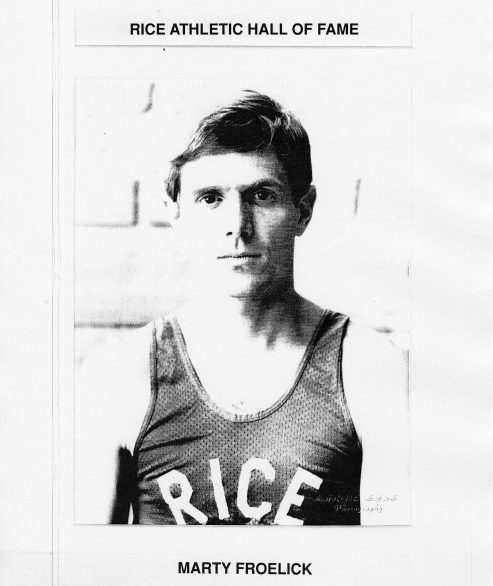
Marty Froelick was a very good distance runner with Rice University, Texas, with a pb for the distace of 2:10 run in the Twin Cities Marathon in 1987.   He also ran several 2:12’s and a 2:11 as well has having a 14:04.7 for 5000 (1978) and 29:14.9 for 10000m.   Jim writes:-

Marty Froelick – 2:10.59

29 Days before marathon. Most days Marty also did morning runs 30-45 mins easy

29 – 30 mile run around 6 min pace
28 – 1 hour easy
27 – 40x 200 jog across middle
26 – 1 hour run
25 – 10 mile run – 2 @ 6.00/ 2@ 5.00/ 2@ 6.00/ 1@ 4.40/ 3@ 6.00
24 – 45 min easy with a few strides
23– 10K road race 30:20
22 – 20 mile run around 6 min pace
21 – 10 x 1K – 3.00 – 200 jog between
20 – 1 hour easy
19 – 2 @ 6.00/ 2@ 5.00/ 2@ 6.00/ 1@ 4.40/ 3@ 6.00
18 – 1 ¼ hours easy
17 – 30 mile run around 6 min pace
16 – 1 ½ hours easy run
15 – 1 hour easy
14 – 6 x mile 4.40 with 1 min rest
13 – 1 hour easy
12 – 2 mile – 10.00/ 5MR/ 2X1 – 4.40 3MR/ 4X880 – 2.16 – 1MR
11 – 1 hour easy
10 – 1 hour easy
9 – 15 miles around 6 min pace
8 – 1 hour easy
7 – 4x mile pace with 1 min rest between
6 – 1 hour easy
5 – 2x 2 miles pace 1 min rest between
4 – 45 min with 5 min pick up
3 – 30 min easy with a few strides
2 – 30 min easy with a few strides
1 – Twin Cities 1st place 2:10.59

Sylvia Mosqueda was a late starter in athletics and you should read some of the stuff available on the web about her career.   She has a 2:37 for the marathon and a 1:10 for the half marathon.  Jim says:- 

Sylvia Mosqueda

Who is Sylvia and what is she!!!

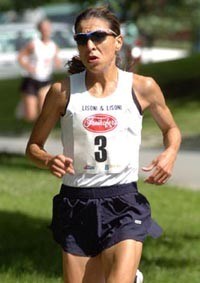
Sylvia is in the front.

Sylvia won the 1987 NCAA cross country championships and in 1988 she won the 10,000 meter title on the track in a time of 32:28.57 which stood for thirty years before it was broken.

I was first contacted about Sylvia who was representing the USA by my wife Carol who was the Team Manager for the USA in the IAAF World Half-Marathon Championships which were held in Bristol England on October 7, 2001. Sylvia told her that she did not have a coach – Carol suggested me.

Sylvia contacted me on November 15th giving me an outline of what she had been doing in respect to training. I prepared a schedule for her for the month of December which I am sure was a wake-up call:
6 x mile with 1 min rest around 5:10
8x 800 with 45 secs rest around 2:32
We decided to have her first race on January 20, 2002 – San Diego Half Marathon which she won in 1:12.37.

The next race planned was a Half-marathon in Austin Texas on February 2, 2002. Ten days prior to the race I had Sylvia do the ‘Ball-Buster’ workout – 2x mile with 30 sec rest 5:12 & 5:09/ jog 400/ 2x 800 with 30 sec rest – 2:29 & 2:30/ jog 400/ 2x 400 with 30 sec rest – 74 & 74/ 5 min rest then repeat/ 5:06 & 5:08/ 2:29 & 2:29/ 74 & 74. After that workout I had a good idea that she was ready to run a fast time.

Carol and I drove over to Austin from Houston to watch the race – Sylvia and I had spoken several times on the phone, but had never met face to face. Driving to the start of the race – Carol spotted Sylvia running up the street – I stopped the car, jumped out, ran towards her – she began shouting “who the hell are you”! – I said “I’m Jim McLatchie – your coach – you silly bugger”.

Gave her a hug and told her to go “kick some ass” and that Carol and I would be out on the course. The rest is history – new course record 1:10.46. She went on to break that record again in 2004 which ranked her 8th best in the USA at that distance with a time of 1:09.52.

Sylvia ran the New York Marathon in 2002 and finished 13th in a time of 2:33.47 and in 2003 she finished 10th overall in a time of 2:33.10. She was the first American to finish the race, she was on the podium with the other top nine women. Alberto Salazar was presenting the prizes, and had to ask Sylvia her name!!

Here is the last 21 days training she accomplished leading up to the race. Mon thru Fri she ran 30 mins in the morning

1. 2x mile- 5.08 – 1 min rest/ jog 400/ 2×800 2.30 – 1 MR/ jog 400/ 2×400 – 70 / jog 5 min then REPEAT.
2. 1 hour run
3. 8 mile run as follows: 1 – 5k pace/ 2 – 10k pace plus 1 min/ 2 – 10 k pace/ 3 – 10k pace plus 1 min
4. 1 hour easy
5. 45 min easy with a few strides
6. 18 miles easy
7. 1 hour easy
8. 3x 3 miles at 10k pace with 4 min rest between
9. 1 ¼ hour with 4x 3 min pick-ups in middle
10. 4x mile 4.52 with 2 min rest between
11. 1 hour easy
12. 45 mins with a few strides
13. 15 miles easy
14. 1 hour easy
15. 2x 2mile at 10k pace with 2 min rest
16. 1 hour easy
17. 45 min with a few strides
18. 45 min with a few strides
19. 20 min easy with strides
20. 20 min easy with strides
21. New York Marathon 10th place in 2:33.10

In 2004 – Sylvia had her best opportunity to make the Olympic team – she was fit and probably in the best shape of her life. In the marathon trials in St Louis she was in second place with 3 miles to go and ran out of steam – everything had ceased up – she could not walk – I had to carry her to the finish area, luckily it was about a mile across the park. Four weeks later she ran a 10,000 in the Mt. Sac relays I explained to her that no one would run under the qualifier in Sacramento because it would be too hot.

Sylvia ran with a woman from Germany until the last mile – coasted to the finish line (big mistake) in 31:57.64 missing the Olympic qualifying by six seconds.

During the 2004 season she recorded her fastest 5000 – 15:33.38 , 15K – 50:08 and ½ marathon 1:09.52

My only regret about coaching Sylvia – is, “I wish to Hell I had the opportunity to coach her when she was in her mid-twenties and not in her late thirties”. All in all we had a great journey.

.

Summit Cross-Country: 2019 – 2020

September 2019:  North West Classic.

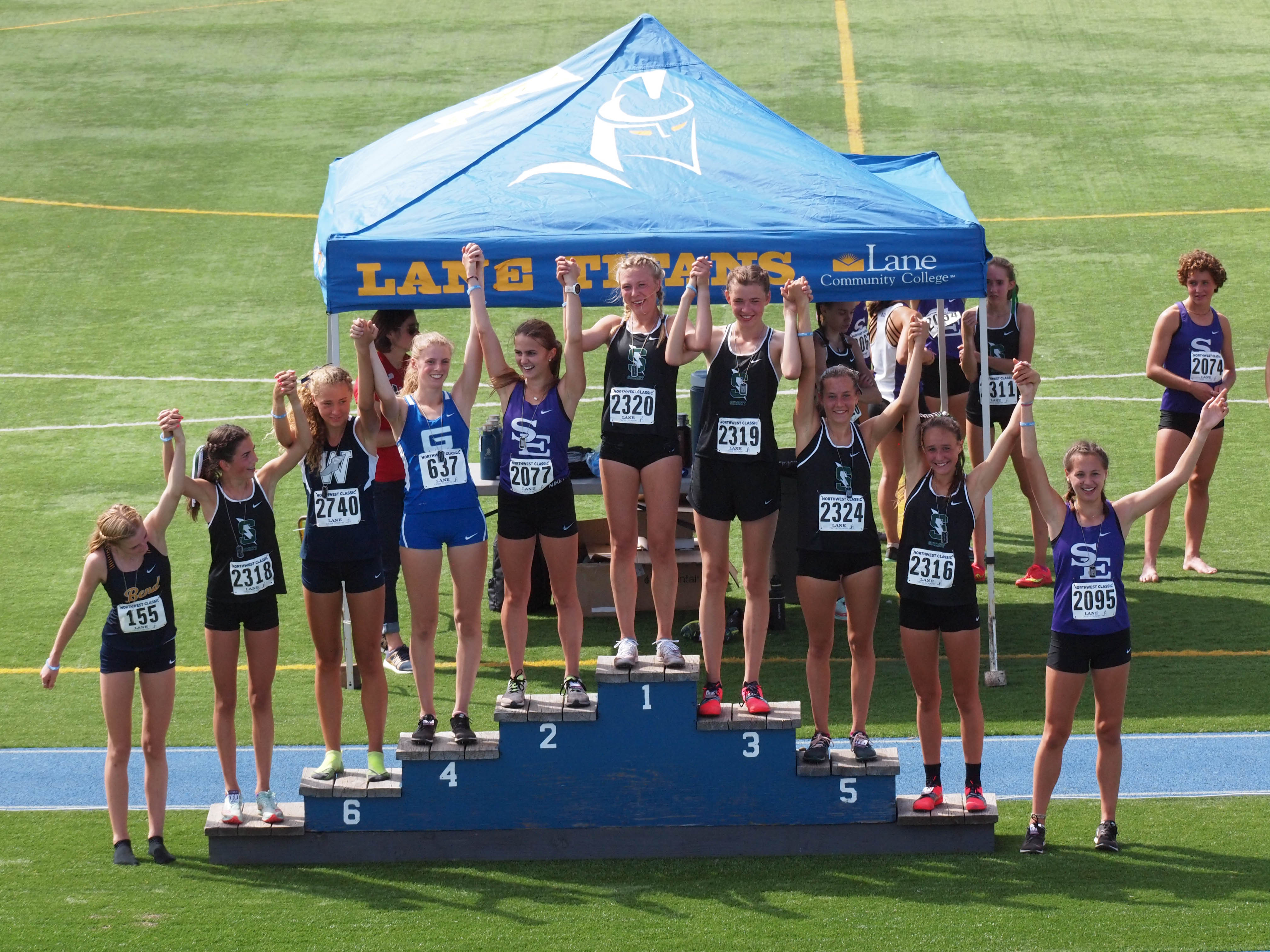
Jim’s comment was a quite laconic “Won all four divisions.   Fiona broke the record by 6 seconds.”

JV Men and Women: Teams 1st and 1st

Name Position
Elijah Pyle 6th
Jack Conde 7th
Charlie McCabe 8th
John Deaver 11th
Evan Grover 14th
Tobias Holme 37th
Name Position
Azza Swanson 1st
Camille Broadbent 2nd
Ellie Skersjaa 3rd
Emilie Eichelberger 5th
Jorun Downing 9th
Maja Arnesen 10th

5A/6A Varsity:    5000 Metres

Again both teams won.   Men on the left, women on the right

Name Position Name Position
Sam Hatfield 9th Fiona Max 1st
Joseph Sortor 10th Teaghan Knox 3rd
Jackson Keefer 15th Stella Skovborg 7th
Mason Kissell 17th Barrett Justema 8th
Parker Meredith 69th Magdalene Williams 22nd

Numbers were big – eg in the Women’s 5A/6A race there were 204 and in the equivalent Meen’s race there were 227.   Fiona won her race by 42 seconds.   


NIKE PORTLAND, 28th September

In the Women’s 5000m Danner Championships, Fiona Max suffered a rare defeat but the team won their race from an entry of 23 teams competing.    The runners were Fiona Max  2nd, Teaghan Knox 3rd, Jasper Fievet 20th, Barrett Justerna  25th, and Azza Swanson 34th.   The Men’s team was unplaced but Sam Hatfield in 27th was their first runner home.    The Junior Varsity women won in a field of 22 teams with Isabel Max going one better than he sister when she won the race from team mate Camille Broadbent with the other scoring runners being Ellie Skersjaa in 4th, Ashley Boone 5th and Emilie Eichenberger 9th.    The JV Men’s team was 3rd out of the 33 teams that completed the course.   There were 240 finishers and the Summit team runners were Robert Gorman 1st, Jack Conde 3rd, Elijah Pile 18th, Sam Timms 40th, and John Deaver 95th.    

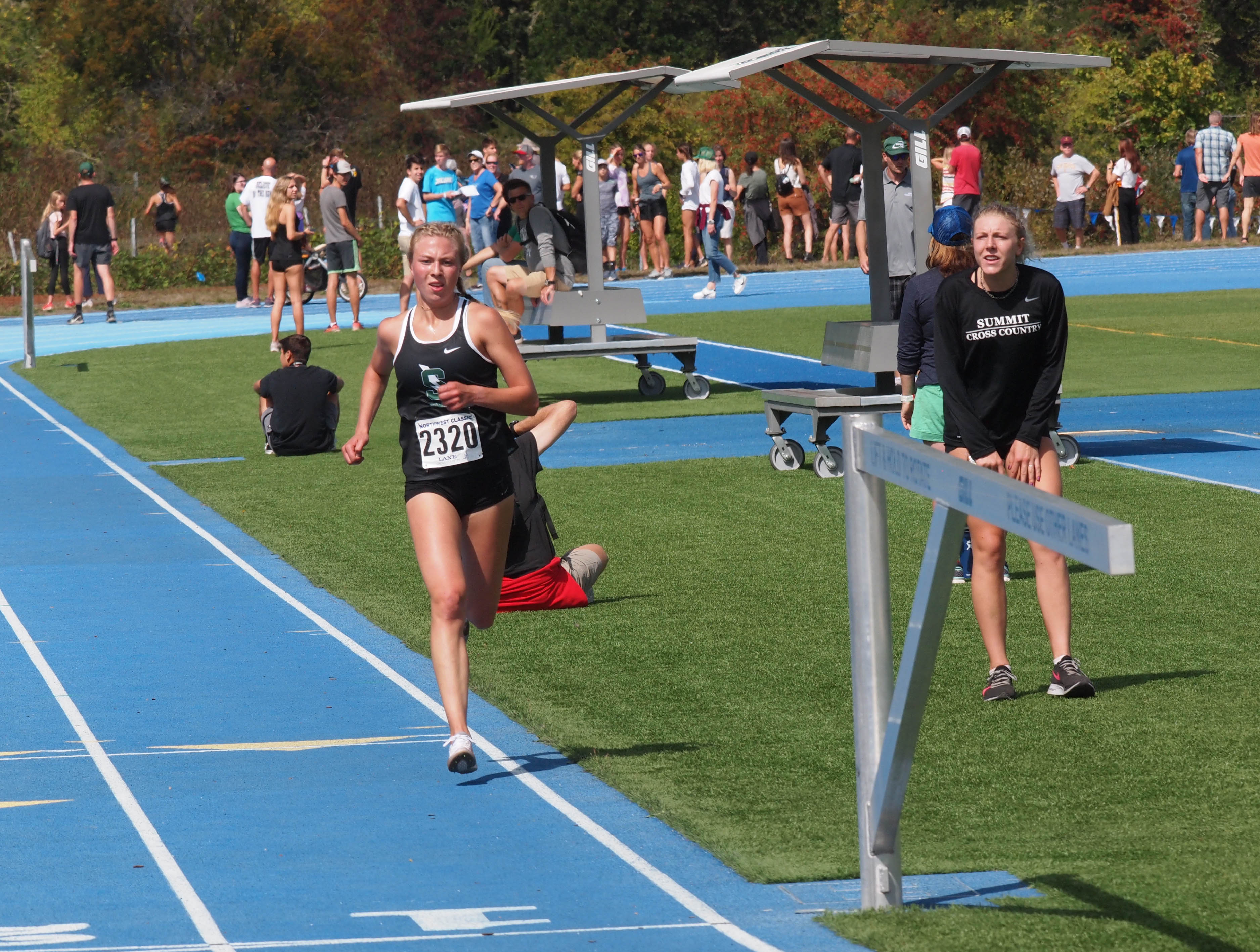
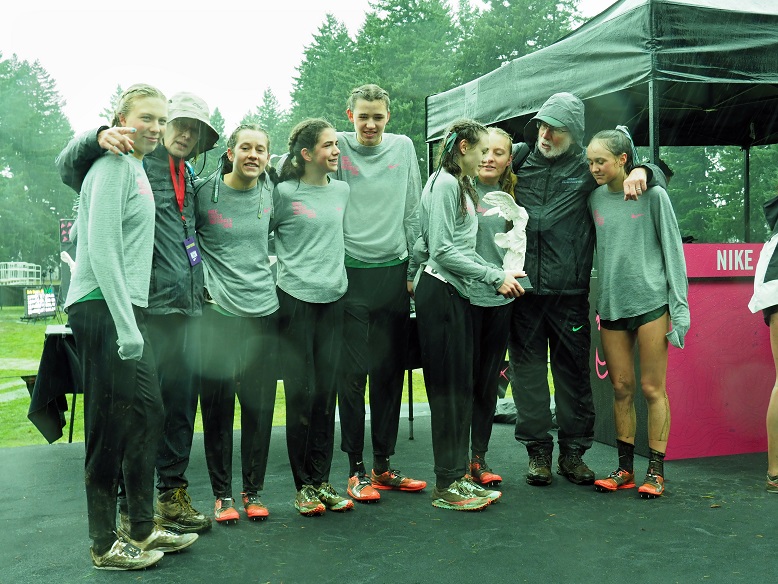
There were many good performances from the Summit teams but they were all praiseworthy given the size of the fields in every race.   There was competition of the highest order – if you doubt that – look at Fiona Max finishing second with team mate Teaghan Knox in the background.

There is an excellent report on the races with dozens of photographs   at this link

 https://www.dyestat.com/gprofile.php?mgroup_id=44531&do=news&news_id=586210

November: the team has won the State Championships for the 12th consecutive year.   Not too bad at all.   There is an excellent article about it at

 http://www.osaa.org/today/article/1254/view?title=Girls+cross+country%3A+Max+leads+Summit%27s+6A+domination 

At the end of November, there were six inches of snow in Bend, Oregon and outdoor training was not possible, so Jim and Carol had them working just as hard – but indoors on treadmills.     The Nationals, which are next up, are in Portland and the girls, parents, coaching staff are all working to get a big group of supporters through to them. 

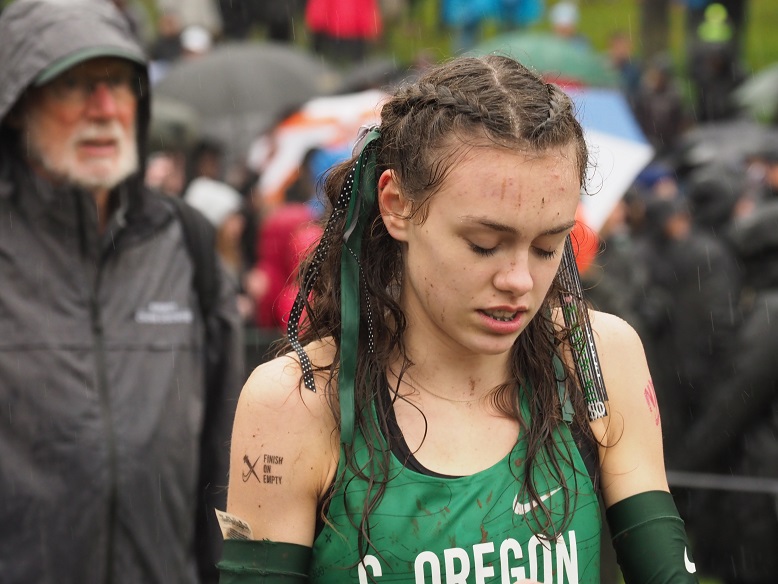
Came the Nike Cross Nationals and the Summit team, running as Central Oregon, just failed to win the title for the second year in succession.   On a dreadful wet day with soggy underfoot conditions, they were beaten into second place by Kinetic who came as a surprise packet, not having any known form at the top level before the event.   They were well beaten (82 points) but part of the story is the fact that the New York team had several over-age athletes.    How big is the race?   Well Peter Thomson describes the event as follows: 

For those of you who weren’t there, the NXN, NIKE Cross Nationals is simply the best organized and presented XC race in the world (just have a look at the thought and care lavished on every aspect). All the athletes are feted and treated like professional athletes with, before the race, using their own named lockers behind curtained cubicles and, surprisingly, a copious quality of NIKE shoes and apparel being gifted. This 8-minute video provides a great insight and also has some footage of the Summit girls. Well worth the price of admission, then …  
 
 
https://nxn.runnerspace.com/eprofile.php?event_id=13&do=videos&video_id=286981-Girls-Race-Webcast-Replay-Nike-Cross-Nationals-2019       (Summit runners in green tops)

Jim and Carol with the team after the race


West of Scotland Cricket Club Sports: 1880 – 1889

16th April,  1881, was the start of a new decade of sports at Hamilton Crescent and the conditions were excellent for the athletes and spectators.   The list of events had grown to no fewer than 21 including bicycle races and several ‘novelty’ events but the real bread and butter athletics events were all well catered for.   Flat races from 100 yards to the Mile plus the hurdles and steeplechase and a range of field events including three of the jumps and the cricket ball throw.   Wauchope and Parsons won their principal events, there was a wide range of schools,universities and sports clubs represented and the day was a resounding success.

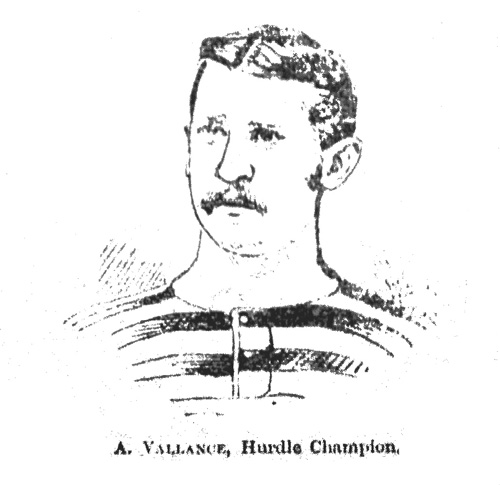
Another member of the Vallance family won the Broad Jump at the event on 15th April 1882 – this time it was Alex, Tom’s younger brother, who also took the honours in the 120 yards hurdles.   The win in the broad jump was actually a walk-over of 18’6″ but in the hurdles race, in which he was a future SAAA champion, but in the hurdles he was followed closely home by JS Blair.   The reporter in the Scotsman was fairly crictical of the meeting saying, “An encouraging number of spectators fringed the ring, and as the sports proceeded the attendance increased, there being ultimately some 4000 people within the gates, to say nothing of those who took up the vantage ground outside.   The programme was on the face of it calculated to excite some interest, but in being performed it paled very much.   Really the contests call for no special remark unless it be that there is room for improvement on the part of the management. ”   There is a sentence or two more in the same vein but for the athletes it was another good competition on a very good surface.    There were only 19 events in 1882 with ‘fine and stirring music’ from the Highland Light Infantry.    The Indian Tug o’War over water somewhat contradicts the reporter from the Scotsman when it says that “carried away by enthusiasm a number of spectators burst into the ring and some time elapsed before a clearance could be effected.”
The SAAA was formed in 1883 and they held their first championships in June that year.   It was a significant year with enthusiasm for athletics at a peak.   One of the keys to success for an athlete in any event is regular competition and meetings such as those offered by the cricket and football clubs were important in this respect – more important than most highland games or works sports simply because of the quality of the surface on which they were held.   A cricket sward is usually smoother and better maintaned than the local farmer’s field.    This year the West Cricket Club held their own sports on 14th April 1883 which was the start of both the athletics and cricket seasons.   The results should come first this year.   

Throwing the cricket Ball: HL Fleming, BLAC; 2.  AGG Asher.   106 yds  6 ins;  Broad Jump:  JW Parsons; 2.  AGG Asher.   19′ 5″;  Pole Jump:  AGG Asher; Quarter Mile Handicap Confined: HR Cobbold;  100 yards: *** ; Quarter Mile Flat Race:  AS Blair  52 1/2 sec;  High Jump:  JW Parsons  5’10 1/2 ins; One Mile: George Gibson; Half Mile Race TG Connell; 3. JJ Johnstone; 120 yards hurdles:  JW Parsons; 2.  HA Watt [Watt actually came in first but was disqualified for fouling]; 200 yards handicap: JS Blair; 2.  AS Blair; Steeplechase: AGG Asher; 2.  John Johnstone.

*** The 100 yards had four finalists – Parsons, AS Blair, JS Blair and TD Stevenson.   The two Blairs and Parsons came to the post together and so the three of them had to run again.   The result was a dead heat between the two Blairs and it was decided to split the verdict.    There were also some ‘novelty races such as the Tug of War over Water and the Blind Wheelbarrow Race.   In the former, the Fettes team did not turn up so Glasgow Academy got a bye into the final where they met West of Scotland (who had disposed of 1st LRV in the first round) who won.   There were also several cycle races on the programme.    

A word about AGG Asher might be in order.   Sir Augustus Gordon Grant Asher was born in Poona, India in December 1861 and was a Scottish international rugby and cricket player.   He was educated at Fettes and Oxford and competed for the Fettesian-Lorettonians club.   In athletics, he won the SAAA pole vault in 1885 and 1886, was second in the 120 yards hurdles in 1885 and in the broad jump in 1886.   As a rugby player,  he played four times for Scotland and the rugby  historian RJ Philips said that: “No one has arisen to bear comparison to AR Don Wauchope at quarter or half back where he and AGG Asher still hold claim as the greatest pair to have played together for their country.”
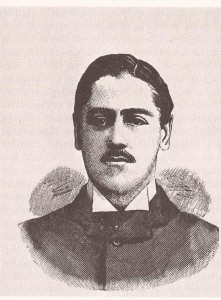
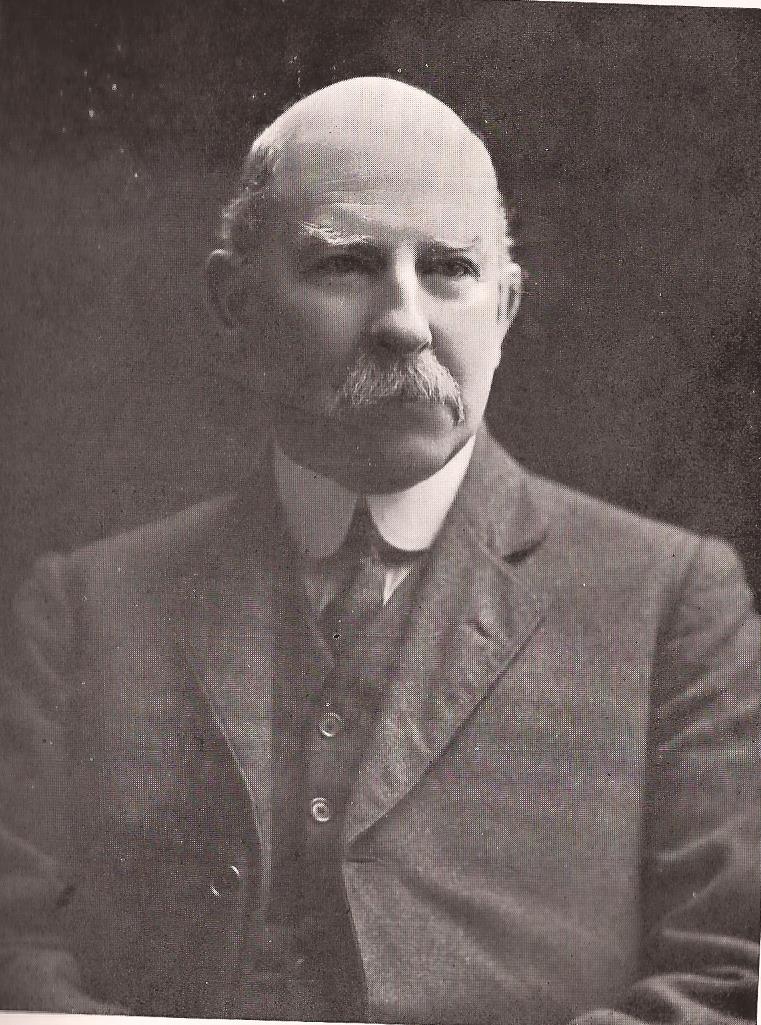
AGG Asher

When it came to the SAAA championships on 23rd June, past competitors who had competed here such as Harvie, Peterkin and Wauchope were successful, and of those who turned out in Partick in April, Johnstone was third in the mile, Watt was third in the hurdles and Wauchope had two silvers.   Parsons and Asher had a particularly good meeting but missed the first SAAA championship although they would go on to have a very good career in their events.   

There would be no criticism, mild or otherwise, from the Scotsman’s reporter for the sports of 12th April 1884.   One of the biggest names in athletics in Britain was present – WG George.   He ran in several races and the steeplechase but, said the report, “he found no rival worthy of his metal.”   There were twenty two events this time round, These included for the first time Putting the Weight which was won by K Whitton.   As well as the bicycle race there was a tricycle race, a blind wheelbarrow race, a half mile obstacle race and a mile obstacle race.   George won the steeplechase and the Mile.   As a man who had broken the world record three times and had a best time for the half mile of 1:57, his time in Partick of 4:40 for the distance was a disappointment.   
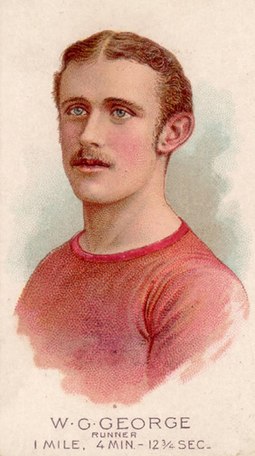


The 11th April, 1885, was one of the days when the Glasgow weather did not co-operate and the spectator numbers were down because of the dull, cold conditions with rain threatening all afternoon.  There were twenty four events in all, mainly bicycle, tricycle and flat races.   WG George was back up again and won the mile – this time in  5 minutes 07 seconds.   This was the year in which he turned professional and for a man who regularly ran faster than 4:20 it was a mockery of a time.   Wauchope and Parsons were there again as was Asher who, showing his versatility, won the steeplechase with its 4 water jumps.   This year the Throwing the Hammer was intriduced and was won by K Whitton who won the SAAA title for the event; another star athlete was J Logan from Vale of Leven who won the half mile and would win the half mile at the Championships that year and the Mile two years later.   It was quite a cast that the organisers were offering the Glasgow Public: George, Logan, Parsons, Wauchope, and Whitton,.   Four Scottish champions and a world record holder.    Athletics in Scotland was in a good condition and the West of Scotland was encouraging it.   
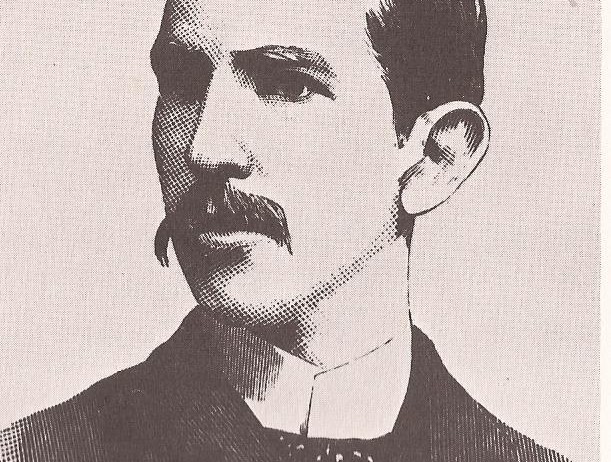
By 17th April 1886 there were two open amateur clubs in Scotland – Clydesdale Harriers and Edinburgh Harriers – and one might have expected them to appear at the sports organised by the West of Scotland Cricket Club but this does not appear to have been the case but there was a good number of class acts at Partick.   The report reads: 

“This important fixture came off on Saturday afernoon at Hamilton Crescent Grounds, Partick.   The weather being favourable, there was a very large attendance.   Music was supplied by the band and pipers of the Royal Scots, under the conductorship of Mr SC Griffiths.   The card contained nineteen events, all of which were well contested, many of the entrants being first class athletes.   The open 100 yards was won by Mr RS Blair of Oxford University, who also gained first place in the quarter mile.   Mr WS Duncan of Edinburgh Royal High School, came in first in the open half mile race, a yard in advance of the second man, after a fine run.   The tug of war was an interesting contest, and here the Queen’s Edinburgh team succeeded in overcoming all opponents in fine style.   Only two contestants appeared for the pole jumping (Mr Asher and Mr Hodgson, both of Edinburgh) and the “blue and white” came off victor.   The first prize for hammer throwing – one of the best contested events on the card – was won by Mr W Weir, who was several feet in front of the second man.   The open mile handicap brought out nine competitors and after a stiff race Mr Smeaton, Kincardine-on-Forth, came first to the tape, several yards separating him from the winner of the second place.   The hurdle and obstacle race and the steeplechase were the amusing features of the day’s proceedings.   Some good sport was witnessed in the school events, all the prizes of which were carried off by representatives of the Edinburgh Schools.”

Before noting the results of those events which were recognised for the SAAA championships, it is worth noting that the pole vault had been, and continued to be, a duel between Asher and Hodgson.   Hodgson had won it in the national championships in 1883 and 1884 in the absence of Asher; Asher won it from Hodgson in 1885 and 1886 and neither would contest it after that.   They met up again at meetings such as this one which was won by Asher of Fettesian-Lorettonians from Hodgson, representing Edinburgh Harriers.   Results of major events:

100 yds Flat Race, open: 1.  AS Blair,  10 2-5th sec;  2.  JW Parsons.     Quarter Mile Flat Race, open: 1. AS Blair, Oxford, 52 2-5th sec; 2. D Landale, Fettes;   880 yards (scr, open): 1.  DS Duncan, Royal High, 2 min 7 4-5th sec; 2. HD Ritchie, Watson’s College.   One Mile handicap, open:  1.  J Smeaton, Loretto, 4 min 49 3-5th sec;  2.  A Brown, Ayr FC.

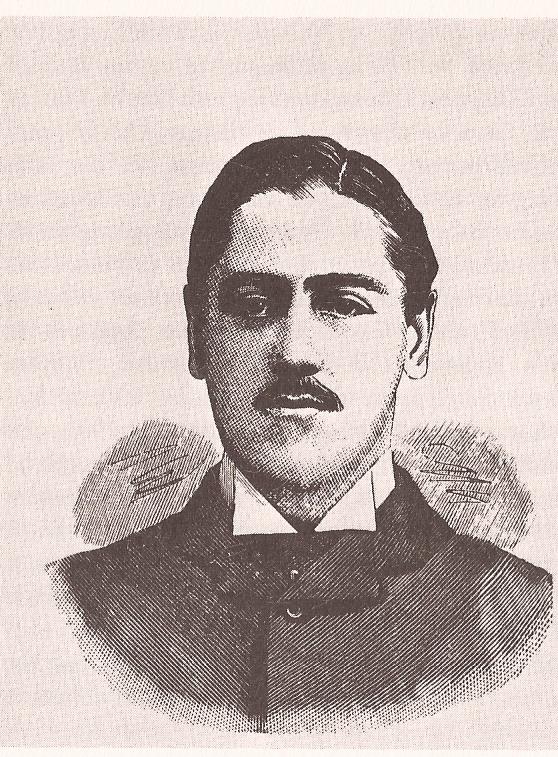
120 yards hurdles:  1.  JW Parsons;  2.  A Vallance, Rangers FC; 

Throwing the Cricket Ball:  1,  AGG Asher 104 yds 3ft 6 ins; 2.  JG Gill, 1st LRV.    Putting the Weight, handicap, open: 1.  WB Johnstone (8′ handicap) 40′ 4″; 2. C Reid, Edinburgh (scratch)  40′ 0″;    Throwing the Hammer, handicap, open:  1.  W Weir, St Mirren’s FC, 97′ 10″; 2.  J Maclachlan, GUAC; 

High Jump:  1.  JW Parsons, LAC, 5′ 8″; Pole Jump:  1.  Asher, failed at 10′; Hodgson.    
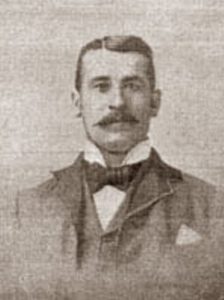
The sports in 1887 were held on 16th April and were described as one of the most fashionable in the Glasgow season and there were between 4000 and 5000 spectators present to see a programme of 19 events.    Alex Vallance, above, was back and running in the hurdles where he led over the last hurdle, stumbled and finished second by three yards to JL Greig of Fettes.   There were runners from all three existing clubs running – Clydesdale, Edinburgh and West of Scotland Harriers all taking part.   Indeed in the new event of a two miles steeplechase there were two from Clydesdale Harriers and two from Edinburgh Harriers making up the field.    This was a serious event over a serious distance rather than the 700 yards+ race with four hurdles and four water jumps.   WM Thomson of Clydesdale Harriers defeated W Jack of Edinburgh with W Henderson third and  DS Duncan fourth.   There was a good turn out in most events with 13 men out for the Mile, won by JJ Smeaton of Tulliallan from WM Thomson of Clydesdale.   
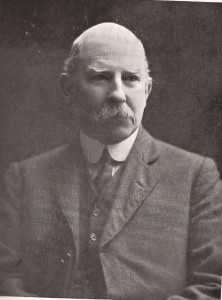
After the Clydesdale Harriers and Edinburgh Harriers were established in 1885, several more athletic clubs appeared and the open athletics movement was really gathering pace in 1888.  There were only 17 events this time round, many were cycle and tricycle races and there were no heavy throws, the Shot putt and the Hammer being conspicuous by their absence.  The Sports were held again on 14th April that year and the results tell their own story.

100 Yards:  1.  JJ Williamson, Hamilton NEFC; 2. HCL Tindall  Cambridge UAC;  3.  IW Reeve, Ediburgh Harriers.      200 Yards flat race open:  1.  NA MacLeod  Loretto;  2.  H Whitelaw  Edinburgh Harriers;  3. HCL Tindall  Cambridge UAC.   440 Yards:  1.  Tindall  Cambridge;  2. A Maxwell  St Mirren FC;  3. T  Blair   Queen’s Park FC.    One Mile Flat Race, open:  1. TS Young, Hamilton Harriers;  2. G Hume  Edinburgh Harriers;  3. WM Thomson  Clydesdale Harriers.      

120 yards hurdles:  1. GT Ward  Clydesdale H;  2.  W Whitelaw.   Steeplechase Handicap:  1. WM Thomson Clydesdale Harriers (scr);  2. J Anderson  Clydesdale Harriers (30y);  3.  A Hannah  Clydesdale Harriers  (20).

Obstacle Race:  1.  JB Park Kelvinside Academicals;  2.  AG Colquhoun  Clydesdale Harriers

Throwing the Cricket Ball:  1.   R Hughes, Motherwell Trinity;  2.  J Gill, Poloc CC.

The referee on the day was AGG Asher.
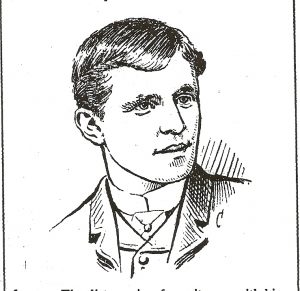
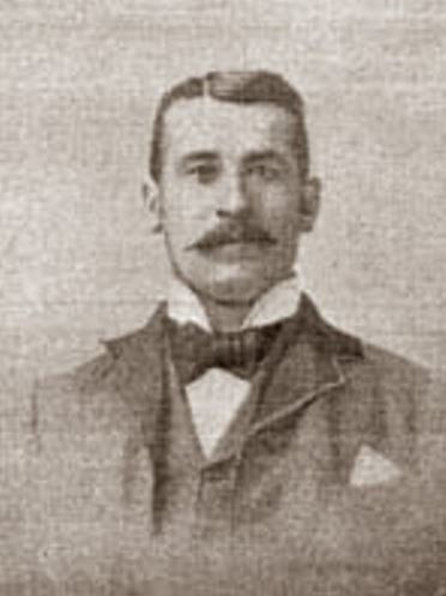
  GT Ward 

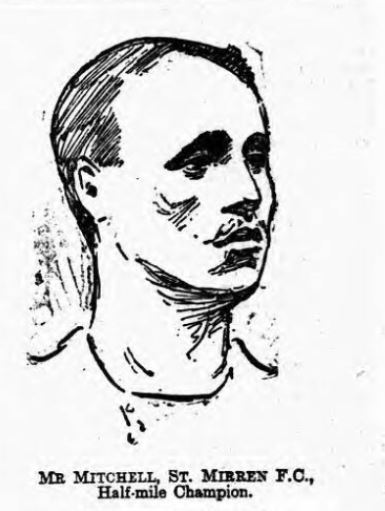
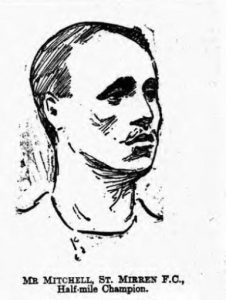
The Sports on 13th April, 1889, had 17 events on the programme “for which very good entries had been received although the standard was hardly up to usual.”   The meeting started at 2:00 pm and finished at 5:00 pm.   Described as ‘the event which practically opens the athletics season’  , all of the events were open.   To keep the spectators entertained on a dull day, the band of the 1st Battalion The Lancashire Fusiliers had 45 performers on site.   Maybe the Scotsman felt thatthe standard was not quite the best but there were at the very least some outstanding athletes on display.   For instance, JR Gow, Rangers FC and Clydesdale Harriers, a future SAAA Champion, won both heat and final of the 120 yards hurdles and the final of the 200 yards,  R Mitchell, St Mirren FC and Clydesdale Harriers, who would win the SAAA half mile that year and held the Scottish half mile record, won the Mile.   There were also some stars in the cycle races including the popular RA Vogt who won races at distances from a half mile up on both track and road all over Britain.   It was a better meeting than the scribe maybe appreciated.
 

And so the decade closed.   The West of Scotland Cricket Club had promoted their meeting now for over 20 years and seen the mammoth changes from a sport that was almost exclusively the domain of public schools and universities to one where there was a multitude of open clubs, a national athletics governing body and an atmosphere of competition rather than entertainment (although there was still a place for the bands).
Training with McLatchie: 5

Milers in Texas


Justin Chaston: Olympic steeplechaser

The athletes that raced the mile race followed the general plan during the track season except when getting ready to compete in a major mile race. Harriers had a couple of athletes who competed in the mile. Jon Warren ran 3:59.30 is the only athlete to have run under 4 minutes for the mile and 2 hr 20 min for the marathon in a period less than 4 months. David Wittman was the other athlete who ran under 4 minutes when he recorded 3:57.47 in the same race as Jon which was the ‘PRE’ Classic in 1994.

Two different athletes. Jon was the strength runner whereas David was the speedster. Jon had recorded 8:30 for the steeplechase where David was a sub 1:50 800 meter runner and was a member of Clemson University team that won the NCAA Indoor 4×800 meter relay title.

I would put together a Distance Medley team which included David and Jon who won most of the Relay meets in Texas. Most of the coaches welcomed the Harrier athletes with open arms even although we beat their teams.

A few sessions prior to a big race. Morning runs were usually 30 minutes easy.

Sunday –        Easy 1 hour

Monday –       5x 500 with 6 min rest. 400 at 57-58 then sprint last 100 meters

Tuesday –      Easy 1 hour with a few strides

Wednesday – 1600 – 4.16/ 1200 – 3.09/ 800 – 2.04/ 400 – 58/ 3 min rest between

Thursday –     Easy 1 hour with strides

Friday –           3(400 2MR 300) 4 min sets/ jog 10 mins- 400

                      Dave – 55.5 42/ 56.5 41.4/ 56.4 44.4/ 54.9

                      Jon –    57.1 43/ 57.2 42.1/ 57.8 46.0/ 56.5

Saturday –     Easy run or rest day

Sunday –        Easy 1 hour

Monday –       Jon – 400-60.1/ 1200- 3:04/ 400-56.4 all with 5 min rest//

                      Dave – 200-24.9/ 200 jog/ 200 – 25.4/ jog 800/ 200 – 24.6/ 300 walk/ 300-37.5

Tuesday –      Easy 1 hour

Wednesday – 2×200 with 30 sec rest/ Dave – 24.8/ 25.6// Jon – 28.1, 27.7

Thursday –     40 min easy with a few strides

Friday –        Travel to Eugene – 30 min easy run with strides

Saturday –      Mile race – David 3:57.47 and Jon – 3:59.30

At that time I had a great bunch of distance runners. David, Jon, Justin Chaston and Sean Murray who ran a 4:03 mile. Easy bunch of men to coach who helped each other achieve their goals.         


Training with McLatchie: 4

Carol as she is now – international runner is now an international coach

Carol McLatchie (nee Urish) was a very good distance runner indeed.   There is a very good summary of her career on the arrs website at  https://more.arrs.run/runner/3109 detailing her career and achievements – it also includes all her races between 1978 and 1996.   A good track runner, she became an excellent road runner winning many honours.   The coach who made this change possible?    Ayrshire’s own Jim McLatchie.   Read what he has to say about Carol as a runner.

*

Carol was unique. Growing up in Kansas prior to ‘Title 9.’ There was no track programs for girls in High School and College. She moved to Houston in 1973 to attend Rice University to work on her Master’s Degree in Geology. While attending Rice she got in involved with several women who ran and started jogging with the group.

The track coaches at Rice University ran a summer track program and held races on Friday evenings. I had moved to Houston that year and formed the Houston Harriers. One of the founding members, Len Hilton who competed in the 1972 Olympic Games was getting back into shape.

Since no one had run a sub-4 minute mile in Texas. I informed him he was going to achieve the goal. I set it up with helpers with me as one of the pacers.

Carol had heard about this race and showed up to watch where Len broke 4 minutes for the mile. She was hooked and joined the Harriers. When she started she could hardly break 40 seconds for 10K. Slowly she began to improve and in the eighties she was a force to be reckoned with in the women’s racing circle.

Carol followed the basic training schedules but when training for a major race the schedule was tailored for her needs.
Her Personal bests:

TRACK
1500 4:28.00
3000 9:19.50
5000 15:45.10
10000 33:03.10

ROADS
10K 32.41
15K 51.22
10 MILES 55.15
20K 1:13.28
½ MARATHON 1:14.50
25K 1:34.30
30K 1:53.30
MARATHON 2:35.10

The following is what she did when running 32:41 for 10K and 51.29 for 15K.
All morning runs were on grass.

1. AM. 18 miles easy
2. PM. 880 – 2.36 440 jog/ mile – 5.17 880 jog/ 2 mile 10.54
3. AM. 4 mile easy/ PM. 9 miles grass – weights
4. AM. 4 miles easy/ Pm. Mile – 5.02/ 1320- 3.53/ 880 – 2.32/ 440-66/ 440 jog between\
5. AM. 4 miles easy/ PM. 6 miles easy
6. AM. Travel to Jacksonville, Florida – 3 mile easy with strides
7. Jacksonville 15K River run – 1st – 51.22
8. AM. 72 minutes easy run
9. AM. 4 miles easy/ PM.2×2 miles 11.06 11.02 with 5 min rest between
10. AM. 4 miles easy/ PM. 12 miles easy
11. AM. 4 miles easy/ PM. Mile – 4.56 lap jog/ 4×220 32/ 220 jog between/ lap jog/ mile – 5.13
12. AM. 4 miles easy/ PM. 9 miles easy
13. AM. 4 miles easy/ PM. 6 miles grass
14. AM. Bayou Classic 10K – first 34.52 – won last 6 years
15. AM. 21 mile run
16. AM. 4 miles easy/ PM. 3x mile 5.07/ 5.09/ 5.10 3 min rest between
17. AM. 4 miles easy/ PM. 9 miles grass
18. AM. 4 miles easy/ PM. 440-73 880 jog/ 880- 2.32 mile jog/ mile 5.21
19. AM. 4 miles easy/ PM. 9 miles grass
20. AM. 6 miles grass/ PM. Fly to New Orleans
21. AM. Run last 4 miles of Crescent City course
22. Crescent City 10K race placed second in 32.41
23. AM. 4 miles easy/ PM. 6 miles grass
24. AM. 4 miles easy/ PM. 8 miles grass
25. AM. 4 miles easy/ 3×440 – 70 -2 min rest/ 880 jog/ 1320- 3.44/ 880 jog/ 3×440 – 70 ,70,69 with 2 min rest
26. AM. 4 miles easy/ PM. 10 miles easy
27. AM. 6 miles easy/ PM. 4 miles grass/ Fly to San Francisco
28. PM. Jogged 30 mins over course
29. Avon 15K finished first in 51.29/ Dietz 2nd in 52.14/ Harriers won team race

Carol’s marathon training followed what I designed for the general marathon schedule except the last few weeks were tailored for Carol. Morning runs were on the Bayou which was all grass.
The workouts below were done 2 weeks after she won Avon 15K in San Francisco.

1. Beach – supposed to run 15 miles – knees sore running on sand- ran 20 mins
2. AM – 4 miles easy/ PM. – 3x mile 5.07/5.08/5.06 with 440 jog/ Jog 880 then 2 times circuit course.
3. AM. 4 miles easy/ PM. – 15 miles easy
4. AM. 4 miles easy/ PM. – 4×440 – 76/74/74/74 /2 miles 10.47/ 440-67/ all with 3 min rest
5. AM. 4 miles easy/ PM. – 1 ½ hour easy run
6. AM. 4 miles easy/ PM. – fly to New York – 30 min easy
7. AM. Breakfast 7:30/ Trevira Twosome 10 mile race placed first in 55:15
8. AM. Easy run around reservoir. Travel to Houston
9. AM. 21 miles easy
10. AM. 4 miles easy/ PM. 12 miles easy
11. AM. 4 miles easy/ 4x 880 2.34/2.35/2.35/2.36 with 4 min rest
12. AM. 4 miles easy/ 1 hour easy run
13. AM. 4 miles easy/ 6 miles easy
14. AM. 5K GAC champs – first – 17.41
15. AM. 15 mile easy run
16. PM. 2x 2mile 11.20 11.28 4 min rest
17. PM. 6 miles easy – grass
18. PM. Fly to Seattle – 6 miles easy
19. Drove Olympic Marathon Trials course – massage – no run
20. Jim drove course I jogged miles 20-23 get and an idea last part of race
21. First Women’s Olympic Marathon Trials – finished 12th in PR of 2:35.10

1981 Carol went to New York to compete in the L’EGGs Mini Marathon which was a 10K road race. Very few people knew her name outside Texas. Greta Waitz, Patty Catalano and Jacqueline Gareau were in the race. Carol’s instructions were simple. Run with the leaders. As the race progressed Carol was still with the leaders and as no one knew who she was they were getting a bit worried. A ‘Dark Horse!’ Carol went on to finish second behind Greta. Now they knew who she was. 

*

That is what Jim has to say on the matter.   There is an interesting ‘lifestyle’ interview from their local paper in Bend, Oregon, which reads:

CAROL URISH-McLATCHIE
2019 National High School Girls Track and Field Coach of the Year, with Jim McLatchie (USTFCCCA)
U.S. Women’s Distance Coach, Track and Field, Pan Am Games 2019, Lima, Peru
How do you define success?
“Success is a feeling of accomplishment after I complete a goal. Success might be winning a race, the team racing well at a big event or a new runner achieving a personal record and watching them figuring out that their hard work has paid off.”
Where would we find you when you have free time in Bend/Central Oregon?
“I like to visit the High Desert Museum, go for an easy ski at Meissner Snow Park or pick up litter on trails near my home. I can also be found exploring the Oregon High Desert like Kam Wah Chung (State Heritage Site) and the Painted Hills.”
What is your secret to good health/fitness?
“At my age, I am thankful I have health insurance and keep regular health appointments. One never knows when you will be hit with a health challenge. I was recently diagnosed with a low-grade breast cancer. I chose an extensive surgery and plan to get back to my usual coaching schedule as soon as I can.”
What lessons have you learned so far in life?
“I have learned that I can learn so much from mentors and people with experience that I have met in my life. My hometown doctor told me to “be myself” as I headed to college in the 60s. Glenn Cunningham spoke to my graduating class of 19 and shared his challenges with life and running. Information like that opened my mind to consider so many more possibilities in my life. I ran competitively for 22 years and I learned that the more energy and focus I put into running the more I improved. Improved performances earned me opportunities to travel and race in many places in the world. I also get a lot of satisfaction out of volunteer activities with USATF (USA Track & Field). Coaching at Summit High School with my husband provides daily delights and puzzles in working with those student athletes. In the long run, I hope the athletes will learn some of the same lessons I have experienced through sport.”


Training with Jim McLatchie: 3

JIM McLATCHIE – Fall – USA – 1963

The weather was conducive to getting some decent workouts under my belt. I had decided to arrange my class schedule so that I had time to get in an easy run before lunch. That along with my morning escapades on the grass plus what I was doing in the afternoon should show some improvement in my racing.

Racing cross country in Scotland where I went several years without getting beat and managed to win the National Title as a junior. All the time I spent running in the hills and up and down coal tips made me nearly unbeatable. So I was hoping that with some extra mileage and better weather I would be hard to beat.

Living in a remote village in Scotland I enjoyed getting out in the fresh air and nature and just run along without a care in the world. I fell down a lot running in the snow. Because of the snow I would miss a turn on a road or trail and end up in a six feet drift. I never panicked, I just lay down and rolled out until I could walk out of the drift and then continue my run.

On most days I was running three times a day with a variation of jogging in the morning. At lunch time I ran about 5 miles easy and in the evening on Monday and Wednesday it would be track type workout. The rest of the week easy running up to 10 miles and if racing on Saturday, Friday would be one workout of thirty minutes easy with a few strides. Before track workout I warmed up and cooled down after a workout.

26 days before USA National 10K cross country championships I do not show 30 min easy jogging before class. Started in November 9th 1963

DAYS from National cross country championships 

26 – 20 x220 with 30 sec rest between average 30+

25 – AM 5 miles easy/ PM – 4x mile ave 5:10s with 440 jog between

24 – AM – 4 miles fartlek/ PM 9 miles easy

23 – AM – 4 miles fartlek/ PM – 4×440 with 440 jog 1-5 ave 57s last – 54.5s

22– PM – easy 40 min with mile in 5min/ 10 min easy – mile in 5 min raining cool 59 degrees

21 – Race Gulf Federation 4 m XC – 3rd in 19:46sec rainy and 60 degrees

20 – AM 9 miles easy – recovery run

19 – AM long easy run of 17 miles

17 – AM – 35 min easy/ PM 5xmile ave. 4:55s with 440 walk between

16 – AM – 30 mins easy with 6×150 easy/ 8×880 with 440 walk ave 2:11.5s

15– 30 min easy with a few strides

14 – Race Houston 10K Trials for Nationals – finished 2nd in 30:42s

13 – 9 miles easy legs sore – felt tired

12 – Went to beach and ran around 1 hour – legs still sore – stood in water

11 – 1 run around 30 minutes – Achilles aching

10 – Day off

 9 – Tough workout – 4×440 with 110 jog – 58.6,59.0,58.4,58.0/ 10 min easy/ 6×110 run bends/ jogged 10 min/ 440 – 54/  felt good

 8 – AM – 4xmile with 220 walk between – 4:58/4:48/4:49/4:44/ Later in day left for East Lancing Michigan with team from Houston – Driving

 7 – As we were approaching Bloomington, Indiana we heard on the radio that President Kennedy had been shot dead in Dallas Texas. As we had Texas plates on the vehicle we were not so sure what would happen when we stopped for the night and ran a bit to loosen up. We ran indoors – WU – 3 miles fast/slow/ CD

 6 – 4:45pm East Lancing Michigan – 40 degrees – 10 miles easy with some strides

 5 – 9 miles easy with some strides

 4 – NCAA Championships – could not run because of freshman rule ran 4 mile easy with some strides

 3 – 4 miles with some easy hills

 2 – Chicago 4 miles easy with a few strides – sore throat

 1 – National 10,000 meters cross country championships in 48 degrees where I finished second to Tom O’Hara 30:12s to 30:17. I made a move with a mile to go and picked up the pace. I was still leading with 200 from finish and I just fell apart. Jeff Fishback was third in 30:22s.

Friday we drove straight back to Texas and I was dropped off in Beaumont and the rest of the team headed to Houston.


Training with Jim McLatchie: 2

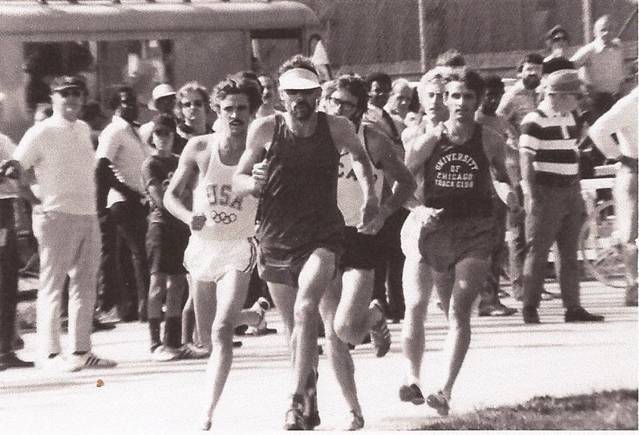
Jim leading Rick Wohlhuter (in the USA vest)

There are not too many coaches who have raced internationally, taken on the best in the world and run in tough races in Britain and America with distinction.   Jim McLatchie is one.   We have looked at his training at home and now we have, in his own words, how he trained in the States after had had emigrated there.   We start with some of the training he did in Texas in the early 1960’s.

 Spring – Summer- USA- 1963

Training in Texas was a completely different as now I was having to deal with heat and humidity whereas in Scotland it was always cold, wet and windy. I arrived in Beaumont at the end of January which was not too bad for running which reminded me of our best days in Scotland. As the months progressed I had a tough time with the conditions. When it got too hot I trained around 9pm at night some days. Every morning around 6:30 am before classes I would jog to South Park High School and run for 30 minutes with a few strides in my bare feet. It was much cooler than in the afternoon which I enjoyed a great deal.

The fall was not too bad as it was much cooler and I got more running under my belt. The following is what I did when I beat Jim Ryun over a mile in Houston. Ryun went on to run in the Olympics and record 3min 51.1 sec for the mile.

Days From race
28 – Rest day
27 – 1 ½ miles of sprint jogs then 2×220 around 27 secs
26 – Warm up 6×220 ave 26 secs with 1 min rest/ jog 10 mins/440 – 53.5s
25 – 5 mile easy run
24 – Warm Up raced 880 in 1min 53.2sec cooled down
23 – 6 miles fartlek
22 – Easy run then 20×110 around bends jog back/ 5MR 440- 54.4s
21 – Rest day
20 – Warm up Time Trial ¾ mile – 3:04s/ 15 MR/ 220 – 25.3s/ 15MR/ 440-54.4s
19 – Easy run with 3 mile Fartlek
18 – Easy run with 3 mile Fartlek
17 – 6 mile run with 1 mile fartlek then 2×200 25-26/jog 440 between
16 – Travel to Brownswood, TX for Conference
15 – Temperature 107 bloody awful. Won mile in 4:23.7s and twenty minutes later had to run 880 where I finished 4th in 1:57s
14 – Travel back to Beaumont
13 – Easy 5 mile followed with 16×140 jogged 300 between/ easy 5 min then 2×220 around 27 sec
12 – Warm up – 10×220 around 30 with 220 jog between
11 – Warm up – 4x 440 around 60 with 110 jog between
10 – Easy 2 miles – 4×880 – 2:08s with 440 walk/jog between
9 – Rest day
8 – Warm up then ¾ mile Time Trial – 3min 3.3s (58/67/58.3) testing kick
7 – Easy run ran through 2 miles in 9min 41s
6 – 8x 220 29-30 with 220 jog between
5 – Easy 5 miles followed with 10×150 pick-ups jog back
4 – Jogged 3 miles with a few strides
3 – Rest day
2 – Rest Day
1 – Mile race led from start to finish first in 4min 7.9s (62,63/63/59.9)

The following week I finished first in the Texas National Championships in Dallas. I jogged easy most of the week with a few 150 and 220’s. Nothing strenuous. This time I held back until the last 660 and ran 4min 10.7s (65,67,60,58.7)

It is a very interesting block of training.   Many runners or coaches tell us in general principles what they did, but few are as open about what they do immediately before and after a big race.   Jim is to be commended for being so open.

Training with Jim McLatchie: 1

Jim winning the Mile from pacemaker Graeme Grant at Westerlands, early 1960’s

Jim McLatchie was a first rate runner from the most unpromising of backgrounds.   From a small mining village in Ayrshire where there was no track, no real sports facilities of any kind and not very much flat,even ground to train on, he made himself into an uncompromising athlete who could run in almost any kind of race and acquit himself well.   He says the following of his training then in his own story:

Early in my career growing up in Muirkirk with no track. I did most of my running in the hills and for strength work I would run up a ‘slag bing.’ A slag bing was created from stones and dirt which was the residue from the coal dug underground. This ‘bing’ was over 200 feet tall and I would run to the summit wearing coal miner’s boots which weighed about four pounds. Each boot had steel heel and toe plates studs in the soles. I would run as many as twenty repetitions. Other days I would run in the hills and visit the local soccer pitch twice a week for speed work. It was a grass surface and I could get about 200 metres around the pitch.

When I moved to Glasgow I was able to train on a 440 yard cinder track and started working on pace. Along with track workouts. At lunch-time I ran on a golf course. Most of the time in my bare feet. There was nothing like feeling the grass as you ran.

I was probably running about 50-60 mile per week, but didn’t really count miles. Time on my legs was more important. Some days due to the weather I would do circuit training indoors. It was effort on many days to open the door and go for a run. We had no indoor facilities. So I was used to running in all weathers: rain, snow, slush and winds.

My schedule was as follows if I was not racing:

Sunday – Long easy run anywhere from 10 to 15 miles

Monday – Track workout

Tuesday – Easy run – if weather was bad in the winter I did circuit training

Wednesday – Track workout

Thursday – Easy run – if weather was bad in the winter I did circuit training

Friday – 3-4 mile – if racing – 30 min warm then strides

Saturday – Race or 1 hour easy

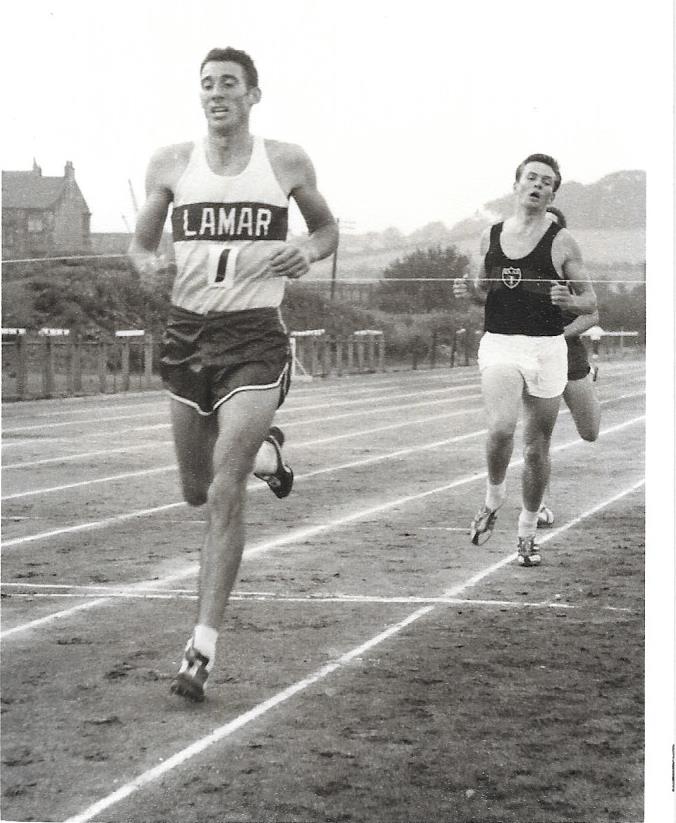
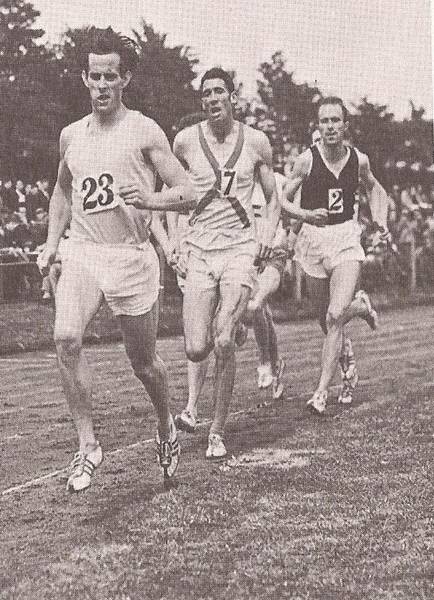
The race where Jim ran his 4:08.3:  Winner Mike Beresford, 23, Jim McLatchie, 7, and Bert McKay, 3, from Motherwell who was third.  Run on cinders.

Below is what I did for 28 days when I ran 4 min 8.3 secs

28 days from race – I ran most days at lunch time on the golf course       usually around 3 miles to loosen up – nice and easy

28 – Warm up/ 10×300 with 2 min rest/ jog 10 min 6×70 walk back

27 – 4×880 in 2:10 with 3 min rest Jog 10 mins/ 2x 440 –   60-62 with 3 min     rest

26 – Rest day

25 – Race – 3ml in 14:46 – warmed up and cooled down

24 – Easy run followed by 6 x 100 and 2 x 400 no times

23 – Rest Day

22 – Race on Grass Track ran ¾ mile in 3min 2.5 sec which I won

21 – Easy run with 6×220 with 1 min rest/ jogged 5 min/ 6×140 with 45 sec   rest between in the middle.

20 – Raced a 3000 meters steeplechase which I won in 9:21.7

19 – Easy 1 hour with 10 x 220 no time 1 min rest between

18 – Raced a Handicap mile won in 4min 03 with a mark off 30 which is 30 yards short of a mile

17 – Easy warm up – grass – 8×400 yards in 54-55 with 2 min rest

16 – Rest day

15 – Track Meet – 880 heats – 1min 52.9/ Final 1:53 off 10 yards – raced 870 yards

14 – Easy run with 6×100 with 1 min rest/ jog 5 min/ 6×140 JB

13 – Easy run with 2 miles fartlek

12 – Warmed up – ran easy mile in 4:13 – cooled down

11 – Lunch time – 20×200 with 45 sec rest/ evening 6×440 in 58 2MR

10 – 20×110 45 sec between (ran the bends on track)

9   – Rest day

8   – Warmed up easy 880 in 1min 57

7  – Rest Day

6 –  30 min easy with a few strides

5 – 3 miles fartlek then 4×220 around 30 with 220 jog

4 – Rest

3 – Rest day

2 – Scottish Championships heats – jogged mile in 4:25.8

1 – Scottish Champs Final – finished second in 4:8.3

Jim ran his 4:08.3 in 1962: in that year he also ran a 1:54.2 half mile, – in addition  a 9:17.0 two miles, a 14:30.5 three miles and  a steeplechase in 9:21.7.   Although he was concentrating on running the half- and the mile, the other distances indicate a strength in depth that many milers do not have: a strength that maybe came from running up pit bings in heavy boots!

His profile as an athlete can be found at    

http://www.scottishdistancerunninghistory.scot/jim-mclatchie/  .

A short quote from it tells us that 

No track – did zig zags on the football field.   Also ran quarter mile straights on the railway line.   Line ran east/west and I used to run 15-20 seconds slower going west (windy as hell).   Scottish National Coach back then was an Englishman.   He used to write me some workouts like 10 x 440 with one minute rest.   I would mail him my times and he would tell me my pace was all to hell.   I told him he needed to come and see what I was training on as he didn’t believe I was doing 440 along a rail line.   He showed up in the village – couldn’t believe what I had to work with.    I did a lot of zig zag training plus runs up and down a coal bing, runs on the moors.   I only ran on the roads in winter when it got too dark to run up the bings.   Did a lot of weight training and circuit training.”   I asked if he ever went to Ayr to train at Dam Park.   This got the following reply: “Never went to Dam Park to train – took forever on the bus which only ran every hour.   Bus – Strathaven – Glasgow, every four hours.   If I had a race in the Glasgow area, I had to make sure I didn’t miss the bus.   It was an all day excursion some times to get to a Meet. ”  

So that’s the first instalment of Jim’s start in athletics.   It was also the first building block on the way to becoming a world class coach twenty years later.

Training with Jim McLatchie: 2   Training with Jim McLatchie:  3    Training with McLatchie:  4   

Training with McLatchie – the Mile: 5         Training with McLatchie – the Marathon: 6   

Training with McLatchie – the Steeplechase: 7


Track and Field: At the Start

HAMPDEN PARK

The pre-amateur era.

Clydesdale Harriers (established on 4th May, 1885) was Scotland’s first open athletic club but it was not the first athletic club because there were University and Private School FP athletic clubs in existence before that, the SAAA Championships were first held in 1883.   Competitive athletics however go back well before that, indeed some extant highland gatherings claim to predate the first Scottish Championships.   As a kind of preamble to the beginning of the SAAA and the Victorian era of sport in general and athletics in particular, I will quote from “50 Years of Athletics” , published in 1933 to celebrate 50 years of the organisation, and the chapter ‘Athletics in the Beginning’ by Kenneth Whitton.   It reads

“Although Scotland’s records do not go as far back as the Tailtean Games in Ireland, yet what we have prove the love of athletics among the Picts, Scots and the gregarious Celts.   From the chief downwards, athletics was the joy of the Gael, indeed the chief was often the most accomplished.   At his door lay the ‘clachneart’, literally the stone of strength or the putting stone and on the arrival of a guest he was asked as a compliment to throw it.   The chief’s followers, and those of his guests engaged in all manly sports, and as the honour of the clan was at stake, it is surmised that in the strenuous contests more heads than records were broken.   The Fraser chiefs were noted athletes, and the father of the late Lord Lovat – an excellent sportsman – was an expert stone and hammer thrower.

In a manuscript lately come to light entitled: ‘Ane breve cronicle of the Erles of Ross’, an account is given of how an earldom was gained by prowess in wrestling.   At the coronation of Edward I there was among those attached to his court in London a famous French wrestler from Normandy who was considered invincible.   But during the gay doings, he was challenged by Farquhar Ross from the North of Scotland, a vassal to the Scottish king Alexander II, and to the amazement and delight of the Scottish king, his wife and a sister of Edward , and the Scottish guests, Farquhar overthrew and signally vanquished the unbeaten champion.   So delighted was King Alexander over his countryman’s ‘notabill vassalage’, as he called it,  that he conferred the Earldom of Ross upon him.   To celebrate his victory and to carry out a vow that he had made, Farquhar erected an abbey, now no longer in existence, but its successor in Kincardine, Ross-shire is still used as the Parish Church.  

At the great royal hunts which took place at Braemar and which often lasted for a fortnight, many chiefs with their followers took part.   Malcolm II started at one of these ‘hunts’ the first recorded ‘Games’ by offering as a prize a sword and a purse of gold to the first man to reach, in a race, the summit of Craig Choinneach.   Two McGregor brothers were favourites, but a third and younger brother, who was late in starting won after a terrific struggle.  

It was not however till 1832 that the first organised Braemar Gathering took place.   Queen Victoria was keenly interested in these sports, and in 1889 invited society to Balmoral.   Later the Duke of Fife gave the present Princess Royal Park where the meeting is now held.   The clansmen gather at the spot where the Jacobite standard was unfurled in 1715 – which event is commemorated in ‘The Standard on the Braes o’Mar’ – and march to the sports ground.

Since the year 1314 without a break, except during the Great War, the Ceres Games, founded to celebrate the return of the victorious Fife villagers from the Battle of Bannockburn, have been held annually.   It is remarkable that the name of the Fife agricultural village, Ceres, is that of the Latin goddess, Ceres, the protectress of agriculture and in whose honour great sports were instituted.

Carnwath in Lanarkshire holds annually a meeting of great antiquity.   The Red Hose race is the principal event, and local and popular tradition has it that in the event of the Carnwath estate becoming heir-less, the latest winner of the ‘Hose’ would become proprietor!

Under the shadow of the Duke of Argyll’s stately castle at Inveraray, a gathering of the western clans’ representative pipers, strong men and runners has been held for centuries.   Running was a feature of this meeting, for the chiefs of old encouraged their ‘gille-ruith’, or running footmen, to excel in the Geal-ruith, or running and leaping  games.

Among great athletes in Scotland, the two whose names were, and still are, in the mouths of everyone, were Captain Barclay of Ury and Donald Dinnie.   The former was a great and up-to-date land proprietor in Kincardineshire.   Sprung from an ancient and physically powerful family, he lived during the later part of the eighteenth century and the first half of the nineteenth.   Educated at Cambridge, he early joined the army and served as ADC to the GOC of the ill-fated Walcheren Expedition.   He was though of little more than average size, possessed of a great strength, speed and remarkable powers of endurance.   Of the latter his great feat of walking 1000 miles in 1000 hours – that is one mile for every hour, was a record to his stamina.   Others who tried this feat broke down at an early stage, but he continued for a period of 42 days and though he lost much weight was at the finish wonderfully fit.   He was a great runner, walker, wrestler and stone-thrower,  and thus resembled Dinnie, who was born in Aberdeenshire in 1837.   Strange to say, Dinnie’s best performances were done when he was approaching forty years of age, and when fifty eight years old was the recognised all-round champion of New Zealand.   Dinnie was undoubtedly the best athlete of his time, and in addition to being heavy-weight champion, excelled in wrestling, leaping, vaulting, running and dancing.

Over a century ago, the Borders had a remarkable man, Will o’Phaup, so called for his farm in the Ettrick valley.   Like Dinnie in the North his name was a household word.   His tombstone at Ettrick Kirk records that for feats of strength and agility, he was not excelled in the kingdom.  

In pre-amateur days Scotland was famous for its distance runners, and many feats of endurance are recorded in books dealing with origins and history of Scottish Highland Gatherings.”

  Having read through the above, you now know where the heading of ‘the pre-amateur era’ came from.   That is of course how the sport began, and we are now clearly in the post-amateur era.   The amateur era was clearly a diversion but it was also a period when sport in all its guises made great progress and wonderful performances were achieved.  Is it too mischievous to suggest that the standards are falling now that we are all ‘post-amateurs’???  

For a note of the Principal Sports Meetings at the very start of amateur athletics including those organised by the major football clubs, go to

Track and Field: The Sports Meetings