1883: April

IMG_7561

Before Clydesdale Harriers and Edinburgh Harriers were founded in 1885, the only amateur clubs were approximately a dozen Former Pupils and University clubs.   But the arrival on the scene of the open athletics clubs was not the start of amateur athletics in the country.   Not by a long way.   Little is known of the sport pre-1885 and it might be instructive to look at athletics in Scotland before that.   We can start with a look at athletics in 1883, before the clubs were gleams in the eye of anyone in either Glasgow or Edinburgh.   Given that meetings were held on most weekdays as well as Saturdays, we can look at coverage in the ‘Glasgow Herald’ of Tuesday and Saturday events for that summer beginning with the month of April.

IMG_7562 (1)

On April 7th there were three athletics meetings reported including the Inter-Scholastic Games, under the auspices of the ‘Edinburgh University Athletic Club’, took place at Corstorphine in the presence of ‘ a large and impressive assemblage.’   In addition to the Edinburgh schools, there was representation from Blair Lodge, Polmont, Trinity College, Glenalmond, Morrison’s Academy, Crieff and the Dollar Institution.  It was reported that ‘as in former years, a large proportion of the prizes went to Loretto .   There were 25 events contested including pole vault, hurdles and a bicycle race.   There was a mile handicap race at Manchester in which many Scots were involved including W Cummings of Paisley (scratch) and it was won by the limit man (off 150 yards), J Morgan of Manchester.    Cummings was absent for the simple reason that he was racing in a meeting at the Shawfield Grounds and making an attempt on the Mile record.   Approximately 5000 were present to see ‘the great match against Time’ by Cummings who held every British title from one to ten miles.   He was attempting to break Lang’s and Richards’s record of 4 min 17 2/5th sec and bets of £20 to £40 were taken against him.   Four timekeepers were appointed – one for each quarter and one for the final time.    At half distance, odds of 3 to 1 were laid that he would break the record.   His third quarter was a bit slower than required, and despite being loudly cheered in the finishing straight, he had paced himself too much in the first half (I quote) and returned a time of 4 min 21 sec.   There was also a 130 yards handicap with five heats and a final – the odds against each runner were quoted for readers.

*

 The following week – 14th April – the biggest meeting was the West of Scotland Amateur Sports.   Not to be confused with the West of Scotland Harriers which appeared later in the 1880’s, this meeting was

“The promenade and amateur athletic sports held annually under the auspices of the West of Scotland Amateur Cricket Club came off on Saturday afternoon on Hamilton Crescent Cricket Ground, Partick.   The weather, the all important matter in out-of-door proceedings, was dull but not unfavourable, and the turnout of spectators was numerous.   The car was, as usual, a very attractive one and embraced a great variety of athletic work.   The events included throwing cricket ball, broad, pole and high jumps, one mile and two mile bicycle races, hundred yards, quarter, half and mile races, wheelbarrow race, hundred and twenty yards hurdle, tug of war over water, and a steeplechase with four water jumps.   

The sports were on the whole quite up to the standard of former years.   Nearly all the crack amateurs were present, and some excellent athletic work was accomplished.   The various races were timed, as usual, by a cronograph kindly supplied by Messrs George Edward & sone, Buchanan Street. “

The other meeting that aftrernoon was the Royal High School Sports in Edinburgh, held on the  School Ground at Holyrood.

*

On April 21st, there were no meetings reported under the ‘Athletics heading’ but there was a single entry under the ‘Pedestrianism’ heading.   This was a meetimng at the Shawfield Ground that had only one race.   This was a 600 yards handicap with four prizes – £12, £2, 15 shillings and five shillings.   These were to be competed for by some well known English peds as well as the local ‘cracks’.   There were to be nine heats but a wee problem developed.

“Everything promised to pass off pleasantly until the final heat came up for decision.   It was then apparent that something was amiss, and several of the bookmakers asserted that Hodgson of Hatton was running under an assumed name.   This was positively denied and the race went on, but just when the competitors were nearing the goal the cry came that “the Englishman wins”.   The crowd then swarmed onto the track, the tape was broken and the race declared void.   The large prizes given by the proprietor have hitherto induced pedestrians from all parts of the country to enter the lists, and the running has been proportionately improved.   It would therefor be cause for regret if these contests should cease owing to unfairness on the part of spectators towards strangers.

As far as the final heat was concerned, Hodgson was running and we read:

“Pye of Morpeth had brought Hodgson from England for the purpose of lifting the handicap and when heats were run off it was clear that the latter had the race at his mercy.   When betting on the Final was opened, the Englishman was made a hot favourite at  2 – 1 on.   But even this price was only taken for a short time and the bookmakers stopped further business.   Latterly however a few bets at 3 – 1 were taken, when a rumour was circulated that Hodgson was not the pedestrian’s name.   Mr Hanratty cautioned him that if he was not properly entered and passed the post first, he would be disqualified.   Hodgson replied that he had just returned from America and that he was running under his own name.   In these circumstances the men went to their marks and were sent on their journey with a capital start, Wilson leading the field for half the distance.   At this stage it looked as if the Englishman had a poor chance of winning.   On entering the straigh for home however, Hodgson gained considerably on his opponents and 60 yards from the post was almost certain of victory.   But the crowd then broke in and considerably interfered with him; and the referee, Mr D Speirs, considering the state of matters, at once broke the tape and declared it no race.   The proprietors took the same view and ordered the final heat to be run over on Saturday first.”

*

The following week, the last in April, at the same venue, there were preliminary heats of a 300 yards handicap and a three-quarter mile invitation sweepstake for which the prizes were £25, £3, £1:10:00 and £1.   These were then augmented by 10/- for each acceptee.   Cummings was entered for this race.   The final heat of the 600 yards carried over from the previous Saturday, A Baird of Glasgow won with Hodgson not in the first three.   Despite the big money, Cummings was again an absentee but there were eleven runners in the handicap.  The report contained many details of betting odds throughout the afternoon and of the prize monery for the various events.

The preliminary heats of a 220 yards race were run off at the Royal Gymnasium in Edinburgh.

Hunter Watson

111 whw 2

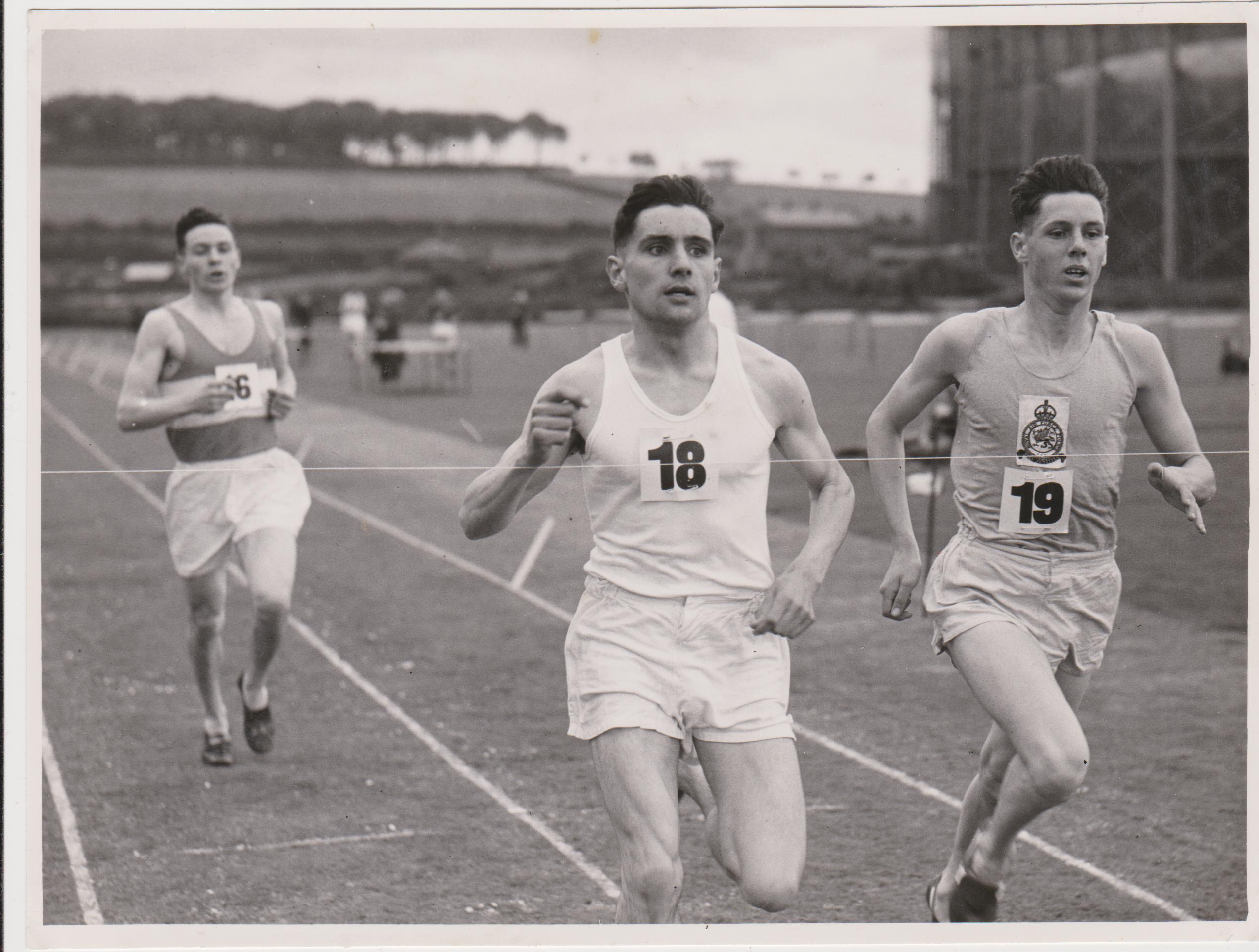
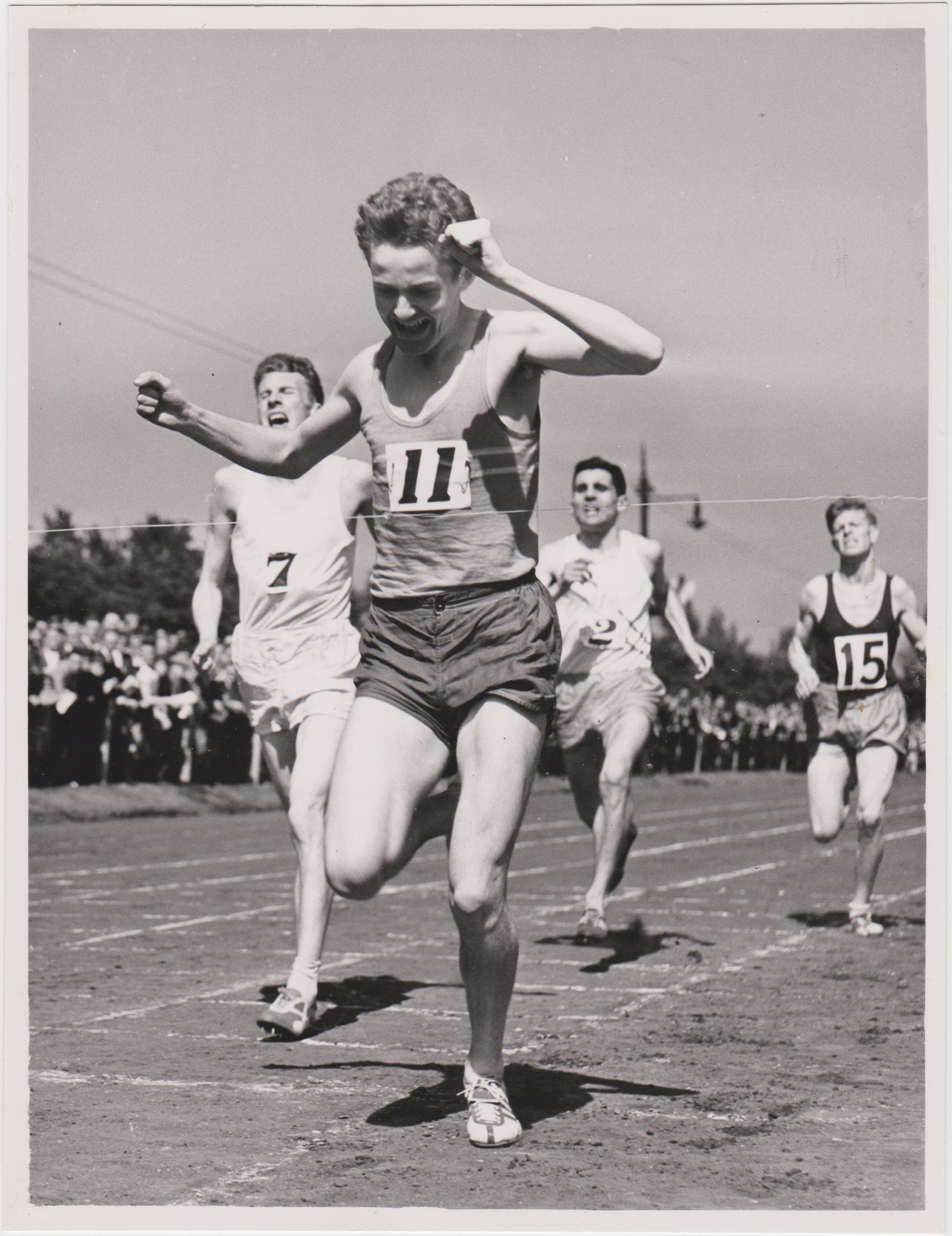
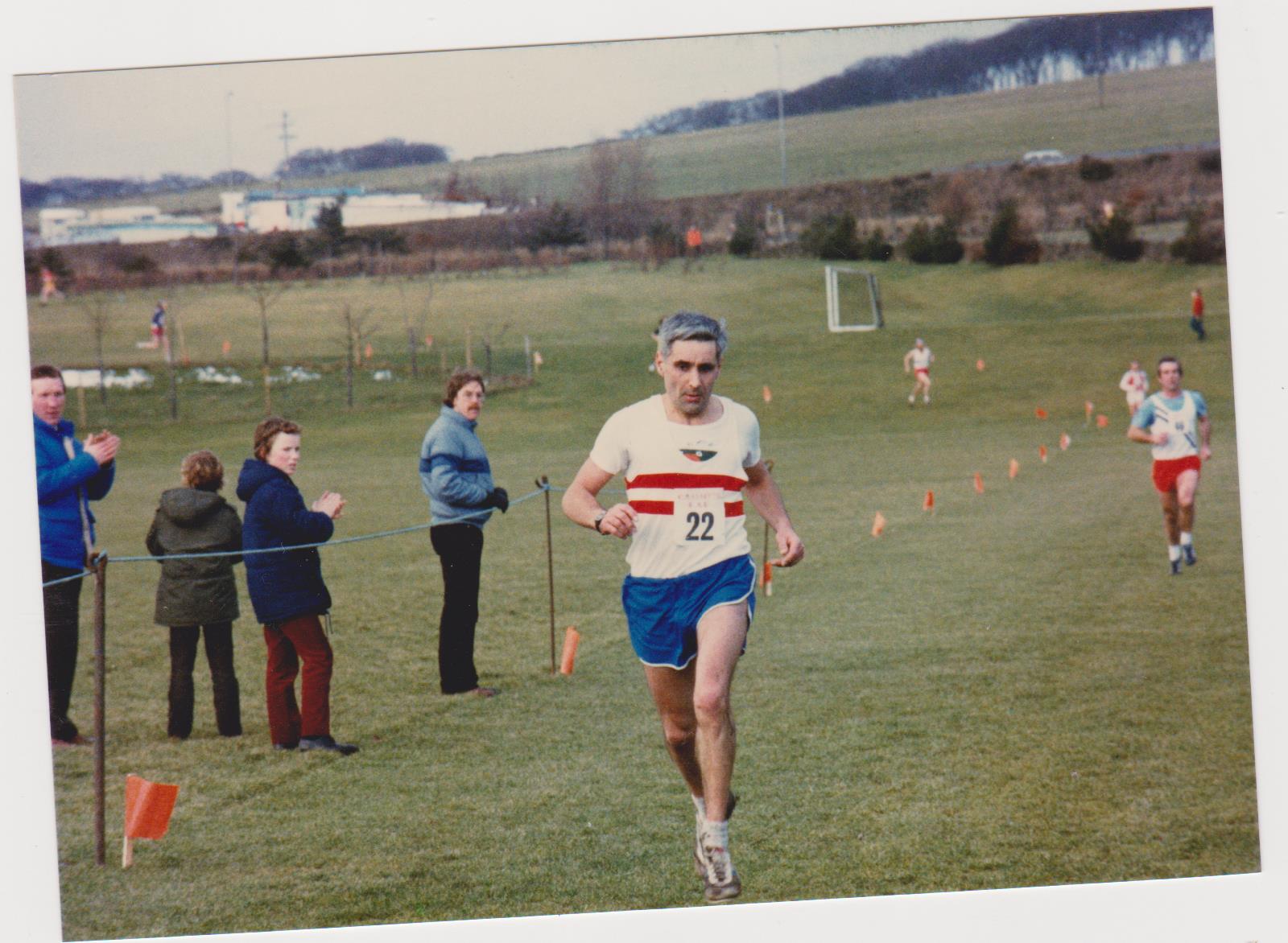
Hunter Watson qualifying for the final of the SAAA Junior Mile in 1954

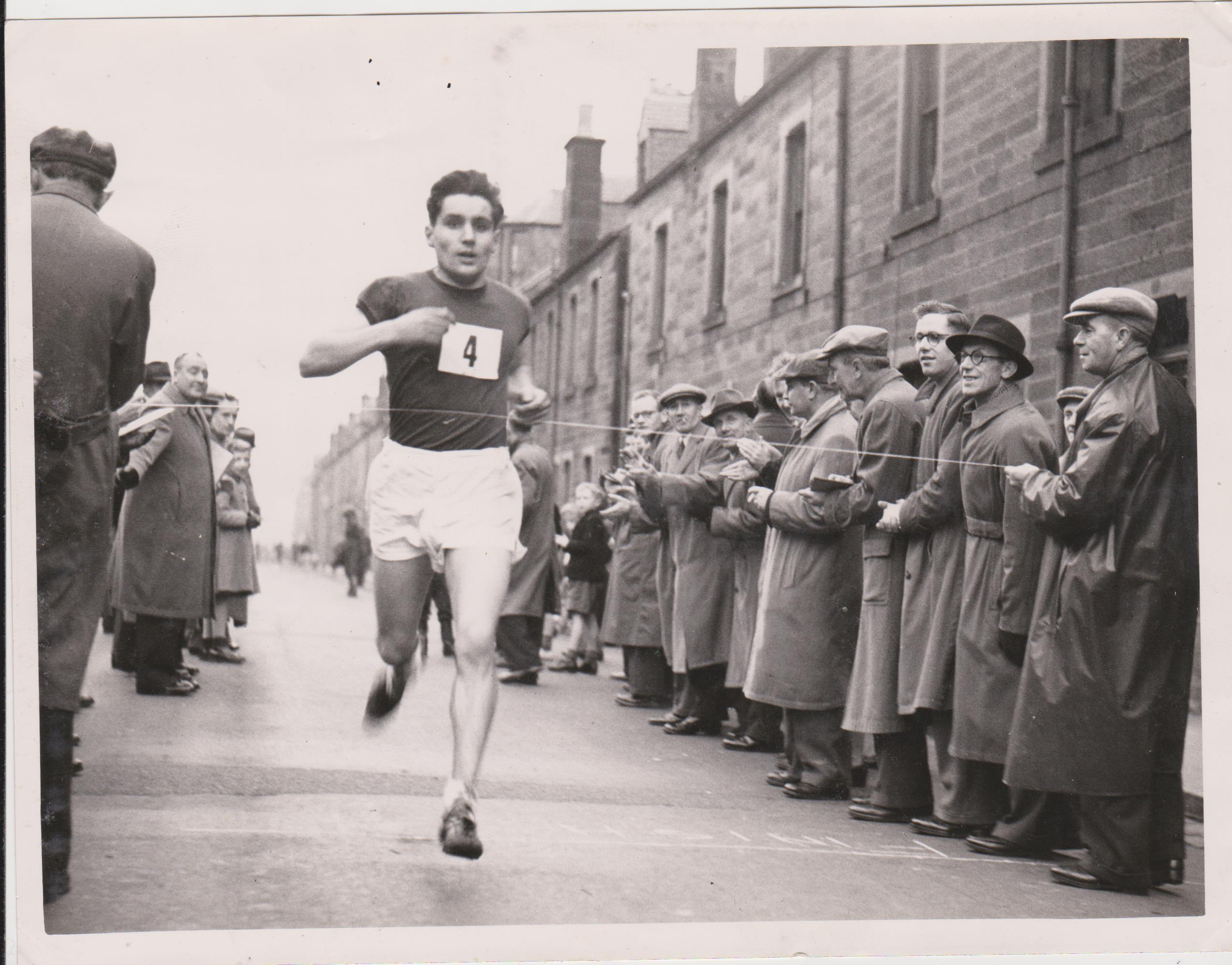
Hunter Watson has had a superb career in the sport – a good class athlete from the age of 15 at school in North Berwick, he went on to play a significant part in the world of athletics in Aberdeen.   He ran with and against some of the very best, maybe particularly during his time at Edinburgh University, and at times defeated them.   As a coach he has developed and worked with international athletes and as an administrator he was for many years an essential part of the Aberdeen AAC committee.

To start with, Hunter did not realise that he had any talent for running until, at age 15 in 1951, he won the half mile for fourth year pupils at the East Lothian inter-school sports. He had been surprised to be selected to represent North Berwick High School at this event because not only had he never run in a half mile race previously but he had not even finished in the top three in any race at the school sports in which he had competed!     He assumes that he was selected to run in that half mile race as a consequence of getting back to the school first when on one occasion the fourth year boys were asked to run round North Berwick Law during a games period. Presumably that made the games master confident that Hunter Watson would not make a fool of himself, and hence the school, in a half mile race.

 Having been given no advice about how to run the half mile, he had no race plan. He simply ran round with the other boys in the race. However, something odd happened half way down the back straight of the second lap: out of nowhere came a sudden urge to sprint for home and that Hunter did, winning in a time of 2:27.  He himself says of this period: “Prior to winning the half mile for fourth year pupils at East Lothian’s inter-school sports in 1951 I had only competed in sprint races and had never finished in the first three since I had no great talent for sprinting. However, after winning that half mile I began regular training and trained for the full range of events at the school sports and not only for the middle distance events. That regular training does make an enormous difference to performance was proved at the school sports in my sixth year. In those sports I finished second in the 100 yards race but won each of the other races, i.e. the 220 yards, the 440 yards, the half mile, the one mile and the 100 yards hurdles. I also won the three jumps: the long jump (19 ft 6 ins = 5.94 m), the triple jump (39 ft = 11.88 m) and the high jump(5 ft =1.52 m). I was unplaced in both the shot put and the discus. Being greedy, that rather annoyed me!”

Wondering whether, if he could win an inter-schools half mile without doing any training, what he might capable of accomplishing if he did do some training. Three years later he found out.

As a student at Edinburgh University, Hunter had a very good cross-country season in 1953/54.   He says that on the Wednesday afternoon of the first week of term there were trials for various sports. He was tempted to go to the trials for the rugby team since he had been rugby captain at North Berwick High School. However, he decided to go to the cross country trials instead. That decision had happy consequences since, during the 1953-54 cross country season, he won the Eastern District Youth Championship on 6th February and subsequently finished second in the National Youth Championship.   In the February issue of the excellent ‘Scots Athlete’ magazine, Emmet Farrell commented that the National Championship in that age group would probably be between Gordon Kerr of Victoria Park and Ian Cloudsley of Shettleston but added, “yet there are good reports from the East of WH Watson (Edinburgh Varsity) ..”  Hunter lived up to the billing by finishing second in the race to Cloudsley, being only two seconds down on the winner. and four seconds ahead of the third man in a very close finish.  The 1954 track season was to be a good one and Hunter has no doubts that the training he did for the cross-country benefited him greatly.

Hunter did not win any individual events during the 1954-55 cross country season but was invariably a counter in the Edinburgh University Hare and Hounds team that did win several team titles then. As a consequence Hunter was awarded a blue from Edinburgh University for cross country.

In summer 1954 Hunter not only won the Scottish Junior Mile Championship but he also finished fourth in the AAA Junior Mile too. His time in that event was 4:21.6, a time which put him tenth equal on the list of the ten fastest British Junior Milers of all time. (At the same age Roger Bannister’s fastest time was 4:23.4.)   The season had started well with a match against Victoria Park AAC at Craiglockhart in which Hunter won the Mile in 4:34.1  and when he won the SAAA Junior Mile at Westerlands on 3rd July, James Logan wrote in the ‘Scots Athlete: “The Mile was won easily by W Watson, the Scottish Youths cross-country runner-up, who strode out very strongly in the last lap.   With developed confidence he is capable of a much faster time than his winning one, which was very good considering the wintry conditions.”   The September issue of the same magazine listed Scottish best performances and Hunter was fifth for the Mile with 4:21.6, a time run at Birmingham on 31st July.

111 WHW 1

Finishing in first place for the University at the East District Relays in 1954

On 6th November 1954, all the Districts held their relay championships and the East District event was at Galashiels over a total distance of 10 miles.   The team of Jackson, Horne, Miller and Watson won by 15 seconds from Falkirk Victoria with their second and third teams in fifth and seventh in a field of 19 teams.  Later that month he ran in his first Edinburgh to Glasgow eight-man relay.   The University had a good team out and Hunter was on the first stage where he finished sixth.   The team finished fourth.  Incidentally, between 1954 and 1971, Hunter ran for four teams in the Edinburgh to Glasgow – Edinburgh University Hares & Hounds, Edinburgh Eastern Harriers, Edinburgh AC and Aberdeen AAC.   He remembers the race with affection and comments

I have fond memories of the early races which were sponsored by the News of the World. That sponsorship permitted 8 buses to be provided, one for each of the stages in order to transport the 20 runners who represented their clubs over these stages. There was very little traffic on the roads then so there were no hold ups and the buses had no difficulty getting to the start of each stage in plenty of time. This permitted runners who had already competed plenty of time to support incoming runners. When I began competing, each race began in St Andrew’s Square in Edinburgh and finished in Ingram Street in Glasgow. Eventually, because of the traffic, both start and finish had to be changed though I am not certain when that happened. When I first ran in 1954 there were still tram cars operating in Edinburgh and cobbled streets. In the early days after each race all the competitors and officials were treated to a meal by the News of the World in a large restaurant in Buchanan Street called Ca’d’oro.   Unfortunately it was destroyed by fire in 1987.”

 The University team in 1954 with runners like Hunter, Adrian Jackson, Horne and Miller was very successful winning the East District cross-country relay in November and the championship in January 1955.   Came the National championship at Hamilton and Hunter was eleventh in the winning team in the Junior race.

During the 1955 track season Hunter’s principal achievement was his win in the mile at the East of Scotland Athletic Championships. His winning time was 4:18.1, a time that bettered the previous best performance of 4:23.3 by just over 5 seconds.

Between 1951 and 1953 there had been a steady improvement in Hunter’s performances which was a consequence of regular training. Perhaps the most significant accomplishment during that period was his win in the junior mile handicap race at Edinburgh Highland Games on 22nd August, 1953.   Running from a handicap of 100 yards, his time was 4:26.9.   Prior to that race, Hunter had not been a member of any club. Within minutes of his win, however, he was invited to become a member of Edinburgh Eastern Harriers. The invitation was accepted.

Image (28)

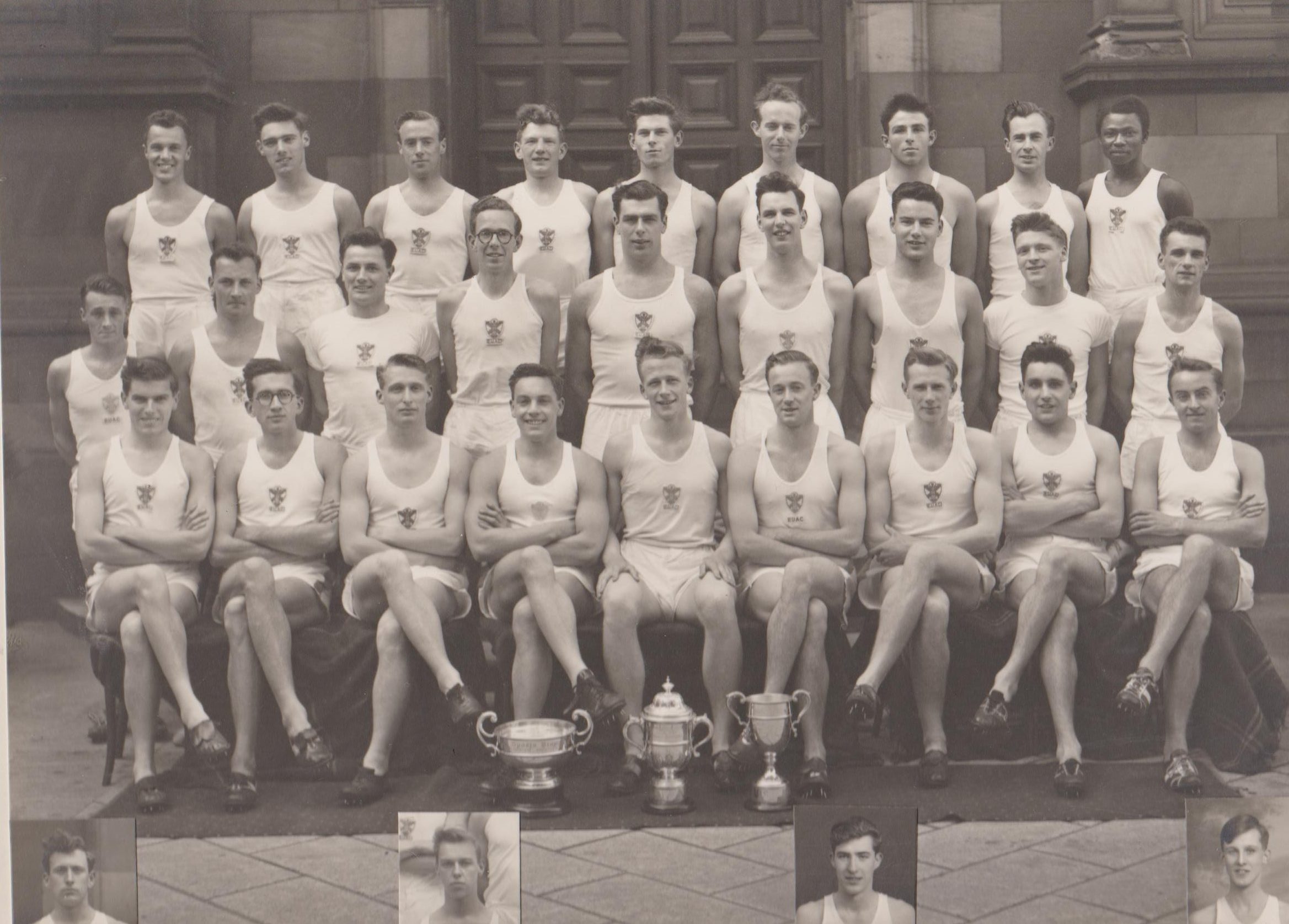
Hunter, second from right in the front row, with the Edinburgh University team which had been Inter-Varsity Champions and Eastern District champions in 1956

Injury had curtailed his participation in the 1955/56 cross-country season but he did finish eighteenth in the National Junior championship.   The subsequent 1956 track season was to be Hunter’s best.

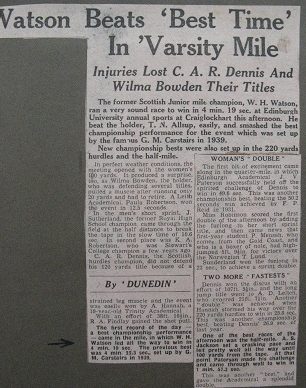
On 12th May 1956 in the regular match with Victoria Park, he again won the Mile, this time in 4:24.8 and a week later, 19th May, in the University championships at Craiglockhart, “WH Watson, a former Scottish Junior Mile Champion, returned a Mile record of 4 min 19 secs.”   This was a feat that produced mixed feelings in Hunter.   He had won the title in a time that had taken 3.3 seconds from the existing record, set by the wonderful Morris Carstairs, and yet the university trophy which went to the athlete judged to have set the best performance of the meeting. The cutting below seemed to think Hunter’s was the top performance.   This went to Paterson who had set new championship records in the 440 and 880 yards.   The half mile was interesting in that Adrian Jackson, whose eye was maybe on an invitation to an up-coming 5000m in Helsinki, ran and pushed the winner to the record.   It is possibly the only half mile that Jackson ran but if it was part of his preparations for Helsinki, then it worked – he won there in 14:13.6.   Hunter continued to run well and at the Scottish University Championships he won both Mile (4:34.3) and Three Miles (16:04.3)  titles.   

The performance which gave him most satisfaction, however, was the one in Manchester on 28th May when he finished second to Martin Walmsley, British Universities Mile champion,  in a mile in a time of 4:14.6.   That was a new Edinburgh University AC record and might have been the fastest mile time ever at that time by a student at a Scottish university.   The purple patch continued when he had an excellent run in the Scottish championships on June 23rd when he was second to Graham Everett recording a time of 4:18.3.   The report on that race read –

“In the much-publicised Mile, the less fancied men must have been surprised to find themselves in the company of the giants at an advanced stage of the race.   With a very fast ‘half’ to his credit earlier in the season, JR Cameron, Thames Valley Harriers, might have been expected to make a very strong final challenge, but Everett commanded affairs immediately the break was made at the second last bend, and, indeed, it was WH Watson who came on in determined fashion to take second place..”      The winning time was 4:16.1 and Cameron ran 4:21.0.   It was indeed a very good run by Hunter if we note that Cameron had run a 4:07.0 Mile on 21st September 1955, and Everett had set a new Scottish record for the distance on 9th June, 1956.

Hunter’s performances on the track while representing Edinburgh University in 1956 led to his being awarded an athletics blue to be added to his cross country blue.

At the start of the winter in the East District league match at Dr Guthrie’s School on 20th October, the first three to finish were Jackson, Watson and JV Paterson and the team won comfortably from Braidburn.   Paterson, Horne, Watson and Jackson also won the East District relay on 3rd November in Perth before the Edinburgh to Glasgow relay at the end of the month.   Hunter ran the first stage, finishing seventh this time and again it was a forecast of the team’s final placing – seventh.   Meanwhile in the same race, Edinburgh Eastern Harriers (whom he had joined in 1953 before starting at Edinburgh University) were making their first appearance, finishing fifth and picking up the medals awarded to the most meritorious performance by an unplaced team.   Hunter missed the closing championships of the cross-country season – District and National – due to injury.  He again represented the University in the Edinburgh to Glasgow in 1957 when he ran the difficult second stage against some of the very best men in the race.  By 1956 Hunter was gaining experience of committee work as a consequence of having been elected to the club committee of Edinburgh Eastern.  

When, on 27 March 1961, Edinburgh Harriers, Edinburgh Northern Harriers and Edinburgh Eastern Harriers amalgamated to form Edinburgh Athletic Club, Hunter was elected unopposed to be Edinburgh AC’s first cross country captain and hence to be a member of the Edinburgh AC committee.

111 whw 3

Finishing third in SAAA 880y in 1960


In 1957 Hunter graduated from Edinburgh University with a First Class Honours degree in mathematics. and in 1959 he graduated from that university with a Master’s degree in education. He then taught secondary school mathematics for six years before moving to Aberdeen in 1965 in order to become a lecturer at Aberdeen College of Education.   While in Edinburgh however he kept on running, and running well, over the country with Edinburgh Eastern Harriers and then Edinburgh AC.  On the track the two medals in the East District championships were noteworthy.   In May 1960 he was second in the 880 yards, behind Neil Donachie and in May 1962, second again, this time in the Mile which was won by Chris Elson.   In the SAAA championships at the end of June there was another very good run when he was third in the 880 yards behind Morrison and Clark.

While in Edinburgh, Hunter had become a qualified coach – and an advanced coach at that.   Under the system used at that time, this was equivalent to the Senior Coach award that came shortly thereafter.   When he moved to Aberdeen, he relinquished the qualification since his new post as lecturer at Aberdeen College of Education allowed no time for coaching.     While teaching at Ross High School in Tranent, he had further evidence that regular systematic training brought real and lasting improvement.   He says of this time:

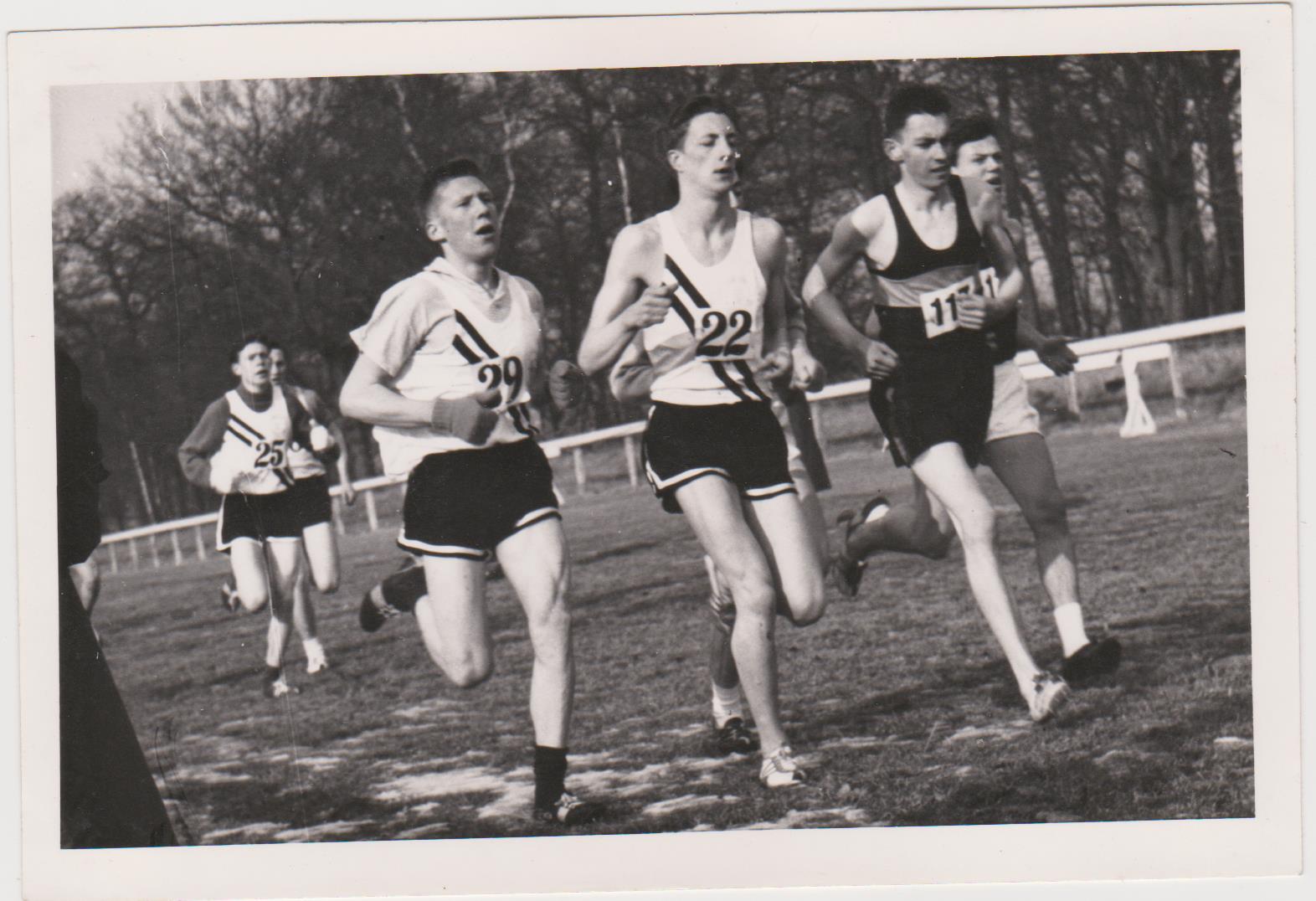
“While a school teacher I observed other boys who apparently only had a modicum of talent blossoming after they also started regular training. These included Billy Donaldson and Gavin Hay at Ross High School, Tranent, the school in which I first taught. In 1961 the best that Billy could do in the school sports was to finish third in the 220 yards for second year boys. I cannot recall Gavin, who was a year younger than  Billy, being placed in anything. In 1963 Billy won the National Senior Boys Cross Country title and also the first of the Scottish Schools Cross Country titles for his age group. At the National he and Gavin helped Edinburgh AC to win the Senior Boys Cross County title at the National Championships. In the East Track and Field Championships, Billy won the Youths half mile and Gavin the Senior Boys half mile. Gavin’s time, which I do not have to hand, was a new championship record. (It was around 2:08, I believe.)”

WHW Hay

Billy Donaldson (the winner) 22 and Gavin Hay 29 in the Boys National at Hamilton in 1963

Fortunately for the sport and for Aberdeen AAC, he did eventually find the time to continue coaching youngsters interested in middle distance and cross-country events.    He did no courses for athletic official status, either track or field, but he has in his time so far officiated at every event on the calendar except the pole vault.   He has even acted as starter and on one occasion officiated as such at a Young Athletes League final at Meadowbank.

111 whw 4

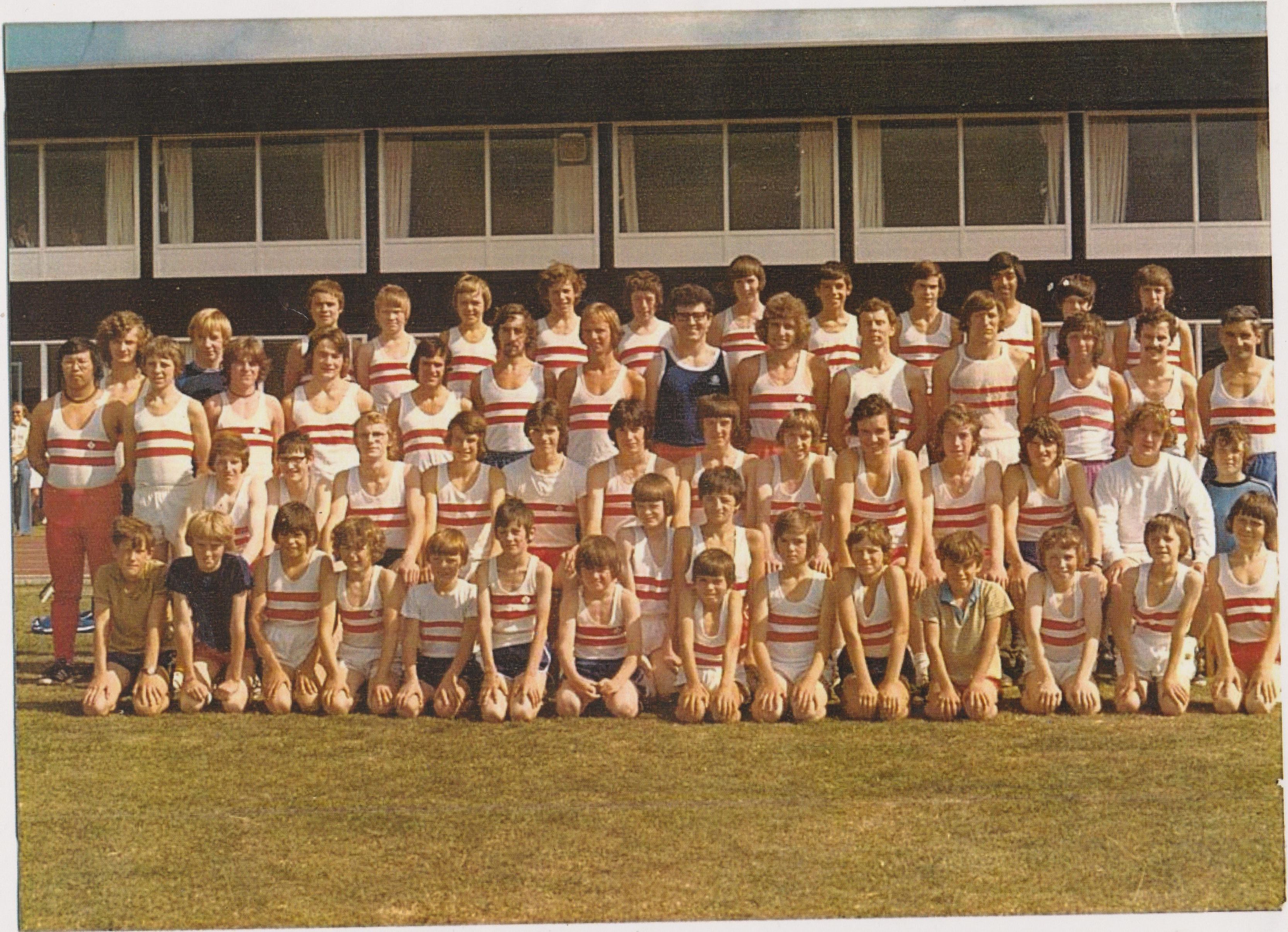
Aberdeen AAC Men and Boys, taken in 1976

Hunter is extreme right of second back row.   Also in that row are Fraser Clyne, 8th right, and Graham Laing, 3rd right,  both ran in the Commonwealth Games: Graham in ’82 and Clyne in ’86.   Also in the picture is Mel Edwards, 6th right.

By 1974 Hunter’s elder son was displaying an interest in athletics and that led directly to him beginning to organise events for youngsters within Aberdeen AAC, a club which he had joined immediately after moving to Aberdeen.  Of this period he says:

“That led to me organising a few events for youngsters at Linksfield Stadium where the club trained. On two occasions I also, without club support, took youngsters to compete in events at some distance from Aberdeen. Their performances were such that it seemed obvious that much could be gained by establishing a Young Athletes Section within Aberdeen AAC. The club secretary gave me the go ahead provided that this section could be self-financing. On that basis I took the necessary steps to establish a Young Athletes Section. Parents were willing to assist me as were two senior members of the club.

On behalf of Aberdeen AAC, I applied to join the Scottish Young Athletes League. My application was accepted and, to the surprise of some clubs in the League, Aberdeen AAC won the North East Section and finished third in the League Final.”

The following year he was elected club secretary.   He remained in that post for twenty years. After he stepped down as secretary he was made an honorary member of the club and he continues to take an interest in it though no longer plays any active part. While club secretary, however, Hunter spent a vast amount of time on club business. He not only performed the normal secretarial duties but he also coached athletes, acted as a team manager, helped to organise road races and convened both athletic and cross country meetings. As far as he was concerned, being secretary of Aberdeen AAC was as much a competitive activity as was being an active athlete.

111 whw 6

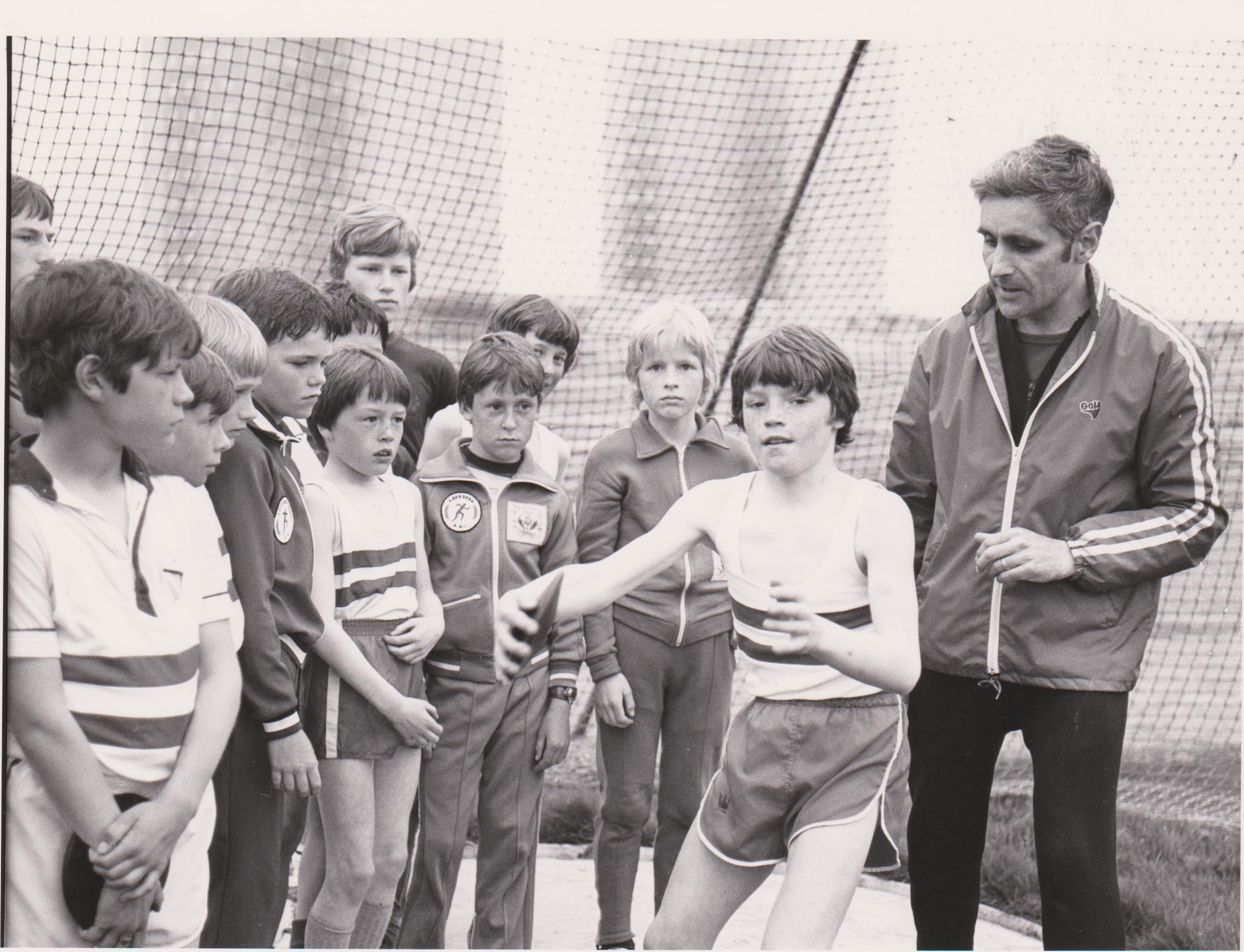
1979.  Coaching some colts (Under 11 years) in discus throwing: preparing to throw the discus is Duncan Matheson who represented Scotland in the Commonwealth Games in 1990 (decathlon) and 1994 (long jump)

Aberdeen AAC had several noteworthy successes during Hunter’s time as secretary and also produced some outstanding athletes, including some who gained international recognition and two who broke Scottish native records.    However, while these successes gave him much satisfaction, he gained even more from the fact that the club thrived during his time as secretary and became far and away the largest athletic club in Scotland.  SAF data reveals that, as at 12 March 1994, Aberdeen AAC had 493 members aged eleven or over whereas Scotland’s second largest club, Pitreavie AAC, had 337 members. (Edinburgh Athletic Club at that time had 312.)  Aberdeen AAC numbers had peaked in 1988 when the club had a total of 606 members of whom 517 were aged eleven or over.   (The club’s number of senior athletes fell slightly when several road runners left Aberdeen AAC to form a separate road running club.)

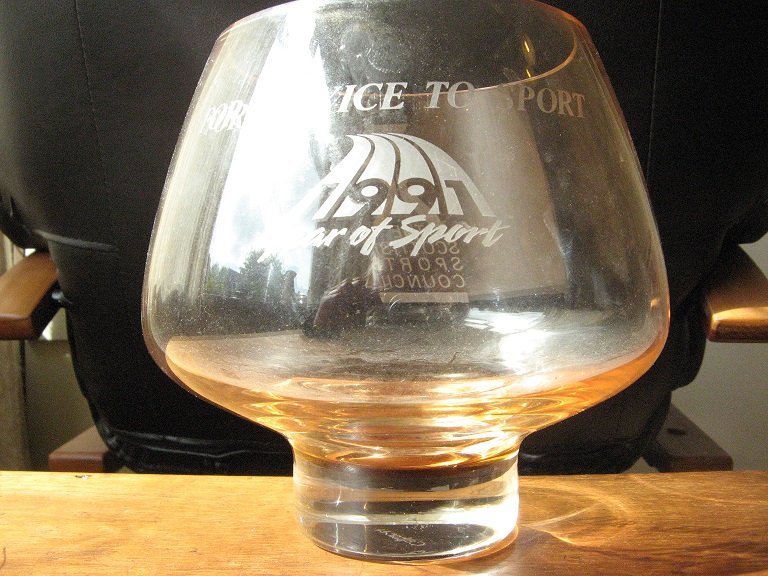
In 1991 the City of Aberdeen presented Hunter with an engraved rose bowl which is now displayed in his home.

Bowl

That the work was appreciated is evidenced by comments from club mates Mel Edwards and Bob Masson.    Bob says

“My first definite memory of Hunter was at a committee meeting in 73 or early 74 where Hunter had been invited to put forward his suggestion for a Young Athletes section in the club.  At that time AAAC had a pretty small membership (probably no greater than 50), predominantly composed of seniors and mainly interested in running, generally of the long distance variety.  His proposal was accepted and Hunter became the secretary of the YA section.  In 1975 he was elected to secretary of the full club, a post he was to hold with distinction for 20 years.

Our paths almost crossed a few years earlier, as Hunter is fond of mentioning to others when we meet at the track.  We both came to the  fourth leg on the E to G relay in 1971 from opposite ends of the distance spectrum.  Hunter was running for AAAC and I was representing Aberdeen University.  We never saw each other during the race but Hunter recalls that we ran identical times for the four mile leg that day.

Over his tenure the club was to grow (about 500 members at its peak) and become more of track and field club and AAAC would regularly qualify for the Young Athletes final.  The men’s team went on to win the Scottish Athletics League finally in 1995, much to Hunter’s satisfaction. On the team bus to the final match at Meadowbank that day went a team of athletes ( not a single one of whom was doubling up in an individual event), substitutes (just in case) and Hunter.  When victory was confirmed, there was an overwhelming desire that it should be Hunter to whom the cup be presented.  I seem to remember that we couldn’t find him in time but there will be a photograph of Hunter and cup surrounded by the entire team somewhere around.

Possibly his most important legacy will be that he managed to persuade Aberdeen City Council that a Track and Field club our size in a city of our size couldn’t hope to develop without an eight lane all-weather track.  The University track at Balgownie had fallen into disrepair and had only been built with seven lanes anyway.  The argument we hadn’t had a home match in the first fifteen years of the Men’s League, amongst others, seemed to have some force and the surface at Chris Anderson stadium was opened in1989.

Aberdeen AAC yearbook no 4 (1993) records that Hunter held several  AAAC veterans’ club records.  These were M40 bests for 800m (2-01.1) and 1500m (4-08.0) set in 1976 and 1977 respectively and the M50 800m of 2- 14.7 set in 1986.  He did show me one of his training diaries, where he recorded the miles covered running (no surprise) but also interestingly  in addition the distances he covered cycling and walking.

After retiring from his post as Secretary, Hunter continued to take a great interest in the activities of the club and in recognition of his many services  he was to become one of the first four inductees as Life Members at the AGM of 2007.  He still frequently attends home league matches, the latest the first meeting of the Scottish League just yesterday (06/05/2017).  He would often cycle from home to the meeting (I’m not sure whether he still does), but if one were to look around the stadium and spot a yellow fluorescent jacket topped with a shock of silver hair then the thought would be “ Hunter’s here again”.

Words to describe the man?  Enthusiastic, dedicated and meticulous aren’t really enough.

The times for the E-G fourth stage in ’71 was 32:47 .   All sections of the club appreciated his work: Bob was very much a track and field man: a decathlete who for many years was Scottish national coach for the event while Mel was a top class road, country and hill runner who won what was probably the best cross-country race I ever saw   Mel says clearly that Hunter deserves an MBE for his work.  He speaks with some knowledge here – the club has two members with the award – Mel himself and Donald Ritchie.  Mel points out that Alastair and Jean Wood ran the club and then Hunter set up the young athletes section before becoming secretary.   “What a work he did”, says Mel, “His phone probably never stopped – and this was when he was still a Maths lecturer!   He was also secretary and I remember many a well organised meeting with lots on the agenda.”

Denis Shepherd elaborates on Mel’s comments about Hunter as a committee man saying:

“Hunter kept a tight rein on the club’s finances in conjunction with the Treasurer.   When preparing the agenda, he scrutinised past minutes and made sure that everything that needed to be decided or organised was brought up in good time.   Everything he said or wrote was carefully considered before he said it: someone said that even when he spoke, his sentences seemed to be coming from a carefully constructed written document.”

More generally, Denis says of Hunter that “he was very pro the club and the athletes he coached.   He was known to try to persuade team managers who had already selected their team to ask a selected athlete to give way to his athlete.   At one Young Athletes League meeting he was appalled that a track official representing the club had done his job properly and disqualified Aberdeen for an illegal change-over.”   The last bit makes him sound like any coach in that situation!

111 whw 7

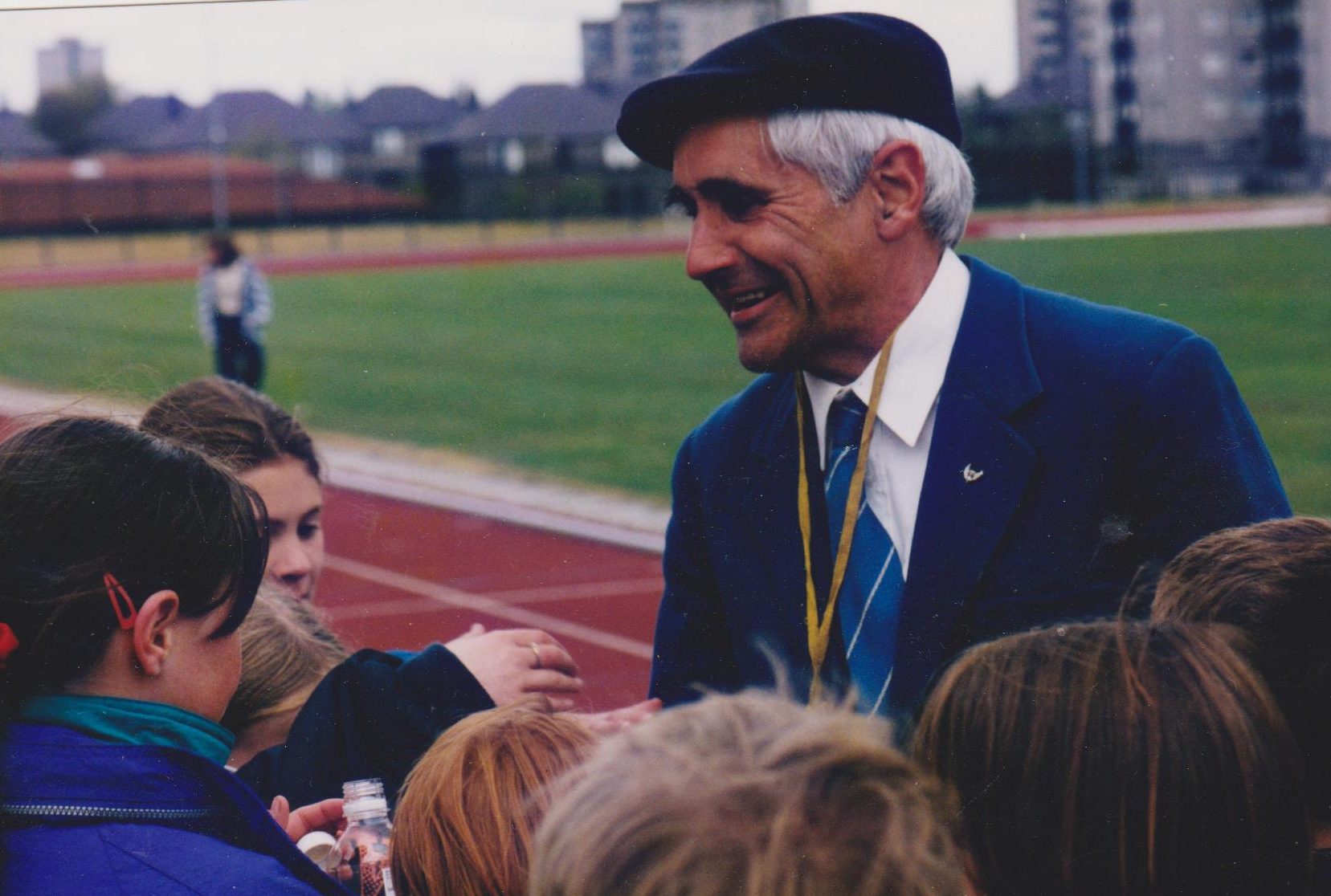
Hunter beseiged by youngsters at the end of a primary schools sports meeting in Aberdeen in 1994.  He had initiated this event several years previously in order to interest youngsters in athletics.

That this reaped a bigger harvest than just bringing athletes to the club is seen by the recruitment of parents as top class officials.   For instance one of those who joined as a consequence was Mark Davidson who was a silver medallist in the 1990 Commonwelath Games 4 x 400m relay.   His own event was the 400m hurdles where he won the Scottish title three times,  he also won the indoor 400 metres flat twice and set many records.   His father – Jim Davidson – became a grade one timekeeper who officiates at local meetings.   Similarly when Duncan Matheson (six Scottish titles outdoors, three indoors, 2nd  AAA’s indoor heptathlon plus the two Commonwealth Games) became a club member both his parents got actively involved: father Miller is still a coach at the club, and his mother became a grade one field judge.   She officiated at the 2014 Commonwealth Games in Glasgow.   When Hunter stepped down, the club president Trevor Madigan took over the task of organising the Primary Schools Athletic Meeting, and this year (2017) Hunter’s daughter-in-law Ruth Watson, kept the family connection going when she was responsible for it.

111 whw 5

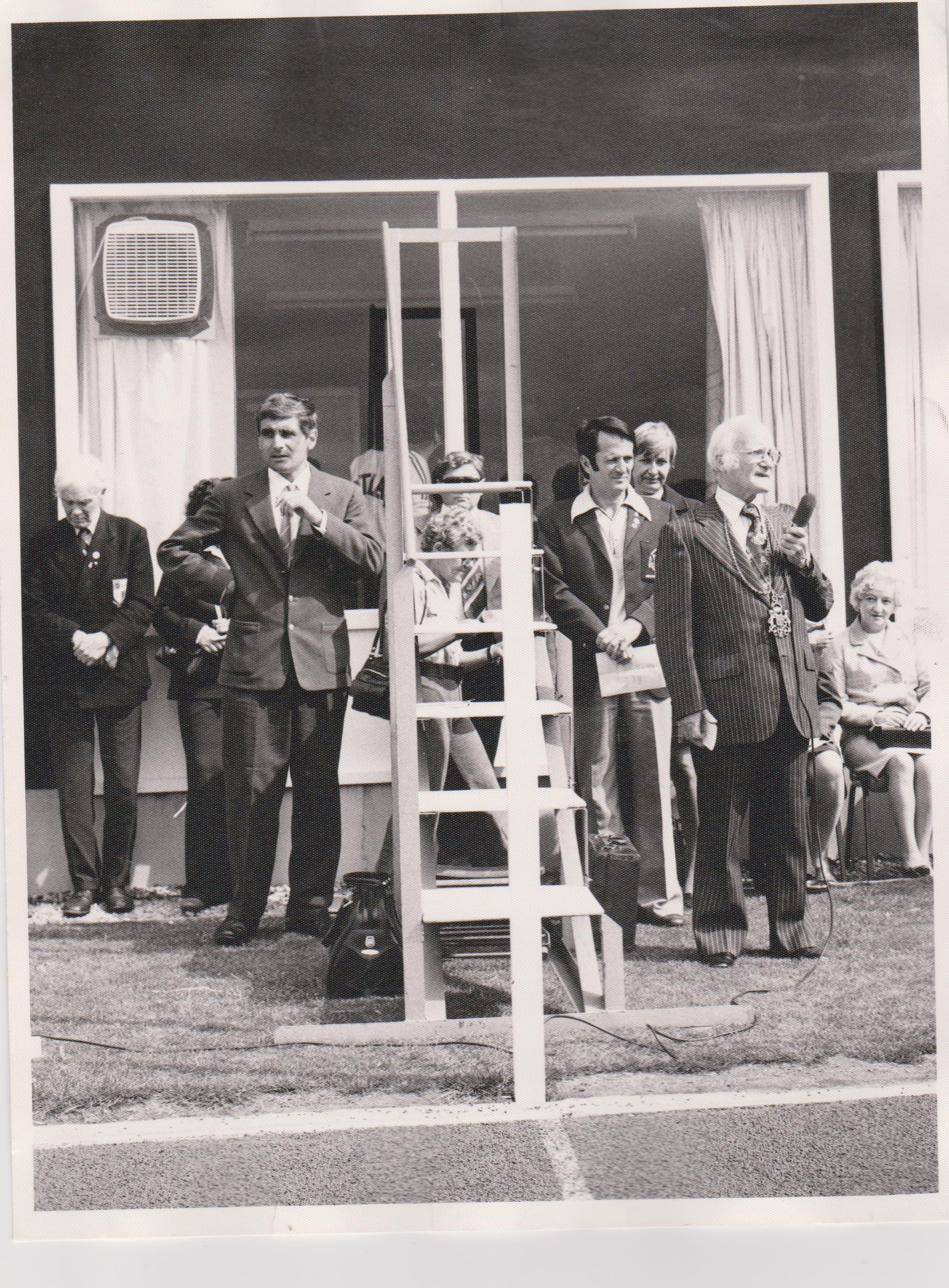
At the conclusion of a girls international match in 1976.   Hunter had persuaded the Aberdeen and Grampian Regional Councils to jointly make available the sponsorship.   It went on to become the Celtic International.   Hunter is standing beside the timekeepers stand.

Although Hunter was heavily involved with club organisation and administration after he became club secretary in 1975, he did manage to put in some useful performances at competitions.   For instance on 12th August, 1973 at the age of 37, he ran 1500m in 3:59.5 which ranked him twenty second senior in Scotland.  This was done while representing Aberdeen AAC in Division 1 of the Scottish League where he finished third A String and fourth overall – among those who finished behind him was Hugh Barrow of Victoria Park.       

Thereafter, notably in 1976 he had a series of good runs. In that year, on 30th May, and having turned 40, he won the Scottish Veteran’s 800m title in a championship record time of 2:01.1.    In the world rankings for 1976 that time of 2:01.1 placed him 9th equal in the 40-49 rankings for the 800m. It stood as a Scottish vets best for the distance until 1993 when clubmate Denis Shepherd ran 2:01.0 in Dundee.   Now, in 2017, 41 years later, it remains the second best time by an Aberdeen AAC M40 for the distance.   Later that summer he won the British Veteran’s 800m title in a time of 2:01.5.    That season he also ran 55.7 for 400m at Balgownie on 4th April, and 4:12.2 for 1500 on 9th May in Dundee.

In 1977 he won the Scottish Veteran’s 1500m title  on in a championship record time of 4:12.6.   He ran 4:12.2 on 9th May 1977 when representing the club in a meeting of the North Eastern League and this placed him 19th equal in the 40-49 rankings for the distance.  This was an official time but on 12th June 1977, he ran 4:08.0 in a Scottish League Division 1 Match at Coatbridge on 12th June.  Here he finished out of the first three and the time is an unofficial one, taken by a club member.  This, of course, meant that it did not count for world rankings.

Because of injury niggles he did not compete again in a championship event until 1986. In that year he won the Scottish Veteran’s 800m over-50’s title in a time of 2:14.7 at Dundee on 29th June.  In ’86 he also ran a 1500m in 4:37.8 at Balgownie in the club championships on 30th August.

We have then three Scottish and one British veteran championship victories – three of those in two summers, and two of them in record time.   One of the interesting things about these is that they are at the same distances as he was running as a schoolboy of 15 in 1951.   Most endurance athletes tend to go up a distance or several as they grow older but Hunter must have looked after himself throughout his career to be able to set records at his original distances.   In the picture below, we see him at the age of 47 in a race where he finished 23rd in a strong field of veteran cross-country runners.

111 whw 8

Scottish Vets cross-country in Aberdeen in February 1983.

Although injury problems in 1987 led Hunter to conclude that it would be prudent to stop competitive running, he remained active. In particular, he continued cycling and was pleasantly pleased to discover that at 80 years of age he was still capable of going for cycles of up to sixty miles, albeit at a much slower pace than when he was younger.

The ability to still be able to cycle significant distances well after joining the ranks of the elderly is only one of the things that gave Hunter satisfaction. Another is that not only is his elder son, Bill, still an active athlete but Bill’s wife and both of his daughters are also. In fact, Bill’s wife, Ruth, is also a coach as is Bill’s younger daughter, Rachel.   Athletics, therefore, remains one of Hunter’s great interests.

We finish with more comments from two of his club mates.   First comes from Lynda Bain, former Scottish women’s marathon champion and record holder:

“Hunter takes a genuine interest in athletes.  He took his position as secretary of Aberdeen AAC very seriously and made the effort to encourage me when I joined the club.  He took the time to keep informed about athletes from the club and their performances.  I have met him recently and he hasn’t changed a bit!  He still looks pretty fit.”

Colin Youngson, former Scottish marathon champion, says

When I was a student at Aberdeen University, Hunter Watson once beat me in a mile race on the chunky cinder track at Linksfield, Aberdeen around 1967.   He simply trailed me unobtrusively until unleashing a tremendous sprint!   After that tactical lesson, I ran the first three laps as hard as I could and moved safely out of his reach.   He had of course been a Scottish One Mile medallist in the 1950s; and won Scottish and British Veterans track titles when he turned 40.   I remember him advising me to breathe only through my nose as I raced.    However I continued to use mouth and indeed ears as well!   As a middle distance coach of AAAC, he organised many track repetition sessions for athletes who performed very well over 800m and 1500m – but few had the stamina for 5000m!   He was a well-respected long-time Secretary and had considerable influence on the club, due to his meticulous organisational skills and encouraging journalism in the club newsletter.    Largely due to his influence, AAAC developed into a marvellous club for young athletes; the seniors won many national road and cross country team medals; and had great success in track and field leagues. In his early 80s, Hunter remains fit, healthy, clever and determined.

Graham Sword

DSCF4358 (2)

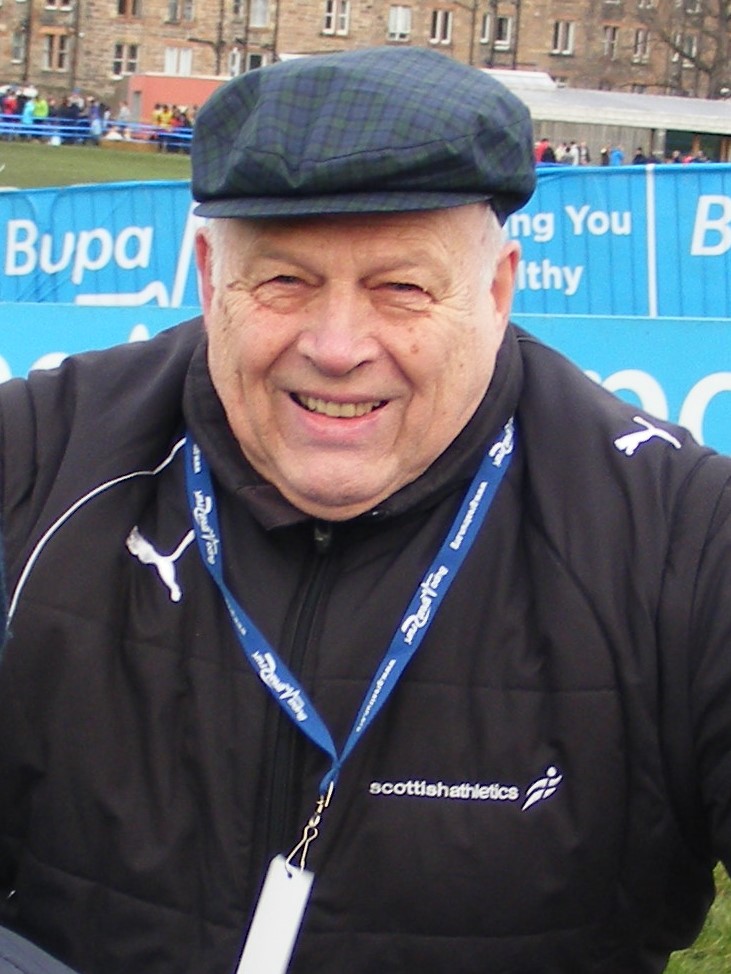
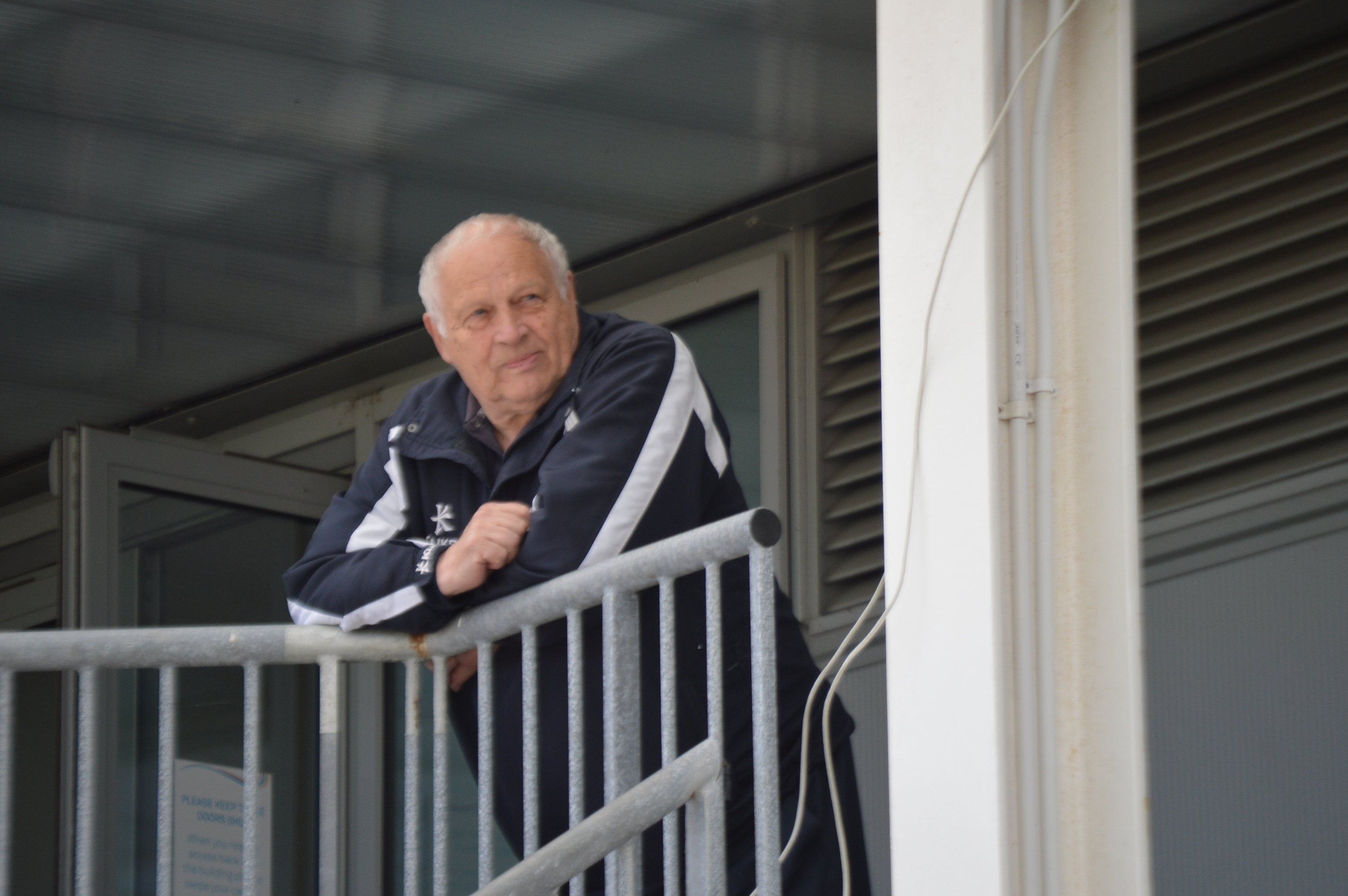
Graham at the International Cross-Country in Edinburgh

Graham Sword has been involved in Scottish athletics for over four decades and is one of the most respected of administrators and officials.   I first met him when we both took our daughters along to Strathkelvin Ladies AC in the late 70’s.   Run by Mollie Wilmoth, Aileen Lusk and Lillias Gorman, it trained at Huntershill along with Springburn Harriers and was a good, well-organised, athletic club.   He himself had no running background but was keen to see Sally Ann and her sister Mandy do well and the family supported the club whole  heartedly.   Although he had no athletics or running bachground, he had been a good all-round sportsman.

foot - Copy

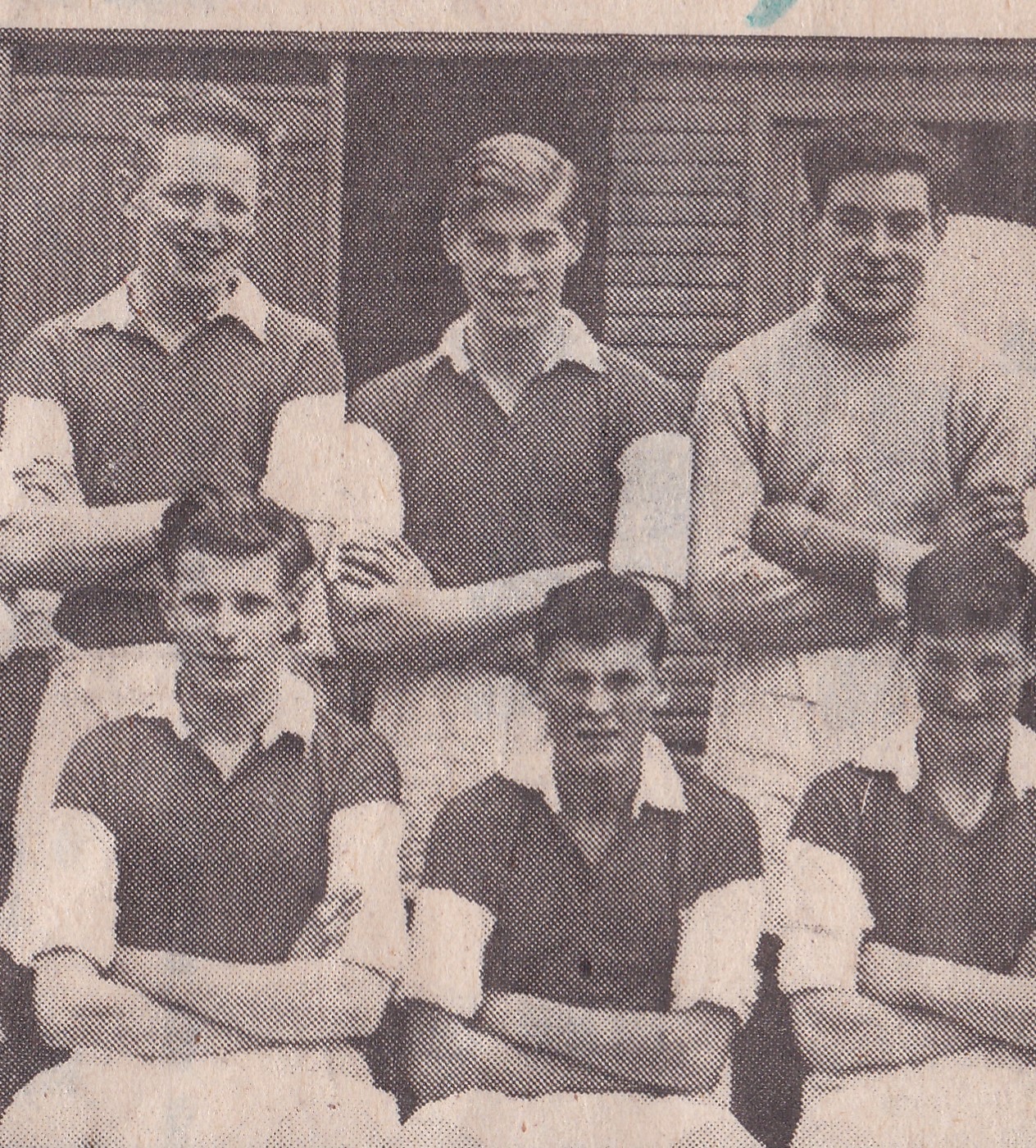
Graham came from a sporting tradition, his father played rugby in the Borders when it was the real hotbed of the sport in Scotland.  Graham was brought up in Forfar where he played football for a number of teams – the picture above is with the Forfar Renton Under 16 – they had just won two trophies in the season the picture was taken.   He also played cricket for the Strathmore club as a wicket-keeper and later as a member of the Bank of Scotland team which played all over the country with regular trips to Ireland.   Given that background, the girls were always going to be active in sport.

cricket - Copy

Sally’s track career lasted longer than Mandy’s: she was a good runner who ran track and cross-country as a young athlete but became a very good sprinter who competed in open meetings, inter-clubs and championships.   As far as times go, she had personal bests of 12.6 seconds (100m), 25.96 (200m), 58.5 (400m outdoors) and 58.71 (400m indoors when finishing third in the Scottish championships in 1993) and was ranked at Scottish level every year from 1990 to 1995.

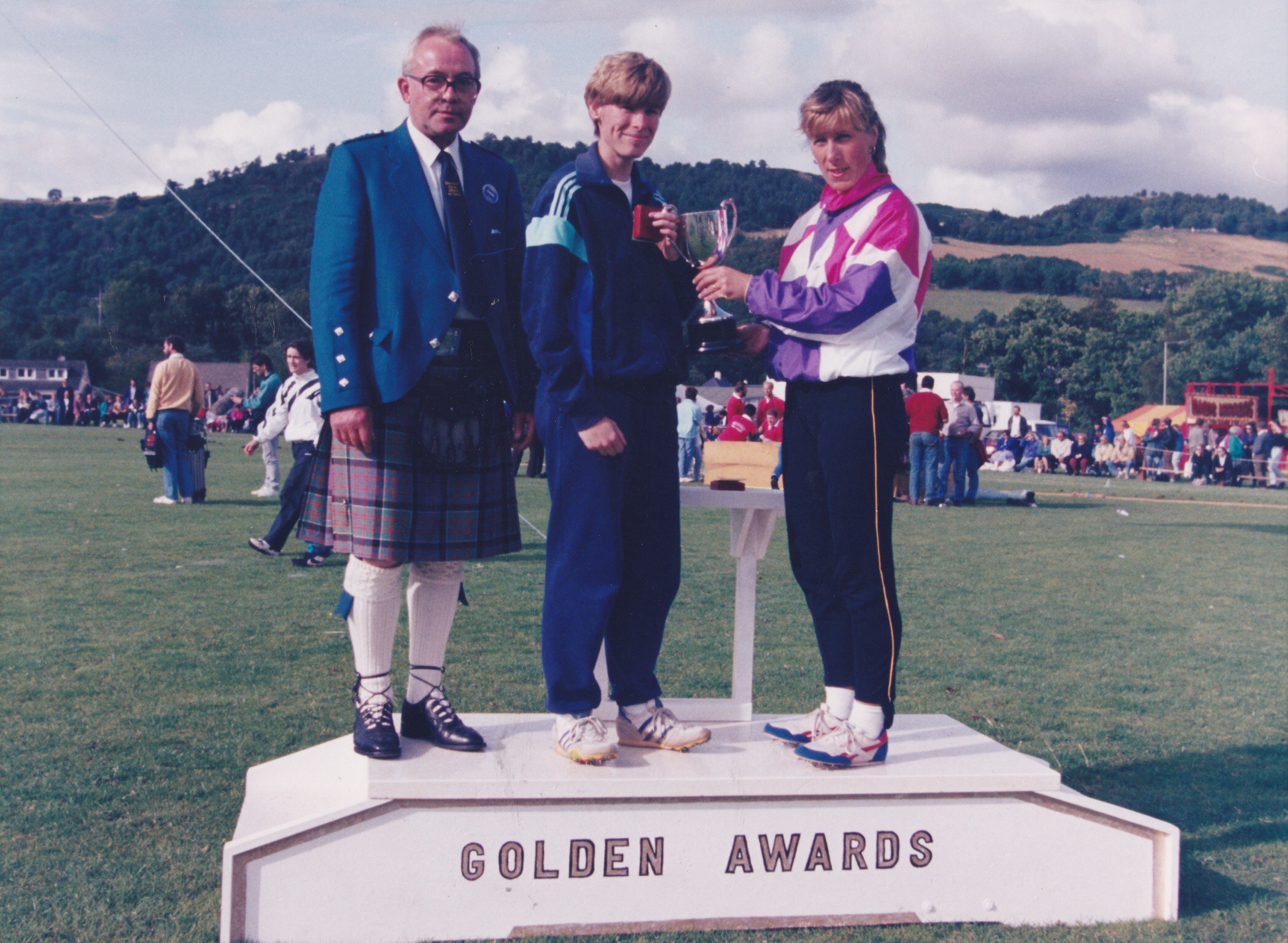
Sal podium 2

Sally at Glenurquhart Highland Games: the final one of the season and

the one where all the prizes are presented

Competitively she was also a very successful highland games athlete, winning many prizes and awards and travelling to  Highland Gatherings all over Scotland.   Her husband, Gary Condie, tells us

“Sally took part in The Highland Games from 1982 to 1999 when she announced her retirement.
The Sword girls first entered Fort William Highland Games  in 1982 with Sally in the track events while younger sister Amanda ran the ‘Quarter Ben’ up Ben Nevis. This whetted their appetite for the Highland Games circuit meaning many weekends for their mum and dad around the country.  When she started out, Sally was able to compete on either the south HG circuit or the North HG Circuit.
In the south she regularly ran at Airdrie, Carluke, Shotts, Bute, Bridge of Allan, Dunblane, Falkirk, Cupar and at the Glasgow Show.    At Bute, track events shared with the pipe bands and one day the 400m set off.   As Sally entered the back straight in the lead the massed bands approached the track.    The race was not recalled and the girls had to negotiate the band as well as the bend to fight their way to the line.  Sal did not come out of the melee first. Well known West of District official, the late Brian Goodwin, who that day was track referee, decided that the result should stand much to the amusement of the athletes.   At Cupar Sally also did not always get the rub of the green when in the handicapped 100m, the front marker athletes got a flyer and were not recalled. When the track referee,  the late George Duncan, was asked why the race was not restarted he told them it was “only a slight false start!”
The most lucrative Highland Gathering in the South was Strathallan HG at Bridge of Allan.   There are only four events for women, Sal didn’t do the 800m, which attracted some of the best sprinters in Scotland.    Sally usually medalled and one year after a very successful day won ‘Athlete of the Day’.
Most of Sal’s success was on the Northern HG Circuit consisting of eight venues – Forres, Elgin, Fort William, Nethy Bridge, Newtonmore, Nairn, Inverness and Drumnadrochit.   At first she was seen as the southern invader and was handicapped out of events because of her successes at other events. Handicapping punished athletes who supported the Highland Games. In one 100m event she started behind a Scottish International.
In her Highland Games career she won the North of Scotland Highland Games championship at 100m, 200m and 400m championship and was overall Champion on 2 occassions. She also won various high jumps, long jumps and relays.   At Elgin while the ladies were competing at the Long Jump the 400m took place without most of the athletes.    Another race was hastily organised but with no medals or vouchers as these had been given out in the other 400m Sally sprinted away to win a bottle of the local sponsors whisky.   A prize she gave to her dad.
Whisky plays a big part in a Highland Games as many local distillers sponsor the events. In Inverness the prizes were a bottle for 1st, half bottle for 2nd and miniatures for third. As Sal won or was placed in the 100m, 200m, 400m, long jump, high jump shot putt and relay, they needed an extra bag to bring the drink home.
At the season’s finale at Drumnadrochit, the heavies, athletes – male and female – must wear a kilt to run a handicapped kilted 200m. While some of the ladies wore small children’s kilts Sally had to borrow a full kilt from the heavies officials while he wore her trousers to cover his modesty. Even when Sally was old enough to take herself to the games it was not unusual for her mum and dad to make a surprise appearance at Drumnadrochit, Nethy Bridge or Inverness as they were “just passing”

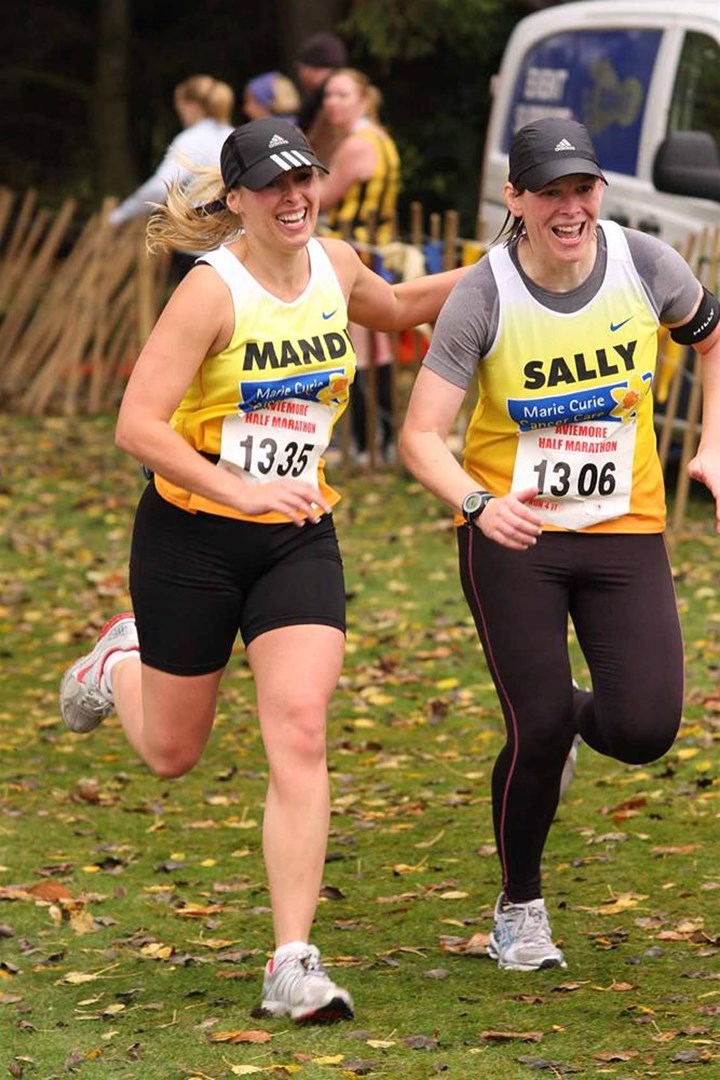
She married Gary Condie in 1992, competed for several years before she retired in 1999.  She returned as a Masters athlete and tried her hand at longer races with respectable times at 5K, 10K, Half and Full Marathons, the last of which was in 2014.  The sisters often ran in the same races and the picture below is a really good one.   Both women looking really happy doing what they’re doing, in each other’s company and an excellent advert for the sport.   Unlike many track people who go up to 26 miles on the road and are never  able to come back down, she has now returned to sprinting with an excellent 9.0 seconds for the indoor 60 metres.    Graham always enjoyed seeing the girls compete all the way through their athletics careers.

Sally and Mandy

Sally and Mandy finishing the Aviemore Half Marathon

Back home, Graham helped out as often as he could at the club and became a qualified time-keeper before moving to Kirkintilloch Olympians when Strathkelvin LAC folded.   As a time keeper he officiated at every kind of meeting imaginable: open gradeds, local meetings, District and National Championships and Highland Gatherings.   Good time-keepers are hard to come by, and Graham was always in demand.   He officiated at club league competitions for both clubs he has been connected with.   That was in summer, but where do timekeepers go in winter?   Cross-country and road running also need qualified officials and he was seen there too, doing his bit for the sport.   He still found time to encourage newer officials and Margaret Daly comments: “I worked with Graham as a time keeper (or assisted as a recorder) at several road and cross-country events both at District and National level.   Some of my fondest memories of my early timekeeping days were thoise working with Graham, Duncan McLaren, Duncan McSwein and Raymond Hutcheson.   Maybe that’s because they used to joke that I brought the average age of timekeepers down by 20 years!   They also referred to me as ‘the youngster’ which did my morale no end of good.”

16 07 July Aberdeen 10

Graham also worked as a timekeeper at various international meetings such as the Special Olympics in Glasgow from 2nd to 9th July, 2005, which offered 26 sports to the nations competing.   Then there were the Natwest Islands Games XI in Shetland in from 9th to 15th July, 2005.  The Games enconpassed 15 sports and these were contested by 24 islands or island groups including Bermuda, Cayman Islands, Rhodes, Faro, Gotland and St Helena.

  There were of course some other non-athletics benefits for a good time-keeper and one of these involved the UEFA Cup Final which was held in Glasgow in 2007 between Sevilla and Espanol.   The phone call came in to the offices for a driver for the occasion.   Graham was appointed and had the pleasure of driving a variety of dignitaries to and from their accommodation in East Kilbride and to the airport.   In return for their services, Graham and fellow drivers were allocated seats behind the dug-out for the actual game.

 His value was recognised by the winter enthusiasts as much as by the summer, as is shown by the fact that in addition to local and national races, open meetings and championships, Graham worked at international cross-country events, including European and World championships whenever they were held in Scotland: in Edinburgh, at Bellahouston and at Tollcross in  Glasgow, at Coatbridge and at Veterans internationals as well as at Senior and Junior matches.   International duty has also taken him to England as a team manager and to Greece.

14 10 October 11 October Aviemore281 (1)

With Sally and Mandy

Like all quality officials however, his involvement did not stop at his first qualification or involvement in the sport.   His work as an administrator of the very highest calibre has been recognised nationally in Scotland and also at GB level.

Graham entered a new phase of his involvement with athletics in the early 1990’s.   Brian Goodwin of Bellahouston Harriers was Secretary of both the SCCU and SAAA West District committees and a semi-formal group consisting of Brian, Graham, Margaret Daly and Derek McGinley started working in the SAAA District offices in Glasgow dealing with the postal entries for championships.    Margaret recalls these experiences from the viewpoint of someone new to the sport at the time: “I was a latecomer to athletics, taking up jogging in my 30’s, and being well and truly bitten by the running bug.   That led to me being part of the group that founded Shettleston Harriers Ladies and within a few months taking on the role as secretary to the club.   I attended (with some trepidation) West District meetings, then held in the Boys Brigade offices in Bath Street.   At that time meetings were well attended and Brian Goodwin was West District Secretary.    I found Graham to be a committed and knowledgeable official.   He had the patience of a saint in my book, the way he handled entries for events, dealing with queries, last minute changes, gripes and complaints from clubs.   His home became an extension of the Scottish Athletics office at entry closing dates with his phone ringing at all hours of the day and night with club officials queries about entry forms.   He always struck me as very athlete-focused and would always try to ensure that if it were possible an athlete would compete in an event, applying rules fairly and with some degree of flexibility as long as it would not compromise an event or a result.”

When Brian moved on to become secretary of the new Scottish Athletics Federation Cross-Country Commission, Graham took over first as secretary of the West District Cross-Country and subsequently also of the Track & Field committees.  His contemporary in the East District was Alex Jackson who says: “For many years Graham was West District secretary and we worked in tandem on many things as I have been East Secretary since 1988.   Graham and Brian Goodwin spent many days/hours working in the SAL Edinburgh office around 2000 to 2005 .   This was in the early days of email and acknowledgments to athletes and other mail still had to go by post.   They used to camp themselves in the meeting room there doing boring but vital tasks like stuffing envelopes while listening to “real” music like Sinatra.”

It is instructive to look at how much work was involved at that time when all championship entries were on paper and sent by post.   For instance, for a championship meeting, they would meet three or four days a week in the Glasgow office.   The postal entries would all come in and had to be entered on ‘spreadsheets’.   These were not Microsoft Word Spreadsheets but large paper documents where every athlete, every club and every event had to be entered legibly by hand.   From these the programme had to be made up and Margaret, as the best typist, typed them up to go to the printer.   Meanwhile entry tickets and timetables had to be sent out to the athletes – the time spent stuffing the envelopes is incalculable.   In addition to that work, there were invitations to go to officials and accommodation and venue had to be booked well in advance.   Graham was still time keeping on the Saturdays while this was all going on.   Then came the day/days of the championship and the troops were back in action.   Graham was involved at many meetings taking the declarations at the meetings  or  taking entry money at the door   and/or  selling programmes.   And then of course, at the end of the meeting there was prize giving to be dealt with.   Often enough Graham had to present prizes.   Graham had done all that work prior to the meeting and on the day he did not see much of the action as he was doing the chores listed above but he still says that the job he liked least was when he had to come into the public eye and present the awards.

It is impossible to keep one with his talents a secret and in 2001/02: he was appointed Finance Officer for  the Scottish Athletics Track & Field Commission and subsequently Raod Running & Cross-Country Commission.   This post was significantly different from anything g he had done previously in athletics.  He held this position at a crucial time in the development of Scottish athletics from an amateur body into a professional one.   Leslie Roy, who has been involved with Scottish and British athletics for at least the whole of the twenty first century so far and with every Commonwealth Games team since 2000, says:

“Graham has held many roles over the years but as a retired Bank Manager his skills have mainly been used in Treasurer/Finance officer roles.  These roles have been with scottishathletics Track & Field Commission, scottishathletics Road & XC Commission, Scottish Young Athletes league and Scottish Athletics Indoor League. 

Graham has done a great job over the years managing the ‘books’ in his own quiet way but he is often seen at scottishathletics championship events taking entry money from spectators and selling programmes as they arrive at stadium.

He has kept finances in order, he is reliable, hardworking, always helpful and everything is done to ensure it is in the best interest of the athletes.  For a great many years he could be found in the scottishathletics office prior to Championships folding letters to athletes and putting these into envelopes ensuring that athletes had all their pre event information. Nowadays, this is all done via Email. Not many people would volunteer to do that or clean all the trophies prior to championships, Graham did.”

Molly Wilmoth tells us that in those days the officials at meetings were paid their expenses on the day and Graham often did that with the help of Brian Goodwin.   Nowadays the expenses are paid often months after the events.   Just another one of Graham’s tasks.

He held the post of Finance Officer until 2014/15.   His efforts have been recognised of course by the governing bodies, not only of Scottish athletics but also at British level.   He was made an honorary life member in the early 2000’s but the really big honour was when he was presented with the Tom Stillie Award in 2004.   This Award takes the form of long sword and is gor services to Scottish athletics.   The first winner was Allan Wells and other recipients include Cameron Sharp, Leslie Roy and George Duncan.   The headline afterwards read, of course, “Sword gets Sword!”

After following this with the Scottish Off Track Official of the Year, in 2006 he received the UK Off Track Official of the Year.   The presentation was made on 25th November 2006 at a glittering function attended by the great and the good of UK Athletics.   Alan Potts received the award for Volunteer Co-ordinator of the Year at the same function but neither man is keen on such high profile occasions and both had to be asked more than once to go down: although they had been nominated, neither thought that they would receive anything!   They both did because they both deserved to.

*

So far we have seen Graham as a parent-helper, time keeper and official, championship administrator and now finance officer.   The honours that have come his way have been well earned but when he was asked what he got out of the sport, what he enjoyed doing most, the reply came like lightning.   “Watching the girls running.”   After 50 years in the sport (and counting) what brought him into athletics is what still gives him pleasure.      Other than that he says he also gets satisfaction out seeing that jobs are done properly .

Typical of the many tributes to Graham from those who worked with him was the following from Clare Barr.

“I first met Graham Sword several years ago when I attended a West District Commission meeting as a rookie club rep, and somehow found myself, completely by accident, as the new District Convenor (I think I sneezed at the wrong moment or something, like when people unintentionally buy a Ming vase due to waving at their friend just as the auctioneer bangs their hammer.)

Anyway, Graham was the West District Secretary and he took me gently under his wing, subtly pointing me in the right direction and showing me the ropes, but he did it so tactfully that I did not realise at the time how much he was helping me.   Graham knows EVERYBODY, and has done for years, and all the District history, so he was brilliant for me as a total newbie – showing me how all the paperwork is processed, and introducing me to all the Officials etc.    Everybody likes Graham. 

At the start I did not realise how much work Graham did on behalf of the West District (on top of his work with the National Road Running & Cross-Country Commission), such as taking in all the West Cross-Country entries to his home address.   I bet the Postman loved him, squashing a mountain of big envelopes through his front door letterbox, but Graham had to sort out and process all the contents before inputting all the entries onto his trusty computer – all in a back bedroom, I believe – before then stuffing all the race envelopes with the bib numbers and declaration sheets etc.   Graham is one of those magic elves, doing all the work that everyone else assumes ‘just happens’, and he never once looks for praise or recognition.   He is truly an unsung hero, and a lovely, lovely, gentle man to boot, and it is always a pleasure to bump into him, when invariably he is ‘on the door’ at athletics events taking the entry money and meeting and greeting the masses.”

Clare’s predecessor as Convenor of the West District was Margaret Daly, herself a respected official who has been quoted above, and says:

“I think I can attribute my own involvement as an official in athletics to the dual persuasion of Graham and Brian Goodwin.  At District meetings, being a ‘new’ apprehensive face in a room full of knowledgeable athletics people, they quickly spotted a gullible potential volunteer and ‘cajoled’ me into turning up to record on the finish line of District Cross Country Championships, initially and soon I found myself at the Edinburgh to Glasgow Road Race, National Road Race Championships, Cross Country Championships and more.  Between them, they got me involved in helping out at track and field events, providing assistance with presentations and encouraged me into a wide range of roles, including timekeeping, administration and team management/selection. I will always be grateful for Graham’s encouragement and support, a support that often extended to him kindly providing a chauffeur service to events when my own transport arrangements fell through.”

Margaret’s last remark puts her in good company – one of Graham’s many functions at some internationals was to act as ‘driver to the stars’ as one correspondent put it!

Molly Wilmoth who organised the Strathkelvin Ladies AC where Graham first won his spurs has followed his career with interest and they are still the best of friends today.   In addition to the various tasks noted already, she points out that he was always available to assist Danny Wilmoth in oprganising the many veterans events in which he was involved as well as his involvement in track & field, cross-country, road running and disability athletics.   Molly lives in Kirkintilloch and Graham in Bishopbriggs, both are timekeepers and since they frequently officiated at the same meetings,  he frequently drove her to events.    It is a friendship which benefited Scottish athletics and that has lasted almost 50 years.

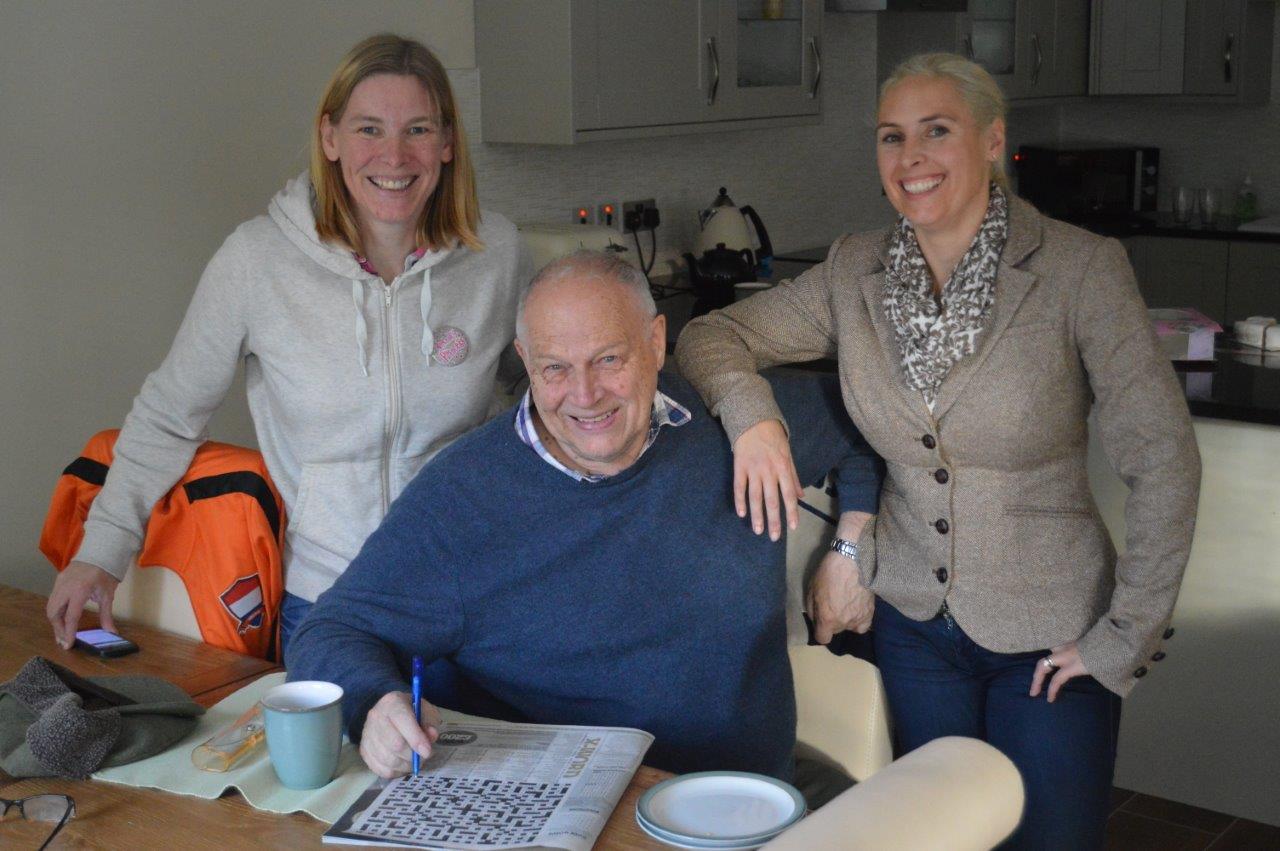
14 10 October 11 October Aviemore290 (1)

Graham with Sally, Mandie and the next generation of Ewan and Alastair 

Very much a family man, he still has his interest in football and he likes watching Clyde and Blackpool with Grandson Ewan.   He has been known to get an athletic meeting started then nip off to pick up his grandson and head for the game.    He even ‘dragged’ son-in-law Gary on holiday to see Carlisle v Blackpool!

Although athletics was not his own sport originally, Graham has done a lot of seriously good work for athletics and contributed to the success of many, many events the length and breadth of the land.   Liked and respected in equal measure, a more-than-capable official, he needn’t hang up his watch for some time yet.   Finally –

Alex Jackson sent this video link – Graham appears talking to the camera at about 1 minute 15 seconds into it.   https://www.youtube.com/watch?v=YmWHbofCtPs   It is of the West Dsitrict Championships in 1996 and Graham appears several times in the course of it.

Summit results: April/May 2017

15th April: Jim and Carole took a total of 5 boys and 6 girls to the Oregon Relays: he reports –

ENTERED 1 BOY IN 3000/ 1 GIRL IN 800 AND 1500

OTHER 4 IN THE RELAYS

BOYS AND GIRLS IN 4X800 AND DMR

*

BIG MEET OVER 100 SCHOOLS ATTENDED – TEAM FINISHED SECOND

DISTANCE KIDS SCORED 50% OF THE TOTAL POINTS

800 – 2ND 2:17.01 ISABEL ( FRESHMAN) PERSON BEST

1500 – OLIVIA – 3RD – 8 SEC IMPROVEMENT

3000 – NIK – 4TH – 4 SECOND IMPROVEMENT

DMR – GIRLS – 2ND BY LESS THAN 1 SECOND – SCHOOL RECORD – 3 FRESHMEN AND OLIVIA

DMR – BOYS – 4TH

4X800 – GIRLS – 4TH

4X800 – BOYS – 3RD – NEW SCHOOL RECORD

SPRINT MEDLEY – GIRLS -2ND”

The complete results are impressive and can be found at

https://www.athletic.net/TrackAndField/MeetResults.aspx?Meet=287302#266

*

This was excellent and followed up by the Varsity finals where trhree of the U 15 girls did particularly well, he reports briefly “SUMMIT KIDS DID WELL – ZOE, ISABEL AND FIONA ONLY 15 YEARS OLD – OLIVIA FASTEST TIME IN THE STATE FOR 800 – WINDY – 15-20 MPH”

and if you doubt his word, the results speak for him:

400 Meters  Varsity – Finals

1. 12 Madison Hergert 56.26a PR Newberg
2. 10 Sydney Gardner 60.38a PR Bend
3. 9 Zoe Villano 60.48a PR Summit
4. 10 Cheyanne Rede 60.55a PR Centennial
5. 11 Anna Hinz 60.57a SR Summit
6. 9 Grace Umfleet 61.08a PR Newberg
7. 12 Carli Feist 61.58a PR Burns
8. 10 Greta Anderson 61.59a Jesuit
9. 9 Emma Patek 61.68a PR Boise
10. 9 Ella Nelson 61.88a PR Jesuit
11. 10 Elliana Wyllie 61.97a PR Mountain View (OR)
12. 11 Dagny Donohue 62.13a PR Bend
13. 10 Gabby Navarro 62.24a PR Jesuit
14. 11 Sarah DeChristopher 62.88a PR Redmond
15. 11 Calista Van Delden 63.14a PR Grants Pass
16. 12 Aubrey Snyder 63.16a Roseburg
17. 9 Julia Nixon 63.51a Boise
18. 12 Adrienne Gulley 63.70a Centennial
19. 11 Audrey Marble 64.02a SR Hood River Valley
20. 11 Mandi Calavan 64.07a Sisters

800 Meters  Varsity – Finals

1. 12 Olivia Brooks 2:13.29a PR Summit
2. 9 Madison Elmore 2:18.07a South Eugene
3. 10 Makenna Schumacher 2:18.72a PR Jesuit
4. 12 Emma Stevenson 2:19.91a SR Summit
5. 12 Grace Crookham-Guy 2:22.52a SR Boise
6. 10 Maggie Liebich 2:23.13a Boise
7. 10 Hallie DeVore 2:24.20a Jesuit
8. 9 Molly Elliott 2:25.28a Boise
9. 11 Ashlynn Lawston 2:25.95a SR Lakeridge
10. 12 Chloe Jensen 2:29.54a Jesuit
11. 12 Ciara Jones 2:29.76a Mountain View (OR)
12. 11 Amber Miller 2:31.16a SR Lakeridge
13. 10 Mckinzee Mode 2:32.87a PR Crook County
14. 12 Autumn Layden 2:33.98a PR Summit
15. 11 Dagny Donohue 2:37.69a Bend
16. 10 Gracie Kasberger 2:38.14a PR Crook County
17. 12 Gabriella Wayne 2:38.36a PR Bend
18. 9 Alyson Thomas 2:39.46a PR Crook County
19. 12 Andrea Broyles 2:40.46a Redmond
20. 10 Tate Ricker 2:41.15a SR Sisters

1500 Meters  Varsity – Finals

1. 9 Isabel Max 4:45.65a PR Summit
2. 10 Eve Jensen 4:45.70a PR Boise
3. 10 Maggie Liebich 4:51.09a PR Boise
4. 9 Molly Elliott 4:51.36a PR Boise
5. 9 Alexis Kebbe 4:55.28a Jesuit
6. 9 Kelsey Gripekoven 4:57.27a PR Jesuit
7. 11 Casey Novak 4:59.52a Newberg
8. 10 Elizabeth Rinck 5:01.15a Jesuit
9. 10 Kelsey Swenson 5:03.24a Mountain View (OR)
10. 9 Lottie Bromham 5:08.74a Hood River Valley
11. 9 Abigail Hein 5:10.41a Newberg
12. 10 Mckenzi Hoyt 5:11.30a SR Burns
13. 12 Grace Hanna 5:17.04a Newberg
14. 12 Victoria Boechler 5:17.35a South Eugene
15. 12 Anna Land 5:19.97a PR Redmond
16. 11 Abigail Stadtlander 5:21.96a PR Centennial
17. 9 Ruby Gates 5:22.06a PR Ridgeview
18. 9 Caroline Sherwood 5:23.31a PR Bend
19. 9 Katie Gebert 5:24.66a PR Boise
20. 12 Gabriella Wayne 5:25.53a Bend

3000 Meters  Varsity – Finals

1. 10 Eve Jensen 10:16.74a PR Boise
2. 9 Fiona Max 10:27.92a PR Summit
3. 9 Kelsey Gripekoven 10:29.24a Jesuit
4. 12 Grace Perkins 10:50.86a SR Bend
5. 11 Hannah Tobiason 11:03.97a Summit
6. 11 Keely McCormick 11:04.12a Jesuit
7. 10 Liv Downing 11:11.48a SR Summit
8. 9 Lottie Bromham 11:13.70a Hood River Valley
9. 9 Abigail Hein 11:13.85a Newberg
10. 10 Kelsey Swenson 11:20.14a Mountain View (OR)
11. 11 Abigail Stadtlander 11:40.46a SR Centennial
12. 12 Katie Weedn 11:41.70a SR Centennial
13. 10 Sophie Steckel 11:44.75a PR Boise
14. 10 Mckenzi Hoyt 11:54.99a PR Burns
15. 9 Celia Acosta 11:55.81a Hood River Valley

800 Meters  Varsity – Finals

1. 11 Kyle Charbonneau 1:56.98a PR Newberg
2. 12 Peter Gentile 1:57.30a PR Newberg
3. 12 Amogh Patki 1:57.75a PR Jesuit
4. 11 Jett Ballantyne 1:57.93a PR Summit
5. 11 Connor Duggan 2:00.00a PR Summit
6. 12 Daniel Sealand 2:00.22a Jesuit
7. 12 Scott Kinkade 2:01.47a SR Summit
8. 11 Henry Potter 2:02.26a PR Lakeridge
9. 11 Shon Martin 2:02.33a Lakeridge
10. 12 Chase Maxfield 2:02.57a Centennial
11. 12 Emmett Bailor 2:03.39a Crook County
12. 12 Barrett Titus 2:03.65a Grants Pass
13. 11 Albert Hesse 2:05.17a Ridgeview
14. 11 Jack Chapman 2:05.74a Lakeridge
15. 11 Braxton Wilson 2:05.82a PR Hood River Valley
16. 12 Luke Willnerd 2:06.17a Boise
17. 11 Maitu Millar-Sanchez 2:06.19a PR Bend
18. 12 Henry Moore 2:06.60a Boise
19. 11 EG Pierce 2:06.80a PR Bend
20. 10 Austin Keetch 2:06.93a Centennial

1500 Meters  Varsity – Finals

1. 11 Albert Hesse 4:09.72a PR Ridgeview
2. 12 Niklas Sjogren 4:09.87a PR Summit
3. 11 Reuben Kosche 4:14.72a PR Boise
4. 11 Chad Ford 4:15.22a PR Summit
5. 12 Alex Harbert 4:15.32a SR Lakeridge
6. 12 Jesse Wiley 4:19.83a Hood River Valley
7. 11 BJ Sauter 4:21.01a PR South Eugene
8. 12 Camden Hammer 4:21.98a Summit
9. 10 Emmett Klus 4:22.23a PR Burns
10. 11 Treyson Conley 4:24.43a Redmond
11. 12 David (Graf) Kirk 4:26.47a SR Boise
12. 10 Trevor Wilber 4:26.64a PR Bend
13. 10 Austin Keetch 4:27.09a PR Centennial
14. 11 Spencer McNall 4:27.45a South Eugene
15. 9 Paul Corso 4:27.62a PR Lakeridge
16. 9 Aidan Strealy 4:28.05a PR Lakeridge
17. 9 Cam McChesney 4:28.54a Newberg
18. 12 Quinton Read 4:28.64a Newberg
19. 12 Jacob Bromham 4:28.89a Hood River Valley
20. 9 Mason Kirk 4:32.45a PR Boise


Jim Says:

20 entries

1 Mile  Elite – Finals

1. 10 Taylor Roe 4:45.97a PR Lake Stevens
2. 9 Lexy Halladay 4:46.35a PR Mountain View (ID)
3. 12 Olivia Brooks 4:51.16a PR Summit
4. 11 Kelly Makin 4:56.99a PR Sunset
5. 10 Makenna Schumacher 4:57.98a PR Jesuit
6. 10 Ember Stratton 4:58.86a SR Sunset
7. 11 Katie Thronson 4:58.91a PR Lewis and Clark
8. 12 Olivia Johnson 4:59.20a PR Barlow
9. 9 Madison Elmore 4:59.46a PR South Eugene
10. 9 Lucy Huelskamp 4:59.94a PR Sunset
11. 11 Brooke Manson 5:00.58a PR Eastlake
12. 12 Lara Rix 5:00.59a PR St Mary’s Academy
13. 11 Caramia Mestler 5:01.54a PR Sheldon (OR)

58 entries

1500 Meters  Varsity – Finals

1. 12 Scott Kinkade 4:02.27a PR Summit
2. 11 Jerik Embleton 4:02.54a SR Marist
3. 12 Dominic Arce 4:02.55a PR Lincoln
4. 11 Dawson Besst 4:03.06a PR Tahoma
5. 9 Quincy Norman 4:03.38a PR Forest Grove
6. 11 Eric Brecht 4:03.52a PR Central Catholic
7. 12 Spencer Tsai 4:03.66a PR South Eugene
8. 12 Griff Hokanson 4:03.86a PR Crater
9. 11 Luke George 4:03.89a PR Issaquah
10. 12 Vincent Huynh-Watkins 4:04.17a PR South Eugene

40 teams

4×800 Relay  Varsity – Finals

1. Cade Greseth
Luke Albert
Yacine Guermali
Daniel Maton
7:57.29a Camas
2. Anthony Ghiorso
Ashton Siwek
Tanner Roark
Gavin Pollock
7:59.84a Rocky Mountain
3. Max Norman
Hyrum Hansen
Riley Stewart
Garrett Stewart
8:00.07a Forest Grove
4. Chad Ford
Connor Duggan
Cole Rene
Jett Ballantyne
8:05.29a Summit

32 teams

DMR 1200-400-800-1600m  Varsity – Finals

1. Isabel Max
Zoe Villano
Emma Stevenson
Fiona Max
12:07.66a Summit
2. Kelly Makin
Georgie Fitch
Lucy Huelskamp
Ember Stratton
12:11.62a Sunset
3. Alexis Kebbe
Ella Nelson
Makenna Schumacher
Kelsey Gripekoven
12:39.45a Jesuit
4. Alexis Espey
Nathalia Campos
Laura Heywood
Sage Martin
12:42.74a Rocky Mountain


Cartoons

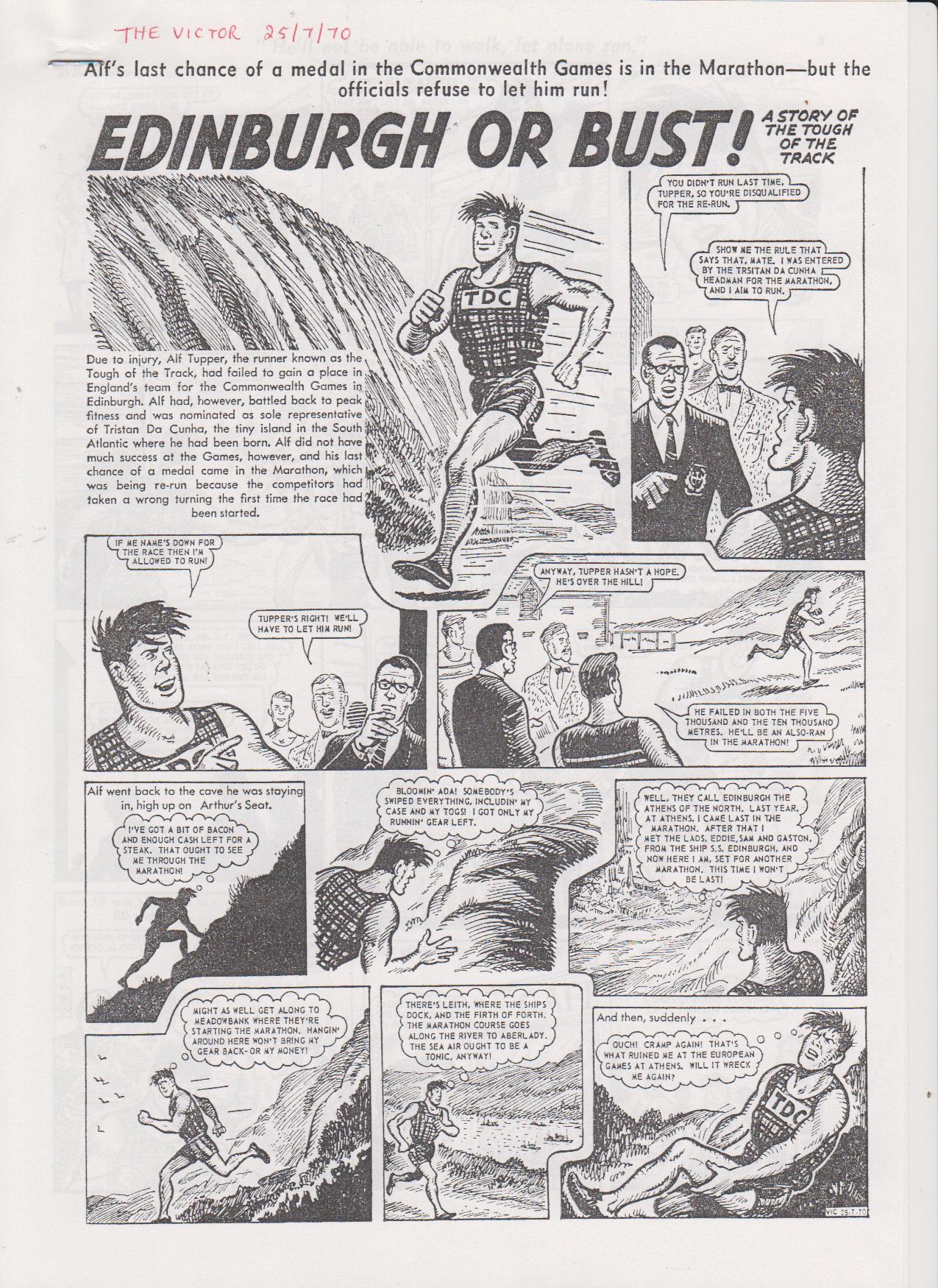
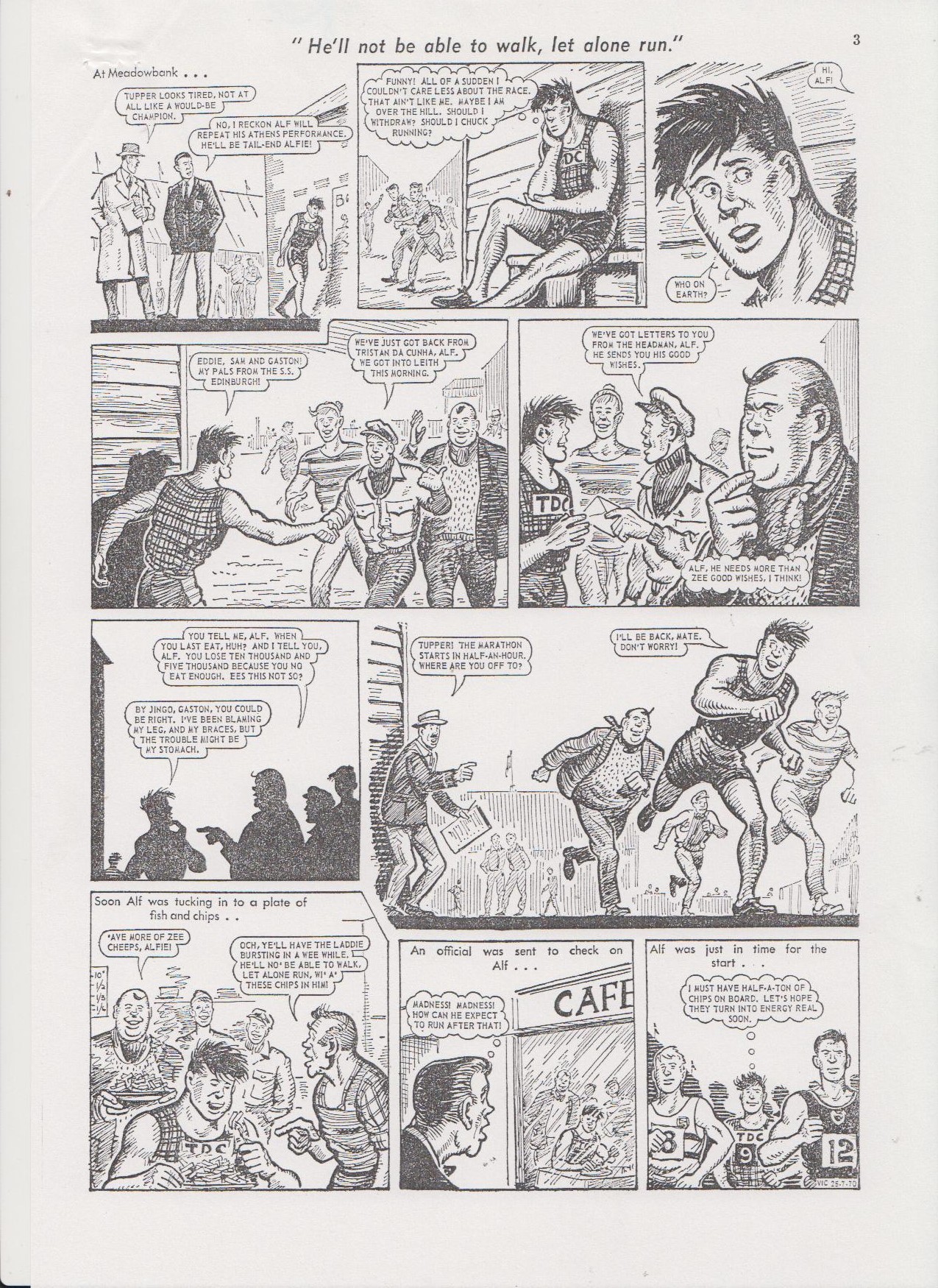
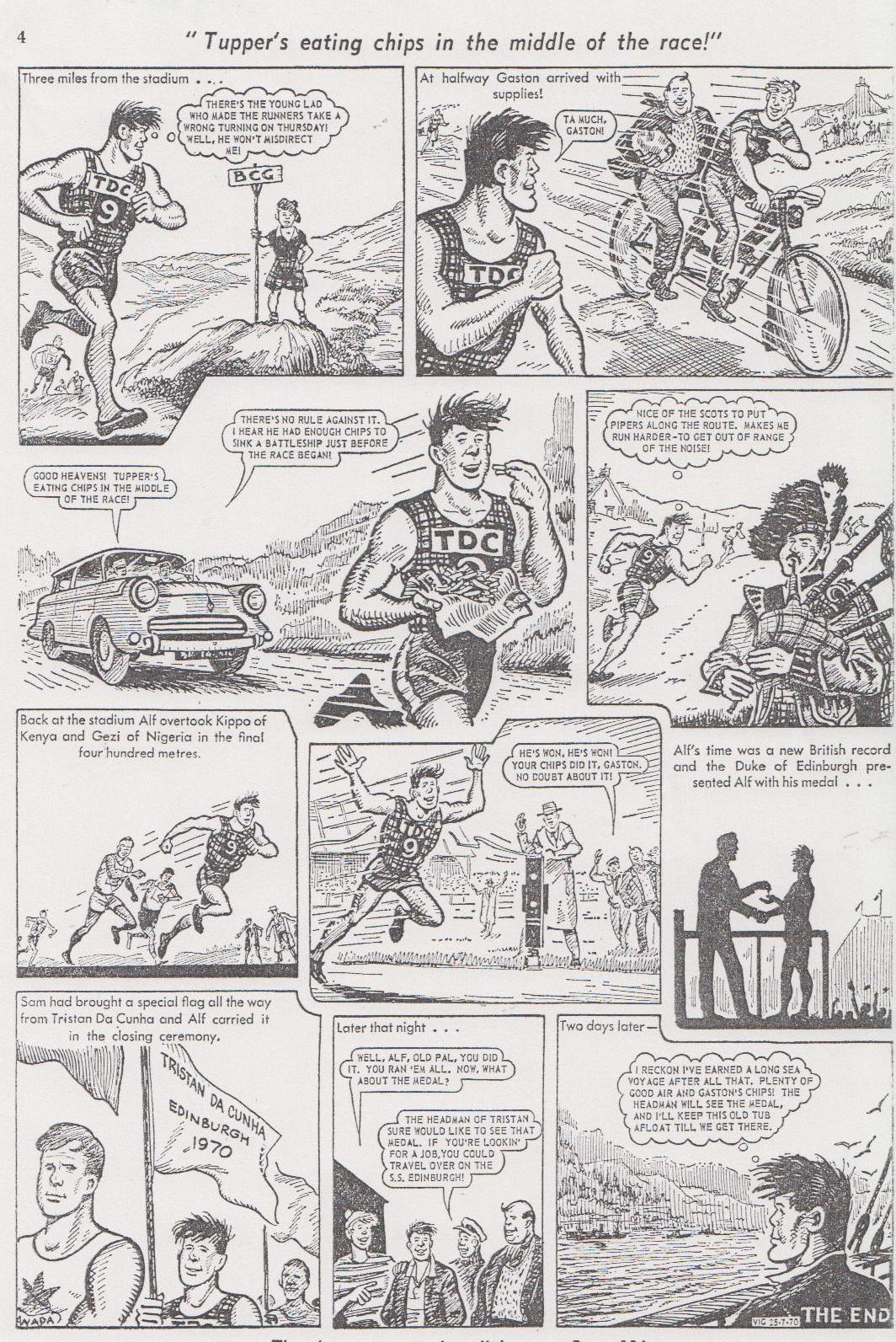
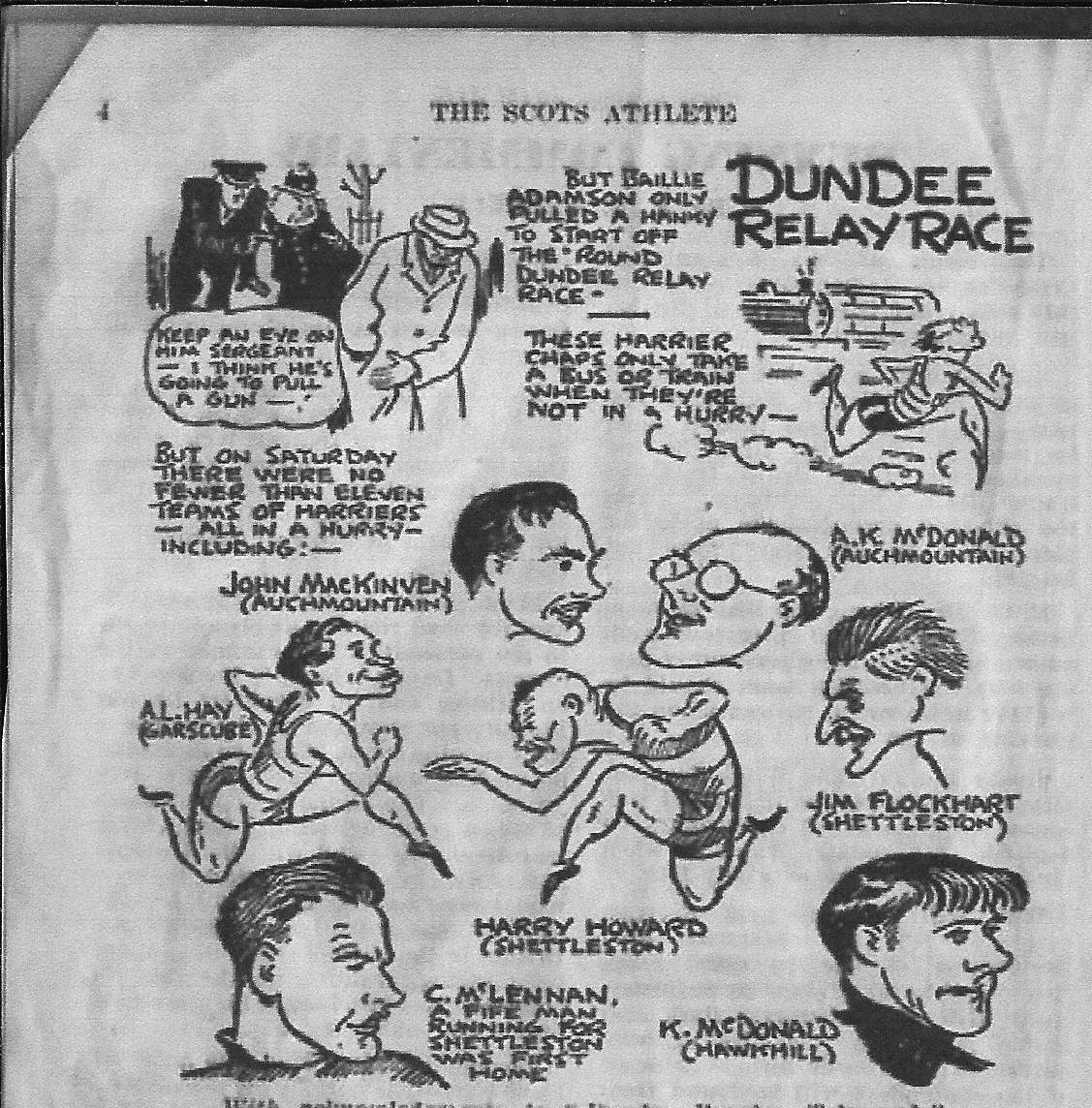
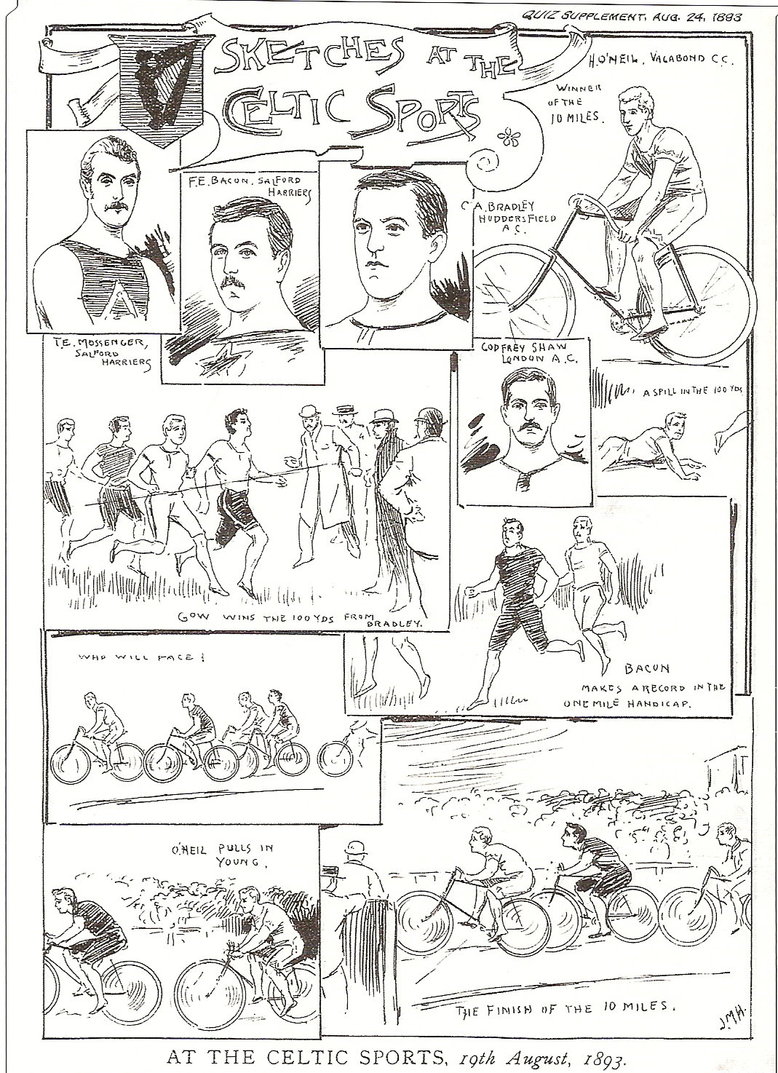
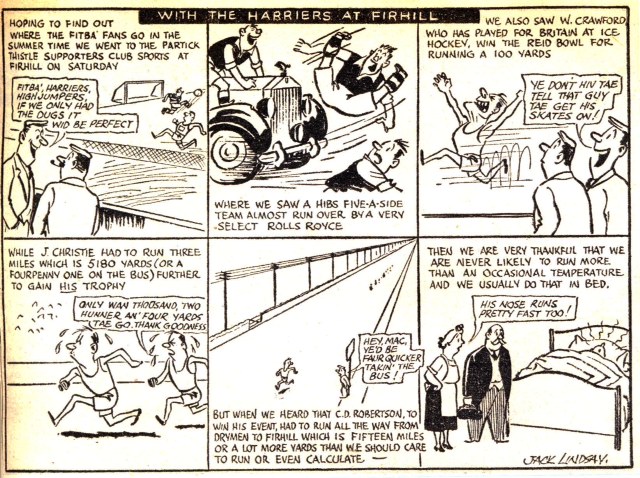
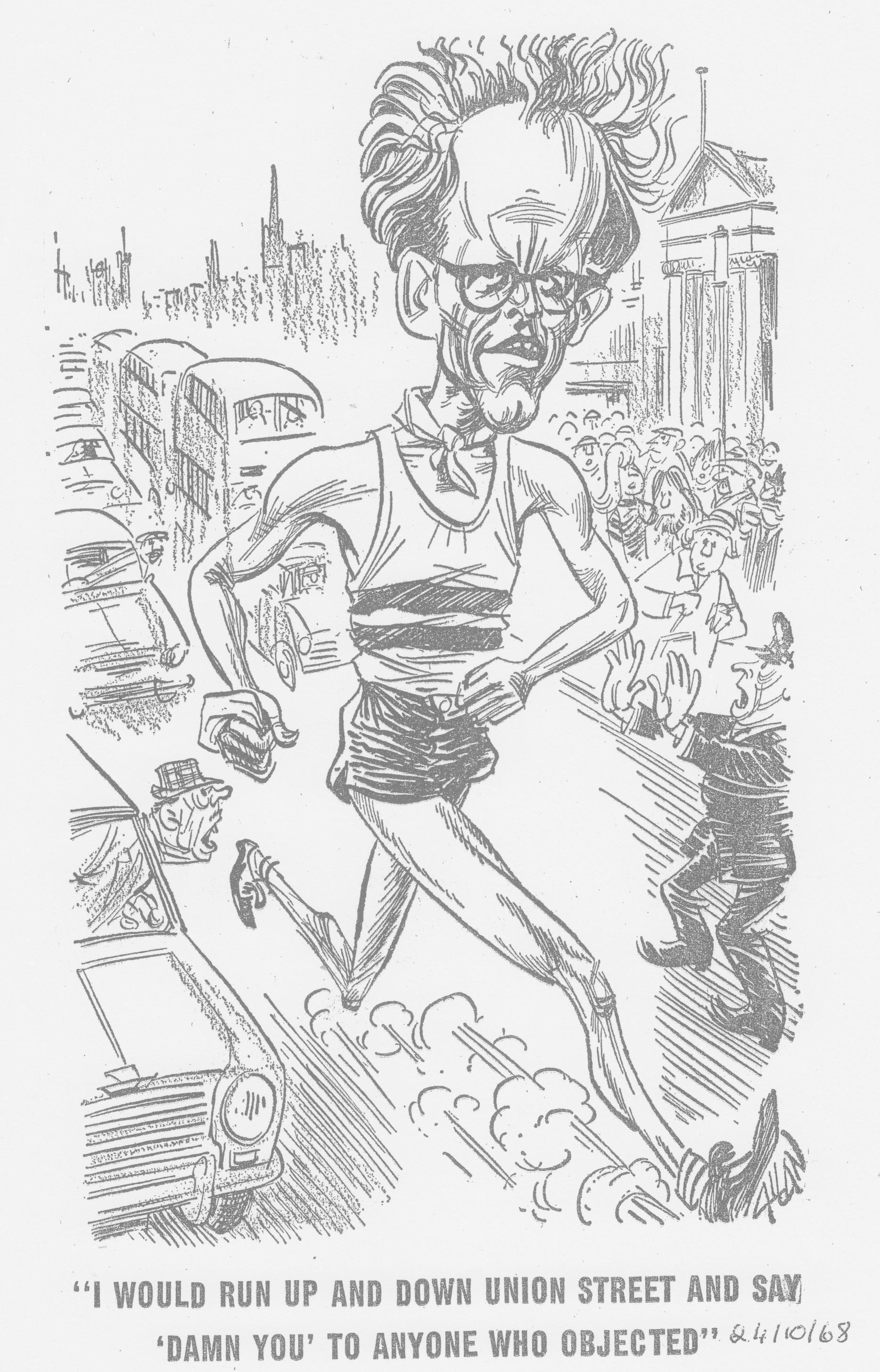
There have always been cartoons of athletes and athletics – cartoons in the sense of line drawings, some of which are humorous, or meant to be so.   What follows is a collection of cartoons in no particular order, many have come from Hugh Barrow’s collection but the most recent is from Colin Youngson and covers the time that Alf Tupper won the Commonwealth Games marathon in Edinburgh. .

Auchmountain cartoon

Round Dundee Race, April 1946

Cartoon WHB Gow

0B68FB15-D67B-4476-B8DA-2E91D48FC90D

Note the venue – Firhill!

Cartoon wood

If you can’t recgnise Alastair Wood, you’re on the wrong website!

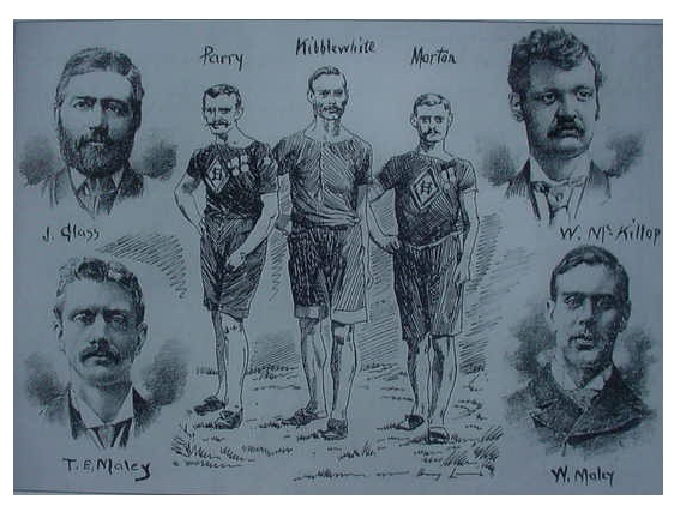
Celtic Sports 1896

Celtic Sports, 1896

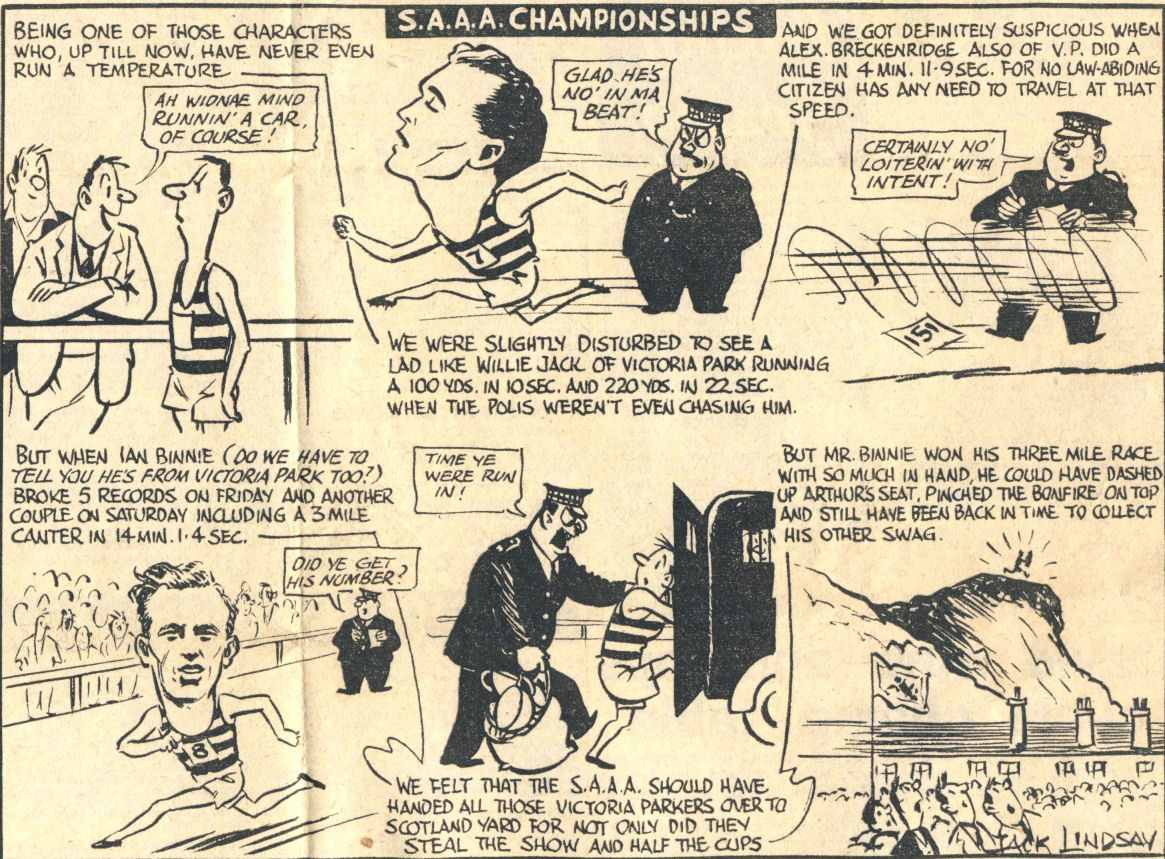
Binnie Cartoon

Victoria Park athletes at the SAAA Championships, 1950’s

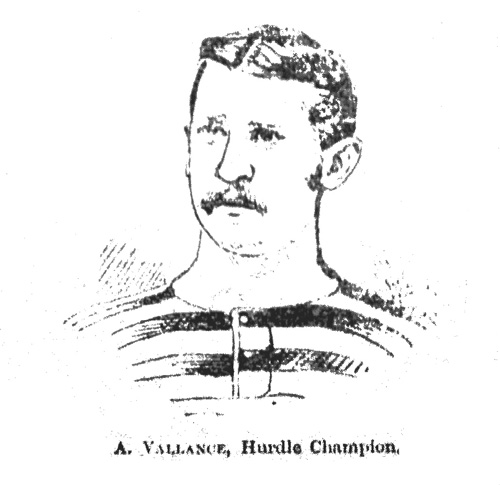
A Vallance

Alex Vallance, Rangers and Clydesdale Harriers

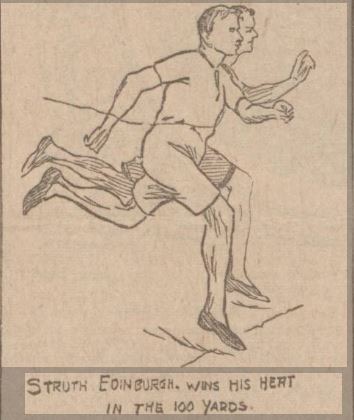
1F26E117-C9EA-4002-BD3C-D84018438095

Bill Struth, pre-Rangers


Aberdeen Athletics Before 1952

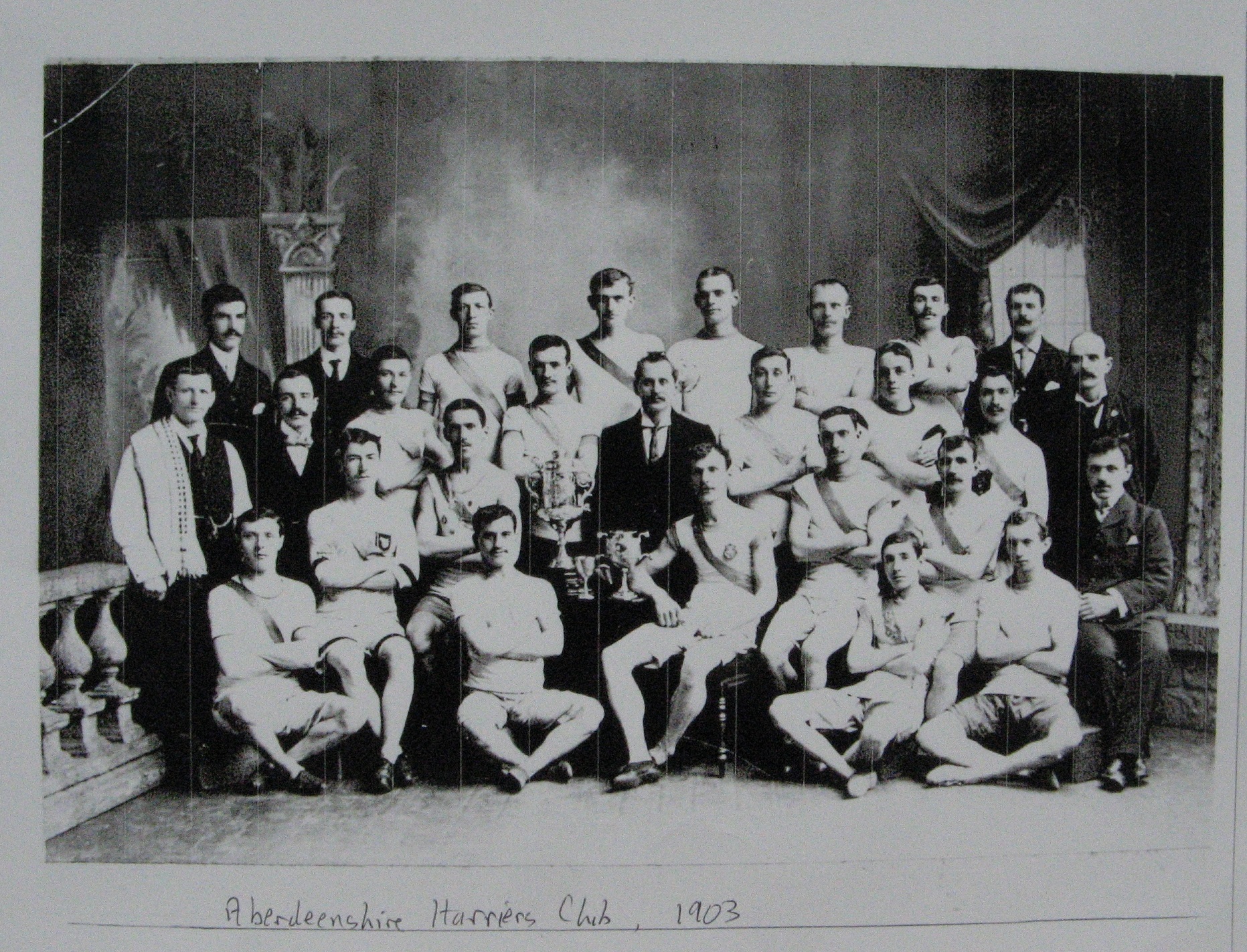
AbShire1903

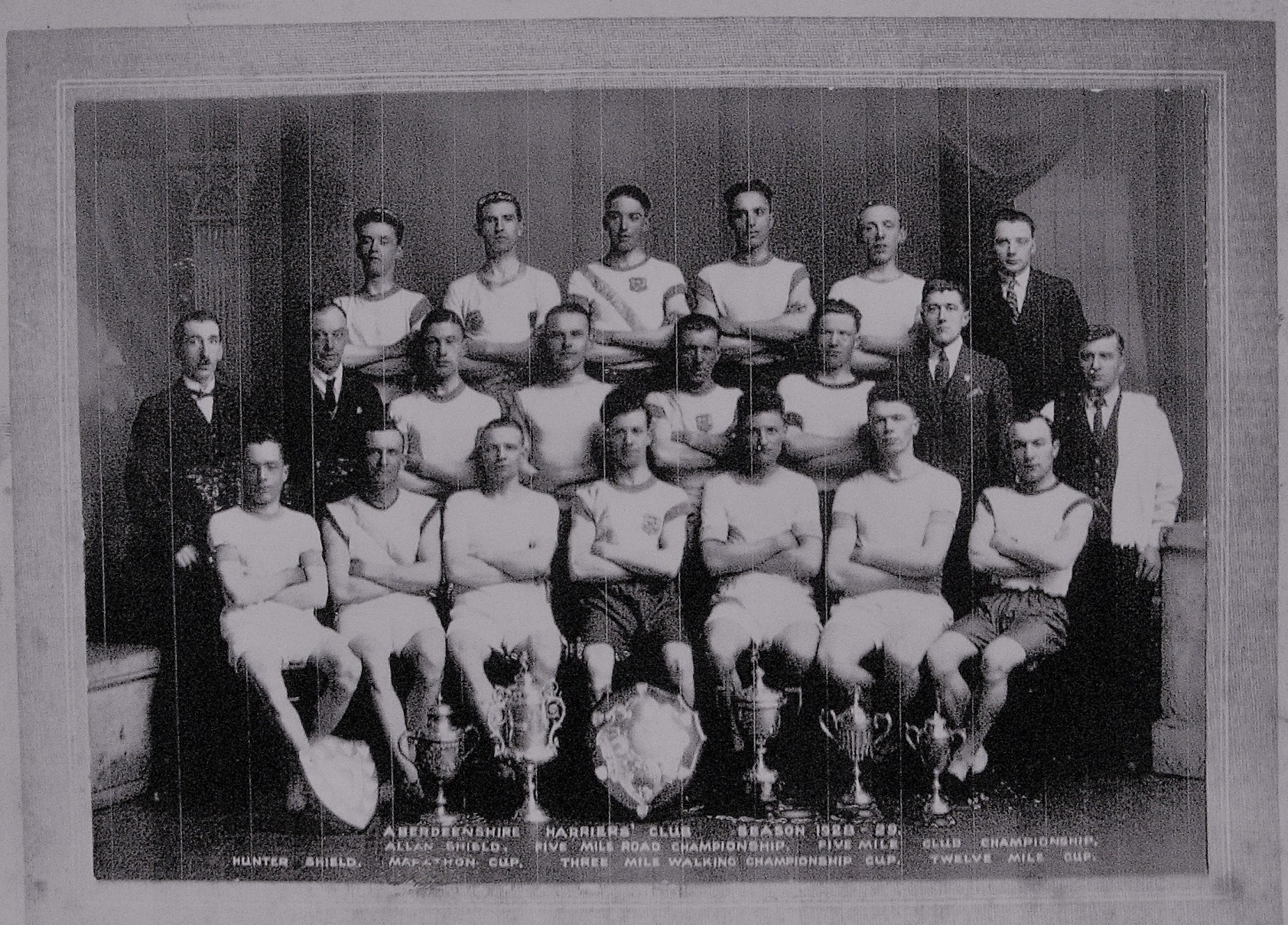
The dates when current athletic clubs were formed are quite clear but what went before is usually as interesting as the current situation.   What went before differs because of the areas in which the clubs appeared.   For instance conditions in Aberdeen were different from those in Ayrshire, and both were different from the Lothians or any of the big cities.   These pages deal with the development of athletics in Aberdeenshire and consist of three separate strands.

  1.   W Hunter Watson’s account as told in a series of papers of what went before the establishment of Aberdeen AAC in 1952.
  2. Colin Youngson’s history of the Shire Marathons in the early part of the twentieth century.
  3. The profile of James Youngson as an illustration of an athlete based in Aberdeen during two distinct periods: the 20’s and 30’s, and then again in the 70’s and 80’s

Aberdeen Athletics Pre-1952

AbShire1903

ABERDEEN AAC

W.Hunter Watson                                                                                                            August 2015  

      (This account of Aberdeen AAC gives some background information in order to emphasise that, although this club was founded in 1952, its roots extend back to much earlier years.)

Aberdeen AAC was formed in 1952 following a public meeting which was attended by J. A. Cavanagh, the father of Ian Cavanagh who later that year won the S.A.A.A. youths’ long jump title with a clearance of 6.39m. (J.A. Cavanagh became Vice President of Aberdeen A.A.C.  He remained in that post until 1955.) The newly formed club managed to arrange at least one match in the summer of 1952, one against RAF Dyce. (The team representing RAF Dyce consisted of young men who were based at the Dyce aerodrome while doing their National Service.) Ian Cavanagh failed to win his speciality, the long jump, but did win both sprints and hence helped Aberdeen AAC to win the match.

The President of the newly formed Aberdeen AAC was Jimmy Adams who had been actively involved in athletics in Aberdeen for over 30 years as an athlete and an administrator. He seems to have been an enthusiast and to have been highly regarded by the young people who had been attracted into athletics by the formation of the new club. One of those young people was Steve Taylor who went on to win the S.A.A.A 3 mile championship in 1961 and 1962 and the 10 mile championship in 1970. Steve has stated that, in the early days, he regarded Jimmy Adams as a “father-figure”.

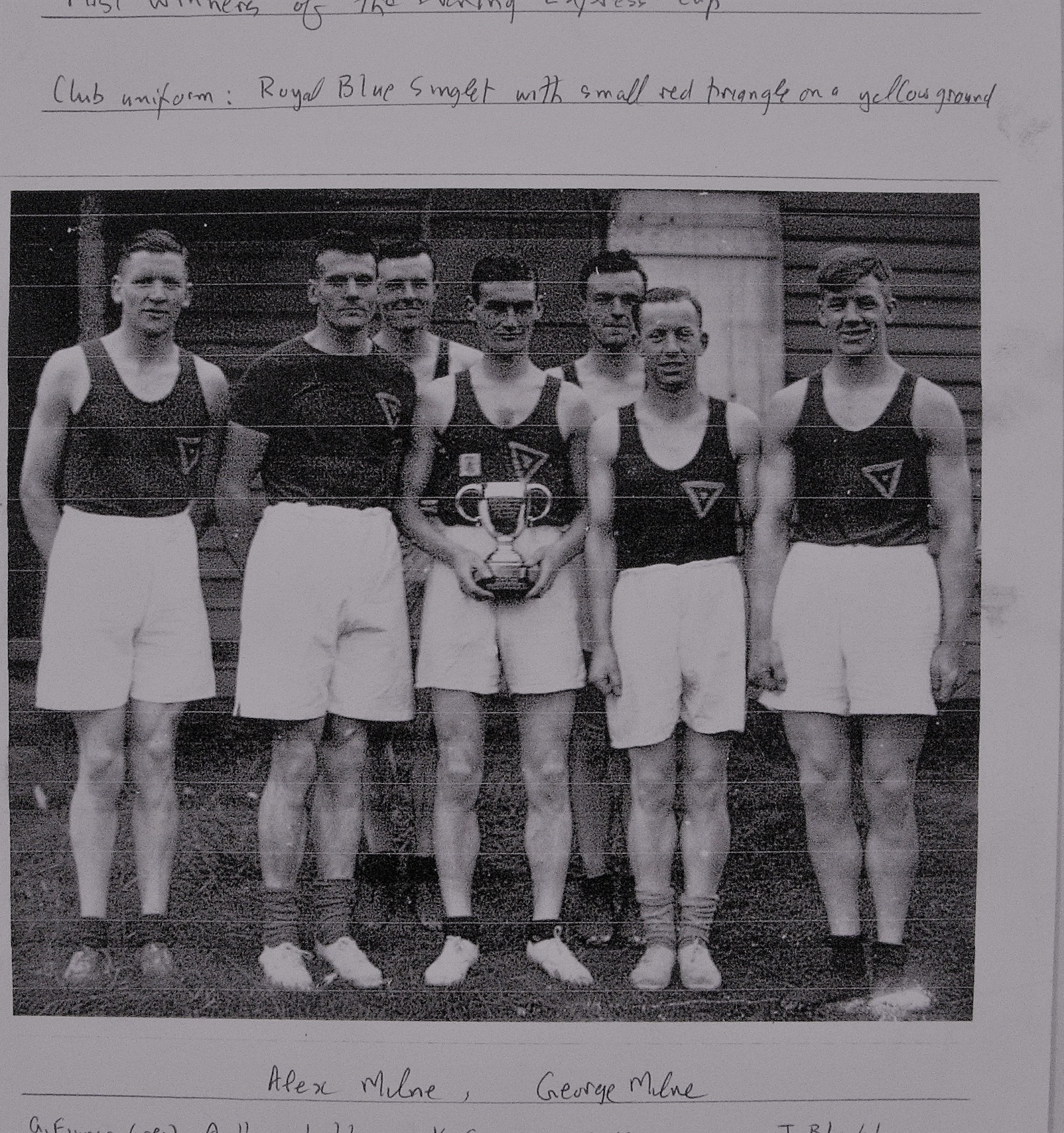
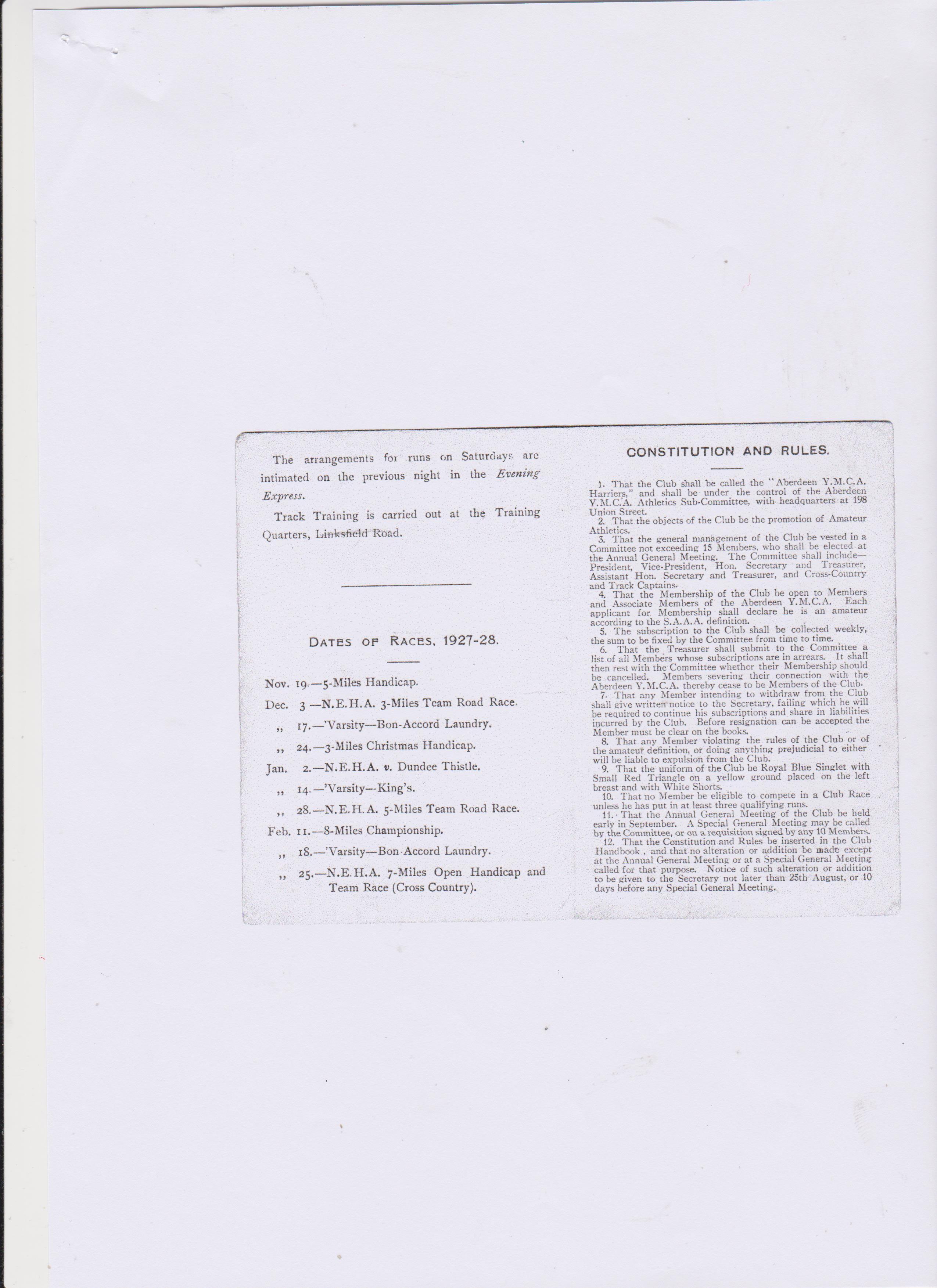
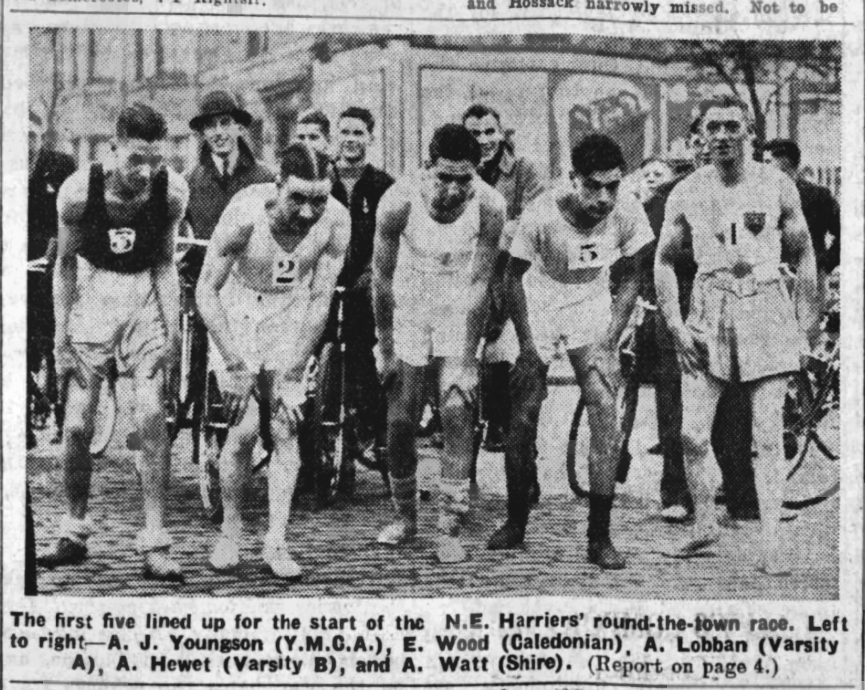
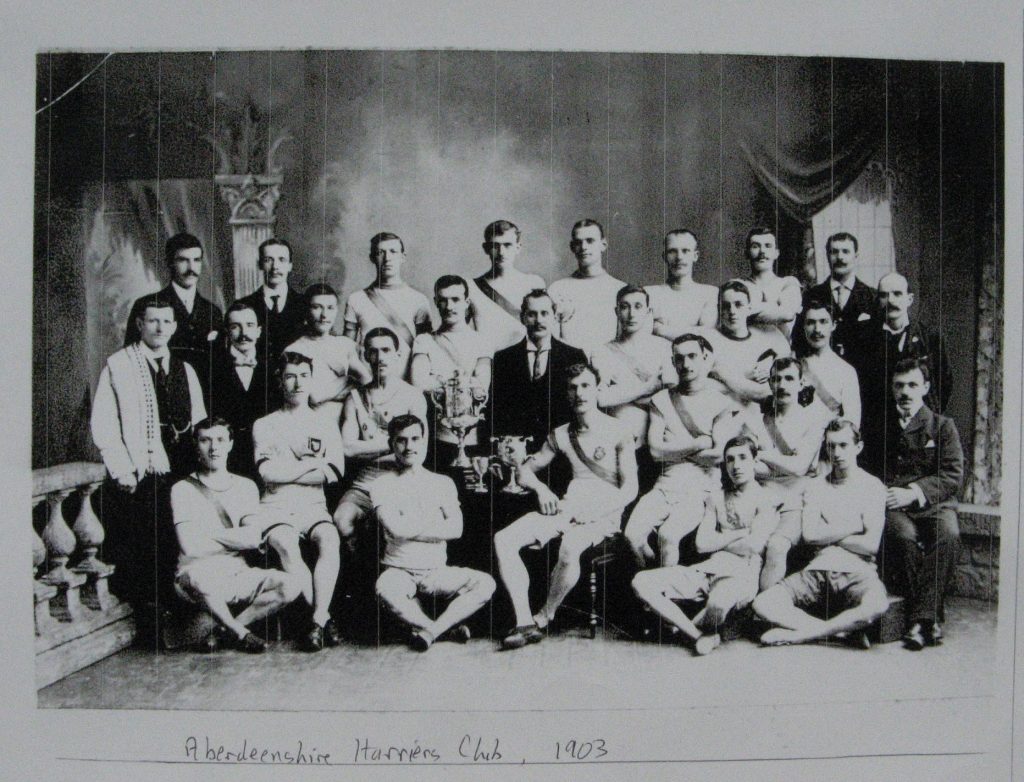
Prior to the outbreak of the Second World War there were several athletic clubs in Aberdeen and much competition was organised for athletes within the city. Jimmy Adams had been the Vice President of the North Eastern Harriers Association which played a major part in organising that competition. One of the events which it helped to organise in conjunction with Aberdeen Football Club was the annual Athletic Sports Meeting at Pittodrie Park, as Aberdeen FC’s ground was then called. A study of the 1931 programme for that meeting reveals that there were then seven open athletic clubs in Aberdeen, four for men and three for women, though only two of those open clubs could be regarded as significant as far as inter-club competition was concerned, namely Aberdeenshire Harriers (the Shire Harriers), founded 1888, and the Aberdeen YMCA Harriers (Aberdeen YM), founded in 1912. In addition, there was the Aberdeen University Athletic Club which at that time was active as a separate entity to a greater extent than it is now.

 Jimmy Adams had competed with great success in the high jump. He claimed that in the course of over 100 competitions within the UK, including two internationals, he never failed to make the top three. One of those internationals was the Triangular International which involved England (including Wales), Ireland and Scotland and which Scotland won in 1923. The Official Centenary History of the S.A.A.A. notes that this success was in no small measure due to the magnificent performance of Eric Liddell in winning the 100 yards, the 220 yards and the 440 yards. That performance was perhaps more remarkable than is generally realised: according to Jimmy Adams, Eric Liddell ran those races in an outsize pair of borrowed spikes with cotton wool stuffed in the toes: he had left his own spikes at the White City where he had been competing prior to the International at Stoke.

The President of the Shire Harriers had been Fred Glegg, who was also President of the S.A.A.A. during the war years. Unfortunately, Fred died in October 1946. Had it been otherwise, the Shire Harriers might still be in existence and have been one of Scotland’s oldest Harrier clubs, the first Harrier Clubs, Clydesdale Harriers and Edinburgh Harriers, having been formed in 1885, only three years before the Shire. The Shire Harriers did function until at least 25 April 1950 when there was an Annual General Meeting held. The minutes reveal that all of the places on the Committee were filled except that of secretary. The previous secretary, Ralph Dutch, had completed his university degree and was, required to do his National Service and hence give up his post as the Shire secretary. With no-one being willing to take on the duties, the club ceased to operate.

Keeping the Shire Harriers going after the end of the 1939-45 War had posed considerable difficulties in part because of a lack of competition. Whereas in Edinburgh and Glasgow the pre-war open clubs largely survived, the Shire Harriers was the only open club to do so in Aberdeen. This meant that there was no longer a North Eastern Harrier Association to organise local competition. The competition provided by the Shire Harriers in the post-war period seems to have been largely handicap competition involving only club members. That would not have been particularly motivating. Another problem that the Shire Harriers had was finding a suitable training venue. They used the rugby pitch at Hazlehead. That was satisfactory in the summer, but not in the winter.

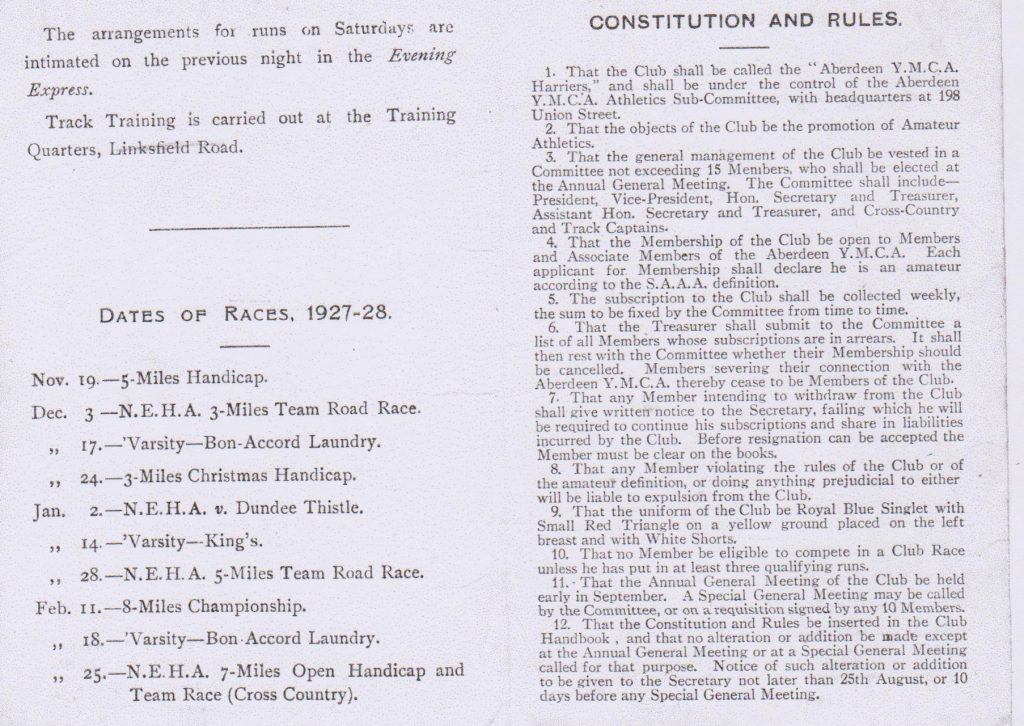
 According to Arthur Lobban, the last secretary of the Aberdeen YM Harriers, the last AGM of that club was in August 1939. At that AGM it was agreed that the club should go into abeyance until the war situation was clear. War was declared on 3 September 1939 and those members of the YM who survived the war did not seek to resurrect the club when the war ended. However, it may have been significant that when a public meeting was held in 1952 with a view to forming a new club, there were reportedly eight former members of Aberdeen YM present. There are grounds for arguing that Aberdeen AAC is actually a successor to the Aberdeen YM Harriers Club:

 the first president of Aberdeen AAC, Jimmy Adams, had been a Vice President of the Aberdeen YM Harriers club;

the first secretary of Aberdeen AAC, Robert Miles, had also been member of the Aberdeen YM Harriers club;

the first constitution of Aberdeen AAC made reference to the “Y.M.C.A. Section”;

Annual General Meetings of Aberdeen AAC were held in YMCA premises until at least 1966.

Obviously Aberdeen AAC had more success than the Shire Harriers in maintaining the interest of its members and there are several possible reasons for this:

Jimmy Adams was successful in persuading the Aberdeen Council to permit Aberdeen AAC to train at Linksfield Stadium, a football stadium with an excellent running track;

club members were encouraged to raise their sights and compete in major championship events; in both 1955 and 1956 an Aberdeen youth won the Eastern District Youth Cross Country Championship (and in 1955 an Aberdeen AAC youth team, which included Steve Taylor, was second in the team race) while in 1956 Pat Bellamy and Alice Robertson (both Committee members) won three S.W.A.A.A. titles between them (high jump, 100 yards and 220 yards);

Aberdeen Corporation began to put on a major sports meeting each summer. (Athletics Weekly printed the results of the meeting held in 1954. I had my expenses paid to travel from Edinburgh to compete in the meeting held in 1956.)

Beginning with the match against RAF Dyce, the new club generated sufficient publicity to make people in and around Aberdeen aware of Aberdeen AAC, something that increased the probability that it would attract new members.

 One new member who joined Aberdeen AAC in 1961 was Alastair Wood, who had won the S.A.A.A. 6 mile championship in 1958, 1959, 1960 and 1961. In 1962, after becoming a club member, he decided to attempt the marathon and discovered that he had a talent for this and, indeed, greater distances. In 1962, after being second in the A.A.A. marathon, he was selected to compete in the marathon in the European Championships. He finished fourth in that event. He continued to compete with great distinction in distance and ultra-distance events for many years and, directly or indirectly, inspired many Aberdeen AAC athletes to undertake the training that helped them to run fast marathons. Between 1966 and 1990 there were twelve members of Aberdeen AAC who ran a marathon in a time less than 2hr 20 min, a statistic that few clubs in the UK could better. Aberdeen AAC, encouraged by Steve Taylor, played its part in promoting the marathon: in 1979 it organised the first of the city marathons in the UK. The winner was Aberdeen AAC athlete Graham Laing. Graham went on to win the S.A.A.A. marathon in 1980 and in 1981 he finished fifth in the first of the London marathons. The following year he represented Scotland in the marathon in the Commonwealth Games, something that his clubmate, Fraser Clyne did four years later.

 Unsurprisingly, the group of Aberdeen AAC athletes who were doing the hard distance training at that time did well in the Edinburgh to Glasgow road relay: in the ten races between 1980 and 1989 Aberdeen won three and were placed third in four of them.

Although from the time that Alastair Wood joined the club until the time that the road runners broke away to form the Metro running club (around 1989) there was a great interest in road running in Aberdeen AAC, track and field was not neglected. Evidence of this was the decision of Aberdeen AAC to be one of the eight clubs to form the Scottish Athletics League in 1972. This gave Aberdeen AAC athletes the opportunity to compete against the best athletes in Scotland on the best track in Scotland. At that time and for a few years thereafter each of the four annual meetings of that league was held at Meadowbank on the track that had been laid for the 1970 Commonwealth Games. (In 1995 and again in 2015 Aberdeen AAC won the Scottish Athletics League title.)

By 1974 it became obvious that there were some talented young athletes who wished to join Aberdeen AAC but for whom the club was unable to offer sufficient competition to keep them motivated. As a consequence a decision was made to join the Scottish Young Athletes League, something that it did in 1975. (Aberdeen AAC has won the Scottish Young Athletes League title only once. That was in 1981.)

A major campaign to attract youngsters into the club was successful in more ways than had been anticipated. Not only did many youngsters join the club but a significant number had parents who were willing to become involved by joining the club committee, by coaching or by officiating. Aberdeen AAC became a club which developed expertise in organising events, so much so that when televised international road races came to Aberdeen the club had no difficulty providing a sufficient number of qualified judges and timekeepers to cope. The club’s proven ability to do this may have been one factor which led to the Scottish senior championships coming to Aberdeen in 2015. That is the first time that these championships have been held outside the central belt of Scotland since 1892 when they were held in Dundee.

The publicity given to the club in 1975 in order to attract a sufficient number of boys for it to be able to compete in the Scottish Young Athletes League, at that time a purely boys league, also attracted girls, but not sufficient for the club to be confident that it could field a team in the Scottish Women’s Athletic League. However, it eventually became evident that this was possible and Aberdeen AAC joined the Scottish Women’s Athletics League in 1976. (Aberdeen AAC has never won this league title but regularly finishes in the top three.) Unlike the Scottish Athletics League, the Women’s League caters for the younger age groups so, as far as track and field was concerned, the club could offer competition to all who wished to join it. (During the winter some members choose to take part in indoor competition but others compete in cross country events. Some local events are organised by the club, but most in which members compete are championship or league events which take place at some distance from Aberdeen and to which buses are sent.)

When Aberdeen AAC was expanding rapidly there was no question of having a waiting list. Partly as a consequence, Aberdeen AAC became one of the biggest athletic clubs in the UK. In 1988 when the club’s numbers peaked: subscriptions had been received from 606 members of whom 517 were aged 11 or over. In 1994, around five years after several road runners had left the club to form Metro, the S.A.A.A. released data which revealed that Aberdeen AAC had then 494 members aged 11 or over. According to that data, Aberdeen was almost 50% larger at that time than Scotland’s second largest club, Pitreavie AAC.

For a time there was pressure from the S.A.A.A. on clubs not to admit athletes in the 9-11 age group, a pressure that was resisted by Aberdeen AAC for good reason. For example, among the boys who began competing for Aberdeen AAC in that age group were Mark Davidson and Duncan Mathieson. Both went on to represent Scotland at the Commonwealth Games, to set Scottish records and to win Scottish titles.

One feature of Aberdeen AAC is the number of members who continue to compete as Veterans, or Masters, as they are now called. At the Scottish Masters Championships, the club whose members have the greatest number of successes is awarded a trophy. According to Stan Walker, the club Vice President, Aberdeen AAC has been awarded that trophy for the ten years up to and including 2015. Stan was a member of the UK 4 x 200m relay team that won at the 2015 European Masters Championships. Another club member, Fiona Davidson, won the triple jump title for her age group at the same championships.

At present Aberdeen AAC seems to be in good health and, judging from the dedication of those responsible for the club, it is likely to be so for some time to come. Hopefully, some of the young people currently in the club as competitive athletes will continue in athletics by filling the other roles necessary for athletics to continue to flourish in Aberdeen, i.e. roles such as administrators, officials, coaches, team managers, conveners, etc. Given that organised athletics in Aberdeen has existed for well over 100 years and given the worldwide popularity of the sport, it is difficult to imagine that there will come a time when no-one in the city will be available to do the needful. It is to be hoped, though, that Aberdeen AAC will not have to cope with a world war as clubs had to do twice in the twentieth century!

                                                 ABERDEEN  ATHLETICS  MEMORABILIA

  1. Hunter Watson January 2016

Introduction

Soon after becoming secretary of Aberdeen AAC in 1975 I began to make enquiries about the history of athletics in Aberdeen. As a consequence I was put in touch with a number of people able to supply me with information.  A few, who seemed appreciative of my interest in the subject, were good enough to give me some of the items in their possession which related to athletics in Aberdeen. These included Ralph Dutch, the last secretary of Aberdeen’s first athletics club, the Aberdeenshire Harriers, which was founded in 1888. He gave me the minutes book of that club and in this paper I have written at some length about what is contained in that book which covers the period from June 1923 to April 1950.

At the age of eighty I have decided that the time has come for me, in my turn, to pass on my athletics memorabilia. I am grateful to Aberdeen University for agreeing to place it in its Special Collection.

 With the agreement of the Committee of Aberdeen AAC, I have included within the material which I am donating some old minutes of Aberdeen AAC. Obviously much information can be derived by studying those minutes. However, there are easier ways to obtain information about Aberdeen AAC from the material donated. For example, I have also donated to the Special Collection my scrapbooks containing press cuttings relating to the club and also club newsletters, club yearbooks and club membership cards.

Ralph Dutch

Ralph Dutch was a colleague of mine at the Aberdeen College of Education. He was the last secretary of the Aberdeenshire Harriers Club (the Shire Harriers). That was Aberdeen’s first Harriers Club and survived for 62 years from 1888 until 1950 when Ralph Dutch was due to be called up to do National Service after his graduation from Aberdeen University and no one else was prepared to fill the post of club secretary which he, of necessity, had to vacate. Ralph gave me a number of items that had been in his possession as secretary: a few items of correspondence, the secretary’s cash float, a number of Shire Harriers lapel badges, a Shire Harriers medal and, of greatest historical interest, the Shire Harriers minutes book that had remained in his possession. In this section I have written at some length about information that can be gleaned about the Shire Harriers by studying that book.

When the minutes book was started the address of the club was given as King’s Crescent: following the end of the First World War the club succeeded in having a clubroom erected there. Some use might have been made of that clubroom by members who took up boxing(!) though boxing competitions seem to have been held in the Music Hall. According to Jim Ronaldson, who was narrowly beaten by Dunky Wright in the 1923 full marathon from Fyvie, “The boxing section destroyed the club; young men joined the boxing section instead of the athletics section.”  Colin ***Youngson’s history of the Shire Harriers’ marathon speculates that the reason that there were no marathons or other long road races in the period 1926 1928 was that the “athletes had been overshadowed by the boxing fraternity”. It appears from the Shire Harriers’ minutes book that there might be considerable truth in the views expressed by Jim Ronaldson and Colin Youngson.  The minutes reveal that there was an AGM on 17 September 1926 and at that AGM the secretary stated that to make up a report for this meeting used to be a serious matter for him but that this year there had really been nothing done by the club in the way of races, etc. to report on! Office bearers were appointed but seem to have achieved very little because there was no further entry in the minutes book until 2 February, 1928 when another General Meeting was held. According to the minutes of that meeting, the chairman stated that “this was the first meeting held of the club since it had again been instituted (sic)”. At that meeting not only were office bearers appointed but dates of various distance races were agreed to. At a later General Meeting on 12 June 1928, dates were agreed for 100 yard, 220 yard, ¼ mile, ½ mile and 1 mile races. These were to be held on Riverside Road! (No doubt that was the road now known as Riverside Drive.) There was also reference to participation in a 1 mile relay race and also in a I mile team race organised by the North Eastern Harriers Association of which the Shire Harriers was a member. The Shire Harriers Club was again providing competition for its members and the “boxing section” of the club seemed no longer to exist.

At AGMs there was regularly expressed concern about club funds and ideas were put forward about fund raising. These concerns were to disappear following the AGM held on 6 September 1928 when members were introduced to Mr F. J. Glegg (Fred Glegg).  According to the Minutes, Mr Glegg stated that he would wipe out the £2 – 2 – 0 ½ deficit which the club had incurred during its first season (after being reconstituted). Further, since he considered that the club still had an uphill fight he would be very pleased to make up any deficiency that might occur as a result of unforeseen circumstances in the future. (It seems that this was never necessary apart, perhaps, during the Second World War when Fred Glegg seemed to keep the club in existence unaided by a committee.)

In 1929 a photograph was taken of the Shire Harriers with the athletes in their strips, the officials in their suits and the trainer (who was paid for his services) with a towel over his shoulder. I have no doubt that Fred Glegg is the man second from the left in the second row. Both he and the man second from the right in that row are wearing lapel badges which seem to be identical to the lapel badges which Ralph Dutch gave me. In the foreground of that club photograph are seven impressive looking club trophies.
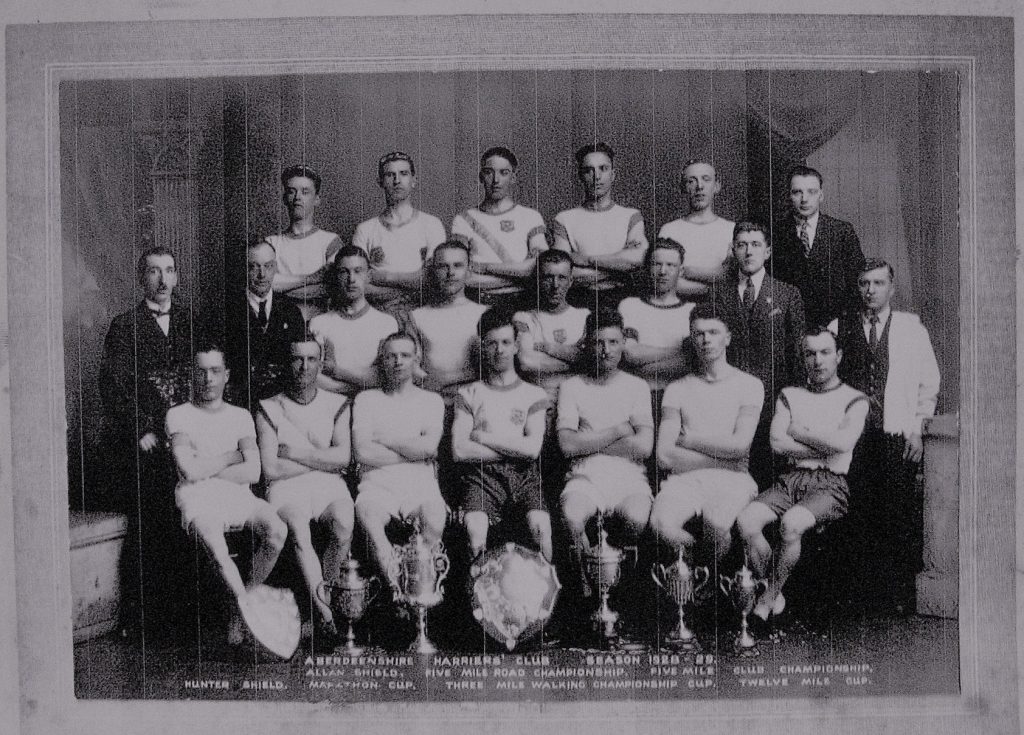
AbShire1929

According to John Keddie’s Centenary History of the Scottish Amateur Athletics Association, F. J. Glegg was President of the Association during the War (1939 – 1946) and in his will bequeathed £50 for a Challenge Trophy.  Unfortunately Fred Glegg died in October 1946. It is the opinion of Ralph Dutch that had he not died so early then it would have been likely that the Shire Harriers would have survived.

Returning to the minutes book of the Shire Harriers, it is noteworthy that at the monthly meeting on 4 February 1930 there was a proposal that the club be wound up and this was seconded! An amendment that the proposal be left over to the AGM was also seconded and carried on the casting vote of the chairman. Thereafter things not only seemed to run fairly smoothly until the outbreak of the Second World War but also to be developing in a promising way. For example, at the Annual General Meeting held on 13 May 1933 it was agreed that the summer athletics competitions be held at Hazlehead and in the Duthie Park. It was further agreed that, in addition to the running events that had been held on Riverside Drive in the past, there be added a long jump, a high jump and a shot putt to the summer competition programme. (These field events could hardly have been held on Riverside Drive.) The following year, on 14 May 1934, it was further agreed that a discus and a javelin be purchased. On 23 January 1936 there was another interesting development: it was agreed that the club should have a junior section open to youths between the ages of 14 and 18 years of age. Also in 1936, at a meeting held on 9 May, it was agreed that “the Ladies Athletic Club” could use the Shire Harriers clubrooms two nights per week for their winter training at a charge of 3/6 per month “including coal and gas”. The Shire Harriers had not become a mixed club, but had taken a first tentative step in that direction. In general, the Shire Harriers showed signs of developing in the ways that the Edinburgh clubs had done in the late nineteen fifties and the nineteen sixties. (I was involved in athletics in the Edinburgh area at that time.)

At the General Meeting of the Shire Harriers held on 7 September 1937 Fred Glegg observed that the club “was now in its fiftieth year”. That confirmed the information that had been given to me by Alex King who was a member of the Shire Harriers in 1912, the year in which he won the “marathon” from Inverurie to Aberdeen: he had told me that the Shire Harriers had been founded in 1888.
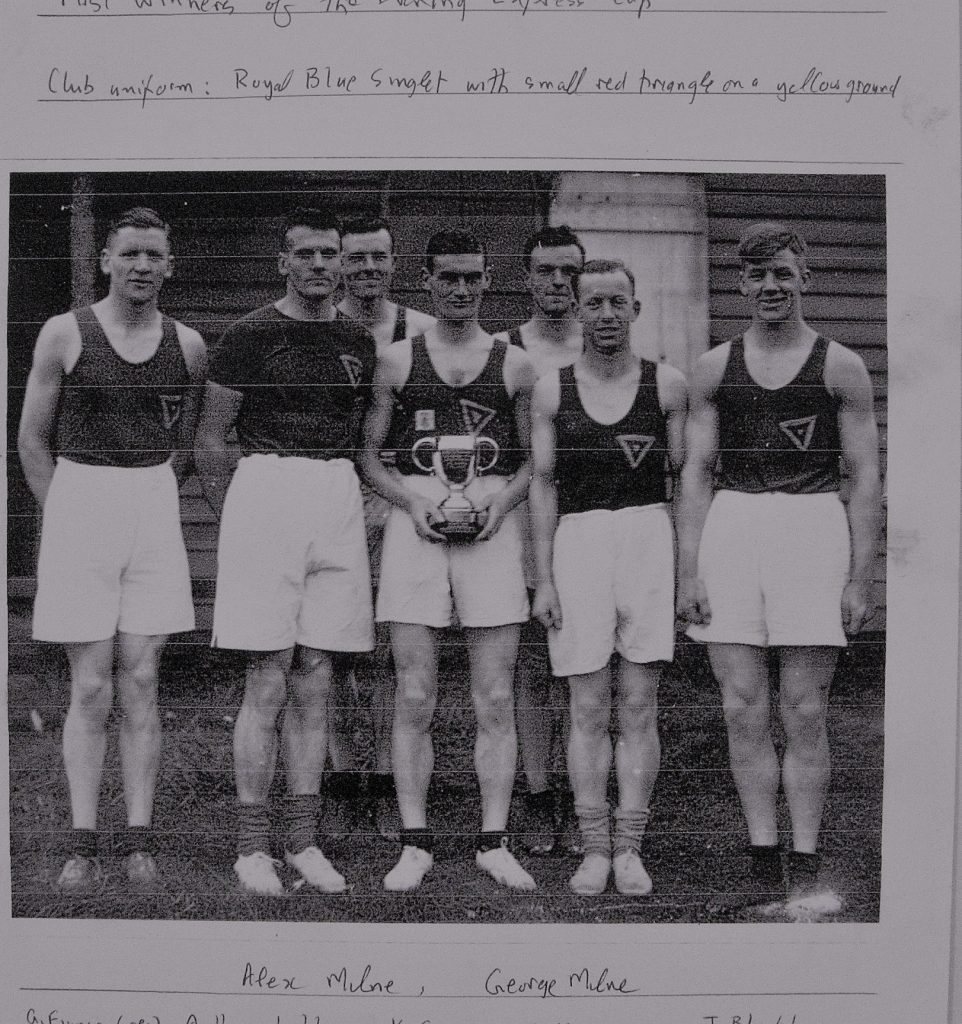
ABYMrelay

Aberdeen YMCA team, winners of the North Eastern Harriers Round the Town relay of 1938.

Back Row:   Alex Milne and George Milne, Front: G Finnie (reserve), A Lobban (then Secretary), K Gray, S Kennedy, J Blacklaw

A marathon craze had swept the UK after the drama of the marathon in the 1908 London Olympics and the Shire Harriers was one of the clubs that began to stage local marathons At that time the distance for the marathon had not been standardised and a marathon was simply a long race staged on a road. The first of the Aberdeen marathons was held on Saturday, 20 March, 1909. The course followed the north Deeside road from Banchory to Aberdeen.  A press report which appeared on 22 March 1909 noted that “The brief interval of fair weather had improved the roads to a wonderful degree and the runners were able to find a fairly hard surface for a considerable part of the way so that the running was not perhaps so hard as was expected earlier in the day.” (At that time the north Deeside road did not have a tarmacadam surface.)

The press report of the race also noted that “At Mannofield runners had difficulty getting a clear passage through the spectators. All the way down Union Street, along Union Terrace, Blackfriars Street and on to the finishing point in St Andrews Street the runner had only a passage about one yard in width and it is probable that  even this space might not have been available had he not been preceded by a car. … In St Andrews Street the huge concourse of people was altogether beyond the control of officials and police. As the men came in they were hurried to Mr Jamieson’s premises in George Street where they were supplied with much needed refreshment and comfort.”

According to Alex King, William Jamieson was a publican who lived in a large house called Thorngrove at Mannofield and who donated a Marathon Cup to the Shire Harriers to be awarded to the winner of each of the “marathons” which they organised. He also provided a gold medal to be awarded to and to be retained by the winner of each marathon. Alex King clearly was in possession of the facts since he had won the Aberdeen marathon on three occasions, namely in 1912, 1913 and 1925. William Jamieson’s generosity towards the Shire Harriers manifested itself in other directions also. In particular, again according to Alex King, he met £100 of the £120 cost of the hut which the Shire Harriers purchased after the end of the First World War and to which reference was made above.

It is not known when William Jamieson first became involved with the Shire Harriers. However, a photograph was taken of club members in 1902 and this might have been taken shortly after William Jamieson became involved with the club, just as a club photograph was taken in 1929, shortly after Fred Glegg (another publican according to Alex King) became involved. In the 1902 photograph it is likely that William Jamieson is the man in the middle of the second row behind the trophies. There is a remarkable similarity between the two photographs, including the presence in each of a trainer with a towel over his shoulder.

The minutes book of the Shire Harriers reveal that meetings were held initially at King’s Crescent. They would have been held in the hut which the club had purchased with the assistance of William Jamieson. Presumably it was situated on the edge of the recreation ground to the north of Nelson Street. The same minutes book reveals that in the years preceding the Second World War meetings were being held in the club house at the Wellington Bridge. This club house was a building at the north end of the bridge which had once been an octagonal shaped toll house. No doubt the Shire Harriers paid rent for the privilege of using it. During the war years Fred Glegg seems to have paid this rent out of his pocket and also the club’s subscription to the Scottish Amateur Athletic Association.

 A General Meeting of the Shire Harriers was held in the Wellington Bridge club house after the war on 6 April 1946. Fred Glegg was there in his capacity as president. A further General Meeting was held in that clubhouse on 9 May 1946. On the latter occasion it was (ominously) noted that F. J. Glegg was unable to be present and that the Vice-President had been killed in hostilities and hence a chairman would have to be appointed for the meeting. One was duly appointed and a businesslike meeting ensued. It was decided to hold events during the summer season provided the rugby field at Hazlehead could be made available for the months of June to August on Tuesday and Thursday evenings. (A tramcar terminus was situated within 100 yards of that rugby field so getting to it would not have presented a problem.) It was also agreed that the committee should look into the possibility of getting fresh quarters.

At a meeting on 14 May 1946 it was decided to combine the 1914-18 and 1939-45 Rolls of Honour into one scroll “including the one already hanging in the clubhouse”. The following names were to be added:

Alex Donald        Lieut.  London Scottish

Harry Donald      Sub Lieut.  Fleet Air Arm

John Gerrie          Gunner  R O

Lindsay Nunar(?) Private  Scots Guards

  1. Stove Staff Sgt Royal Army Pay Corps

At a meeting held on 25 November 1946 it was intimated that the club had lost a faithful friend, the late Mr Glegg. He had been a faithful friend from 1928 and had been keenly interested in the club “to the last”. According to Ralph Dutch, Fred Glegg was about 48 years of age when he died.

 At a meeting on 13 May 1947 it was agreed that nothing should be done regarding a combined Roll of Honour until the club again acquired a clubhouse in which the scroll could be displayed. The former toll house on Wellington Bridge had ceased to be used by the club in 1946. From 27 August 1946 the club used the rugby pavilion at Hazlehead for its general and committee meetings as well as for changing. However, that pavilion, which belonged to Aberdeen Corporation, was also obviously used by rugby players as well as by members of the Shire Harriers.  Since the Shire Harriers failed in its attempt to again acquire a clubroom for its exclusive use, the scroll commemorating club members who had been killed in action during the First and Second World Wars was never produced.

The above noted five men were not the only former members of the Shire Harriers who had been killed during the Second World War. Another was William Chapman. According to his grandson, this former member “was killed in a German bomber attack on his home on the Beach Boulevard in August 1941 at age 33”. (Aberdeen was frequently bombed during the Second World War.)

At the final General Meeting of the Shire Harriers on 25 April 1950 there were some interesting items of business including a reference to a possible ladies’ section. However, the meeting was unable to find anyone willing to take over the duties of secretary from Ralph Dutch who was due to be called up after graduating from Aberdeen University that summer to do his National Service. As a consequence the Shire Harriers ceased to function

C. Adams (Jimmy Adams)

When a new club, Aberdeen AAC, was constituted in 1952 Jimmy Adams was its first president. Almost certainly it was due to his influence that, from its beginning, Aberdeen AAC catered for women as well as for men even though pre-war there had only been single sex clubs in Aberdeen and even though at that time in Edinburgh most, if not all, athletic clubs were single sex.

When he was a young man Jimmy Adams had been an international athlete who represented Scotland in the high jump in two of the Triangular Internationals that had been held in the nineteen twenties. He had also been a member of the Aberdeen YMCA Harriers Club (the YM Harriers), a club which, according to Alex King, was founded in 1912. Jimmy Adams had been a Vice President of that club. He also had been a Vice President of the North Eastern Harriers’ Association, a body responsible for organising competitions for the athletic clubs in Aberdeen between the two World Wars.

Jimmy Adams provided me with much information in letters which he wrote to me. He also provided me with memorabilia which included old press cuttings, old photographs, the SAAA Championship medals which he had won and various old programmes. Of particular interest to anyone conducting research into pre-war athletics in Aberdeen are likely to be the programmes of the Athletic Sports Meetings organised jointly by Aberdeen Football Club and the North Eastern Harriers’ Association. These programmes provide information about the athletic clubs in Aberdeen at the time (including ladies’ athletic clubs), athletes participating, officials and prizes. I regard the prizes as most attractive. Certainly they were much better than most of the prizes which I won when competing in (amateur) Highland Games meetings in the north-east of Scotland.

Arthur Lobban

 Arthur Lobban had been the last secretary of the YM Harriers. When I spoke to him he informed me that the last AGM and prize giving of that club had been in August 1939 and that it had then been agreed at that meeting that the club should go into abeyance until the war situation was clear. The books of the club were “returned” to the YMCA in Aberdeen. War was, of course, declared on 3 September 1939. The YM Harriers club was never reconstituted but, as explained in my paper about Aberdeen AAC, it can be argued that Aberdeen AAC was a successor of the YM Harriers club. (That paper is included within the memorabilia donated to the University.)

As well as giving me much information, Arthur Lobban also gave me some of his athletics memorabilia. I was particularly interested in the medals which he had won while competing in events organised by the North Eastern Harriers Association. These medals are of high quality with three of the medals awarded for wins in individual championship events appearing to be made of silver. Other medals for team events such as the Round the Town Relay appeared to be made of copper but were well made. To my mind, these medals, together with the programmes given to me by Jimmy Adams, reflect favourably on those who were organising athletics competitions for athletes in Aberdeen prior to the Second World War.

Like Jimmy Adams, Arthur Lobban gave me old press cuttings from which much information can be obtained about athletic activities and individual athletes in Aberdeen in years past. I was also given old photographs from both of those men. One of those photographs was taken at the “YMCA Harriers headquarters” in a hut on the river Dee, possibly the hut belonging to the Dee Swimming Club which Arthur Lobban mentioned when he spoke to me. The photograph shows club members getting a “rub down” after a race. Two of those engaged in giving the rub down have towels over their shoulders as did the trainers in the Shire Harriers photographs.

Alex King

References have been made to Alex King above in connection with his success in winning the early Aberdeen “marathons”. When the Aberdeen marathon was revived in 1979 it was won by the Aberdeen athlete, Graham Laing. Shortly before the second marathon of the modern era, a reporter did a preview of the race and included in his preview photographs of a young Alex King with his trophies beside Graham Laing with his. Being aware of my interest in Alex King, the reporter subsequently gave me a copy of that photograph of Alex King and it is included among the memorabilia which I have donated to the University. Also included is a letter to me from Alex King, a letter in which he outlines his athletics history. Graham Laing, incidentally, went on to win the 1980 Aberdeen marathon in spite of international competition. He later was selected to represent Scotland in the marathon in the 1982 Commonwealth Games.

Robert Miles

Robert Miles was the first secretary of Aberdeen AAC. It was he who gave me information about the public meeting held in 1952 which led to the formation of this new club. Robert Miles also gave me some documents relating to the club which were still in his possession as well as Aberdeen AAC membership cards for the 1954 – 55 and 1955 -56 seasons.

Someone, I cannot be certain who, also gave me a membership card issued by the Aberdeen Y.M.C.A. Harriers. This contains much fascinating information.

For some reason unknown to me Aberdeen AAC ceased to issue membership cards until I became club secretary in 1975. The first of those cards, issued in 1976, reveals that the club was affiliated to the S.A.A.A. the S.W.A.A.A. and the S.C.C.U. and S.W.C.C.U. This demonstrates that the club offered competition to both men and women during both the track and cross country seasons.

                                   ABERDEEN  ATHLETICS  MEMORABILIA

Hunter Watson                                                                                                                                January 2016

Introduction

In this paper I provide some more information about the athletics memorabilia that Aberdeen University has kindly agreed to put into its Special Collection. I do this in the hope that the information might encourage some people to look at material lodged there and, perhaps, go on to produce a short history of athletics in the Aberdeen area. Alex Wilson and Colin Youngson have already produced a brief history of the Shire Harriers marathons and that is included within the memorabilia which I have offered to Aberdeen University.

Alex King

In the my preceding paper I made reference to Alex King, winner of three of the Shire Harriers’ marathons, and I mentioned that a letter from him to me was included within the memorabilia. The following are some of the significant points contained within that letter:

He got a bronze medal at the Scottish Olympic Marathon Trial in 1912.

On 26 July 1913 he ran 15 miles at Pittodrie in a time of 1 hour 26 minutes and 36 seconds.

He joined the Canadian army and won the 1 and 5 mile races organised by it in Kent in 1916.

He finished third in a 1500m race at a big international meeting of the Allied Armies in Paris in 1918.

At 60 years of age he ran the mile in 5:42 (This is a superior performance to the 5:23.5 which is the Aberdeen AAC over 60 record for the 1500m.)
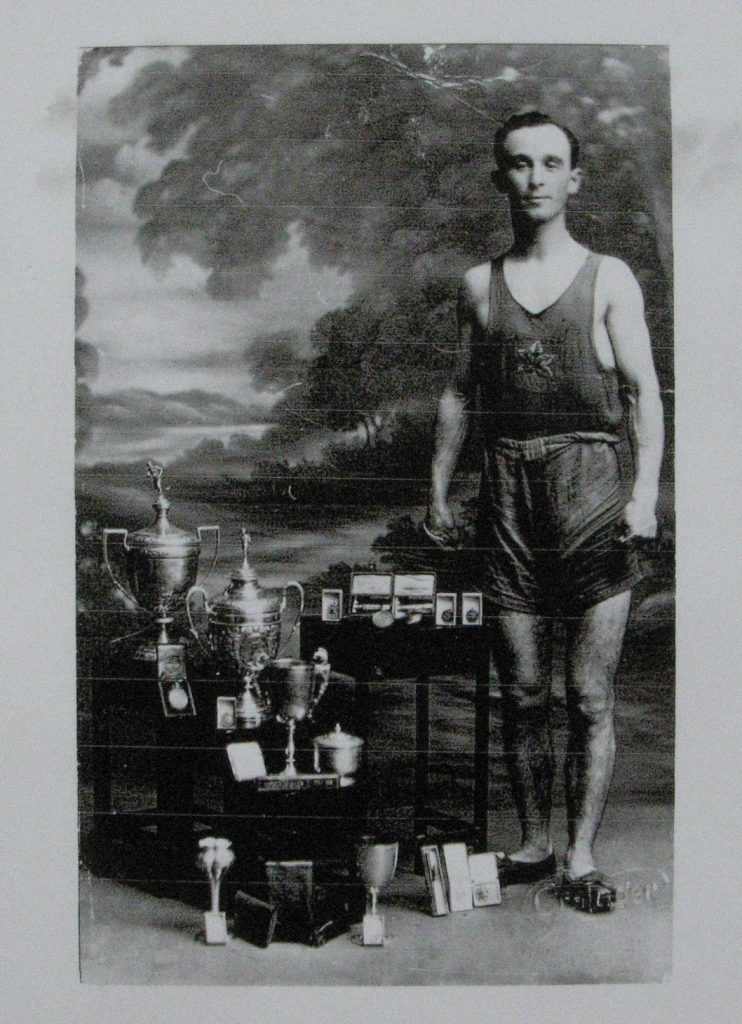
AbAlexKing

Alex King

Jimmy Adams

In my previous paper I also made reference to the letters written to me by Jimmy Adams, a former Scottish Internationalist and the first President of Aberdeen AAC. As well as letters, he sent me the bronze SAAA Championship medal which he had been awarded for the high jump in 1921 and the silver medals which he had been awarded for the same event in 1922 and 1923. He also gave me British YMCA National Hexathlon Honours Ribbons which he had obtained in 1920 and 1922. (These were given to YMCA members who had attained the requisite standards in three field events and three track events.)  Jimmy Adams also gave me several photographs and press cuttings. He gave me those various items in the expectation that I “would be good enough to preserve them”. Were he alive today then he might be delighted to learn that Aberdeen University is prepared to put all that he gave me into its Special Collection.

Jimmy Adams had been a pupil at Robert Gordon’s College. He left that school in 1911 and found work in the Harbour Treasurers’ Office but found that rather boring so “joined a ship (Deep Sea Tramp)” which took him round much of the world. In 1914 the ship which he was on had an encounter with the German light cruiser, the Emden, and that resulted in Jimmy Adams, and presumably the other crew members, being landed at Pondicherry. (By early September 2014 the Emden was cruising in the Indian Ocean attacking British merchant shipping. However, the captain of the Emden did his best to ensure the safety of the crews of the ships which he attacked and it was common for them either to be put ashore in a neutral port or to be transferred to a non-belligerent ship. If the captain of the Emden had been a less chivalrous person then athletics in Aberdeen might have followed a different path.)

After Jimmy Adams got home from Pondicherry, he joined the navy. According to information about him in a press report, “He was serving as a range-finder with the Grand Fleet at Scapa Flow in 1914(?) when it was announced in daily orders that anyone interested in athletics would be allowed ashore to train for the fleet championships.”  He made known his interest and later won the high jump title in the Fleet championships at Rosyth. In 1918 he was chosen to represent the Grand Fleet against the American Fleet.

When Jimmy Adams was discharged from the navy in April 1919 he settled in Aberdeen with the intention of joining one of the city’s athletic clubs. It was a toss-up as to whether he should join the Shire Harriers or the YMCA Harriers. However, on one occasion he happened to meet Charlie Howie, secretary of the YMCA Club, and Charlie persuaded him to join the YMCA Harriers. (According to Alex King, the Aberdeen YMCA Harriers had been founded in 1912 by Charlie Howie and another man called J.V.E. Barron.)

In one of his many letters to me Jimmy Adams wrote “At that time we had a ‘stripping hut’ in Viewfield Road opposite Rubislaw Quarry … An oil lamp was our only means of lighting.” There was also “a large zinc bath which we filled with water from a tap in the adjoining property. This I may say was for anything from 10 to 30 members to sponge themselves down or wash on their return from a training run … Eventually we had to move from there … and we rented a wooden hut on the banks of the River Dee near the Suspension Bridge (the Wellington Bridge) on the south side. The heating of the water was by the same method and the same bath (was used). First to arrive got the water from the Dee, lit the stove and with fingers crossed away the members went for the usual Road Training Session …” (Among the memorabilia is a photograph of YMCA members in that hut.)

“After 2 or 3 years we (all the YMCA members) transferred to a hut we had erected on a vacant piece of ground which the YM had rented. There we all did our share of making a lovely (by late 1920s standards) cinder track.” That track was to the south of Linksfield Road opposite where the Linksfield Stadium was later built and where the excellent all-weather track is now situated at the Aberdeen Sports Village.

In the same very full letter Jimmy Adams wrote “Prior to the 1914-18 War there were the Aberdeenshire Harriers, the YMCA and, of course, the University Athletic Association. At the end of the War there came a revival of athletics and we had the ‘Shire Harriers, YMCA Harriers, Thistle Harriers, Shamrock Harriers and the Varsity Athletic Club. Eventually, after a brief life, the Shamrock and Thistle Clubs folded up and left the remaining 3 clubs to carry on to the 1939-45 War.” (It should be noted that, according to Arthur Lobban, prior to the 1914-18 War there was also an Argyll Harriers and an Aberdeen and District Harriers Association.)

“When the Corporation built Linksfield Stadium it was really to supply the needs of 2 Junior Football Clubs … as they had lost their ground … called Advocates Park … The old YMCA hut and cinder track was to be taken over for a housing programme so we got the use of Linksfield Stadium on a rental basis.”

 “My greatest ever joy was at Stoke when the late Eric Liddell … won the 100, 220 and 440 yards.” In another letter Jimmy Adams stated that Eric Liddell had run those races “in my spikes as he had left his own at the hotel he was staying in when he was competing at the White City grounds”. In this letter Jimmy Adams expressed the opinion that Eric Liddell was the only British athlete to have won 3 races in international competition in one afternoon. Given the circumstances, it is hardly surprising that witnessing Eric Liddell accomplishing that feat is something that Jimmy Adams remembered with particular pleasure.

   “As far as Ladies Clubs are concerned, originally the first Ladies Club in Aberdeen was the Aberdeen Ladies Hiking and Athletic Club in the late 1920’s and had, I believe, a sort of affiliation with the Aberdeenshire Harriers Club (unofficially). Then there was I rather think, a breakaway few, by way of some internal trouble who left and started up another Club which was then known as the Bon-Accord Ladies Athletic Club.” (It should be noted that the programme for the 1931 Sports Meeting which was held at Pittodrie on18 July 1931 there were 7 entrants from the Bon-Accord Ladies Athletic Club and 14 entrants from the Aberdeen Hiking and Athletic Club as well as a few entrants for ladies events from neither of those clubs.)

Aberdeen Y.M.C.A. Harriers membership card
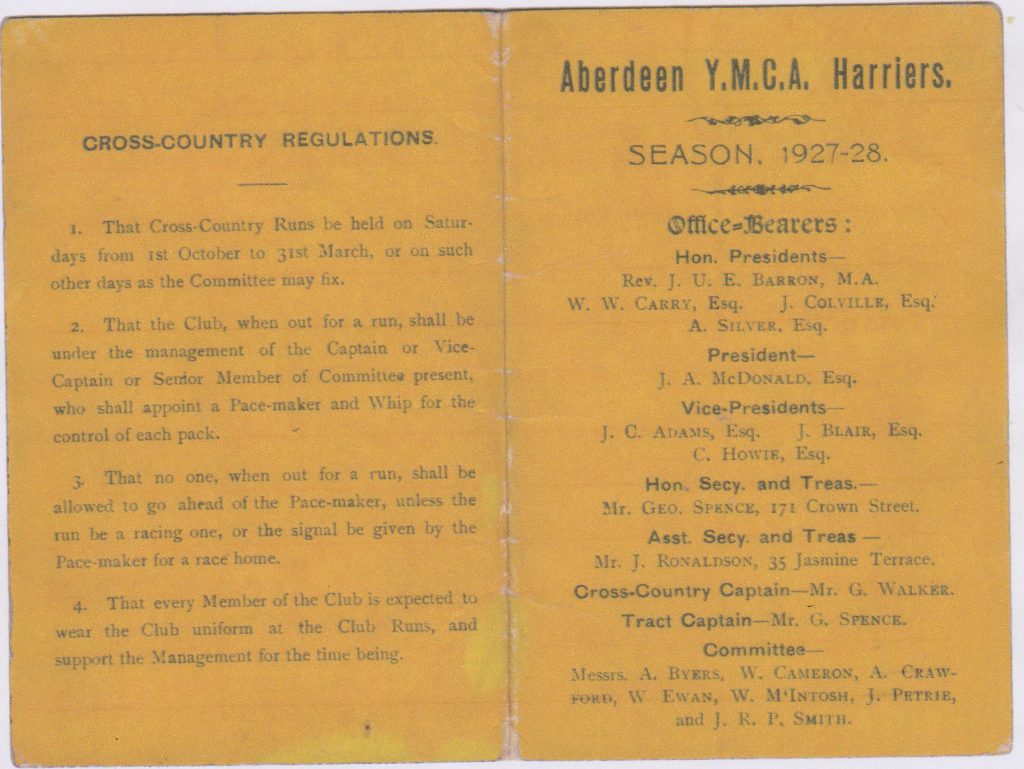
Image (14)

Image (15)

I expect that I was given the YMCA Harriers membership card for season 1927-28 by Jim Ronaldson who was the assistant secretary and treasurer of the club for that year. He was one of those whom I visited when seeking information about athletics in Aberdeen in the years preceding the Second World War.

A study of that membership card reveals much of interest. For example, Charlie Howie, a founder of the club, was then one of its Vice-Presidents as was Jimmy Adams. Also of interest may be the following:

 The club colours were a Royal Blue Singlet with a Small Red Triangle on a yellow ground placed on the left breast and with White Shorts.

The Constitution of the club stated “That the Club shall be called the ‘Aberdeen Y.M.C.A. Harriers’ and shall be under the control of the Aberdeen Y.M.C.A. Athletics Sub-Committee with headquarters at 198 Union Street”. (Former members of the Aberdeen YM Harriers, including Jimmy Adams, played a major part in establishing Aberdeen AAC in 1952 and it was no doubt for this reason that Aberdeen AAC for several years held its Annual General Meetings in the YMCA premises at 198 Union Street. Indeed, those AGMs were still being held there in 1966 after I became a member of the club.)

The cross country regulations of the YMCA Harriers stipulated that a Pace-maker and a Whip shall be appointed for the control of each pack and, further “That no one, when out for a run, shall be allowed to go ahead of the Pace-maker, unless the run be a racing one, or the signal be given by the Pace-maker for a race home”. (When I joined Edinburgh Eastern Harriers in 1953 that club had no such regulation relating to cross country running. However, at the opening run of each season the various Edinburgh Harrier clubs once met together at the Portobello Baths and the runners divided themselves into a fast and a slow pack, each under the control of a Pace-maker and a Whip. Each year towards the end of the run, members of the fast pack were lined up on the promenade at Portobello and then raced the final half mile or so to the baths where we enjoyed a pleasant swim. The fields over which we ran then are now built up. The same, obviously, is true of many of the fields in which cross country events once took place in Aberdeen. As for the use of Pace-makers and Whips, I doubt whether this would now be appropriate for confined club runs but believe that there could still be a place for them in inter-club runs. It is my opinion that not every inter-club event need be of a competitive nature.)

    The programme of events contained in the YMCA membership card reveals that two meetings with the University were to take place from the Bon Accord Laundry. (As can be confirmed from the internet, this laundry had been situated on Abbotswell Road, which had once commonly been called Laundry Brae. This laundry, not Aberdeen’s only one, had been established in 1886.)

The Milne twins

Two of the best runners in the Aberdeen YMCA club in the years immediately preceding the Second World War had been the twins, Alex and George Milne. In a photograph taken of the Aberdeen YMCA team that won the Round-the Town Relay Race in 1938, Alex and George Milne are the two athletes at the back of the group.

Alex Milne was an athlete whose performances would still be considered of high quality by modern standards. Evidence of this is contained in the press report which noted that Alex had set a course record of 25 minutes 31 seconds for the 5 mile fourth stage of the Round-the-Town relay race. The fact that the stage included a significant hill makes his performance all the more impressive. The course was described in the press as follows: “Out Menzies Road to Kirk o’ Nigg, down Abbotswell Road and over Bridge of Dee and in Riverside Road to Victoria Bridge to the fifth take-over.” George Milne, for his part, broke the record for the second stage by a margin of 37 seconds.

Another press report stated that “By his victory in the North Eastern Harriers’ Association’s five miles cross country championship this afternoon, Alex. Milne, Y.M.C.A., is the first man in the North-east of Scotland who has won four successive individual championships over this distance”. In that event George Milne had finished in third position not far behind his brother.

In 1939 the Milne twins made the long journey south to Hawick to match themselves against the best cross country runners in the East of Scotland. In that race, the Eastern District Cross Country Championships, George finished in a creditable fourth position with Alex in seventh. Unfortunately the Aberdeen YMCA Harriers were unable to send a team to this distant event. It is unlikely that they would have won it, but it would have been interesting to find out how they would have compared with other East of Scotland clubs. Many years later, Aberdeen AAC proved that it could comfortably hold its own with clubs from elsewhere in Scotland.

Influences from Edinburgh

   As the documentation demonstrates, after I was elected to the Committee of Aberdeen AAC in 1966 I organised a jumble sale in order to raise funds for the club. I also organised a schoolboys cross country event in order to attract boys into the club. Both of those ideas were based upon what Edinburgh Eastern Harriers had done when I was a member of that club. I was unsuccessful, however, in persuading the then Committee of Aberdeen AAC to produce a membership card along the lines of the Edinburgh Eastern Harriers’ card even although I brought one along to a committee meeting.

 When I later became club secretary of Aberdeen AAC I did not attempt to organise another jumble sale to raise funds: other means of fund-raising were adopted. I did, however, organise cross country races for primary school children, both boys and girls, in order to attract youngsters into the club. I also, with the full agreement of the club committee, arranged that membership cards were produced. These resembled the Edinburgh Eastern Harriers’ membership cards in that on the front cover they showed when the club was founded and, inside, they contained club records. Later (as a result of a suggestion by Edwin Reid, one of the excellent Aberdeen AAC presidents) within the membership card there was included the club constitution. The Aberdeen AAC membership card, however, contained no information about fixtures. Instead members of Aberdeen AAC, during my time as secretary, were issued with a programme detailing cross country events at the start of each cross country season and a programme detailing track and field events at the start of each track season.

The format of the club membership card remained basically unchanged until at least 2003. Sometime thereafter it was decided to issue members with a small laminated card which gave only the name of the member, the membership number of the member, the name of the membership secretary and the website address of Aberdeen AAC. That was a sensible thing to do since members already received a yearbook which contained club records. To that has been added the club constitution and, each year, an up-to-date list of club office bearers and ordinary committee members. That club year book is now a publication of which Aberdeen AAC can be rightly proud. For example, the 2015 Yearbook contains

Coloured photographs of members

Club Records for all age groups

Highlights of the club’s 2013-14 and 2014 seasons

Club all-time lists of senior Scottish champions

All the Club’s major games representatives

Club all-time indoor rankings – senior events

Club indoor records for all age groups

Club all-time top 20 lists – senior events

Club all-time top 10 lists – U 20, U17 & U15 events

Club all-time top 10 lists – veteran men and women

2014 top 5 rankings for all age groups.

Anyone studying those yearbooks will be impressed by the standard of the performances of members of Aberdeen AAC, by the range of age groups and events for which the club caters, by the dedication of Denis Shepherd and others who compile the data and, of course, by all those who by their efforts ensure that the club continues to provide the coaching and competition which members rightly expect.

                                                           ATHLETICS  IN  ABERDEEN

W Hunter Watson                                                                                                                           January 2016

Introduction

    This paper follows on from my three previous papers on the topic of athletics in Aberdeen. It corrects and clarifies some of what was contained in those. In spite of its title, the paper does not confine itself exclusively to athletics nor to Aberdeen: it contains a few other snippets of information which I came across in the course of my research, snippets which might be of interest to some.

I am well aware that my papers have hardly scratched the surface of the topic of athletics in Aberdeen. I have not, for example, written about Aberdeen University athletes, not even about James Soutter or Quita Shivas (really Isobel Shivas) even though both of these athletes gained Olympic selection. Hopefully others will eventually fill in some of the gaps.

Jimmy Adams

In my paper entitled “Aberdeen AAC” I wrongly stated that Jimmy Adams was the secretary of the North East Harriers Association. However, as noted in my paper entitled “Aberdeen Athletics Memorabilia” he was, in fact, the Vice President of that Association. (This information was contained in one of the letters written to me by Jimmy Adams.) Further, as can be verified by studying the medals given to me by Arthur Lobban, the correct title of that Association was the North Eastern Harriers Association.

In a letter which made reference to the hut on Viewfeld Road from which the YMCA Harriers trained in the early 1920s, Jimmy Adams wrote “We had our pennyworth in the tram car to Bayview (the terminus) and walked the rest of the way”. Thus at that time tramcars did not go as far as Hazlehead Park. That they eventually did so is proved by a photograph in the book entitled “Aberdeen’s trams 1874-1958”. The photograph in question shows a tramcar fitted with a snowplough clearing the tracks to Hazlehead in March 1955. That book about Aberdeen’s trams noted that “By 1920 the Corporation Tramways carried more than 49 million passengers a year, and although the Suburban Tramways were abandoned in 1927, the Corporation Tramways continued to develop. In 1946 69 million passengers were carried by tram and 39 million by bus”. Tramcars were a popular means of transport, but they were liable to hold up traffic somewhat and that might have been one of the reasons why a decision was made to remove tramcars from the streets of Aberdeen and several other cities including Edinburgh. (The latter city, at great expense, has begun to reintroduce them.)

Women’s athletics

In my paper entitled “Aberdeen Athletics Memorabilia” I stated that in 1953 I had joined an Edinburgh club called Edinburgh Eastern Harriers which was similar to the pre-war Harrier clubs in Aberdeen in that it did not cater for women. I further stated that on 27 March 1961 there was a joint General Meeting of three of the Edinburgh Harrier Clubs, namely Edinburgh Harriers, Edinburgh Northern Harriers and Edinburgh Eastern Harriers. Those present agreed that those three clubs should amalgamate to form a new club to be called Edinburgh Athletic Club. I observed that this new club was to be affiliated to the S.A.A.A. and the N.C.C.U. but not to the corresponding women’s organisations. I wondered whether each of the three clubs that had come together to form Edinburgh AC might have catered only for men and boys and whether, initially, Edinburgh AC might also have been without women as members. As a result of enquiries which I have made, I have now established that one of those three clubs, namely Edinburgh Harriers, did accept women as members. Beyond reasonable doubt, Edinburgh AC would have done so also from its inception.

During the course of my research I discovered that the Scottish Women’s Amateur Athletic Association (the S.W.A.A.A.) had been established only in 1931. According to the information supplied to me by Jimmy Adams, the Aberdeen Ladies Hiking and Athletic Club had been established in Aberdeen by the late nineteen twenties, and hence before the establishment of the S.W.A.A.A.. It is possible, therefore, that this Aberdeen club was one of the first in Scotland to cater for women who wished to take part in athletics.

 While on the internet to obtain information about the S.W.A.A.A., I noticed that it contained a list of Scottish women’s best performances in athletic events. I was intrigued to observe that the first of the best performances of Scottish women for the mile was credited to a member of the Aberdeen Bon-Accord Ladies Athletic Club, namely Agnes Milne. She is credited with having run a mile in a time of 5:45.0 on in Aberdeen on 2 May 1931. This was presumably at an open meeting organised by Aberdeen University since the Athletic Sports Meeting at Pittodrie was held in July. It should be noted that in a letter to me, Alex King credited Alice Milne with a faster time, namely 5:20, but he does not specify when she achieved that performance. I suspect that she did so before the S.W.A.A.A. was established and before, therefore, that organisation began to compile lists of Scottish women’s best performances. It should be further noted that a time of 5:20 for the mile is a superior performance to a time of 5 minutes for the 1500m. Although 5 minutes for the 1500m is far short of current international standards, most managers of women’s club teams today would be delighted to have available for selection someone who was as good a middle distance runner as was Alice Milne all those years ago. One wonders what she might have achieved on a modern track with modern training methods and a good diet.
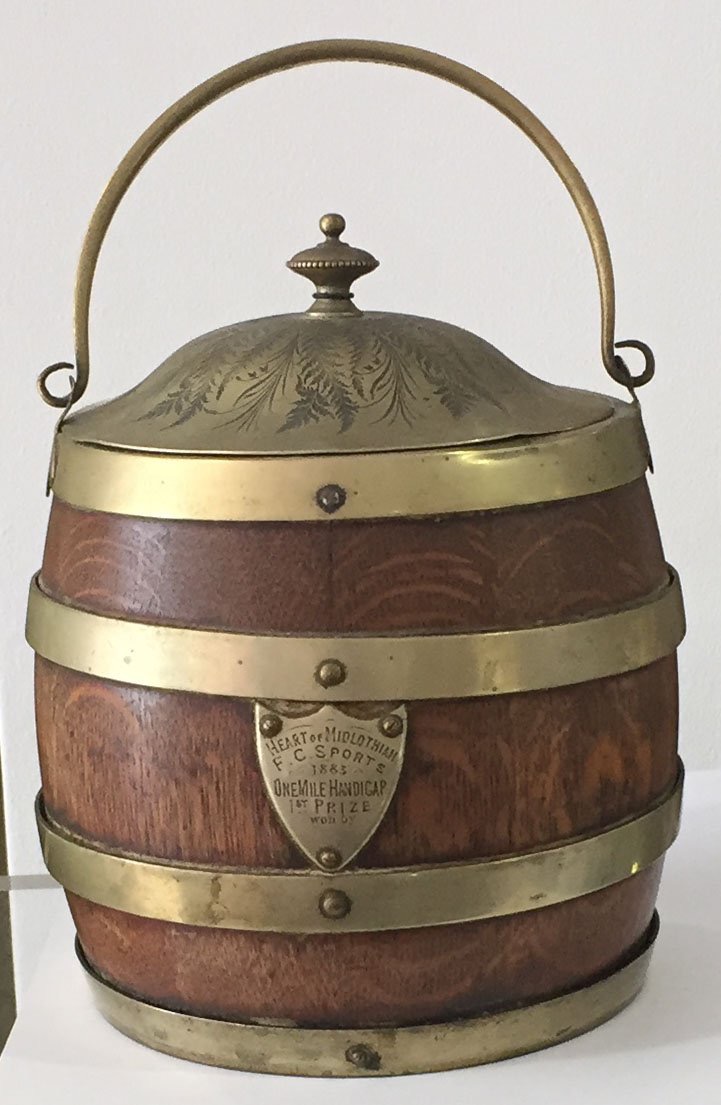
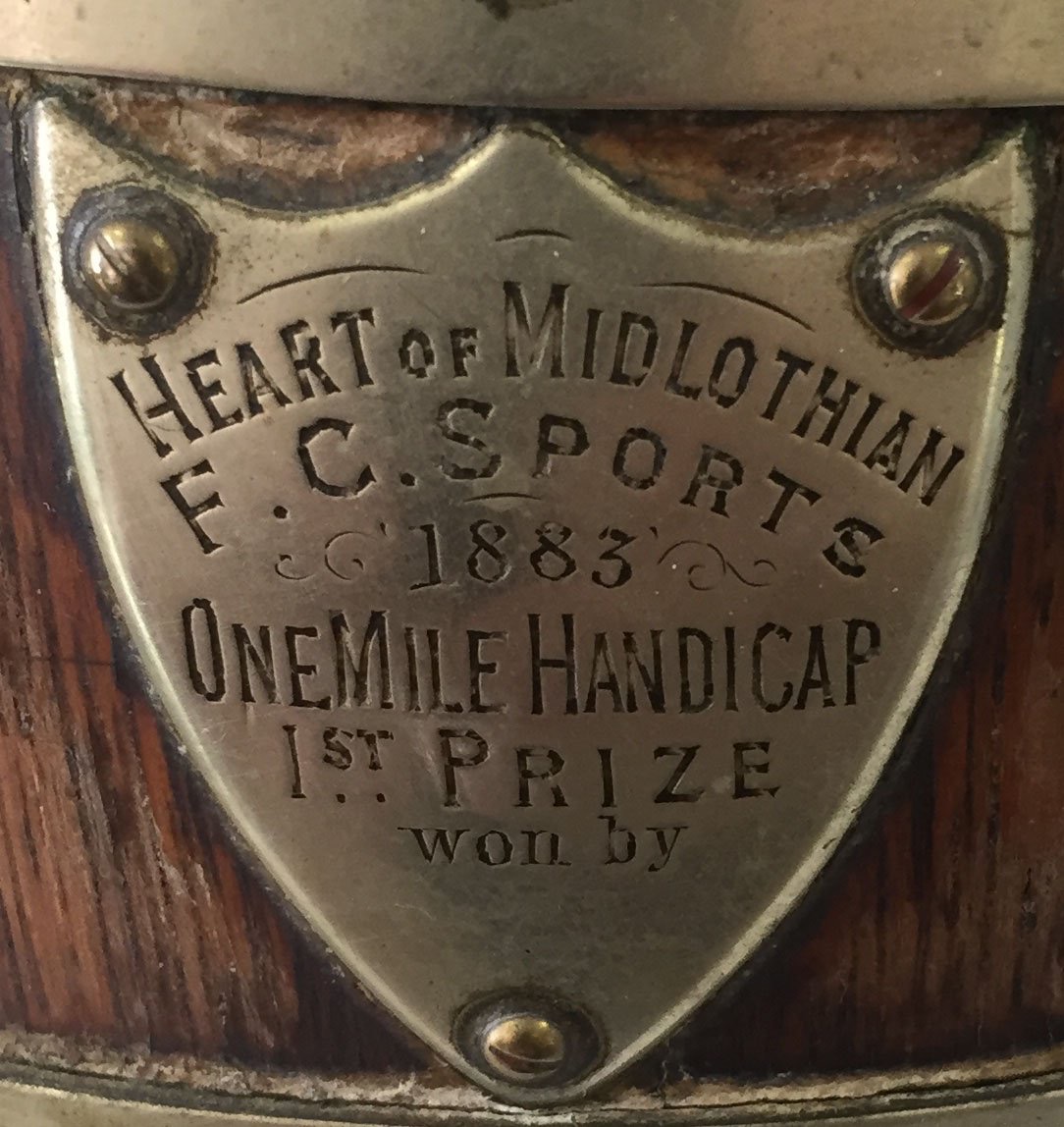
James A Youngson

JAY1

The history of athletics is usually told in terms of statistics but it is also the case that the progress of any sport can be measured by examining the people who take part in it.   That approach also incorporates a bit of social history and James Youngson’s sporting career illustrates the sport and its practitioners across several decades and in at least two periods: the sport before the War and the distinctly different period of the 70’s “running boom.”    His son, Colin, has written about his Dad’s career and it is attached here.   To me, though, his running later in his life was as significant as his early running: had he been a non-runner before 1977, the exploits thereafter would have made a praiseworthy career in their own right.   We will, therefore, begin with that simply because I don’t want it to appear as a coda or tailpiece at the end of an athletic career.   Colin writes:
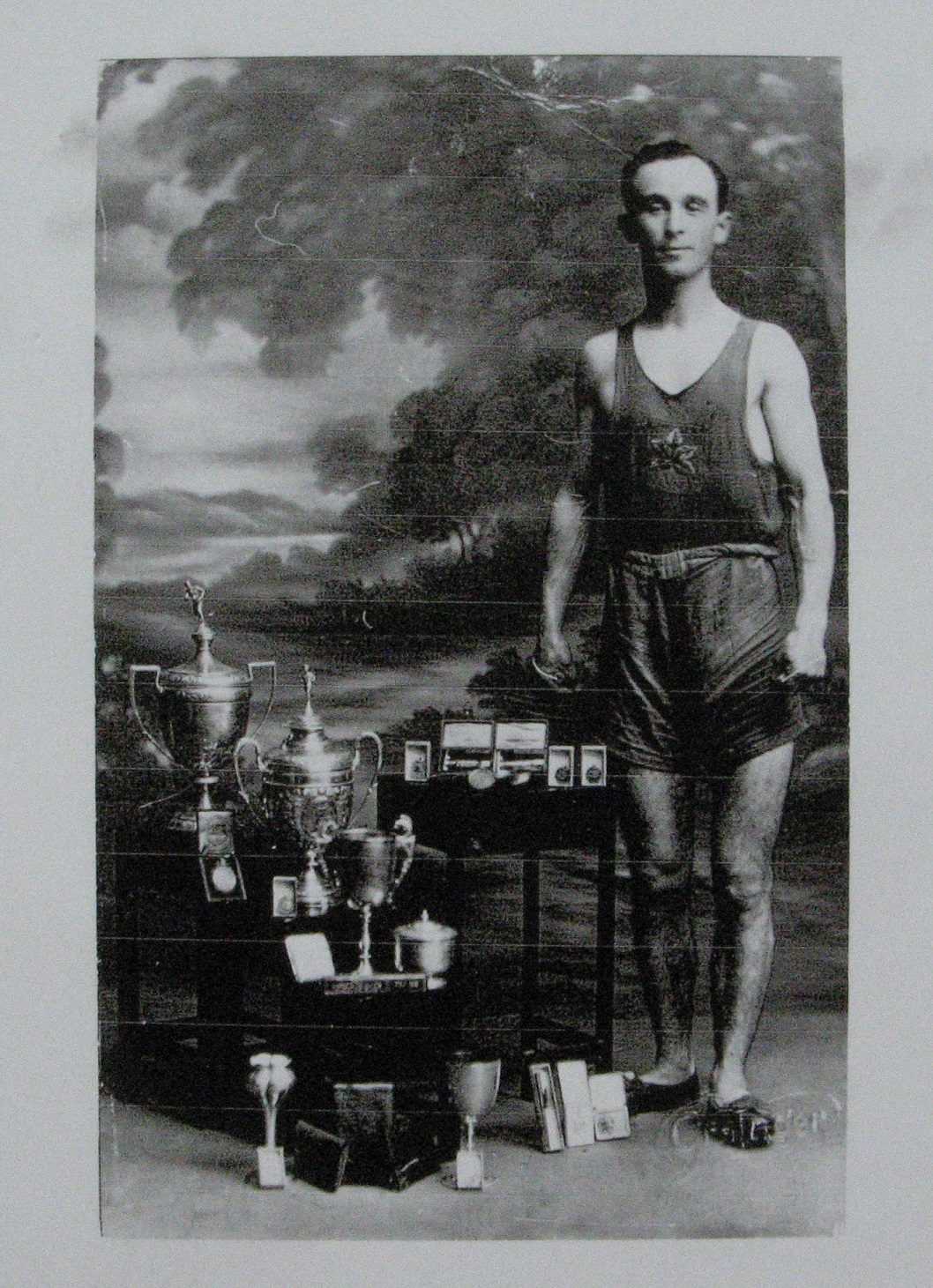
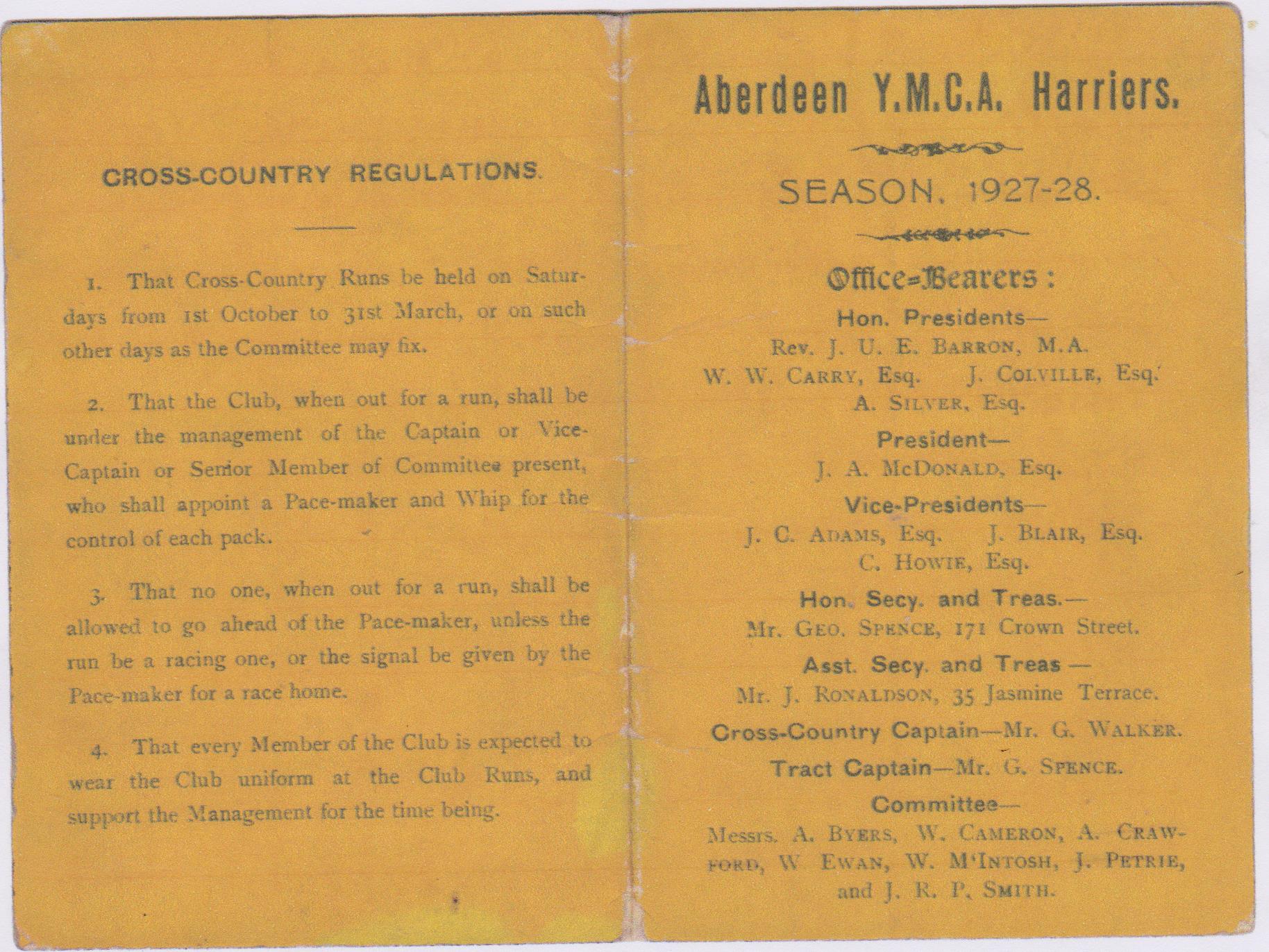
My father took up running again in 1977, aged 64. In 1981, aged 68, he ran the Aberdeen Marathon in an impressive 3.31.16.

1980 events included managing 18 miles in a Hazlehead Park sponsored walk in April; and completing the 4th Annual Scolty Hill Race in Banchory. I also remember him really enjoying the Aberdeen AAC club half marathons (From and to the Bridge of Dee: out the North Deeside Road, turn left at Milltimber Brae and again at the Mill Inn, then in the South Deeside Road.) Dad said it was his favourite distance because, unlike after full marathons, he could then enjoy wolfing down a big meal! On the 24rd of August, he took part in the World Friendship Jog before running the marathon in the 13th Annual World Veteran Championship Marathon, around Bellahouston Park in Glasgow. I was a jogging supporter that day, and can assert that Dad’s 3 hours 45minutes 21 seconds (for 3rd M65) was slowed somewhat by his prostate – no less than six comfort breaks! His age-group team gold (with other M65s, the great Gordon Porteous and Bert Grant) was Scotland’s only one. The World Veterans team gold medal and (silver individual one for third place) are delightful thistle-shaped designs by Carrick Jewellery Ltd.

In 1981 he ran an impressive 39 laps in the Evening Express Jog Walk at the Duthie Park on 14th June. The programme for the 27th September 1981 City of Aberdeen Milk Marathon includes 14 ‘Pen Portraits – Athletes to Watch’.   Those with photographs are: Alastair Wood; Don Ritchie; Fraser Clyne; Colin Youngson; and James Youngson of Aberdeen A.A.A.C.   “Now aged 68, set his best time of 3.36.18 in last year’s race when winning the over 60 class.   Father of Colin.”    Dad just loved publicity!   Race day was wet and windy, and the course typically far from flat. Unfortunately I had a sore throat, a stomach bug and surprisingly enough sense to avoid taking part.   Dad, however, (who may even have tried the pre-marathon carbo-loading diet) arrived at the Duthie Park finish full of life, terribly apologetic about having run right away from his 47 year-old club-mate Ian Morrison.  A great performance, which is still the Aberdeen AAC M65 club marathon record in 2017. His diary comments: “Very windy but with strength from God and Lord Jesus, do 3.31.16 Very stiff but enjoy a meal when I get home.”

Note the company in which he ran: such as Gordon Porteous and Bert Grant are excellent athletes.   He would have been a welcome addition to any veteran team between 1970 and the present.  The scene in which he ran in the 70’s and 80’s was very different from his earlier days in the sport  –

*the carbo-loading diet hadn’t been invented when he started out,

*there were now international races for veteran athletes,

*even domestically, veteran athletes had no recognition,

* the Milk Marathon tells us that there was sponsorship for ‘amateur’ races,

Unlike many of the marathon men of the 70’s and 80’s, however, James had a running career before that one.   The two are as distinct as chalk and cheese.

abmar81progC

From the Aberdeen Marathon Programme in 1981.

Colin continues –

BUT WHAT ABOUT HIS EARLY RUNNING CAREER?

Impressed though I am by Dad’s comeback running (even more impressed, now I approach my 70th birthday myself), I was intrigued about the running he did in his youth. There were clues: his Gordonians blues blazer, tie and scarf (dated 1933-34); a personal best mile mentioned as 4 minutes 40 seconds; a North Eastern Harriers Association medal engraved on the back ‘3 Miles 1934-35’; a weird anonymous medal with a design, which could just be Egyptian. Then there was the battered little presentation case of six knives (Sheffield England; Stainless De Luxe) which he boasted he had won (under an assumed name, to preserve his amateur status) for winning a mile on the professional Aboyne Highland Games grass track. In the town of his childhood at Birse Cottage, and probably in front of the King. No prize his son Colin could ever win, he insisted, could ever compare with these! (In July 1989, my three boys were mildly amused onlookers when I too entered under a pseudonym (‘Jim Alexander from Aboyne’!) and finished third in half-mile and mile races at the professional Taynuilt Highland Games, winning a couple of fivers and escaping detection by SAAA snoopers!)
Of course ‘young Dad’ must also have been ‘cross-training’ like crazy, as well as running, and race-walking to and from Burtons, via Jack’s Brae: sea swimming on the first of January or in the salt water Beach Baths or even in Egyptian brine; cycling up to Ballater after work on Saturdays, staying at a Youth Hostel, and then taking his racing bike through the Lairig Ghru; sleeping in mountain bothies and ditches; speedy hill-walking away from Jimmy Chivas; playing football, badminton and basketball and striding out briskly in the Egyptian desert while towing dogs called Joe, Bess or Ena; and (mainly after the war, I believe) taking part in time-trial fixed-gear bike races on the South Deeside Road.

Hunter Watson, the long-time Aberdeen AAC secretary and historian, offered more information in a club magazine. Apparently, during the two World Wars, the association of local clubs was renamed the North Eastern Harriers Association (NEHA), and the 3-Miles team Road Race usually took place in December. Another regular event was the Round the Town Relay. The YM Harriers were often the best team in Aberdeen during the 1930s (others included Aberdeenshire Harriers, Aberdeen University, Shamrock Harriers and Caledonian Harriers). Prominent YM athletes at that time included the Milne twins, Alex and George, who did especially well in five and seven mile races. (Auntie Peggy Dad’s older sister, married an Alexander (Alec) R. Milne, who died on 28th February 1978. He was a retired Aberdeen Savings Bank manager (Holburn Branch); and his last address was 1 Hopecroft Gardens, Bucksburn. In Aberdeenshire ‘Alex’ is usually pronounced Alec. Had Peggy first met him due to the fact that her brother Jim was a team-mate of Alex in the YM Harriers? Maybe I will find out Alex’s date of birth via his death certificate; and then ascertain whether he had a twin brother called George!)

The club rented a wooden hut on the south bank of the River Dee, upstream from the Victoria Bridge. This hut belonged to a swimming club. Lighting was by paraffin lamp, and water had to be carried in from the outside and heated over a stove lit by the athletes. A zinc bath was used for sponging after training runs. Track training was carried out on a cinder running track in Linksfield Road. When they all went out for a cross-country or road training run, a ‘Pace-maker’ and a ‘Whip’ were appointed, to make sure that the pack stayed together, until near the end when they were free to race home. (Even when I ran for Victoria Park AAC in Glasgow in the early 1970s, a similar system operated, with a slow pack going off first, and then the fast pack to chase them round a certain traditional road route.) Then in August 1939 the YM Harriers agreed that the club should go into abeyance until the war situation became clear. War was declared on 1st September; and the club was never formally reconstituted. However some of its trophies are still competed for by Aberdeen AAC.

On the quest to find out about Dad the young athlete, I went to Aberdeen Public Library and looked up microfilm of old editions of ‘The Press & Journal’ and ‘The Evening Express’.
He left Gordon’s College at the age of 15, probably in 1928, but retained his link with the school as a Gordonian. His Blues Scarf has the dates 1933-34. Was this for summer track athletics or winter road and cross-country? On Saturday 17th June 1933, the Evening Express has a brief mention of an athletics contest between Aberdeen University and Gordonians at King’s College grass track (where I also raced many times in the 1960s and 1970s). The Students won, but five Gordonians, including ‘J.A.Youngson’ are reported to have done well! The reporter was ‘confident that, with a bit more training, Gordonians will give their rivals a better tussle’. Dad may also have competed for Gordonians at King’s in a five-team athletics match on 5th August 1933. ‘Varsity’ won; with Shire Harriers second; Gordonians third; in front of Dundee Hawkhill Harriers (!) and Aberdeen YMCA. By the way, until the 1970s it was traditional to refer to athletes by their initials in sports reports. Hence J.A. Youngson. I remember Mum saying that some of Dad’s pre-war friends used to call him JAY rather than James or Jim!

(In his diary on March 4th 1978, Dad mentions going down to King’s College and jogging round the field “which takes me back some 40 years. Very enjoyable. Manage 9 laps plus and ease-off lap. Home to a large meal.”)

So how about the 1933-34 Winter Season? Well although Gordonians had a pretty good athletics team, it seems that they could not field a squad to take part in cross-country events. This would explain why there is no mention of Dad taking part in the NEHA fixtures that season. It also explains why he later changed clubs, joining Aberdeen YMCA Harriers in early Winter 1934.

On December 14th 1933, the EE published a timewarp photo of three ‘Trail-layers’, each with a satchel under his left arm, dropping a trail of shredded paper for a NEHA cross-country course. I knew of this system, but it had stopped by the mid-sixties, when I first ran cross-country. Did all the runners get lost if it was windy?

However Dad definitely ran well for Gordonians in Summer 1934. I remember that he said he used to train sparingly, since athletes at the time were afraid of becoming ‘stale’. A 1933 EE article on diet emphasises that ‘over-feeding and rushing of meals will bring on staleness quicker than anything else’. Oatmeal porridge is recommended, as well as fish, milk, eggs, roly-poly pudding. Vegetables are deemed necessary at dinner, but only a few potatoes. In the morning, the kidneys will be cleared if one drinks a glass of water. Cakes and sweetmeats are regarded with suspicion. An occasional dose of treacle is considered a good laxative. Simple foods and not overloading the stomach should pave the way for future success!

On the Wednesday the 4th of July 1934, the EE reports that there was an athletic meeting at Seafield (Gordon’s College’s old sports grounds, where in 1965 I finished a very long way ahead in the one mile race on a grass track during the local derby Aberdeen Grammar School versus GC match.) Dad however, representing Gordonians, finished half a yard down on Alex Milne of the YMCA, who won in 4 minutes 50 and four-fifth seconds, with George Milne third. Maybe they talked Dad into changing clubs that autumn! Dad is also named in the winning medley relay team (probably running 880 yards) when Gordonians beat Aberdeen YMCA Harriers. This was also the overall result in the match. Very probably it was Dad’s form this summer which won him his Gordonian Blue, and enabled him to buy his scarf and the blazer which he wore so proudly.

On Friday 27th July 1934 there was a match at Hazlehead: AU Hares and Hounds vs YMCA vs Gordonians. On this occasion, Dad finished third in the two miles race, behind one Varsity runner and one Shire man. There was a team race, so he certainly would not have been last! The winning time was 10 minutes 19 seconds. Gordonians had one extremely good sprinter and some field athletes, but Dad seems to have been their best distance man. Incongruously, right next to the P&J athletics report is a very large advert for cigarettes with the slogan ‘Have a Capstan!’.
On the 4th of August 1934, adjacent to a list of results from the Empire Games is an equally detailed list of results from the Pittodrie Sports! Dad finished third in the one mile behind a couple of successful local runners: C. McPherson and A. Watt (both Shire). It must have been a thrill to race against the best local men (and some from Dundee) in front of a crowd of 5000 on the Dons’ hallowed ground.
It was announced in the EE in late October 1934 that “The Aberdeen Y.M.C.A. Harriers have now everything in apple pie order for the coming season. Although the active membership is 21, there are still a few vacancies for lads who wish to take up the harrier game.” Who could resist the call? Not Dad!
Then, Eureka! A report of the race in which Dad won his NEHA medal! The P & J on Monday 19th November, 1934, described a race which happened on Saturday 17th. Below is a summary.

“DOUBLE HONOURS FOR Y.M.C.A.

In the North Eastern Harriers Junior 3 miles 6-man team championship, held at the Links, Aberdeen Y.M.C.A. Harriers achieved individual and team victories.” There follows an account of the first two miles, led by various nonentities. Then! “In the last mile, the favourite, James A.Youngson, went to the front but could not shake off the Milne twins, who were running in a loose and easy style. These three club-mates had a desperate fight, until the final sprint. Alex Milne won by inches from James A. Youngson, with George Milne a yard behind.
1 Alex Milne YM 16.45 and one fifth of a second
2 James A. Youngson YM
3 George Milne YM.

Team placing:
1 YMCA (1, 2, 3, 7, 10, 11 = 34 points
2 Aberdeenshire Harriers
3 Aberdeen University”
(Outsprinted in a close race! This explains my genetic inability to win in a sprint, then.)
The EE on the following Saturday 24th November 1934 comments further, in a weekly column by “Roadside” who deals with cycling, running, race walking and track athletics.
“PROMISING ‘Y.M.’ RUNNERS
Last Saturday’s three-mile junior team race at the Links resulted in another YMCA triumph. Alex Milne, James A. Youngson, and George Milne filled the first three places and the club also won the team event by a comfortable margin.
The ‘Y.M.’ also had the first three men in the two-mile novice championships at Pittodrie Park in October. This would seem to indicate that they have, at present, the best set of youngsters in the city.
To get back to the three-mile junior race. The event was held under ideal conditions and, although the time does not stand comparison with former years, it must be kept in mind that formerly the course was shorter. The lap has now been carefully measured, and it is 854 yards which gives a course of six laps plus 156 yards. The previous course never exceeded 5 and three-quarters laps. The running of the race on the left-hand turn, and the shifting of the finishing line was, I think, quite a successful innovation.”

Next step was to try to find an account of the novice two-mile race, round the cinder track the outside of the football pitch before the Dons home match versus St Mirren on October 13th, 1934. If Dad had ended up favourite for the three-mile event, surely he must have won the earlier race? But no, he didn’t even run, although the Milne twins did, so Dad must have won a novice race previously, just possibly while representing Gordonians during 1933-34, and subsequently had been upgraded to ‘junior’ athlete status. A ‘novice’ before the war was someone who had never won a race in open competition.

On Saturday 24th November 1934, there was a 20-mile relay race from Invercannie Waterworks near Banchory (starting on the 20th milestone on the N. Deeside Road) to Aberdeen. Although the Milne twins ran for the YM Harriers, who finished second, Dad was not named in their team that year.
In December 1934, Dad was mentioned in the EE as liable to figure prominently in the forthcoming YMCA Harriers 5 mile club championship over the Torry course. This was “likely to result in a duel between James Youngson, James Thow and the twin brothers – Alex and George Milne”. The route was from the foot of Menzies Road, past Craiginches to the top of Nigg Brae, where the runners took the turning that led to Bridge of Dee, before crossing the bridge and racing down Riverside Road, to finish near Victoria Bridge. However Dad did not take part. Arthur Lobban won, followed by Alex and George. In Dad’s 1981 interview he said that he had some success before the war in local one mile and two mile events. In addition, he definitely ran well over three miles; but perhaps five miles was too far, considering how little he trained. Maybe, by contrast, the Milnes gained superior stamina because they banged in the miles by training together all the time – tantamount to cheating!


There is no mention of Dad in early 1935, until the last race of the season, on Saturday 16th February 1935. The EE article states the following.

HARRIERS RACE FOR CALEDONIAN CUP

Six Teams to Compete in Stiff Test

The fifth annual three-mile race for the Caledonian Cup will be held under the auspices of the North Eastern Harriers Association, today at 3 p.m.
The competition is open to all amateur clubs within the area. Teams are of twelve runners each, of whom the first six men home count for places.
Teams are forward from ‘Varsity, Shire, Aberdeen YMCA, Gordon Highlanders (2 teams) and Elgin YMCA Harriers.
The course is from South Esplanade West, past Craiginches to Harpers’ Works, striking off to the left to take the fields over to the road leading under the railway. Runners then take the country again to come on to the road at the railway cabin, and thence back to the finishing point in South Esplanade West.
Stripping accommodation is at the Dee Swimming Clubhouse, near Victoria Bridge, but ‘Varsity and ‘Shire will strip in the ‘Shire hut at Suspension Bridge.
Trail layers are asked to report at Dee Hut, at 2.15 p.m.”
There follows a full list of entrants, oddly not including Lobban and the Milnes.

Next Monday’s P&J has the results!

Y.M.C.A. Man First Home in Harriers’ Event

“Varsity won the N.E. Harriers’ Association three-mile junior team championship which was decided over a course at Torry on Saturday afternoon.
A field of sixty runners took part. From the start, A.R. Hewitt and N.R. McLean (‘Varsity) forced a stiff pace, with J.A. Youngson (YMCA) five yards in the rear. Taking the country, McLean went to the front, with Hewitt and Youngson at his heels.
Midway over the country the three leaders were having a tousy duel, the Elgin team being well bunched together for the team award. Coming on to the road again, McLean was clinging to three-yard lead, from Youngson and Hewitt, with H. McDougall (‘Varsity), J. Riddell (Elgin) and W. Grant (‘Shire) ten yards behind.
In the last 200 yards Youngson came away with a terrific burst of speed to pass McLean and carry on to win his first individual honour by twenty yards in the good time of 16 minutes 35 and a fifth seconds.
An exciting duel took place between McLean and Grant for second place, the former just getting the verdict by inches at the tape.”
Well! Where did that sprinting power come from? Perhaps this was Dad’s greatest-ever victory. Presumably, having won a ‘junior’ race, he would now be classed as a senior athlete!
The following Saturday’s EE ‘Roadside’ column emphasises how well Elgin YM had done, to come second to Varsity in the team race. Then he writes “The individual winner was J.A. Youngson of Aberdeen Y.M.C.A., who returned the second-fastest time for a winner of this race. The cup and individual medals were presented to the successful competitors by Mr Alexander Silver.”
Evidence of Elgin YMCA Harriers Club’s rise to prominence came in their promotion of an amateur athletics meeting on Wednesday 19th June 1935. This was the first meeting held since the inauguration of the club, and took place at Boroughbriggs Park, Elgin (where I raced a North District cross-country league race at the age of 62 in 2010!) In the previous Saturday’s EE, ‘Roadside’ mentioned that “The ‘stars’ to appear in the one and two miles handicap races are W Fraser (AU), L Davidson (‘Shire) and J.A. Youngson (Y.M.C.A.).” Then the P&J on Thursday 20th reported that the Two miles race (handicap) was won by local runner J. Riddell in 9 mins 41 and three-fifths seconds, from J.A. Youngson (Aberdeen YM) and A. Murray (Elgin).

www.rastervect.com

In November 1935, Dad was selected to compete in a legendary Aberdeen team race.. Alex Wilson, a fellow contributor to the rather impressive Scottish Running History website (www.scottishdistancerunninghistory.scot) supplied me with the following report in ‘The Scotsman’:

“ROUND THE TOWN RELAY RACE AT ABERDEEN

The North-Eastern Harriers’ Association held their 20-mile Round-The-Town Relay race at Aberdeen on Saturday 30th November 1935. Five teams of six-a-side participated in the event, which was won by Aberdeenshire in the excellent time of 1 hour 44 mins 17 secs.
G. Lobban (University ‘A’) led J. Youngson (Y.M.C.A.) by ten yards at the first lap, covering the distance in 12 mins, 12 secs. In the second lap, D. Annand (University) and A. Milne (Y.M.C.A.) ran abreast until 100 yards from the finish, when Annand pulled away to lead by 10 yards at the take-over. In the third lap, G. Milne (Y.M.C.A.) finished 100 yards ahead of L. Murray (Aberdeenshire) , and in the fourth, fifth, and final stages C. McPherson, W. Grant and F. Yeoman, of the Aberdeenshire team, secured the lead respectively. Results were:
1 Aberdeenshire Harriers
2 ‘Y.M.C.A.’
3 University ‘A’
4 University ‘B’
5 Caledonian Harriers.”
Hunter Watson supplied more information. The YM Harriers had not long been formed (possibly in 1933); and Dad would have worn a royal blue vest with a red and yellow triangular badge.
The P&J listed all the numbers of all the competitors in the five participating teams; and stated that the Shire Harriers had a winning margin over Dad’s team of only a hundred yards, with the University a further 400 yards behind. In addition there is a blurred picture of the five first lap runners, who were (left to right): “A.J. Youngson (initials wrong way round) (Y.M.C.A.); E. Wood (Caledonian); A. Lobban (Varsity A; A. Hewet (Varsity B); and A. Watt (Shire)”. Dad is indeed wearing a dark vest with triangular badge and white shorts and white shoes, and looks very young (22), with short dark hair and skinny legs. What a pity the microfilm spoiled the clarity of the photo.
The man who outsprinted Dad – ‘G. Lobban’ of the University, does not exist in the programme. This refers to A.W.C. Lobban, who was listed as Varsity B but must have run for the A team. There is also an A. Lobban (Arthur, later the club secretary) in the YMCA team. I assume these were two different athletes (both good runners).
1935 was the very first ‘Round-The-Town Relay Race’. Six stages made up a total of around 19 miles. The First lap (2 and a half miles) started at the end of University Road, and went along King Street, up School Road and St Machar Drive to Great Northern Road and along to the end of Anderson Drive to the first take-over. (Dad must have been okay on uphills.) His 1935 time for the First lap was faster than the stage winners in 1936, 1937 and 1938. YMCA won the last two events. The Relay will have stopped after that, due to the start of the Second World War.)
Second lap (4 miles) – over Anderson Drive to the Bridge of Dee. Third lap (3 and a half miles) – Over Bridge of Dee and Abbotswell Road to Balnagask Road, out to the terminus at the end of Victoria Road, and in to the end of Menzies Road. Fourth lap (5 miles) – Out Menzies Road to Kirk o’ Nigg, down Abbotswell Road and over Bridge of Dee to Victoria Bridge. Fifth lap (1 and three-quarters miles) – Along the Quay to the end of Market Street and down to the end of Church Street, thence to the Promenade and to ‘the Dance Hall’. Sixth lap (2 and three-quarters miles) – Along the Promenade to the Bridge of Don and in King Street to the end of University Road, where the race finished.
And that is the last mention of Dad’s early running I have found. Certainly he did not run longer cross-country fixtures (over five or seven miles) in January and February 1936; and did not defend his Caledonian Cup title, probably because, having won a ‘Junior’ event, he was no longer eligible. Furthermore, there is no mention of J.A.Y. in the summer 1936 Amateur track season. Was that when he was running under a pseudonym in Professional Highland Games like Aboyne, Ballater and Aboyne – when the famous steak knives (which I keep now) were won? If only I had asked what name he ran under!

ABYMrelay

The Aberdeen YM Relay team, winners of the North Eastern Harriers Round the Town Race, 1938

Back Row: A Milne, G Milne;   Front: G Finnie (reserve), A Lobban (then secretary), K Gray, S Kennedy, J Blacklaw

But Dad was a man who took up new hobbies with great enthusiasm; and many of these did not last long. Perhaps he felt he had run as well as he could over one to three miles and did not want to devote more time to training. Perhaps he was sick of being outgunned by the Milne twins, who continued to do well right up to World War Two. Maybe Dad was working long hours and preferred to use his leisure time for cycling or walking. In any case, this ‘restless character’ was in no danger of getting fat or unfit!
I have Dad’s diary for 1944, at the age of 30, when he was stationed in North Africa not far from Cairo and when his handwriting was less illegible. He was playing quite a bit of football; and then on 23rd April, there is the following entry: “Did my first training run round the perimeter wire. I felt fine.” Next day: “Another training spell. My legs felt quite stiff so must carry on every day until they are looser.” He runs every day; it takes about 8 minutes for each circuit. 28th April: “I don’t feel so good, have strained the old chest muscles over my heart.” He rests and then on the 1st of May: “Hurrah! Got up feeling much better but pain still there so no training now. I am sorry, but I will go too hard at it in training.” On the 3rd: I have gone to the sick officer to find my pain is simply muscles and my heart is fine.”
On the 5th of May: “Am longing to start training again but pain is still there.” Three days later: “Started training again doing exercises and four times round the square. Pain over heart not as bad now.” 9th May: “Do some light exercises. Will I be fit for Sports Day, I wonder.” Next day: “Exercises and a few laps. Doug Stone and Derek Payne came training with me which was a nice change.” By the 20th: “More training with short bursts of speed and finished with a quarter mile and beat Derek easily but felt very tired afterwards.” Two days later: “Tired after hard swim in salt water and felt stiff. Doesn’t agree with running.”
On the 24th of May: “Felt low all day. Did four laps. Thoroughly enjoyed it.” (I think that says a lot for the therapeutic effect of exercise on Dad’s mood; and that was almost thirty years before he added constant prayer to his regime.) The day after: “Race day but left it alone. One of the boys is supposed to have done the mile in 5 mins. Very good going. I doubt if I could beat 5.30. However enjoyed the training.” (Note the characteristic Youngson lack of confidence before races.) 26th of May: “This is my last day of training. Did a fast half mile with Derek Payne. Felt fine and looking forward to Sports Day. This sort of life suits me. I don’t have much time to think.” Then after two days rest, on the 29th of May: “Well, the Sports Day. As usual was very nervous. 2nd in half mile to Jock David, in 2.12 and two-fifths secs; 2nd in the mile in 5mins 2 and a half secs. So what, I lost to better men but I’m not so young as I was (i.e. not quite 31). Very, very tired. Bed is the best place and the best friend.” Thereafter he gave up running and took up regular badminton! He also enjoyed reading ‘Cycling’ magazine. That September he was sent to hospital by the R.A.F. unit psychiatrist because of serious stress at work (no mention of malaria, but he may have suffered that as well during this period). Two months later he felt fit, but with weak legs; and by the end of 1944 he was sailing past Gibraltar en route for Britain at long last. He may have competed again in 1945; or he may have waited until 1977 to start running once more!
After marrying my mother to be Flora in 1945 (from his diaries it is clear how happy they were with each other) he seems to have restricted his exercise routine to cycling to and from work. However by 1948, apart from hurling me about in the infamous bicycle side-car (sometimes to watch the Sunday morning finish of 25 or 50 mile cycle races, while Mum went to church), he had a number of weekend and holiday bike rides down to Mum’s relatives in Dunblane and district; up Deeside or through Banff and Buchan and over the Highlands. Then in 1949, having built a new bike (a Raleigh Record Ace) he got me a special seat and put in a lot of road miles. On one holiday in July 1949 he went off on his own to Lochinver and on 24th July stayed at Achmelvich Hostel (on the hilly route I did with Innis this summer). Mum did a little bit of cycling too!
For 1950 he kept a cycling mileage total: 2790 and a half! The most serious holiday trip in July took him to Fraserburgh; then Inverness, Ullapool, Achmelvich. Lairg, Tongue, Castletown, John o’Groats, Wick, Carbisdale Castle Hostel, Bonar Bridge, Strathpeffer, Inverness, Aviemore, Braemar, and home. Although he did use one local train and one bus, he cycled 441 miles in a week, with two days over 100 miles!
Dad’s Youth Hostel card makes fascinating reading. Between 1951 and 1954, as well as ‘local’ stays at Feughside, Ballater and Braemar, he stayed at places as various as Crianlarich, Penrith, Truro, Land’s End, and Dublin.

One of Dad’s two major foreign trips was either in 1952 or 1956 (unfortunately I do not have those diaries) when he spent a hectic fortnight probably touring Germany and what used to be called the Benelux countries – I have his battered map but no indication about the route, which would have been supplied by the Cyclist’s Touring Club (CTC). Certainly in July 1954, when he was newly 41 years old, his hostel card and map both indicate a vast tour of Scandinavia. He must have gone south by train before taking a boat from Newcastle to Esbjerg in Denmark. Then he cycled east to Kolding, Odense and Copenhagen before boarding the little ferry from Helsinborg (Elsinore) across to Sweden. He stayed at Orkellunga Youth Hostel and then turned north to Jonkoping and Karlskoga (quite close to Orebro, where Stella and I worked in 1973). After that, it was west to Karlstadt, into Norway and probably on to Oslo. Then he stayed in Eidfjord and Bergen, where he boarded the boat back to Newcastle. I can only speculate on the enormous number of kilometres covered! As late as 1959, as well as leaving me puffing behind on Mum’s lady’s black bike en route to Feughside (19 miles) or Auchmithie (Arbroath – 53 miles!), he was off touring Wales. Later destinations included Broadmeadows in the Borders, Winchester, Cumbria and Once Brewed (a hamlet on Hadrian’s Wall).
As Dad used to say,

“Tell me, do YOU ever take any exercise?!”

Summit: Summer 2017 Women

100 Meters  Varsity – Finals

1. 10 Rebekah Miller 12.20a PR North Salem
2. 10 Elise Unruh-Thomas 12.46a SR South Eugene
3. 9 Gracious Lusby 12.53a Roseburg
4. 10 Baylee Touey 12.88a North Valley
5. 11 Emma Normand 12.99a Summit
6. 12 Elayna Hayes 13.33a SR North Eugene
7. 10 Hazel Mesman 13.42a Churchill
8. 12 Jazmyne Malone 13.97a North Eugene

100 Meters  Varsity – Prelims

1. 9 Gracious Lusby 12.63a Roseburg
2. 10 Elise Unruh-Thomas 12.68a South Eugene
3. 10 Rebekah Miller 12.72a North Salem
4. 11 Emma Normand 13.14a Summit
5. 10 Hazel Mesman 13.26a Churchill
6. 12 Jazmyne Malone 13.50a North Eugene
7. 10 Baylee Touey 13.58a North Valley
8. 12 Elayna Hayes 13.72a North Eugene
9. 11 Brooke Johnson 13.73a Grants Pass
10. 11 Haley Smith 13.80a Summit
11. 11 Gabriel Mathews 13.81a Springfield
12. 10 Molly Guerra 13.83a Grants Pass
12. 9 Julia Daniels 13.83a South Eugene
14. 9 Ciana Reyes 13.89a Churchill
14. 12 Aubrie Johnson 13.89a South Medford
16. 9 Carly Courtwright 13.93a Summit
17. 9 Camdyn Bruner 14.05a Grants Pass
18. 10 Sydnee Howard 14.14a Henley
19. 9 Natali Tomlin 14.19a Lebanon
20. 12 Taylor Mynear 14.21a SR Klamath Union
21. 11 Jayda Willis 14.26a South Medford
22. 9 Lily Allen 14.33a North Valley
23. 9 Madison Shearer 14.49a Henley
24. 10 Cassidy Webber 14.68a North Bend
25. 12 Haley Mynear 14.75a Klamath Union
26. 12 Haley Francois 14.88a SR South Eugene
27. 9 Marta Holmes-Sipal 15.05a Oakland
28. 9 Zoey Acker 15.24a North Bend
29. 11 Olivia Sallee 15.29a PR Ashland
30. 12 Jasmyn Lee 15.40a Springfield
31. 9 Bella Sallee 15.67a PR Ashland
32. 10 Hannah Cagle 16.10a Oakland
10 Anna Nash SCR Phoenix
11 Emonie Snowton SCR Phoenix

200 Meters  Varsity – Finals

1. 12 Deshae Wise 25.43a SR Grants Pass
2. 10 Elise Unruh-Thomas 25.74a SR South Eugene
3. 10 Nina Richardson 26.36a SR North Eugene
4. 9 Gracious Lusby 26.37a Roseburg
5. 11 Emma Normand 27.50a Summit
6. 12 Lindsey Bonney 27.81a Grants Pass
7. 10 Hazel Mesman 27.90a SR Churchill
10 Baylee Touey SCR North Valley

200 Meters  Varsity – Prelims

1. 9 Gracious Lusby 26.25a PR Roseburg
2. 12 Deshae Wise 26.30a Grants Pass
3. 10 Elise Unruh-Thomas 26.31a South Eugene
4. 10 Nina Richardson 26.93a North Eugene
5. 10 Baylee Touey 27.46a North Valley
6. 11 Emma Normand 27.67a Summit
7. 12 Lindsey Bonney 27.79a SR Grants Pass
8. 10 Hazel Mesman 27.94a Churchill
9. 9 Sasha Eustis 28.09a PR South Eugene
9. 9 Julia Daniels 28.09a PR South Eugene
9. 11 Annie Croco 28.09a SR Lebanon
12. 9 Ciana Reyes 28.19a PR Churchill
13. 9 Chelsea Howard 28.29a North Bend
14. 12 Aubrie Johnson 28.64a South Medford
15. 10 Sydnee Howard 28.95a SR Henley
16. 11 Gabriel Mathews 28.98a Springfield
17. 12 Elayna Hayes 29.36a North Eugene
18. 10 Brielle Stanley 29.37a Churchill
19. 11 Carolyn Cuilty 29.38a Roseburg
20. 9 Carly Courtwright 29.58a Summit
21. 10 Rachel Arts 29.72a PR Oakland
22. 11 Alexandra Walker 29.73a Summit
23. 9 Lily Allen 29.89a North Valley
24. 11 Jayda Willis 30.41a South Medford
25. 10 Keisha Franklin 30.60a SR Springfield
26. 10 Willow Keefe 30.64a Ashland
27. 9 Lupe Ortiz Huerta 31.00a PR North Salem
28. 9 Annika Strasman 31.15a PR North Bend
29. 9 Marta Holmes-Sipal 31.75a Oakland
10 Anna Nash SCR Phoenix
10 Hannah Cagle SCR Oakland
11 Emonie Snowton SCR Phoenix

400 Meters  Varsity – Finals

1. 9 Zoe Villano 1:01.30a PR Summit
2. 11 Anna Hinz 1:02.15a SR Summit
3. 12 Aubrey Snyder 1:02.88a PR Roseburg
4. 11 Calista Van Delden 1:04.00a SR Grants Pass
5. 10 Baylee Touey 1:04.15a North Valley
6. 10 Emma Brooks 1:04.50a Summit
9 Shayla Westfall SCR Grants Pass
10 Ayla Klingler SCR Grants Pass

400 Meters  Varsity – Prelims

1. 10 Baylee Touey 1:01.73a North Valley
2. 10 Hannah Peterson 1:02.12a PR Henley
3. 9 Zoe Villano 1:02.82a Summit
4. 11 Anna Hinz 1:02.98a Summit
5. 10 Emma Brooks 1:04.13a Summit
6. 11 Calista Van Delden 1:04.70a Grants Pass
7. 12 Aubrey Snyder 1:04.75a Roseburg
8. 10 Ayla Klingler 1:05.30a PR Grants Pass
9. 9 Shayla Westfall 1:05.62a PR Grants Pass
10. 12 Megan Hoback 1:05.70a North Valley
11. 11 Frida Graumann 1:06.02a Ashland
12. 12 Megan DeMaria 1:07.03a SR South Medford
13. 10 Ella Purdy 1:07.36a PR South Medford
14. 11 Jastyn Shilts 1:07.58a SR Lebanon
15. 10 Keisha Franklin 1:07.76a SR Springfield
16. 10 Brielle Stanley 1:08.19a SR Churchill
17. 9 Abbey Sellars 1:08.93a North Eugene
18. 12 Ashley Yorges 1:09.49a Churchill
19. 9 Sophia Tate 1:09.72a Roseburg
20. 11 Alie Voskes 1:10.28a SR Ashland
21. 9 Makoa Matthews 1:10.55a North Bend
22. 12 Brittney Manahan 1:10.62a Phoenix
23. 9 Marta Holmes-Sipal 1:13.84a Oakland
12 Jestyna Mosttler SCR Phoenix

800 Meters  Varsity – Finals

1. 9 Madison Elmore 2:16.0h PR South Eugene
2. 9 Isabel Max 2:18.4h PR Summit
3. 11 Sailor Hutton 2:20.0h PR Bandon
4. 11 Kelsey Washenberger 2:23.9h SR Summit
5. 11 Madison Willhoft 2:24.1h SR North Salem
6. 12 Danielle Jantzer 2:24.5h SR Phoenix
7. 10 Ahdra Klingler 2:31.0h PR Grants Pass
8. 12 Lydia Scott 2:32.1h South Medford
9. 9 Rebecca Miller 2:33.1h PR North Valley
10. 11 Delaney Bloomer 2:36.7h SR South Eugene
11. 10 Emily Bath 2:38.6h Grants Pass
12. 10 Deanndria Shields 2:38.9h SR South Medford
13. 10 Lupita Alegria 2:39.2h Phoenix
14. 10 Braidy Smith 2:40.5h SR Henley
15. 12 Talia Park 2:41.7h SR South Eugene
16. 9 Sophie Elstone 2:42.5h PR Churchill
17. 10 Katie Aley 2:43.1h PR Churchill
18. 12 Taylor Mynear 2:43.7h PR Klamath Union
19. 9 Taylor Mortenson 2:44.0h PR Ashland
20. 12 Alyssa Monohon 2:44.1h SR North Bend
21. 9 Natalya Opsahl 2:44.3h PR Henley
22. 11 Nicolette Coffman 2:49.1h Klamath Union
23. 10 Rosemaline Watley 2:52.3h PR North Salem
24. 11 Kyla Martinez 2:55.8h North Valley
25. 9 Hayley Summers 3:00.1h North Bend
9 Natalie Elstone SCR Churchill

1500 Meters  Varsity – Finals

1. 12 Olivia Brooks 4:36.1h PR Summit
2. 11 Sailor Hutton 4:41.5h PR Bandon
3. 9 Fiona Max 4:48.1h PR Summit
4. 9 Abi Swain 5:02.0h PR North Salem
5. 12 Lydia Scott 5:03.0h PR South Medford
6. 10 Alexa Hague 5:10.6h PR Ashland
7. 10 Amy Workman 5:13.6h SR Lebanon
8. 9 Faith Schultz 5:14.1h PR Grants Pass
8. 9 Gabi Wisnovsky 5:14.1h PR South Medford
10. 9 Aimee Boechler 5:15.0h PR South Eugene
11. 10 Niyah Thomason 5:17.5h PR North Eugene
12. 10 Kira Morrow 5:18.7h PR Henley
13. 9 Natalie Elstone 5:20.0h PR Churchill
14. 10 Makenzy Stiffler 5:20.2h PR Churchill
15. 11 Jordyn Holland 5:27.6h PR South Eugene
16. 10 Kiara Harris 5:28.0h PR Lebanon
17. 11 Nicolette Coffman 5:34.0h PR Klamath Union
18. 9 Samara Park 5:34.5h PR South Eugene
19. 12 Alyssa Monohon 5:40.6h SR North Bend
20. 9 Melina Villegas 5:42.6h Springfield
21. 9 Jadzia Engle 5:44.4h PR Springfield
22. 11 Melody McGrath 5:48.2h North Valley
23. 11 Emma Blake 5:49.4h SR Klamath Union
24. 11 Natashia Mathus-Vichi 5:49.6h Grants Pass
25. 11 Kyla Martinez 6:04.5h North Valley
26. 12 Hailey Finnigan 6:05.6h North Bend
11 Madison Willhoft SCR North Salem

3000 Meters  Varsity – Finals

1. 11 Hannah Tobiason 10:46.7h SR Summit
2. 10 Hazel Richards 10:57.2h PR Ashland
3. 10 Isabella Ayala 10:59.1h PR Lebanon
4. 12 Shayla Potratz 11:08.0h PR Phoenix
5. 10 Emelia Sherman 11:11.4h PR Springfield
6. 11 Jazmin Duncan 11:22.8h SR South Medford
7. 9 Samantha Dara 11:26.0h PR Grants Pass
8. 9 Gabi Wisnovsky 11:35.0h PR South Medford
9. 12 Victoria Boechler 11:37.4h SR South Eugene
10. 12 McKenna Tanselli 11:48.0h SR Lebanon
11. 10 Savanna Kyser 11:54.1h PR Churchill
12. 10 Emma Haburn 12:02.7h North Salem
13. 9 Morgan Bream 12:04.4h PR North Bend
14. 10 Eden Childers 12:08.2h PR Roseburg
15. 12 Abbey Fleming 12:24.0h SR South Eugene
16. 12 Kelly O’Malley 12:34.3h PR North Eugene
17. 11 Melody McGrath 12:36.2h SR North Valley
18. 11 Megan Rutherford 12:43.8h SR North Bend
19. 12 Kiley Stackpole 12:47.4h PR Klamath Union
20. 12 Jamie Walker 12:50.9h PR Klamath Union
21. 9 Sarah Sturley 13:10.3h Grants Pass

100m Hurdles – 33″  Varsity – Finals

1. 12 Deshae Wise 14.58a SR Grants Pass
2. 12 Camille Weaver 15.29a Summit
3. 11 Quin Fraley 16.66a Summit
4. 9 Sienna Bauer 16.99a Phoenix
5. 10 Sofia Tringolo 17.19a Phoenix
6. 12 Megan Cornett 17.21a Summit
7. 10 Aaliyah Fitzke 17.40a PR North Salem
8. 12 Ashley Clark 17.78a North Salem

100m Hurdles – 33″  Varsity – Prelims

1. 12 Deshae Wise 15.20a Grants Pass
2. 12 Camille Weaver 15.55a Summit
3. 11 Quin Fraley 15.90a SR Summit
4. 9 Sienna Bauer 17.00a Phoenix
5. 12 Megan Cornett 17.44a Summit
6. 10 Aaliyah Fitzke 17.46a North Salem
7. 10 Sofia Tringolo 17.47a Phoenix
8. 12 Ashley Clark 17.73a North Salem
9. 9 Alexis Osorio–Walls 17.79a PR Ashland
10. 9 Kianna Ferris 17.80a PR Churchill
11. 12 Elizabeth Meyr 17.93a Lebanon
12. 10 Phoebe Larson 18.03a PR South Medford
13. 9 Emmaleise Freeman 18.04a PR Churchill
13. 10 Morgan Gorman 18.04a PR South Eugene
15. 11 Kate Gerl 18.05a South Eugene
16. 10 Rachel Arts 18.27a Oakland
17. 10 Dani Pritchard 18.29a Roseburg
18. 10 Lauren Martines 18.46a North Eugene
19. 12 Kaylyn Kraft 18.74a SR Ashland
20. 9 Maliyah Thompson 18.80a North Salem
21. 11 Mia Groff 18.87a Henley
22. 9 Maya Scott 18.97a Churchill
23. 10 Skylar Farmer 19.33a South Medford
24. 11 Kalista Ross 19.60a North Bend
25. 10 Kaylee Simonson 20.32a Oakland
26. 9 Hailey Westbrook 20.38a Grants Pass
27. 9 Madison Shearer 20.42a Henley

300m Hurdles – 30″  Varsity – Finals

1. 11 Jordan Wormdahl 46.93a SR North Eugene
2. 11 Quin Fraley 46.97a Summit
3. 10 Aaliyah Fitzke 49.60a SR North Salem
4. 11 Maddie Hagfors 49.61a PR Summit
5. 9 Asha Turnbull 50.65a Summit
6. 10 Sofia Tringolo 50.76a PR Phoenix
7. 9 Sophie Elstone 52.30a PR Churchill
11 Myreen Edwards SCR South Eugene

300m Hurdles – 30″  Varsity – Prelims

1. 11 Quin Fraley 47.42a Summit
2. 9 Asha Turnbull 49.60a Summit
3. 11 Maddie Hagfors 49.74a Summit
4. 11 Jordan Wormdahl 49.79a North Eugene
5. 11 Myreen Edwards 50.64a SR South Eugene
6. 10 Sofia Tringolo 50.96a Phoenix
7. 10 Aaliyah Fitzke 51.67a North Salem
8. 9 Sophie Elstone 52.45a Churchill
9. 9 Emmaleise Freeman 52.47a PR Churchill
10. 10 Lyndee McLauchlin 53.01a PR Henley
11. 9 Hailey Westbrook 53.04a PR Grants Pass
12. 10 Skylar Farmer 53.45a South Medford
13. 9 Kianna Ferris 53.50a PR Churchill
14. 11 Janel Urbina 53.90a North Salem
15. 11 Keelyn Coe 55.04a Grants Pass
16. 9 Sienna Bauer 55.08a Phoenix
17. 12 Katherine Meyr 55.32a SR Lebanon
18. 12 Elizabeth Meyr 55.59a Lebanon
19. 10 Dani Pritchard 56.67a Roseburg
20. 11 Mia Groff 57.08a SR Henley
21. 12 Allyssa Burkett 57.65a SR Springfield
22. 10 Phoebe Larson 58.21a South Medford
23. 10 Kaylee Simonson 58.44a PR Oakland
24. 9 Bella Sallee 1:00.27a Ashland
25. 12 Haley Mynear 1:00.36a Klamath Union
26. 11 Olivia Sallee 1:03.62a PR Ashland
9 Mayah Pappas SCR Roseburg

4×100 Relay  Varsity – Finals

1. Molly Guerra
Deshae Wise
Brooke Johnson
Lindsey Bonney
50.14a Grants Pass
2. Jazmyne Malone
Jordan Wormdahl
Kara Ryker
Nina Richardson
50.55a North Eugene
3. Emma Normand
Carly Courtwright
Anna Hinz
Quin Fraley
50.56a Summit
4. Sofia Tringolo
Danielle Jantzer
Anna Nash
Emonie Snowton
51.32a Phoenix
5. Sydnee Howard
Hannah Peterson
Madison Shearer
Lyndee McLauchlin
52.26a Henley
6. Haley Francois
Sasha Eustis
Myreen Edwards
Julia Daniels
52.29a South Eugene
7. Gracious Lusby
Aubrey Snyder
Carolyn Cuilty
Hannah Bartlett
52.56a Roseburg
8. Brielle Stanley
Hazel Mesman
Ashley Yorges
Ciana Reyes
53.04a Churchill

4×400 Relay  Varsity – Finals

1. Ayla Klingler
Brooke Johnson
Calista Van Delden
Deshae Wise
4:10.2h Grants Pass
2. Olivia Brooks
Emma Brooks
Anna Hinz
Isabel Max
4:10.5h Summit
3. Abi Swain
Aaliyah Fitzke
Madison Willhoft
Rebekah Miller
4:18.7h North Salem
4. Aubrey Snyder
Carolyn Cuilty
Mayah Pappas
Hannah Bartlett
4:19.6h Roseburg
5. Madison Elmore
Myreen Edwards
Kate Gerl
Delaney Bloomer
4:24.9h South Eugene
6. Sofia Tringolo
Lupita Alegria
Sienna Bauer
Danielle Jantzer
4:25.6h Phoenix
7. Ciana Reyes
Ashley Yorges
Emmaleise Freeman
Hazel Mesman
4:26.8h Churchill
8. Jastyn Shilts
Elizabeth Meyr
Katherine Meyr
Annie Croco
4:30.3h Lebanon
8. Ella Purdy
Lydia Scott
Aubrie Johnson
Megan DeMaria
4:30.3h South Medford
10. Frida Graumann
Alexa Hague
Alie Voskes
Taylor Mortenson
4:37.2h Ashland
11. Taylor Mynear
Haley Mynear
Kiley Stackpole
Emma Blake
4:41.30a Klamath Union
12. Melina Villegas
Emelia Sherman
Allyssa Burkett
Keisha Franklin
4:41.8h Springfield
Rebecca Miller
Lily Allen
Megan Hoback
Baylee Touey
SCR North Valley

Shot Put – 4kg  Varsity – Prelims

1. 12 Kiya Wilder 37-02.00 Klamath Union
2. 11 Lilianne Smith 35-03.50 PR Ashland
3. 11 Jessica Peterson 35-02.00 Roseburg
4. 9 Kaylee Touey 33-06.50 PR North Valley
5. 12 Arianna O’Connor 33-01.00 PR Henley
6. 10 Kiara Ballard 32-11.50 North Salem
7. 11 Jessica Lyon 32-07.50 PR Grants Pass
8. 9 Jessalyn England 32-06.50 PR Grants Pass
9. 11 Morgan Hagfors 31-10.00 Summit
10. 11 Caitlin McClelland 31-07.50 North Salem
11. 12 Manya Mendrin 31-03.50 North Salem
12. 10 Morgan Hopkins 31-03.00 Lebanon
13. 10 Kate Bakken 30-10.50 Springfield
14. 9 Nina Munson 30-02.00 Ashland
14. 12 Madelene Marroquin-Salazar 30-02.00 SR Phoenix
16. 12 Savanna Christman 29-09.00 Lebanon
17. 10 Cassidy Jones 29-03.00 PR Oakland
18. 10 Brianna Scholer 29-02.00 North Eugene
19. 12 Jeidah Dezurney 28-06.50 Lebanon
20. 11 Brenda Farias 28-05.50 PR Springfield
21. 10 Shasta Cunningham 28-03.50 North Bend
22. 11 Catherine Oswalt 28-02.50 Springfield
23. 11 Carson Miller 27-10.50 Summit
24. 12 Isabella Maranghi 27-10.00 Grants Pass
24. 11 Ashlyn Hermanson 27-10.00 Roseburg
24. 11 Sophie Ballard 27-10.00 Roseburg
27. 10 Kaelyn Sharp 27-09.00 PR North Valley
28. 11 Haley Smith 27-06.00 Summit
29. 12 Chelsea Henslee 27-05.00 Klamath Union
30. 11 Allison Meza 27-04.50 South Medford
31. 11 Maddi Carrier 27-00.50 North Eugene
31. 11 Shayla Freirich 27-00.50 Henley
33. 9 Abigail Kirby 26-08.00 North Bend
34. 11 Elizabeth Powell 26-07.00 Oakland
35. 11 Chrissy Strickland 25-05.00 Churchill
36. 12 Aja Rountree 23-09.50 Churchill
37. 12 Paige Rosenberg 23-01.00 South Medford
12 Angel McNabb ND South Eugene

Discus – 1kg  Varsity – Prelims

1. 11 Haley Smith 119-02 Summit
2. 10 Morgan Hopkins 107-02 PR Lebanon
3. 12 Jeidah Dezurney 105-07 Lebanon
4. 12 Savanna Christman 104-09 SR Lebanon
5. 12 Kiya Wilder 104-05 Klamath Union
6. 10 Brianna Scholer 102-06 North Eugene
7. 10 Molly Guerra 99-07 Grants Pass
8. 12 Aja Rountree 98-07 SR Churchill
9. 12 Manya Mendrin 96-07 North Salem
10. 11 Jessica Peterson 92-09 Roseburg
11. 10 Bella Moses 90-11 SR South Eugene
12. 10 Erin Nichols 89-07 PR Oakland
13. 9 Annika Strasman 87-06 North Bend
14. 11 Maddi Carrier 87-03 PR North Eugene
15. 11 Morgan Hagfors 87-01 PR Summit
16. 10 Kate Bakken 86-05 PR Springfield
17. 11 Sophie Ballard 85-06 Roseburg
18. 10 Kaelyn Sharp 84-07 North Valley
19. 11 Caitlin McClelland 84-01 North Salem
20. 11 Elizabeth Powell 82-05 Oakland
20. 11 Julie Jarvis 82-05 Grants Pass
22. 11 Shayla Freirich 81-10 PR Henley
23. 12 Madelene Marroquin-Salazar 81-04 Phoenix
24. 11 Lilianne Smith 80-11 Ashland
25. 10 Gretchen Lucido 80-08 PR Roseburg
26. 10 Kayla Cox 79-06 PR South Medford
27. 11 Brenda Farias 79-03 Springfield
28. 9 Olivia Opsahl 78-01 Henley
29. 9 Nina Munson 77-01 Ashland
30. 9 Kaylee Touey 75-09 North Valley
31. 11 Jessica Lyon 74-03 Grants Pass
32. 10 Bryleigh Oneil 72-02 PR Springfield
33. 10 Audrey Cox 70-05 North Bend
34. 12 Malia Conner 68-04 Bandon
35. 11 Kori Delgado 67-06 Klamath Union
36. 12 Paige Rosenberg 53-00 South Medford
37. 10 Brielle Stanley 51-01 Churchill
12 Angel McNabb ND South Eugene

Javelin – 600g  Varsity – Prelims

1. 12 Megan Cornett 121-00 Summit
2. 12 Myla Norvell 111-03 Ashland
3. 12 Katelyn Frederic 110-08 Lebanon
4. 10 Bella Moses 107-00 PR South Eugene
5. 12 Audrey Hysell 106-00 Lebanon
6. 11 Aubree Esterline 103-03 Grants Pass
7. 11 Carson Miller 102-05 Summit
8. 11 Chrissy Strickland 101-05 SR Churchill
9. 10 McKenzie Van Ess 100-04 PR Grants Pass
10. 12 Madelene Marroquin-Salazar 100-01 SR Phoenix
11. 9 Kaylee Touey 100-00 North Valley
12. 11 Lauren Campbell 97-02 PR Henley
12. 11 Mikayla Najar 97-02 SR Klamath Union
14. 12 Jordan Kujawski 96-08 Grants Pass
15. 11 Haley Smith 95-02 Summit
16. 12 Midori Adams 94-05 Henley
17. 10 Kate Bakken 94-04 Springfield
18. 10 Gretchen Lucido 94-02 PR Roseburg
19. 10 Kaelyn Sharp 93-09 North Valley
20. 11 Ashlyn Hermanson 91-00 SR Roseburg
21. 10 Cassidy Webber 90-09 North Bend
21. 11 Lilianne Smith 90-09 PR Ashland
23. 10 Kiara Ballard 90-04 North Salem
24. 12 Lauren Kerlegan 88-09 Lebanon
25. 11 Jessica Peterson 86-00 Roseburg
26. 11 Maddi Carrier 85-05 North Eugene
27. 9 Maya Cole 83-02 North Bend
28. 11 Allison Meza 82-02 PR South Medford
29. 11 Kori Delgado 74-10 Klamath Union
30. 11 Elizabeth Powell 74-04 Oakland
30. 12 Bailey Masterfield 74-04 Oakland
32. 10 Cassidy Jones 70-00 Oakland
33. 11 Catherine Oswalt 68-08 Springfield
34. 9 Merissa Corron 60-09 North Salem
35. 10 Kayla Cox 58-00 SR South Medford
36. 12 Eleanor Winston 51-10 Bandon
12 Angel McNabb ND South Eugene
9 Daisy Passenger SCR South Eugene

High Jump  Varsity – Prelims

1. 11 Aubree Esterline 5-02.00 Grants Pass
2. 9 Alexis Osorio–Walls 5-01.00 PR Ashland
3. 12 Camille Weaver 5-00.00 Summit
4. 9 Taylor Chocek 4-10.00 South Eugene
5. 11 Maddie Hagfors 4-10.00 Summit
6. 10 Lyndee McLauchlin 4-10.00 Henley
7. 12 Nishi Chase 4-10.00 Klamath Union
8. 12 Megan Hoback 4-08.00 North Valley
9. 11 Julia Hager 4-08.00 Summit
10. 10 Hannah Bartlett 4-08.00 Roseburg
11. 10 Aaliyah Fitzke 4-06.00 North Salem
12. 10 Rosemaline Watley 4-04.00 North Salem
12. 11 Allison Meza 4-04.00 South Medford
12. 12 Emilee Reister 4-04.00 Henley
12. 10 Maddie Harvey 4-04.00 Lebanon
12. 12 Jestyna Mosttler 4-04.00 Phoenix
12. 10 Lauren Martines 4-04.00 North Eugene
12. 10 Kaitlyn Bingham 4-04.00 North Bend
12. 10 Skylar Farmer 4-04.00 South Medford
12. 9 Makayla Sikahema 4-04.00 Grants Pass
12. 9 Abbey Sellars 4-04.00 North Eugene
12. 9 Maria Knight 4-04.00 North Bend
23. 10 Faith Jordan 4-02.00 Roseburg
23. 10 Kylie Copenhaver 4-02.00 North Valley
25. 11 Kassidy Calhoun 4-00.00 Phoenix
10 Cassidy Jones NH Oakland
12 Risa Rettig SCR Churchill
11 Brooke Johnson NH Grants Pass
11 Claire Bailey NH South Eugene
10 Sammie Kessler SCR South Eugene

Pole Vault  Varsity – Prelims

1. 12 Nishi Chase 10-00.00 Klamath Union
2. 11 Delaney Fields 9-06.00 Churchill
3. 12 Fiona Keller 9-06.00 PR Grants Pass
4. 9 Emmaleise Freeman 9-00.00 Churchill
5. 9 Elizabeth Verheyden 9-00.00 PR Summit
6. 11 Sage Miller 8-06.00 Summit
7. 10 Leah Pfeiffer 8-00.00 Summit
8. 9 Iyla Cooley 7-09.00 Ashland
9. 11 Berkeley Skuratowicz 7-06.00 Ashland
10. 11 Juleanna Byrne 7-06.00 Grants Pass
11. 9 Patty Morhain 7-06.00 PR Roseburg
11. 11 McKayla Wilson 7-06.00 North Salem
13. 12 Isabel Ramos-Garcia 7-00.00 North Salem
14. 11 Melody McGrath 6-06.00 North Valley
15. 9 Megan Baird 6-00.00 Oakland
10 Cassie Cook NH South Eugene
10 Maya Kaperick NH South Eugene
11 Emma Blake NH Klamath Union
10 Rachel Arts NH Oakland
12 Sisalee Parrish NH Henley
11 Kalista Ross NH North Bend
12 Damie Zomerschoe NH North Bend

Long Jump  Varsity – Prelims

1. 12 Camille Weaver 18-00.00 Summit
2. 10 Nina Richardson 17-06.50 SR North Eugene
3. 10 Rebekah Miller 17-03.00 PR North Salem
4. 12 Lindsey Bonney 16-09.25 PR Grants Pass
5. 9 Taylor Chocek 16-05.25 South Eugene
6. 9 Mayah Pappas 16-02.00 PR Roseburg
7. 9 Chelsea Howard 15-09.50 PR North Bend
8. 11 Gabriel Mathews 15-07.00 Springfield
9. 9 Camdyn Bruner 15-02.00 PR Grants Pass
10. 10 Anna Nash 14-10.50 Phoenix
11. 9 Jada Wollen 14-10.00 North Eugene
11. 11 Annie Croco 14-10.00 Lebanon
13. 9 Natali Tomlin 14-09.50 Lebanon
14. 12 Arianna O’Connor 14-06.50 Henley
15. 12 Reianne Roberts 14-05.50 North Salem
16. 9 Asha Turnbull 14-05.25 Summit
17. 10 Hannah Bartlett 14-04.00 Roseburg
18. 9 Cameron Branch 14-02.00 Springfield
19. 10 Tatiana Kelly 14-00.00 SR North Valley
20. 11 Kassidy Calhoun 13-11.00 Phoenix
21. 9 Maliyah Thompson 13-08.50 North Salem
22. 11 Alexandra Walker 13-08.00 Summit
23. 11 Berkeley Skuratowicz 13-06.00 Ashland
23. 12 Isabelle Taylor 13-06.00 Henley
23. 9 Sasha Eustis 13-06.00 South Eugene
26. 12 Rowan Colby 13-03.50 SR North Bend
27. 10 Kendal Beagley 12-02.00 North Valley
27. 12 Meghan Russell 12-02.00 South Medford
29. 9 Megan Baird 12-00.50 Oakland
30. 9 Gracie Reichenbach 11-02.00 South Medford
31. 10 Cassidy Jones 11-00.00 Oakland
32. 10 Hannah Cagle 9-06.00 Oakland
10 Morgan Gorman ND South Eugene

Triple Jump  Varsity – Finals

1. 10 Rebekah Miller 36’10 North Salem
2. 12 Camille Weaver 36’8 SR Summit
3. 9 Asha Turnbull 33’8 Summit
4. 12 Reianne Roberts 32’7 North Salem
4. 11 Gabriel Mathews 32’7 Springfield
6. 10 Emma Brooks 31’11 Summit
7. 10 Tatiana Kelly 31’8 North Valley
8. 12 Arianna O’Connor 31’5.5 Henley
9. 9 Cameron Branch 31’4 Springfield
10. 12 Nishi Chase 30’11 SR Klamath Union

Triple Jump  Varsity – Prelims

1. 9 Camdyn Bruner 30’10 Grants Pass
2. 12 Isabelle Taylor 30’8.5 SR Henley
3. 9 Malia Walker 30’4 PR North Eugene
4. 12 Lauren Kerlegan 29’8 Lebanon
5. 10 Rebecca Potts 29’7.5 Grants Pass
6. 9 Maliyah Thompson 29’4 North Salem
7. 12 Jestyna Mosttler 29’2.5 Phoenix
8. 10 Ella Bloom 28’8 PR South Medford
9. 9 Sienna Bauer 28’4 Phoenix
10. 10 Lainey Smyth 27’9.5 South Medford
11. 12 Rowan Colby 27’9 North Bend
12. 10 Faye Fatou 27’5.5 South Eugene
13. 11 Delaney Fields 27’4 Churchill
14. 10 Kaylee Simonson 26’8.5 Oakland
15. 10 Kylie Copenhaver 24’10 North Valley