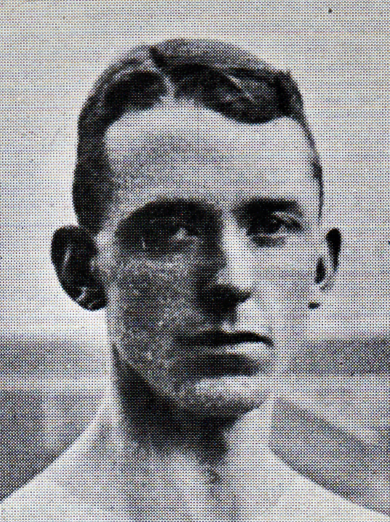
John McGough

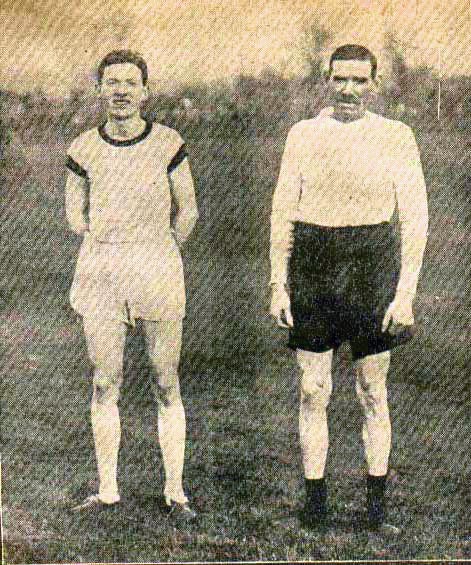
McGough headshot

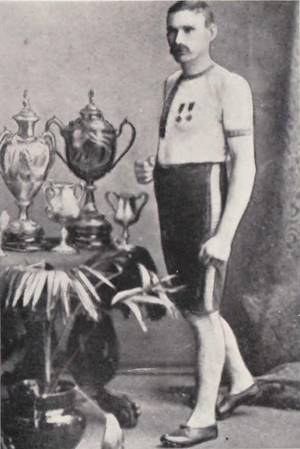
JOHN McGOUGH: The Flying Postman

The following detiled and well-researched piece about John McGough has been written by Alex Wilson who has provided all the photographgs, except for the 1907 AAA’s championship and the Olympic trial which appear courtesy of Kevin Kelly.

It’s almost an understatement to say that Celtic athletes were prominent in international track and field athletics in the late 19th and early 20th century. The names of Tom Conneff, Walter Newburn, John Flanagan, Paddy Ryan, Denis Horgan, Tom Kiely, Peter O’Connor, Tim Ahearne and the brothers Con and Pat Leahy are among the early Irish T&F greats who created world records and won Olympic medals across a range of events. Many more among the Irish diaspora competed with distinction under the flags of Great Britain, USA, Canada and South Africa. The Scoto-Irish middle distance runner John McGough is a classic example, a son of Erin fostered by the Scottish harrier system.

John McGough saw the light of day on January 20 1881 in the hamlet of Annagleve, a farming community located about two miles SSW of Castleblayney in County Monaghan. He was the eldest child of Thomas and Bridget McGough, who, to escape poverty, emigrated to Scotland and settled in Glasgow when McGough was an infant. McGough grew up in the Gorbals district, the heart of Glasgow’s Irish community, and later became the town postman. Little could Thomas and Bridget McGough have known that their boy would blossom into a wonderful athlete whom John W. Keddie described in “Scottish Athletics” as the “dominating force in Scottish middle distance running in the first decade of the new century”.

In a “Scots Athlete” piece entitled “A potted history of Bellahouston Harriers” by W.R. McNeillie it is gleaned that the club “was formed in 1892 in and around Govan, having as their earlier headquarters, Govan Baths, the nucleus of the club being postmen to whom it must have been just a quick step from walking to running.” As a postman, McGough had an important duty to discharge, letters being the principal means of long distance communication in the early 1900’s, as ordinary families couldn’t afford telephones. People expecting news would wait for the postman, who was easily recognisable by his navy blue uniform and peaked hat. A town postman had a lot of walking to do, covering at least ten miles a day and sometimes even double that, carrying a heavy mailbag slung over his shoulder or pushing a cart laden with parcels. The volume of mail in those days was such that a postman did several rounds a day, serving each household only once, and worked six days a week. “There is nothing like delivering letters on a long round for developing the leg muscles and producing real champions,“ said a Post Office official. “People sometimes claim that postmen are slow, but our list of record holders shows that in reality they are about the the speediest class of worker in the country. Postmen often claim that they walk thousands and thousands of miles in the course of their duties, and our list proves that they have speed as well as stamina. Healthy recreation was always encouraged in the Civil Service.” The list of famous G.P.O. athletes is a long one and, apart from John McGough, includes such names George Dunning, London G.P.O., the national cross country champion of 1881 and 1882 and long-time holder of the world 25 mile record; Bobby Bridge, the Chorley postman who broke every walking world record from eleven to sixteen miles in 1914; and Alf Shrubb, who was the postman at Horsham from 1901 to 1904 and broke every world record from 2000 yards to the hour.

In the early years the Bellahouston Harriers were solely a cross country club. Training was done work permitting and typically limited to a couple of runs a week through the Pollok estate from the Govan Baths in Summerton Road. The harriers did not hold their first summer championship until 1900, when the winner, according to McNeillie, was one J. McGough. A novice at the time, McGough won his first open race in July of the following year at the Clydesdale Harriers sports at the Exhibition Exhibition Sports Grounds in Gilmorehill. The Glasgow Herald reported that “a comparatively unknown man in J. McGough, Bellahouston Harriers, 40 yards, won the half mile”. The race brought out a big field and in the final heat McGough won by six yards from A. Grant, Edinburgh University, in 2:00.2. The following month, he was once again in the frame at the Celtic FC sports, where he finished second in the mile handicap off 60 yards. That season he won seven prizes, chiefly firsts. It was already clear that Bellahouston Harriers had an emerging star in their ranks.

1902 SEASON

McGough came out late in the season and was immediately successful, winning a two mile team race at the West of Scotland Harriers’ sports at Ibrox Park on 14th June in 9:54.6. A week later he caused a sensation by lifting both the one and four mile titles at the S.A.A.A. championships at Hampden Park on June 21st. The report in The Scotsman: “One mile – 1, J. McGough, Bellahouston Harriers; 2, W.H. Mill, West of Scotland Harriers. Three ran and W.R. McCreath made all the running. At the bell, however, McGough went to the front, and running away from his opponents, ultimately won by twenty yards. McCreath stopped 200 yards from the tape. Time, 4 mins 33 3-5 secs. Four miles – 1, J. McGough, Bellahouston Harriers; 2, A. Wright, Wellpark and Maryhill Harriers; 3, J. Ranken, Watson’s College A.C. Six turned out, and Ranken, McGough and Wright were left to finish. When the bell rang it was seen that the first-named had no chance of winning, and the other two went ahead together. A great race was ran between this pair. Wright, who was second to Mill last year, challenged the leader, but McGough stuck gamely to his advantage, and was a popular winner. Time, 20 mins. 51 3-5 secs.”

After claiming double gold in the Scottish championships McGough suddenly found himself running off scratch and heavily handicapped. That, however, did not deter him from winning the two miles flat handicap at the Clydesdale Harriers sports at Hampden Park on Thursday 26th June in 9:43.4, a time just two seconds shy of the Scottish native record.

As Scottish champion he was automatically selected by the S.A.A.A. General Committee to represent Scotland in both the mile and four miles in the annual international contest between Scotland and Ireland at Ballsbridge, Dublin, on July 19th. The contest, then in its eighth year, was the world’s first regular series of international matches and, at the time, the season highlight for both Irish and Scottish athletes alike. Scotland, the holders, were without several of their stars, notably Jack Paterson and Duncan Mill, winners respectively of the one mile and four miles in 1901, and found themselves on the receiving end of a 9-2 drubbing by the Irish. The running of McGough, beaten into second in both the mile and four miles by J.J. Daly, was symptomatic of the Scots’ overall showing. The Edinburgh Evening News: “Both these events were regarded as certainties for our youthful champion, J. McGough, and the defeat carried consternation into the Scottish camp. Daly’s sprinting of the last lap of the shorter distance took McGough completely by surprise. When Daly darted ahead at the bell, and prematurely took McGough’s ground, the latter made no effort to hold him, under the impression that the big Irishman would come back to him, but amidst wild “hurrors” from the spectators, Daly ran in a strong winner by twenty-five yards in 4 min. 27 4-5 sec., a time which nobody deemed him capable of. He is one of the ugliest runners we ever saw, lurching along with giant strides, but “handsome is as handsome does” all the world over, and Daly must rank as one of the best milers Ireland has yet produced. In the four miles McGough was looked upon as likely to turn the tables, and excitement rose to a high pitch when the pair alone remained on the track with half a mile to go. In the back straight of the second last lap McGough on the inside made an attempt to draw away, whereupon Daly swooped down upon him, and fouled him so badly as to cause him to reel. Before McGough recovered Daly was 20 yards in front, but with a great effort McGough began to close up the gap 300 yards from home. At the foot of the straight Daly was palpably in extremis, but try as McGough liked he was still three yards to the bad when the Irishman broke the worsted in 20 min. 42 3-5 secs. McGough was distinctly unlucky to lose, and on a cinder track we are confident that he would beat the Irish champion. The last mile was run in 5 min. 0 2-5 secs., and the intermediate mile times were: one mile, 5 min. 3 1-5 secs., two 10 min. 24 2-5 secs., three 15 min. 42 1-5 secs.”

A fortnight later, in a meeting at Barrhead, one of many that had to be postponed that summer due to the Coronation of King Edward, McGough delivered one of the best performances of the day in the half mile handicap off 8 yards. “He ran as he always does, with rare judgement, and it goes without saying that his triumph was well received,“ the report read.

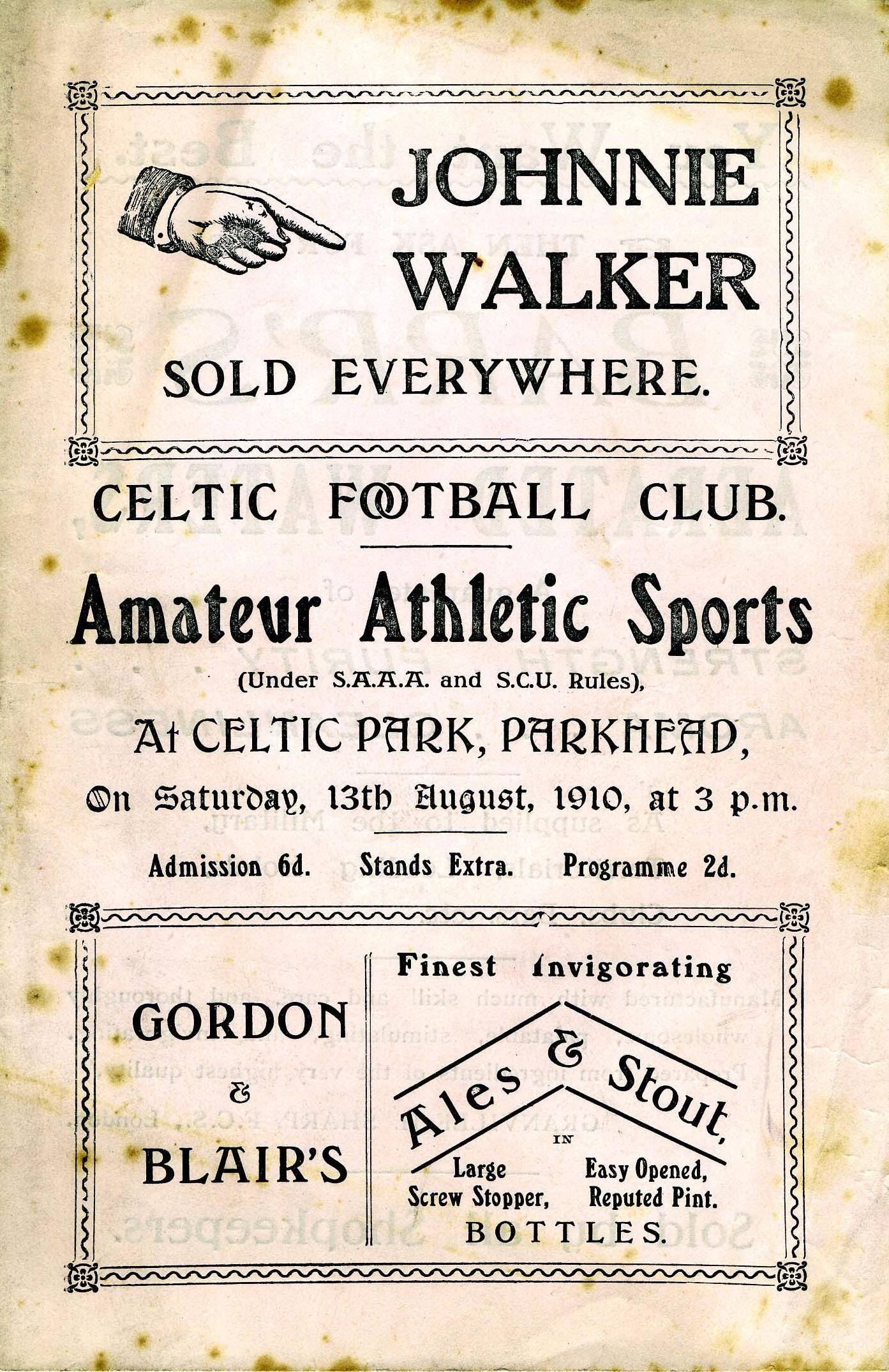
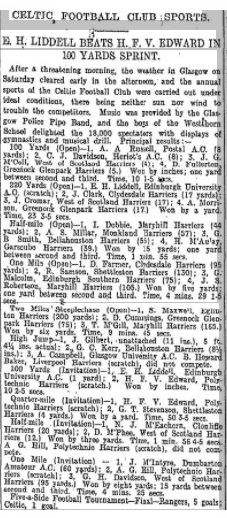
At the Celtic FC sports the following Saturday he produced another excellent performance in the mile handicap in front of a bumper crowd of 25,000 spectators. The race fell to A. Duncan, of the Olympic Harriers, 120 yards, in 4:21. McGough just failed to get up to win the race, but managed to get the better of his Irish rival Daly, both men running from 40 yards, the one getting second and the other third.

Thus concluded a season in which McGough had gone from being a relative unknown to the new face of Scottish athletics. In all, he added 19 prizes to his trophy cabinet. More importantly, from a broader perspective, he was the only Scottish middle distance runner then who was capable of filling the big boots left by Jack Paterson and Duncan Mill. Even though still in the early stages of his athletic career, he was, it seemed, carrying not only the mail but also the hopes of a nation on his shoulders.
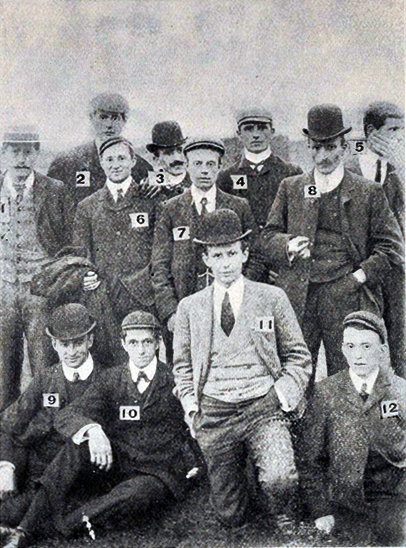
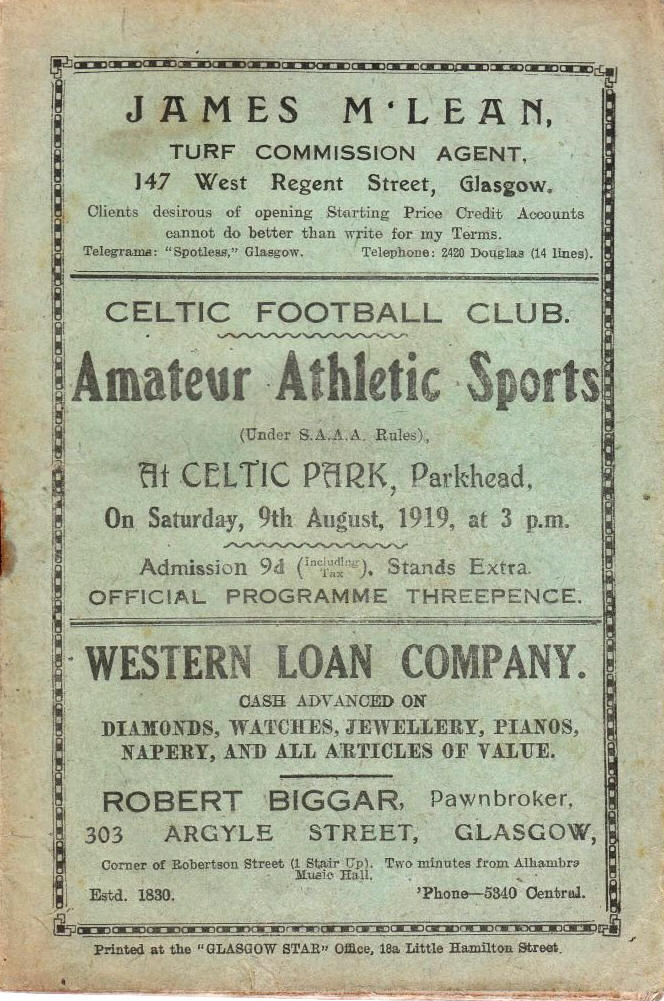
Celtic Sports, 1902

Celtic FC Sports, 1902: Daly 5, Joe Binks 7, Rimmer 9, McGough 12

1903 SEASON

A winter of stamina-building pack runs and inter-club runs saw McGough emerge from the winter of 1902/3 an improved athlete. He kicked off his track season at Parkhead on May 11th at the annual sports of the North Cycling and Motoring Club, where he won the half mile handicap off 8 yards. “In the half mile flat handicap,” reported the Glasgow Herald, “J. McGough, Bellahouston Harriers, ran splendidly getting through about 40 runners, and winning easily. Time: 2 min. 2 3-5 sec.“

A few days later he was matched against fellow Scoto-Irishman Pat McCafferty over four miles in the West of Scotland Harriers sports held at Ibrox Park on Thursday 14 May. It wasn’t much of a contest, though, because McCafferty retired at two miles and McGough finished alone. His time of 20:21.8 was another personal best and brought him to within 11 seconds of the Scottish native record.

Four days after that, McGough tested himself against English cracks Sid Robinson, Northampton, and Jack Rimmer, Southport, in a two miles handicap at the Glasgow Merchants Cycling Club sports at Parkhead. In view of his good early season form, it’s maybe a little surprising that he was given an 80 yard start on his English rivals, who were the backmarkers. Not surprisingly, neither Robinson nor Rimmer figured prominently, while McGough cut through the field like a hot knife through butter and came home the winner by 15 yards in 9:26.4. As was a common practice in those days, it had been arranged that the Bellahouston Harrier would run on for another 80 yards to complete the full distance. His time of 9:37.0 was a new Scottish native record, four seconds inside the old figures that had been held by Andrew Hannah, Clydesdale Harriers, since 1894. “Record breaking,” wrote a Herald columnist, was an “infallible test of athletic excellence”

His appetite for record-breaking whetted after making his first incursion into the record books, McGough then set his sights on the three miles native record – 14:57.2 by William Robertson, of Clydesdale Harriers – in a handicap race at the Edinburgh Harriers sports at Powderhall Grounds on June 6th. The report read: “This was one of the tit bits which the promoters of the sports had arranged. Additional interest was added to it by the appearance of Daly and McGough at scratch. The entries numbered twenty-seven, and twenty-one competed. The absence of P.J. McCafferty, W.S.H. (125 yards) and W. Robertson, C.H. (140 yards) was regrettable, as between them and the scratch men a good race was expected. For some time neither of the scratch men made much ground, but as some of the competitors with the large starts dropped off and the field was thinned, they began to draw in the remaining men. With five laps to go, after having covered seven, Daly dropped off, but McGough held on his course. It was unfortunate that he got no assistance in the way of pacing. Many of the runners dropped off, leaving him to cover the large gap between him and those with the big starts. If he had had a strong runner in front of him he certainly would have made a great show, as he finished only 4-5th secs. outside record time. The winner finished apparently fresh after a sprint for the tape. McGough on coming into the straight was loudly cheered for his sprint home. His time was 14 mins. 58 secs.” Clearly the record was at McGough’s mercy, given good conditions and a good race.

Next on the agenda was the S.A.A.A. championships at Ibrox Park on June 20th, when the main feature was McGough’s bold attempt to pull off an unprecedented triple in the half mile, mile and four miles. The Edinburgh Evening News takes up the story: “Hugh Welsh was the first man to win both the half mile and the mile, a feat he accomplished in 1896, ’97 and ’99. His ambition, unfortunately, did not turn in the direction of triple honours. J. Paterson, who began as the four miles champion, and worked down to the lesser distances, in 1900 won the half mile and mile, and he might have forestalled McGough had he possessed the stamina of the Bellahouston man. Paterson was actually three distance champion in 1900, he having won the ten miles championship in April, but it has been reserved for McGough to be the first to win three distance races in one day. He was fortunate in respect that he had his easiest undertaking first; had Cowe met him at four miles after a gruelling mile, the chances are that the Berwick man would have been champion instead of runner-up. But McGough well deserved his laurels. He beat a prettier runner in Roxburgh over half a mile in the capital time of 2 min. 1 3-5 sec., in the mile he pulled out Ranken and made the Watsonian do the best time of his career – as a matter of fact, Ranken’s 4 min. 30 1-5 sec. has only two or three times been beaten in the championship – and in the last race of the day he wore down a strong and plucky runner in J.B. Cowe, winning in 20 min. 30 1-5 sec., the fastest time on record in an S.A.A.A. championship, and not 20 sec. outside Duffus’ Scottish “native” record time for the distance in the S.A.A.U. championships of 1896. The times alone stamp McGough as one of the greatest runners we have ever had in Scotland. He was in distress in one portion of of his race with Cowe, who has a lot to learn in the matter of tactics, but in each case his strong sprint pulled him through, and his capabilities were not bottomed at any distance on Saturday.”

The feat of winning all the distance events at a single one-day championship is one of such singular difficulty, it has never been repeated since. McGough being postman, it was of course a red letter day in the annals of S.A.A.A. history. Here is the account of all three races as published in The Scotsman:

Half mile: 1, John McGough (Bellahouston Harriers); 2, William Roxburgh (Hamilton Harriers). The winner went to the front from the crack of the pistol and was never overtaken. Roxburgh made his effort coming round the last bend, by which time Smith had dropped well out of the race, but McGough shook off the challenger, and, finishing strongly, won by about eight yards. Time 2 mins. 1 3-5 secs. One Mile: 1, John McGough (Bellahouston Harriers); 2, John Ranken (Watson’s College A.C. and Edinburgh Harriers). McGough won the second championship in easy fashion by about a dozen yards in the good time of 4 mins. 27 3-5 secs. The lap times were 66 1-5 secs., 2 mins. 15 ½ secs., 3 mins 24 1-5 secs. Four Miles: 1, John McGough (Bellahouston Harriers); 2, James B. Cowe (Berwick Harriers). J. Ranken dropped out with a mile gone in 4 mins 55 4-5 secs., and Robertson retired at two miles, which took 10 mins. 5 3-5 secs. McGough was leading when three miles had been covered in 15 mins. 23 secs. With two and a half laps to go, Cowe went away with a spurt, and it looked for a minute or two as if the champion was going to give in, but he soon pulled up and took the lead again. With the ringing of the bell McGough forced the pace, and it was at once seen that Cowe could not finish like a champion, and continuing to go strongly round the last lap, amid enthusiastic cheering, McGough won his third championship of the day by about twenty yards. Time 20 mins 30 15 secs.

The S.A.A.A. entered McGough for the A.A.A. championships at Northampton on Saturday 4th July. In his first event, the half mile, he made the mistake of trying to win from gun to tape, for despite his best efforts, he was unable to get away from experienced campaigners Bert Blunden and Albert Barker, and ultimately ran himself to a standstill, giving up 200 yards from the finish. He was also entered for the mile, which the peerless Alf Shrubb won easily in 4:24.0, but heeded the advice of his friends to “stand down”.

He was selected for both the half mile and the mile in the Scoto-Irish contest at Powderhall on July 18th. The half mile was one of the doubtful events, for he was up against Irish speed merchant James Finnegan, winner of the half mile in the previous two encounters. However, McGough left very little hope for the Irishman by going away at a cracking pace and, leading from start to finish, won by ten yards in 2:03.4, a good time considering the sodden track and bleak and miserable weather. The mile was a more tactical affair, in which McGough avenged his previous year’s defeat at the hands of J.J. Daly, powering through a 61 sec. last quarter to win by 12 yards from the burly Irishman. Overall, though, Scotland lacked the strength in depth, and again Irish eyes were smiling when they retained the team contest.

On Wednesday 22nd July McGough made another appearance in Edinburgh, in the Leith Shamrock Cycling Club sports at the Hawkhill Ground. Alongside the American sprint ace, Arthur Duffey, he was the main attraction of the evening. Running from scratch in the mile handicap, he threaded his way through a big field, and was cheered home the winner by eight yards in a new personal best of 4:26.6.

In Rangers F.C. sports at Ibrox Park on Saturday 1st August he ran in the mile handicap. A big crowd of 12,000 spectators cheered as worked his way up through the field and got up to second, six yards short of catching W. Watson, Edinburgh Southern (80 y), in 4:28.4. When the meeting continued on a wet and cold Monday evening the Scottish champion started from the scratch mark in the two miles handicap, and, taking the lead after 1 ¼ miles, breasted the tape in a new Scottish native record of 9:36.4, three-fifths of a second inside his own figures.

He concluded his track season a week later at the Celtic F.C. sports, but did not have the freshness in his legs needed to make up some big starts in a field of 53 runners and retired before the finish. “McGough,” wrote the Glasgow Herald, ”made a plucky effort to get through the labyrinth of competitors, but did not succeed, and he, along with J. Daly, the Irish crack, gave up on entering the finishing straight.“ Handicaps with large fields, were great crowd entertainment, but had their obvious drawbacks for the backmarkers, who were additionally handicapped by the sheer weight of numbers, being forced to constantly dodge and weave through slower runners and run wide on the bends and in the straights.

Thus ended a memorable season during which he had amassed 24 prizes and created S.A.A.A. championship history by winning all three distance titles in one day, not to mention scoring a “double” in the Scoto-Irish contest and setting a couple of native records.

1904 SEASON

McGough was no cross country runner and derived little pleasure from heavy going or ploughed fields. Bearing this in mind, he showed loyalty beyond the call of duty by turning out for his club in the 1904 Scottish Cross Country Championships at the Agricultural Grounds, Scotstoun. After leading in the early stages, said the report, he slipped down the field upon entering the open country and, though we don’t know his finishing position, he presumably finished well down the order. However, the work he put in during the winter showed when he opened his track 1904 campaign with a bang in the West of Scotland Harriers sports at Ibrox Park on Saturday 21st May. The meeting was actually a team competition for the Connell Cup, and four teams took part, including the ultimate winners, South London Harriers. One of the highlights of the meeting was the appearance in the one and three miles of English champion Alfred Shrubb, who had only just recently smashed the world five mile record. The neatly moustached Englishman had swept all before him since 1902, but had yet to make acquaintance with the Glasgow postman, who, after finishing runner-up to E.H. Montague (SLH) in the half mile, faced Shrubb in the mile. “The mile was a specially interesting race, in which the respective champions of Scotland and England fought out the issue. Going off at a fast pace – the first quarter was covered in 58 sec. – Shrubb speedily scattered the field, and at mid distance only the Scotch champion remained seriously to consider. Drawing slowly on the South Londoner, the Scot closed up the gap, and the pair ran stride for stride till 300 yards from home. Then a ding-dong finish was witnessed, lasting round the final bend and into the straight, where McGough gained an advantage, which attended him to the tape. Shrubb tens yards from the tape easing up, seeing pursuit hopeless. Shrubb was beaten by two yards in 4 min. 26 sec., and the merit of McGough’s win all the greater because prior to the mile McGough had run a close second in a scratch half mile to E.H. Montague, a club-mate of Shrubb’s.” McGough’s victory over the indomitable Shrubb was, of course, something of a novelty and, wrote The Scotsman, caused “a scene of excitement which is seldom witnessed at an athletic meeting in Glasgow.” The Glasgow Herald: “Some have it that the Scottish champion does not always show sound judgement, but, be that as it may, he gave a flawless display on Saturday.”

When the meeting continued on the Monday, McGough turned out in the three mile handicap against Shrubb, amongst others, and served up the highlight of the evening by knocking more than 13 seconds off the Scottish native record. In spite of running such an impressive time, bad handicapping saw him finish unplaced, the winner being J.R. Moffatt, of Larkhall Harriers, who with the benefit of a liberal 450 yards start broke the tape in the then fanciful time of 14:12.4. The Scotsman reported: “A. Shrubb, English champion, was at scratch, and the handicap was framed with a view to record-breaking. The Englishman, however, gained nothing on McGough after the first half mile, and retired after running two miles. McGough, who ran in rare style, maintained a steady pace throughout, and although only fourth in the handicap, completed the full distance in 14 mins. 44 3-5 secs.” Shrubb, who had also run the three miles at the Saturday meeting in 14:59.4, was clearly not at his best and stale from his heavy racing schedule, but this does not in any way diminish the quality of McGough’s performance, particularly when it is considered that the three miles was a distance he rarely attempted.

McGough was among the entries for the 1000 yards handicap at the Clydesdale Harriers sports on Saturday 28 May, but was called upon to give 57 yards to S. Carson, and this task was five yards too much for him. He ran fairly well, but could do no better than 2:21.4. The following week, at the annual athletic gathering of the Edinburgh Harriers at Powderhall Grounds, he was in better fettle, breaking the two minute barrier in the half mile for the first time with a time of 1:59.6. Being rather heavily handicapped, however, he was unable to get among the first three, William D. Anderson, of Olympic Harriers, winning off 20 yards in 1:58.0. Later in the same afternoon, he turned out in the two mile handicap where, despite a sterling 9:41.4 performance, he was unable to get anywhere near the leaders, Sam Stevenson, Clydesdale Harriers, taking advantage of a 180 yard allowance to win comfortably in 9:22.0.

On June 11th he again confronted Alf Shrubb in a mile handicap at the West of Scotland Harriers meeting at Ibrox Park, where earlier in the afternoon the Londoner had electrified the crowd by smashing the world two mile record to win in 9:09.6. In spite of his exertions, the Englishman conceded McGough 15 yards in the mile. It proved to be a great race, McGough and Shrubb running neck and neck on the last lap. Then the Englishman edged ahead in the home straight and won by a yard amid tumultuous scenes with the clock stopping at 4:23.8.

McGough was conspicuous by his absence when the meeting resumed on the Monday evening, when, once again, the undisputed star of the show was Alf Shrubb, who served up a world four mile record of 19:23.4. In spite of the record-breaking exploits of Alf Shrubb and his face-off with John McGough at the Saturday function, the overall attendance at both meetings was disappointing (a mere 6,000).

A fortnight later McGough had no difficulty in retaining his half mile and mile titles in the S.A.A.A. championships at Powderhall Ground, the former by a couple of yards from William Anderson in 2:01.8 and the latter by 30 yards from Sam Kennedy, Garscube Harriers, in 4:36.4. By winning the mile for the third time McGough made the 25 guinea silver challenge cup his to keep. To be allowed to keep an S.A.A.A. challenge cup in any event, you had to win the title either three times in succession or four times in total.

On July 2nd McGough renewed his rivalry with Alf Shrubb in the mile flat race at the A.A.A. championships at Rochdale. Shrubb, as expected, took the lead early on and, setting a fast pace considering the stormy weather, held it until 300 yard from home, when Joe Binks, the British record holder, went ahead. Shrubb, however, came again, and won a desperately close race by a yard, just managing to hold off McGough, whose late charge carried him past Binks and into the silver medal position. McGough’s time of 4:22.2 was faster than he had ever previously run in public and some consolation for narrowly failing to win this, the blue ribband event. Among Scots (amateurs), only Hugh Welsh had run faster. In 1906 Shrubb would describe this race as the hardest battle he had ever had.

Fresh from his medal-winning run in the A.A.A. championships, McGough took full advantage of favourable weather and track conditions at the Behahouston Harriers sports at Ibrox Park on Saturday 9 July to erase not one, but two, Scottish native bests from the record books. Running from scratch, he finished fourth in the 1000 yards handicap, recording a personal best of in 2:18.8 – a 1.2 sec. improvement on the previous figures for the distance which had stood to the credit of James Rodger, of Maybole, since 1895. Later in the afternoon he turned out in the two miles handicap, and, taking the lead with a lap to go, stretched away to win comfortably in a time of 9:36.0, four tenths of a second inside his own figures. The setting of two native records in two separate distance races in the space of a single afternoon was a Shrubb-esque feat and, accordingly, the Glasgow Herald’s editorial reads like a laudatio: “It is not too much to say that John McGough has made the Bellahouston Harriers. For years he has taken a great pride in the club, and in turn the members have taken a great pride in him. By his brilliant achievements he has given Bellahouston Harriers a name which is now a household word in athletic circles everywhere, and that name he enhanced on Saturday , on the occasion of their first open sports, by creating two fresh records in the 1000 yards and the two miles, taking 1 1-5 off the former and 2-5 sec. off the latter. He was the winner of the longer distance, but in the 1000 yards he was unplaced , which is to be regretted, as his running was worthy of being crowned with first honours. McGough is an extraordinarily fine runner ; as a matter of fact, he comes next to Hugh Welsh, of the Watsonians, whose running must still be fresh in the minds of many.”

The record-breaking double at Ibrox obviously augured well for the annual Scoto-Irish contest, held a week later at Ulster Cricket Club, Belfast, where, as Scottish champion, McGough was nominated for the half mile and the mile. The weather was fine and there was a large attendance, but the playing field was anything but level, literally, and so not conducive to fast running. In the half mile McGough looked to have the trace sewn up, but was denied when Ireland’s James McKenzie came with a storming late run to win by four yards in 2:03.6. However, he made amends in the mile, which he won easily from Ireland’s Michael Hynan in 4:27.6. Once again, though, Scotland lost the contest with only four wins to Ireland’s seven.

After the international match McGough continued to show good form throughout the remainder of July and August, when the big sports meetings of Glasgow Rangers FC and Celtic FC traditionally rounded off the season, even if the handicappers were not on his side. In the Edinburgh Northern Harriers’ sports at Powderhall Ground on July 30th he was too heavily handicapped to have any hope of winning the half mile from scratch, and first prize went to John Clelland, of Edinburgh Harriers, 50 yards, in 1:57.0. Despite running two minutes dead, fifth place was the best he could do. His next engagement was in the Rangers sports on Saturday 6 August, when 12,000 spectators turned out in uninviting weather and were rewarded with some excellent T&F fare including a record hammer throw of 51.71 metres by Tom Nicholson and a popular evens win for James P. Stark, of the West of Scotland Harriers, in the 100 yards handicap off 2 ½ yards. McGough was running in the mile, the final event on the programme, and again conceded some formidable starts to his fellow competitors including 15 yards to Darlington’s George Butterfield, whom he had only just managed to beat in the A.A.A. mile. He got into frame by finishing third, but was unable to do anything about Butterfield, who gleefully sprinted to victory in 4:24.2, more than making up for his 15 yard start in the process. McGough returned to Ibrox on the Monday evening, when he again he faced Butterfield in the two miles handicap, both men running from scratch on this occasion, and the 6,000 spectators witnessed a terrific race. Butterfield ran magnificently, sprinting away from McGough a furlong from home to win by fully ten yards from A. Wright, of the Wellpark Harriers, in 9:28.4. There was a separate watch on McGough, who in finishing third was timed at 9:32.4, an improvement of 2.6 seconds on his own native record.

McGough ran his last race of the season five days later at the last important athletic meeting of the Scottish season, the annual sports of the Celtic Football Club at Parkhead. The sky was overcast, and during the progress of the sports there was occasional showers. Notwithstanding the weather there were 20,000 spectators present, which was the biggest attendance of all the fixtures held that season. In the one mile handicap, Wright of Wellpark Harriers took full advantage of a 55 yard allowance to win a close contest in 4:23.4. However, the interest in this race centred chiefly around the scratch men McGough and Butterfield. Towards the end of the race McGough left the Englishman several yards behind and it looked like he was going to avenge his earlier defeats. With an astonishing sprint, however, Butterfield overtook McGough ten yards from the line and finished a yard in front, both men clocking 4:25.

Thus ended another fine season in which there had been little to fault, save for a tactical error that cost him victory in the A.A.A. mile championship. Earlier in the season he had run his best race to date when he showed English distance-running maestro Alf Shrubb a clear pair of heels in the mile at the West of Scotland Harriers sports. He had defended his Scottish half mile and mile titles, and, by winning the latter for the third time in a row, had claimed the valuable silver challenge cup. He had also defended his mile crown in the Scoto-Irish contest. And, most importantly, he had shown continued improvement by setting a string of personal bests and Scottish native records over distances from 1000 yards to three miles. He had gained 26 prizes in all, this being made of 10 firsts, 12 seconds and 4 thirds. It was all good stuff, but the best was yet to come.

 1905 SEASON

McGough kicked off his 1905 campaign with a four miles match against Hugh Muldoon in a sports gathering at Belfast on May 20th, winning by 20 yards in 21:12.4. This he followed a fortnight later with a double start in the Edinburgh Harriers sports at Powderhall, where he took second in the 1000 yards handicap in 2:23.4 before carving up the field to win the two miles in 9:37.0. A 4:30.4 handicap mile victory at the Edinburgh Pharmacy AC sports on June 7th and a 9:43.0 win in the two miles team race at the West of Scotland Harriers meeting at Ibrox Park on June 10th set him up nicely for an attack on the Scottish 1000 yards record at Ibrox on the Monday evening. The weather was good, but a strong wind prevailed. He set off in good style and, running strongly, made up all the handicaps and broke the tape first in a time of 2:18.2, which bettered his own Scottish native record by six tenths of a second. McGough‘s “fine running was the feature of the meeting”, said the Herald.

The following weekend, he scored the easiest of wins in the one mile handicap at the Bellahouston Harriers sports at Ibrox Park in 4:24.2. This was a perfect tune-up for the twenty-third S.A.A.A. championships held at the same venue on June 24th in fine weather. The attendance at the national championships, however, was disappointing, and not more than 2000 people were present. But if the number of spectators was small, the sport was of the highest order. One native record was broken, this being in the half mile. It was also one of the best races of the day. In addition to McGough himself, it featured that peerless Army runner Wyndham Halswelle and William D. Anderson, now a fellow Bellahouston Harrier having switched his allegiances from Olympic Harriers. The pace was fast as W. Roxburgh (W.S.H.) led the field through the quarter in 58.8 sec., and the finish culmimated in a “magnificent struggle” with Anderson just getting home ahead of McGough in a new native record time of 1:58.8. By so doing Anderson was eligible for a second, special gold medal, in addition to the winner’s gold medal. McGough finished a mere yard adrift, recording a personal best of 1:59.0, and Wyndham Halswelle was two yards behind McGough with 1:59.4. It was the first time in championship history that the first three men had finished inside 2 mins. Sadly, the mile championship took place in the absence of Charles Henderson-Hamilton. The Edinburgh-born Oxford University student, who had won the mile in the varsity match on 31st March in a sensational 4:17.8, was unavailable as he was reading for his Army exams. John Ranken, Watson’s College AC, took on the pace-making duties and led until a furlong from home, when McGough accelerated away to win title No. 4 by fourteen yards in 4:24.2. In his wake, fast times were returned by A.M. Matthews, Edinburgh University AC, second in 4:27.4; and Ranken, third in 4:28.0.
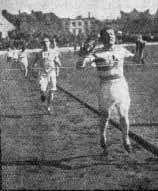
AAA 1905 1m George Butterfield

AAA 1905 1m George Butterfield

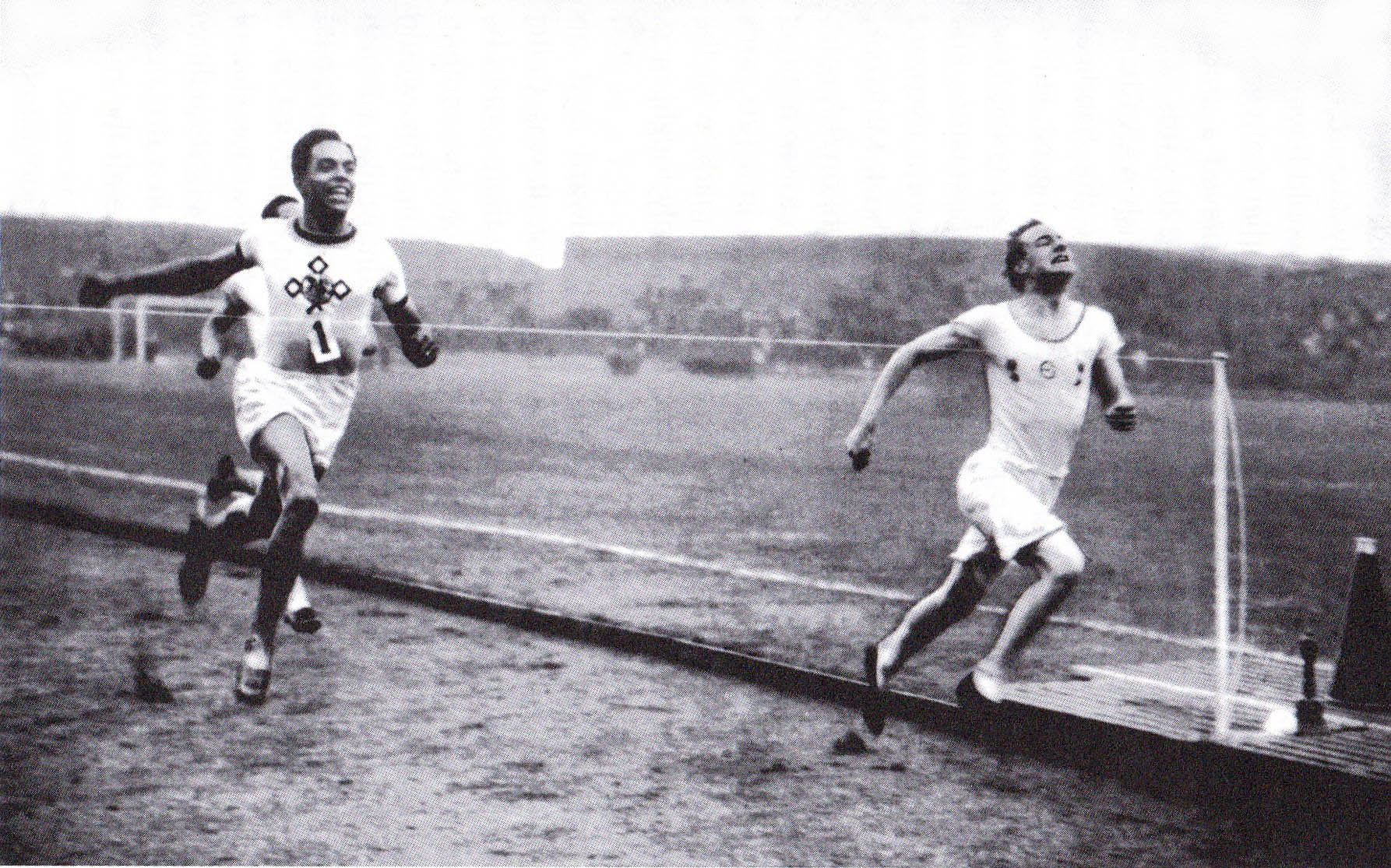
July was just around the corner again, and that traditionally began with the A.A.A. championships. On Friday week McGough travelled south to Stamford Bridge in hopes of making amends for his narrow defeat at the hands of Alf Shrubb in the mile a year earlier. He was still smarting over the tactical blunder that, he believed, had cost him the title. This year, at least, there was no Shrubb to contend with; he had pulled out of the mile rather than confront McGough and Butterfield. “It is no use killing myself,” was his eloquent argument. Nevertheless, a strong field of eleven runners lined up in sunny weather. First George Butterfield and then Joe Deakin, of Herne Hill Harriers, set the pace. James Roberts, of Sefton Harriers, went ahead in the third lap, and at the bell it was Roberts leading, followed by Butterfield and McGough. So it remained until halfway round the final bend, when Butterfield showed what a brilliant tactician he was by suddenly hustling past Roberts and streaking to victory by four yards in 4:25.2. McGough immediately gave chase, but he could not close the gap, and for the second year in a row he finished runner-up in the British championship.

A week later, McGough put in an appearance at the St. Bernard’s F.C. sports at the Gymnasium Grounds, Edinburgh, where he was the main attraction alongside Wyndam Halswelle, who stirred up the 2,000 strong crowd with a 32.6 sec. victory in the 300 yards handicap off 2 yards. McGough turned out in the mile, in which 26 ran, conceding starts up to 125 yards. He also gave spectators something to cheer about as he gradually reeled in all his opponents, producing a grandstand finish to get home first by a yard in 4:25.2. Earlier in the day, there had been skullduggery afoot in the heats of the 120 yards handicap, where one of the competitors, looking to set himself up for a big win in the final, was disqualified for running with lead weights sewn into the soles of his spikes.

After collecting his silverware, he hurried back to Glasgow to catch the mail steamer from Greenock to Belfast, where he competed next day in the one mile handicap and in the three miles championship of the Gaelic Athletic Association, the G.A.A. being the older of Ireland’s two rival governing bodies. In the latter event, he defeated Hugh Muldoon by 20 yards to win his first Irish title, albeit in a slow time of 16:18.8.

The Emerald Isle clearly had a special place in McGough’s heart as witnessed by his affiliation to the G.A.A., and the fact that he aspired to winning titles not only in Scotland and England, but now, also, in his country of birth. There was, however, never any question of him switching his allegiance to Ireland at this time, and he dutifully turned out in the colours of Scotland in its encounter against Ireland at Powderhall Grounds on July 15th.

The meeting took place in the presence of 5,000 spectators and ended in a very decisive victory for the Scots, by eight points to three. “A feature of the day’s sport,” wrote The Scotsman, “was the running of the new quarter mile champion, Lieutenant Halswell, and J. McGough, who won the quarter and the mile respectively very comfortably from their Irish opponents.” As to the actual race, “A.M. Matthews, Edinburgh University, paced the champion for the first two laps, with the Irishmen in very close company, and at the third round McGough assumed the lead. On the last lap, G.N. Morphy, Dublin, challenged McGough, and led him five yards at the bend. McGough, however, came up the straight in great style, and won by a yard and a half, J. Fairbairn-Crawford, M.C.C., and Matthews being half a dozen yards behind.” The weather was fair, but the presence of a fairly stiff breeze showed its effect on the time sheets, which credited McGough with 4:30.2.

A fortnight later McGough was once again headed south where he would be representing his employer in the inaugural British Postal Service championships. The event was promoted by the St. Martin’s (G.P.O.) Harriers and held at Putney Velodrome and attended by athletes from postal services throughout the United Kingdom. McGough was the class act in an otherwise modestly contested meeting where the showcase event was the mile championship for a gold medal and the Dewar Challenge Shield presented by Sir Thomas Robert Dewar, M.P., the name behind the world-famous Scottish whisky and a leading sporting patron. After comfortably winning this in 4:36.6, McGough ran the last leg for his team (Glasgow P.O.) in the inter-office relay race and left his opponents standing, winning by 80 yards.

“Alfred Shrubb doubly defeated”     “run off his legs”

Racing in London on the Saturday might not have been the ideal preparation for his next engagement, the West of Scotland Harriers’ sports at Ibrox Park on Monday 31st July, but McGough possessed surprising recuperative powers. The preview in that day’s edition of the Glasgow Herald read: “J. McGough may not be at his best, as he has travelled from London overnight, but he is a runner of great resource, and rarely fails to give a good account of himself on the Rangers ground.” This assessment was to prove dead on. The principal event of the evening was a three-way mile and a half scratch race between Alf Shrubb, the English ex-champion in the mile, George Butterfield, the present mile champion of England, and McGough, the Scottish mile champion. F.J. Spencer, South London Harriers, also took part, presumably as a pacemaker, and led for the first quarter of a mile, which he covered in 59 sec. He then retired leaving Shrubb first, Butterfield second, and McGough third. In this order they passed the half mile post (2:09.0), three-quarters of a mile (3:22.6), mile (4:37.0) and mile and a quarter (5:49.6). Then the real racing began. “When the bell rang for the last lap”, reported the Herald, “half a yard covered the three competitors. Three hundred yards from home McGough got up on Shrubb, and then Butterfield came away. A hundred yards from the post the three men were abreast of each other. Butterfield was the first to show in front, but McGough made a splendid effort, and a magnificent race took place between the two men, the Scottish champion winning by inches, with Shrubb fully two yards behind. McGough had a flattering reception on retiring to the pavilion. Time: 6 min. 52 3-5 sec.” It was a brilliant piece of tactical running against two of the world’s pre-eminent runners, and possibly his single best race to date. The Herald: “McGough…came out as a tactician in this race, which is rather a new role for him.” Another paper described the race as “one of the finest seen in Scotland for some time”. The time constituted a Scottish amateur record, but it was inferior to the best mark on record by a Scot. That stood to the credit of professional Bob McKinstray, Maybole, who set a then world record of 6:50.0 at Manchester on February 23, 1867.

McGough was back at Ibrox Park on the Saturday for the Rangers F.C. sports, where he again clashed with George Butterfield in the invitation mile handicap. Once again, he got his nose in front of the Darlington man, winning by half a yard in 4:27.0, a good time on a heavy track and in windy conditions. The Herald: “McGough, for the second time in six days, got the better of Geo. Butterfield, who in the mile on Saturday, as in the mile and a half on Monday last lost first place by inches only. It was a strenuous effort on the part of both, and the one was as cordially applauded as the other on retiring to the dressing room.”

There was no time to recover, though, for the next day McGough continued his winning streak by claiming a second G.A.A. title over two miles at Dundalk, where he was credited with a dubious near-world-record time of 9:15.0.

Another three-way mile and a half race at the Celtic F.C. sports before 25,000 spectators on August 12th saw Butterfield back to his glorious best. The darling or Darlington won by three yards from Alf Shrubb, who in turn beat McGough by a yard. Given that a stiff breeze was blowing, the winning time of 6:55.4 represented exceptional running. The supplementary meeting of Celtic F.C. on the Monday was to be the scene of yet more record-breaking in a special four miles handicap featuring once again the talents of Shrubb and McGough. There were twelve entrants and Shrubb, scratch, was giving away 100 yards to McGough and 470 yards to the limit man. The Herald picks up the story from here: “The amateur athletic sports of the Celtic Football Club were continued last night at Parkhead in fine weather and before a large attendance, attracted by the entry of several English cracks. Principal interest centred in the four miles flat race handicap, in which Shrubb, Butterfield and McGough met. An exciting race was witnessed. The London runner was in grand form, and starting at once to draw in his men succeeded in passing McGough when two miles had been covered. Half a mile short of that distance Butterfield had retired, owing to the muscles of one of his legs stiffening. After he had taken the lead of the Bellahouston man Shrubb went straight ahead, and got into the first place at the end of two and three-quarter miles. He won in 19 minutes 34 seconds by fully 100 yards from McGough, who completing four miles put up a record for a Scottish runner of 20 min. 6 1-5 sec., the previous best being 20 min. 10 3-5 sec. “ The management of Celtic FC subsequently decided to present McGough with a special medal for breaking the Scottish four miles record.

A few races later he wrapped up his season at the Salford Harriers Autumn sports at Belle Vue on 9th September. His head-to-head against Butterfield in the half mile scratch race was one of the highlights of the meeting, a real crowd-pleaser. McGough had a slight advantage on Butterfield as they entered the home straight, but could not hold off his fast-finishing rival, who roared to a two yard victory in 2:00.2 , with McGough returning 2:00.5.

Overall, this had been the Bellahouston man’s best season yet, with only a few minor blemishes on an otherwise perfect record. He had appropriated the Scottish mile title for a fourth time in a row, but had been denied a second title in the fastest half mile championship in S.A.A.A. championship history. Later he had stamped his authority on the mile in the Scoto-Irish contest, winning for a third time in succession, and, for good measure, had also claimed the Postal Service mile championship and two Irish G.A.A. titles, not to mention finishing runner-up in the A.A.A. mile. He had erased three Scottish records from the history books that season, namely the 1000 yards, the mile-and-a-half and the four miles. He had captured 20 firsts, 5 seconds and 5 thirds, or 36 prizes in all, that season, bringing his grand total in four seasons to over 100 prizes. As to this, the Herald commented: “Other athletes may have won as many prizes; but few, if any, in Scotland, in recent years at least, have had their victories embroidered, so to speak, with record tinsel to the same extent as this crack Bellahouston Harrier. It is when one bears in mind that McGough has not the time to give to special preparation that his performances are all the more creditable, and the very natural assumption is that with sustained training on systematic and scientific principles he might easily succeed in placing some of the Scottish records in a more exalted position than they occupy now.“

1906 SEASON
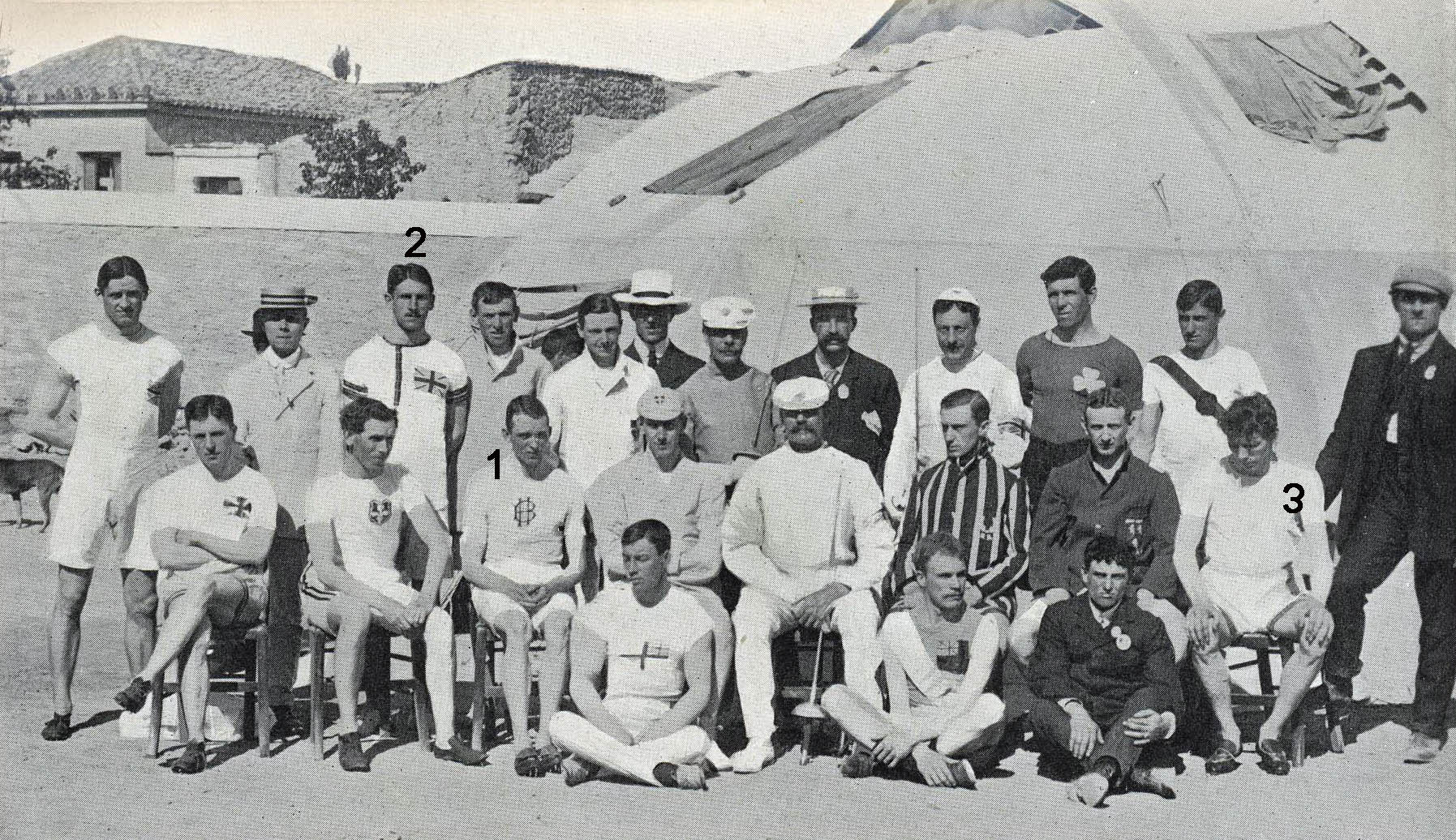
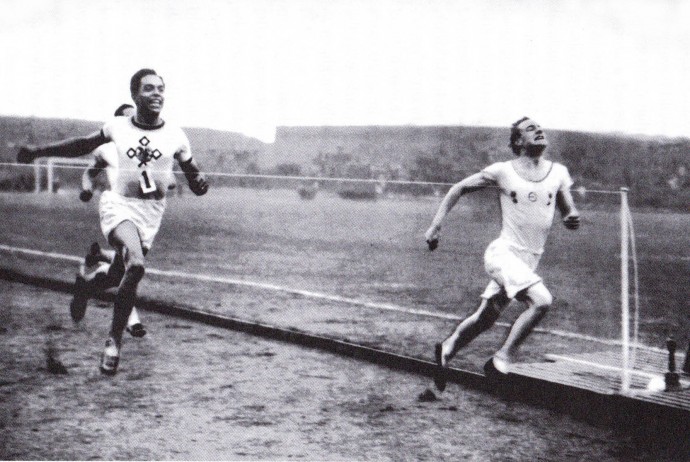
McGough 1906 Olympic team

1906 Olympic Team: McGough is Number 1, Halswell  is Number 2

Onward to ancient Olympia

The 1906 Intercalated Games, celebrated in Athens, Greece, were an aberration, the only Games in Olympic history to break the quadrennial sequence. There was no UK selection process per se. Eligible athletes were invited to notify the A.A.A. of their definite intention to compete on the understanding that they would do so at their own expense. Only a small number of entries were received from British athletes, owing to the prohibitive cost of travelling to Athens and back, and the sheer amount of time involved in making the trip. They included several Oxbridge students and Lieutenant Halswelle, the great Scots hope. With Ireland competing under the British flag, given that it did not have a national Olympic committee, the two feuding Irish amateur athletics federations, the Irish Amateur Athletic Association (I.A.A.A.) and the Gaelic Athletic Association (G.A.A.), raised subscriptions to send three of their athletes. The roster also included the Bellahouston pair of John McGough and William Davison Anderson, whose participation was, presumably, paid for by a subscription and/or by a grant from the special fund of £208 that the Greek government had given to the English A.A.A. Notable absentees included Alf Shrubb, who had turned professional after being suspended; and George Butterfield, a busy hotelier.

The five-day itinerary would see the British team journey by boat from Dover to Dieppe and by train across Europe via Paris, Turin, Brindisi and Bari, then by boat to Corfu and Patras, and finally on to Athens. The three-day rail journey was something of an odyssey as food was in short supply and rumbling stomachs were the order of the day. It was not until the athletes boarded the steamer in Bari that they had their first square meal since leaving Britain. On their arrival in Athens the visiting teams were billeted at the Zappeion, where catering was provided by the organisers, but the Americans, among others, were unhappy about the arrangements and the food, and moved out and checked into a hotel. McGough had four days to settle in and acclimatise to the hot conditions before taking part in the 800 metres. With only the first two to progress to the final, he was eliminated in the fourth heat, won by the American Paul Pilgrim, the eventual gold medallist in this event, in 2:06.6. The relatively modest times posted throughout the games were accounted for by the slow running track in the Panathenaic Stadium, an elongated horseshoe-shaped 400 metre circuit with long straights and bends so tight they were virtually turn-arounds. To make matters worse, the surface was of loose sand and ashes, which, without an underlying layer of clay, made the going soft and heavy. Later that afternoon McGough turned out for the final of the five miles, where he was one of twenty-five starters. A blistering pace was set from the gun as the runners from the various nations vied for pole position. England’s Henry Hawtrey, the favourite, took command in the second half of the race, and lived up to his billing by pulling clear of the field to win by 50 yards in 26:11.8 – a fast time given the circumstances. Ireland’s John Daly was third past the post, but was disqualified the next day for bizarrely obstructing the Swede Edward Dahl in the home straight by running zig-zag, owing, he claimed, to exhaustion. McGough finished, but was outside the first eight. His outings on 25th April, though fruitless, gave him the invaluable opportunity to tune up for his main event and get to grips with the peculiar track. The 1500 metres heats were decided on the afternoon of 27th April and preceded by a spot of tourism unthinkable in elite track and field athletics today. The British team had, namely, begun the day by visiting the Acropolis! That wasn’t a problem for McGough, of course, who was well used to putting in a full day’s work before donning his spikes. The trouble with the afternoon programme was that there was no timetable. In any case, protocol dictated that competition not commence until the arrival of the King and the royal family, who attended the games every day and even helped out with officiating field events. McGough and his fellow athletes had no option but to hang around waiting for their turn. The first of two heats fell to 1904 triple Olympic champion Jim Lightbody (USA) in 4:19.4, with Kristian Hellström (Sweden) second, James P. Sullivan (USA), third and Greg Wheatley (AUS) fourth. McGough won the second in 4:18.8, with Reginald Crabbe (GB) second, George Bonhag (USA) third and Harvey Cohn (USA) fourth. Both qualifying rounds were relatively close affairs, and there was not much to choose between the eight finalists. In the final two days later the pace was set by George Bonhag, with Greg Wheatley (AUS) second, Cohn third and Lightbody, the holder, fourth entering the last lap. McGough was sitting at the back of the pack, as he had done throughout the race together with Crabbe. Bonhag was moving along at a great lick and had the field strung out behind him in more or less single file, but had no response when Hellström made his bid for glory approaching the last bend. For a moment, the big Swede looked all over a winner, but Lightbody quickly covered the move and unleashed a devastating burst of speed which saw him open a gap on the field. McGough, who was badly placed when he hit the home straight, summoned a great finish which carried him past all of his rivals bar one to clinch the silver medal. There was, however, no denying the fair-haired University of Chicago student, who won with five yards to spare, arms raised aloft in celebration. The winning time was worth only about 4 min. 30 sec. for the mile, but on this track it was a brilliant piece of running. 

            Result: 1, James Lightbody (USA) 4:12.0; 2, James McGough (GBR) 4:12.8; 3, Kristian Hellström (SWE) 4:13.6 

McGough’s compatriots did well, too. William Anderson qualified for the 400 metres final after winning the repechage race in 53.0, the equal fastest time of the Games, but was out of sorts in the final two days later and wound up eighth and last. Wyndham Halswelle was decorated with silver in the 400 metres and bronze in the 800 metres, being the only British double medallist if you exclude Irish jumpers Con Leahy and Peter O’Connor, who were forced to compete under the British flag. Though eclipsed by Halswelle, McGough has the distinction of being the first Scottish athlete to win an Olympic medal. The first Scot to win an Olympic medal in any sport was, incidentally, golfer Walter Rutherford, who won silver at Paris in 1900.

When McGough arrived back to Scotland a few weeks later the national track season was just getting under way. Both McGough and Anderson, revealed the Glasgow Herald, spoke highly of the treatment they received while at Athens. A few days after his return McGough turned out in the National A.C. meeting at Parkhead and won the half mile handicap at a canter in 2:06.2. The Herald reported: “The feature of the meeting was the running of John McGough in the half mile handicap, which he won pretty much as he liked. The going was again heavy, otherwise he would have put in an even better performance. The trip to Athens has done McGough some good, and there are substantial grounds for assuming that his reputation will be vastly enhanced this season.”

The pick of McGough’s other early-season outings was a 600 yards flat race invitation handicap against rivals Halswelle and Anderson in the Clydesdale Harriers sports at Parkhead on May 26th. Halswelle had given starts of 15 yards to McGough and 10 yards to Anderson, and, despite being baulked twice, took the lead a furlong from home and won a brilliant race by 4 yards from McGough in a Scottish record time of 1:12.8 for this rarely-run event. After that McGough put in a series of fast races over his preferred distance, the mile. He started with a 4:27.6 at Powderhall Grounds on June 6th, and followed that up with a 4:24.8 at Parkhead on June 18th and a 4:25.0 at Powerhall Grounds on June 20th, still finding the time in between to take second in a mile and a half handicap at Ibrox Park on June 16th.

This of course augured well for the S.A.A.A. championships, decided at Powderhall Grounds in favourable weather before 6000 spectators on Saturday 23rd June. The half mile, in which McGough faced, among others, Wyndham Halswelle, the Olympic bronze medallist in this event, went pretty much by the form book. McGough led the field of four until entering the home straight, when the holder, Anderson, retired, leaving Halswelle and McGough to fight it out. Halfway up the straight the Lieutenant burst ahead and streaked to victory by seven yards in 2:00.4. McGough just held off club-mate, 21 year old Jimmy Vallance, a fellow postman, to take the silver medal in 2:01.5. An aspect of early S.A.A.A. championships was that medals were awarded to only the first two in each event, bronze medals being given to all those who, not taking the first or second place, reached the standard fixed by the General Committee. This was the case with Jimmy Vallance, whose 2:01.8 was comfortably inside the 2:03.0 standard. In the mile, A.M. Matthews, Edinburgh University AC, made the pace for three laps, then McGough drew level and kicked away to win easily by 12 yards in 4:32.6, thus extending his stranglehold on the event to five wins in a row. The most noteworthy feature of the meeting, though, was the running of Wyndham Halswelle, who amassed four titles, a feat unprecedented and unmatched in the annals of the Scottish championships. In addition to winning the afore-mentioned half mile, he was first in the 100 yards in 10.4, the 220 yards in 23.2 and the quarter mile in 51.4.

A fortnight later McGough lined up for AAA mile championship at Stamford Bridge, alongside a strong field including George Butterfield and Olympic five miles champion Henry Hawtrey. A sixty-second opening quarter quickly saw the field strung out, Hawtrey among others finding the pace too hot, but some half a dozen men were still together when the bell rang, with McGough sitting at the back of the pack. F.A. Knott , of South London Harriers, led until a furlong from home when Butterfield surged into an eight yard lead. A few seconds later McGough came out of the ruck in hot pursuit, but though he managed to make up a little ground, it was a case of “too little, too late”. A sub sixty second last lap saw Butterfield streak home the winner by four yards in a superb 4:18.4. McGough recorded a personal best of 4:19.2 in finishing second, eight yards ahead John Lee, of Heaton Harriers. The race was one of the fastest in A.A.A. championships history, the winning time not far outside the British record of 4:16.8 set by Joe Binks in 1902. Alongside Halswelle’s emphatic 48.8 sec. win in the quarter mile it was the outstanding performance of the championships. McGough would have taken some consolation in becoming only the third Scottish amateur after Hugh Welsh and Charles Henderson-Hamilton to break 4 mins. 20 secs., but the overriding feeling would probably have been one of frustration over finishing a close runner-up for the third time in a row. “From a Scottish point of view the most disappointing result was the mile, in which John McGough for the third time had to be content with second place – twice to George Butterfield and once to A. Shrubb. While the race, from the time aspect, was the best the Bellahouston Harrier had yet accomplished, it was, in tactics, absolutely the poorest in which he had performed for some time. For some inexplicable reason he lagged far behind till the last lap, or thereabout, and when he did make his effort it was too late. Still, he was finishing faster than Butterfield, and with another twenty yards he would have won. If only the feet had Butterfield’s head, he would be invincible over the mile. “ If any criticism could be levelled at McGough, then it was his poor tactical judgement, sentiments echoed by John Keddie in “Scottish Athletics”: “He had a habit of hanging back in a race, which presented few problems in domestic competitions, but often meant in International events that he gave himself too much to do in the closing stages”. In fact, he was about to make his worst-ever tactical mistake.

The 1906 Scoto-Irish International, the twelfth meeting between the two countries, was held the following weekend at the Ulster Cricket Club, Belfast, in an atmosphere of acrimony between the G.A.A. and the I.A.A.A., whose long-standing working relationship had broken down earlier in the year. McGough had competed at a Celtic FC meeting in Belfast under G.A.A. rules two days earlier, winning the two miles and finishing third in the one mile handicap, off 15 yards, in an excellent time of 4:20.0 worth about 4:23 for the full mile. Little did he know that his actions would have consequences, but more on that later. In the international match on July 14th he was teamed with A.M. Matthews in the mile, and the Scottish pair made the pace closely tracked by the Irish runners Ivo Fairbairn-Crawford and George Morphy. This is how it remained until the last lap, when McGough slipped away and looked to have the race sewn up before inexplicably snatching defeat from the jaws of victory. With a terrific sprint, Morphy caught McGough napping just before the finish line and beat him by a foot in 4:33.2. The Glasgow Herald made no bones about it, his defeat was down to bad tactics: “The surprise in Belfast was the defeat of John McGough in the mile. Over-confidence no doubt was to blame, for, however good a runner G.N. Morphy may be, he is not in the same street as the Bellahouston Harrier. All the same, it must be admitted that McGough is not a good performer in scratch races.” This was harsh criticism given that McGough had, within the space of five seasons, accounted for nine Scottish track titles, two Irish titles, three Scotland v Ireland titles, three A.A.A. silver medals and an Olympic silver medal.

McGough subsequently ran a couple of low-key races, winning them all, including a fast mile at the Abercorn F.C. sports in Paisley on July 21st. The Herald: “The best races was the one mile handicap, which John McGough won in 4 min. 25 1-5 sec., which is a very fine performance, considering the size and condition of the track. The S.A.A.A. champion has had a very successful handicap season, it is only in scratch races that he had failed to rise to the eminence of his powers.”

He had a week to sharpen up for the West of Scotland Harriers meeting at Parkhead, where he and George Butterfield, both off 5 yards, were the backmarkers in a specially framed half mile invitation handicap. The crowd was not disappointed when both men, despite the miserable weather, scorched round the track and carved up a good field, Butterfield winning by a yard and a half from McGough. The times were outstanding:1:57.2 to 1:57.4. McGough would have bettered the native record had he run through to the full 880. Be that as it may, by running 875 yards he had, unbeknown to anyone, run the fastest ever 800 metres by a Scot!

Though this was his longest season to date, the good performances just kept on coming. “John McGough”, wrote the Glasgow Herald, “appears to be in irresistable form”. When the W.S.H. meeting continued on the Monday evening, McGough turned out in the pouring rain for the mile and a half handicap. Despite conceding big starts, he caught the last of his rivals at the bell and won with the greatest of ease in 7:00.0. Two days later, in a Wednesday evening meeting at Larkhall, he took the one mile handicap in 4:27. Then, on Saturday 4th August, he put in an appearance at the Glasgow Rangers F.C. sports, held of course at Ibrox Park before 12,000 spectators in unsettled weather. In the final of the half mile handicap, after a close race, he was first off 5 yards and ran on to complete the full distance in 1:59.4. Earlier in the day, in the third heat, he had done the full distance in 2:01.0. When the meeting resumed on the Monday evening, McGough and Butterfield, for a change, kept out of the way of each other. Butterfield, though unplaced, delivered the best performance of the meeting by setting a Scottish all-comers record for the 1000 yards of 2:16.6. McGough, for his part, provided the other highlight in the mile and a half handicap. In his sixth race in just nine days, he finished second in 6:54.6, only two sec. outside his own record for the distance.

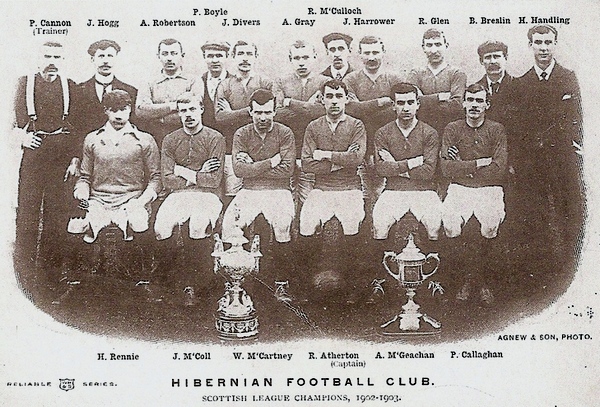
The following weekend it was the other half of the Old Firm’s turn to hold their annual sports. Celtic F.C. were, certainly at the time, the mecca of the Scottish athletic world, their meeting drawing together an impressive assemblage of 30,000 people in excellent weather. Wyndham Halswell was the magnet, the Lieutenant duly turning out in three events – the 100 yards, the quarter mile and the half mile. His victory in the 440 yards handicap was the feature of the meeting. In spite of a heavy handicap and the soft track, the “epochmaker”, as he was labelled, won by six yards and lowered his own Scottish native record by six tenths to 49.0 sec. “Halswelle’s 49 sec. here,“ opined the Herald, “is equal to 48 sec. in England, and the magnificence, as well as the significance of the performance can only be appreciated by those who are in a position to contrast the conditions in Glasgow with those in the South of England.” Not to be outdone, McGough produced a tremendous effort in the one mile handicap to get within six yards of catching A.B. Hepburn, who won in 4:20.8 off 115 yards. His time from scratch was a Scottish native record of 4:21.6, clipping two seconds off the former record which had stood to the credit of Hugh Welsh since 1898. Later in the afternoon he again toed the line in a special half mile invitation race against rivals Butterfield and Halswelle. Though he had been given a five-yard start, he was, understandably, running on tired legs, and was just run out of it, Butterfield winning by a foot from Halswelle in two minutes dead. As to his performance in the mile, the Glasgow Herald wrote: “This is his second best public effort, the best being his 4 min. 19 sec. at the A.A.A. Championships last month. We have been expecting a new record from him for some time back; indeed, all his performances since the West Harriers meeting when he did the mile and a half in 7 min., have led up to this brilliant effort, and like every clever article, he keeps the best till last. Being closely associated with the Celtic Football Club, McGough is naturally proud that Parkhead shares with him the glory of the record.” One may ask as to what exactly is meant by “closely associated”? As far as is known, McGough was a follower of Celtic F.C. and gave the club his services as an expert masseur during the winter months when he was not competing.

McGough returned to Parkhead when the Celtic F.C. fixture resumed on the Monday evening and uncorked a powerful finish to claim the one mile handicap from John Lee, Heaton Harriers (25 yards), and arch-nemesis George Butterfield. His winning time of 4:23.2 was, relatively speaking, a superior performance to his record run on the Saturday considering the sodden track. Again, though, he stood in the shadow of Wyndham Halswelle, who showed off his prodigious versatility by running second in the 110 yards sprint and then winning the 1000 yards handicap from scratch in 2:19.0. As the Glasgow Herald put it: “Another light, a little less replendent than the Lieutenant, is John McGough, of the Bellahouston Harriers.“ Although McGough and Halswelle came from very different backgrounds, they had lot in common – they were about the same age, both were Catholic, they shared the experiences of the Athens adventure and came home Olympic medallists, they were the leading lights of Scottish athletics, they were sometime rivals; and, last but not least, they were both coached/advised by former professional miler Jimmy Wilson, the popular trainer of Rangers Football Club.

For McGough, it had been a long five months since embarking on his expedition to Athens, but his season was not over yet. There was still the small matter of defending the British G.P.O. mile title, which he had taken at Putney the year before. To that end, he again had to travel all the way south to London. The 1906 Postal Service sports were held under the auspices of St. Martin’s Harriers at Herne Hill Velodrome on Saturday 15th September. Presumably to make the journey worth his while, McGough competed in three events. He was the virtual scratch man in the half mile, off 5 yards, conceding starts even to the likes of Jack George, a real speed merchant. The South London Harrier had, that year, run superb times of 50.2 sec. for the quarter and 1:57.8 for the half. Inevitably, off 11 yards, George won comfortably. McGough didn’t stand a chance, but completed the half mile by running 5 yards beyond the winning post in a personal best of 1:58.2. Though six tenths of a second inside William Anderson’s Scottish record, the mark did not find its way into the record books of the S.A.A.A., which recognised only native best performances achieved in Scotland. In a mile relay race (won by the Glasgow P.O. team) he ran the half mile in 2:01.8. Finally, he stamped his authority on proceedings in the mile championship of the Postal Service, taking only 4 min. 38.8 sec. to retain the title of “fastest postman in Britain”.

McGough‘s final race of the season on September 26th required that he journey to the other end of the country, having been selected to represent the Rest of Scotland in a match against Scottish Students in Aberdeen to commemorate the quartercentenary of the university. The athletics events were decided on the grass track at King’s College Recreation Ground before a large gathering. In the mile McGough defeated Edinburgh University student A.M. Matthews, his sole opponent, by two yards in 4:30.8. This win was actually one of three by the Bellahouston Harriers, who contributed six points to an 18 points to 12 triumph for the Rest of Scotland team, R. Kitson taking the 220 yards in 24.4 and Jimmy Vallance the quarter mile in 54.2.

The Glasgow Herald encapsulated his 1906 season thus: “Next to Lieutenant Halswelle, there is no more interesting personality in athletics circles than John McGough, of the Bellahouston Harriers. The S.A.A.A. champion is one of ourselves in the sense that he is a product of the Glasgow school of athletics, and that, no doubt, accounts largely for his popularity in and around the city. McGough has had a very successful season – in fact, the most successful in his career. He may have won more prizes last season, but his racing has touched a higher level this season, and that, after all, is the greater accoont than the accumulation of silver plate. His best performance was in the English championships in July, when he ran second to George Butterfield in the mile in 4 min. 19 sec. McGough should have won this race, as at the finish he was comparatively fresh, while the Darlington runner was all out. McGough did the mile at Belfast in 4 min. 20 sec., which is his next best performance; while his Scottish record at the Celtic sports comes next, though possibly it will be remembered long after the others are forgotten owing to the fact that it is enhanced in the official records of the S.A.A.A.“ The naked figures for the season were 14 firsts, 9 seconds and 2 thirds. But, of course, they do not tell the full story.

As hinted at earlier, McGough was inadvertently caught in the maelstrom of Irish political in-fighting during the early part of the season, when he was suspended by the I.A.A.A. for competing in a meeting held under G.A.A. rules in Armagh. Prior to the falling-out, athletes had competed with impunity in the promotions of both governing bodies, and McGough had, perhaps naively, availed himself of this freedom. The spirit of goodwill having evaporated amid the widening rift, he found himself being made an example of. Fortunately, he was later reinstated after arguing that he taken part in the proceedings purely for charitable purposes. As one might imagine, a champion runner like John McGough was a coveted asset and, hence, possibly more eligible for clemency than, say, lesser mortals.

1907 SEASON
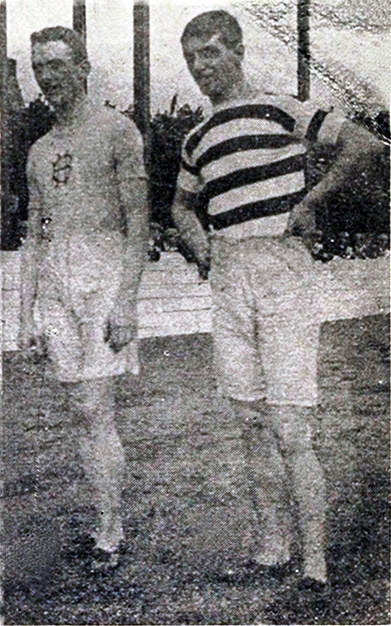
www.rastervect.com

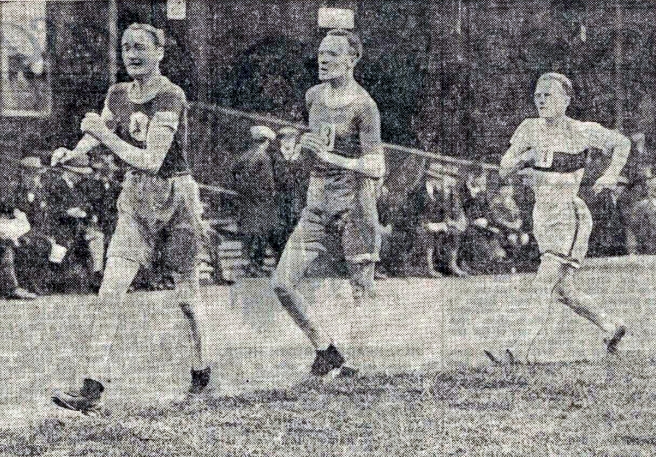
John McGough and James Vallance of Bellahouston Harriers, 1907

McGough kicked off his 1907 season by making an appearance in the I.A.A.A. championships on May 20th at the RDS Showgrounds in Dublin, where his participation might be seen as a conciliatory gesture to the I.A.A.A. after its decision to rehabilitate him several months earlier after he had flouted their rules. Entered as “John McGough, Castleblayney & Bellahouston Harriers” he was unplaced in the half mile, but later turned out to win the mile by inches from George Morphy in 4:48.0. Of course, the opportunity to compete in Dublin also gave him the pretext to represent Castleblayney, where he still had family. The McGoughs, like many an Irish family uprooted by poverty, kept close ties with their ancestral homeland.

As was his usual modus operandi, McGough did several tune-up races prior to the Scottish championships beginning with a 4:27.2 mile in the Bellahouston Harriers meeting at Ibrox Park on June 1st. “The mile flat handicap”, reported the Herald, “witnessed a fine effort from John McGough, who finished second in 4 min. 27 1-5 sec., which on a sodden, heavy track, shows what he might have accomplished under more favourable conditions.” The vagaries of the Scottish climate have always had a major bearing on T&F performances during the summer season, even more so in the days of grass and cinder tracks, which were typically not well drained and, thus, at the mercy of the elements. When the meeting continued on the Monday evening McGough took on George Butterfield in a special one mile match, which, however, was as disappointing as the attendance, McGough winning by 15 yards in 4:36.0 before a mere smattering of spectators. As a result of the low overall attendance, the sports were a financial failure and Bellahouston Harriers incurred a big loss which could have threatened their existence were it not for some new-fangled accounting.

The going was also “extremely sticky” at the Queens Park FC sports on June 15th at Hampden Park where McGough delivered the outstanding performance of the meeting in the one mile handicap losing by just a few inches from scratch in 4:24.8 – a time the Herald’s athletics expert reckoned to be worth around 4 min. 20 sec. in good conditions.

Heavy and blustery conditions again greeted the competitors in the 25th annual Scottish championships held at Powderhall Grounds on June 25th. With the holder Halswelle unable to defend his title in the half mile after picking up a thigh injury in the 220 yards sprint, McGough had no trouble securing his third title in this event in 2:06.8. His winning margin of half a yard over Jimmy Vallance belied the ease with which the victory was accomplished. With William Anderson taking third, Bellahouston Harriers scored an historic 1-2-3 clean sweep. McGough had even less difficulty defending his crown in the mile, which he won by 10 yards from A.M Matthews in 4:34.2. As the Herald put it, “John McGough captured the half and mile events without turning a hair.” By winning his sixth consecutive mile title, he took possession of the 25 guinea challenge cup for this event for the second time. Also celebrating his sixth successive title was hammer thrower Tom Nicholson, who would go on to win the Scottish hammer title an amazing 19 times in a row, in addition to amassing 14 shot put titles.

Scottish hopes in Scoto-Irish International held at Ibrox Park on June 29th in front of 6,000 spectators in fine weather suffered a blow when Wyndham Halswelle pulled out on account of the injury he had sustained at the Scottish championships. The Scottish team without Halswelle was well below strength, and as a upshot of this lost narrowly by 5 points to Ireland’s 6. McGough had been selected to run in both the half mile and the mile, but only took the latter event seriously. The “half” was a tremendously fast race, Ireland’s Ivo Fairbairn-Crawford front-running his way to an impressive victory in an all-comers’ record of 1:57.2. Finishing close behind was Jimmy Vallance, who ran a blinder to clock 1:59.0 for second place. McGough gave up early in the second lap, as did George Morphy, both men evidently saving something for the mile. In the mile, with A.M. Matthews out injured, John Ranken set the pace until a lap from home. Then McGough went to the front and launched a long sprint which took the sting out of Morphy’s finish and carried him to victory by 20 yards. McGough would have been delighted by his fast time of 4:22.2, but perhaps even happier about avenging his defeat by the Irishman in Belfast the year before. Ireland were without a second string since McGough, I.A.A.A. champion, and Scottish champion, had been selected by both sides! “sportsman” had this to say: “McGough did not seem to be more than stretching his legs in the half mile. That was only natural, as, with the mile in view, he wanted to harness his reserve energies for the latter event. He certainly ran a good race over the longer journey, and his sprint at the finish was longer sustained than usual. McGough’s 4 min. 22 1-5 sec. was as smart a bit of running for a mile as he has shown this season.“

McGough’s strong performance in Glasgow again saw him pegged as one of the favourites for the A.A.A. mile championship to be decided on July 6th at the Manchester Athletic Ground in Fallowfield. He was still searching for his first win in this event after finishing second for three straight years. Unfortunately, a strong wind kept down the attendance and a sodden cinder track prevented any new records being accomplished. A field of eight runners faced the starter in the mile. W. Cottrill, of Hallamshire Harriers, led the first lap in 59.8 sec., but soon fell back, having shot his bolt. Then Deakin, of Herne Hill, took command, closely followed by McGough, Butterfield and Lee, and held that position until the end of the third lap. As the bell rung out Lee made his effort early and opened up a gap of three yards, but Butterfield’s strength told over the last furlong into the wind. The Darlington Harrier charged past the Heaton Harrier in the home straight and ran to the tape a winner by 3 ½ yards in 4:22.4, a last quarter of 63 sec. doing all the damage. Behind him, Deakin got up to snatch second place away from Lee by a foot. McGough was run out of it on the last lap, and retired, presumably after having realised the race was a lost cause. The Herald’s analysis: “George Butterfield’s 4 min. 22 2-5 sec. for the mile must be considered in some respects his greatest achievement, and in the light of that fact, which will scarcely be disputed, it is easy to account for the defeat of John McGough, not that the Bellahouston Harrier, up to a certain point, ran indifferently by any means, but the Darlington man happened to excel himself.” In spite of McGough’s failure, Bellahouston Harriers rejoiced in an A.A.A. title courtesy of 32 year old ex-soldier Tom Kirkwood, who retained the shot put title he had won the previous year whilst serving in the Liverpool Scottish Volunteers. Jimmy Vallance also picked up a standard medal after finishing fourth in the half mile in 2:01.0
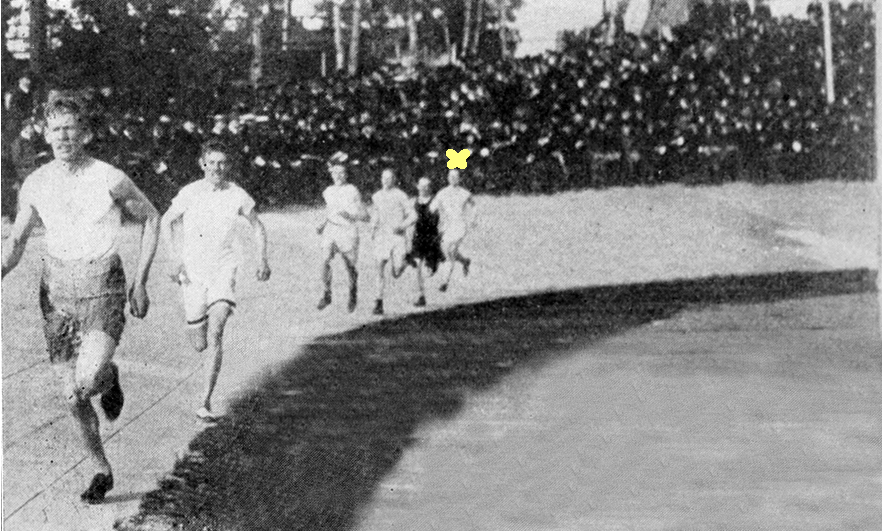
McGough Stockholm 1907Stockholm, 1907.   Petterson leads

The following weekend McGough made his way down to London and, representing Glasgow G.P.O., comfortably defended his title in the One Mile Championship of the Postal Service at Herne Hill Velodrome, winning by 25 yards from C.S. Read in 4:42.4. By winning the mile championship for the third time in succession, under the rules then in place, the Dewar Challenge Shield was his to keep. Afterwards he ran an excellent race from 15 yards in the one mile handicap, doing about 4:22.4 for 1745 yards, although hampered by a big field.

What happened next is unclear, but it appears that McGough was badly spiked in a low-key race at Liverpool, as a result of which he suffered an injury that impacted the remainder of his campaign for that year. The month of August 1907 was certainly one he would have wanted to forget in a hurry. He was below par for weeks on end and failed to finish a string of races, but to his credit, at least he attempted to honour his engagements. It took until September for the injury to clear up, by which time, however, the British track and field season was effectively over. Keen to get a few races in before hanging up his spikes for the year, he obtained permission from the A.A.A. to run at meetings in Kristiania (Oslo) and Stockholm. His first race was a 5000 metres at Kristiania on September 14th , but misfortune struck and he missed the start owing to the late arrival of his boat. The following day, however, he got to the stadium on time and lined up for the 1500 metres and came home second behind Austrian internationalist Felix Kwieton in 4:22.0. Then it was on to Stockholm for a three-day international meeting where Britain was represented by McGough and three A’s 100 yards champion John Morton (South London Harriers), each competing in three events. Morton was in blinding form, winning the 100 yards in 10.2 sec., the 100 metres in 11.2 sec. and the 150 metres in 16.7 sec. Unfortunately, the same cannot be said for McGough in the middle distance events where the standard would have been well within his compass had it not been for the fact that he was still nothing like at his best. In his first outing, a 1500 metres on September 20th, he was beaten into third place, trailing home some 30 yards adrift of the winner, Sweden’s Edward Martin Dahl, in 4:16.8. In the 800 metres on the following day he could finish no higher than fourth, but showed improvement by returning a reasonably good time of 2:01.6. The third day of the meeting saw him finish unplaced in a fast 3000 metres, in which Dahl again stamped his authority on the race with an impressive 8:55.0 clocking. Having enjoyed the sightseeing and the hospitality of his Scandinavian hosts, which would have gone some way to atoning for his underwhelming performances, it was back to Glasgow where the mail was no doubt piling up after his week-long absence.

It had been a season for mixed fortunes for McGough, capped by an impressive victory in the all-important Scotland vs. Ireland fixture in an excellent time just outside his own native record. Other highs were his victory in the I.A.A.A. mile championship and his half/mile double at the Scottish championships, where he took ownership of the mile challenge trophy for the second time after winning the event for the sixth time in a row. The Dewar Challenge Trophy also became his absolute property after winning the British G.P.O. mile title for the third time in as many years. Lows were, of course, his disappointment in the A.A.A. championships and the spiking-related injury which he suffered at Liverpool, ruining the remainder of his season at home and scuppering his chances of setting any records at the August meetings in Glasgow. Consequently, for the first time in several seasons, McGough was not his club’s most successful performer, that particular honour going to Jimmy Vallance. A late-season tour of Scandinavia produced a mixed bag of results, but at least it gave him another taste of international competition, and the chance to end the season on his own terms.


1908 Season

From the outset, the 1908 season was dominated by the Olympic Games which were to be held in London. The 1908 Olympic Games had originally been scheduled to be staged in Italy, but after the eruption of Mount Vesuvius in 1906 the overwhelmed Italian government relinquished the right to host the games, whereupon the British stepped into the breach at short notice. Lord Desborough, chairman of the British Olympic Committee and the driving force behind the British effort, persuaded the organisers of the Franco-British Exhibition in London to build a multi-purpose stadium, the largest in the world with a seating capacity of 68,000, at no cost to the B.O.C. in return for three quarters of the ticket and programme sales. The White City Stadium was truly built on a Olympian scale, the giant cinder track measuring just three laps to the mile. The news that Britain would be hosting the Olympic Games in 1908 generated unprecedented home interest across all sports, the competition for the generous allotment of starting places in the track and field events being particularly intense. The S.A.A.A., as one of the regional associations eligible to enter a contingent, arranged for several trials to be held over metric distances at concurrent meetings in Edinburgh and Glasgow on June 6th. The “1500 metres S.A.A.A. Olympic Trial” was decided in conjunction with the Bellahouston Harriers sports at Ibrox Park imparting a “dash of novelty” to the programme, although the attendance (1,500) was a little disappointing in view of the fine weather conditions. With just a couple of low-key races under his belt, McGough was raring to go, even if he only had just one opponent in the shape of Sam Stevenson. The Clydesdale Harrier had narrowly beaten McGough in a mile handicap at Wishaw a couple of weeks earlier, but was not expected to trouble the Bellahouston Harrier in a race on level terms. Nevertheless, a spirited contest was witnessed by the diminutive crowd, both men duelling it out through the vast emptiness of Ibrox Park before McGough turned on the speed on the last lap to win by 30 yards in a Scottish record of 4:10.2. For good measure, McGough turned out in the one mile handicap later in the proceedings and produced an excellent run from scratch to get within a yard of Robert Magura, Glenpark Harriers (115 yards), in 4:25.4 – his fastest in over ten months. For these performances McGough was nominated alongside 11 others to wear the British colours in the 1500 metres at the London Olympics.
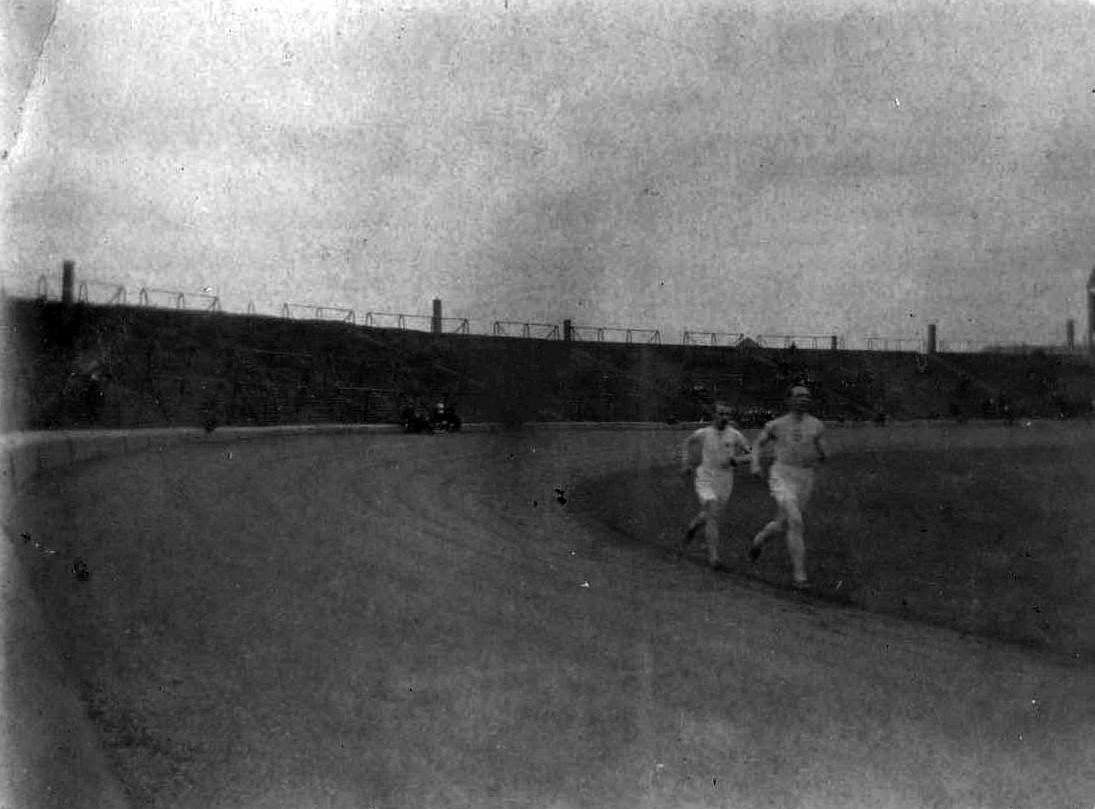
Olympic Trial, Ibrox 1908Olympic Trial at Ibrox Park in 1908

Picture courtesy Kevin Kelly

On the surface, it looked as if McGough was rounding into form with the Olympics just over a month away, but by the following week it was public knowledge that he was nursing an ankle injury after he pulled out of the Irish championships. Contrary to expectations he turned out in a mile handicap at Saughton on June 17th, but failed to do himself any justice and retired well before the finish. It was the same story at the Queens Park Rangers sports held on June 20th at Hampden Park, where he was unplaced in the one mile handicap. “John McGough,“ wrote the Herald, “was not seen at his best; as a matter of fact, it was obvious to all that he was running under physical disabilities. With the championships so near he should have been resting on Saturday instead of aggravating his infirmities.“ His subsequent absence from the S.A.A.A. championships the following weekend spoke volumes. The injury, reportedly a “weakened tendon achilles”, was evidently worse than first thought and bad enough to seriously derail his Olympic preparations. In his absence, Rob Burton, Berwickshire Harriers, won the S.A.A.A. half mile in 2:02.0 and the old Watsonian Harry Jamieson, Edinburgh University AC, took the mile in 4:33.8.

On July 8th, five days before the heats of the Olympic 1500 metres, the Evening Telegraph revealed that McGough had taken “a quiet week in Ireland with a view to his complete recovery from the minor mishap which prevented his running in the championships.”

Two days prior to the games, McGough finally tested his strapped-up foot and his form by turning out for Scotland at the annual Scoto-Irish contest. The encounter took place at the Scottish National Exhibition Grounds in Saughton, Edinburgh, the Scottish equivalent of the Franco-British Exhibition in London. Features included a sports ground complete with a quarter mile cinder track, which, however, was loose and heavy after recent rainfall. In the mile, the Irish champion Morphy made the mistake of watching McGough rather than Harry Jamieson, who stole a march early on and led by 20 yards at halfway. Neither Morphy nor McGough was able to make up the deficit the lanky Scottish champion, who was no stylist but very effective, winning by 3 yards from Morphy in 4:39.0, who, in turn, was just ahead of McGough. It was no the confidence-building performance he would have hoped for in the run-up to the Olympics but at least he was, for want of a better phrase, back on track.

The qualifying rounds of the 1500 metres were decided on July 14th, the second day of the track and field programme. There were eight heats, and with only the winner advancing to the final. They were unevenly seeded and consequently a string of “big guns” fell at the first post. There was a shock in the very first heat, when reigning champion Jim Lightbody was eliminated. Then, in the second heat, McGough’s great rival George Butterfield was unceremoniously knocked out. In the third heat, the Italian champion Emilio Lunghi failed to progress to the final despite smashing the Olympic record. McGough was next up, drawn in heat 4 alongside Vincent Loney (GB), Harry Coe (USA), Stylianos Dimitriou (GRE) and Joseph Dreher (FRA). The Official Olympic Report noted that McGough’s left ankle was bandaged and that he “set a lively pace until just before the bell“. Handicapped by his injured achilles tendon, however, he was unable to respond when first Loney and then Coe shot past him on the last lap, Loney winning by 3 yards from the American in 4:08.8. A disconsolate McGough trailed home third some 50 yards adrift in 4:16.4 and took no further part in the proceedings.

His outright Scottish 1500 metres record of 4:10.2 was to be short-lived, Arthur Robertson improving it to 4:07.2 in Stockholm in September 1908.

For McGough, it had been a cruel twist of fate to suffer injury at the time of the Olympics because he was back to something like his best within a few weeks of his early exit from the 1500 metres. He had something to prove when he turned in in the Rangers Sport on August 1st, a week after the conclusion of the track and field programme at the White City stadium. The meeting featured a mouth-watering billing that included several Olympic medallists and international stars, attracting a big crowd of 15,000 spectators, who were treated to some excellent sporting fare despite the windy conditions. Emil Voigt, Manchester, the Olympic five miles champion, was sublime in the four miles, winning by 30 yards from another gold medallist, the Scot Arthur Robertson, in an impressive time of 19:40.0. The newly crowned Olympic 400 metres champion Wyndham Halswelle was a whisker outside his own Scottish all-comers’ record in the 300 yards handicap, where he finished second in 31.4 sec. In the 100 yards dash Olympic 100 metres champion Reginald Walker, of the South African Olympic team, took advantage of the wind at his back to clock a brilliant 9.8 sec. in his heat, this being the first ever sub-ten performance witnessed on Scottish soil. The mile handicap saw McGough drawn alongside Olympic 1500 metres silver medallist Harry Wilson, Hallamshire Harriers, and his old adversary George Butterfield on the scratch mark. Unfortunately the starts were too much for even these fine athletes and the race was won by R.S. Sinclair, Glenpark Harriers, who had the limit. McGough was fifth past the post in about 4:28.0 and surprised many, perhaps even himself, by defeating Wilson by several yards. His performance would, no doubt, have elicited mixed emotions – delight that he had beaten the Olympic silver medallist tempered by frustration over his recent tribulations. In the supplementary meeting two days later, he started in two races, devoting his main effort to the half mile, where finished third behind the Olympic 800 metres champion Mel Sheppard (USA) and Butterfield in two minutes dead after pacing Sheppard to a Scottish all-comers’ record of 1:56.0.

McGough concluded his Scottish campaign on August 19th when the represented the S.A.A.A. select in a match against the Irish Americans at the National Exhibition Grounds and was outsprinted by teammate Harry Jamieson in a tactical mile race in which both Scots had the satisfaction of beating the American couple. McGough, it was noted, “whose strong point used to be finishing, could not respond to Jamieson’s challenge.” A topsy turvy season indeed.

1909 SEASON
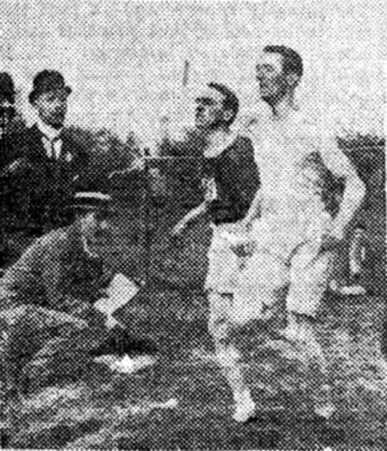
McGough beats McNicol, 1910

John McGough pips Douglas McNichol for the SAAA Mile in 1910

1909 was to be a relatively quiet year by McGough’s prolific standards, starting relatively late in the season and ending early. This year he was probably less conspicuous by his absence than would usually have been the case, as Scotland was in the grip of a marathon craze, the event having been popularised at the 1908 Olympic Games by Dorando Pietri, the tragic hero who staggered across the line first after a dramatic finale only to be disqualified. Meeting promoters were incorporating marathon races into their programmes, because, due to their novelty appeal and theatrics, they were a sure-fire crowd-puller. For the first time in his career, he went into the S.A.A.A. championships without having run a single race, foregoing even the chance to compete in the Irish championships in late May. The big question was, therefore, whether he had been able to re-capture form he had shown in 1907. In the week preceding the national championships, the Glasgow Herald was hedging its bets as to the outcome of the mile: “If in form John McGough will be a hard nut to crack in the …mile, though in the latter H. Jamieson, the holder, who is now residing in the North of England, will not part with his honour without a desperate struggle. Jamieson has never done the “times” that McGough has to his credit, but the latter went off last season and it is not public property whether he has regained his distinguishing qualities of 1907.” The S.A.A.A. championships were held at Ibrox Park on Jun 26th before a crowd not numbering many more than 3,000, who witnessed one of the best meetings on record as far as keen contests and close finishes were concerned. As was expected, the mile was one of the finest races of the day. McGough was eager to recover his lost laurels after injury had forced him to reliniquish his title to George Watson’s College student Harry Jamieson the year before. The Scotsman takes up the story: ”Ten of the eleven entrants competed, and the excitement began when the last lap was entered on. The holder (Jamieson), McGough, McNicol (Polytechnic Harriers), and T. Welsh were all together. Later it was a duel between Jamieson and McGough. It was a great finish. First Jamieson went to the front, but McGough passed him, and coming down the straight the western man looked a winner, but Jamieson had something in reserve, and, amid great excitement, won a splendid race in the excellent time of 4 mins. 29 1-5 secs.“ There was less than a yard between Jamieson and McGough, with Douglas McNicol and Tom Welsh also beating the standard time of 4 min. 33 sec. By securing second place, McGough was of course assured of selection for the Scoto-Irish contest. The tone of the Glasgow Herald’s commentary was upbeat: “The defeat of John McGough in the mile was a disappointment to his Ibrox admirers, but the fact of him running so well should be some compensation, as it shows that with a little more practice he will get back to his form of two seasons ago.”

Whether or not McGough could rediscover his form of 1907 remained to be seen, but the Herald was not far off the mark in predicting further improvement. A fortnight after the Scottish championships McGough put in an appearance at his club’s annual sports on July 10th at Ibrox Park, where he finished second in the one mile handicap in a season’s best of 4:26.8. His performance was the feature of a fixture somewhat spoiled by inclement weather. “All things considered,” wrote the Herald, “the racing at Ibrox, on Saturday under the auspices of Bellahouston Harriers of John McGough disclosed vivid signs of his old form in the mile.”

Next up was the fourteenth annual encounter between Scotland and Ireland, which took place at the RDS Showgrounds, Ballsbridge, on July 17th before 4,000 spectators. The result was an easy win for Ireland by eight events to three, thanks in no small part to the appearance of the Olympic 200 metres champion John Kerr, an Irish-Canadian, who set an Irish record of 22.2 sec. in the 220 and equalled the existing record of 10.2 sec. in the 100. For Kerr the chance to represent Ireland was, it was said, the fulfillment of a lifelong ambition. McGough, judging by his close Irish ties, may have harboured similar thoughts, but his loyalty to Scotland in the athletic field was unwavering. In the mile race, one of the most competitive events of the contest, McGough came close to securing a point for Scotland. A strong finish disposed of the Irish champion Ivo Fairbairn-Crawford and the Scottish champion Jamieson, but George Morphy, buoyed by a partisan home crowd, overtook him in the home straight and won by a yard in 4:33.6. Both Fairbairn-Crawford and Jamieson failed to finish. Jamieson, whose full name was Henry Tonkinson Jamieson, was born in Edinburgh on November 30 1885. A chartered accountant, he retired from athletics after the Scoto-Irish contest owing to limited opportunities for training. In 1911 he secured an appointment in Canada and lived there until his death in 1983 at the ripe age of 98.

Uncharacteristically, McGough ran only one low-key race during the next three weeks. Perhaps he had decided he needed to conserve his resources, be it to stay injury free or to be at the best of his ability. In any case, his next major race was at the Rangers F.C. sports, held on Saturday August 7th in fine weather and before a full house at Ibrox Park. The meeting featured many outstanding performances, including, notably, a 9.8 sec. by the South African Reginald Walker in the invitation 100 yards handicap and a Scottish all-comers’ record of 13:57.2 in the two miles walk handicap by Ernest Webb, of Herne Hill Harriers. The mile handicap was no less competitive, Eddie Owen, the scratchman, just getting the better of Clydesdale’s Alex McPhee (45 y) and McGough (15 y) in a thrilling contest. The Broughton Harrier, 1908 Olympic five miles silver medallist, was all smiles after notching up a lifetime best of 4:20.2. McGough ran on to complete the full mile in 4:24.0, which, noted the Herald, was his best showing in a couple of seasons. It was on this high note, however, that he decided to end his season. He did not turn out when the meeting resumed on the Monday evening, and so was spared having to see two of his native records erased from the books. No fewer than seven new records were created at this meeting within the space of just two and a half hours, including two native records that had previously stood to McGough’s credit. In the 1000 yards flat race Adam Turnbull, of the Clydesdale Harriers, knocked two fifths of a second off his record figures, while in the mile and a half handicap Arthur Robertson, Broughton Harriers, not only bettered McGough’s native record but also the all-comer’s record with a time of 6:48.4. Records are made to be broken, as they say, and in those days Ibrox was the place to do it. In good weather the Ibrox was, without doubt, one of the fastest tracks in Britain. With one or two exceptions, all Scottish records had been set there.

 1910 SEASON
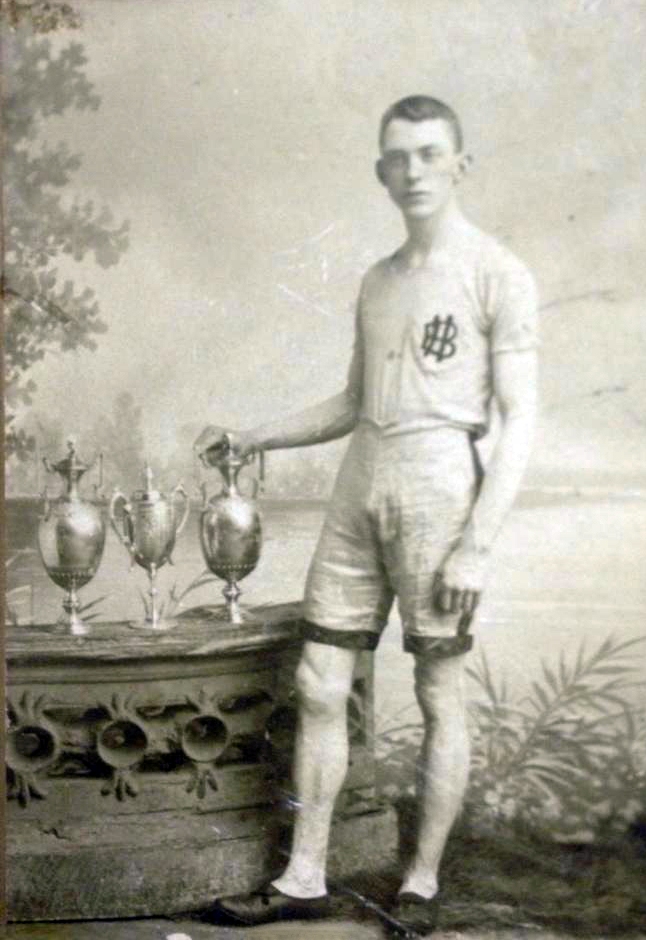
McGough with SAAA Challenge TrophiesJohn McGough with SAAA Challenge Trophies

In view of McGough’s sparse racing programme in 1909, one could be forgiven for thinking that his enthusiasm was waning, but in fact this was not the case – he still had unfinished business to attend to. Although a little past his prime, his 4:24 mile at the Rangers F.C. sports in August had shown that he was still a force to be reckoned with. The Scottish mile title, which had eluded him for two seasons, would have been firmly in his sights for 1910, especially after the retirement of his recent nemesis Harry Jamieson. Sticking to the light racing schedule he had favoured the previous year, he ran only one race ahead of the S.A.A.A. championships – on June 11th, when he dutifully turned out for his club in its annual sports and finished second in the one mile handicap in 4:29. The star of the show, however, was not McGough, but rather his fellow Bellahouston Harrier Richard Quinn, who strode to a Scottish mile walk record of 6:45.6.

The Scottish championships were held on June 25th at the Powderhall Grounds, which on this day were bathed in brilliant sunshine and promised an equally brilliant afternoon of athletics. Few if any of the events decided that day, however, could rival the mile for sheer show-stopping excitement. The Scottish Referee gives a good account of the race: “The one mile was a mile which recalled those of the late A.E. Tysoe and Hugh Welsh on the same ground, or of Andrew Hannah, W. Robertson , or S. Duffus, or of John McGough himself and Murphy in the ‘National at Belfast. The record-holder of the mile was in spanking form, but he caught a tartar in D.F. McNicol, of the London Polytechnic Harriers., an old Edinburgh lad of Duncan [D.S. Duncan] build and heart, who led the champion in grand style to the tape, which he was only prevented bursting first by McGough’s breast, amid breathless excitement. Many imagined that McNicol had actually won, so close was the finish. McGough had the judges’ just verdict, however. The loser forced too much, and should have waited a little longer before making his effort. Champion McGough regained the honour he last held in 1907, and robbed Edinburgh and holder Jamieson of his title. The winner’s quarter miles were: First, 1 min. 7 2-5 sec.; half mile, 2 min. 20 1-5 sec.; threequarters, 3 min. 30 3-5 sec.; and mile, 4 min. 32 4-5 sec.”

This gutsy victory brought McGough’s tally of S.A.A.A. mile titles to seven, equalling the record number of wins in a single running event held by Andrew Hannah, of Clydesdale Harriers, who amassed seven wins in the 10 miles championship between 1889 and 1896. As can be seen from the splits, the race was a tactical affair and only really came alive in the last quarter. In the past McGough had often let himself down through poor tactical judgment, but on this occasion he timed his effort perfectly to defeat such formidable an opponent as Douglas McNicol. The Polytechnic Harrier, who had been born in Chelsea of Scottish parents in 1885, was a rising force in Scottish athletics and destined the following year to win the prestigious A.A.A. mile championship that had always eluded John McGough.

The team to oppose Ireland in the international athletic contest at Ibrox Park was chosen at the conclusion of the championship gathering in Edinburgh. McGough was selected for the ninth time in as many years, which, in those days at least, was remarkable consistency.

The following week McGough ran third in a mile handicap at Beith, where there was much bumping and barging, and it was reported that he “was twice interfered with …or he might have won”. Nonetheless, his time of about 4:27.2 was a season’s best and stood him in good stead for the match against Ireland in a week’s time. On the Wednesday evening, while McNicol was running a mile a season’s best of 4:25.8 at Stamford Bridge, McGough won the mile in a sports meeting held by St. John’s Young Men’s Catholic A.C. at Ibrox. A devout Catholic, he was, revealed the Glasgow Herald, “the means of establishing this club, and that it is a popular denominational institution goes without saying. It has very large membership, and is on excellent terms with all the athletics clubs in the district.“ Another item in the same paper referred to McGough as “the controlling spirit” of St. John’s Young Men’s Catholic A.C. Over and above his demanding day job, his side job at Celtic, his training regimen and his racing schedule, he evidently still had the time and energy to engage in voluntary work in the local community! Adjectives like “indefatiguable” spring to mind.

The sixteenth annual international athletic contest between Scotland and Ireland took place at Ibrox Park on Saturday July 9th. Only 2,000 spectators turned out in sunshine to witness the struggle for supremacy, which ended in a record win for the Scottish team by nine points to two. The mile race, featuring McGough and McNicol representing Scotland and Frank O’Neill and James Bill representing Ireland, promised to be one of the most competitive races of the afternoon – and it did not disappoint. A punishing early pace proved too much for O’Neill, the Irish four miles champion, who dropped out after about half a mile had been covered, leaving McNicol, Bill and McGough to fight out a thrilling battle on the final lap. The Irish mile champion Bill looked to have the race sewn up 40 yards from home, but then McNicol uncorked an amazing finish, which brought a roar from the crowd and victory in the last strides. Both men were given the same time (4:26.0). McGough, unable to get back on level terms, gave up in the home straight. He, too, would have beaten 4 min. 30 sec., but with only the winner counting, there was no point in continuing.

The following weekend, McGough turned out in the annual meeting of the Ayr Football and Athletic Club at Somerset Park, a popular fixture reckoned by some to be the best provincial meeting in the country. In the one mile handicap, McGough, running from scratch in a field 40 runners, put in some excellent work get up to third place. His time was returned at 4:32.0, which, adjudged the Herald, was “a creditable performance for grass.” His clubmate John Templeman, an up-and-coming talent whom he had conceded 30 yards, won in 4:30.2.

With the start of the football season now just a few weeks away, there were only a few more good competitive opportunities left before the domestic athletics season was over, these being the Rangers FC sports on August 6th, the Edinburgh Northern Harriers sports on August 10th and the Celtic FC sports on August 13th.

The Rangers FC sports once again drew a big crowd of 10,000 spectators, but the conditions weren’t great. A stiff breeze was blowing, and while it helped the sprinters, it was very much against the longer distance runners. The mile race, traditionally one of the centrepiece events, attracted a massive entry of 81. There were in fact 69 runners at the start, which was still a big field for a mile race, but that number decreased to 40 within half a mile as runners with starts were overhauled and dropped out. The backmarkers, Eddie Owen (scratch), Harold Wilson (scratch) and Douglas McNicol (15 yards), all ran disappointingly, and not one of the three finished. McGough, with pride at stake after being conceded 20 yards, went out hard and showed his rivals from England a clean pair off heels. Frank Stoddart West of Scotland Harriers (105 y), was leading by 20 yards on entering the straight, and though McGough made a plucky attempt to pull him in, he ran out of track, there being a “good six yards” between the two at the post, while W.F. Taylor, Bellahouston Harriers (135 y), was a couple of yards behind the Scottish champion. McGough’s time off 20 yards of 4:21.6, worth about 4 min. 25 sec. for the full mile, was his best performance of the season, unfavourable weather conditions notwithstanding.

On the Wednesday evening McGough put in an appearance at the fifteenth Edinburgh Northern Harriers sports at Powderhall Grounds. One of the features of the meeting was the running of Rob Burton in the 1000 yards handicap, the Scottish half mile champion winning with ease from Eddie Owen, with whom he started from scratch, returning an excellent 2:19.0 in windy conditions. The mile handicap was another fine race, in which McGough (15 yards) again faced Douglas McNicol (also 15 yards) and the Broughton Harriers pair of Eddie Owen (scratch) and Bill Scott (30 yards). The Scotsman reports: “The first lap was rattled off in 59 sec. which was a trifle too fast to permit of record-breaking, and at the end of the second the time was 2 mins. 6 secs. At this point all the backmarkers; Owen, Scott, McNicol and McGough, were together and well placed. And so they ran until coming round the first bend for home – the race was run left hand in. First Owen looked like a winner, and then fell back, and next McGough appeared to have an excellent chance, with McNicol dropping back, but well in the straight Scott, who was ahead, put on a spurt, and McGough could not respond and was comfortably beaten, with Scott easing up. Time: 4 mins. 24 secs. Owen’s time off scratch was 4 mins. 25 2-5 secs., and McGough’s for the full mile was 4 mins. 27 secs.” This was another very solid run from McGough, who, though in his thirtieth year, which was well past the usual retirement age in those days, looked like he could go on churning out high-calibre performances ad infinitum. In fact, it was to be the last track race he would finish.

Although he turned out in the one mile handicap at the Celtic FC sports three days later, he did not have the legs to overhaul another big field for the third time in eight days and dropped out. It was, perhaps, not exactly the way he would have wanted to bow out, but bow out he did. The first mention found of his retirement is in an early 1911 edition of the Glasgow Herald, a brief notice/eulogy that reads: “We have the best authority for saying this. John McGough has resolved to retire from the running path, which he has adorned for the last ten years. He feels he has had a full share of the pleasures of the track, and thinks the time has become to make room for others. Mr. McGough has had a wonderfully brilliant career. His first notable success was at the Glasgow Exhibition in 1901, and in 1902 he captured the mile championship, which, with the exception of 1908 and 1909, he has held all these years. Few have done more to raise the tone of the running path than John McGough, who from that and other points of view will always hold a cherished place in the record of amateur athletics in Scotland.”

McGough’s retirement left the way clear for Douglas McNicol, who “ruled the roost”, as it were, for a few seasons. The anglo Scot delivered one of the finest performances of the 1911 S.A.A.A. mile championship, where he front-ran his way to a emphatic 50 yard victory, returning 4:26.4 in heavy conditions. He was, in the opinion of the Herald, a “worthy successor to John McGough, whose record …will take some beating.” After retaining the mile championship in 1912, he was beaten in 1913 by Duncan McPhee, who, in turn, would dominate the event well into the 1920’s.

After his retirement McGough continued to work as a postman until he was appointed to the position of assistant trainer to Bob Davies at Celtic FC, thereby following in the footsteps of many a well-known footracer. His tenure at Celtic ended in 1914, when he went to Manchester to assist Bob Davies with the training of the Manchester United players. After the suspension of league football due to the outbreak of WW1, he returned to his native Ireland and became a farmer in Annagleve. Sadly, there was to be no reunion after the war with his former rivals Wyndham Halswelle, George Butterfield, Douglas McNicol, William D. Anderson, John Ranken and Tom Welsh, all of whom perished in the hostilities.

After his return to Annagleve, he became involved with Gaelic football and was, for example, the masseur of the Cavan G.A.A. team which won the All-Ireland final at the New York Polo Grounds in 1947.

Attempts at his remaining Scottish native records for one, two and three miles would be a feature of athletics meetings throughout the 1920’s. His two miles record held firm until 1927, when Donald McLean lowered it to 9:31.0 at the Maryhill Harriers sports. His mile record withstood all challenges until 1930, when Tommy Riddell improved it to 4:21.0 at the Rangers FC sports. They were still chasing his native three miles record until 1931, 27 years after it was set, then Jimmy Wood knocked four tenths off it in a four miles handicap featuring the great Paavo Nurmi at Ibrox Park.

John McGough was not a wealthy man by any stretch of the imagination, but he was a man of noble spirit and generosity. During the writing of this piece, the gold medal he won in the 1904 S.A.A.A. mile championship came up for sale on ebay. What was remarkable about this medal was the inscription “TO W. LAW”. He had evidently gifted it to clubmate William Law, who in 1904 was an aspiring young sprinter. The gesture must have worked its magic because Law would win his own S.A.A.A. medal, a silver, in the 220 yards final of 1908. Many years later Bellahouston Harriers made a perpetual trophy of a valuable silver cup handed back to them by John McGough. The aptly-named “McGough Trophy” was awarded to the winner of the 17 mile Stewarton to Pollokshaws road race promoted by Bellahouston Harriers between 1943 and 1946.
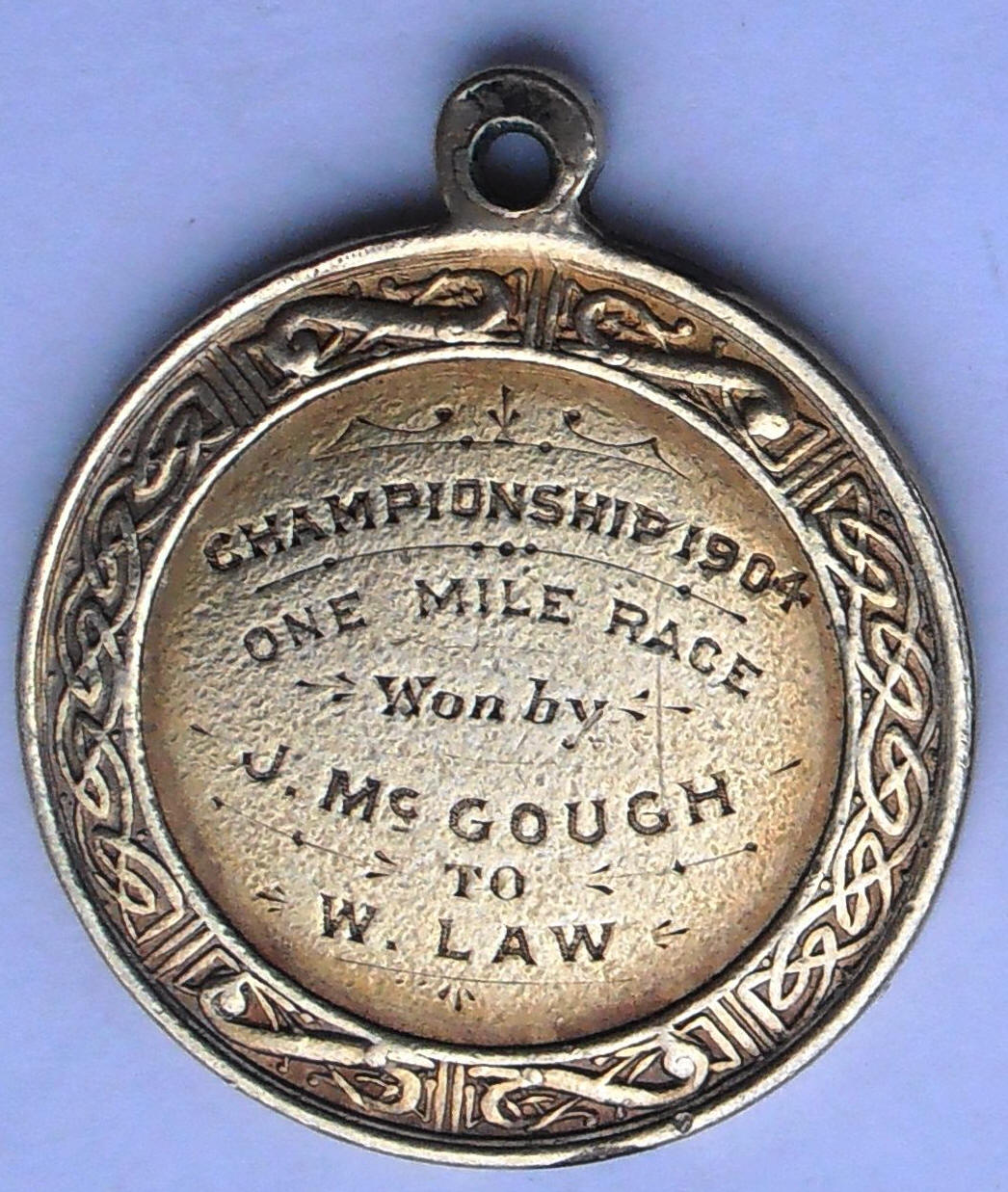
McGough SAAA Mile Medal 1904

As far as record breaking goes, he was nothing if not prolific. At one time he held every native record from 1000 yards to four miles. The native half mile record eluded him, although his 1:58.2 at Herne Hill in 1906 was, at the time, the fastest on record by a Scottish amateur. As mentioned earlier, records are there to be broken, but it took until 1931 to finally erase his name from the record books. His record of six successive victories in the Scottish mile championship was equalled by Tommy Riddell in 1935 and finally surpassed by Graham Everett when he won his seventh straight title in 1961. However, one record that has never been equalled, let alone broken, is his amazing three titles in one afternoon in the distance events. He was, in view of these rare accomplishments, perhaps a little unlucky to be overshadowed throughout most of his career by the incomparable and utterly brilliant Wyndham Halswelle, who was listed No. 1 in a list of all time greatest Scottish sporting heroes in the Glasgow Herald in an article preceding the 2004 Olympics. John McGough was listed as number 19. He will, though, always hold a special place in the annals of Scottish Olympic history as the first athlete to win an Olympic medal. Regrettably, he is still the only Scot ever to have garnered Olympic honours in a middle distance event. To date, only one other Scot apart from himself has ever appeared in a Olympic final at 800 metres or 1500 metres, that being Frank Clement, fifth in the 1500 metres at Montreal in 1976. Interestingly, Clement also wore the colours of Bellahouston Harriers, albeit not actually at the Olympics like John McGough!

Here is a list of his best performances at each event by year

  800m Half mile 1000 y 1500m Mile 2 miles 3 miles 4 miles
1902         4:32.0e 9:43.4 15:42.4+ 20:43.2e
1903   2:01.6     4:26.6 9:36.4 14:58.0 20:21.8
1904   1:59.6 2:18.6   4:22.2e 9:32.4 14:44.6  
1905   1:59.0 2:18.2   4:24.2 9:37.2 16:18.8 20:06.2
1906 1:57.4 1:58.2   4:12.8m 4:19.2      
1907 2:01.6m 2:06.8   4:16.8m 4:22.2      
1908   2:00.0e   4:10.2m 4:25.4      
1909         4:24.0      
1910         4:27.0      

 Alex would like to thank athletics historian Kevin Kelly for his generous assistance in compiling the profile.
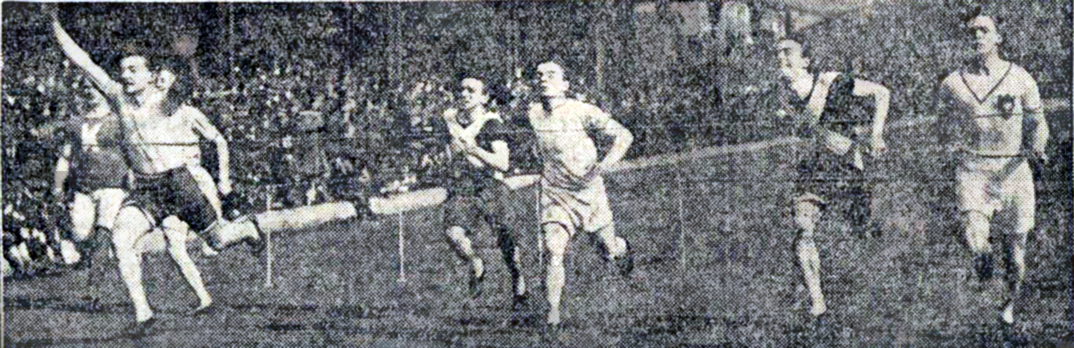
Celtic Sports: 1900 – 1910

www.rastervect.com

100 Yards race at Celtic Park in 1915

The difficulties faced by the organisers of Celtic FC Sports in the mid- to late-30’s which saw or accelerated the decline, and eventual demise of the once fine athletic meeting should not blind us to the fact that it had been running successfully since the end of the nineteenth century.   The Scottish athletic scene had many very good sports meetings, each with its own date on the calendar and this made it difficult to switch any one meeting.   Celtic’s date was the second Saturday in August and when the football season started a week earlier then there was a clash and the club had to move its sports.   Some examples of the other dates:

First week in June was Queen’s Park FC Sports, Third in June was the Glasgow Police Sports, fourth week in June was the SAAA Championships, First week in July was the Partick Thistle Sports, third week in July was Clyde FC sports – but they were for a time a professional games and they only reverted to the amateur code in 1935, first week in August was Rangers sports.    There were others – Monkland Harriers sports on last week in May, Greenock Glenpark Harriers were on the last week in July – an so on.   There was an opening on the second Saturday in July when the football season made the change necessary, but after the first CFC meeting, the organisers of the Triangular International changed the date of their fixture from June.   The Celtic meeting as a major fixture was almost certainly doomed from that date.   This page is to give some idea of the size of event that they hosted – for instance, they always needed a follow-up or supplementary meeting on the Monday after the Saturday; there were many heats in the sprints – over 20 was not uncommon and 25 were known.   We have only a brief coverage of each sports from 1900 here but they should give an indication.

*

In 1900, the Celtic FC Annual Sports Meeting was a major athletic fixture in Scotland.    Coming as it did the week after the Rangers Sports, it was the last big meeting of the summer before King Football started his winter reign.    The meting on 11th August 1900 was followed by a supplementary meeting there on the Monday evening with the same athletes from the USA, Ireland and England as well as Scotsmen.    There were also cycling events and five-a-side football.   These things did not happen by accident.   Willie Maley had been at the AAA’s Championships and ‘succeeded in inducing AF Duffy the 100 yards champion; W Long, 440 yards champion; John Flanagan, world’s record holder for hammer throwing; and John Bray, Canadian half-mile record holder, to compete at the Celtic Sports meeting on Saturday and Monday next.   This is a big catch, and all interested in athletic science must be indebted to the Celts, and through the Celts to Mr Maley for bringing such an accomplished quartette of athletes to Glasgow.’

The report on the meeting read:

“Bad as the weather was on Saturday, there was some really fine flat racing at Parkhead and in reviewing the proceedings, one can merely speculate what developments there might have been under more congenial conditions.   As it is, M Long’s remarkable running in the quarter handicap will go a long way to give the Celtic meeting this year an exalted place in athletics history.   To cover the distance in 50 seconds in pelting rain and on a sodden track is great work – the greatest perhaps that the American has put in since he came to England.   True he ran a shade faster at the English championships but the conditions at Stanford Bridge were very different from what prevailed at Parkhead, and it is when we bear this in mind that the dignity of Saturday’s performance is found.   Long now holds the “all-comers” 440 record, Bredin being the previous holder.   It was in his Heat that the American accomplished 50 seconds, and although he ran a shade slower in the Final, he had a punishing finish with McFarlane, Edinburgh Harriers  24 yards, for first place.   The invitation 100 yards handicap was the next most interesting item to Long’s record.   There were three Heats, two of which produced grand finishes, the third of which was spoiled through Tewkesbury anticipating the pistol.   The starter declared the Heat “no race” and though the American attempted to get a place, he failed.   The Final was an exciting clash.   J Ford of Motherwell Harriers, four and a half yards, beating M Long, scratch, by a foot, while Ballantyne, who comes from the Border counties was third off five and a half.    Ford never ran better than he did in this race, and the speed he disclosed in this event as well as in the 120, makes him the fastest amateur in the Western District.    The feature, or at any event, one of the features of the 120 handicap, which we may say was replete with exciting incidents – was Tewkesbury’s victory from virtual scratch, one and a half yards.   Long did not run, while both Duffy and Rowley were absent.   D Carr, an old stager, won the half-mile off 60 yards in 1 min 56 sec.   Even when in his prime, Carr has never been able to accomplish anything like this time.   Therefore we must regard this as the race of his life.  S Mitchell, another runner who has not blossomed into a winner for at least a couple of seasons, secured the mile in 4 min 25 sec off 105.”   

The supplementary meeting on the Monday was held in fine weather with a crowd of 10,000 spectators – an excellent attendance for an evening meeting and maybe a testament to the quality of the Saturday event in the rain.   The feature of the meeting was said to be the running of the American runner M Long but my attention was drawn to the winner of the fifth Heat of the open 100 yards – AS Maley (running for Celtic FC) off one and a half yards.    There were no fewer than thirteen Heats of the 100 yards, Maley was second his semi-final, and won the Final.   There were eight Heats in the 220 yards which was won by Long.    The runner who was third in the six laps steeplechase was also running for Celtic FC.    The programme also had men competing in the colours of Queen’s Park FC, Royal Albert FC and Annfield FC.

william Maley

On the Monday before the 1901 meeting, the ‘Glasgow Herald’ again remarked on Maley’s efforts.   “The Celts make their annual athletic appeal on Saturday first, and from the elaborate arrangements made by Mr William Maley, they are not likely to appeal in vain.   The American runners are the trump card this season, as they were last, and the recollections of Maxwell Long’s brilliant quarter-mile running last August should make all who saw him on that occasion anxious to see him again.   He does not come arrayed in English championship honours, as he did a year ago, but for all that his reputation is as great now as it was then.   Long is one of the pedestrian marvels of the present day, and so too is A Duffy, who has been described as “the greatest sprinter in the world for his inches”.   Duffy could not come to Glasgow last August but he is a certain starter this weekend.   He will run in the 100 yards open, while it is just possible the Celts will put up an invitation handicap for the American’s special delectation.   Duffy will teach Scotch sprinters how to start and if his example in this important matter is to be followed, we shall have faster sprinters than at present.   R Wadsley who is running at the Exhibition tonight, having arrived in the city from Manchester yesterday evening, may remain over for the Celtic Sports, and if he does, he and Long may meet in the quarter-mile handicap, in which case we will have the English championship battle all over again.   All round the entries are large and influential, even more so than in the case of Rangers on Saturday, and there should be some good sport.”   The report continued to list some of those who would be competing and in  general the article may well have helped attract at least part of the crowd.

Held on 10th August 1901, the Celtic Sports in the opinion of the reporter for the ‘Glasgow Herald’ would have had an even greater crowd than the previous year ‘but for the breakdown in the weather’ – as it was the attendance was estimated at 15,000!   Again there were Americans, Irish and English competitors as well as domestic Scots including the great John McGough of Bellahouston Harriers.    From early in the report: “It has been said by one whose opinion in athletic matters is valued highly that the Celtic meeting is the greatest in the country, and with the recollection of many fine gatherings which the club has celebrated, we are not inclined to question the verdict.”  What was in the meeting in 1901 to occasion that kind of remark?   A Duffy the American sprinter who had been invited in 1900 but had failed to turn up, was there and he beat Denis Murray of Dublin by half a yard in 10.4 – a disappointing time but he was running on sodden grass.   There were 23 heats (twenty three)  Heats of the 100 yards; the heralded American Maxwell Long won his Heat of the 440 yards but did not turn out in the Final ‘fearing a breakdown’; Baxter, the American high jumper gave an exhibition; N McIntosh (Maryhill Harriers) won the mile from John McGough who was conceding 60 yards.    McIntosh was competing the previous year as ‘Celtic FC’.     As before, there was a top-up meeting on the Monday evening with 9 heats of the 220 yards and last year’s 100 yards winner, AW Maley – was second after leading most of the way.   There were also several athletes racing in their football club colours, among them Clyde FC, Annbank FC, Hamilton Academicals FC.

“The directors of this club submitted an attractive programme, which brought together on Saturday athletes from all parts of Britain, whilst one or two well-known American sprinters &c were among the competitors.   The weather was perfect and there was a large attendance of 20,000 of the public.”

*

In 1902 the sports were on 9th August, the sports seemed to go off well, but there was only a vestigial report – they fell at the time of the Coronation of King Edward and the crowning of Queen Alexandra and the sports coverage was minimal with athletics possibly the most minimal of them all.   It could have been worse – the Rangers Sports were cancelled.  The papers were full of the coronation with pages of coverage, line drawings, diagrams, reports on all the celebratory activities.   The Herald for example had four or five broadsheet pages of reportage plus a couple of pages with short pieces covering the celebrations in many towns and villages throughout Scotland.   There was great competition for the attention of the ‘man n the street’.  Celtic had been hoping for Alfred Shrubb to come north but he had apparently already agreed to compete in fixtures nearer home.   The reporter pointed out that distance runners were very popular than sprinters in these parts “no doubt due to the fact that they give better value and more sustained excitement” than sprinters.

The 1903 sports were held on 8th August – 24 heats of the open 100 this times – with a total of six track events and four field and a total of £700 drawn at the gate.    The standard was high with, eg, Tom Nicolson against Denis Horgan of Ireland in both weight and hammer and an international high jump competition.    Coverage was limited to a couple of lines plus results but it was another very successful meeting.     The follow-up meeting was on Monday,  10th, and not only were there athletic events + cycling but there was motor cycling events in which the Scottish one mile record was broken.

The preview of the 1904 version of the club sports read, “By their ingenuity, liberality and enterprise the Celtic Football Club have created for themselves a very high ideal as sports promoters and the query on all hands is, “Will they maintain that ideal in connection with the forthcoming meeting?”   As far as we can gather they will.   In the first place it is only natural they should profit in many ways by the extraordinary exertions put forward by the Rangers FC and if they do we are at once ensured of an exhibition of athleticism equal at least to what was witnessed at Ibrox Park on Saturday.   And in the second place the Celts, possessing as they do the finest cement track in Scotland, will provide cycle racing of the very highest class.   …    Mr Maley is hopeful of inducing A Shrubb to come North for the mile handicap, and if he is successful, we will have a series of lively passages between him and John McGough.   Strange as it may seem, the Bellahouston crack has never done anything great at Parkhead and he does not like to be reminded of this by his Celtic friends.   But it is scarcely fair to upbraid him, even in a jocular way, for not establishing records at Parkhead, as by August he can hardly be at his best.”

On to the meeting on 14th August, “The Celtic Football Club on Saturday added another to the many splendid honours they have to their credit as sports administrators.   One, in fact, is left to wonder what the attendance would have been had the weather conditions been a little better.    It ruined more or less all ? , and at one time it looked rather bleak for any form of outdoor recreation, but about two o’clock there was a change for the better with the result that crowds flocked to Parkhead and it is estimated that attendance was not much under 30,000 which is a tribute to the stature of Celtic Sports.”    The fields were made up mainly of Scots with some good Englishmen taking part, many good races were held although  no records were set.   On the Monday meeting, held in better weather, also had some top class competition with the invitation 100 yards being won by the American AF Duffey ‘by inches’ from JW Morton of England in 10.6 seconds.    R Craig of Bellahouston Harriers won the 1000 yards race by about two inches in a field of 50 runners.      Duffey was considered the fastest man in the world at the time and had been encouraged to come to Scotland by William Wilton of the Rangers in 1903 for their Sports the previous week.      Duffey had been favourite in the 1900 Olympics but despite a  good run in the Heats had to pull up in the final with an injury.   American 100 yards champion in 1899, he won the AAA’s in England every year from 1900 to 1904.   He ran 9.6 for 100 in 1902, a world record, but after a quarrel with the AAU over his refusal to wear Spalding running shoes he was found guilty of breaking the amateur code.   There is genuine dispute over this verdict – the AAU President worked for Spalding Shoes and it was after the refusal to wear these that the President himself brought the accusation that Duffey had been accepting illegal expenses every year since 1899.   There seems to be little if any evidence that he did actually do a bad thing!   However, when he came to Ibrox in 1903 and Parkhead in 1904, he was still a world class athlete.   There were also cycle races and a motor bike race.   I don’t know of any other meeting during the period that actually had motor bike races at their sports but then maybe the aforementioned cement track was used for these.

What was it with Celtic Sports and the weather in August?   The weather on 12th August 1905 was again against good running.   “As luck would have it, Saturday was a bad day for athletics and while in many respects the Celtic meeting will stand out as one of the most successful of the long and brilliant series held by that club, nothing was achieved that will single it out as memorable in later years.   The sprinters had a strong wind to battle against and this very naturally had a prejudicial effect on form.   It was the strong men who in most cases carried the day, and this was perhaps more marked in the sprint than in the distance events.   Quite a number of the lighter men did not compete at all, any chance they had of distinguishing themselves being neutralised by the vigour of the breeze.   The invitation 100 yards handicap was won by  JW Morton, the English champion, in 10 3-5th sec and in  ordinary circumstances the time would have been 10 seconds.   Kitson was second with Stark third.   Lighter than the other two, undoubtedly Stark suffered by the conditions, and that he managed to even finish third, says a great deal for his pluck and determination.  JB Taylor, the American, did not break the record in the quarter.   No one expected he would in such conditions but many thought he would have done better than he did.   WD Anderson won in 51 2-5th sec off 10 yards, Blunden being a good second off 8 yards, while the American just succeeded in beating W Roxburgh for third place.   Again RS Stronach had a popular win over in the hurdles over E Amsler of America.   This is the fourth time in succession that the Scot has beaten Amsler.   On Saturday however he had less to spare than in the other races, the American running him to a couple of yards.   Where Stronach  excels is the facility with which he clears the lights.   A Shrubb lost the mile-and-a-half invitation race to G Butterfield and in view of the fact that McGough beat the Londoner a few days ago there should not be too much difficulty in allocating to each his position in the order of merit. The story of the race is that Shrubb led throughout and was overcome at the crucial stage – the sprint.   The first half-mile was done in 2 min 9 sec, the mile in 4 min 36 secand the full distance in 6 min 55 2-th sec.   The two open  sprints were won by J Smith of Bellahouston Harriers – the 100 yards off 8.5, the 220 off 15.   Smith would seem to be possessed of great sprinting resource as he won the first round in 10 3-5th sec, the second in 10 1-5th and the Final in 10 sec.   It is interesting to mention that Smith at the June meeting of the West of Scotland Harriers was in receipt of 9.5 yards from Morton and did not win, while on Saturday off a reduced mark, he carried off one of the great prizes of the year.   This is the first time this season that Smith has ventured beyond the initial stage of a handicap.   WH Mill, West of Scotland Harriers, won what, under better conditions, would have been the fastest half-mile of the season, off 35 yards: as it was the time has only once been bettered  and that was at an Edinburgh meeting.   The mile went to a stalwart Irishman, SS Lee, the Junior cross-country champion of Ireland, and the steeplechase, which provoked a constant ripple of laughter, was captured by A Russell of Walsall who enjoys a unique reputation for this class of pedestrianism.   One very marked feature of the track races, was the extraordinary success of the Bellahouston school.   Eight of the 100 yard Heats and three of the 220 yards were captured by members of that club while of the prizes they won three firsts, three seconds and three thirds.”

That is the report in its entirety and the preview of the Monday meeting concentrated on the Four Miles Handicap.  

“We are to have A Shrubb in a Four Miles Handicap  and that is something which is not seen every day.   Two years ago Shrubb ran a very fine race at the Celtic enclosure, the occasion being the summer sports of the West of Scotland Harriers, when he created record, 19 mins 32 2-th sec, which he afterwards lowered at Ibrox to 19 min 23 2-5th sec, in the historic ten miles race.   We are not likely to have either of these efforts repeated tonight, although we shall be surprised if the Englishman does not crack 20 minutes.   Last week on grass he was quite at his best, beating Alridge quite easily over four miles, and as this is the distance he favours most, we feel confident he will put in a performance worthy of the great name that he enjoys.   There are twelve entrants, distributed as follows: J McGough, Bellahouston Harriers 100 yards; S Stevenson, Clydesdale Harriers, 120 yards; PC Russell, Bellahouston Harriers, 230 yards; G McKenzie, West of Scotland Harriers 320 yards; T Robertson, Edinburgh Harriers 390 yards; J Reston, Clydesdale Harriers, 400 yards;  WJ Elliott, Herne Hill Harriers, 420 yards;    R Craig, Bellahouston Harriers, 430 yards;   WG Kerr, Clydesdale Harriers, 430 yards; T Stewart, Springburn Harriers, 450 yards; J Stewart, Maryhill Harriers, 450 yards; J Mullinch, Bellahouston Harriers, 470 yards.   In other words, Shrubb is asked to give away a lap and 30 yards which is a very formidable task.”   The 220 yards featured English and American runners as well as Scots and was also previewed fairly extensively.    It should be noted that among the runners in the Four Miles were two past or future Olympians in McGough and Stevenson and several Scottish cross-country internationalists including James Reston  who emigrated to the USA in 1920 and was the father of the great American political columnist James Scotty Reston.

After that the race had to be good.   The headline the following morning read: “SHRUBB AND McGOUGH IN GOOD FORM.”   and the article, although brief, reported on a good race.   The amateur athletic sports of the Celtic Football Club were continued last night in fine weather and before a large attendance attracted by the entry of several English cracks.  Principal interest centred in the Four Miles flat race handicap in which Shrubb, Butterfield and McGough met.   An exciting race was witnessed.   The London runner was in grand form, and starting at once to draw in his men succeeded in passing McGough when two miles had been covered.   Half a mile short of the distance, Butterfield had retired owing to the muscles in one of his legs stiffening.   After he had taken the lead of the Bellahouston man, Shrubb went straight ahead and got into first place at the end of two and three-quarter miles.   He won in 19 mins 34  seconds by fully 100 yards from McGough who completing the four miles put up a record for a Scottish runner of 20 min 6 1-5th sec, the previous best being 20 min 10 3-5th sec.”   The evening saw 16 heats of the 100 yards and 8 heats of the 220 yards as well as two cycle races.   Home Scots won the sprints.    

If 1905 was good, 1906 was better.   Held on 11th August, the report was headlined “CELTIC CARNIVAL”.    The headline act was Lieutenant Halswell but the reporter was in no doubt about the place of the Celtic FC meeting in Scottish athletics.

“All roads lead to Parkhead on the day of the Celtic FC Sports.   Glasgow people seem to have got it into their heads that all worth seeing in athletes and athletics are to be seen as they are seen nowhere else, at the meeting of the Celtic Football Club.   This is eminently flattering to the Parkhead management, though at the same time it is hard to say the least on such clubs as Clydesdale Harriers, West of Scotland Harriers and Bellahouston Harriers, all of whom in their own modest way have done, and are still doing incalculable service in the cause of athletics advancement in the city.   There was a great variety of events on Saturday: if anything the programme was a little too rich in good things.

An Epoch Maker Lieutenant Halswell was the “magnet” and it goes without saying that he rose to the dignity of the occasion.   He gave no fewer than three very noble turns, all of which were greatly appreciated, though of course the one that caught the fancy most was the 49 sec in the quarter mile, which is three-fifths better than his previous accomplished if we mistake not, in the West of Scotland Harriers June Sports at Ibrox Park.    Halswell on Saturday could have easily given the concessions that proved too severe for him at Ibrox, so full of life was he at the finish.   He was also second in the invitation 100 yards off one and a half yards, and was just defeated in the half-mile scratch by George Butterfield of Darlington Harriers in 2 min.   It was the brains of the latter that triumphed in this race and if Halswell knew as much of the science of running as the AAA mile champion, his efforts, great as they are, would be even greater.   Butterfield, for instance, would never have courted the jostling that ruined Halswell’s prospects in this race.    All the same, the Lieutenant is a fine athlete, and there is not, we are safe in saying, another runner, be he amateur or professional, who could do what he did at Parkhead on Saturday with apparently so little exertion.   Halswell’s 49 sec here is equal to 48 sec in England, and the magnificence, as well as the significance, of the performance can only be appreciated by those who are in a position to contrast the conditions in Glasgow with those in the South of England.   We are afraid Halswell will not succeed in breaking world’s record in Scotland, and for the fruition of his ambition he should go to London before the season ends.   One who has accomplished so much already should not stop till he has erased the present world’s record for the quarter.    There is a rumour that he is retiring from the path tonight, but this is not true as he has applied to the AAA for permission to run at Christiania, Norway towards the end of the month and it may be taken as certain that he will represent the rest of Scotland against Scottish Universities at Aberdeen on the occasion of the King and Queen’s visit to that city in September.   What will happen afterwards will be determined by military considerations.  

New Mile Record   Another very fine performance was John McGough’s mile record of 4 min 21 3-5th sec.   This is his second best public effort, the best being his 4 min 19 sec at the AAA’s Championships last month.   We have been expecting a new record from him for some time back; indeed, all his performances since the West Harriers meeting when he did the mile and a half in 7 min, have led up to this brilliant effort, and like every clever article, he keeps the best till last.   Being closely associated with the Celtic Football Club, McGough is naturally proud that Parkhead shares with him the glory of the record.   Tonight he will endeavour to improve on Saturday’s time and by way of aiding him,. the Celts are putting up an invitation handicap with G Butterfield, Darlington Harriers, scratch; JW Lee Heaton Harriers, 25 yards; Sam Lee, Bellahouston Harriers, 70 yards; and J Lambie, Bellahouston Harriers 80 yards.   In addition there is the 1000 yards handicap, which will be quite as interesting as the mile, from the fact that Lieutenant Halswell is to run.   Last Monday night, George Butterfield managed to slice a fifth of a second off  the all-comers record which had resisted every onslaught.     It was an excellent performance and will give the Rangers carnival a prominent place in athletics history.   Butterfields time was 2 min 16 4-5th sec with which he displaces the name of FE Bacon, one of the great athletes of the Victorian era.   Halswell has designs on the 1000 yards record and, if he can stay the distance, certainly has the necessary pace; but how he will negotiate the large field is another matter.   Vallance who won the open half-mile in 2 min off 13 yards is off 10 in the 1000 and the man who can plough through a field of seventy runners, as he did on Saturday, is possessed of greater speed and stamina than he has previously been credited with.   Taking the time of the open half, and that of the special invitation – 2 min – there was evidently not need for a special race over this distance, as the backmarkers would have been supreme in the one as they were in the other.”

The report continued with coverage of the sprints but the big events had clearly been the endurance races mentioned above.   As for the Monday session, the sport was good, the crowd was large and appreciative but no records were set.

McGough and Butterfield were again present and in action on both sessions in 1907 and, following the example of Rangers FC, a five-a-side tournament was introduced with four teams competing – Celtic, Rangers, Partick Thistle and Clyde – on the Monday evening.    Of the Saturday the report read – “Failure as a term has no place in the vocabulary of the Celtic FC.   All the years they have held sports, they have drawn immense crowds, and we should say that Saturday’s attendance will compare favourably with the past.   There must have been 20,000 people present, while the private enclosures were as well patronised as on the occasion of an important football match.   Nor was the large crowd sent away disappointed. With the exception of the world’s cycling champion, all who were advertised to appear, were present.     Throughout there was some excellent sport and there is a general impression that it would have been even better but for the negative effect of the wind which, in the case of the sprinters, was right in their teeth.”    The sprints were contested by Scottish, English and American runners, the invitation mile was won by an Englishman and ‘neither McGough nor Butterfield were seen to advantage’, and it was pointed out that Bellahouston Harriers had four wins to their credit.   There was an interesting comment that I will quote without adornment:  “The open 100 yards which has lost a lot of its monetary charm in consequence of the suppression of open betting, was won by GJ McNeil (Kilbirnie).”

 The Monday session attracted approximately 5000 spectators and the star was the American Nat Cartmell who won the invitation 120 yards plus the 220 yards handicap.   There were thirteen heats of the 100, necessitating semi-finals as well as final  and seven heats of the 220 which had no semi-finals.   In the 1000 yards, there were 36 runners with Butterfield and McGouch on scratch but they did not finish.    The weather of course played  its part – a torrential downpour just before the start affected the attendance and left some puddles on the track and infield

The crowd numbers quoted for these meetings generally are astonishing to the present day athletics supporters – in 1907 there were 20,000+ spectators over the Saturday afternoon and Monday evening events.    The numbers competing are no less surprising – at times over 100 in a mile handicap, 25 or more heats of a good 100 yards.    Some say that Scots today ‘love their sport’ but that generally means they love watching football.    This was the first time that Celtic had 5-a-sides at their athletics meetig and the crowds were not really appreciably bigger than in previous years.   Have we really more to do with our time these days?   Is the  publicity and ‘selling of the events’ less than it was then?    Is athletics less entertaining?

The Rangers Sports at this time also had two meetings – the big Saturday one and the supplementary on the Monday with a couple of featured races and a restricted programme of, in the main, local events.   The net result was a wonderful ten days when the Glasgow citizenry had the Rangers Sport on the Saturda and the Monday followed five days later by the Celtic Sports on the Saturday. Normally there would have been a fourth session – the Celtic Monday meeting – but in 1908 for some reason this did not happen.   The success of all these meetings in the London Olympics year of 1908 was noted in an article praising the efforts of both clubs to provide top-grade entertainment.

AN ATHLETIC BOOM

Last week was a memorable one in the sporting history of the city, [reported the Glasgow Herald of 10th August 1908].   On Monday the Rangers FC concluded what from every point of view had been the most successful meeting that they had held for a very long time, while on Saturday Celtic FC added one more to their brilliant list of triumphs.   Both are in the fortunate position of having money to spend, and money judiciously handled will yield, as we have just seen, as big a return from athletics as from most forms of public amusement.   That there was more lavish expenditure this season than previously is frankly acknowledged by the two managements and, without pausing to inquire how this sort of thing squares with official notions, we would merely mention that the Glasgow public has much to be grateful for to the Rangers and Celtic for introducing so many of those who distinguished themselves at the recent Olympic Games.  But for those clubs it is just possible that we might never have had the privilege of seeing Melvin Sheppard, Reginald Walker and others who, by their achievements at the stadium, have enrolled themselves in the lists of the immortals.   All are agreed that good as the racing was at Ibrox on the first day, it was infinitely better on Monday evening.   General excellence took the place of individual excellence for the greater part and, after all, there is a greater source of satisfaction in this   than in the creation of records, the one being the gratification of personal ambition, the other being the manifestation of universal competitive interest.   It is difficult to say whether Reginald Walker’s win in the open sprint or Sheppard’s win in the half-mile was the finer effort.   Both are monumental in that the time in the sprint is likely to be bracketed with JM Cowie’s record of 10 sec while Sheppard’s half-mile will rank as one of the finest ever witnessed in Britain and its significance is greatly enhanced by the fact that for a third of the distance he may be said to have cut out his own pace.  It was however a disappointment to many at Ibrox that that he did not run in the handicap specially prepared for him.   Those who saw Walker’s finish in the final of the 100 yards handicap will never forget it.   At 20 yards from home he seemed hopelessly beaten but with a supreme effort managed to break the tape first.    …..

As we have seen, the Rangers function scintillated with excitement and there was a renewal of this form of appreciation at Parkhead on Saturday afternoon.   If anything, however, the Celts programme was too large.   A start was made at 2:45 and it was seven o’clock when the last event was decided.   Roughly speaking there were four hours sport and, however interesting the proceedings, it was felt that for once, the limits of discretion had been exceeded.    No athletic meting should exceed two and a half hours, or at most three hours, and when a programme cannot be compressed within those limits there is a miscalculation  of public endurance.     Where the Celts erred was in combining a two days programme into one; but in this connection we are in a position to state that in another year there will be a return to the custom of a double meeting which, as we had occasion to remark recently, should never have been departed from, least of all this season when the country at large was extending hospitality to so many eminent American athletes …

Reginald Walker of South Africa, who had an excellent appreciation of everything Scotch except the climate, only ran in the 100 yards at Parkhead where he was third but Sheppard turned out in the half-mile.   “Perhaps the best performance of the afternoon was M Sheppard’s half-mile in 1 min 56 1-5th sec or a fifth worse than his time at Ibrox last Monday.   This is a marvellous performance when allowance is made for the fury of the breeze.   Under normal Glasgow conditions, it is believed Sheppard, paced as he was, would have come close to his world’s record time at the Olympic Games.   T Fairbairn Crawford is entitled to part of the honour as he ran a vigorous race.   Lieutenant Halswell did not run in the quarter which lost all of its interest on that account.   ….   the winner of the open mile, G Dallas, who is a good cross-country runner, finished quite fresh in 4 min 22 3-5th sec.”
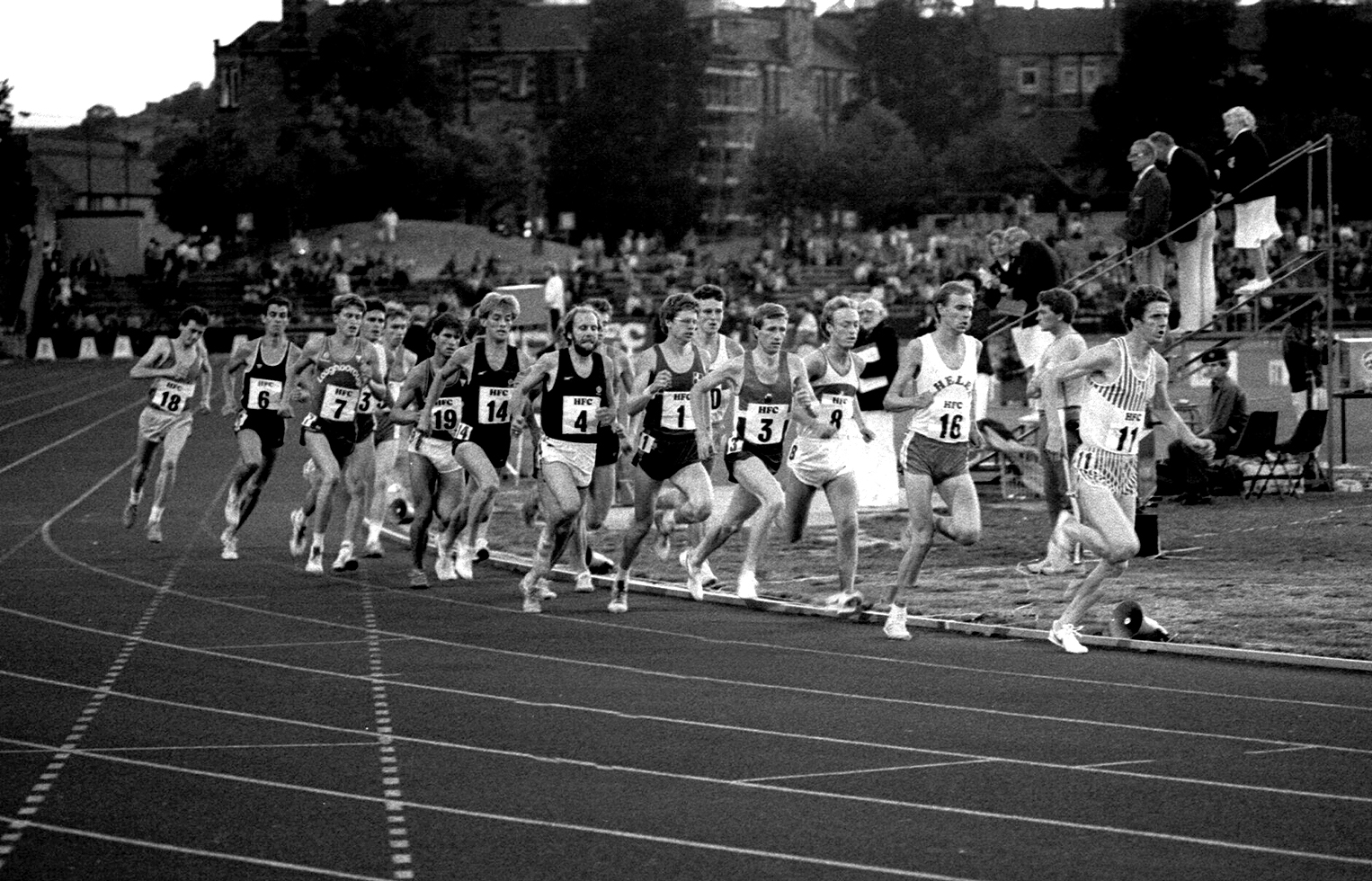
There was a total of 11 running events plus cycle racing plus several field events on the programme.   The comments on the money available to the two clubs and the comment on how ‘money judiciously spent squares with official notions’ is a leading one.

The meeting on 14th August 1909 was held under a cloud: Mr McLaughlin, the Celtic chairman who had been a key figure in organising the sports had died and there was talk of cancelling the meeting.   It went ahead because there were several English runners who had travelled a long way to compete.   It was nevertheless a low-key affair with the top men being Cartmell, Rodger and Tom Jack.

Steeplechase, Celtic Sports, 1910  (Photo courtesy Eric Giacoletti)

“Glasgow Herald” Report:

In 1910, the story was very different and the report started: “Everything for the time being seemed to contribute to the magnificent success which the Celtic management scored in connection with their amateur athletic sports on Saturday: the weather was charming, the huge crowd were in excellent spirits, the running, if never sensational, was always interesting and often exciting and, all combined, gave quite a distinctive note to the meeting.   But amid so much of a congratulatory character, there was a pretty general feeling that the programme assumed pretty unreasonable dimensions.   Apart from motor-cycle flights, which cannot be described as sport by any stretch of the imagination, there were no fewer than 15 races, not to mention countless heats and a five-a-side football competition.”   There was much more about the length of the meeting and the need for a ‘pruning knife’  – similar to previous comments on the meeting and to several others such as the Glasgow Police Sports which were notorious for over-running.   In the sports themselves, EW Haley from London won three of the four invitation events – the 100 yards, the 220 yards and the 440 yards – with the other, the invitation half mile, being won by JC English (Manchester AC) in 1 min 57 1-5th off 20 yards but a new record 1 min 58 2-5th sec was set by R Burton, the SAAA Champion who was third finisher.   John McGough was defeated in the Mile by Owen (Broughton Harriers) who was giving him 20 yards.   After several years of criticising the organisation of the sports, the final sentence of the report read, Considering the magnitude of the programme, the arrangements were highly creditable to Mr W Maley who deserves special credit for the triumph which crowned his labours on Saturday.”

 Having come from 1900 to 1910, we will soon start a new page for 1910 to 1920 but it is clear from the little reported here that the Celtic FC Sports were major events that attracted some of the top athletes of the day to Parkhead.

Celtic Sports: 1911 – 1920

CELTIC SPORTS 12.08.10

Programme courtesy Mr A Mitchell

The Celtic Programme of August 1910

By 1911, the Celtic Sports was one of the biggest meetings in the country and the second Saturday in August was the date.  Coming as it did one week after the Rangers FC Sports, it completed a week of top class sporting action in the city with tens of thousands attending the Saturday meetings.   Both clubs put on Monday ‘supplementary’ meetings too which regularly attracted 5000-8000 a time.   In 1911 the Celtic FC Sports meeting was held on 14th August.

It was a huge success.   Even the ‘Glasgow Herald’ reporter had difficulties toning down his exuberance as he wrote of it.   “Besides FL Ramsdell, HE Gissing and JJ Flanagan of America, several distinguished English athletes and cyclists took part in the annual sports of Celtic FC at Parkhead on Saturday and, as a consequence, competition in many events was very much above the average of what is usually witnessed in the city, celebrated as it is for its rare sporting associations.   The Celtic management spare neither money nor time in connection with their sports, and this season by way of celebrating an interesting epoch in their history, they extended more invitations than they usually do, with the result that Saturday’s meeting in many respects will hold a cherished position in the club’s records.   Large as the attendance was, it it would have been larger still but for the tramway strike.   As it was, the official estimate was 30,000.   The arrangements of Mr Maley were in advance of anything previously witnessed at Parkhead, and when we mention that over and above football there were 53 different events all of which were disposed of in three hours and a half, it will be admitted that there has been nothing better in the way of athletics management seen in the city.   Every item was so rapidly dealt with that there was scarcely any time for reflection.  

HE Gissing won the invitation half mile in 1 min 58 sec which in cold type does not compare with his recent efforts at Ibrox and Parkhead.   It should be noted, however that weather conditions on Saturday were somewhat against fast times, though, had he taken part in the open 880 yards which was done in 1 min55 2-5th sec, it is just possible that we might have got a sensational performance.   Gissing, however has imparted gaiety to Scottish athletics this season and his three half-miles and 1000 yards efforts will not soon be forgotten.   The 100 yards special handicap was brilliantly won by VH D’Arcy of Polytechnic Harriers.  He had two yards from Ramsdell and finished a yard ahead of RC Duncan in 10 1-10th sec, which is a yard worse than “evens”.   D’Arcy is a very powerful finisher but a bad beginner.   Ramsdell was not at his best in this race, and this is not surprising in view of the amount of travelling and running he has put in this week.   In the furlong however he had the satisfaction of winning by a short distance from RC Duncan in 223-5th sec.   The Polytechnic crack did not run in this race while Duncan and others were at a disadvantage  owing to the fact that they had just taken part in a strenuous relay race.   Both Gissing and Ramsdell were favoured in this respect.   ….. “

Harry Gissing was a member of the Irish-American Athletic Club of New York and a noted middle distance runner, Ramsdell was a sprinter from the University of Pennsylvania and Cornell and JJ Flanagan was an Olympic record breaking hammer thrower who won three Olympic gold medals, the first of these being in 1900.   At Parkhead Flanagan was second in the handicap hammer thgrow to Scotland’s T Nicolson who had a 10′ handicap allowance.    But the Americans were indeed as good as the reporter from the ‘Herald’ said they were.

The comments on Willie Maley’s management skills are interesting but not really surprising.  He had been involved in the sport since the early 1890’s with Clydesdale Harriers, was now on the SAAA Committee where he would later be tasked with leading a post-war committee on the re-establishment of the sport after the 1914-18 war.   In addition both Ibrox and Parkhead were used for several sports meetings every summer – some by clubs such as Clydesdale Harriers (who favoured Ibrox but also used Parkhead ), Shettleston Harriers (who favoured Parkhead), West of Scotland Harriers (who moved from one ground to another depending on when they held their meetings), and some by a variety of public services such as  Glasgow Transport (who favoured Helenvale), Glasgow Police (who favoured Ibrox) and Lanarkshire Police who latterly went to Shawfield).   The result was that the groundsmen became expert in getting the impedimenta associated with every event on and off with minimum fuss, the organisers had good connections with the governing bodies and athletic clubs and there was generally a high level of expertise at all clubs.  Possibly higher than at some specialist venues in the twenty first century.

Celtic Programme CH

If 1911 was good, 1912 was better with an estimated 40,000 spectators at Parkhead on a sunny and warm afternoon to see even more American and English athletes in action.   The half-mile scratch race was won by America’s Melvin Sheppard (Irish American Club) from Germany’s Braun with JE Meredith of the American Olympic team third, but only in a time of 1:58 – in a refrain that was familiar over the years, not as fast as he had done at Ibrox the previous Saturday.   Hardly surprising at the end of a long season with two races the week before.   The race was said to be disappointing with Meredith dropping out with 200 yards to go.   The Mile was won by Ireland’s R Hales of Donore Harriers in 4 min 24 4-5th sec and WR Lippincott of the American Olympic team was third in the invitation 220 yards handicap behind Hawich RFC wing three-quarter WR Sutherland of Teviotdale Harriers (8 yards) and RC Duncan of West of Scotland Harriers.

The meeting on Tuesday promised a very good 1000 yards invitation with Sheppard, Braun and Meredith, all off scratch, George Dallas Maryhill Harriers) and Sam S Watt (Clydesdale Harriers) off 38 yards, in a field of 38 entries.   There were also invitation races at 100 yards and two miles.   As it happened all three scratch men ran in the 1000 yards but were unplaced with the winner being L Littler (Bellahouston) off 80 yards from JB Thomson of West of Scotland off 95 yards.   Part of the explanation might lie in the fact that they Olympians all ran in a scratch invitation 440 yards with Sheppard winning in 51 4-5th seconds.   There were two five-a-side tournaments, Rangers defeated Airdrieonians in the Senior final and Petershill beat Shettleston in the Junior 5-a-sides.   The motor cycles were also in action as were pedal cycles.   The crowd was estimated at 5000.

1913 was the year Willie Applegarth set a Scottish 100 yards record at Ibrox and then broke the 220 yards record at Parkhead seven days later!   Applegarth was one of the best sprinters in the world and ran in the 1912 Olympic 100 metres, 200 metres and as a member of the GB 4 x 100 relay team and in the process won bronze in the 200m and gold in the relay.      A year later he was racing in Glasgow so he was probably at his best.  He turned pro in 1914 and emigrated to the USA in 1922.  But it was a real coup for Rangers FC and Celtic FC to have such a runner at their meetings.  This probably contributed to the 36,000 who turned up to spectate.

The record was discussed first.   “A new Scottish record at 220 yards was created by WR Applegarth, who, it will be remembered, broke the 100 yards record at Ibrox the previous Saturday.   The new time for the distance was accomplished in the seventh heat of the open handicap at the distance.   Applegarth was on scratch, conceding starts up to 25 yards.   He ran strongly all the way just overtaking in the last two yards T McAllister the winner of the two sprints at the Rangers Sports who had 18 yards.   Applegarth’s time was 22 seconds, or one fifth better than the record established by DF Lippincott at Ibrox last August.”   Applegarth also ran in the 120 yards off scratch but finished second, and in the 220 final he caught his foot on the inside of the bend, failed to recover and finished out of the prizes.      In the distance races, the three miles handicap was won by England’s E Glover from Ireland’s P Flynn and A Loch of Clydesdale Harriers in third.   Loch also won the handicap mile and George Dallas won the invitation 500 yards.

August 15th, 1914, was the date for the last big amateur meeting in Scotland before the declaration of war.    At Parkhead, for that is where it was held, there was yet another American to add to those seen in recent years:   Homer Baker.   Baker was the US half-mile champion in 1913 and 1914 and toured Europe in 1914, winning the AAA’s title from Albert Hill.    He ad a best time of 1:56..4 and held the world best for 660 yards of 1:20.4 for 26 years.

He was written of as follows: “Homer Baker has the genius of racing in a fuller degree than any other American that has visited Glasgow.   An estimate of this kind, of course, is based entirely on times accomplished, and Baker’s excel those of Melvin Sheppard, HE Gissing and others of remoter days.   Baker was less favoured in the matter of weather than than were Sheppard or Gissing when they made their records at Ibrox, and when that is borne in mind, the value of his efforts is greatly enhanced.   Let us recall Baker’s performances in Glasgow.   At the Rangers Sports he took part in the half mile handicap and was third in his heat in 1 min 56 sec, thus equalling Scottish record.   In the final he finished fourth a shade worse than existing record.   The double journey does not appeal to many Americans any more than to some of our own runners, but it is inevitable when there are 80 runners.   In the 1000 yards handicap at Ibrox, Baker was first in 2 min 16 2-5th sec or a fifth faster than Gissing’s time in 1911.   At the Celtic Sports, the American won the invitation half-mile handicap in 1 min 55 4-5th which is a fifth faster than Sheppard’s time at the Rangers Sports in 1908, and it is reasonable to assume tat in more favourable weather conditions he would have accomplished an even finer performance – some say 1 min 54 sec at least.   At the English championship in July, Baker won the half-mile in 1 min 54 2-5th sec but his Celtic performance is even better when the relative ground conditions are taken into account.   Baker on Tuesday evening of last week finished fourth in the 1000 yards in 2 min 16 sec.   All the watches were on the American and the time may therefore be taken as authentic.   These form a casket of memorable performances.    They impart to the season much the same importance as WR Applegarth gave to last summer’s racing.   Baker sailed for home last Saturday and expects to take part in the American championships next month.   He is much pleased with the cordiality experienced at Ibrox and Parkhead and the hospitality of the Celtic will remain in his own words “a cherished memory for years.”

It was however impossible to get away from the what which was inevitable and the column which had the above report on Baker had this a bit further down.   Many clubs from all sports also made donations of money and all had members serving in the forces.   It is worth bearing these circumstances in mind when reading about the various athletic meetings up to 1918.   The freedom of American to come and go at this time when their country was not involved in the war is also noted.

SPORT AND WAR

 Sporting bodies are contributing munificently to the various war funds.   First and foremost up to the present is the Scottish Football Association’s  £1000 with the promise of more if required; an excellent second is the Scottish Football Union with £500.   The Celtic, true to one of the fundamental principles on which the club was established, contributes £100 and the MCC, the fountain head of cricket, has has given £250 to the Prince of Wales’s Fund.   These examples are expected to be widely followed during the present week: – Several of the Glasgow Academicals have joined Lord Tullibardine’s new force    – Mobilisation of the Territorials prevented WF Taylor, President of the Bellahouston Harriers; JM Taylor of the West of Scotland Harriers, and others taking part in the recent sports of the Celtic FC;   – WR Applegarth was a Territorial but resigned last summer, it is just possible he may rejoin his old regiment;   – it is stated that no fewer than 600 applications have been received by Cambridge Officers Territorial Corps, and that headquarters have been opened at Corpus Christi College.   Students who have been prominently identified with sports of the ‘Varsity, especially rowing, are predominant among the applicants;   – Colonel JD Boswell, an ex-President of the Scottish Football Union, is with the Ayrshire Yeomanry;   – T Barrie Erskine, Clydesdale Harriers is proceeding immediately to join the Officers Special Reserve on active service, and his brother Ralph, the ex-amateur lightweight champion, will also join the forces;   – the Open Amateur Golf Championship of Irelandwhich was to have been held at Portrush in the first weekend in September has been abandoned owing to the crisis;   – WR Milligan, who has been at the head of the Rugby reformers in the district, has re-enlisted with the 5th Scottish Rifles;   – It has been suggested that in the event of the receipts of the League clubs falling off to the extent anticipated, the professionals should assist to ease the situation by consenting to take reduced wages.   – Ronald Cowan, who played several games for West of Scotland last season, has taken a commission in the 6th HLI, the head of which, Colonel Cochrane, is an old rugby footballer.   Cowan’s military experience was gained at Merchiston as a cadet.   – There is some anxiety at Derby with regard to S Bloomer, the English international “soccer” player, who went to Berlin as coach shortly before  hostilities broke out.   – Glasgow University is giving the flower of its athletic resources to the war.   The following , among others, have volunteered through the Officers Training Corps for commissions.  (a) in the Territorial Force for home defence;   (b) in the Special Reserve of Officers, the latter to fill vacancies as they occur in the regular army:-   Territorial Force – J Hood, J Andrew, J Millar (Rugby)A Kennedy (tennis), – Gilchrist (hockey);   Special Reserve – WE Maitland, JN MacKay, FE Ferguson, TC Caldwell, HH Spencer (rugby), DM Hill (tennis), HT Alexander, MT Allen, P McQuaker, HEC Bacon, GH Davis (hockey).   Dr Stanley Robertson has joined the Navy.   JB Sweet of international Rugby fame, has also taken a commission in the reserve.

On 14th August 1915, in front of a crowd of 18,000,   it was a purely domestic field although there were several quality athletes in action including J Wilson who won the mile.   The programme included flat handicaps at 100 yards, 220 yards, 440 yards, 880 yards and one mile plus a 100 yards for military personnel and an invitation military marathon race and a five-a-side tournament.   “For the open events there were large entries, for the 100 yards being 52 and the furlong 50.   Proceedings began with the half mile handicap, for which there was an entry of 37, but several of the entrants did not run.   G Dallas (Maryhill Harriers), virtual scratch at 8 yards, was generally expected to win the race, but though he caught the field with 100 yards to go, he failed to  finish at his usual pace, and was fourth at the tape.  J Wilson, the Scottish four miles champion, competed in the mile, in which he showed a considerable improvement on his form throughout the season, winning winning by a yard in 4 min 28 sec.   Six teams entered for the marathon race, which was run on the track, and resulted in an easy win for the for the first team of the 8th Provisional Battalion HLI.
If 18,000 was a good crowd for wartime, the attendance in 1916 was estimated at 40,000.   There were three events for the military – 100 yards flat race handicap military, the three miles military marathon race and the six laps steeplechase (military and navy) – as well as four open races and a five-a-side tournament.  The report read:   “The Celtic Football Club has the happy knack of introducing a touch of originality into the programme of its athletic sports.   In consequence it usually reaps a rich harvest.   Many novel items were presented on Saturday and these first attracted and then pleased a large crowd.   Enterprise met with its fitting reward.   It is however impossible to escape from the feeling that the programme was overloaded and that the enjoyment of the spectators was diminished by the necessity of simultaneously watching a variety of happenings.   The dissipation of attention subtracted from the intensity of the pleasure.   A reproduction of the methods of bomb-throwing under trench conditions was both picturesque and educative, and left a clear impression of the accuracy with which such missiles can be directed.   The military marathon severely tested the stamina of the competitors and the Royal Scots Fusiliers, who won, showed remarkable freshness after such a gruelling ordeal.   Sailors from HMS Pactolus created amusement in an obstacle race, and the boys of Westhorn School gave a pleasing display of physical drill.   The element of pageantry was provided by a procession symbolic of the Allied cause, but it is to be feared that the feature was greater in conception than in execution.   However it pleased the crowd, ever ready to respond to any stimulus to their patriotism.    From the foregoing catalogue of novelties, it will be apparent that ordinary athletics were overshadowed.   Generally speaking the running lacked distinction although it was never commonplace.   The outstanding character was Joe Gamble of the Irish Guards, but he was not in his best form.   …. “

A very interesting report in lots of ways but the fact that the event was still going ahead during the hostilities and still attracting a crowd of that size must have been encouraging.

A good meeting on a good day with a domestic field.   In 1916, the crowd was again thought to be about 40,000, a programme of four events – 100, 220, 880 and Mile – was carried through along with the three ‘military only’ events but the report was vestigial.   The country at large had other things to think of.   On the athletic front, a sports meeting had been organised in 1915 and again in 1916 by Harland and Wolff at Ibrox in aid of local war funds.    I couldn’t find the report of the 1917 meeting but in 1918, on 10th August, 30,000 spectators turned up for the meeting which had seven events, five-a-side football, a gymnastic display by the boys of Westhorn School and a parade by the bands of the Royal Scots Fusiliers which ‘blended pipes and brass’ plus a parade ‘symbolic of the Alliance against Germany.’     For all that the athletics ‘did not fail in attractiveness’, the report was scanty with the invitation 220 yards being the highlight of the afternoon.

Celtic 1919

Celtic FC Sports: 1918 – 1935

The cartoon above shows just how much money Maley was making in football, for the club of course, more than he would have made from athletics, but the interest in the sport continued.

Willie Maley: SAAA President 1920-21

The sports continued throughout the War and the story of that period (with a slight overlap up to 1920) can be read here – Celtic Sports: 1911- 1920.  

This page begins at the end of the First World War and the position of their manager Willie Maley.   As is well known, Maley was a runner with Clydesdale Harriers who sprung a surprise when he won the SAAU 100 yards championship at Hampden in 1896.   He had been on the Harriers football committee and had possibly trained with them at Ibrox before being approached to join the football club.   His love of the sport did not fade however and he was a member of the SAAA and became President in 1920-21, going on to become a Life Vice President.   He was always active on the athletics front, and one of the big jobs he was given was that of the re-structuring of the sport after the War.   At the SAAA AGM in February 1919 he was elected vice president and on to many sub committees.   He was on the Finance Committee (as was Matthew Dickson), on the International Conference group, on the West District Permits Committee, the Handicapping Board of Control and the Reconstruction Committee.    If ever there were a record of involvement in athletics, it is in this imposing list of responsibilities

He presided over a meeting in Edinburgh in 1919 to review the recommendations of the Reconstruction Committee referred to above.   There were seven recommendations to be approved:

  1. Applications for reinstatement from pre-war professionals were to be decided on their merits;  applications from amateurs who may have forfeited their status during the war be viewed sympathetically;
  2. The Scottish Police Force, still outside the Association should be approached with a view to getting them into line with those forces affiliated with the SAAA.
  3. That an endeavour be made to persuade the Executives of Highland Gatherings to hold their sports under SAAA laws.
  4. To ask clubs to hold events for schoolboys in their sports programmes, and in the case of clubs with grounds of their own to allow for training facilities and to endeavour to get old athletes to attend the leading grounds  to coach boys in field and other events;
  5. Give greater encouragement to field events;
  6. To approach the railway companies with a view to getting reduced fares for competitors at athletic meetings;
  7. To circularise all Higher Grade and Secondary Schools to hold sports wherever practicable and to send a similar circular to clubs whose one time annual sports have been allowed to lapse.

Other recommendations included (a) the setting up of a organisation with a subscribing membership in each county; (b) the promotion of county championships for track and field, cross country, elementary schools championships, secondary schools championships; (c) to form similar organisations in each county and burgh, rural and urban districts; (d) “believing that prizes of large intrinsic value are prejudicial to true amateurism, the Committee recommends that the limit of value for an individual prize shall be £1”: in this respect I quote from the Clydesdale Harriers Committee Meeting Minute of 24/2/20, “Mr McGregor reported that he had attended a meeting of the SAAA and that the motion to increase the prize limit from £7:7:0 to £10:10:0 had been passed unanimously”  (e) a manual for the organisation and management of athletics should be prepared for circulation.

This is not the place to discuss these interesting recommendations or to speculate on what would have happened if they had been adopted in their entirety.

www.rastervect.com

THE CELTIC SPORTS

All photographs from Alex Wilson

In addition to the work on the committee and various sub-committees of the SAAA, he helped organise the annual club sports and it is unlikely that he did not have a hand in the many athletics events hosted at Celtic Park.

The first sports meeting after the war was on 10th August 1918 and referred to as the Celtic gala.   It included ‘a series of spectacular items’ such as the Band of the Royal Scots Fusiliers which provided the novelty of both pipes and brass instruments, the youths of Westthorn School provided a gymnastics display, and the ‘management introduced an element of pageantry into the programme by means of a parade symbolic of the alliance against Germany, as well as the obligatory five-a-side football.   As far as what were termed ‘the more particularly athletic events’ were concerned, the race of the day was the invitation furlong in which an Argentinian called Bollini finished second to a Scot called Mcfadden (further details were not published by the Glasgow Herald’) and the Two Miles handicap was a hard battle between from W Ross and G Malcolm, both from Edinburgh with Ross (off 15 yards) winning from his rival who was off 105 yards.

A year on, the situation was a bit more back to normal, and the meeting was held on 9th August 1919.   The report from the “Glasgow Herald” was as follows:

“RECORDS AT PARKHEAD.   Evidently the officials at the Celtic Football Club expected that new records would be created in the half and one mile at Parkhead on Saturday, as the best times on the books of the Scottish Amateur Athletic Association for these distances were given in the programme.   Expectation was fulfilled, Sgt Mason lowering the half-mile time, and AG Hill that of the mile.   In one way Hill’s performance was the more meritorious, as the mile was an open event and the English mile champion had a very large field to get through.   In the circumstances he did remarkably well, in reducing by 1 2-5th seconds a record that has stood since 1894.   The weather was favourable for fast running, and good times were registered throughout the afternoon – that of the open 100 yards for instance being recorded as 10 seconds, the 220 yards at 22 seconds, and the mile at 4 min 17 13 4-5th seconds.   The mile was won from 145 yards and it is not surprising that Hill – who of course ran the full distance – failed to finish first.
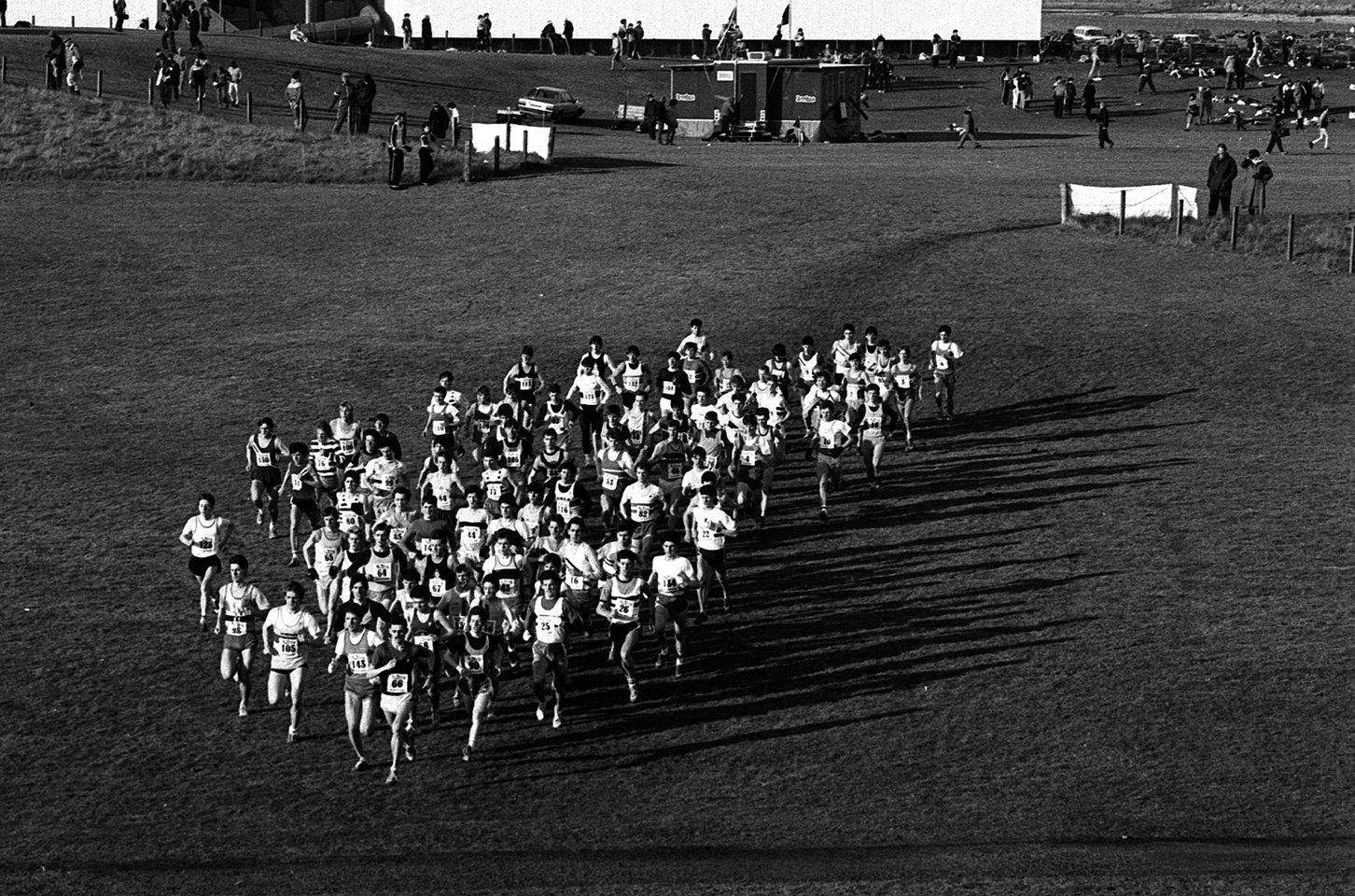
The other record was made in the invitation half-mile, which had an entry of 14, although some of those, including Hill, did not turn out.   Sergeant Mason had an allowance of 10 yards but in the champion’s absence, he preferred to start from scratch, and justified his optimism by winning the race and beating Homer Baker’s 1 min 55 4-5th sec by two fifths.   Next to Mason’s successful attempt on record, the feature of the event was the fine effort of S Small, who from 30 yards, ran a good race and was actually moving faster than the New Zealander at the finish.      …..   None of the southern visitors entered for the half-mile, and most abstained from the furlong probably in view of the relay race towards the end of the programme.   By running this event on handicap terms, the issue was made more open that it otherwise would have been; but before the start, Maryhill Harriers were not too confident that the 45 yards allowed them would enable them to beat the Polytechnic, and the fear proved well founded.”  

There were about 30,000 spectators and the entries included ‘several well-known English and Colonial runners.’   The relay was won by Poly Harriers in 3 Min 32 4-5th sec, with Maryhill second and a Celtic Select third.   The team was Sgt Mason, JB Bell, MC Cook and Sgt Lindsay.

The sports of 1920 had a huge entry. For instance “with 22 preliminary heats of the 100 yards, interest began to flag, though it must be confessed that a similar complaint could not be made of the 19 heats of the furlong.”   the sheer number of entries in 1920 necessitated semi-finals as well as heats before a final could be run.   Despite the prolongation of the meeting this occasioned, there were three invitation events that were of the highest class.   One of these was the half-mile in which W Ross of Edinburgh, running from a mark of 12 yards beat the scratch runner GL Morgan of Salford by a yard.   There was an invitation 120 yards race from which three of the eight invited withdrew.   Gagan of Salford won from AH Goodwin (Maryhill Harriers) – who had already run a heat and semi-final of the open sprint!   In the invitation 220, Dumbarton runner A Gordon won by a foot from S Colberry (Maryhill Harriers).

Clearly a very successful meeting with an almost entirely domestic entry.   The fact that it was almost the final event of the season and the fact that t was coming one week after the Rangers Sports in no way affected the enthusiasm of the paying Glasgow public.   The venue itself was popular, with meetings organised by many clubs – Maryhill Harriers, Shettleston Harriers, Clydesdale Harriers and especially St Peter’s AAC holding good meetings at Parkhead.   The SAAA Championships, the first after the War, were held there in June 1919 with the 10 miles championship also held at Celtic Park in April that year.   The championship would be held there again in 1921 and 1923 while the 10 miles would be held there again in 1920, ’21 and ’22 (and fairly frequently thereafter).    There was still a preference for Hampden and Ibrox was also very popular but Celtic Park was a recognised championship venue.

Programme courtesy Andy Mitchell

In 1921, Albert Hill and Eric Liddell were in action on the track and the standard generally was the highest it had been since 1919.   Before that, the national 10 miles and seven miles walking championships had been held there on 30th April, and the championships proper had been on 25th June.   In these, Eric Liddell won the 100/220 yards double, Duncan McPhee had won the 880 yards/Mile double, and Tom Nicolson had won the Putting the Weight, Throwing the Hammer, and Throwing the Hammer (standing style) triple.   August had started with the Rangers Sports on the first Saturday and the Celtic event was on the second Saturday, the 14th.   We often complain now of the dominance of football but it seems that this has always been the case.   The report begins,
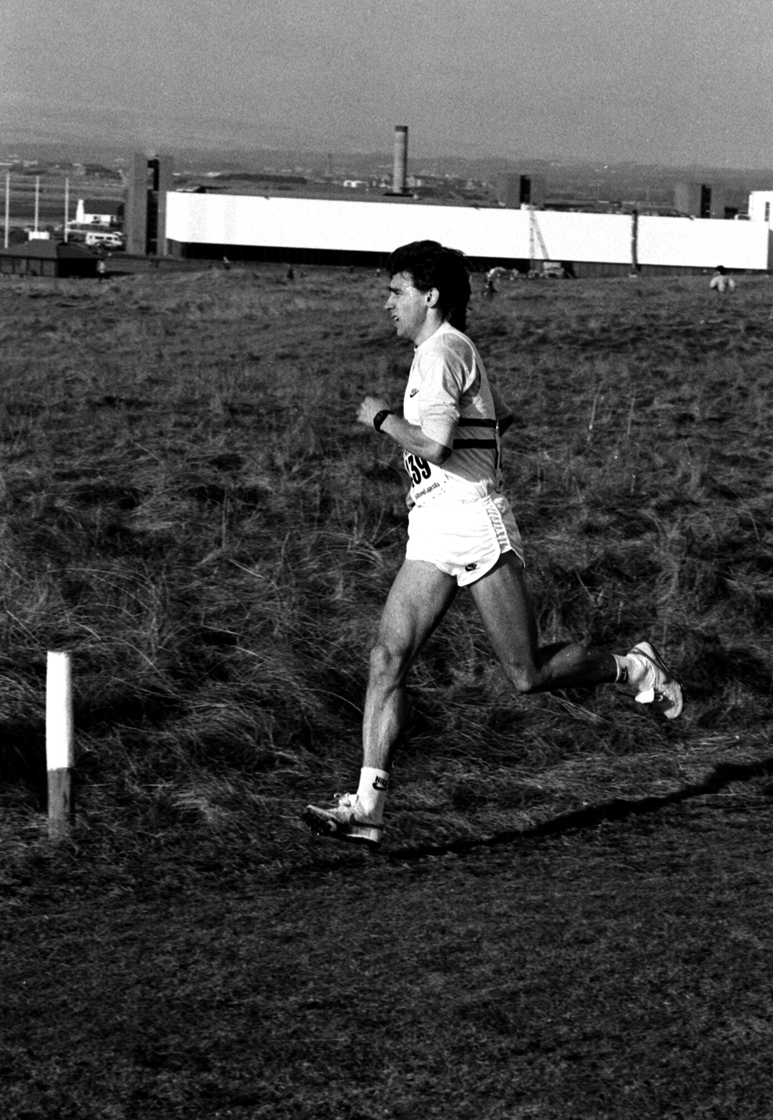
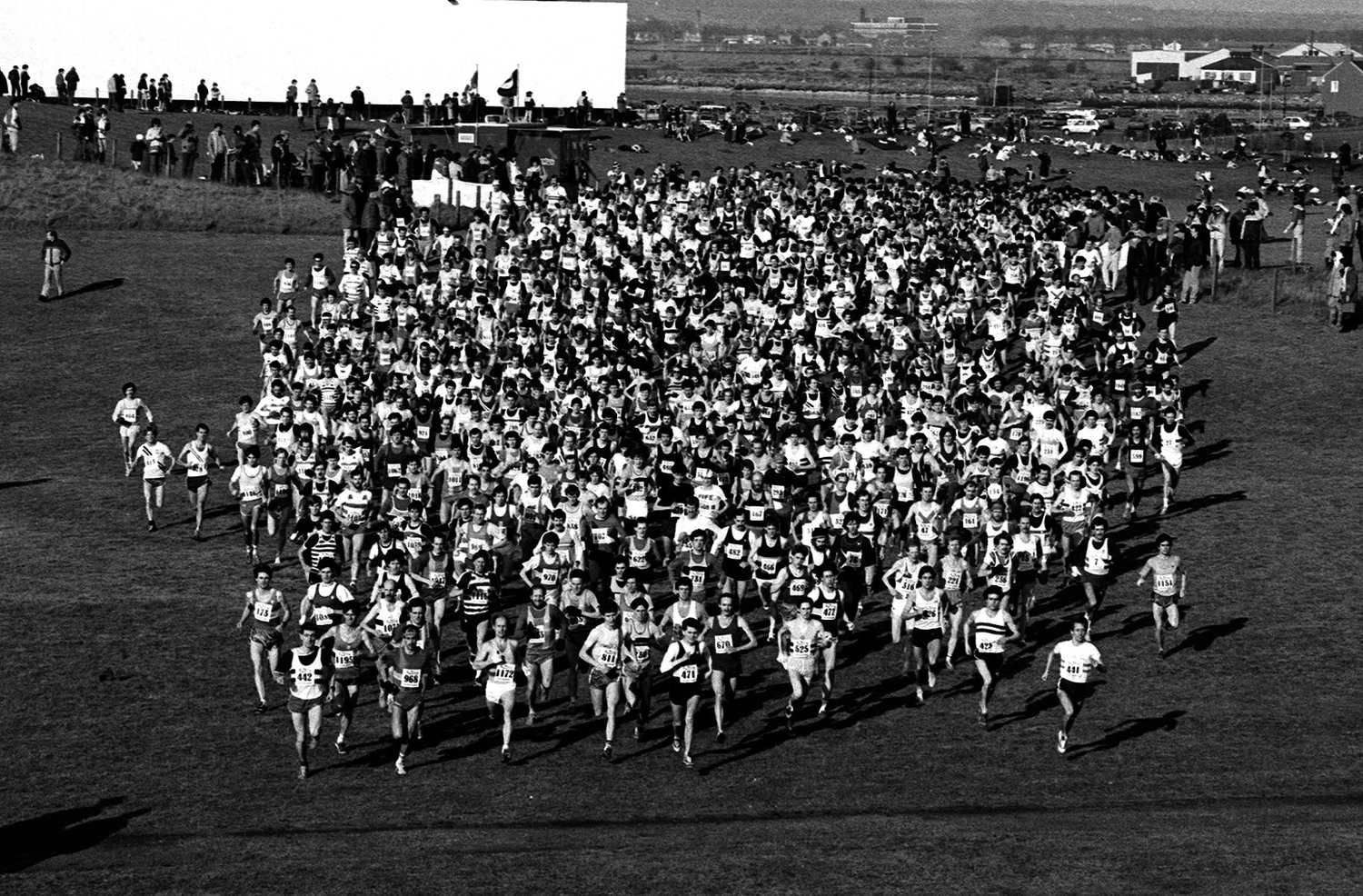
“The second Saturday of August usually sees the close of the athletics season  so far as important amateur meetings are concerned, and the rule holds good this year as next Saturday football will be in full swing.   Athletics cannot compete against football, and only in some of the war years was it possible to conduct athletic meetings after the commencement of the football season.   Those meetings that were held were for the most part largely successful but they were not ordinary club fixtures.   They were abnormal products of an abnormal time, they were mostly organised by munition workers and they depended largely for their success on the support of those same workers.   They could not be safely repeated now.   Therefore, as in bygone times, nothing of importance from an athletic point of view comes after the meeting of the Celtic Football Club which on Saturday was favoured with fine though dull weather and an attendance of 18,000..”     
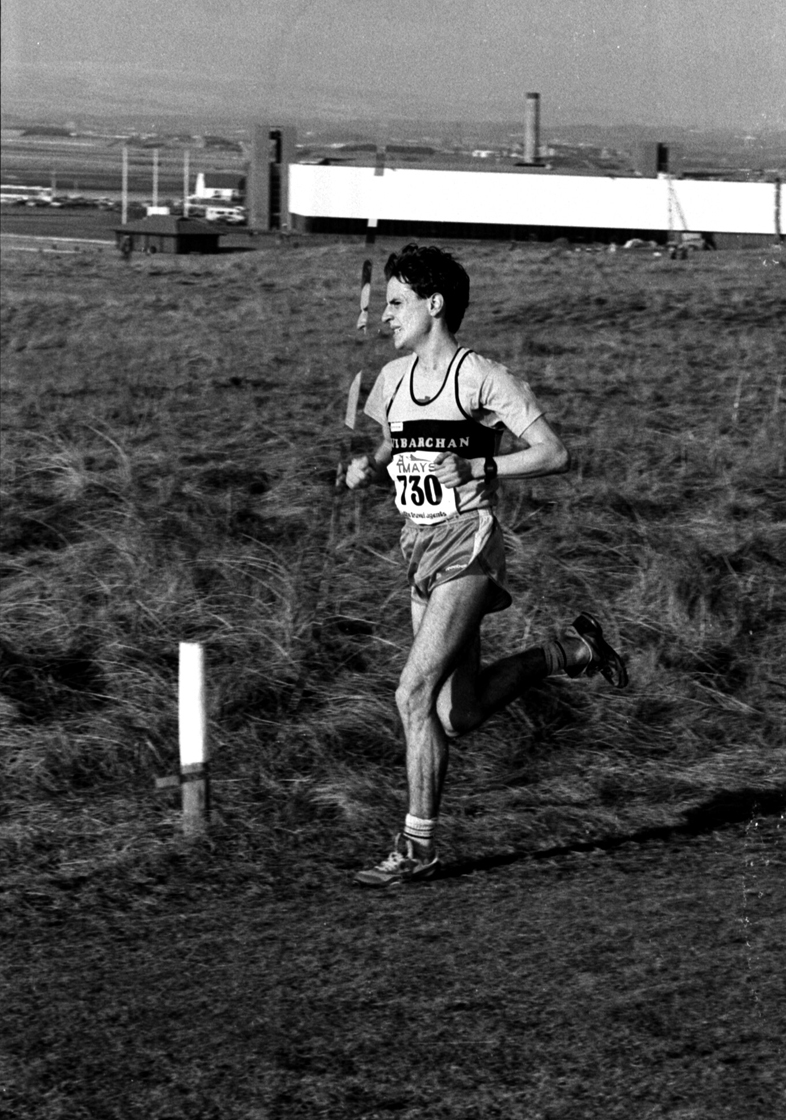
The report on the meeting went on as follows:   “AG Hill it is true was only second in the Mile handicap, but the race was run in fast time for this part of the country and Hill had practically no pacing.   Had McPhee, Hatton and Ross run, the result might have been different.   The Scottish champion was at 20 yards, Hatton at 30 yards and Ross at 35 yards, whereas Hill’s nearest actual opponent was at 45 yards.   In the circumstances Hill did well to beat all but one.   He did not start in the half-mile, in which MJ McEachern, the  quarter-mile champion of Ireland, secured a comfortable win in a very fast time.   The English champion, HFV Edward was seen to advantage in the quarter-mile invitation in which he was able to give the Scottish champion four yards and to finish a yard to the good.   Over one of his own distances, the 100 yards, however, he was unable to concede a yard to EH Liddell, the Scottish champion.   Liddell, a runner of good performance and even greater promise, gained a narrow victory, and emphasised his quality by winning the open furlong from scratch.

Open Winners.   Beyond Liddell’s meritorious win in the open furlong there was nothing outstanding in the open events.   The 100 yards was won by a runner who has hitherto been unheard of, AA Russell, from 8 yards.   He achieved some prominence at the Rangers Sports by winning his Heat and Semi-Final with a yard less, but was unable to find  place in the final.   Dobbie, of Maryhill Harriers, who has been running for several years, picking up a prize now and then, scored a meritorious win in the half-mile, and the mile went to a competitor who has this season shown improving form, D Farmer of Clydesdale Harriers.   In this event, J Hatton, Surrey Athletic Club, was virtual scratch at 10 yards, the Scottish champion being a non-starter, but he was able to get through the huge crowd – the entries numbered 146 – and failed to find a place.   The expeditious methods of the management of the meeting may be judged by the fact that the programme was completed fully 20 minutes before the advertised time.”

The invitation event winners were Eric Liddell in the 100 yards in 10 1-5th seconds; HVF Edwards in the 440 yards in 50 3-5th seconds, the half-mile by J McEachern (Clonliffe Harriers) from D McPhee in 1 min 56 4-5th sec, and J McIntyre (Dumbarton – 60 yards) in 4 min 23 sec from AG Hill (scratch).   And as a matter of interest, Rangers beat Celtic  5 – 1 in the five-a-sides.  Complete results below, courtesy Andy Mitchell:

Celtic 3 Liddell 1922

Eric Liddell winning the 120 yards at Parkhead in 12.2 in 1922.

Liddell was back in 1922.   He had won the 220 yards at Ibrox a week earlier in 22 seconds from two yards, Edward having  failed to qualify.   The weather for the Celtic meeting was in stark contrast to that a week before with rain depressing the attendance to half of what it would normally have been.    The first race was the 120 yards invitation.   “The result of the first race, a victory for EH Liddell, pleased the crowd and the procedings were greatly enjoyed throughout.   The opening event was the 120 yards scratch race that was substituted for the handicap originally contemplated.   Liddell was to have received a yard from HFV Edward, but as it turned out he did not need it, winning by rather more than that margin.   It was a well-run race, Edward and Liddell being level until this last quarter of the distance when the Edinburgh man drew steadily away.   Again in the 220 yards handicap, Liddell gave a fine display.   He had two yards on Edward who showed some improvement on his previous running, but not enough to catch Liddell who won comfortably.   The quarter-mile proved a brilliant victory for GT Stevenson who showed that he has now regained championship form.   Earlier this season he ran indifferently but wins on two successive Saturdays prove that he is now at his best.   Duncan McPhee had little difficulty in getting home first in the half-mile.   He ran steadily all the way getting home without being seriously challenged.   His time, 1:58, is faster than the native record but he started from  six yards.   CR Griffiths, the scratch man, failed to find a place.”

It was a pity that the crowd was a relatively poor 15,000 compared to the 30,000 at the Rangers Sports but the meeting ran to time, the crowd were happy and it had been a successful meeting.

*

The SAAA Championships were held at Parkhead again in June 1923 with double victories for Liddell (100/220 yards), McPhee (half-mile/mile), JG McIntyre (Four Miles/ten miles) and FOUR victories for TR Nicolson (Putting the Weight, Throwing the Hammer, Throwing the Hammer (Standing Style) and Throwing 56 lb Weight).   Liddell was also a member of the Edinburgh University team that won the relay from Maryhill Harriers.   Liddell, McPhee and McIntyre all ran and there were no field events in 1923.   However, Liddell disappointed this time round – “Apart from his initial dash in the 100 yards invitation, when he showed traces of his wonted vigour, the British champion seemed still out of form.”  He finished third in this race behind J Crawford of Queens Park FC and WP Nichol of Highgate Harriers.  Duncan McPhee turned out in the Open Mile but was unplaced.    The only champion to win was McIntyre who won the Two Miles Invitation in 9:35.4 off an allowance of 60 yards from CE Blewitt, the scratch man, of Birchfield Harriers.   Reported as the race of the day, it seemed that Blewitt had it all sewn up when McIntyre’s late challenge carried him to victory.   The Glasgow Herald was in no doubt that the meeting had been a success:

”  The closing meeting of the Western athletic season at Celtic Park must be written down an unqualified success.   True, the French champions were not forward, but such was the quality of the native talent that the absence of the continental contingent did not detract from the standard of entertainment provided.   CE Blewitt, WP Nichol and CR Griffiths maintained their high reputations, but EH Liddell and D McPhee were still in the shadow, neither being able to secure more than a third place.   The most thrilling event was the Two Miles Invitation, the finish of which will live in the memory of all present as the most stirring of the season.   JG McIntyre, Blewitt and   CH Johnston virtually hurled themselves at the tape almost simultaneously, the judges placing these runners in the order named.   … Blewitt who expressed his desire to compete in the eight laps steeplechase, found his task too formidable and it was not surprising to find him drop out with a lap to go.”

If the press were united in their praise in 1923, they were not so in 1924.   Let me quote from the ‘Glasgow Herald’ of August 11th 1924.   “In former years the second Saturday of August saw the last of the big amateur athletic gatherings in Scotland.   Rangers Football Club occupied the first Saturday, Celtic the second; but this year there has been a change, the East-End club giving up their sports in favour of a five-a-side football tournament.   The estimated attendance at Parkhead on Saturday, 15,000, compares badly with the 40,000 or 50,000  that assembled at Ibrox a week previously, but the Rangers offered attractions of an almost unprecedented nature, the competitors including some of the most famous competitors from the Olympic Games in Paris.    Had Celtic followed suit they might have had an equal attendance, but on this occasion they chose to follow a more prudent but less heroic course.   The performances of the Olympic giants at Ibrox were not impressive, and it might not have happened that the glamour had gone off, and that the Parkhead club might have been saddled with the heavy expense of a first class meeting and missed the reward.   Still, the decision to abandon an old-established meeting, and one that has always been held in the highest repute, is to be regretted, and all interested in athletics in Scotland and hope that the meeting will be revived next year.”

The none-too-subtle advice was taken and the event was held again on 8th August 1925.    The weather was good and there were 10,000 spectators – there were also no fewer than eight clubs represented in the five-a-sides.

“CELTIC’S SUCCESS.   Although Celtic were without the usual array of prominent athletes from a distance, their sports on Saturday proved from a sporting point of view one of the most successful meetings held by them in years.   JJ Ryan, the Irish four miles champion, was the outstanding personality in the distance race, and he had a hollow victory, only one other of the ten starters finishing.   Ryan conceded a start of 25 yards to TM Riddell, the Scottish one mile champion, who led for about half-distance; but the pace he set was too hard and he did not finish.   The weather was exceedingly hot, and the other seven runners found themselves in like case and were unable to stay the distance.   Riddell was successful in the half-mile invitation in which, from the 5 yards mark, he returned the good time of 1 min 57 4-5th sec.   Five-a-side football bulked largely in the programme and was probably responsible for a large proportion of the 10,000 spectators.    The winners were the redoubtable Rangers who are almost as successful in the abbreviated game as in the full Association code.”  

So there it is – the Sports returned but with an expanded football element.    There were eight races and a high jump – the distance race referred to was over three miles and the winning time was 14:48.6.   The Rangers meeting of the previous week had several American athletes among the participants and Scottish records were set in four events – the 1000 yards, the 120 yards hurdles, the high jump and the pole vault – the 1000 yards and high jump being British records as well.   There were four invitation events and nine open events of which three were field events and the estimated attendance 30,000.     The contrast was marked and two football club sports meetings which had at one time been pretty well comparable, had diverged to a fairly large degree: the one going for bigger names, top quality competition and maximising the athletics, the other pulling back from athletics (the two best competitors in 1923 and 1925 being Irish champions among almost entirely domestic fields) and inflating the football component.   It was a trend that would continue to develop.

Into 1926 and the football season started on the second Saturday of August – with the Rangers sports on the first Saturday, what were the Celtic management to do?   Abandon the whole idea?   No, what they did was to switch from a Saturday to the following Tuesday evening.   The ‘Glasgow Herald’ previewed the meeting.   “The last of the big athletic meetings in the West takes place tomorrow evening at Parkhead, where Celtic Football Club hold their annual sports.   Many of the distinguished athletes who competed at Ibrox have stayed over, and several special events have been framed.   JJ Webster Birchfield Harriers will take part in a Three Miles handicap and  Tom Riddell will do his best at his own headquarters in the Mile.   The entries actually exceed last year’s total.”   Tom Riddell had attempted to break the mile record at Ibrox on the Saturday and was going to have another go four days later at Parkhead, where as a member of Shettleston Harriers, also domiciled in the East End of Glasgow, he probably did regular training.   The report simply read: “CELTIC FC SPORTS.   Celtic Football Club held their annual athletic sports and five-a-side tournament at Celtic Park last night before 8000 spectators under moderately good conditions.   There was a good representation of amateur talent providing interesting running; and a particular attraction, to JW Webster, of Birchfield Harriers, who unfortunately failed in his attack on the Three Miles record.   The Maryhill Harriers members were prominent on the prize list.”

The result of the three miles handicap special was – 1.   D McLean (Maryhill Harriers) 145 yards; 2.   WH Calderwood (Maryhill Harriers) 125 yards;   3.   F Stevenson (Monkland Harriers)   145 yards.    Time 14 min 39 45th sec.

Second in the Mile Handicap was D McSwein from Greenock Wellpark Harriers off 100 yards – Parkhead seemed to suit him – he had won the event the previous year from 125 yards.   Duncan McSwein went on to be a famous long serving treasurer of the SCCU.

www.rastervect.com

The picture above comes from the annual SAAA championship meeting in April where the two long distance events took place – the 10 miles championship and the 7 Miles Walk.   It had been held often at Celtic Park and it took place again in 1927.   The Celtic Sports did not take place on the second Saturday in August since the football authorities felt that their season should now begin on that date and it is fair to suppose that Celtic were looking for a suitable date.  What is sure is that it did not take place on the first Saturday, the following Tuesday or the Tuesday after that.   The meeting had decamped to the 2nd July.   Their range of alternative dates was circumscribed (a) by all the other regular meetings, and (b) by the lengthening football season – ending later and starting earlier.   Queen’s Park FC Sports were on the first week in June, the Glasgow Police on the third week in June, SAAA Championships a week later, Greenock Glenpark were on the last week in July, Rangers on the first week in August and so on.   It had to be a move back and the second Saturday in July seemed a good choice but this year it fell on the same day as the English championships.

“There was a time in the past when Celtic Football Club’s meetings scintillated with most of the stars that shone in the athletic firmament, but this year the bringing forward of the gathering, due to the encroaching of the football season and its consequent coincidence with the AAA championships compelled the management to rely entirely on home talent.  Frankly the absence of the imported element did not affect the afternoon’s sport, so varied and well balanced was the programme.   Chief interest centred naturally on the two special handicaps over 880 yards and the two miles, as it was no secret that these had been framed with a view to giving JD Hope and Donald McLean , both national champions, opportunities of placing new national figures on the record books of the SAAA.   Neither of them succeeded but the feeling of disappointment, particularly in McLean’s case, was more than counter balanced by the interesting character of both events.   In the half-mile, JD Hope ran his best race ever over the distance as far as time goes, as in finishing three yards behind WH Calderwood (Maryhill Harriers) the winner, his time worked out as 1 min 58    1-5th sec.   Calderwood, who made such an excellent showing in the half-mile against Griffiths and Houghton at the Tramways meeting on Tuesday evening, ran from 12 yards, and his time was recorded as 1 min 57 4-5th sec, the same as CB Mein’s Scottish record.    It is somewhat surprising to find the Maryhill man in this form when it is considered that he made his first public appearance of the season only a week ago.

It cannot be said that in the two miles McLean displayed sound judgment.   Probably the failure of his pacemaker, and his anxiety to be in touch with the leaders may account for his mile time of 4 min 38 1-5th sec, but it was evident that his exertions in the early stages had left him with no reserve when challenged by F Stevenson and J Suttie Smith 100 yards from the tape, as he eased up when headed and cantered the rest of the way home.   From start to finish it was a replica of the four miles championship duel between Stevenson and Smith, and as before Smith’s superior speed in the finishing straight brought him home a good winner.

In Smith we have one of the most promising distance runners we have had for a long time.   His action is easy and his judgment good, and when allowance is made for the few opportunities he had had in Dundee for testing his strength against first-class opposition, his advance has been rapid.    He has had four visits to Glasgow  this season and has collected three first prizes and one second.   His time on Saturday off 20 yards was 9 min 31 sec, and running out the full distance was was clocked as doing 9 min 34 2-5th sec.”

The meeting had seven open races and four special invitation events with one field event  and two cycle races included in the programme.   The five-a-side was won by Rangers 3-2 over a Celtic side which included McMenemy and McGrory.

Problems arose on the new date almost immediately – the triangular international with England and Ireland which had previously been held on the last Saturday in June moved to the second Saturday in July in 1929, and was still there in 1930.   The reason is understandable.   It was the week after the SAAA Championships.   To compete in two such high profile events in successive weeks was not ideal and they were moved.   This left Celtic with another headache.   Almost every Saturday in June and July was taken up with one event or another, some of the major events are listed above but other football clubs such as Partick Thistle and Falkirk had their own dates, and there were meetings all over the country from Golspie to Lockerbi via Aberfeldy, Beith and Catrine.

In 1930 the club was back at the first Tuesday in August, the 5th to be exact.    The report, in its entirety, read:   “KEEN TUSSLES AT CELTIC SPORTS.   The sports meeting under the auspices of Celtic Football Club were held at Celtic Park last night  in fine weather and before 5000 spectators.   The sport throughout was interesting.   In the two miles team race, the struggle between Donald McLean and WH Calderwood for victory was the chief feature.   McLean jumped into the lead at the bell and, running strongly, defeated his team mate by five yards.”    A good meeting with the report apparently written on the back of an envelope.   There were also cycle races and, naturally, a five-a-side competition.  McLean’s winning time was 4:46.8 and Celtic beat Partick Thistle 4 – 3 in the football.

Despite the success of the 1930 meeting there was apparently no follow up meeting in 1931 – at least not on the three dates previously used by the club – second Saturday in July, second Saturday in August or second Tuesday in August.

THE CELTIC SPORTS

In 1932, the  triangular international was again on the second Saturday in July and the Tuesday in August which had previously been the club’s alternative date of choice saw most of the regular athletes (Bobby Graham, Walter Calderwood, etc)  in action at the Springburn Harriers meeting at Helenvale.   At Celtic Park, Celtic FC had their final trial before the opening of the football season the following Saturday.

The sports of 1933 were unable to go ahead on the first Tuesday in August because the Glasgow Transport Sports were taking place at Helenvale that night – nor were they to be found on the following Tuesday or on any of the ‘vacant’ Saturdays in the year..

In 1934 the sports were held on Tuesday, 7th August and although the event was covered there was no report on the athletics – the entire report was devoted to the fact that a Celtic player called Crum (we were never told his Christian name by the ‘Glasgow Herald’) had his leg broken when he fell in a tackle by a Clyde player called McPhail during the first five-a-side match.   Five paragraphs were devoted to the event.   There were six races, two cycle races and a five-a-side tournament.   The races were all domestic affairs with not a single big name or champion among them.

Just when you thought the event was on its last legs, an excellent meeting came up on Tuesday 6th August 1935.    The headline read: “NEW SCOTTISH RECORD AT CELTIC SPORTS: R GRAHAM’S SUCCESS OVER THREE-QUARTER MILE.   The annual sports meeting of Celtic FC was held last night at Celtic Park, Glasgow, in fine weather conditions and before a moderate attendance.   Some excellent sport was witnessed, and in the special invitation race over the three-quarter mile, R Graham set up a new Scottish record of 3 min 4 6-10th sec, this time being 1 6-10th sec faster than that set up by Tom Riddell at the Queen’s Park Sports three years ago.   Graham ran from the scratch mark, instead of the 10 yards as originally intended in the handicap and he was accompanied by J Gifford and JP Laidlaw to both of whom he conceded 10 yards.   He covered his first lap in 61 seconds, but took 63 4-10th for the second.   In his final 300 yards however, he put in a great finish catching the leaders at the last bend went on to win by six yards from W Gunn. “   There were six races, three cycle events and a five-a-side.    The fields were entirely domestic and almost exclusively from the West of Scotland.

On 3rd August, 1936, the programme was even more reduced with only five races, three cycle races and a five-a-side competition with four teams taking part – Rangers, Celtic, Partick Thistle and Queens Park.    The fields were composed of local athletes and the complete report read: “CELTIC FC SPORTS: SHAWFIELD HARRIERS PROMINENT.   The annual athletics sports meeting promoted by Celtic FC took place last night at Parkhead, Glasgow, where an interesting programme was quickly and successfully carried through.   About 6000 spectators were present.     Shawfield Harriers were prominent, J Baillie having a good “double” by winning the 100 yards and 220 yards handicaps, and G Beveridge getting the Mile.   Celtic were popular and deserved winners of the football tournament.”  

In 1937 and 1938, team trials seemed to be the order of the day for the club and there were no notes of any Celtic FC Annual Sports on the usual dates available to them in the past.   On Wednesday, August 9th, 1939, there was no report on any sports although there was a lot of praise for Willie Maley’s book “The Story Of The Celtic.”

It would seem that the great sports meetings held by the club for several decades had come to a stuttering halt.    They were thrown in chaos when first of all the SFA decided to start their League programme on the second Saturday in August making the event impossible, and then by the SAAA/AAA/NIAAA altering the date of the international to the new Celtic date in July.    It might be instructive to look back at the Celtic Sports as they were at the start of the century on a fresh page.

Paddy Cannon

Paddy Cannon 1

Paddy Cannon

The article below is a fascinating account of the life and sporting career of Paddy Cannon, written by Alex Wilson who donated it to us and published in the Track Stats magazine.   Alex has taken a lot of trouble to research the subject and he is the only one from that particular period on this website.   It not only tells us a lot about the man himself but also illustrates and describes an athletics scene that is different from our own but which at its heart is basically the same.

The Career of Paddy Cannon, farm worker, record breaking professional runner, successful football trainer.

By Alex Wilson

The name of Paddy Cannon, alias Peter Cannon, will not be familiar to many today, but in his time he was a very popular figure in his native Scotland and even further afield.   During the 89 years of his life, he created what you might call an enduring legacy by leaving his indelible imprint in the history books, both as a distance runners and as a football coach.   Cannon was of medium build, stood 5’8″ (173cm) and never weighed more than 147lbs (67kg) during his competitive days.   But behind the moustache and unassuming demeanour lurked a ferocious competitor with a burning desire to win – whatever the sport.   In addition to setting two professional world records on the running track, he coached Edinburgh side Hibernian to their last win in the Scottish Cup.

Paddy Cannon first saw the light of day at Raploch, near Stirling, on 14th January 1857, the son of Irish immigrants Peter and Bridget Cannon.   His father was an agricultural labourer who worked on King’s Park Farm.   In those days the farm occupied a sprawling piece of land beneath the craggy outcrop on which Stirling Castle stands.   Today, it’s a golf course.   From an early age he learned to pull his weight on the farm.   Just like any other youth, he played football and enjoyed sports, but never did he imagine that he would make history on the running track and set two world records.   In fact, he was 20 years of age before he realised that he had any talent for running.   It was by mere chance that Paddy Cannon became a runner.

The story has it that in 1877 a Glasgow shoemaker who had settled in Stirling noticed a group of young men in King’s Park.   The shoemaker had been an athletics trainer and, seeking to carve out a new niche for himself in Stirling, persuaded the men to show their paces.   One of these was Paddy Cannon, who, despite being dressed in heavy workboots and corduroys, romped home an easy winner.   The shoemaker was so impressed with what he saw that he arranged for another trial a short time later.   On this occasion he brought along a pair of running shoes for Cannon who, now properly attired,   showed his true ability.    Excited by his discovery, the shoemaker became Cannon’s sponsor and two weeks after the second tryout persuaded Cannon to enter the Strathallan Games at Bridge of Allan.   He ran in the open mile off the 100 yards mark.   there was a huge field but Cannon held his own and but for inexperience would have won.   He was only beaten by a foot and a half into third place behind David Livingstone of Tranent, himself on the cusp of a successful career.   On May 31st 1881, Livingstone would finish second in 53:53.5 to William Cummings in the prestigious “Ten Miles Race for Sir John Astley’s Champion Belt” at Lillie Bridge Grounds, West Brompton.   Cannon’s rookie performance created quite a stir among the local pedestrians.   A week later at Falkirk, he avenged his Strathallan defeat by winning the confined mile for Stirlingshire men, the open mile and the two and three mile handicaps!   This was an extraordinary performance for a novice.   Paddy Cannon would not have been a runner had it not been for the Scottish Highland Games, a millennium old tradition which had enjoyed something of a revival in Scotland with the advent of half-day working on Saturdays and statutory bank holidays.   By the late 1870’s they were a common and highly popular Saturday afternoon pastime.   He was practically invincible in two and three mile races at Highland meetings where he would concede all manner of starts to his opponents and still come out on top   Unfortunately, promoters were rarely particular about track measurement or timekeeping.   All that essentially mattered was finishing order, as this dictated the distribution of prize monies.   many of Cannon’s performances no doubt some very good ones, are therefore unknown.    Not much is known about Cannon’s early career, save that he is said to have run the great William Cummings of Paisley, then world record holder for the mile,  to within a yard in the Bute Highland Games in the early 1880’s.

In 1883, Cannon renewed his rivalry with David Livingston in the Five Miles Championship of Scotland at Arbroath on 15th September.   In a close-run race he finished a yard behind the Tranent runner  who was credited with a time of 24L31.0.   It would have been a world record had the track withstood scrutiny.

Back on the Farm and hard Work to keep Fit

After his early successes, Cannon went back to working on the farm with occasional spells at the saw-mills during the winter, and when the summer came round, he would free himself for the Highland Games season.  However the farm work, as Cannon knew, was hard graft without labour saving mechanisation.   Stacking hay, to mention but one example, was an intensely physical chore before  the advent of hay baling machines.   This was one reason why Cannon was extremely fit despite doing little in the way of specific training.   In fact he was a great believer in the benefits of walking and hard work.    By his own admission he was a hard taskmaster, as demanding of himself as of others, a sentiment echoed by John James Miller in “Scottish Sports and How to Excel in them: a Handbook for Beginners”:   “Punishment”, vowed Paddy Cannon to me on one occasion, “that’s the keynote for distance running efficiency.   That is the mill I had to go through and there’s absolutely no other way.”   Unusually fro the time, Cannon neither drunk nor smoked.   His physical fitness and healthy lifestyle no doubt enabled him to withstand the rigours of weekly competition during the summer Highland Games season.   He usually ran in two events, and sometimes in three, at meetings, racking up the racing miles.   He clearly showed a preference for meetings which promoted both one and two mile events where he could make double money.   In 1885, having been practically unbeatable in Scotland over two miles, Cannon turned his attention further afield.   Pedestrianism was flourishing in Lancashire and Cannon’s sponsors entered him for what was a famous four-mile handicap promoted by Albert Fletcher at the Moorfield Recreation Grounds in Failsworth, near Manchester.   The “All England Sweepstakes” were held on 19th September 1885 and featured a quality field including Arthur Norris of Brentwood and William Cummings, lately of Preston.   Cannon was comparatively unknown in these parts and Cummings was handicapped by 200 yards.   Cannon’s backers couldn’t believe their luck and betted heavily on their man at odds of 4 – 1 against.   The outcome was almost a foregone conclusion: Cannon overhauled the last of the runners to whom he had conceded starts at the halfway mark.   Taking the lead before the three mile mark (c14:40), he ran out an easy winner in 19:28.0 (equivalent to a shade over 20 minutes for the full four miles.)   The backmarkers didn’t stand a chance, and Cummings pulled out early in the race after failing to make any inroads on Cannon’s lead.   Needless to say, Cannon’s jubilant backers went home with a sackful of money.   However, in his defence, Cummings was likely saving himself for an upcoming race at Lillie Bridge that would decide a high-stakes three-race match against Walter George, the ex-amateur champion from Worcester.   If so, the strategy certainly paid off, Cummings easily defeating George by 420 yards in a world record time of 51:06.6 amid claims that George had been poisoned.

Cummings and Cannon seem to have struck up a working relationship after crossing paths at the Failsworth meeting.   A little over a week after Failsworth, Cannon accompanied Cummings to Lillie Bridge for his race against Walter George.   On 3rd October both men appeared in the Mile Handicap at the Edinburgh Royal Gymnasium.   The reporting newspaper noted that Cannon had been “training along with the Scottish champion Cummings.”   The working partnership continued in 1886 when Cannon trained Cummings at Preston in preparation for another series of matches against Walter George over a mile, four miles and ten miles for £200 each.   The first match in the series, a Mile race at Lillie Bridge on 1st August culminated in a victory for George in a phenomenal 4:12 and three quarters – over three seconds below the previous world record held by Cummings, who collapsed (gave up) 100 yards from home.   Cummings levelled the scores by winning, albeit with suspicious ease, the second race over four miles at Preston Pleasure Gardens in 20:12.6 on 11th September, thereby forcing a lucrative decider at Aston Lower Ground, Birmingham, on 2nd October.   This time George had his revenge, setting a hot pave with the avowed intention of running his opponent off his legs.   Indeed he succeeded in breaking Cummings in the third mile, which can be explained by the fact that the first three miles were accomplished in a near-world-record  14:40.2.   Cummings fell increasingly further behind and eventually retired in the sixth mile, having been lapped.   George reached six miles in 30:26.8 but without any opposition to spur him on, slowed thereafter to outside world record pace and was eventually allowed to stop in the ninth mile.   That concluded Cannon’s working partnership with Cummings, even if the consensus was that Walter George was unbeatable.   Cannon had by all accounts done a good job of nursing Cummings through injury and back to peak fitness.   In his mile race against George, Cummings after all had led at the three quarter mile mark in a near-record 3:07 and three quarters, and would probably have beaten his own best time had he finished.

With the matches out of the way, Paddy Cannon and William Cummings went back to being adversaries.   Apart from coaching Cummings, 1886 was a relatively quiet year for Cannon.   He did, however, seize the opportunity to visit his ancestral homeland turning out in the half mile and mile handicaps at the Caledonian Games at the Ball’s Bridge Ground, Dublin, on 13th June.   He was npt in his best form however, and lost both events, coming in third in the half mile in 2:09.5 and second in the mile in 4:41.3.   On to the 1887 season which Cannon began with a bang, winning the two mile handicap at the Broxburn Annual Athletic Games on July 14th, in 9:21.0 – a Scottish professional record  and one of the fastest times to date.   Nine days later, he showed a good turn of speed in the mile handicap at the Edinburgh Royal Gymnasium finishing third off 50 yards in an estimated 4:21.0.   On 8th September 1887, Cannon dispelled any doubts that there might have been over his performance in the

two miles at Broxburn by winning the two mile handicap at the Manchester Royal Jubilee Exhibition Sports, held to commemorate 50 years of Queen Victoria’s reign.   After rushing through the first mile in 4:33.0, the Stirling runner came home in 9:21.5, defeating fellow Scot Joe Newton of Dundee by 150 yards.   Also in September, 1887, and probably in connection with his appearance at the Manchester Exhibition, Cannon competed in the ix Miles Handicap at Failsworth – the scene of his four miles coup two years before.   The field included Will Snook, of Shrewsbury, the former Birchfield Harrier who, as an amateur, was a two-time AAA 10 Miles Champion and two mile world record holder.   In 1886 Snook had been suspended by the Amateur Athletic Association on allegations of roping (not trying to win) un the National Cross Country Championships and banished to the professional ranks.   Snook had recently won a mile race at Leicester in 4:27.8 and so was still a force to be reckoned with .   Details are sparse, save that Cannon was placed at the 110 yards mark and won in 30:46.2 (worth 25:54.7 for five miles), beating Snook by 400 yards.

Three months later Cannon returned to Failsworth Ground to race Arthur Norris of Brentwood in a mile race for a £50 cup and £50.   Norris, a 4:36 miler, had unexpectedly defeated Cummings the previous year and needed only to win to make the cup his absolute property.   He received 40 yards start, thus presenting Cannon with a stiff task.   A crowd of fully 1000 persons watched anxiously as cannon went off at a great pace and caught his man at half way, but he couldn’t break Norris and in the home straight the Brentwood man drew right away to win by eight yards in 4:31.5.    In Cannon’s defence, the Failsworth race came only three weeks after marrying a 22 year old weaver called Annie Mackin at St Mary’s Chapel in Stirling.

Cannon set about preparing for the 1888 season with a new found zeal and strength of purpose his self-professed ambition to set up a professional record for the two miles or any other distance.   Having broken with his previous summer/winter cycle by running at Failsworth in late 1887, Cannon entered the Professional Mile Championship at the recently opened Victoria Park Grounds, Govan, on 21st January 1888.   There were three competitors: himself, William Cummings of Preston and Arthur Norris of Brentwood.   The match was for a sweepstakes of £25-a-side and a challenge cup.   The 50 guinea solid silver cup had been presented by Mr Lewis, a London patron of pedestrianism, and had to be held against all-comers for 18 months.

Defeat by William Cummings for the Mile Championship

Despite the unfavourable weather and a heavy track due to rainfall on the morning of the race, some 3000 persons assembled to witness the event.   Cummings was the favourite at 6 to 4, while odds of 3 to 1 were being offered against Norris and 4 to 1 against Cannon.   Norris received 40 yards start, Cummings and Cannon starting from scratch.   Cannon reeled off the first quarter in 62 seconds with Cummings, playing his usual waiting game, on his shoulder.   At the end of the first lap, Norris still had his handicap having set off at an equally hot pace.   In the second lap, the scratch men pegged back 20 yards on Norris and the half mile was reached in 2:09.5.   Cummings went past Cannon in the third lap and was within 10 yards of Norris when the three-quarter mile post was reached in 3:16.0.   Cummings rushed past Norris on the last lap and sailed up the straight, looking back the easiest of winners by 10 yards in 428.0.   Cannon was second in an estimated 4:30.0, a similar distance in front of Norris.   In February 1888, there was talk of a series of races against William Cummings at two miles, four miles and six miles, each race worth £25 a side.   However, the proposed match fell through, as these kinds of tentative arrangements so often did.   On 14th May 1888, Cannon entered into a three mile match with Robert Hunter of Govan at the Victoria Park Grounds, Govan, conceding Hunter a start of 350 yards.   Nine days earlier, Hunter had run a dead-heat with Cannon in another three mile handicap at teh Vale of Clyde AC sports having received 350 yards start there too.   A close race was again expected though Cannon was still the bookies’ favourite at 6 – 4 on.   The Stirling man went away at such a fast pace that everyone expected him to crack.   However he was in fine fettle and the track was in good condition.   Hunter was overhauled three quarters a mile from home and retired with a lap to go.   Never slackening his pace, Cannon plugged away and broke the tape amid thunderous applause, to find that he had written his name into the record books.   His time of 14:19.5 was fully 16 seconds inside Jack White’s record.   From now on, Peter Cannon would be named in the same breath as Walter George and William Cummings.   Cannon now turned his attention to the two miles record.

The opportunity arose out of a three-way two-mile sweepstake involving himself, Walter George and William Cummings.   Cummings however was forced to withdraw at the eleventh hour owing to a leg injury.   On Saturday, July 28th, 1888, in heavy rain, Cannon finally crossed swords with the great Walter George at the Victoria Park Grounds in Govan.   A close race was anticipated, and given the constellation, a world record was definitely in the air.   Of the two men, George had the faster time, having run 9:17.4 at Stamford Bridge in 1884, but Cannon was the man in form.   Despite the weather, some 3000 spectators turned out to witness the race.   The track was rough and heavy, and a record looked impossible, but the Stirling man was undeterred.   The toss fell to George and he took the inside lane, but shortly after the start, Cannon went to the front and soon left his illustrious opponent far behind.   He was 150 yards ahead at the end of the first mile in 4:33.4, his powerful stride eating up the ground.   Maintaining an electrifying pace, Cannon won easily by 300 yards and brought the house down with a comprehensive victory.   The official timekeeper, Mr Bonar registered 9:12.5 on his watch.   Cannon had therefore missed Bill “Crowcatcher” Lang’s long-standing record by a mere second.   But for a better surface and someone to push him, as James Sanderson had done Bill Lang at Manchester 25 years earlier, the record would have been his.    In return for his efforts, Cannon carried off a mammoth money prize of £300, which surely would have made up for any disappointment he felt at missing the record.   That year, Cannon made another attempt to break the two miles record at the Glasgow Exhibition enclosure on September 8th.   His race was the highlight of an excellent afternoon of sports at the “Highland Gathering” and witnessed by a bumper crowd of upwards of 25,000 spectators.   With a number of runners starting ahead of him, Cannon made his usual fast start, passing the mile post in a blistering 4:32:0   However this effort was too much to sustain; he faded in the closing stages and was left licking his wounds in second place.   Ferguson of Greenock took full advantage of 140 yards start to win a “punishing” race by a good 10 yards in 9:22.4 to Cannon’s estimated 9:25.0.

An attempt on the four mile record and a crowd of 10000 to spur him on

Cannon returned to the Glasgow Exhibition and made his next record attempt in a Four Miles Handicap on Saturday November 3rd 1888.   The world’s best was 19:36.0, accomplished by Jack White, the legendary “Gateshead Clipper” at Hackney Wick on 11th May, 1863.   The weather was raw and uninviting, and not conducive to record breaking but nevertheless a large crowd turned out to watch the professional sports and, in particular, to see Paddy Cannon run.   Eight started, the Stirling man the back marker off scratch and conceding big starts to veterans William “Cutty” Smith of Paisley, and Bob Hunter of Govan.   The task looked impossible for when the men stood on their marks, Smith and Hunter were only 40 yards behind Paddy, with practically a lap in hand.   Nonetheless, Cannon immediately set about pegging back their lead, passing the mile post in 4:48.2, 2 miles in 9:44.0 and 3 miles in 14:45.0.   Entering the last half mile he was only 50 yards down on the leaders, Hunter and Smith and closing rapidly.   In the last lap he finally took the lead but despite a spirited sprint down the straight to win by 12 yards, he missed breaking the world record by 4.2 seconds.   Nonetheless his time of 19:40.2 was a Scottish professional record.   So great was the disappointment among followers of pedestrianism that the Executive of the Glasgow International Exhibition staged a special four mile race against time and arranged to give a valuable prize if he broke the record.   The trial finally came off on the evening of Thursday, November 8th, 1888.   The track, according to “The Scotsman”, “was officially measured and certified … [as] a guarantee to those who look upon Scottish performances as open to question.”   Three well-known runners were entrusted with the task of pacing Cannon – Bob Hunter of Govan, J Ferguson of Greenock and A Arrol of Glasgow – each taking it in turns to draw Cannon out.   the track was specially lit up for the occasion, and at eight o’clock in the presence of 10000 vociferous spectators the race got under way.   there was a high, biting wind blowing throughout the race and having to run alone  did not make Cannon’s task any easier.   All he had to guide him as to his progress was the timekeeper’s call every half mile.   Cannon set off at a quicker pace than five days earlier, passing the mile in 4:22.0 and two miles in 9:37.8.   After the call at two and a half miles (12:06.2), he knew that he had the record within his grasp.   Having covered three miles in 14:34.4, a time only he himself had bettered, Cannon went through three and a quarter miles in 15:47.0 and three and a half miles in 17:002.2 to reach the bell in 8:15.4.   The crowd sensing a new record was imminent, the noise inside the enclosure grew to a deafening pitch as the excitement mounted.   Straining every sinew, Cannon finished with a sprint to stop the clock in 19:25.4.   Finally the record was his!   Not only that, he had neaten the existing mark by fully 10.6 seconds!   His intermediate quarter times from three to four miles were world records too.

Cannon was still hungry for success and, therefore, two world records were not enough.   He would not rest until he had claimed the two, five and six miles figures as well!   Another winter of hard training lay ahead.   On 4th January 1889, Cannon began his quest with an assault on Jack White’s figures for five and six miles at Hampden Park, Glasgow.   He had with him three pace makers – Robert Hunter of Govan, H McDermott of East Calder and Tom Graham of Lanark.   the conditions were not ideal – a cold wind was blowing and the track was soft owing to a recent frost.   When the race got under way at 2:35 pm a large crowd was present to cheer the Stirling man on, with the pace makers organised to draw him out mile by mile.   He shrugged off the adverse conditions and gave it his best, passing the mile in4:45.6, two miles in 9:46.4, three miles in 14:52.0 and four miles in 19:59.4.   However the record was never truly within his grasp that afternoon, and despite efforts by Graham and Hunter to shield him from the wind, Cannon slowed to reach five miles in 25:13.4 – a fine time but well short of the requisite 24:40.0.   Ultimately it was too tall an order, even for a man of his ability.   However a strong closing mile brought him to within 27 seconds of the record, and he breasted the tape in 30:17.0.   Cannon at least had the consolation of setting a new Scottish professional record, eclipsing the previous figures of 30:18.4 set by his great rival, William Cummings during his record-breaking ten miles at Lillie Bridge on 29th September 1885.

From One Highland Games to Another: two in One Day

Following a successful summer campaign, with recent wins at the Strathallan Meeting and in the Great Three Mile Handicap at the Bute Highland Games, Cannon launched yet another attack on the two miles record.   The undertaking took place on the ground of St Mirren FC at Westmarch, Paisley, on the morning of Friday 16th August 1889.   Cannon ran strongly throughout, sprinting the last 200 yards, but again the record eluded him.   the official timekeeper’s watch registered 9:13.0 – 1.5 seconds outside Bill Lang’s mark.   Cannon was said to have remarked on finishing that he could have broken the record had he been pushed.   Most runners would have been satisfied with a good day’s work, but not Paddy Cannon!   Later that afternoon he put in an appearance at the Luss Highland Gathering in the picturesque village of Luss, on the shores of Loch Lomond.   However after his hard work at Paisley, coupled with the fact that he had been over-handicapped, he had to be content with second place in the two mile handicap.   Two weeks later, on 31st August, Cannon competed in the Two Miles Flat Race at the inaugural Highland Games and Sports in Belfast, Northern Ireland, where there was a large Scottish colony, thus ensuring a good attendance.   Cannon was a little off colour, probably because of the long journey over from Scotland, but caught and passed every opponent but one.   Compatriot Tom Graham took full advantage of 145 yards start to win by 30 yards in 9:42.2 to Cannon’s estimated 9:30.0.   For Cannon the nig race of 1889 was only a month away: the One Mile Championship for a sweepstake of £1100 and Mr Lewis’s Silver Championship Cup.   It took place at Victoria Ground, Govan, on Saturday 28th September 1889,   The four competitors who joined in the sweepstakes were William Cummings, Preston, and Peter Cannon, Stirling, both off scratch; George Powell, Wales, 30 yards start and Fred Goodwin, London, 66 yards.   Each man had laid a £25 stake.   Cummings was the holder having won the first race at the same venue twenty months earlier.   An immense crowd of spectators filled the enclosure and the stands, with most interest centring on the mile championship.   In the days preceding the event, the Glasgow Herald had dampened any expectations of a phenomenal time by commenting that the ground “was not a good one” .   Indeed the 352 yard track was heavy and on the day of the race a gusty wind was blowing.   Cannon, reportedly “in capital condition”, was attended on by JM Campbell of Alexandria.   Cumming was the bookies’ favourite on 7-4 on, while odds of 6-4 were being offered against Cannon.   When the race got under way, Powell set off quickly and overhauled Goodwin in the second lap but then retired, suffering from cramp.   Cannon and Cummings ran side by side, and the Stirling man tried earnestly to shake off his opponent, albeit without success.   The first four laps took: 48 and a quarter, 1:41 and three quarters, 2:36.0 and 3:35 respectively, and after Goodwin was passed the race took on an air of inevitably for Cummings was a 52 second quarter miler.   Sure enough when they entered the home straight Cummings pulled out and, amid thunderous cheering, romped home the easiest of winners by six yards, smiling and looking back.   The times were as good as could be expected: 4:28 and three quarters for Cummings and an estimated time of 4:29.9 for Cannon.   Being from nearby Paisley, Cummings was a popular winner.   By retaining the Mile Championship, he not only won the sweepstakes but after the race, Cummings announced his retirement from racing after having already announced his intention to do so.

The Clans Gather in Paris, and the “Great Champions” race at One Mile

In the autumn, Cannon crossed the English Channel to represent his country in the Gathering of the Clans in Paris as part of the Exhibition.   This unique sporting event saw the greatest number of Scots descend on the French capital since the days when the Scots furnished a fighting contingent for the Kings of France in the 16th and 17th centuries.   However, instead of men-at-arms, this particular Scots contingent – some 300 strong – consisted of bagpipers, wrestlers, caber tossers and, of course, athletes.   There were ten entries for the ‘Great Champion One Mile Race’ on Thursday, October 17th, 1889.   They included Will Snook and Joe Hind of Carlisle, but neither man had shown good form that year, and Cannon was the favourite.   The race was not so much fast as controversial, for Cannon was badly fouled by both Snook and Hind in the closing stages and he could only finish third.   However, the stewards ruled in his favour and awarded him the win, much to the displeasure of the English supporters who in turn cried “foul”.   Snook who had been first past the post  was relegated to second, and Hind to third.   the ruling made a great difference to Cannon’s pocket, for the first prize was 50 guineas, a gold vase and the medaillion d’honneur de Paris (Paris Medal of Honour).   In the four mile champion race the next day, Cannon with a point to prove, set off quickly and ultimately ran out an emphatic winner, finishing a quarter of a mile in front of Snook in 20:34 and three quarters.   The French spectators were said to have been awestruck by his running.   For his efforts, Cannon collected 100 guineas and another gold vase and medaillion d’honneur de Paris, making the trip to France a highly profitable venture.

Just as Cannon was at the pinnacle of his career, a leg injury caused him to break down in training.   The injury was so serious that it wrecked the first half of the 1890 season.   A proposed three race match against J Courtney of Portsmouth fell through and tentative plans to go to America and compete against their best professionals also had to be shelved.   The trip to Paris had evidently whetted Cannon’s appetite for racing abroad.     Cannon eventually made a recovery and when he won the two mile handicap at the Glasgow Police Sports in 10th May 1890 he knew he was back on track.   Injury or no injury, Cannon evidently had his mind set on racing in America, and in early June 1890, he sailed out of Glasgow on SS Ethiopia, travelling under his alias, Peter Cannon.   Upon his arrival in New York, Cannon stopped with a friend in Brooklyn and let it be known that he was ready to accept engagements with “any man in America”.   Despite securing the services of MJ Finn of Natick as his manager, Cannon’s search for competition at first proved fruitless.   His main would-be adversaries, Peter Priddy of Pittsburgh and James Grant of Boston were playing hard to get, demanding that he put up $1000.   After failing to secure a match within several weeks of his arrival, a disappointed Cannon was on the verge of returning to Scotland when the Caledonian Club came to the rescue.   Scots accounted for a large share of the immigrant population in North America, and consequently most major cities had their Caledonian Club or a similar organisation, which served to promote the musical, Literary and social heritage  of Scottish culture.   The premier event in the calendar of any Caledonian Club was the annual Scottish Highland Gathering and Games which naturally were similar to those typically held in the Motherland.   And so it was that Cannon participated in the 37th Annual Picnic and Games of the Boston Caledonian Club at Oak Island Grove, Revere Beach on Thursday 28th August 1890.   The club had put up $2000 for professional athletes and a good field was thereby secured, upwards of 15000 spectators paid their admission to watch the event.   the bustling ground was awash with men in kilts and echoed to the sound of bagpipes.

Cannon was entered for the five mile scratch race.   It was the event of the day and had been the principal topic among athletes in the month  leading up to the Gathering.   The Caledonian Club had allocated some $300 to this race alone.   Cannon was up against stiff competition in the shape of James Grant, Boston; Peter Priddy, Pittsburgh; Ed McLellan, Pittsburgh; Dan Burns, Elmira; and Nick Cox, New York.   Grant, the local hero, was tipped to win, having set an American five mile professional record of 25:22.3 at Cambridge, Mass, only three days earlier.    Cannon must have been mortified by his billing as “Peter Cannon, Champion of England”!   Ed McLellan set the pace from the second mile onwards, reaching three miles in 15:49.0, with only Cannon and Priddy for company, and Grant who was suffering from cramp 50 yards in arrears and practically out of the race.   Three and a half miles were dispatched in 18:35.0 and four miles in 21:21.0.   the order remained unchanged until a quarter of a mile from home, when the Pittsburgh duo set about themselves, much to the detriment of Cannon, who lost contact, McLellan producing the better finish  to win by 20 yards in 26:37.5.   Priddy was second and Cannon third.   A newspaper reported that “Cannon was left by the two Americans as if anchored”, but without detracting from what was a respectable performance under the circumstances.   On 1st September, Cannon competed in the five mile race in Philadelphia, PA.   It was the feature event of the annual athletic sports promoted by the Philadelphia Caledonian Club at Rising Sun Park.   A crowd of 5000 “canny Scots” witnessed a close race between Pennsylvania’s own Peter Priddy and Cannon, the former winning in an astounding time of 24:30 which suggested that the track was considerably short.   Only three days later, Cannon was back in action at the 34th Annual Games of the New York Caledonian Club at Jones Wood and Washington Park, New York.   He was entered for the three and five mile scratch races both of which were open to all-comers.   In his first event, the three miles, victory went to Peter Priddy in 15:40, Cannon comin in second before an audience of 10000 ebullient spectators.   The subsequent five mile race provided the most thrilling finish of the day.   British ex-patriot Nick Cox of New York took the lead from the start and set a stiff pace which only Cannon and Priddy were able to match.   Cannon moved to the front half a mile from home and began a long drive but Priddy went right after him and took the lead, both men dropping Cox.   Thus it remained until the finishing straight when Priddy and Cannon engaged in a mad scramble for the line, Priddy winning by inches as both men clocked 26:59.0.   After a week of frenetic activity Cannon concluded his racing tour of America, packed his belongings and bade farewell to the Land of Opportunity.   The 1890 season had been one of mixed fortunes.   Apart from his racing tour of America, the year had marked the birth of Cannon’s first child, John.    Over the next decade, the family would grow to include another four boys and a girl.

Paddy Cannon did not so much retire from professional running as to fade away.   Age was beginning to creep up on him and after the injury-plagued 1890 season his performances began to slip.   Cannon was now at the crossroads. with the responsibilities to think about, his first priority as a parent was to feed and clothe the family.   The money from pedestrianism was a supplement, no more, no less.    His regular income came from working on a farm where he prided himself on being a threshing machine operator although this was generally considered a hazardous job.   Threshing engines were designed for the removal of husks from grain to make flour.   They had various moving mechanical parts and their operators literally risked life and limb.   A contemporary newspaper tells of a woman threshing machine operator who “had her clothing caught in the machinery and one of her legs drawn and dreadfully mangled”.   Another tells of a foreman who “put his hand too far into the beaters while feeding the machine and the beater tore a finger from his hand.”   From 1890 onwards, Cannon confined his competitive outings mainly to weekends and public holidays.   He continued to compete at Highland Meetings for several more seasons and, for a time at least, continued to pull crowds thanks to his undiminished popularity.   He held on to his scratch man status for a while, albeit conceding ever decreasing starts as his biological clocked ticked onwards.   At the Blackford Highland Games on August 10th, 1891, he won the two miles off scratch but had to settle for second to John Taylor of Kirkcaldy in the mile handicap after finding himself unable to make up the handicap of 25 yards on the latter.   On August 27th 1896, Cannon, now in his 40th year, was third in the two mile handicap at the Abernethy Games where, remarkably, he was still the backmarker!

By now however he was generally receiving rather than giving starts and, therefore still enjoying a modicum of success at meetings.   At the Jedburgh Games on July 11th 1896, he competed in three events, winning the ‘Basket and Stone’ race (winning £1), finishing third in the ‘Go as you Please competition’ and winning the two mile handicap (winning £1 10 shillings).

Paddy Cannon 2

An older looking Paddy Cannon dressed in running kit

Two weeks later, at the Kelso Gathering, he had another payday when he finished third in the half mile handicap off 65 yards, third in the two mile race and second in the mile handicap off 75 yards.   The following year Cannon competed at the Strathallan Games in the two mile handicap, which featured Anglo cracks Harry Watkins and Fred Bacon.   He started from the 75 yard mark alongside T Conchie of Shap who provided a turn-up for the books by winning in 9:33.2.   A newspaper described it as a “very punishing race”, adding gallingly that “veteran P Cannon [brought] up the rear.”

One Sporting Career Finishes, Another Opens.

However, little did Paddy Cannon realise that as the curtains were coming down on one great career, another exciting career was about to take off!   In 1896, Cannon took on a job as the groundsman of Hibernian Football Club (Hibs) in Edinburgh.   He enjoyed outdoor work and coming from a Catholic-Irish household, was a loyal Hibs supporter.   It was something of a dream job for Cannon, and would be the beginning of an association that would last for almost half a century.   The family moved to Edinburgh and into a tenement at 9 Lyne Street in the aptly named Canongate district which then had a large Irish population.   Hibs were founded by Irish born football enthusiasts in 1875 and named after the Roman word for Ireland.   Hibs early years were turbulent.   In 1887 they won the Scottish Cup, but the following year they almost went out of business when a number of their best players defected to the newly formed Glasgow Celtic Football Club.   The game wasn’t professional in those days so no money changed hands directly.   However Celtic lured away the Hibs players by offering them businesses such as pubs and shops.   Consequently Hibs struggled to field teams during the following seasons.   Things went from bad to worse when their treasurer emigrated to Canada with a large portion of the club’s funds.   The upshot was that the club went defunct in 1891.   A reformed club called Hibernian Football Club was established in 1892 and acquired a lease on a site at Easter Road which is still their home to this day.   Hibs fortunes took a turn for the better when their committee promoted Paddy Cannon to the post of trainer-groundsman in 1897  thereby enabling the club to draw on Cannon’s experience and knowledge of conditioning for athletic performance.

Cannon put his charges, many of whom were young players, through a new training regimen destined to reap benefits in the longer term.   His training methods were considered innovative and modern in that era and he was highly respected by the Hibs players of the day.   The young Hibs players blossomed under his tutelage, and with club secretary Dan McMichael holding the reins, Hibs reached the final of the Scottish Cup in 1902.   The week before the final, Cannon primed his charges for the big challenge with long walks to Portobello, dominoes at night and a “diet of thick potted-head sandwiches washed down with cups of milky cocoa.”   It was his unique way of fostering good team spirits.   The plan worked perfectly: the Hibs team gelled together to beat Celtic 1-0 in the final, which bizarrely was contested at Celtic’s home ground of Parkhead Stadium.   The following year Hibs won the Scottish League title for the first time in impressive style, amassing 37 points in 22 games to finish six points clear of Dundee FC.   Arguably the period between 1901 and 1903 was the finest in Hibs history when they were concurrent holders of the Scottish Cup and the Scottish League Championship Trophy.   Hibs have won the Scottish League Championship three times since then but have never repeated their Scottish Cup victory of 1902.

Of course other clubs were quick to follow the example set by Hibs.   “Levelling the playing field” so to speak.   Hibs would never again reach those lofty heights during the remainder of Cannon’s tenure as their trainer but they performed by and large consistently during this period, save for a bad patch during the First World War and were never once relegated.

Like Father, Like Son: Another Cannon on the Track

Cannon’s son Tom was cast from the same mould as his father and shared his father’s passion for running and football.   Not surprisingly, he also followed in his father’s footsteps, becoming a professional runner and later a football trainer at Hibs.   It was probably his son Tom’s running aspirations which induced Paddy to make a sensational comeback on the pedestrian scene in 1918 at the ripe old age of 61.   A nostalgic match over half a mile was arranged between himself and his old adversary William Cummings at Ibrox Park, Glasgow, on August 17th 1918.   Even in old age, Cummings (60) was still the faster of the two men over the short middle distance, winning by 30 yards in 2:49.   Sadly this was to be Cummings last appearance on the running track.   he died the following year in a Glasgow hospital.    At the same Ibrox meeting, Banknock coal miner George McCrae eclipsed William Cummings’ ancient 10 miles record with a time of 50:55.0.   Earlier in the year McCrae had also erased Cannon’s three miles mark of 14:19.5 from the record books with a time of 14:18.6.   George McCrae was, as it were, the “spiritual successor” to Paddy Cannon.   In fact, McCrae was the first Scottish runner since Paddy Cannon’s heyday to be truly worthy of such an epithet.

The following year, Cannon entered the Powderhall Marathon alongside his son Tom.   remarkably, the distance, ten miles, was the farthest he had ever raced!   Of course given his age, he was the limit man with a start of nine laps.   the veteran Hibs trainer tenaciously defended his lead for fully half of the distance but then had to yield to his younger rivals.   He eventually finished fifth, just outside the prize list having covered seven miles in about 52 minutes.   For a man approaching 62 and on a heavy track and in cold conditions, it was a creditable performance.   The new ten miles track record holder McCrae finished eleventh in the handicap but did enough to win the £25 and the challenge cup for the fastest time (53:32.0).   What an occasion it must have been witnessing those two greats of Scottish distance running, Paddy Cannon and George McCrae running in the same race.

PADDY CANNON 63 and son

Paddy Cannon and son Tom

As heart warming as it was to see the old champion back in action after all these years, Paddy Cannon never intended to make more than a brief comeback for the sake of the family album, as it were.    From then on he left all the running to his son Tom who developed into a 4:30 miler and flew the Cannon family flag for several years, winning various Powderhall handicaps over the mile and two miles.   In the early 1920’s, Paddy Cannon retired from active trainer duties and handed over the reins to his son and fellow pedestrian “Di” Christopher of Currie.   However, he remained loyal to Hibs and worked as their groundsman until old age compelled him to give that up too.   He was blessed with a long and healthy life and remained a loyal football and athletics enthusiast until his death in his ninetieth year at City Hospital, Edinburgh, on August 23rd, 1946.   His wife Annie died three weeks after him.   In the late 1920’s a journalist writing in praise of Paddy Cannon created what is actually a fitting epitaph to the man:

“He was a great athlete and a sound trainer, and the pity is that Scotland cannot raise more of Cannon’s kind.”

Paddy Cannon’s Personal Best Performances

Distance Time Venue Date
880 yards 2:09.5e Dublin 13 June 1886
1500m 4:10.5e Edinburgh 23 July 1887
Mile 4:29.9e Govan 28 Sept 1889
2 Miles 9:12.5 Govan 28 July 1888
3 Miles 14:19.5 Govan 14 May 1888
5000m 15:05.2 Glasgow 8 Nov 1888
3.25 Miles 15:47.0 Glasgow 8 Nov 1888
4 Miles 19:25.2 Glasgow 8 Nov 1888
5 Miles 25:13.4 Glasgow 4 Jan 1889
6 Miles 30:17.0 Glasgow 4 Jan 1889


Paddy Cannon 4

I hope and think that you will agree that the above comprehensive account of the life and times of a wonderful athlete sheds some well-deserved light on an athletics scene similar to our own but of which too little is known by the present generation.