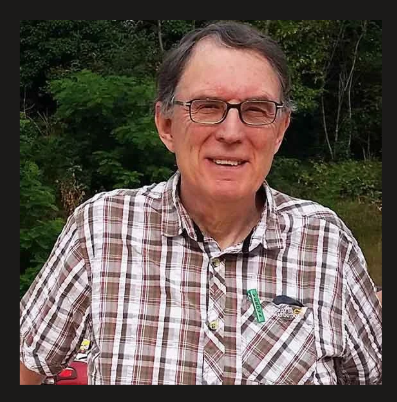
The photograph above is that of athletics historian Andy Milroy. Known world wide particularly for his place in researching and documenting the history of ultra running he was also one of the founders of ARRS – the Association of Road Running Statisticians. Inducted into the Ultra Running Hall of Fame in 2024, the Ultra Magazine has this to say of him below a bold head line telling us that
“It is not an understatement to say that ultrarunning as we know it today exists largely because of Andy Milroy.”
“Andy isn’t an ultrarunner but he has been one of the most important figures in world ultrarunning over the last 60 years. A quiet figure hailing from Trowbridge, Wiltshire, Andy Milroy is now a – possibly the – world authority on ultramarathon running, juggling his teaching vocation with travels around the world to major running events and meticulously compiling data of running records across road and track. Full disclosure, although Andy has been heavily involved with the initial setup and curation of the UK Ultrarunning Hall of Fame, his own inclusion is purely the work of Robbie Britton and Andy Nuttall – and we are sure that nobody will disagree.
A founding member of the International Association of Ultrarunners (IAU) in 1984, and later its technical director, Milroy oversaw the organisation of the World Ultrarunning Championships from 1990 to 1999, and co-founded the Association of Road Racing Statisticians (ARRS) is 2003. He has written or co-written several books including Training For Ultrarunning, The Ultramarathon Race Handbook (translated into many other languages including Greek and Korean) and The Long Distance Record Book (with progressive record lists for 10 miles up to 2,000 miles going back to the Middle Ages and even ancient times) along with many articles for a cornucopia of publications. Additionally, Milroy has been an official at many races including referee, race director and chief recorder.”
It is an honour to print the account below on the first six-day road race by Andy, who joins others of our sports historian contributors like Tom McNab, Alex Wilson and Hamish Telfer . Now read the article.
THE EARLIEST KNOWN SIX DAY RACE WAS WON BY A SCOT
The earliest known Six Day race, currently known, was won by a Scot, a highlander who was a running footman.
Reference to the “foteman that runnen” was first made in 1450. Internationally Basques from the Pyrenees on the Franco-Spanish border, the Irish and Highlanders from Scotland were all popular and fashionable among the wealthy aristocrats. Such running footmen ran alongside the relatively slow moving coaches of those days, ready to deal with any obstructions or to run ahead to arrange accommodation in inns.
Such footmen also, on a day to day basis, operated like an early form of email, carrying letters and notes between neighbours, relatives and friends.
These rich aristocrats also enjoyed racing their footmen, frequently wagered exorbitant sums on private foot-races pitting their own running footmen against those of rivals. Such races were usually over short distances, less than ten miles.
Such races had taken place for much of the seventeenth century. James I, the new Stuart monarch, had enjoyed racing such footmen.
On the 10th April 1721 a match was made for a race from London to York and back, between two running footmen Peter Hughson (also spelt in contemporary newspapers as Hewson), a Scottish highlander, footman to the Earl of Essex and Thomas Butler, an Irishman, footman to Mr Clayton for £100 (I have also seen £500 quoted).
The wager was for the footman to complete the journey in 6 days.
The fact we have so many details about the race and the runners makes it historically significant.
On the Monday morning the two runners set out from St. Giles’s Pound, Shoreditch in London to race to York and back, said in the 18th century, to be a distance of 396 miles. This would involve the footman covering 66 miles a day, a stiff undertaking on the roads of that period.
The two footmen ran together for about the first thirty miles, when the Irishman, Butler, began to flag.
Hughson pushed on and it was later reported in the newspaper “we are assur’d he went thro’ Huntington, which is fifty miles, about five a clock the same day he set out; and it was not doubted but he would reach to Stamford that night, which is seventy four miles of his way”
Meanwhile Thomas Butler was still having problems, A newspaper reported that “the exceeding bad weather on Tuesday, which made the roads wet, slippery, and stiff” caused Butler to feel sick. He vomited and then had a “high fever” for four hours and not able to stand up, let alone run. Butler then gave up the race and on Wednesday was brought back on a wagon, “and continues very ill”
Hughson successfully returned from York and reached London in the fifth day by 4 o clock. He was welcomed – “an abundance of horsemen are gone to meet him.”
The Earl of Essex had promised if his running footman achieved the feat within the six days he would settle a pension of £50 pounds per annum on him.
£50 a year in 1721 would be worth perhaps £135,000 today – so a huge amount of money was at stake.
So what was the background of Hughson the Highlander? The Hughsons were a branch of the much larger Clan MacDonald and Clan Gunn (the latter came from the far north of Scotland and the Shetland Isles)
The actual link between the Hughsons and Shetland go back to the early 1600s.
In 1614 or 1617 a salvage master from Norway came to Shetland to salvage a ship that had gone aground on the Skerries. He met and married a local girl and changed his name to Hugh Noble. His male descendants were to be known as Hughson and spread out from Shetland
Peter Hughson was the running footman of William Capell, the Earl of Essex. Capell, 3rd Earl of Essex was 24 years old in 1721 and was an English courtier and diplomat. The links with running footmen was traditional among the Capell family who were famous for their ties to these swift couriers.
The huge sum of money (£50 a year) may well have resulted in an extended celebration by Hughson. He was literally drunk on his success when a fatal accident happened. Peter Hughson was crushed by the wheel of a a carriage on the 20th July 1721 while intoxicated.
The life of a running footman could be very demanding and yet few accounts of their feats have come down to us. The frequent walks from London to York and back by Foster Powell from 1773 onward were remembered and recounted as highlights in the age of pedestrianism, but the similar feat by Peter Hughson fifty years earlier was forgotten, maybe because they were primarily for the enjoyment and gratification of the aristocracy. The likes of Foster Powell and other pedestrians interacted with ordinary people and sometimes were dependent on their coin donations for survival.
***
That is Andy’s article on a fascinating race and there are of course several books by him on ultra distance running and racing – eg “The History of the 1000 mile race” , “Training for Ultra Running”, and North American Ultra Running” which are available via Amazon.