Hugh’s Photos, Clippings and Memorabilia

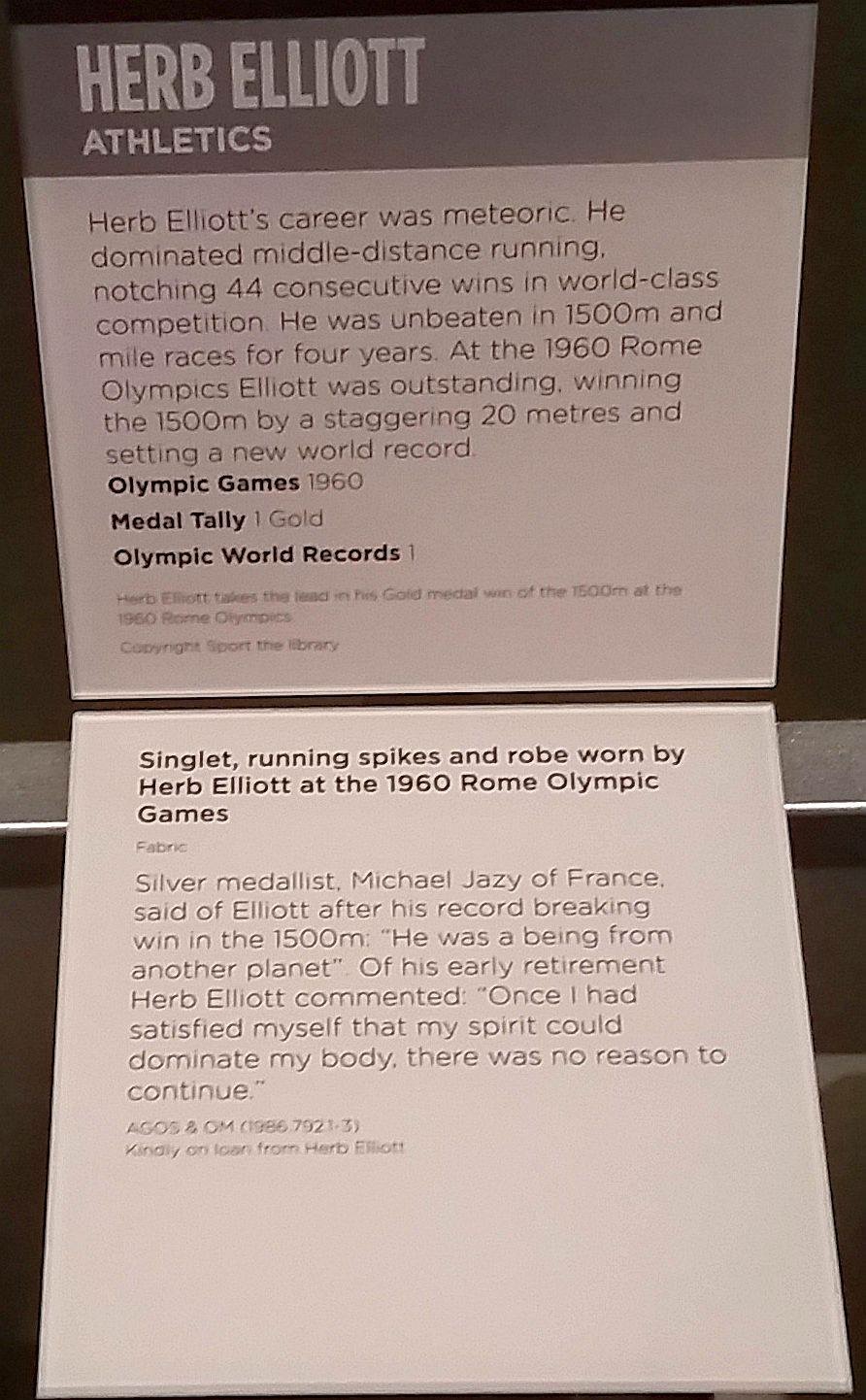
Hugh Barrow’s collections of photographs, pictures and memorabilia receive many visits each week and these are the new additions of items of interest to us all.   First, from the Australian Sports Museum in Melbourne we have the plaque at one of Herb Elliott’s items – read it and wonder!   I talk frequently about ‘our heroes’ – one of mine used to start  us off with ‘I mind one time when …’ – and probably the athletes of the 21st century think it’s an old man being sentimental.   It isn’t.   We did have particular athletes that we looked up to and Herb Elliott was the supreme runner, certainly for any miler; the nonpareil as the really old runners used to say.   Unequalled – then along came Peter Snell and the debates started.   Zatopek was ‘the man’ for long distance runners although Alain Mimoun was also a superb athlete who was fated to be the Merv Lincoln to Zatopek’s Elliott.  Note Michel Jazy’s comments below. However here is the plaque –

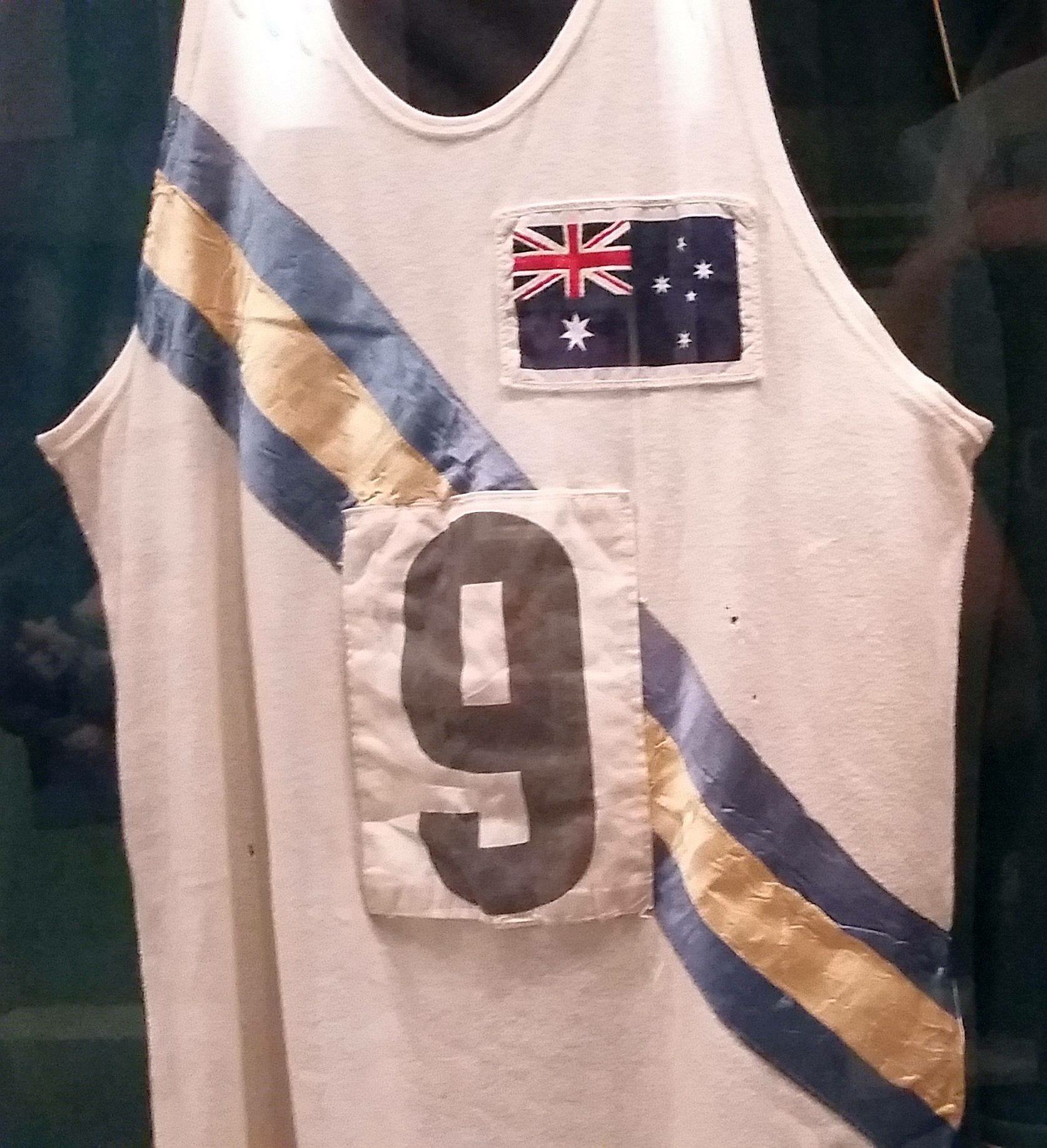
… and here is The Vest …

If you want to see more of Herb and his coach, Percy Cerutty, scroll down the page.


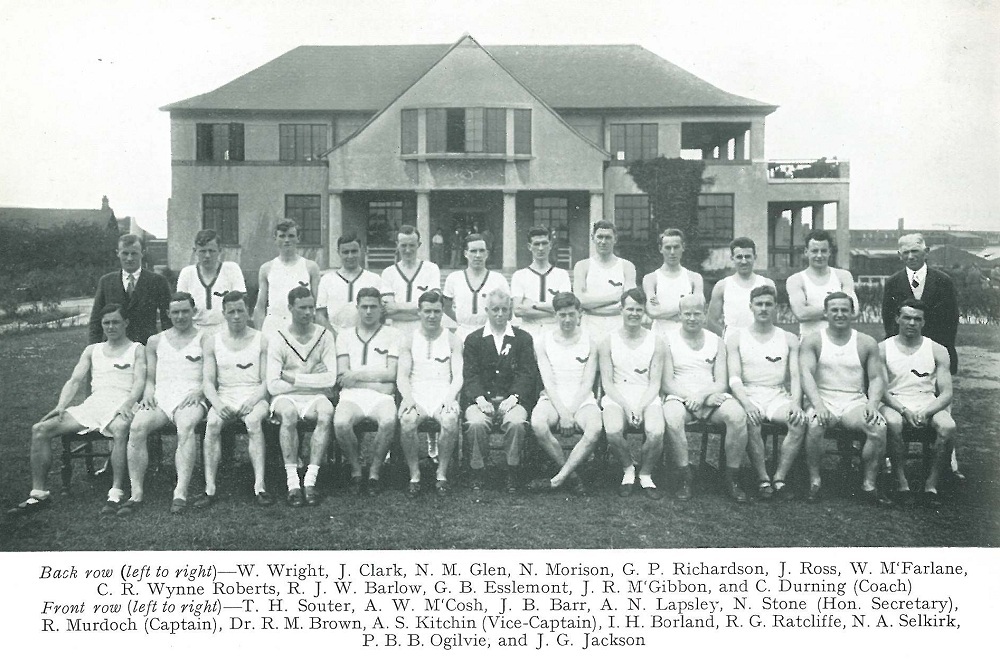
 Westerlands in the 1920’s:

WHB Westerlands

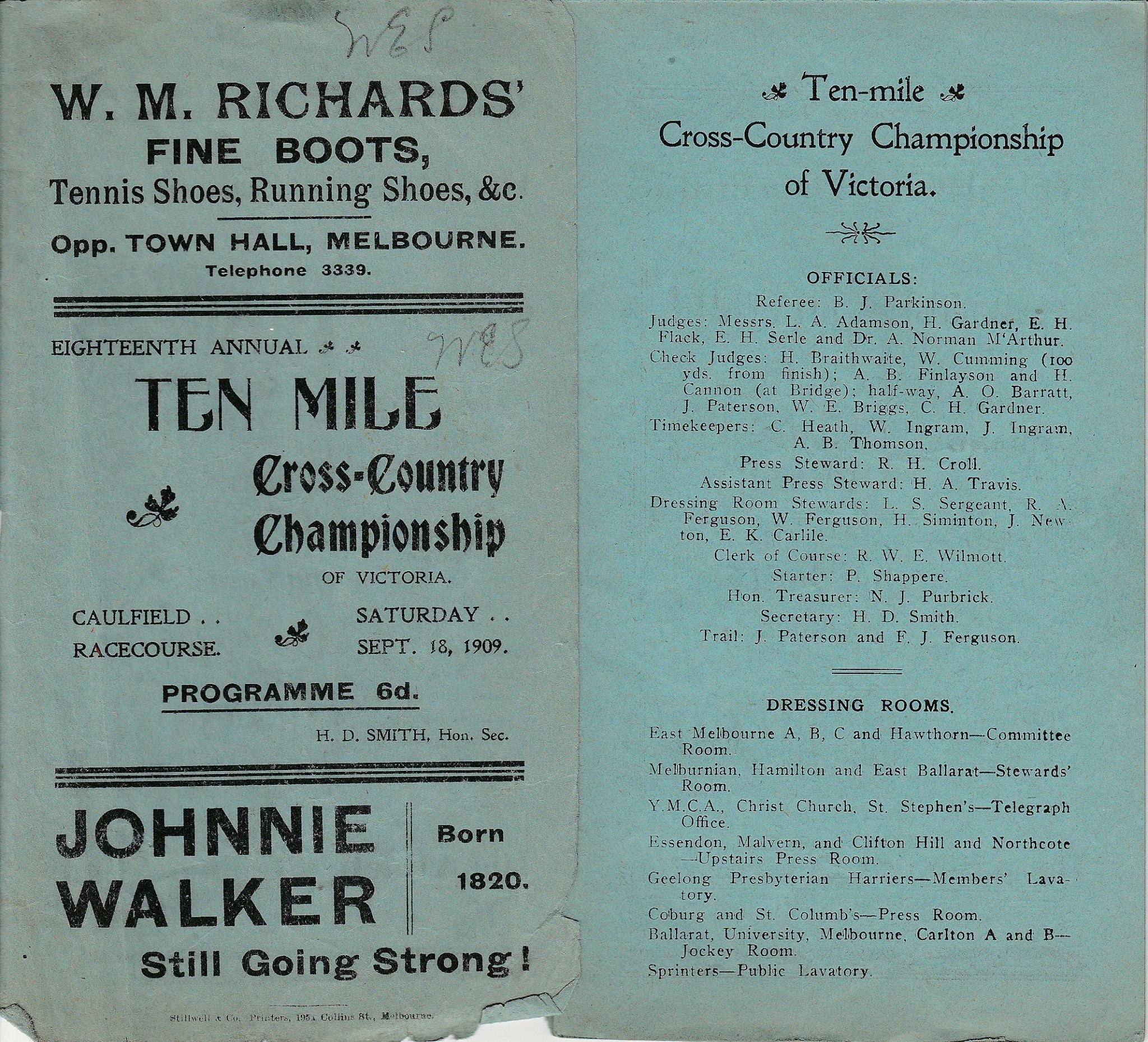
Programme of the Australian ‘Ten Mile Championship of Victoria’.   Have a look at the Dressing Room arrangements!

WHB Victoria Dressing Room

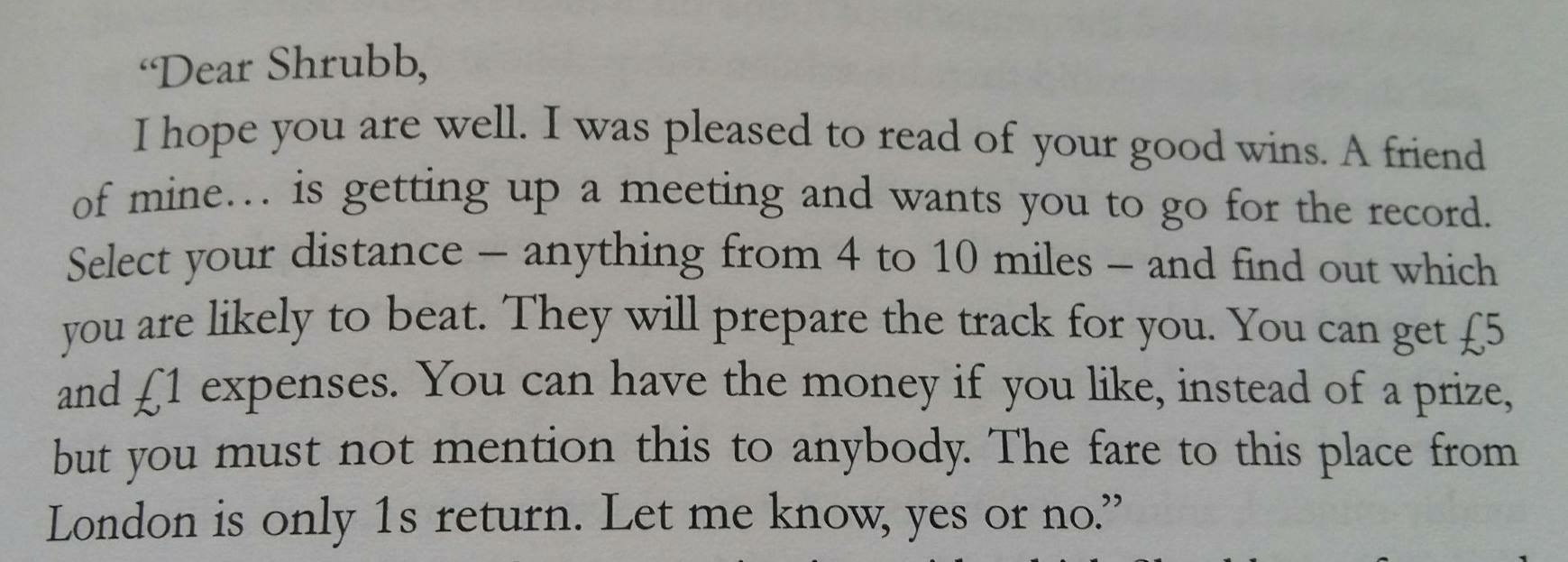
Now a reminder of the good old amateur days with a letter to Alf Shrubb.

IMG_6957

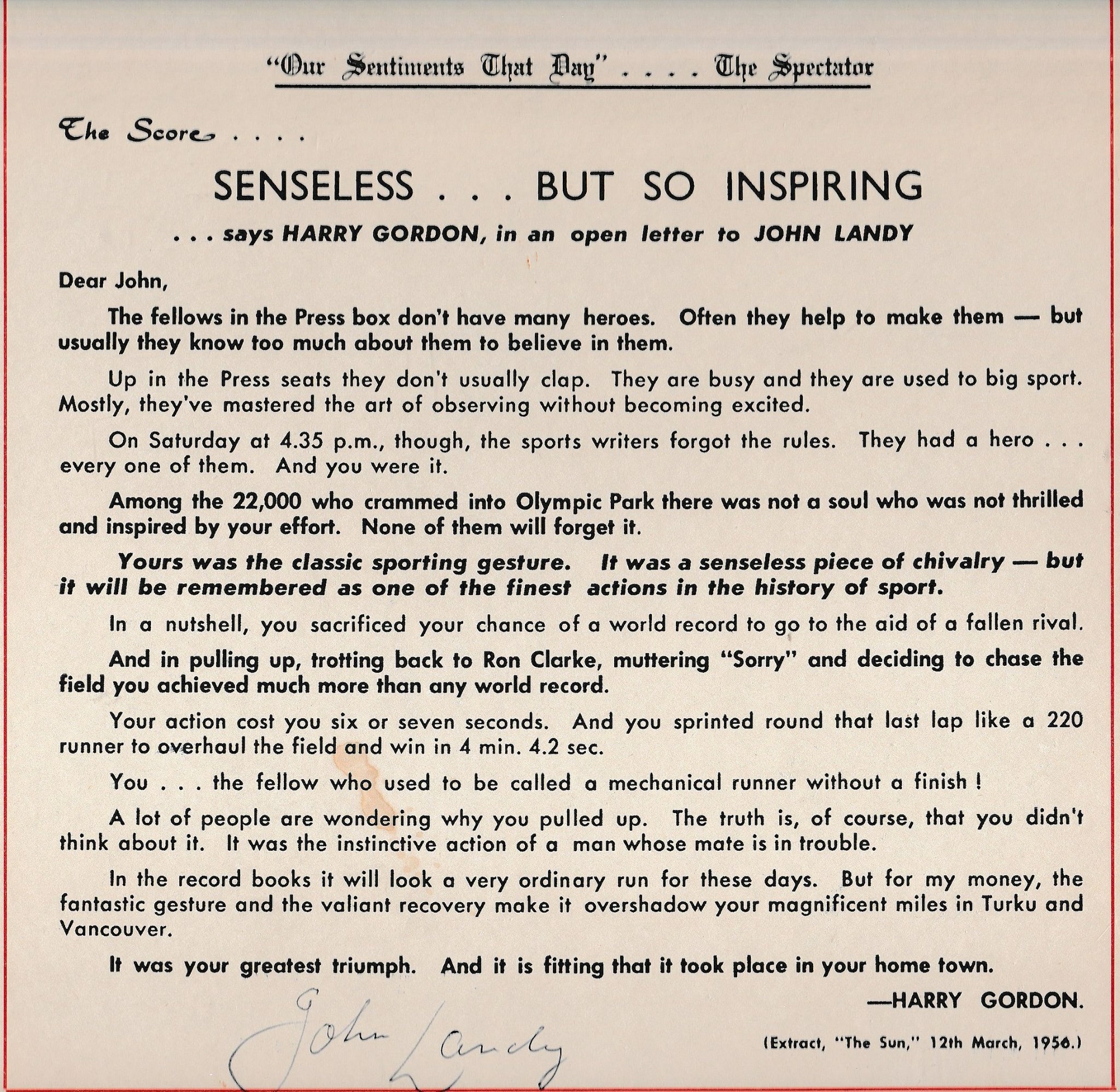
Next, a public letter to John Landy – signed too!

IMG_6983

IMG_7123

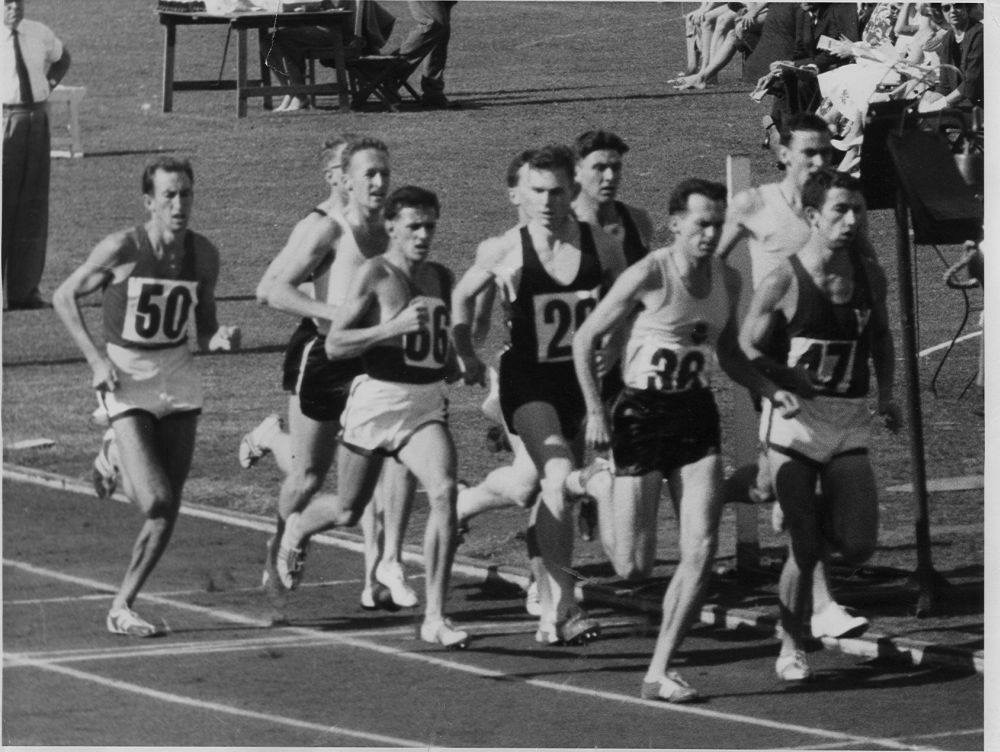
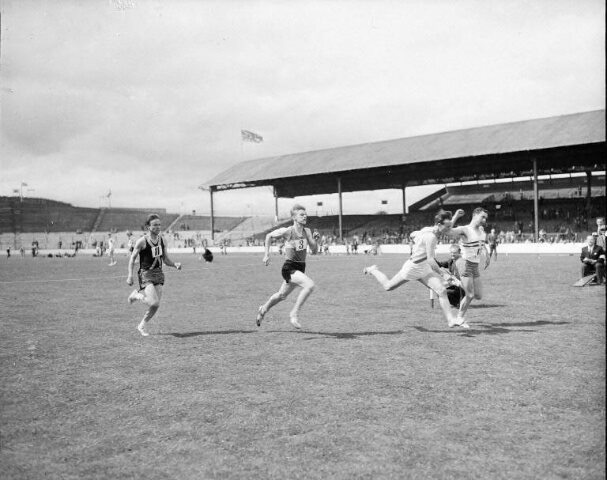
The race that got Peter Snell (25) to Rome: Herb Elliott (50) in there too.

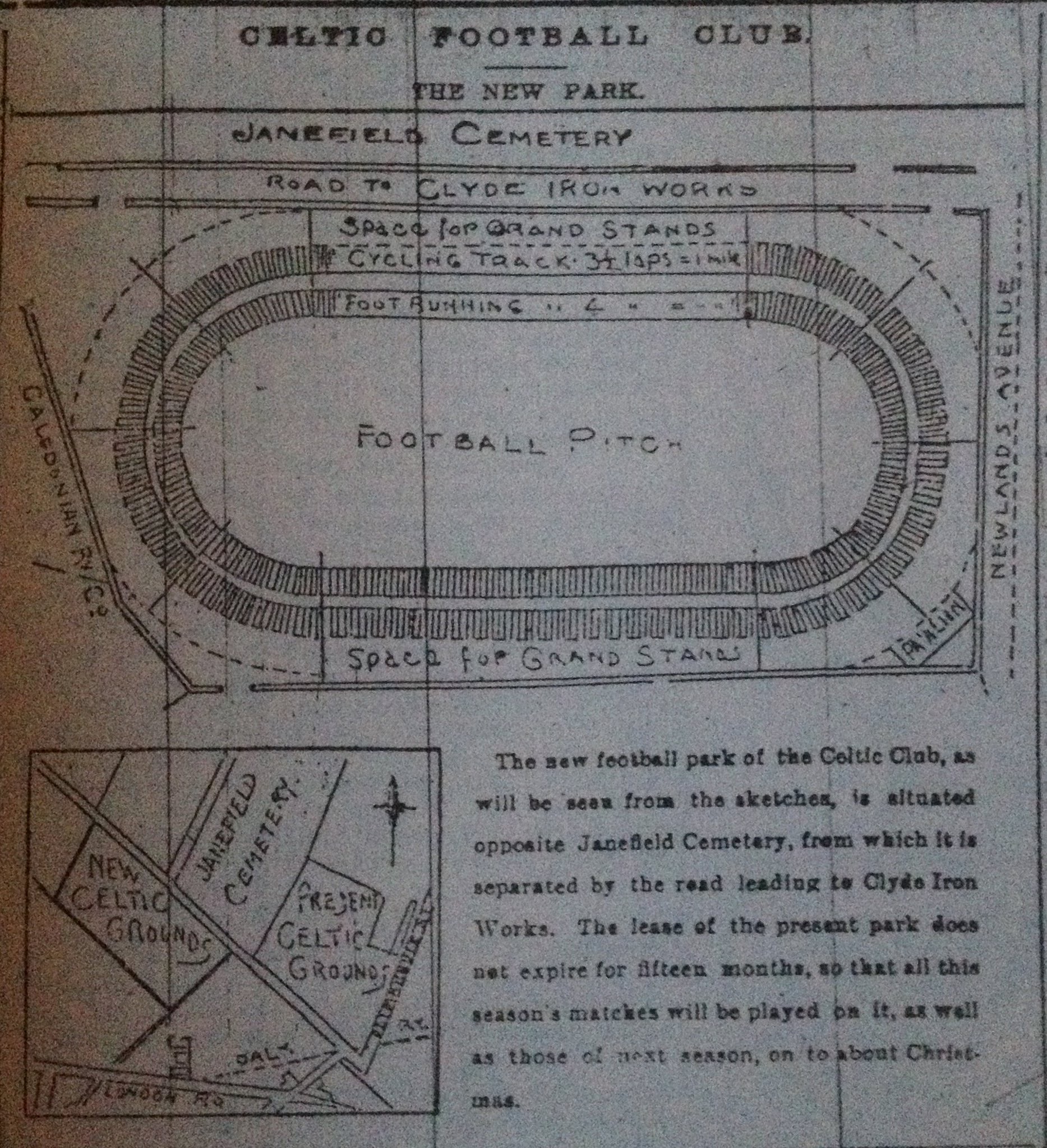
Next is the plan of Parkhead at the start of the twentieth century when major athletic meetings, including SAAA Championships, were held there.   But note the two tracks: the inner for runners, the outer was of concrete for (1) cycle racing: separate races were held for hard tyres, cushion tyres and pneumatic tyres.   (2) the Celtic Sports were the only one that had motor cycle trials, which had motor cycle records set, and these were held on the outer track.

WHB Parkhead tracks

WHB Herb Zat

It wouldn’t be Hugh Barrow without a Herb Elliott picture: two greats – Herb with Zatopek

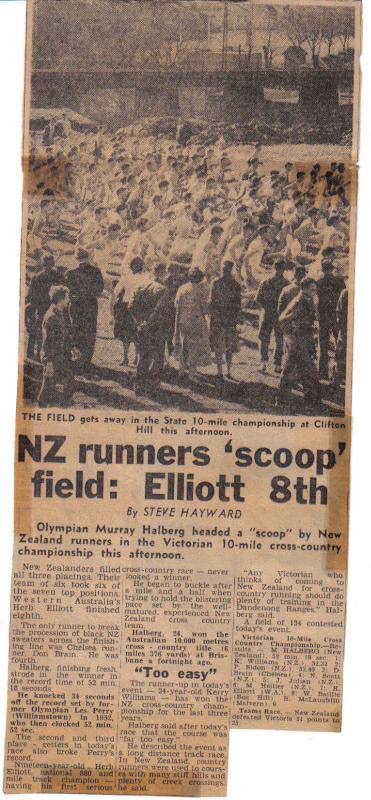
Below is a report on a race which Herb didn’t win

WHB Herb 8th

IMG_6044

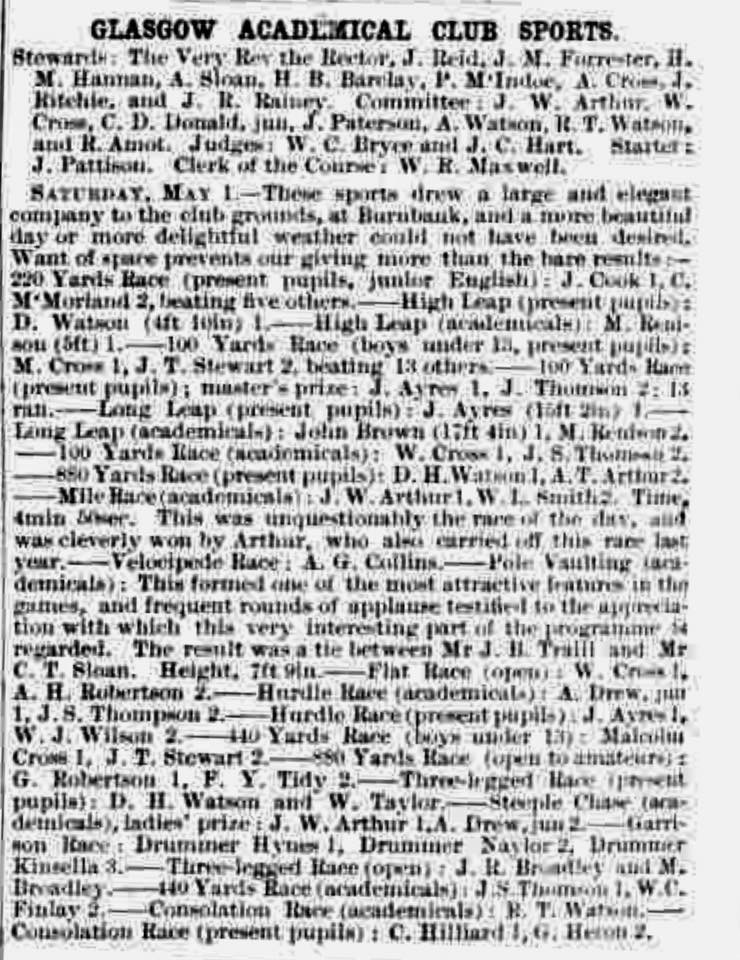
Above is a very interesting cutting indeed.   Hugh says:

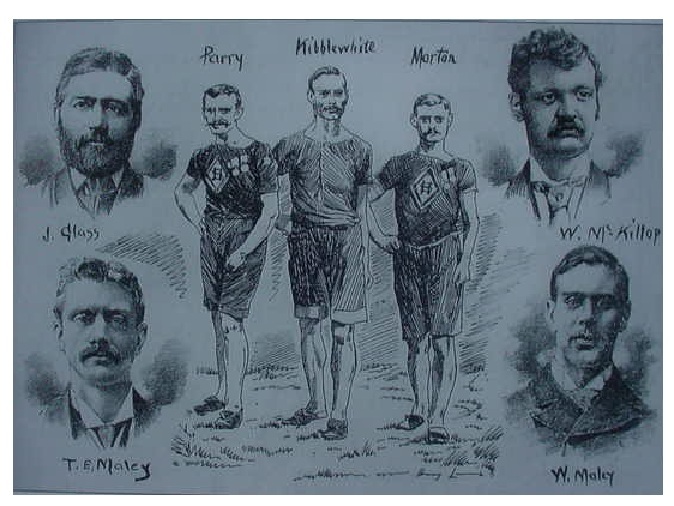
“It was 1869 – Many of these athletes were involved in the birth of international rugby in 1871
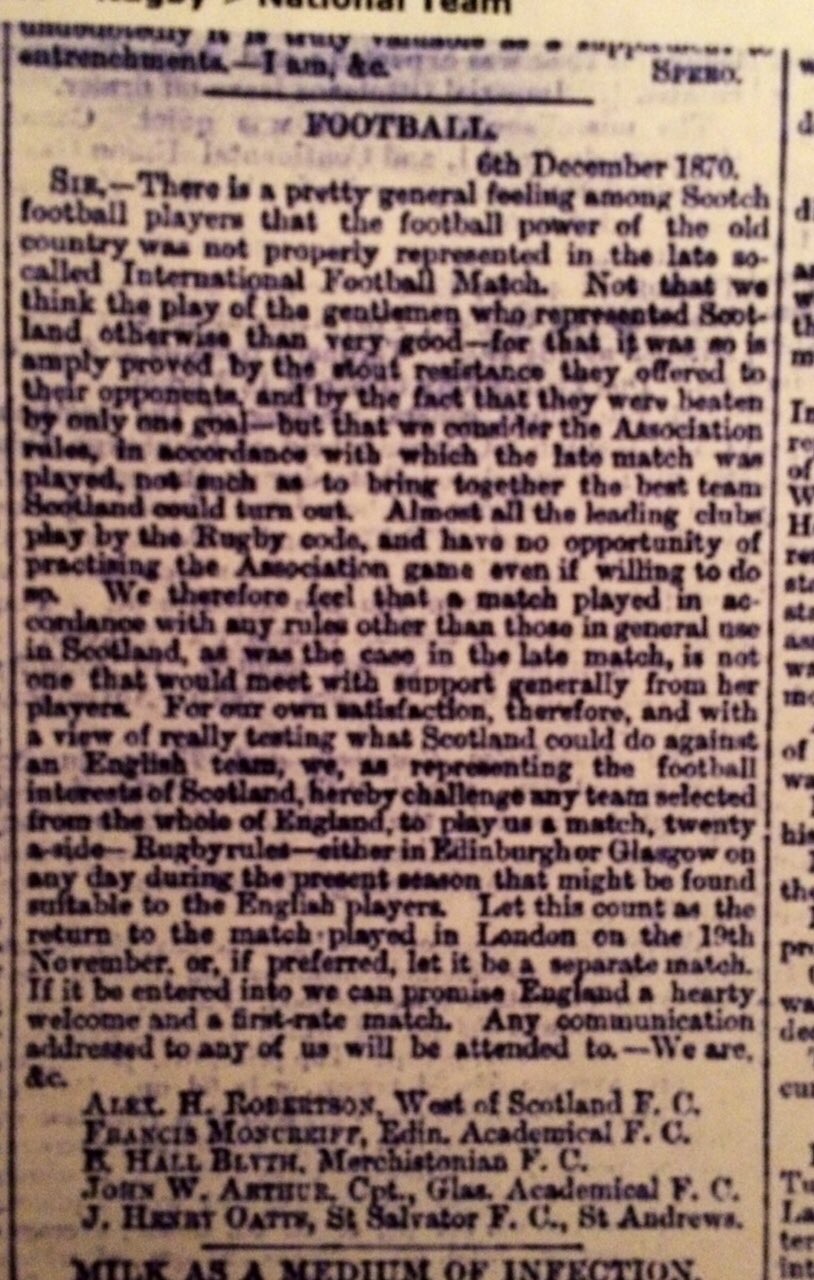
Arthur and Robertson signed the famous challenge letter in Dec 1870 that led to the first game v England in March 1871.   Arthur ,Cross ,Robertson all played and Cross scored the first ever recorded in international”
Below is the letter referred to above
WHB Letter

WHB Shawfield

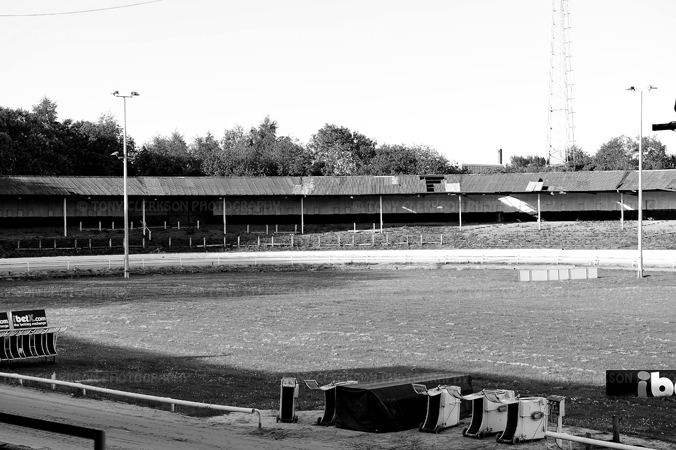
Another athletics venue of old:  Clyde FC’s Shawfield Park which was the venue for such big events as the Lanarkshire Police Sports.   There was an inner and outer track here too – the outer for dog racing.

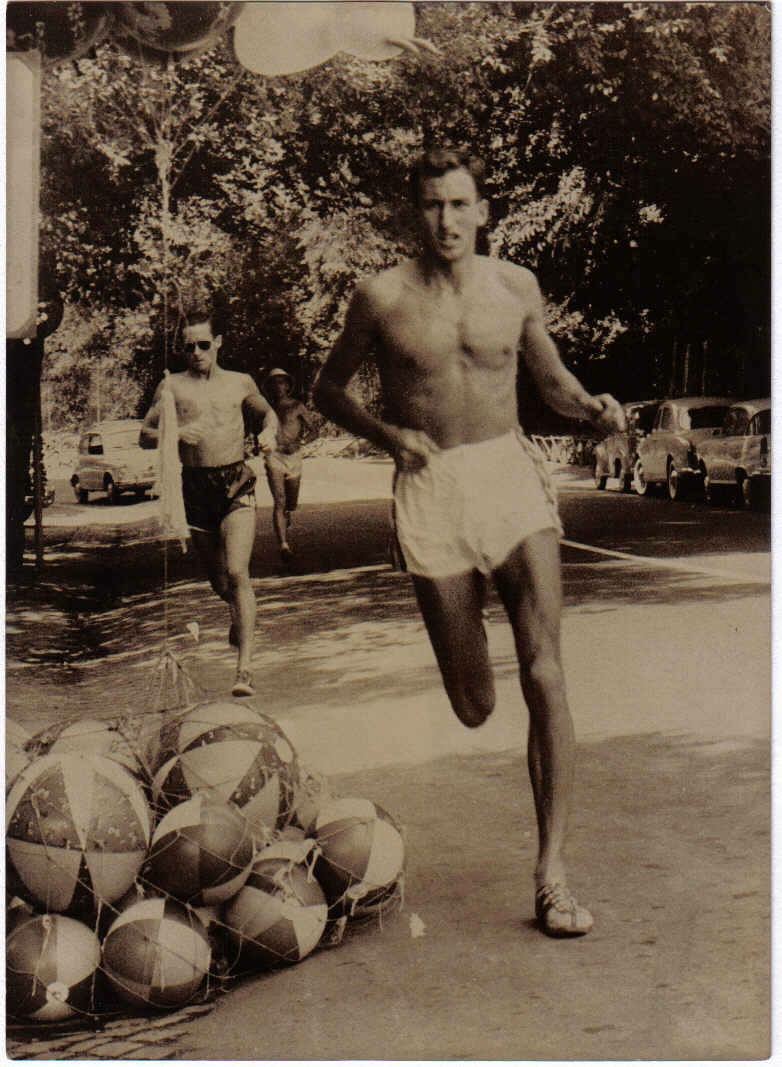
Below:   Herb Elliott training in Rome

IMG_6578

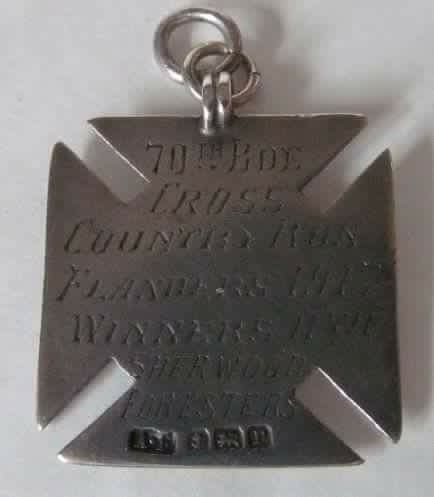
The grouping below has one of the most unique medals I have ever seen. Then there are several clippings and other things from the past, followed by some more modern photographs (ie from after 1960).   First of all – the medal from cross country races at Flanders Field in 1917.   Note the hallmark on the medal.

WHB Flanders CC

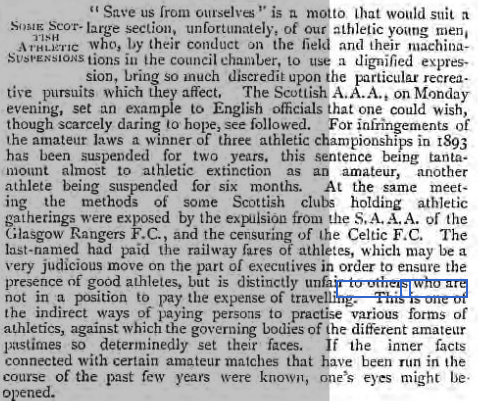
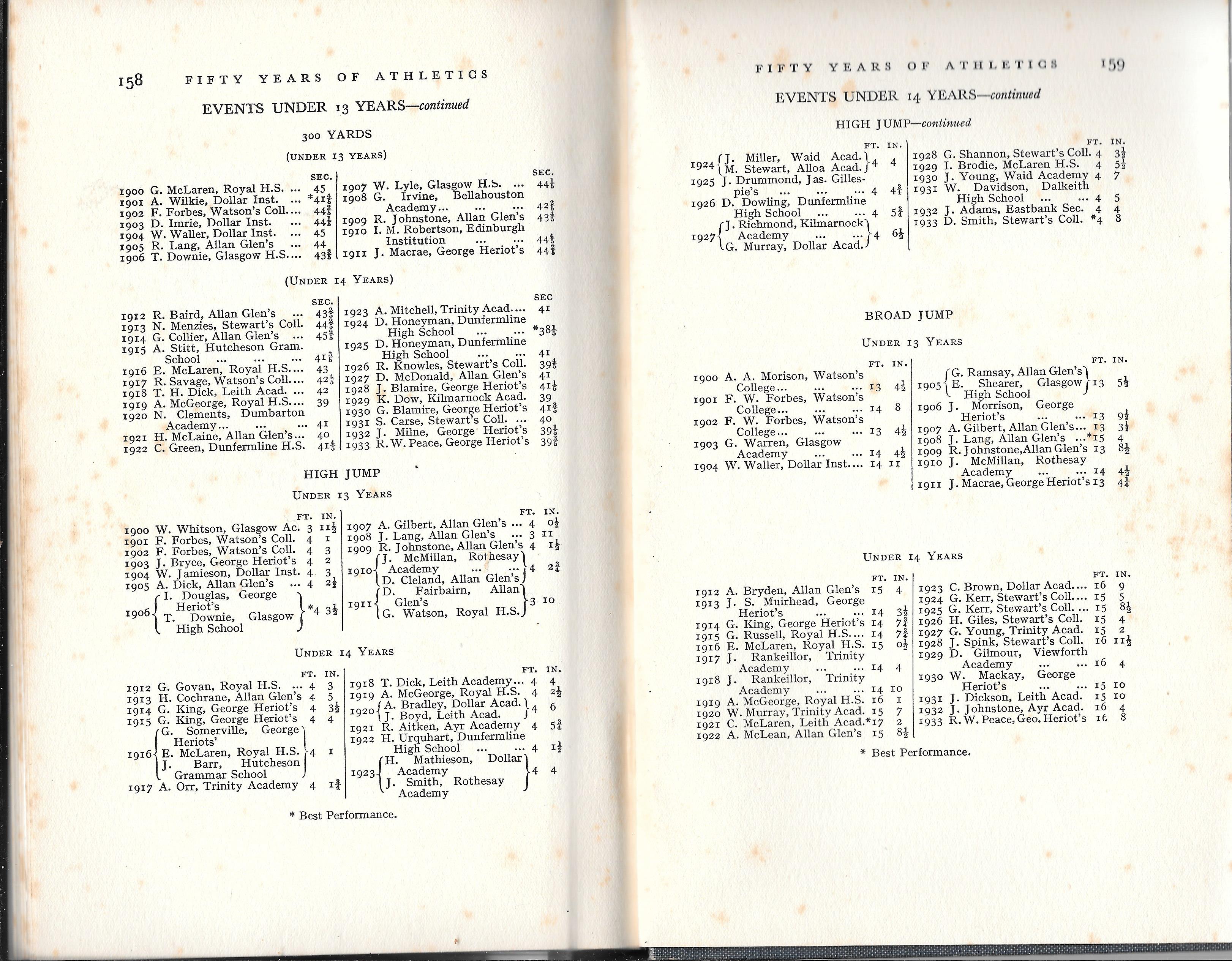
In this post-amateur era, it is difficult to realise how serious the founders of amateur athletics were in the beginning.   Just read ‘Fifty Years of Athletics’ elsewhere on this site to get the picture.   The clipping below is self explanatory.

WHB Suspensions

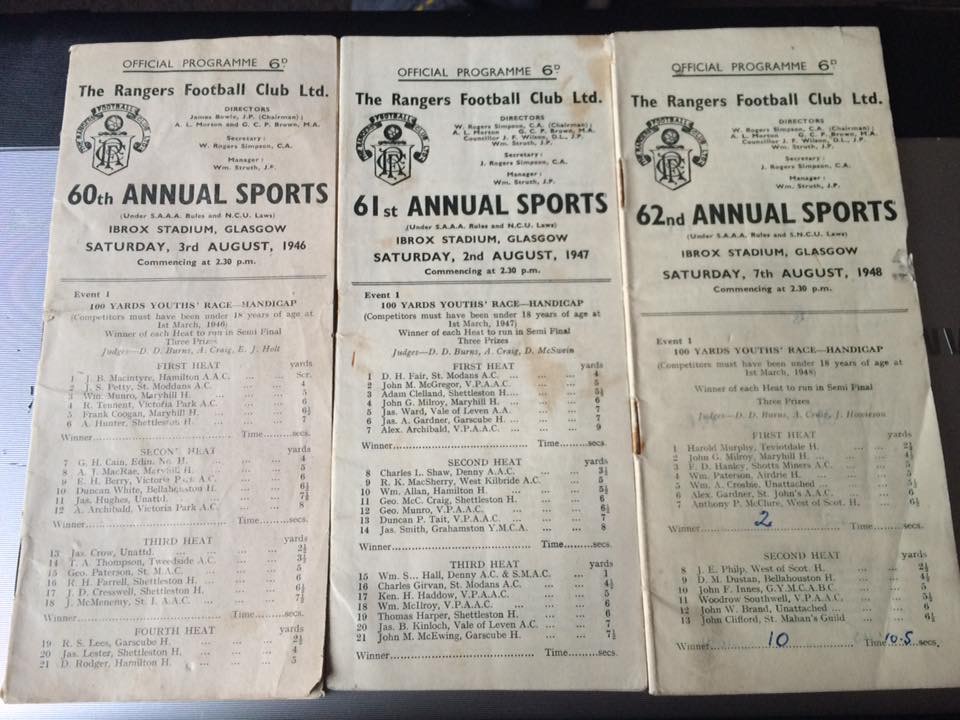
Below is from an early Rangers Sports at Ibrox

WHB Rangers Sports

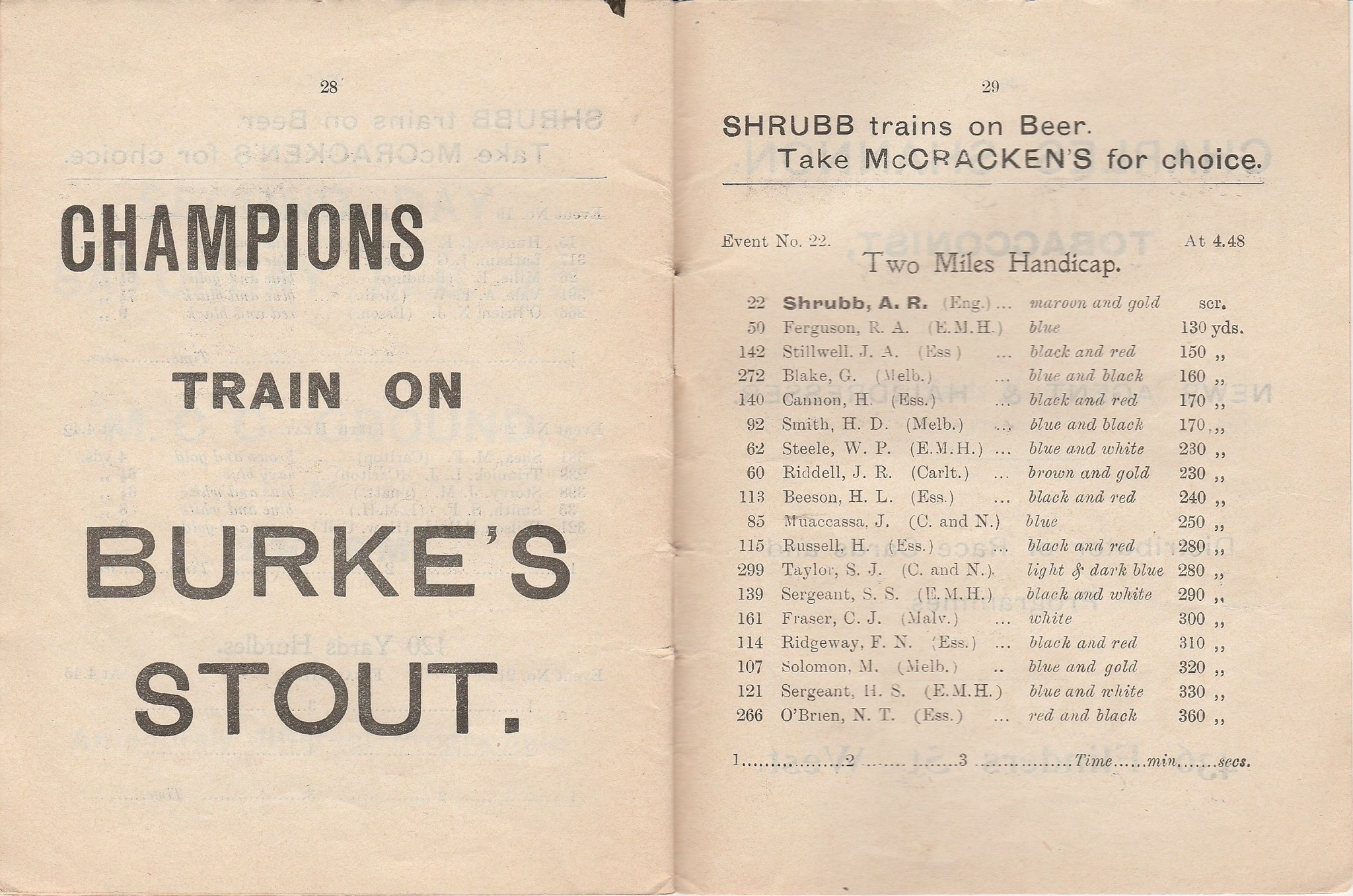
Extract from an Australian programme for a race including Alfred Shrubb: note the nutrition advice!

WHG Shrubb Race Start

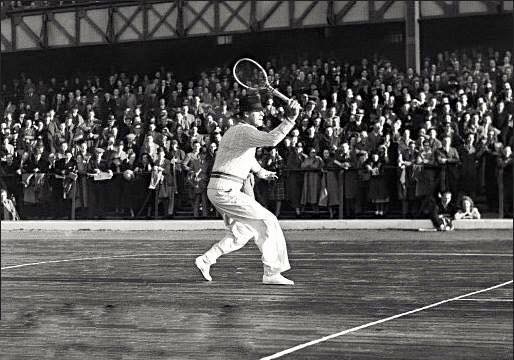
Rangers were not slow to experiment or to let their supporters witness top class sportsmen and women form other sports: this is from a tennis demonstration at Ibrox.

WHB Tennis Ibrox

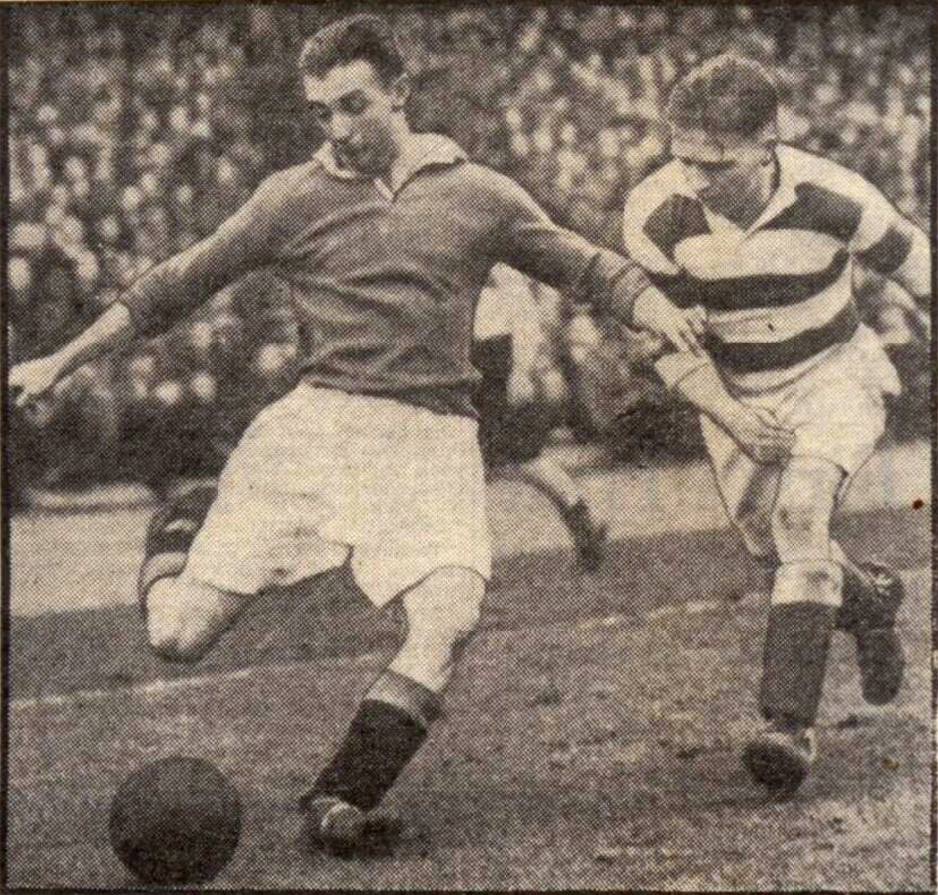
Then Stanley Matthews came on a one-day contract to play in an exhibition match – here he is in a Rangers jersey.

WHB Matthews at Ibrox

No comment!

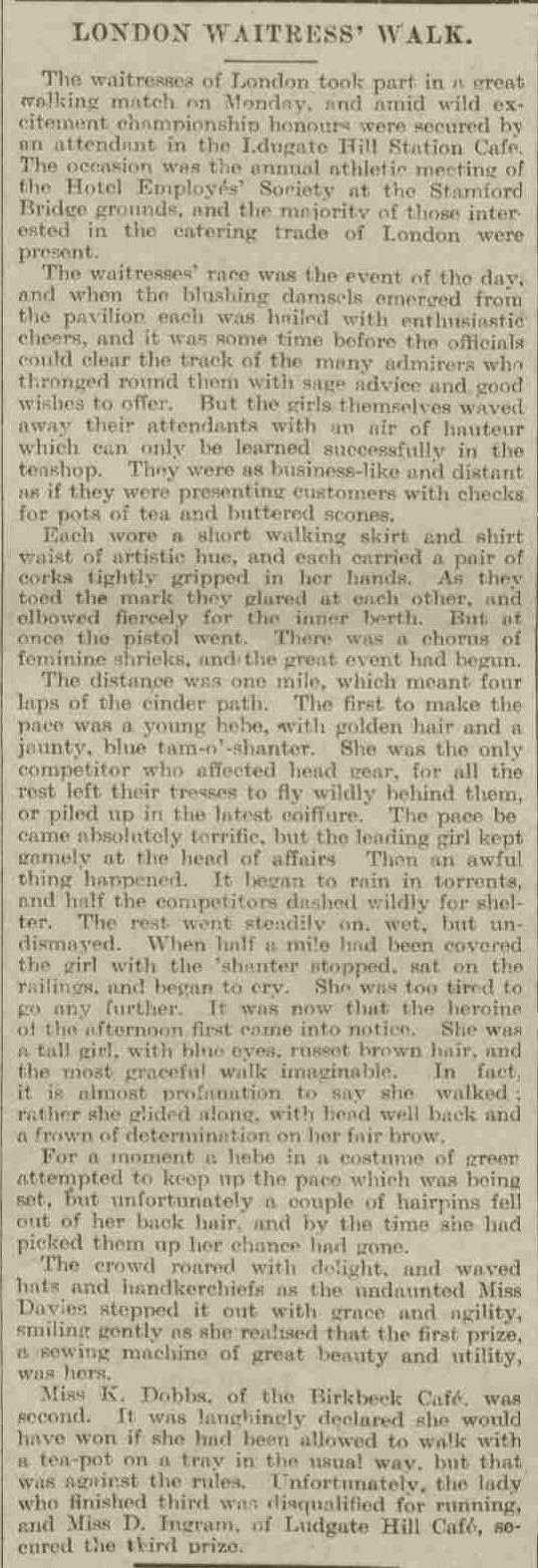
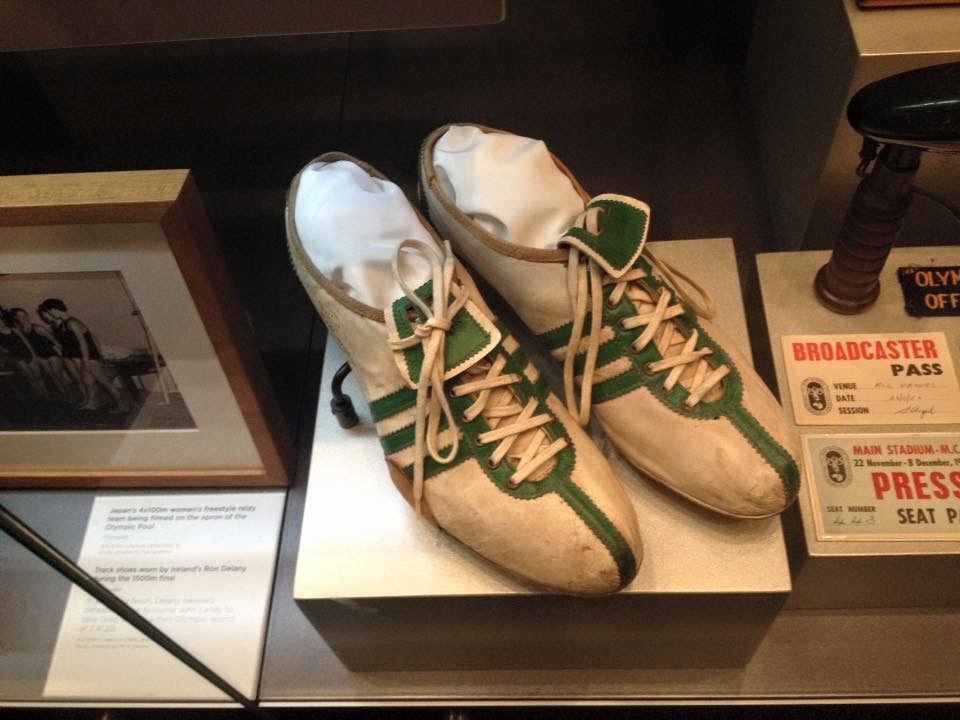
WHB Waitress Walk Ronnie Delany’s spikes, worn in the 1956 Melbourne Olympics 1500m final.   Now in the National Sports Museum in Melbourne.   Why can’t we do things like that?   eg The NZ museum in Dunedin has Shirley Strickland’s long jump measured out in a sand pit, Bob Charles’s winning putt is laid out on a putting green in the museum, etc.
WHB Shoes

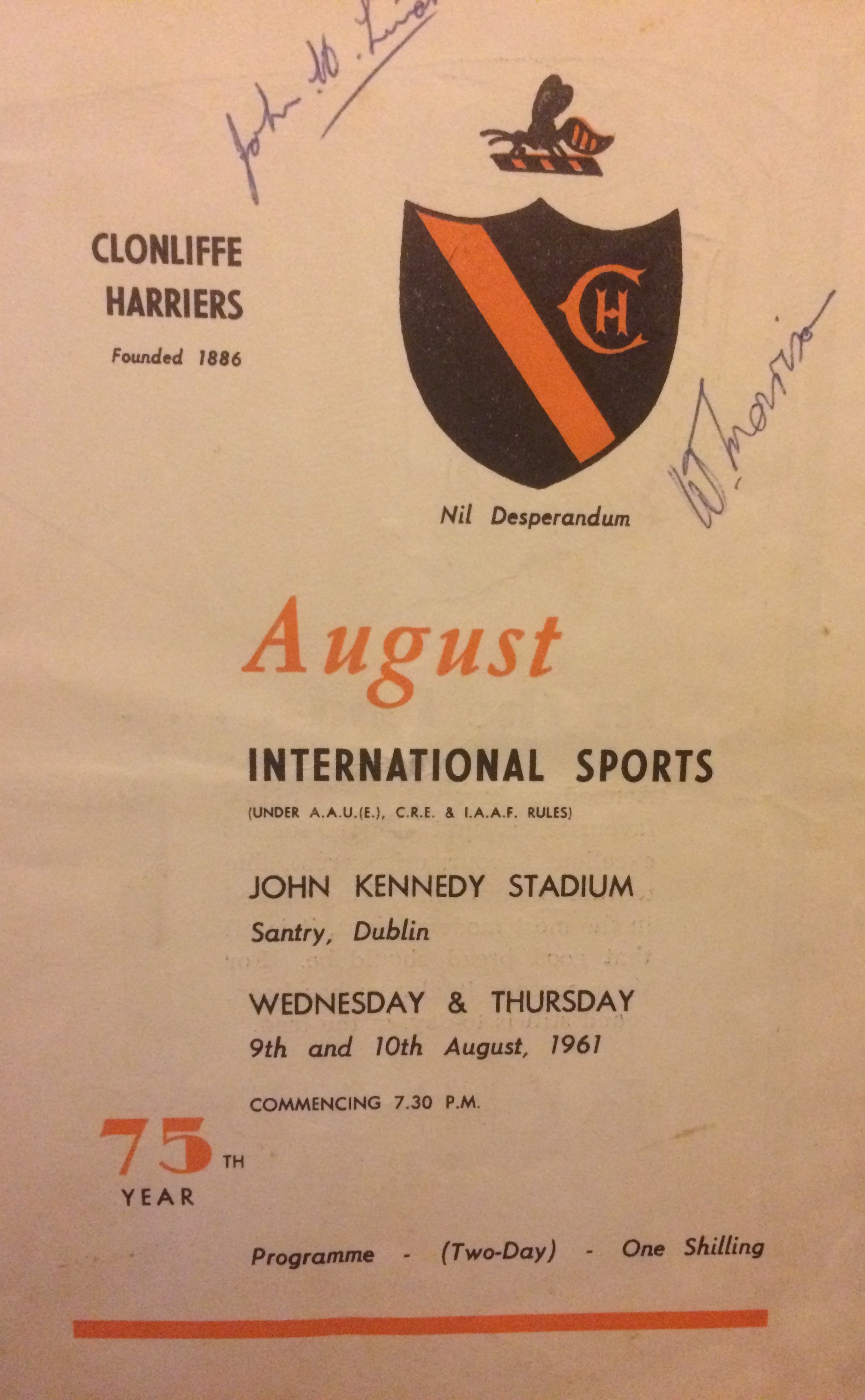
WHB Ireland 1961

Ibrox Sports: Note the runner from Auchmountain Harriers on the right

 WHB Auchmountain Ibrox
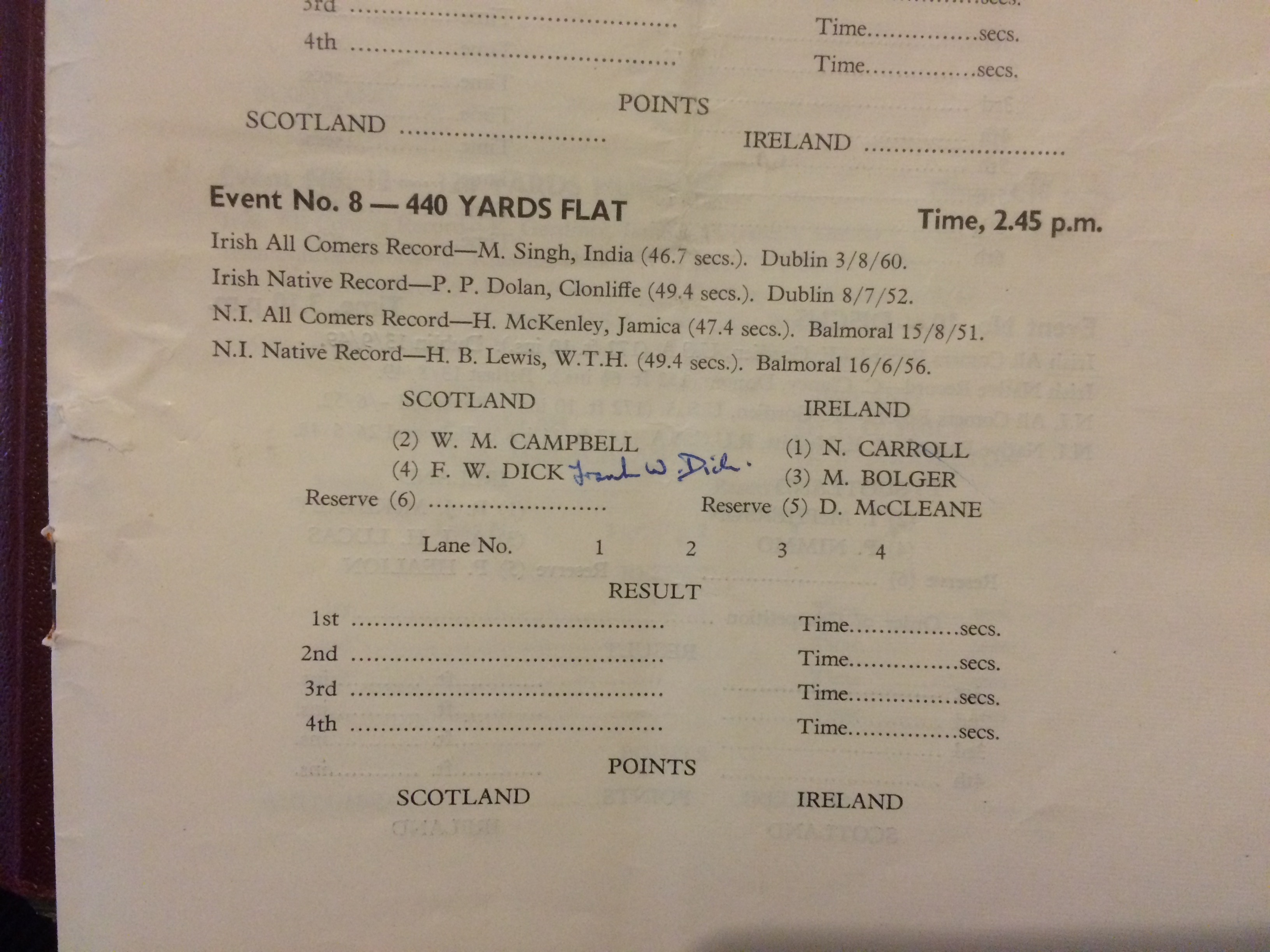
Extract from an international programme: note the autograph!

WHB F Dick International

Competitors at Rangers Sports

WHB Rangers Sp

Rangers 7

Sports Miscellany: 29th July 1912

The Queen’s Park will run two open handicaps – 100 yards and 880 yards – in connection with their club sports on Thursday evening first.

Dr JL Huggan – the Edinburgh University and Jed-Forest rugby three-quarter back – is due congratulations on passing tenth among the thirty successful candidates for commissions in the Royal Army Medical Services.

F Boor, who was one of the ‘stars’ at the recent sports of Ayr United FC, has got himself into trouble with the National Cyclists Union and in consequence has been ordered the ‘rest cure’ till the beginning of the year.   Boor was to have taken part in the Celtic Sports but that arrangement will now fall to the ground.

Maryhill Harriers are holding confined sports at Ibrox Park on August 14th.   The programme is of modest dimensions.   There are a number of first-class runners at this club, among others G Dallas, G Hamilton, J McFarlane, JA Coyle and D Fulton.   The decision to hold confined sports should help to increase the membership.

Ralph Craig, who won the 100 and 200 metres at the Olympic Games, has now retired from athletics; he has conquered all that is worth conquering and believes it better to retire with an unsullied reputation.   At one time it was thought that Craig would run at the Celtic Sports but he has returned to America and the last has been heard of him in connection with amateur athletics.

JG Brock (Clydesdale Harriers) won no fewer than four firsts at the Young Men’s Christian Association’s camp at Ardgoil during the Fair holidays.   The sports were a great success there being over 500 entries.   HJ Christie first caught the racing fever at the YMCA Camp two years ago and from a modest beginning has developed into one of the speediest amateurs in Scotland.   Mr William Gardiner has organised these camp sports for several seasons, and their success is to be measured as much by the unalloyed enjoyment they afford as by the number of recruits they give to open athletics.

Although JT Soutter’s leg is now quite sound again, it is stated on most reliable authority that he has now retired from the track.   If such be the case, British athletics will be much the poorer in the near future for the Aberdeen University divinity student, with a distinct personality of his own, has been an ornament to the track since his debut in open competition in 1910.   He shares the Scottish native half-mile record of 1 min 58 2-5th sec with R Burton, and each has beaten the other thrice on level terms, but Soutter’s best performances were accomplished last year in England where he ‘clocked’ 1 min 57  sec at Birmingham, 1 min 57 1-th sec at the British Press Charity Sports, and 1 min 56 1-5th sec in the AAA Relay Championships at Fallowfield, Manchester.

Local sprinters are debating eagerly the respective merits of RC Duncan, George Sandilands and HJ Christie, all of whom are on the same mark in the 100 yards – viz. 1 yard.   Duncan and Sandilands, it will be remembered, put up a great race at the SAAA Championships, and although the former was accounted the better man, not a few thought Sandilands was slightly in advance of the West of Scotland Harrier.   Still, there was little between them, and now that Christie has worked his way to the same mark as Duncan and Sandilands, many would like to see either the Rangers or Celtic extending an invitation to each to run a level race.   It might lack the electrifying effect of a race composed of Olympic and other champions, but from a local point of view it would be infinitely more interesting.

Mr JE Sullivan, secretary and treasurer of the American Athletic Union, is indignant at the accusations of semi-professionalism in connection with international sport.   In an interview he says:-

“There is no call for the introduction of this argument.   There no doubt are, and always will be, isolated cases of men in amateur sport who are not pure amateurs.   Doubtless you can think of some on your side of the water, although I do not doubt that the Amateur Athletic Association and its kindred bodies do their best to deal repressively with any breaches.   We are in the same position in America, and our record shows that we also do much to keep semi-professionalism down.   The difficulty will arise with greater force in Sweden, Germany, Finland and other countries which have not the advantage of years of organisation which America and England have enjoyed.   We made no imputations on the cleanness of British amateur sport, although in my long experience there are plenty of instances of British champions turning professional.   As to international sport generally, we do not allow our athletes to race abroad without our permission, and I think it could be better regulated if there was agreement between the various nations on this point.”

History, it is fully expected, will be made at the Rangers Sports on Saturday, and that is equivalent to saying that there will be some sensational running.   Hannes Kolehmainen is their trump card, though possibly the best running will be seen in the half-mile if Melvin Sheppard, JE Meredith and H Braun are among the competitors.   A few days ago at Berlin Braun scored a notable victory over the Americans.   The Bavarian is a beautiful runner, and the public will be charmed with his style as much as by his speed qualities.   Sheppard we have seen before, and many must still have vivid recollections of his “all-comers” record set at Ibrox.   Meredith is the American holder of the 800 metres.   He is only 19 years of age, and it may interest some to know that he was trained by an old Scottish runner, Jimmy Curran.   As to Kolehmainen. whose brother by the way was running at the Clyde’s ground on Saturday, Little need be said beyond the fact that he was the most striking figure at the recent Stockholm games, winning no fewer than three distance events, and making time in each which gives him an incomparable position among present day runners.   Kolehmainen won the English four miles championship last season and his performance on that occasion will not be forgotten by those who had the pleasure of witnessing it.   There will be lots of crack runners, besides the ones we have mentioned, and if the anticipations of the Rangers committee are realised, the meeting on Saturday will be one of the best they have yet held.

Two Army records were lowered last week in the Army Championships.   Lieutenant HE Blakeney, Royal Sussex, won the hurdles in 15 2-5th sec, or a fifth faster than CRL Anderson’s time in the English championships.   This is Lieutenant Blakney’s best performance, and it is one that elevates him to a very high position as a hurdles performer.   Then in the three miles Sergeant O’Neill, Connaught Rangers, was first in 14 min 45 sec, which is excellent travelling, and accentuates one’s regret that the Irish crack was not at Stockholm, not that he would have made any impression against Hannes Kolehmainen but he would certainly have acquitted himself better than several who represented Great Britain.   Corporal Hutson ran second to O’Neill in the mile, the time for which was 4 min 28 1-5th sec.   These two wins are among the finest O’Neill has to his credit in open competition.   Sergeant Gray, who ran such a plucky race in the Scotland  v  Ireland international, was beaten by Lieutenant Alan Patterson in the quarter-mile in 51 1-th sec, which was a shade too good for him, as on Powderhall, which is greatly superior to the track at Aldershot, his time was 52 sec.   Patterson also won the half-mile, beating among others MC Harrison, an old Irish international runner.    In the officers 100 yards, Patterson was first in 10 4-5th sec and Captain Dugmore, ASC, cleared 21 feet 9 inches in the broad jump.   Lieutenant R Simson, the old Edinburgh Academy boy, took part in several of the events but could not breast the tape first in any.   On the whole, the performances were an advance on last season, and Army athletics, if not all that they might be, are in a fairly satisfactory condition.

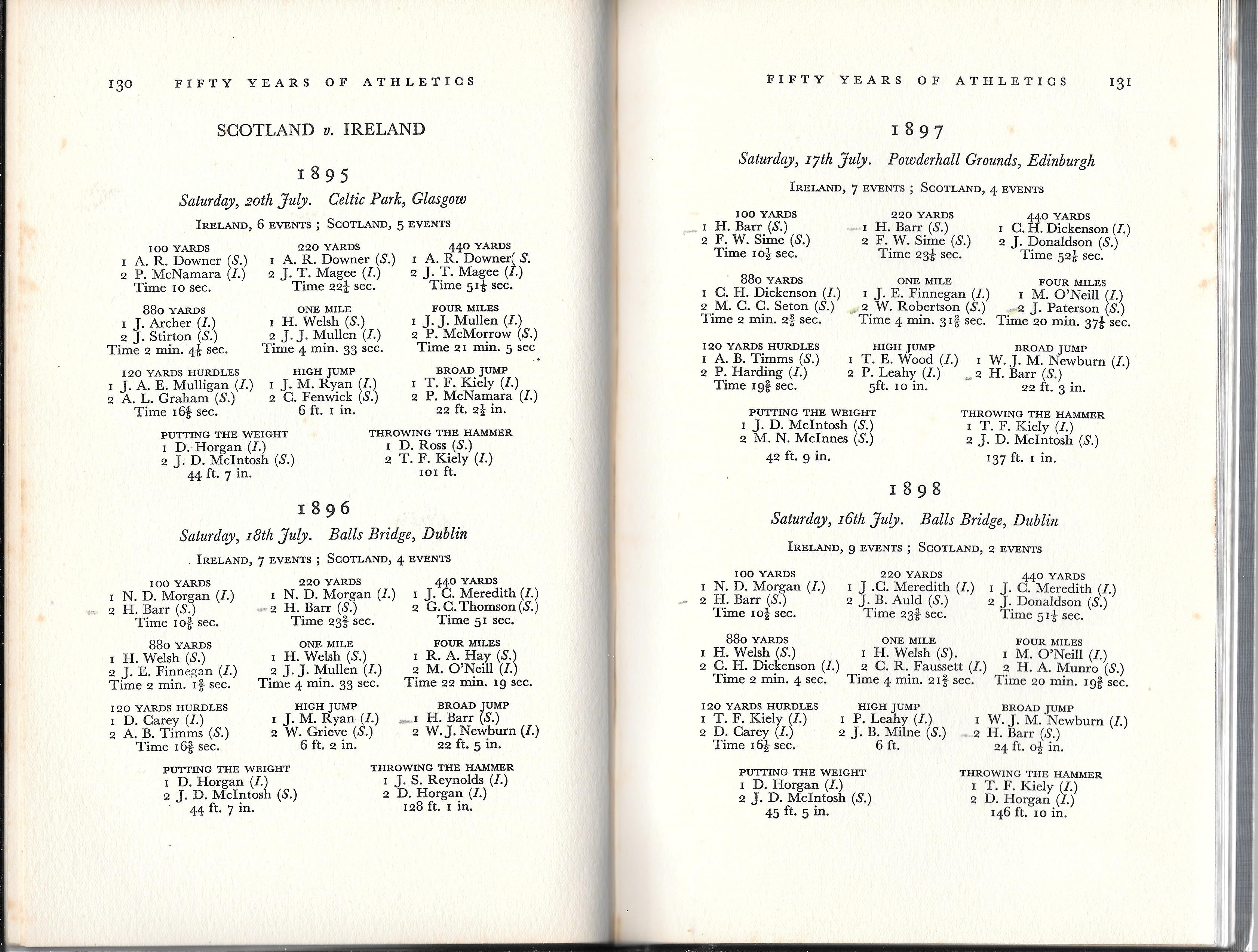
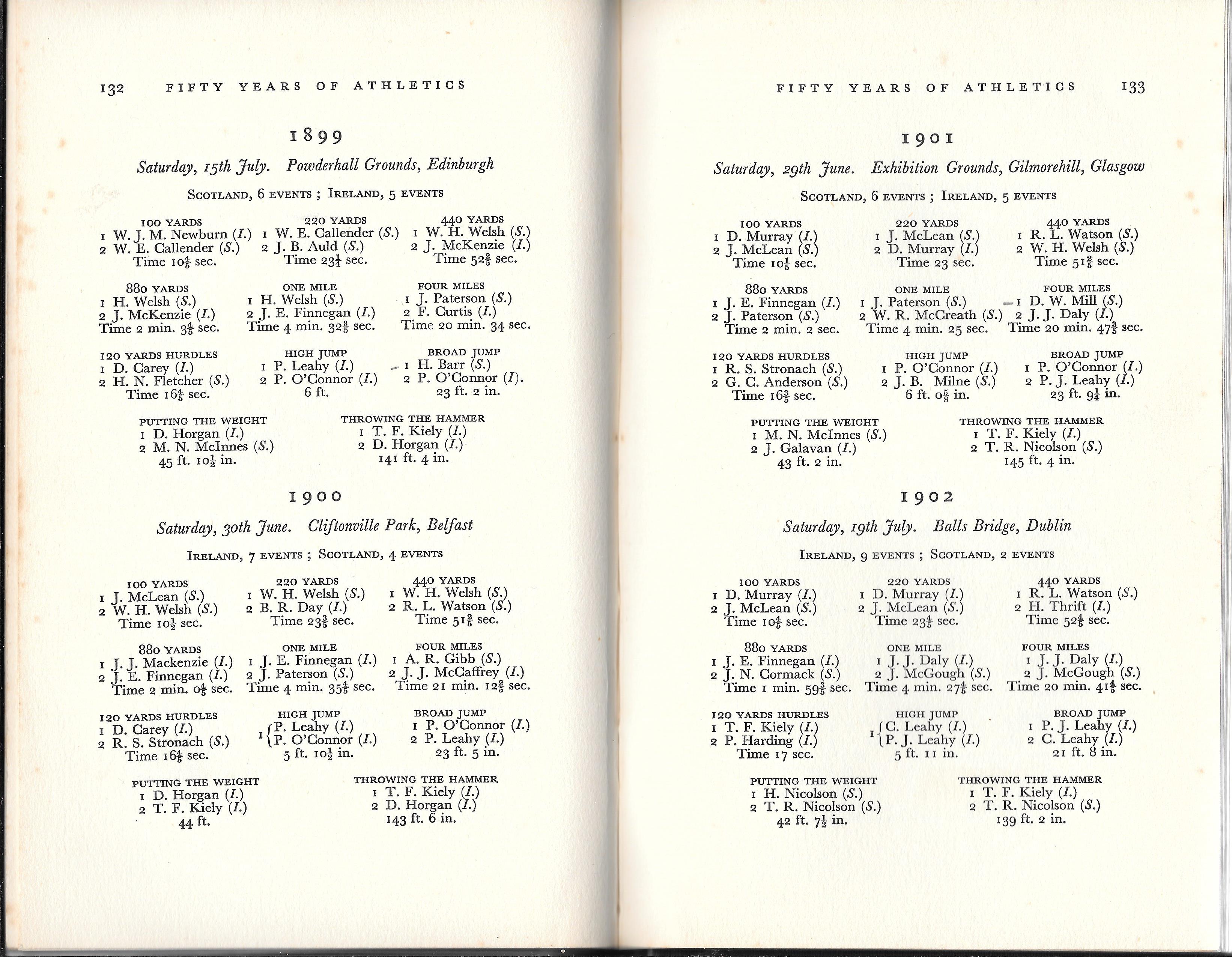
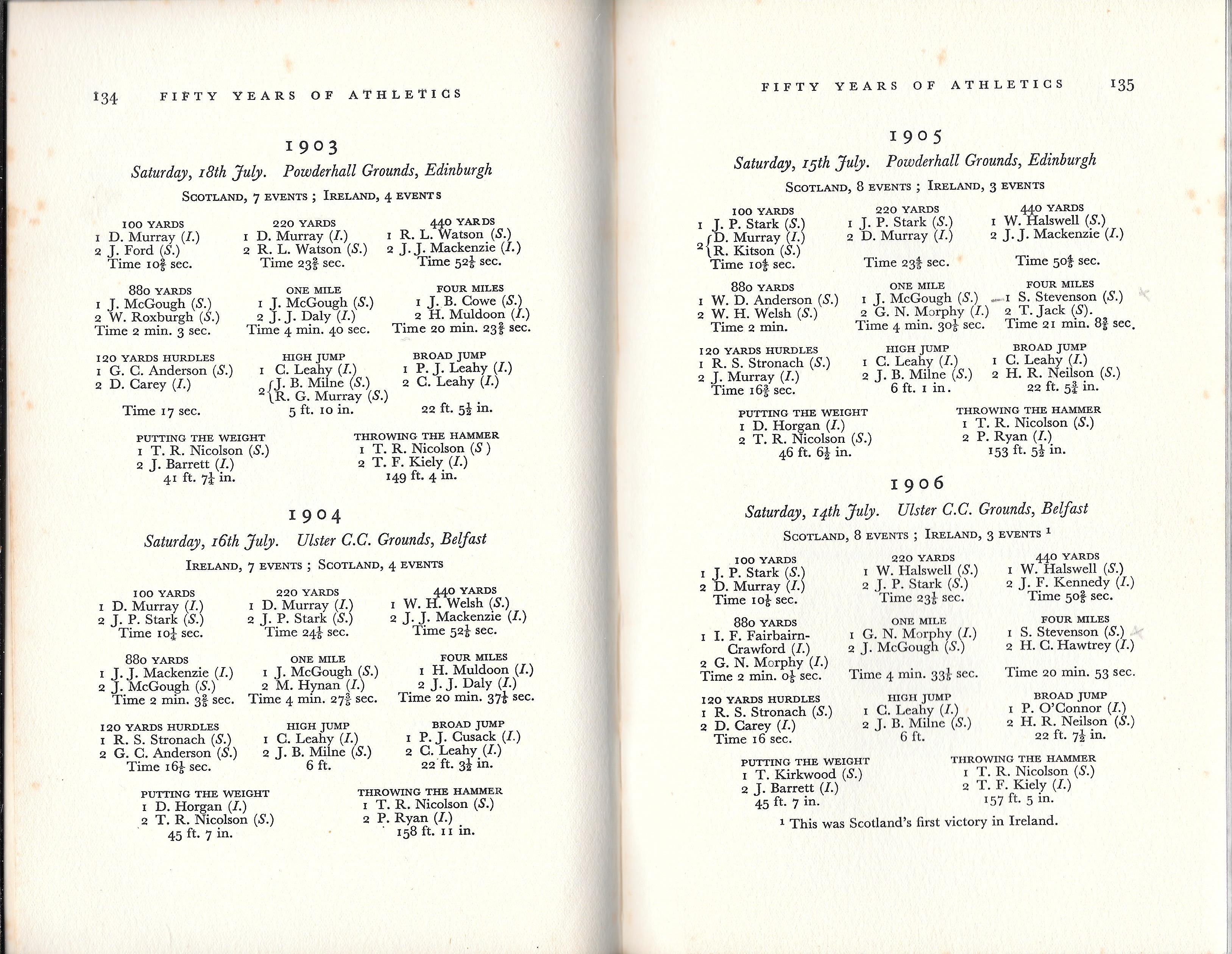
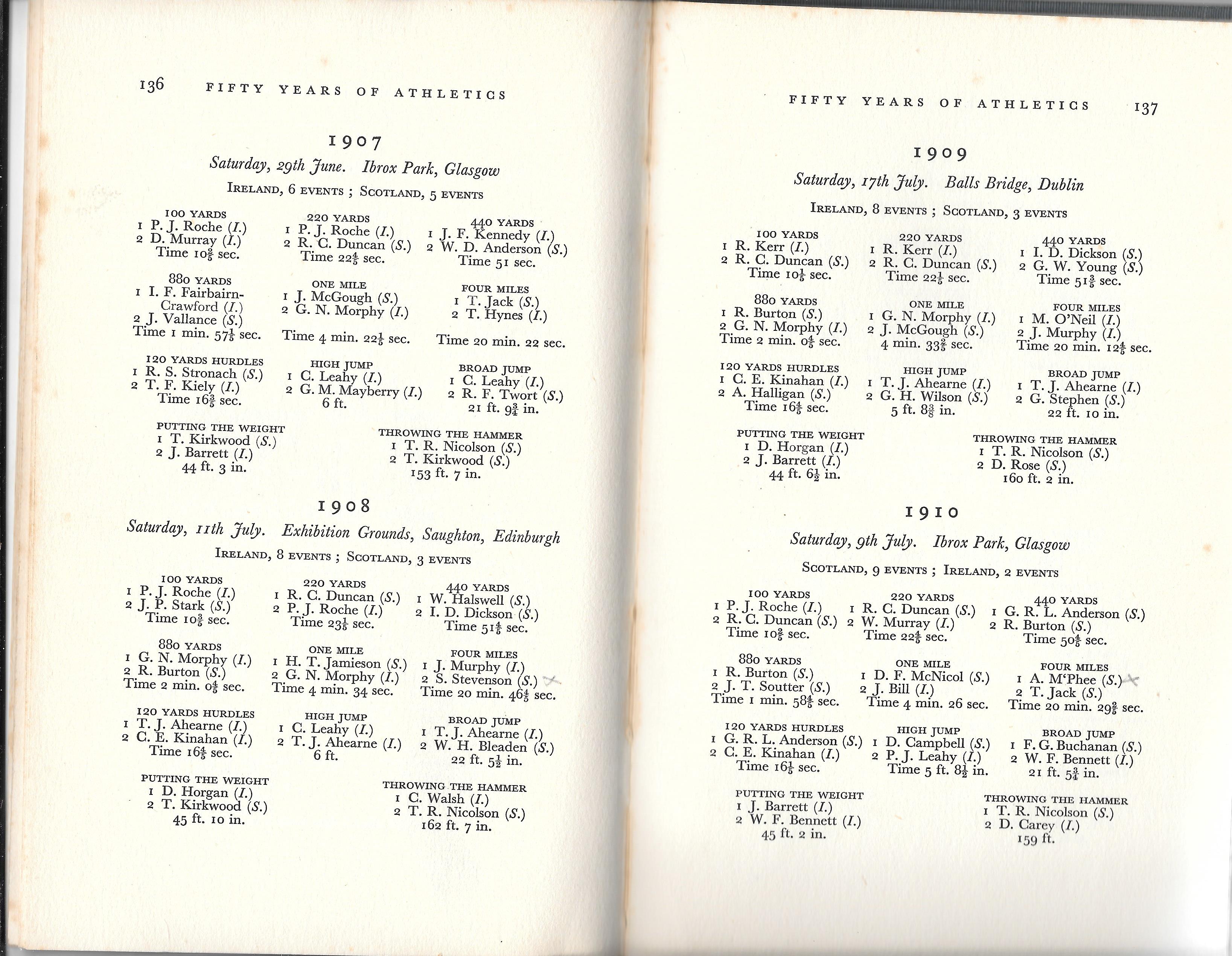
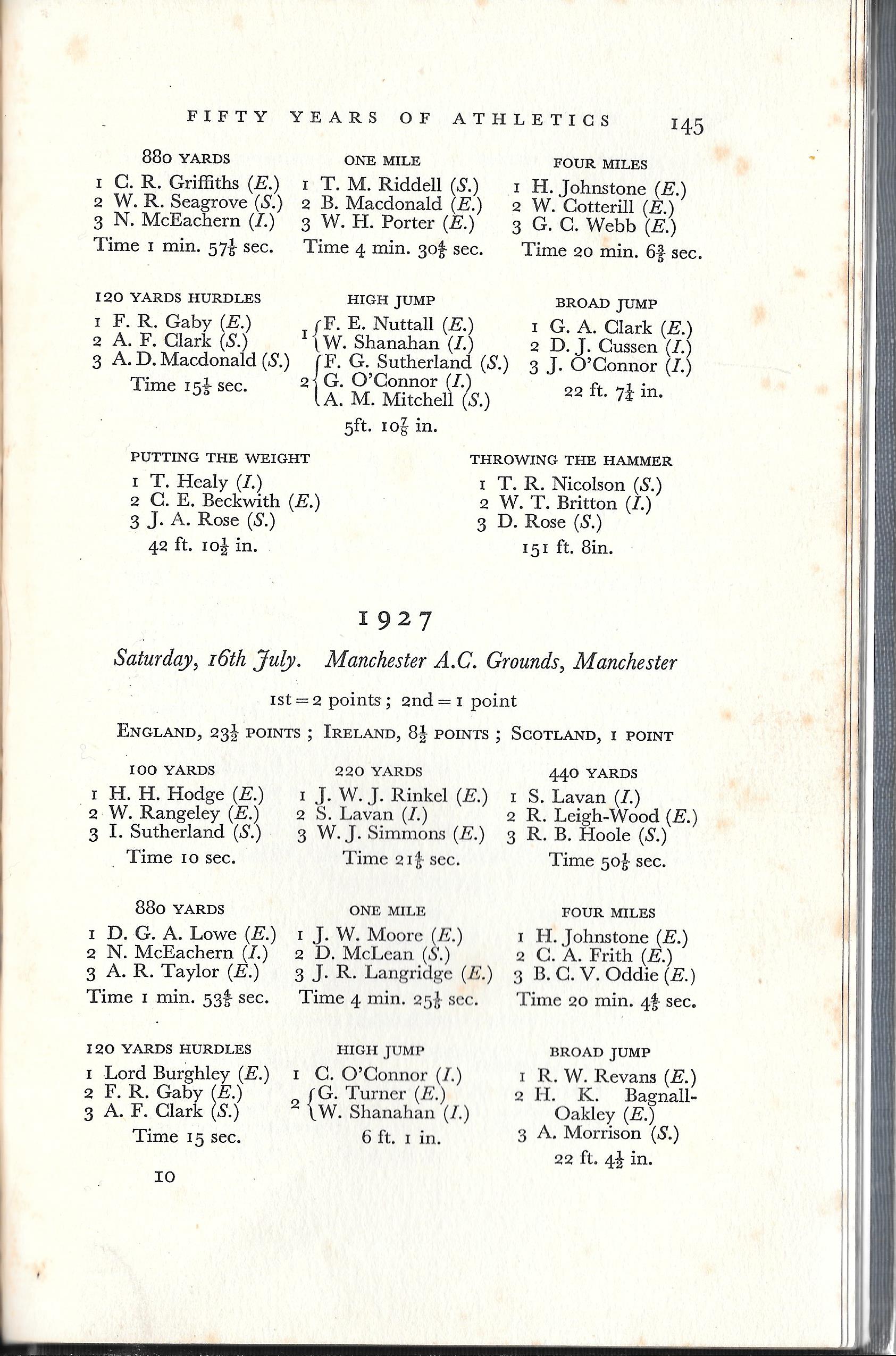
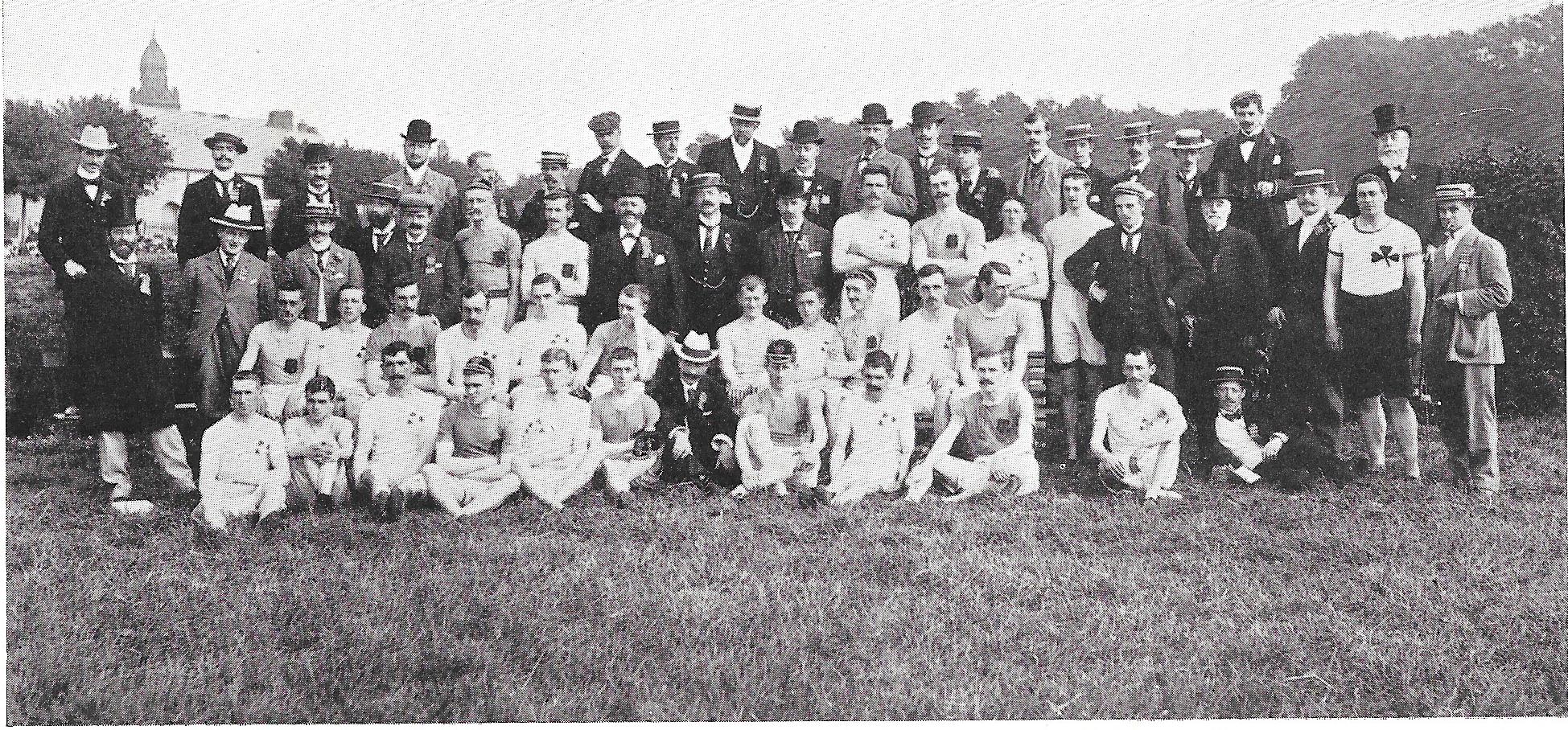
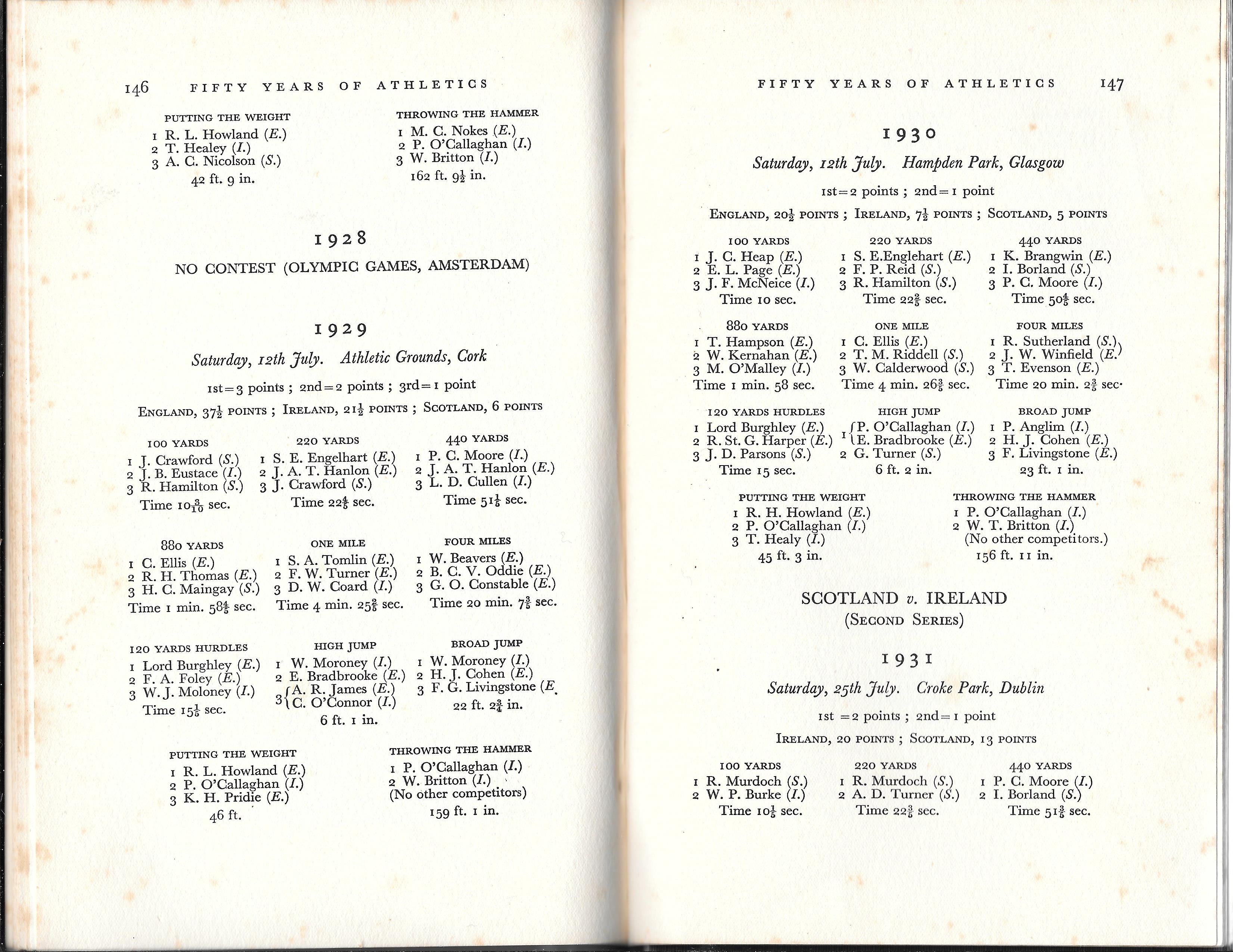
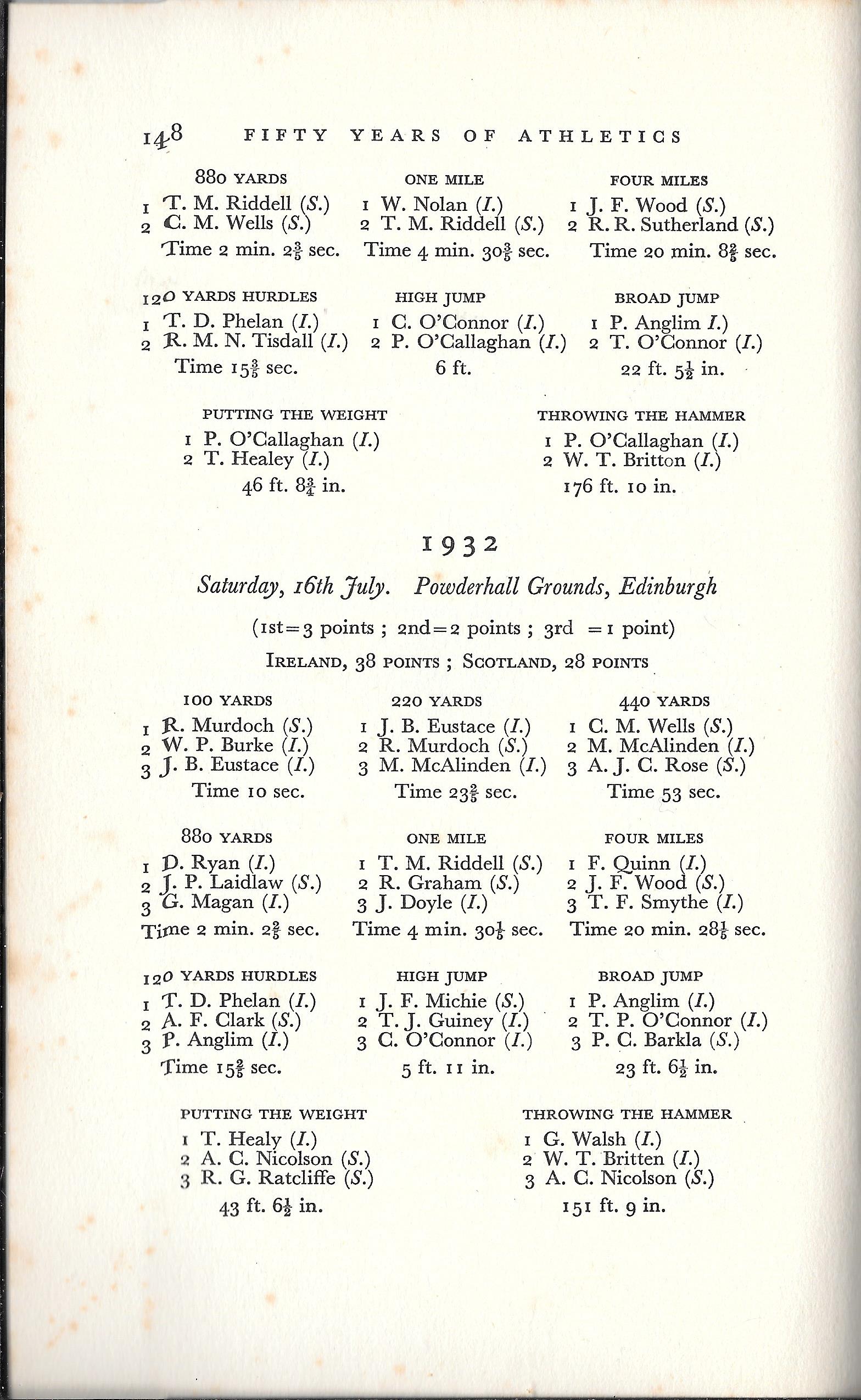
Scotland v Ireland: A Retrospect

SCOTLAND  V  IRELAND: A RETROSPECT

By DA Jamieson

In July 1891 a special meeting of the General Committee of the Scottish AAA was convened to consider a proposal which had been received from the Irish AAA inviting a team of representative Scottish athletes to take part in a series of races against selected representatives of the Irish Association.   The distances suggested for competition were 100 yards, 440 yards and One Mile, and it was further suggested that this series of races should form the crowning feature of the Irish All-Round Championship Meeting which was to be held at Balls Bridge, Dublin, on 15th August of that year.   The proposed conditions of the contest were that the Irish Association should provide the prizes, whilst the Scottish body were to defray their own expenses.

In spite of its allurement, however, this invitation was declined by the Scottish AAA; but the potentialities of such a contest were perceived by the Scottish executive, and accordingly the Honorary Secretary was instructed top open negotiations for the institution of an international contest on a broader basis than the original suggestion – namely, to embrace all championship events.   The question of guarantees was also raised, and it was suggested that these should be given by each country in turn.   In this manner, then, was laid the foundations of an International athletic contest with Ireland, which was to continue without interruption for nearly twenty years.   But although the foundations were truly laid in 1891 through force of circumstances the edifice itself was not erected until four years later.

It was not until December of 1894 that overtures were again made by the IAAA to the SAAA with regard to instituting an annual athletic contest between the countries on the lines of the Oxford  v   Cambridge match, in which the odd event in eleven items was to decide the winner.

This  proposal was cordially accepted by the SAAA executive with the following suggestions:   (1) That the first contest be held in Scotland;   (2) That a guarantee be given to the visiting team to cover expenses;   (3) That the programme of events to be decided should be the Scottish championship events – the Ten Miles excepted; each country to have two representatives in each event, with three in the Four Miles race;  and (4) that in Scotland the Hammer to be thrown in the Scottish style and in Ireland under Irish rules.

In the main, agreement was reached on all these points, save that the guarantee condition was waived on a counter-proposal from the IAAA that there be an equal division of the net proceeds of the drawings.   The way was now cleared for both parties to implement these proposals, and thus on 20th July 1895 the first International contest with the Irish AAA took place at Celtic Park, Glasgow, which resulted in a win for Ireland.

Many famous Irish athletes were introduced to Scotland through the medium of the Scoto-Irish contest, and it may prove of interest to recall those whose charm endeared them to their Scottish friends.   Throughout the years of these international contests no Irish sprinter stands out with such clarity in one’s memory as Denis Murray, probably the most graceful sprinter who ever pulled on a running pump.    The second of a trio of famous brothers which included John – a good all-rounder, and pre-eminent in field events, and Willie also a first class sprinter – Denis Murray won the 100 yards race four years in succession for Ireland, in addition to winning the 220 yards in three successive years.    His was the perfection of style, and he ran his races without the least suggestion of stress or strain.

It is a remarkable circumstance that fifteen years were to elapse ere Scotland was able to register a win in the High Jump event; but when one remembers the names of the “leppers” who wore the shamrock emblem during the years 1895-99 one’s feelings of disappointment give way to a mood of resignation.   Here is the list: JM Ryan, PJ and Con Leahy, P O’Connor and TJ Ahearne.   Truly these men rose literally to heights unattainable by the Scottish representatives – good jumpers though they were.

Similarly in the Broad Jump event, it was only the sterling performances of Hugh Barr (Scotland) which broke the monopoly of Irish victories on two occasions over a period of fifteen years.   One recalls with keen appreciation how Bar, with practically his last effort in the Broad Jump event, on the occasion of the fifth contest of the series at Powderhall Grounds, Edinburgh in July 1899, created a new Scottish native record, incidentally winning the event and the contest for his country.   It was in the fourth match of the series that WJM Newburn – a veritable giant of an athlete – created a world’s record of 24 feet 1 1/2 inches in the Broad Jump.   A remarkable feat also falls to be related in connection with a high jump performance by P O’Connor on the occasion of an International at the Exhibition Grounds, Gilmorehill, Glasgow.   The judges were so impressed with the prodigioud bound taken by O’Connor when clearing the height of 6 feet 6 5/8th inches that measurements were taken from his take-off to his landing spot and the distance was found to be 17 feet.   This was not only high jumping – it was literally a steeplechase performance!

Memory quickens also at the names of Denis Horgan, Tim Kiely, JJ Flanagan and J Barrett in the field events.   A great personality was Denis Horgan, who toyed with the putting ball in the most leisurely manner conceivable.   He, to the huge amusement of the spectators, often sought inspiration from a black bottle – carefully enwrapped with accompanying tumbler in the folds of his jacket – invariably placed at a convenient distance from the putting-circle.   This egg and brandy flip – for such it was – formed a most important item in the genial Irishman’s field equipment.

And what of the duels between Tom Nicolson, TF Kiely and P Ryan in the Hammer event!   How these great exponents used to hurl their implements through space until it seemed as if the confines of the ground itself would surely be exceeded in some of their mighty efforts.

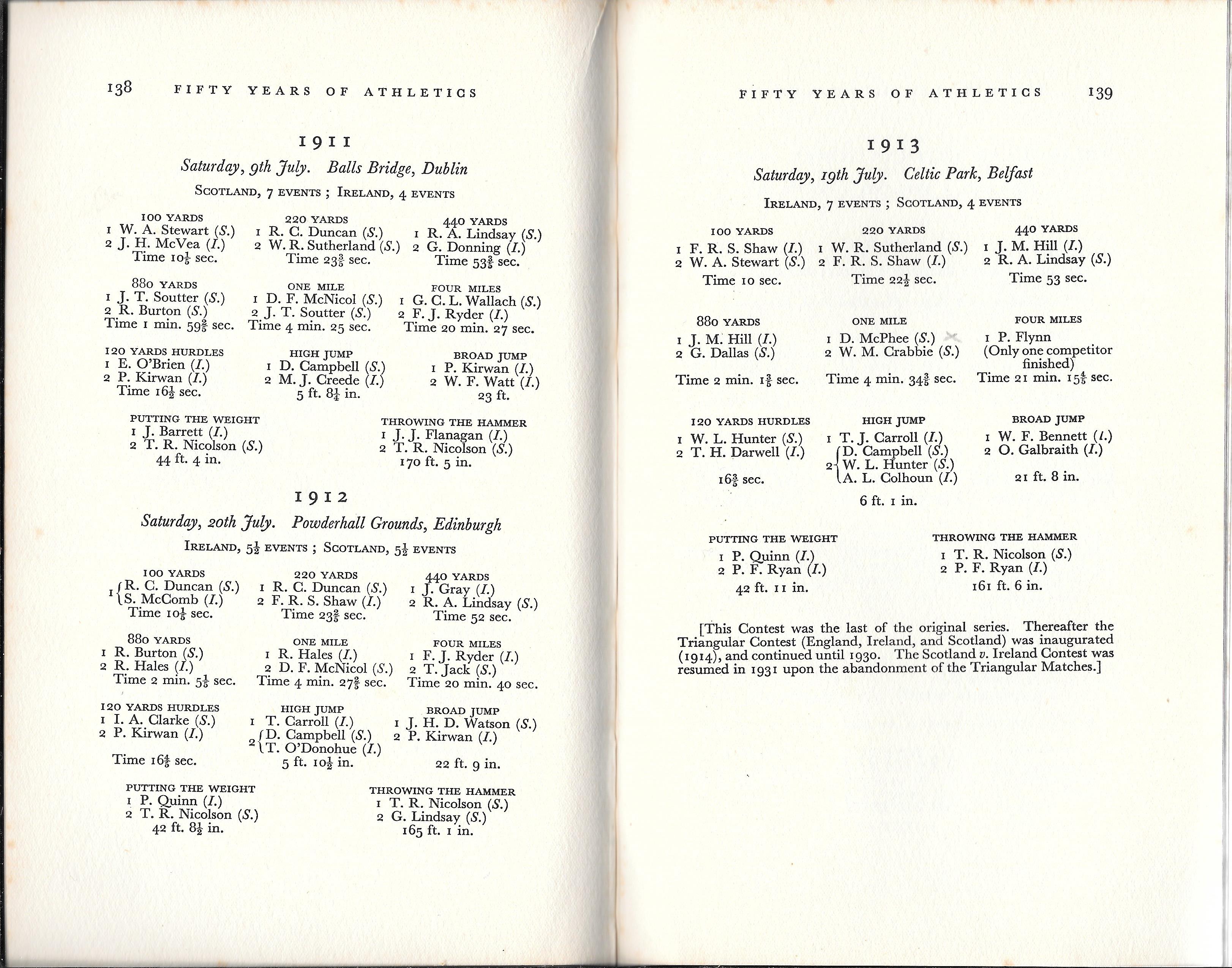
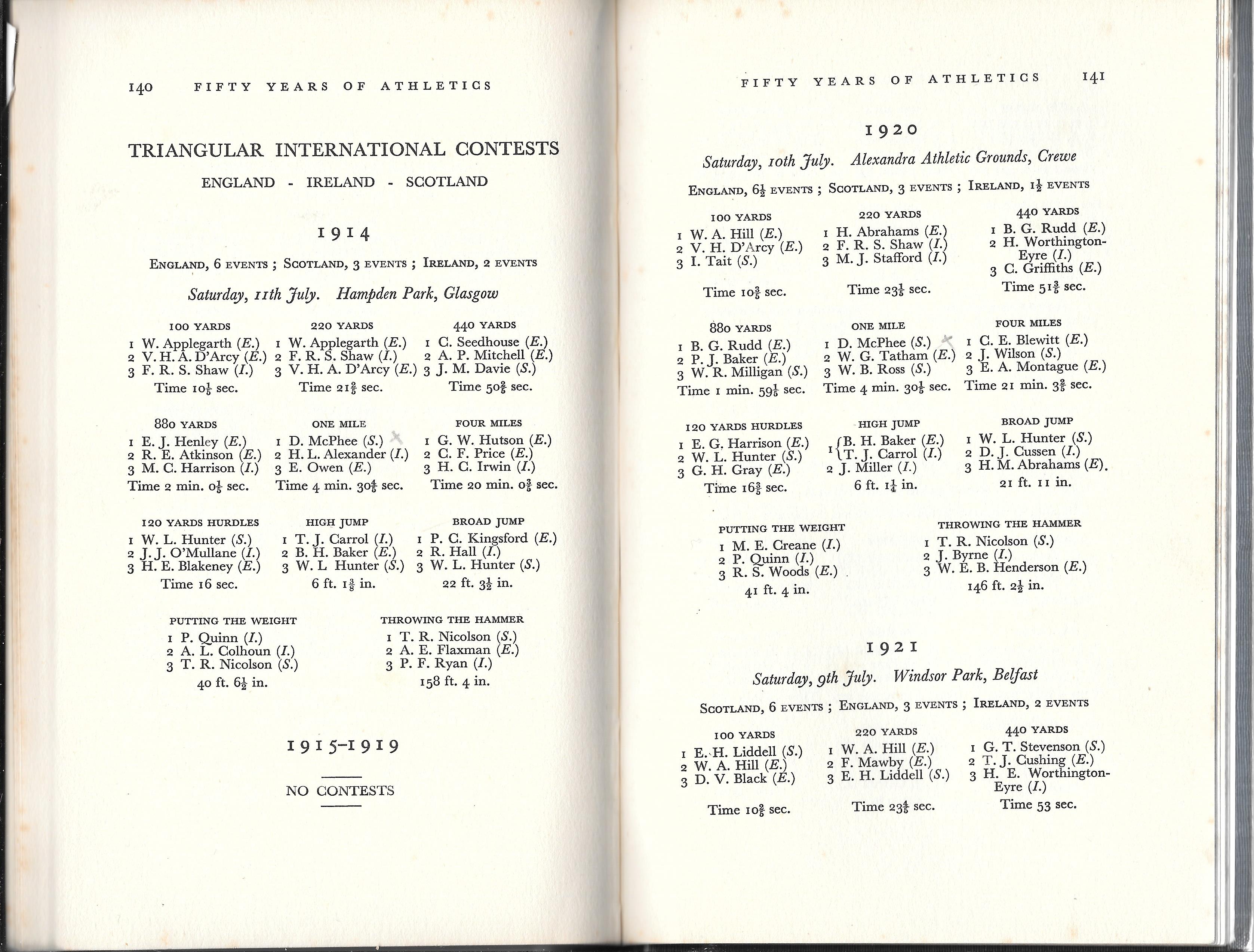
Athletic horizons were extending however, and with the inauguration of the Triangular Contest between England, Ireland and Scotland, the Ireland  Scotland contests came to an end In July, 1913 at Belfast, when Ireland finished as she had begun by winning the match by 7 events to 4.

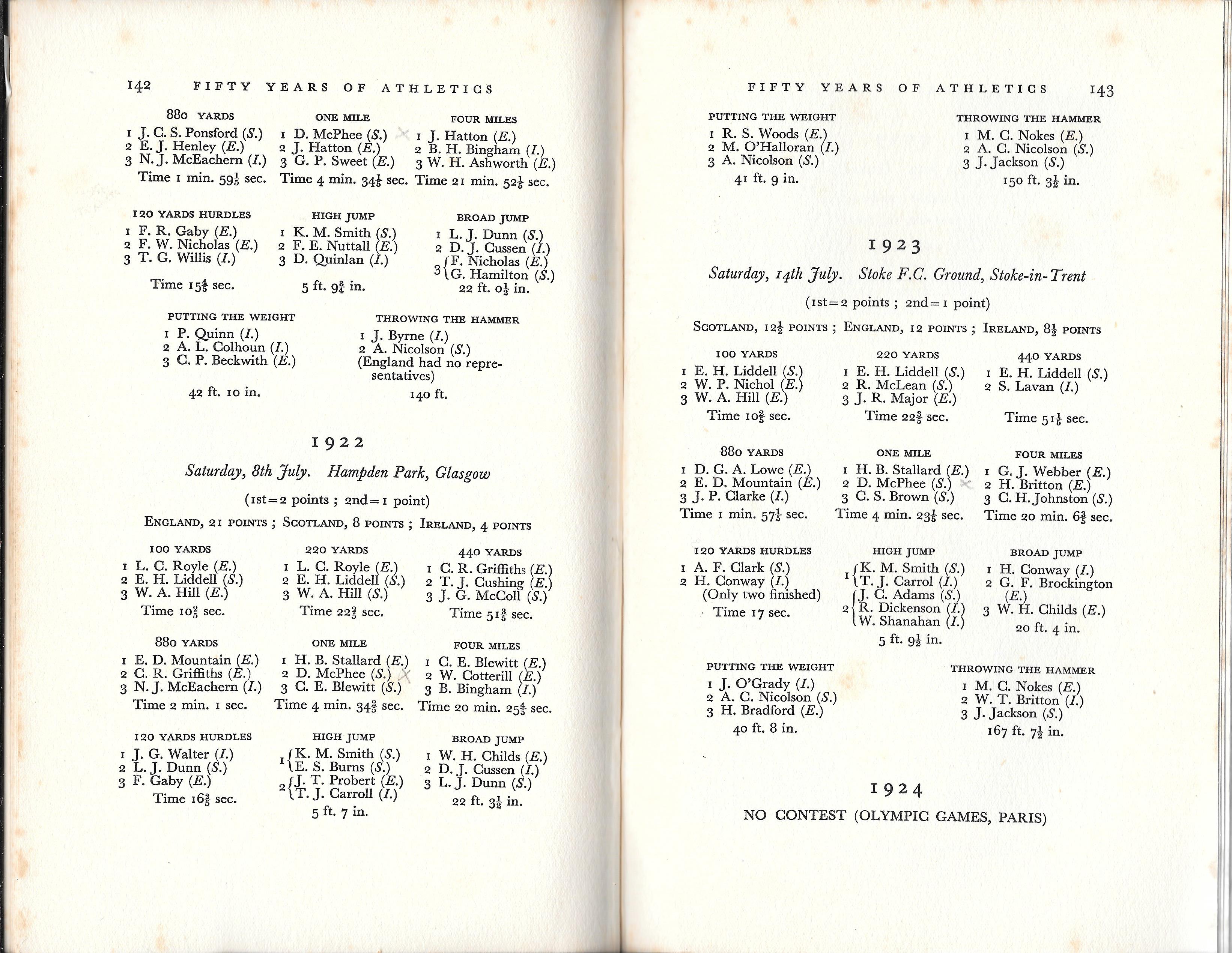
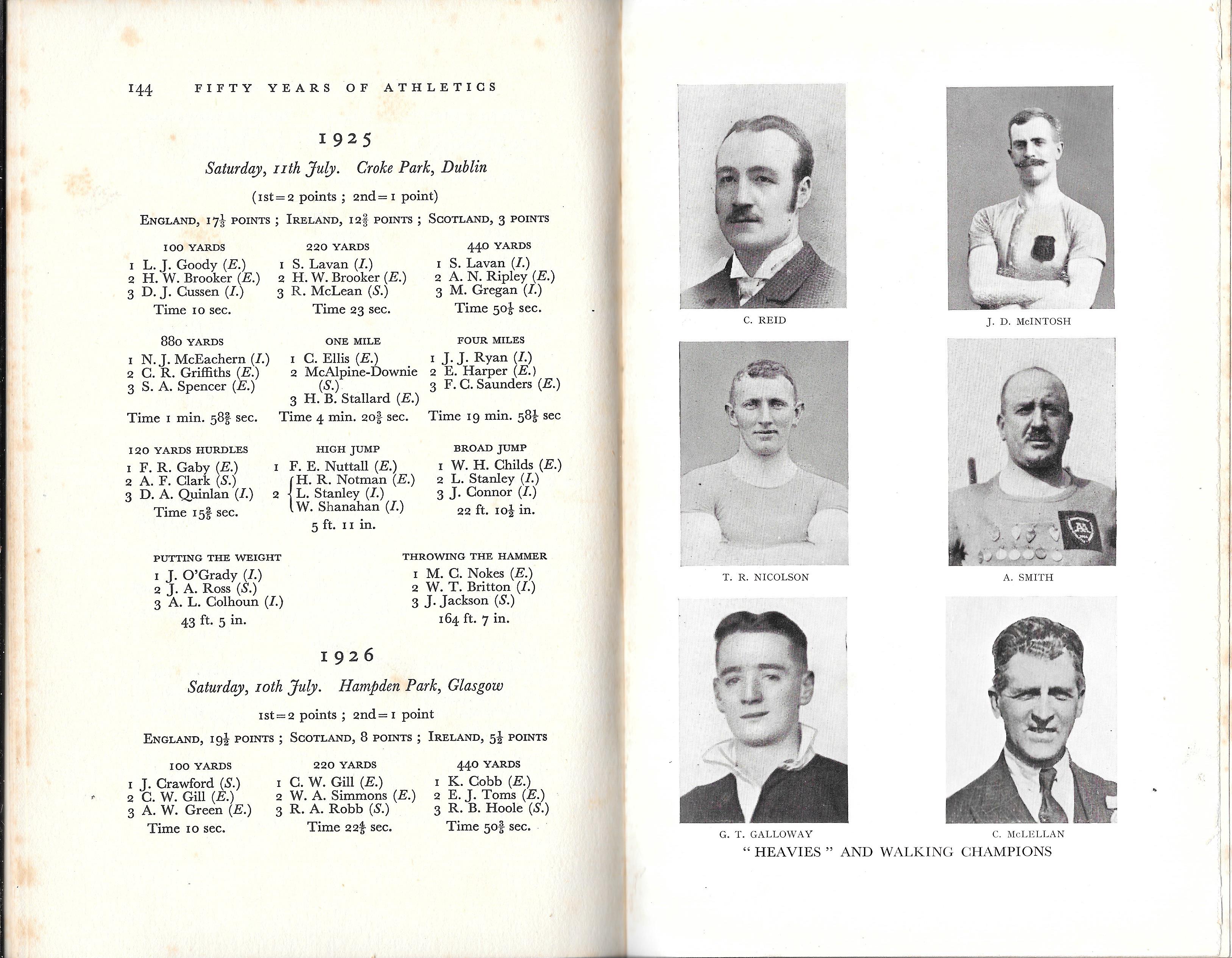
On 11th July 1914 was decided the first of the Triangular Series at Hampden Park, Glasgow.   England signalised her entry into this competition by a win, the scores reading:   England 6 pts;   Scotland   3 pts;   Ireland   2 pts.   Then followed the blight of was, and to the generations of that day athletic Internationals and such like distractions passed into the limbo of forgotten things.

Statistics: International Contests

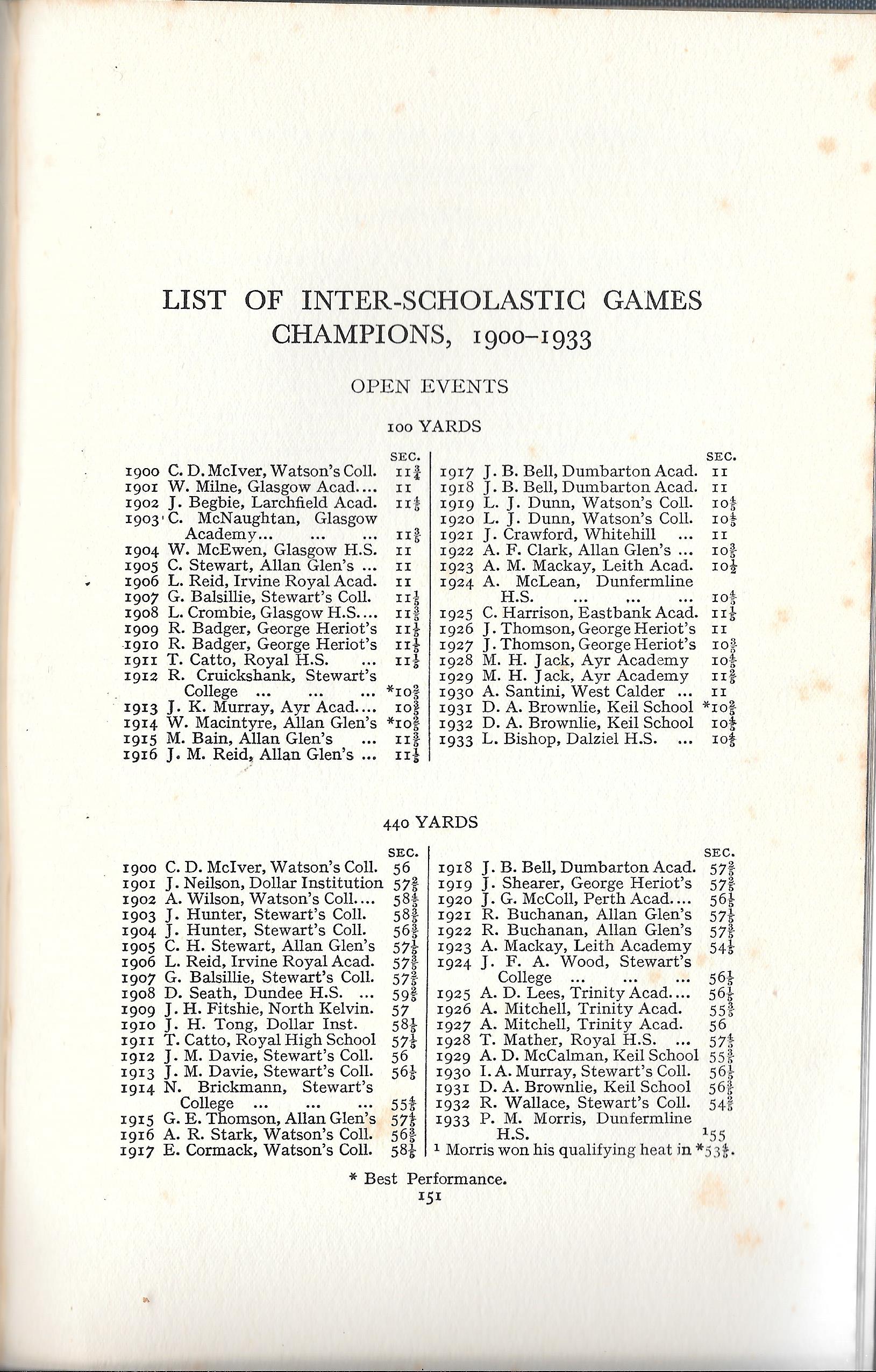
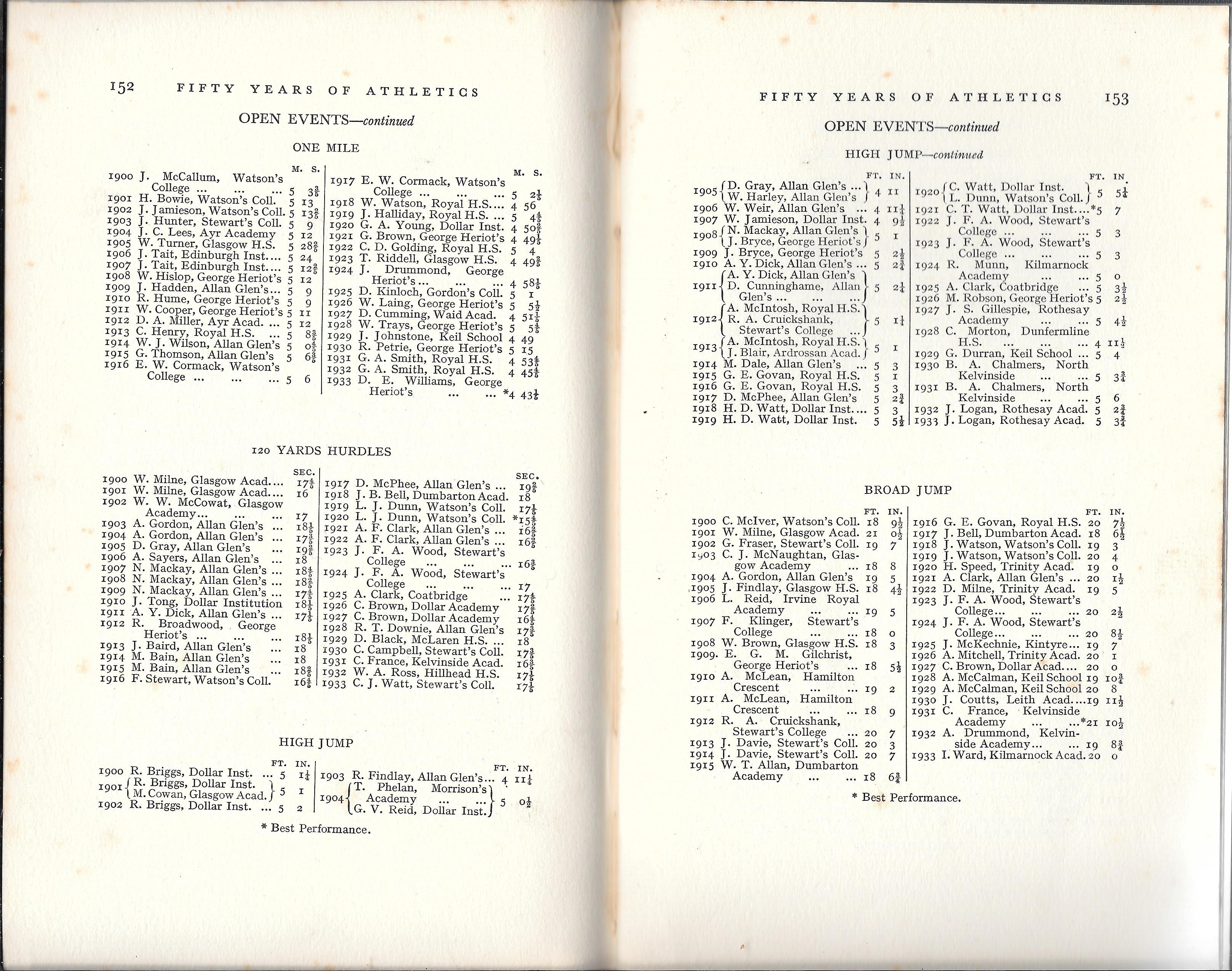
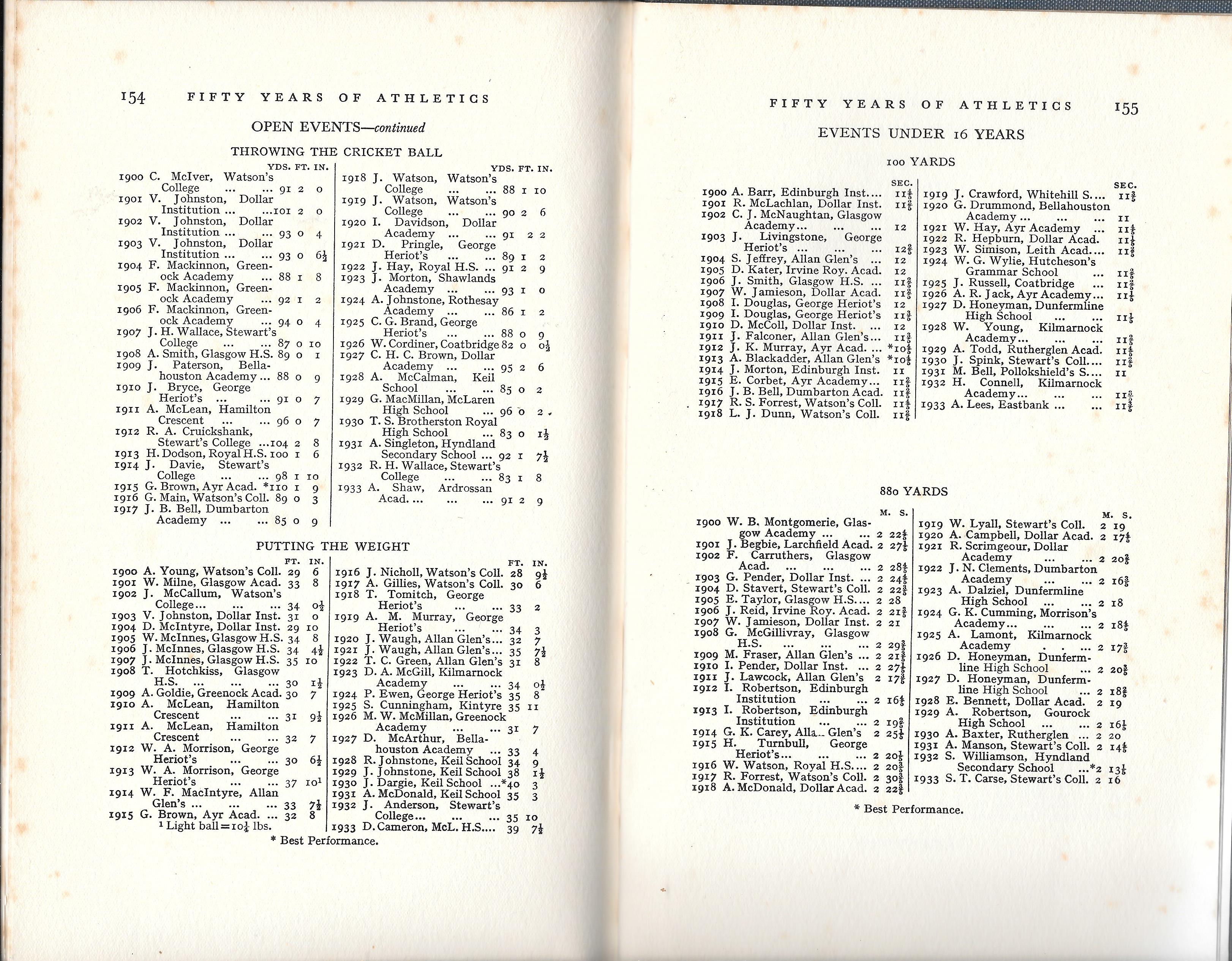
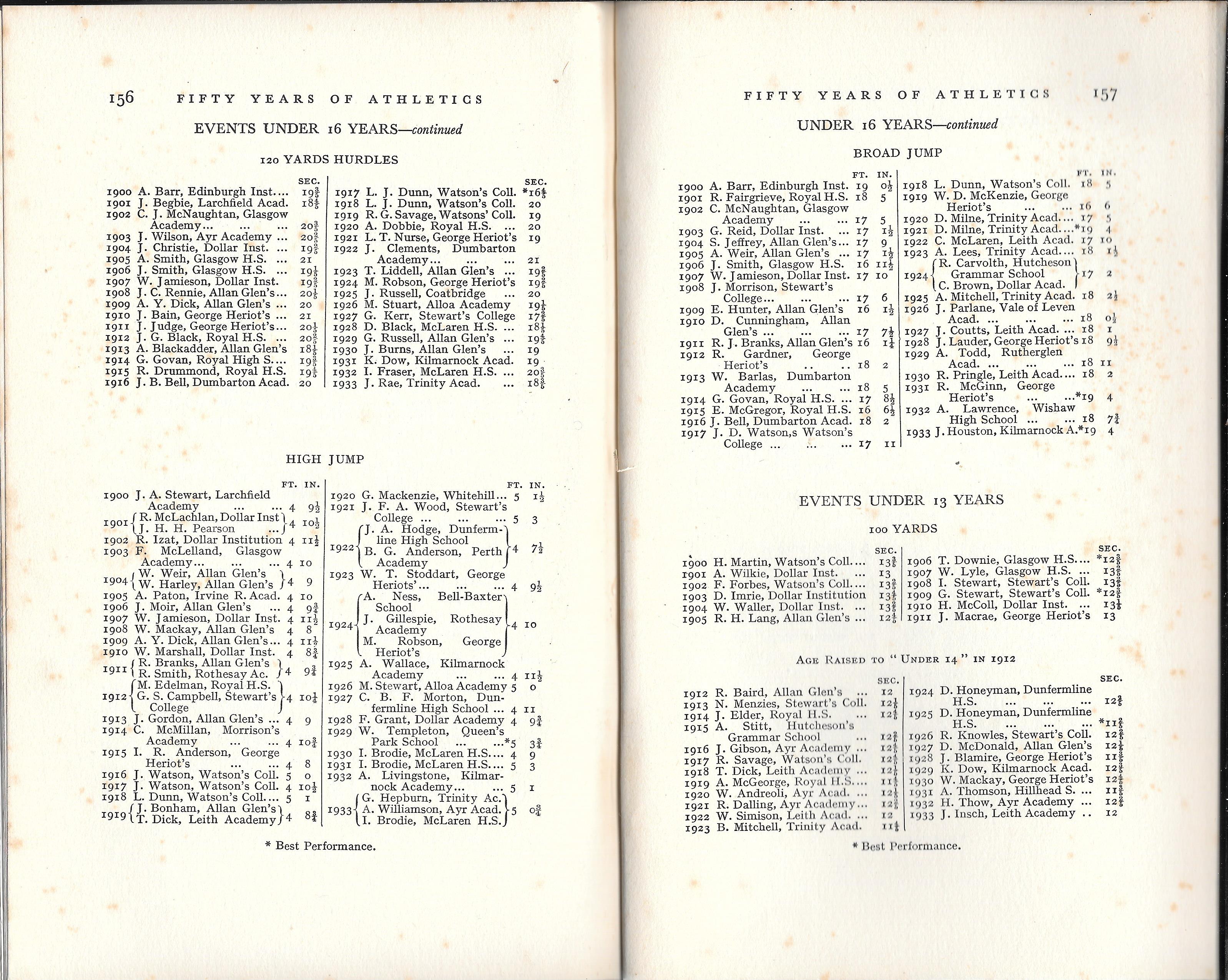
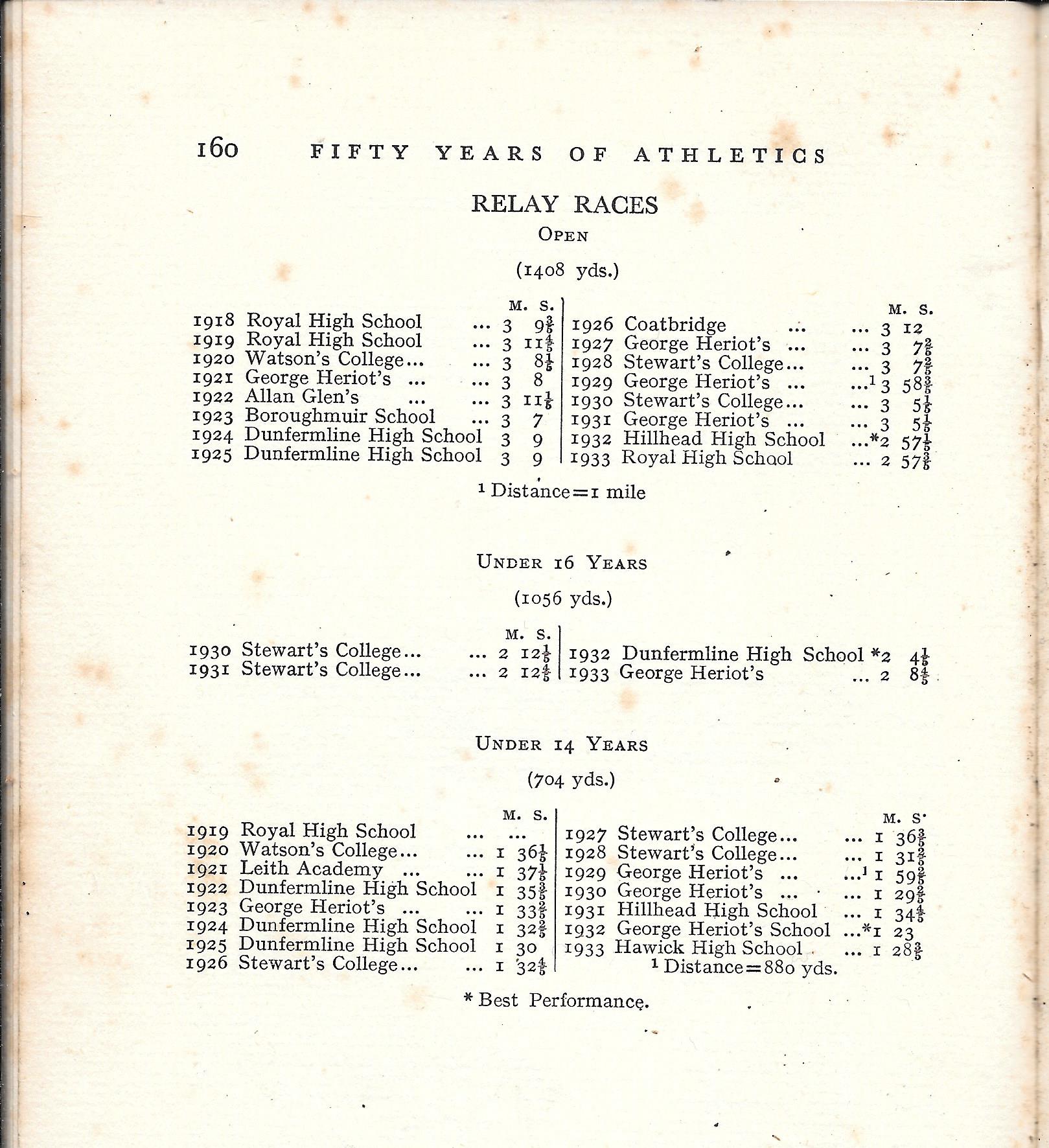
Inter Scholastic Games